
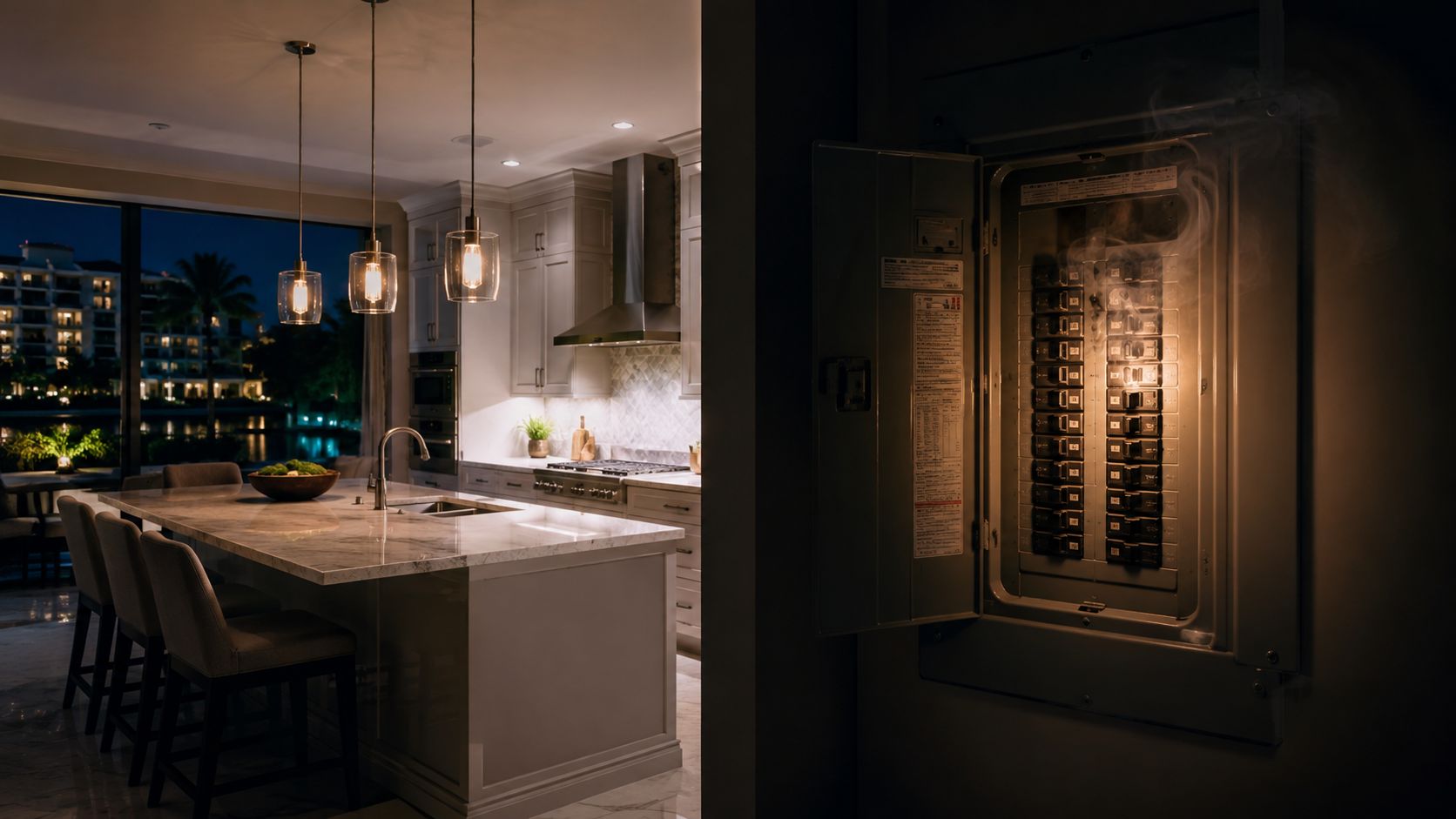
It's 11 p.m. in Boca Raton. Half the kitchen has gone dark, the refrigerator is silent, and the breaker panel feels warmer than it should. Then you notice the faint smell of hot plastic near the wall.
That's when most homeowners search for an emergency electrician near me and start calling the first numbers that appear. Slow down for a moment. The right first move depends on whether you're dealing with a neighborhood outage, a tripped circuit, or an energized fault inside the home. A calm decision in the next ten minutes can keep a damaged circuit from becoming a fire.
Table of Contents
- When the Lights Go Out and the House Doesn't Feel Right
- Your First Ten Minutes Before You Call Anyone
- What Fair Emergency Electrical Pricing Actually Looks Like in 2026
- How to Vet a Nearby Emergency Electrician Before They Show Up
- Why a Local Palm Beach County Contractor Changes the Outcome
- What Emergency Electricians Actually Fix in the Field
- A Quick Decision Framework: When to Call the Utility, 911, or an Electrician
When the Lights Go Out and the House Doesn't Feel Right
A partial outage creates confusion because the house may look only mildly affected. The living room lights work, but the kitchen outlets don't. One bedroom is dark while the rest of the home has power. A breaker may have tripped, or a connection may have overheated behind the panel, receptacle, or wall.
The symptoms matter more than the hour. A dark circuit with no odor or heat may need prompt service, but a warm panel, visible sparking, smoke, buzzing, or a burning smell calls for emergency action. Don't keep resetting a breaker that trips immediately. Don't open the panel cover, pull wires, or touch a discolored breaker.
The danger is real
NFPA research estimates that, from 2020 through 2024, local fire departments responded to an annual average of 46,652 home electrical structure fires. Those fires caused about 527 civilian deaths, 1,580 civilian injuries, and $2.4 billion in direct property damage each year. They represented roughly 13% of home structure fires and 18% of home structure fire deaths, according to NFPA's home electrical fire research.
That doesn't mean every flicker signals a fire. It means you should treat heat, smoke, odor, and repeated faults as information, not annoyances. If you're unsure whether flickering lights are harmless or a warning sign, this guide to what causes flickering lights in a house can help you understand the possibilities, but active burning or sparking still requires immediate safety action.
Contractor's rule: A breaker that trips once may be protecting you. A breaker that trips repeatedly is telling you to stop using that circuit.
The rest of the decision is straightforward. Check whether the outage affects other homes, inspect only what you can reach safely, record the symptoms, and call the right party. The utility handles a broad supply outage. A licensed electrician handles an indoor fault after the utility confirms its service is available. Fire, smoke, or immediate danger comes before both.
Your First Ten Minutes Before You Call Anyone
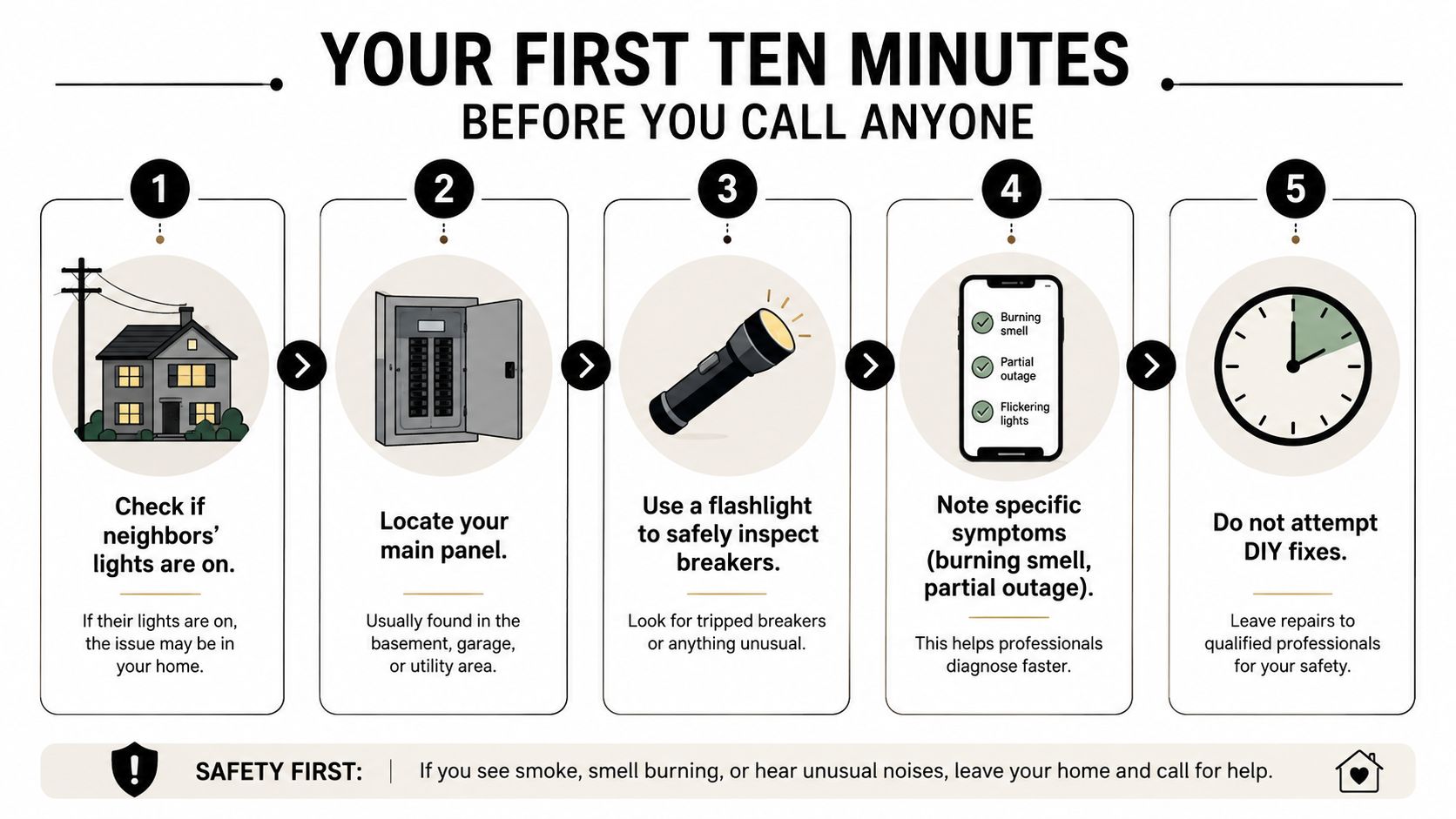
Start with the outside view. Look toward nearby homes or common areas. If the block is dark, streetlights are out, or neighbors report the same failure, contact the utility provider first. Don't hire an electrician to repair wiring that isn't the source of the outage.
Weather makes this distinction especially important in Palm Beach County. By mid-2025, 45% of U.S. utility customers had experienced at least one outage, and nearly half of those outages were attributed to extreme weather. In the South, extreme-weather outages averaged 95.2 hours, according to POWER Magazine's 2025 blackout overview.
Follow the symptoms
Check the outage pattern. If every room and neighboring property is dark, treat it as a utility issue. If only your home is out, check whether the utility has reported a service interruption before arranging electrical repair.
Locate the panel without touching damaged areas. Use a flashlight, not a candle. Look for a breaker sitting between positions, scorch marks, smoke, condensation, or melted plastic. If the panel is hot, wet, smoking, or visibly damaged, step away.
Notice the smell from a safe distance. A sharp odor of burning plastic or insulation near an outlet, switch, appliance, or panel points to overheating. Don't lean into the panel or remove covers to find the source.
Disconnect one obvious appliance only if it's safe. If a single appliance has a damaged cord, smoke, or a strong odor, keep away from the damaged area and shut off the circuit if you can do so without contact with heat or exposed conductors. Otherwise, leave it alone and wait for a professional.
Write down the details. Record which rooms lost power, which breaker moved, whether lights flickered first, and whether you heard buzzing or saw sparks. Those details help the dispatcher prioritize the call and prepare the technician.
If you need more help identifying a localized fault, use this explanation of how to find an electrical short in a house, but don't perform live testing or dismantle equipment. A useful keyword-intent framework, such as SemDash keyword targeting workflows, can help content teams organize emergency symptoms by intent. For a homeowner, the practical lesson is simpler: describe the symptom precisely rather than searching only by a broad phrase.
Leave when the situation can escalate
Leave the property and call 911 if you see flames, heavy smoke, explosive popping, or a rapidly worsening electrical odor. Don't use water on an electrical fire. Keep people and pets outside and tell firefighters where the panel or affected equipment is located.
A utility outage generally doesn't require an electrician at the start. A partial outage without heat or odor may be scheduled promptly. A burning smell, warm panel, visible sparking, repeated immediate breaker trips, or water intrusion near electrical equipment deserves emergency dispatch.
What Fair Emergency Electrical Pricing Actually Looks Like in 2026
Emergency pricing should be clear before the truck rolls. A legitimate contractor may charge for dispatch, diagnosis, after-hours availability, or the first block of labor. That's reasonable when the company explains each charge and gives you a written repair estimate before work begins.
Consumer watchdog reporting warns that emergency home-repair bills can vary widely, with online-sourced providers quoting different prices and service standards for the same urgent electrical problem. Read the warning about overstated emergency home-repair bills before you authorize work under pressure.
What the first visit should include
Expect the technician to identify the hazard, make the area safe, test the affected circuit, explain the cause in plain language, and separate temporary stabilization from permanent repair. If a panel must be replaced, wiring needs opening, or storm damage requires coordination with the utility, the contractor should say so before proceeding.
| Visit Component | What It Covers | What's Reasonable |
|---|---|---|
| Dispatch or trip charge | Travel, after-hours availability, and getting a technician to the property | A stated fee confirmed before dispatch |
| Diagnostic assessment | Visual inspection, safe isolation, and electrical testing | A clear explanation of what the diagnostic charge includes |
| Initial labor | The first portion of hands-on troubleshooting or stabilization | A defined hourly rate or labor block, not an undefined minimum |
| Parts and materials | Breakers, receptacles, connectors, covers, or other approved components | Itemized pricing tied to the proposed repair |
| Written repair quote | The work required after diagnosis | Customer approval before non-emergency repair work begins |
Red flags that should stop the call
Be cautious when the dispatcher won't state any pricing structure, says the final bill will be determined only after arrival, or uses vague language such as “minimum hours” without defining what that means. An invoice that doesn't identify the contractor or provide licensing information also deserves scrutiny.
You can use this phone script:
“Before dispatch, tell me the trip charge, diagnostic charge, labor rate, after-hours policy, and whether I'll receive a written quote before repair. Will the person arriving be your employee or a subcontractor, and what license information will appear on the invoice?”
A fair contractor may not know the final repair price until testing is complete. That's acceptable. Refusing to explain the fee structure is not.
How to Vet a Nearby Emergency Electrician Before They Show Up
Search results don't prove that a contractor is local, licensed, insured, or available. A polished website can belong to a call-routing service that sends your information elsewhere. Verify the company before you provide payment details or authorize work.
Run a fast licensing check
For a Florida property, ask for the electrical contractor license number and verify it through the state's professional licensing system. Confirm that the license is active and matches the business or qualifying individual named by the contractor. If the dispatcher avoids the question, move on.
Ask for proof of liability insurance and workers' compensation coverage before work begins. Insurance protects against certain property and injury risks, while workers' compensation helps distinguish a properly organized operation from a casual labor arrangement.
Ask who will actually answer at night
“24/7” can mean a live dispatcher, an answering service, or a technician who handles calls directly. Ask whether the overnight representative can triage electrical hazards, whether the technician is already in Palm Beach County, and how the company handles a delay.
Use recent local reviews to look for specific descriptions of emergency communication, arrival updates, diagnosis, and billing. Ignore vague praise that doesn't describe the work. Businesses developing actionable home service SEO should understand why those details matter, but homeowners should use them as practical verification signals.
Here are the four questions I'd ask before dispatch:
- Who is coming? Get the technician's name, company name, and licensing information.
- What happens first? Confirm that the technician will inspect and test before proposing repairs.
- What will I pay before approval? Ask for every known trip, diagnostic, labor, and after-hours charge.
- What can you handle tonight? A real contractor should explain whether the visit covers temporary stabilization, permanent repair, or both.
For a broader homeowner checklist, use this guide to how to find a good electrician. The best answer to “emergency electrician near me” isn't the first listing. It's the nearby contractor who gives you enough information to make an informed decision before arrival.
Why a Local Palm Beach County Contractor Changes the Outcome
Local knowledge changes emergency work because electrical systems fail in local conditions. In Palm Beach County, a contractor may encounter older homes with aluminum branch wiring, coastal corrosion around panels and connections, and water intrusion after severe storms. Those conditions don't replace testing, but they give an experienced technician useful context before opening the equipment.
A genuine local operation should also explain how its after-hours coverage works. The phone should reach a person who can record symptoms, identify immediate hazards, and give a realistic arrival window. “Available all night” means little if nobody can prioritize a smoking panel or distinguish a utility failure from a private wiring fault.
What established service should look like
Lighthouse Energy Services has operated since 2005 and describes a team with more than 100 years of combined experience. Its service model includes 24/7 residential, commercial, and industrial response, phones answered by licensed electrical professionals, transparent quotes, and no additional after-hours charges. Those are specific operating details to verify with any contractor you consider, not assumptions to make from a search listing.
For commercial properties, continuity matters even more. A retailer may need refrigeration and security systems protected. A property manager may need a panel fault isolated across a shared building. A tower owner may need aircraft obstruction lighting restored and documented. A contractor familiar with both residential troubleshooting and specialized commercial systems can ask better questions at dispatch.
Content teams studying a Bruce and Eddy HVAC guide will recognize the broader service-business principle: local visibility only helps when the underlying operation supports the promise. For homeowners, that means checking the practical details, including who answers, who arrives, what they're licensed to do, and how the quote is presented.
Lighthouse Energy Services also handles specialized aircraft obstruction lighting for rooftops and towers. Its listed efficiency work includes installation of the Smartcool ECO3 device, which the company says can reduce air-conditioning electricity consumption by up to 25 percent. That is a planned efficiency service, not an emergency fix, so it should be evaluated separately from urgent fault repair.
What Emergency Electricians Actually Fix in the Field
The truck's arrival is only the beginning. A competent technician doesn't start by replacing parts. They first control the hazard, isolate the affected equipment, test for voltage, and determine whether the fault sits in a breaker, conductor, connection, appliance, meter area, or utility supply.
Common Palm Beach emergency scenarios
A panel smokes after lightning. The technician keeps occupants away, checks for heat and visible damage, isolates affected circuits, and tests whether the damage extends beyond a single breaker. The repair may involve replacing damaged components, correcting a failed connection, or coordinating with the utility if the service equipment is involved.
Only part of the home has power. A failed main breaker, damaged feeder, or loose service connection can leave some circuits working while others remain dead. The electrician verifies incoming and outgoing voltage, checks the main equipment, and identifies whether the issue belongs to the homeowner or the utility.
Storm water reaches an outdoor panel. Wet electrical equipment is not a reset-and-see problem. The technician isolates the equipment, assesses water damage and corrosion, and determines which components require replacement before re-energizing the system.
An older condo has a burning-odor receptacle. The electrician checks the receptacle, box, wire terminations, and connected load. A discolored outlet may be the visible symptom of a loose connection or overloaded circuit, so replacing only the plastic face without finding the cause is poor work.
A tower loses aircraft obstruction lighting. This is specialized commercial work. The contractor must inspect the lighting equipment, controls, wiring, and power supply, then restore the system in a way that supports the building's operational and compliance needs.
What you should receive before approval
The technician should explain what was found, what was made safe, what remains at risk, and which repair is necessary now. Ask for photographs of concealed or damaged components when practical, an itemized estimate, and a description of any follow-up work.
Time and cost depend on access, damage, parts, permits, utility coordination, and whether the system can be stabilized safely. Anyone promising an exact repair time or total price without inspecting the fault is guessing.
A Quick Decision Framework: When to Call the Utility, 911, or an Electrician
Start with the hazard, then choose the right response.
- Call the utility first when the whole neighborhood or block is dark. The utility must confirm whether service is reaching your property.
- Arrange electrical service promptly when only your property or one circuit is affected and there is no heat, odor, smoke, or visible damage. A simple breaker reset is reasonable only if the panel is dry and undamaged.
- Call 911 for fire, smoke, escalating danger, or an immediate threat to people. Leave if conditions are worsening. For burning odors, sparks, heat, water near electrical equipment, or repeated immediate trips, keep clear and request emergency electrical help.
How do you decide whether a partial outage can wait?
Use the condition of the affected area. Waiting until morning is reasonable only when it is stable, dry, cool, and free of odor, smoke, sparking, and repeated breaker trips. Turn off the suspect circuit and leave it unused until inspection. Any worsening symptom ends the wait.
What should you ask about permits?
Ask whether the repair requires a permit or inspection, especially when work involves a panel, service equipment, or concealed wiring. The electrician should explain who handles the permit, whether utility coordination is required, and what remains incomplete if the system can only be stabilized temporarily.
What if the electrician finds another hazard?
Stop the work approval and ask for a clear risk explanation. Request photographs when practical, the immediate safety action, the recommended repair, and separate pricing for work that can wait. Do not approve extra repairs from a vague verbal description.
Keep the written diagnosis and invoice. These records clarify what was found, what was made safe, and which work remains.
A qualified emergency electrician gives triage guidance, explains the risk, and provides a clear repair decision before work begins.
If you're in Palm Beach County and dealing with sparking, burning odors, partial power loss, storm damage, or a failed panel, contact Lighthouse Energy Services for 24/7 emergency electrical troubleshooting and repair. Their licensed electrical professionals handle residential, commercial, industrial, and specialized obstruction-lighting needs with transparent pricing and no extra after-hours charges.