
A pedestal trips at 2 a.m., four lots lose power, and the first question is usually, “Who owns the problem?” The answer may sit at the boundary between park distribution equipment and a resident's manufactured home. If your contractor can't identify that boundary quickly, the outage gets longer, the permit process gets messier, and responsibility gets pushed around while residents wait in the heat.
Palm Beach County has a substantial manufactured-housing footprint. A University of Florida housing dataset lists 20,118 mobile homes or trailers in both its 2010 and 2024 ACS estimates, alongside 730,240 total housing units in 2024 (University of Florida Shimberg Center housing data). The countywide homeownership rate was 69.71162% in 2024, and one county table lists 18,021 owner-occupied mobile home or trailer units (University of Florida Shimberg Center housing data). That's enough installed electrical equipment to make maintenance, compliance, and storm response an ongoing operating concern.
A qualified mobile home park electrician in Palm Beach must understand both sides of the lot line. Park managers, HOAs, and homeowners should demand a written scope that says which equipment belongs to the park, which belongs to the resident, what permits apply, and who handles inspection and utility coordination.
Table of Contents
- What a Mobile Home Park Electrician Actually Handles in Palm Beach
- The Full Scope of Services a Park Electrician Should Provide
- Code and Permit Requirements in Florida for Park Electrical Work
- What to Ask Before Hiring a Mobile Home Park Electrician
- Typical Costs for Park and Mobile Home Electrical Work
- Emergency Response Protocols for Park Electrical Outages
- Storm Hardening and Proactive Upgrades for Older Parks
What a Mobile Home Park Electrician Actually Handles in Palm Beach
The first call after a multi-lot outage should go to someone who understands the park's distribution system, not just household receptacles. A tripped pedestal affecting four lots could come from a damaged feeder, a failed disconnect, a loose termination, corrosion inside the meter equipment, or a fault downstream in one home. Sending a general residential electrician without lot-side experience can waste the first visit because the technician may diagnose the symptom instead of tracing the shared equipment.
The lot-side scope
Park-owned electrical infrastructure commonly includes:
- Service pedestals, including disconnects, terminations, enclosure condition, and connections serving individual lots.
- Feeder conductors, which carry power from park distribution equipment to a manufactured home.
- Meter bases and meter banks, where corrosion, loose connections, or damaged hardware can interrupt service.
- Grounding and bonding, including the relationships between the service equipment, pedestal, feeder, and home.
- Common-area lighting, maintenance buildings, gates, pumps, and other shared loads.
Florida's electrical workflow treats the site electrical system separately from the home interior. The lot-level service entrance, pedestal, utility connection, and feeder conductors aren't automatically part of the same scope as wiring inside the manufactured home.
The home-side scope
Inside the unit, the electrician may replace a deteriorated main panel, troubleshoot branch circuits, add a dedicated circuit for an appliance, repair damaged wiring, or address missing GFCI and AFCI protection. Those jobs can be resident-owned even when the feeder and pedestal belong to the park.
Palm Beach County treats mobile and manufactured homes as a distinct regulated category, and its building guidance requires permit staff to verify proposed locations in Special Flood Hazard Areas (Palm Beach County mobile and manufactured home permit guidance). That regulatory distinction matters on the lot side, where a contractor must understand park plans, flood-zone requirements, inspections, and utility release procedures.
Practical rule: Every work order should identify the equipment owner, the electrical boundary, the permit responsibility, and the inspection requirement before repairs begin.
The right contractor moves between both scopes without confusing them. That means the technician can repair a resident's panel, diagnose the feeder supplying it, and explain clearly whether the park, homeowner, utility, or another party must approve the next step.
The Full Scope of Services a Park Electrician Should Provide
A dependable park electrical contractor should cover more than emergency breaker resets. The work falls into four practical groups, and each group needs a different diagnostic approach.
Lot-side distribution work
Start with the equipment that can affect multiple homes. A clean service call might include testing a pedestal, isolating a failed feeder, rebuilding damaged terminations, correcting grounding and bonding, or servicing a meter bank. If one pedestal serves several lots, the electrician should document the upstream and downstream condition rather than replacing a breaker and leaving the underlying fault in place.
The written scope should state whether it includes shutdown coordination, utility contact, excavation, conductor replacement, inspection, and restoration. Those details prevent a “repair” from turning into an unresolved infrastructure problem.
Interior manufactured-home work
Resident-owned work includes panel changeouts, circuit troubleshooting, outlet repairs, dedicated appliance circuits, and code corrections. Older homes may also require AFCI work on applicable 120V branch circuits, GFCI protection, replacement of damaged connectors, or correction of exposed wiring.
Florida law protects compliant interior improvements. Park owners generally can't charge an additional fee or restrict installation, service, or maintenance of appliances or interior improvements solely because a resident is making the change, provided the work complies with applicable codes (Florida Statute 723.044). The contractor should still document the work and keep resident-owned wiring separate from park-owned distribution assets.
Emergency and storm response
A serious service provider should respond to sparking equipment, burning odors, arcing panels, loss of power to several lots, and post-storm damage. The first objective is life safety and isolation. Temporary restoration comes only after the electrician confirms that energizing the system won't create a larger hazard.
Value-added work
Electrical service can also include efficiency and load-management projects. For example, a contractor may evaluate an air-conditioning load and install a Smartcool ECO3 device, which the publisher describes as capable of reducing AC electricity consumption by up to 25 percent (Lighthouse Energy Services). Treat that as a site-specific assessment, not a guaranteed result.
Bundling inspections, resident repairs, pedestal work, and storm preparation with one qualified contractor reduces coordination friction. That matters most during a multi-lot outage, when park staff can't afford separate contractors arguing over where the responsibility starts.
Code and Permit Requirements in Florida for Park Electrical Work
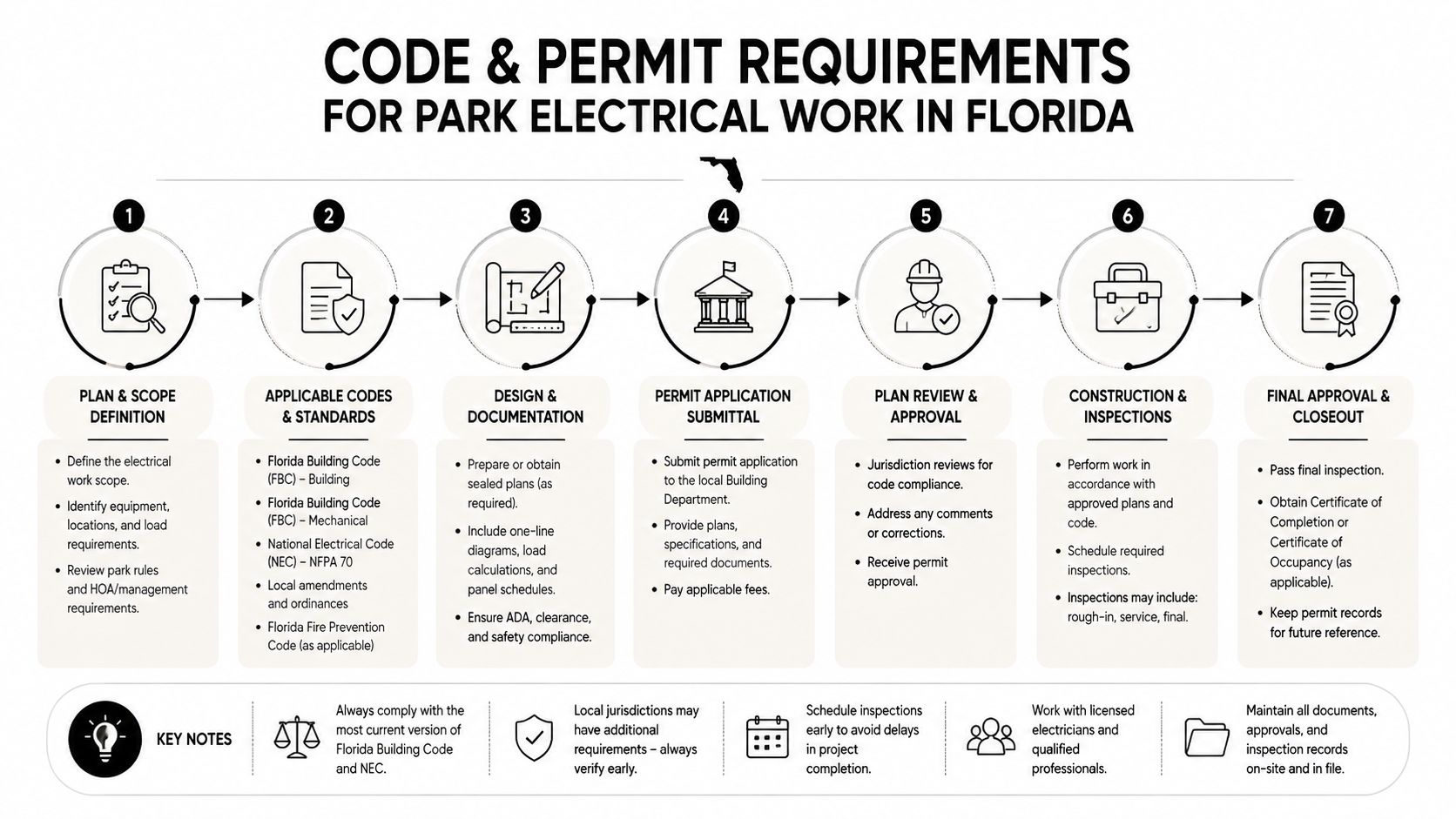
Park electrical work fails when contractors treat a manufactured home like an ordinary detached house. Florida applies a layered framework. The site distribution system, the manufactured-home interior, the Florida Building Code, local permitting, flood-zone requirements, and utility procedures all have to line up.
Start at the lot-service interface
The practical sequence begins with the park's engineered service plan. The electrician should confirm that the pedestal and feeder conductors match the required single-phase 120/240V park distribution standard, then inspect the feeder connection to the home's main panel under NEC Article 550 and the Florida Building Code framework.
The interior wiring and park infrastructure should be documented as separate scopes. A home panel replacement doesn't automatically authorize feeder work, and a pedestal repair doesn't resolve an unsafe panel inside the unit.
Catch the failures inspectors see repeatedly
The recurring problems are practical, not mysterious:
- Missing arc-fault protection: Article 550 requires arc-fault protection for applicable 120V 15- and 20-amp branch circuits in mobile and manufactured homes.
- Loose connectors: Poor terminations can create heat, arcing, voltage drop, and repeated trips.
- Improper panels: An incorrectly installed panel, poor labeling, or defective bonding can stop approval.
- GFCI gaps: Wet locations and other applicable areas must receive the protection required by the governing code.
- Exposed or damaged wiring: Physical damage and unsuitable connections should be corrected before energizing.
Approved manufactured-home inspection agencies must inspect at least 75% of each module's subsystems during production, according to Florida code practice guidance. That benchmark illustrates the state's reliance on repeated verification rather than one casual signoff.
Follow the permit sequence
The safe workflow is straightforward:
- Confirm the local jurisdiction and scope.
- Secure the required permit.
- Verify panel condition, grounding, and bonding.
- Confirm lot numbers and meter equipment are clearly identified.
- Schedule the electrical inspection.
- Correct any deficiencies.
- Request utility release only after approval.
Palm Beach County permit staff must verify proposed mobile or manufactured-home locations in Special Flood Hazard Areas. Flood-zone review can therefore affect the project before electrical work begins, especially when a relocation, service change, or broader site modification is involved (University of Florida Shimberg Center housing data).
For help organizing a correction scope, use this Florida electrical code violation correction service. Don't let a contractor convince you that skipping a permit is a shortcut. It usually creates a second visit, a failed inspection, or a utility-release delay.
What to Ask Before Hiring a Mobile Home Park Electrician
The first call should be an interview, not a vague request for “someone to look at it.” Give the contractor the park name, affected lot numbers, equipment involved, and whether the outage affects one home or shared distribution. Then ask questions that expose whether the company understands the work.
Licensing and field experience
Ask for the Florida electrical contractor license number and proof of insurance. Ask how often the company works on manufactured-home parks, pedestals, feeder conductors, meter banks, and Article 550 interior systems. A contractor who only discusses receptacles and household panels may not be equipped for the lot-side problem.
Emergency readiness
Ask whether the phone is answered by a licensed electrical professional, whether true 24/7 dispatch is available, and whether the company adds an after-hours surcharge. Get a defined arrival window, not “we'll send someone when we can.” For a multi-lot outage, the dispatcher should ask about sparks, smoke, burning odors, affected lots, breaker positions, recent work, and storm damage.
Park-specific permitting
Ask who confirms the jurisdiction, pulls the permit, coordinates inspection, marks the meter base or lot number, and communicates with the utility. Ask how the contractor handles flood-zone review when the project involves a mobile or manufactured-home location. Florida's framework requires more discipline than a routine interior repair.
Commercial discipline
Require a written quote with equipment ownership, exclusions, temporary restoration limits, permit costs, inspection responsibilities, and payment terms. References from other Palm Beach parks or comparable property managers are more useful than a generic residential review.
| Category | Key Questions | Why It Matters |
|---|---|---|
| Licensing | What is the Florida electrical contractor license number, and can you provide insurance documentation? | You need a qualified, accountable contractor. |
| Park experience | Do you handle pedestals, feeders, meter banks, and manufactured-home panels? | The lot-side scope differs from ordinary home repair. |
| Emergency service | Who answers after hours, and is there an extra emergency charge? | A real outage requires immediate, informed triage. |
| Permits | Who pulls permits and schedules inspection before utility release? | Skipped steps create failed inspections and delays. |
| Scope control | Which equipment belongs to the park and which belongs to the resident? | Clear ownership prevents disputes and duplicate work. |
| Pricing | Is the quote written with exclusions and no hidden fees? | You can approve work without guessing at the final scope. |
Reject contractors who won't provide license information, give only a verbal price, blur park and resident responsibilities, or pressure staff to bypass permits. Those aren't minor communication issues. They're early warnings about closeout problems.
Typical Costs for Park and Mobile Home Electrical Work
Electrical budgeting works better as a decision framework than as a posted price list. The same symptom, a tripped breaker, can require a simple replacement, a panel investigation, a feeder repair, or a multi-lot infrastructure project. Accessibility, corrosion, permit requirements, shutdown coordination, and after-hours timing all affect the final scope.
Diagnostic and minor repair work
This tier covers troubleshooting a trip condition, replacing a failed breaker or receptacle, tightening an approved connection, repairing a small lighting issue, or correcting an isolated GFCI problem. The important cost question is whether the electrician is charging only to reset equipment or is testing far enough upstream and downstream to identify why it failed.
Ask for the diagnostic findings in writing. If the report says “breaker replaced” without recording voltage, load condition, termination condition, and affected equipment, the park may be paying for a temporary symptom fix.
Mid-level work
Panel changeouts, pedestal rebuilds, dedicated appliance circuits, and selective AFCI or GFCI corrections sit in the middle. These jobs often become more involved when the electrician finds an undersized feeder, corroded grounding electrode, damaged enclosure, or panel that can't accept the required equipment.
A useful quote separates labor, materials, permit and inspection handling, shutdown coordination, restoration, and unresolved conditions. That makes competing bids easier to evaluate without relying on the lowest initial number.
Capital projects
Full feeder replacement, meter-bank reconstruction, and multi-lot storm hardening require planning. The contractor may need an engineered design, utility coordination, staged outages, inspections, and restoration sequencing. A capital scope should explain how many lots are affected, what temporary arrangements are possible, and what conditions could change the work.
Bundling recurring inspections with planned repairs can reduce repeated mobilization and improve consistency. Ask whether the contractor offers transparent pricing, documents deficiencies by lot, and avoids adding after-hours charges when a genuine emergency occurs. The cheapest visit isn't always the lowest operating cost if it leaves the same fault ready to fail again.
Emergency Response Protocols for Park Electrical Outages
Treat a park outage as an operational incident. Don't send maintenance staff into a sparking pedestal, and don't tell residents to keep resetting breakers when equipment smells hot or shows signs of arcing.
Dispatch the right response
Emergency dispatch is justified when you see:
- Sparking or arcing equipment, especially at a pedestal, meter bank, disconnect, or panel.
- Burning odors or smoke, which may indicate overheated insulation or a failing connection.
- Power loss across multiple lots, suggesting a shared feeder or distribution fault.
- Storm damage, including water intrusion, fallen equipment, damaged conductors, or exposed wiring.
- Repeated breaker trips, particularly after a repair or weather event.
Before calling, collect the affected lot numbers, whether common areas are also out, breaker positions, recent electrical work, visible damage, and any reports of burning smells or noise. Tell residents not to touch damaged equipment. If occupants need practical guidance during the outage, share this resource on keeping connected without power.
Expect triage, isolation, and documentation
A competent contractor should put a licensed electrical professional on the phone, establish a defined arrival window, separate life-safety hazards from comfort outages, and explain what can be restored immediately. The electrician should isolate unsafe equipment before attempting temporary power restoration.
For property managers, the call should produce a record: time reported, lots affected, equipment isolated, temporary measures, cause suspected, parts required, permit status, and next inspection step. That record protects residents and gives the park a defensible maintenance history.
Use this Palm Beach County emergency electrical repair service when the issue exceeds routine maintenance.
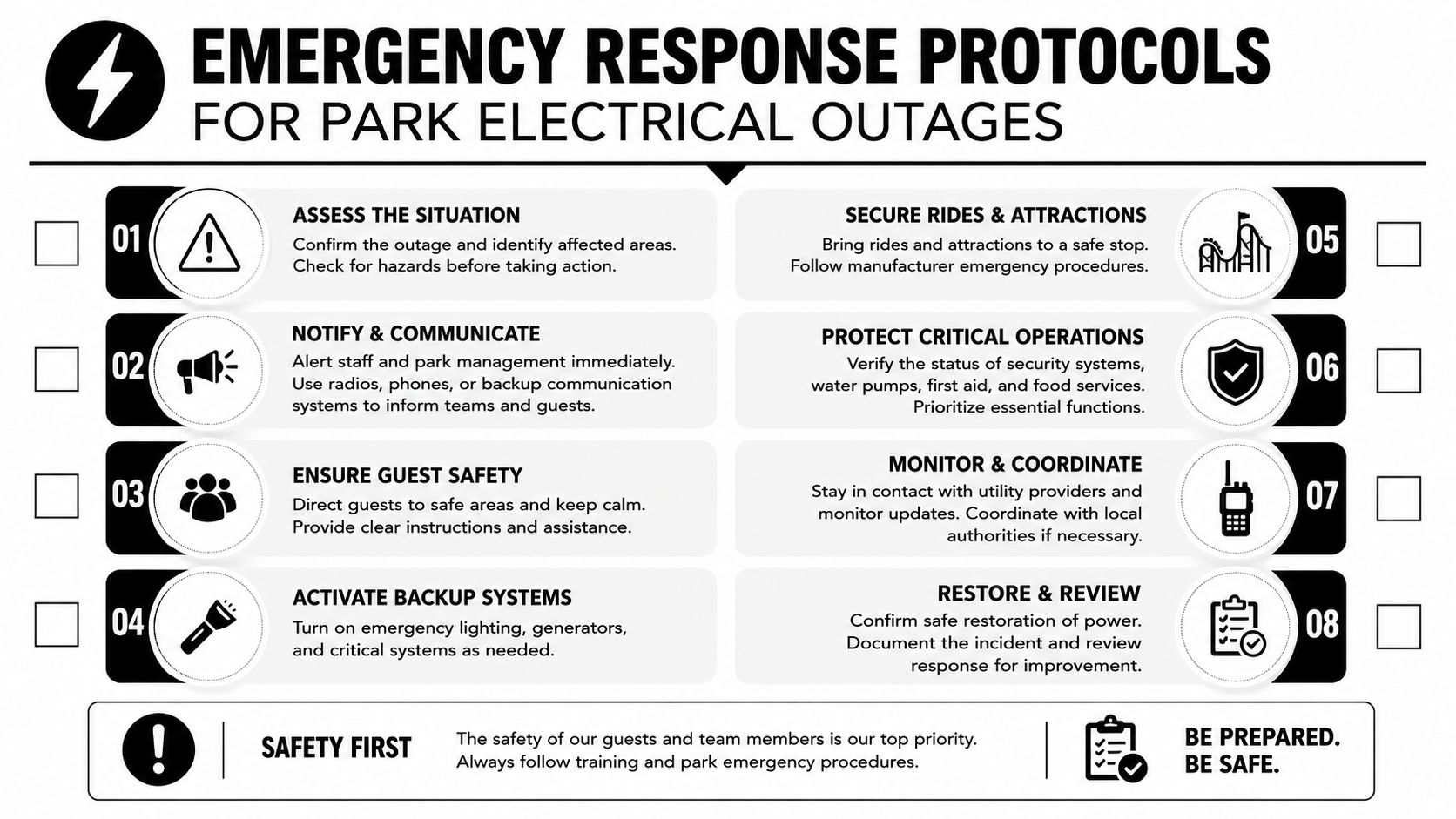
Tape this triage sequence inside the maintenance office:
- Keep residents away from damaged equipment.
- Call emergency services if there's fire, smoke, or immediate danger.
- Record affected lots and shared equipment.
- Avoid repeated resets.
- Isolate the suspected pedestal, feeder, or panel.
- Dispatch a licensed electrician.
- Document temporary restoration and permanent repairs.
- Schedule inspection and closeout before returning unresolved equipment to service.
Storm Hardening and Proactive Upgrades for Older Parks
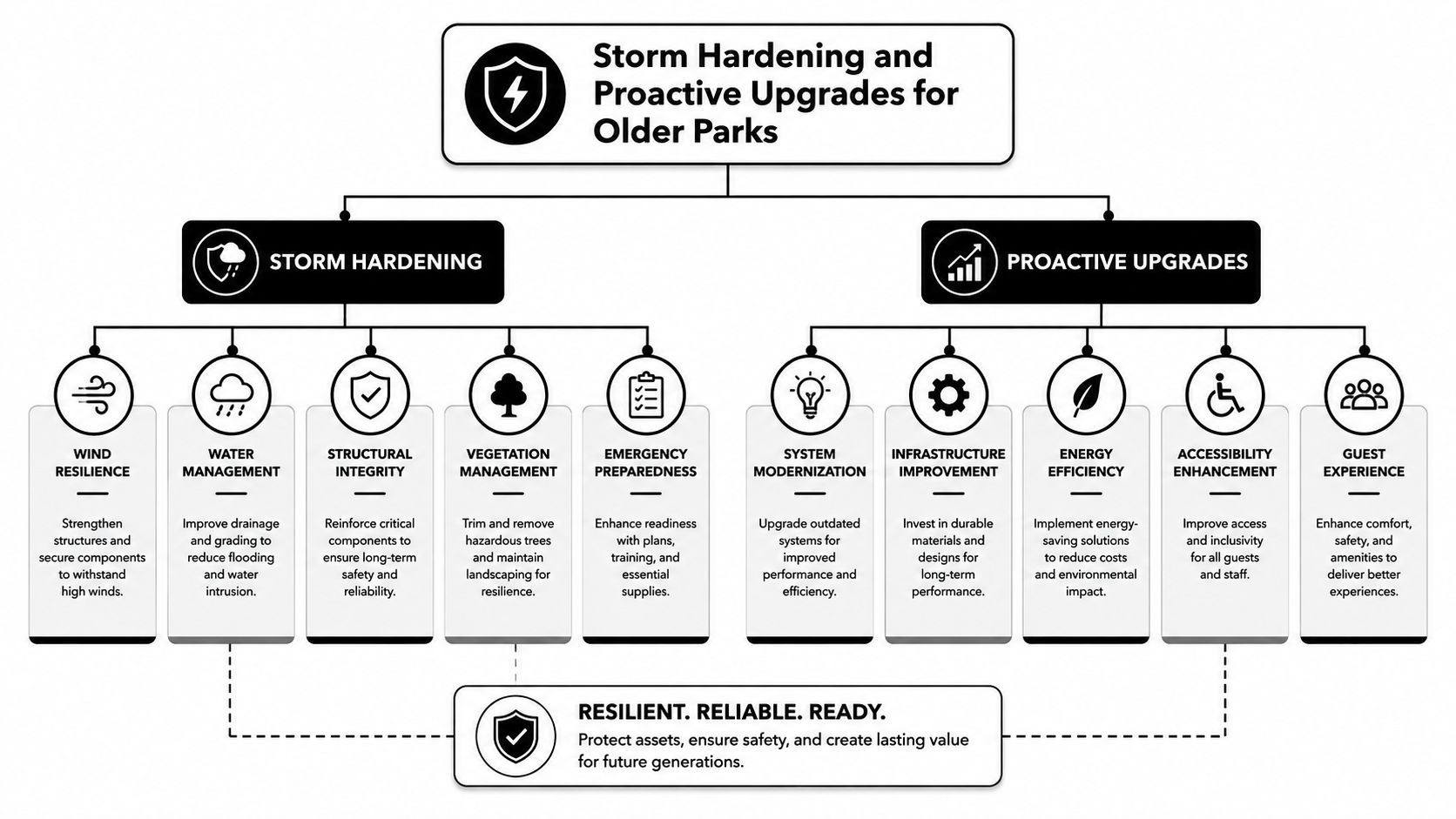
Older park infrastructure should be managed as an asset-risk problem, not as a collection of unrelated service calls. A failing pedestal can affect one home. A damaged feeder or meter bank can interrupt several lots at once, create resident complaints, and force emergency coordination when crews and equipment are hardest to secure.
Palm Beach County's property-maintenance rules require electrical equipment to be properly installed and maintained in a safe, approved manner (Palm Beach County property-maintenance code). That is the baseline. It doesn't tell a manager which feeder to replace first, so the park needs an inspection-led capital plan.
Find the weak points before the storm does
The first inspection should map the park's electrical assets and assign ownership. Record pedestal condition, feeder type and apparent capacity, meter-bank condition, grounding and bonding, panel age and configuration, common-area loads, and past outage locations. Don't wait for a failure to discover that several lots depend on a corroded enclosure or a feeder that can't comfortably serve modern air-conditioning and appliance loads.
Common warning signs include:
- Undersored feeders: Older infrastructure may not suit current resident loads, especially after appliance additions or panel changes.
- Corroded meter banks: Coastal exposure and water intrusion can degrade enclosures, terminations, and service connections.
- Outdated panels: Older installations may need selective AFCI and GFCI corrections or a complete replacement.
- Weak grounding systems: Corroded or damaged grounding electrodes can complicate inspection and increase fault risk.
- Unclear responsibility: A park may repeatedly repair home-side symptoms while the shared feeder remains the main problem.
A manager should rank each finding by safety risk, number of lots affected, likelihood of failure, inspection complexity, and storm-season urgency. That produces a defensible sequence instead of a first-come, first-served repair list.
Build a three-year hardening plan
Year one should establish control. Inspect every lot-side distribution asset, correct immediate hazards, update one-line diagrams or site records where available, label pedestals and meter equipment, and resolve the failures most likely to cause multi-lot outages. Schedule work early enough to allow permits, inspection, and utility coordination before the busiest storm conditions.
Year two should address shared infrastructure. Prioritize feeder replacements, meter-bank repairs, grounding improvements, and common-area equipment that can affect multiple residents. Stage shutdowns by section so the park can communicate clearly and avoid unnecessary disruption.
Year three should complete selective interior upgrades. Replace panels that can't support safe operation, add required protection where applicable, and coordinate resident-owned work with park-side improvements. Don't replace every panel automatically. Replace the equipment that presents a documented safety, capacity, reliability, or compliance problem.
A hardening plan is useful only when it names the asset, the owner, the risk, the permit path, and the next scheduled action.
Florida's manufactured-housing framework reinforces coordinated permitting, inspection, and utility procedures. County guidance also requires flood-hazard verification for proposed mobile and manufactured-home locations, so projects involving site changes shouldn't be treated as informal electrical maintenance (University of Florida Shimberg Center housing data).
Compare prevention with repeated emergency work
A rolling repair pattern looks inexpensive because each visit addresses one visible failure. It's usually poor management. Repeated trips consume staff time, create resident disruption, and leave the underlying feeder, meter bank, or grounding problem in place. A planned rebuild can require more coordination at the start, but it gives the park a defined scope, inspection path, and completion record.
The University of Florida Shimberg Center's 2025 annual report lists 114 manufactured-housing parks in Palm Beach County and reports 3,405 manufactured-housing parks in Florida. It also records 4,021 mobile homes placed on individual parcels in Florida in 2024 (Shimberg Center Annual Report 2025). The installed base and continuing activity make electrical compliance a continuing operational issue, not a one-time modernization project.
Property managers should also coordinate electrical work with broader storm preparation. A practical Florida weather protection guide from Pinnacle Property Media can support the wider property plan, while the electrician focuses on service equipment, feeders, panels, grounding, safe shutdowns, and restoration.
Choose one accountable point of contact
The contractor you retain should be able to handle residential and commercial scopes, respond around the clock, provide licensed professionals on the phone, and explain the difference between a resident repair and a park infrastructure project. Lighthouse Energy Services states that it has operated since 2005 and provides residential, commercial, and industrial electrical work, including emergency troubleshooting, permit coordination, feeder upgrades, meter repairs, meter-bank installations, and manufactured-home panel work (Lighthouse Energy Services).
Its service model also includes transparent quotes, on-time arrival, no extra after-hours charges, and Smartcool ECO3 installations for air-conditioning efficiency. Those capabilities matter only when they're tied to a documented scope and a code-compliant closeout.
For backup planning, review hurricane backup generator installation in Florida as part of the park's broader resilience strategy. A generator doesn't repair a damaged feeder or make an unsafe pedestal acceptable. The transfer equipment, load plan, permits, grounding, and operating procedure still need professional design and inspection.
The practical standard is simple. Hire a contractor who can diagnose the lot-side system, repair the resident-side wiring, manage permits, coordinate inspections, respond during storms, and tell everyone exactly where responsibility ends.
Lighthouse Energy Services can serve as a single electrical contact for Palm Beach County parks, HOAs, property managers, and homeowners, from Boca Raton to Jupiter. Visit Lighthouse Energy Services to request a clear assessment for pedestal and feeder work, manufactured-home repairs, code corrections, storm hardening, or emergency response planning.