
A hurricane warning in Palm Beach County changes the tone of a normal afternoon fast. People start checking batteries, flashlights, sump pumps, garage doors, and whether the fridge will stay cold if the grid drops out overnight. A backup system can calm that panic, but only if it's installed legally, sized correctly, and built to pass inspection the first time.
Residential backup power systems have moved well beyond a niche purchase. The global residential backup power market is projected to grow from USD 10.9 billion in 2024 to USD 21.8 billion by 2034, which points to a near doubling in value and a clear shift into mainstream household planning Market.us. In a county where storm exposure and service interruptions are part of life, the central issue isn't whether backup power makes sense. It's whether the system will protect the home without creating a code violation, a fire risk, or a failed final inspection.
If a property owner is already thinking about risk, it helps to think beyond the generator or battery itself and review managing property threats as part of the bigger picture. Backup power is one piece of a larger resilience plan, not a standalone purchase.
Table of Contents
- Why Backup Power Compliance Is Critical in Palm Beach County
- Understanding the Layers of Electrical Code
- Key Requirements for Different Property Types
- Navigating the Palm Beach County Permitting and Inspection Process
- Common Violations and Your Practical Compliance Checklist
- Why Your Project Demands a Licensed Palm Beach County Electrician
Why Backup Power Compliance Is Critical in Palm Beach County
A homeowner calls after the forecast cone shifts west, and the project suddenly becomes urgent. The generator pad is already poured, the battery location is already chosen, and someone wants power “by the weekend.” That's exactly when mistakes happen, because panic pushes people toward shortcuts that don't survive an inspector's review or a storm's demands.
Backup power is supposed to reduce risk, not add it. A non-compliant installation can create exposed conductors, unsafe fuel connections, backfeed hazards, and emergency shutdown problems that only show up when the system is under load. If the work isn't permitted, the homeowner can also end up facing delays, rework, and insurance questions after a loss. Those are not theoretical problems; they're the true cost of treating electrical work like a furniture delivery.
Practical rule: if a backup system can't be explained clearly to an inspector, it usually wasn't laid out correctly in the first place.
Palm Beach County property owners also need to think in terms of documented compliance, not just functionality. An installation that runs during a test can still fail if the disconnects aren't labeled, the clearances are wrong, or the transfer equipment is misapplied. That's why licensed work matters. It creates a paper trail, a code basis, and a system that a real inspector can verify instead of guess at.
The market is growing because households now view resilience as basic infrastructure, not a luxury. That shift makes compliance even more important, because the more common these systems become, the more closely they're reviewed and the less patience officials have for sloppy installation. The safest project is the one that works on the wall, on paper, and under inspection.
Understanding the Layers of Electrical Code
Think of the rules as a stack, not a single book. The broadest layer sets the electrical safety baseline, the next layer adds Florida construction requirements, and the local level narrows things further for Palm Beach County review. If one layer says the installation is acceptable but another layer says the placement or documentation is off, the project still fails.
The national baseline
At the national level, the National Electrical Code governs how standby and optional power systems are installed, including transfer equipment, grounding, conductors, and labeling. The important thing for homeowners is not memorizing article numbers, but understanding the purpose behind them. The code is designed to keep backup power from energizing the utility lines, overheating conductors, or creating a shock path that puts people at risk.
For a homeowner, that means the transfer method matters as much as the power source. A battery system, standby generator, or hybrid setup still has to isolate properly from the utility and feed the loads in a way that matches its listed design. If the installer treats that as an afterthought, the whole system can become a compliance problem instead of a resilience asset.
Florida and county review
Florida's building framework then adds the state-level expectations for permitted work, inspections, and product approval. Palm Beach County sits inside that framework and can add procedural requirements that affect where equipment goes, how plans are submitted, and what must be on the paperwork before work starts. That's why the same system can be accepted in one place and delayed in another.
A useful way to think about it is simple. The NEC answers whether the design is electrically safe, Florida answers whether the work belongs in the built environment, and Palm Beach County answers whether the actual job matches the approved plans. Those layers stack, they don't replace one another.
For code-conscious project planning, it helps to review a sizing discussion like how to size a generator for your home before the equipment is chosen. A system that is too small or too large can complicate the code path from the start.
A clean permit package doesn't just speed approval. It also tells the inspector that the installer understands the job's scope before the first wire is pulled.
The point of all three layers is the same, safe installation with verifiable documentation. In practice, that means the work has to be designed as a code-complete system, not assembled from parts and hoped through the finish line.
Key Requirements for Different Property Types
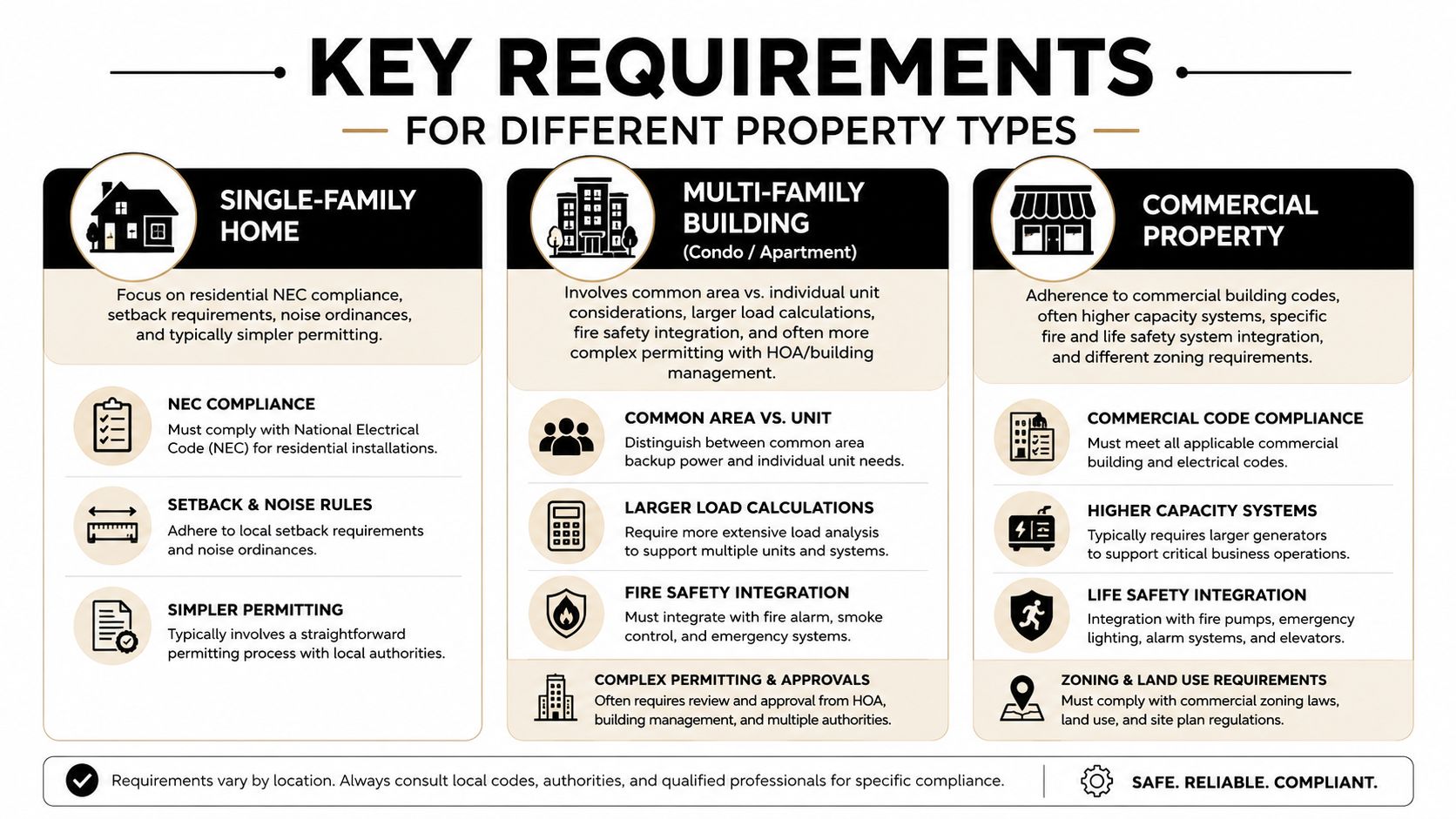
A single-family home, a condo, and a larger facility don't get treated the same way. The equipment may be similar, but the compliance questions change fast once load size, shared spaces, fuel routing, and life-safety integration enter the picture. That's why property type drives the project more than the sales brochure does.
Homes versus shared buildings
For a typical house, the main concerns are load calculation, transfer method, exterior placement, and the ability of the system to handle startup surges. A residential standby generator is often sized in the 10 to 26 kW range, which reflects the need to cover continuous household loads and motor-start surge from appliances like HVAC compressors Generac brochure. Batteries are handled differently. A whole-home residential backup system often needs at least 10 kWh for about a day of normal household loads, while broader coverage commonly moves into the 20 to 30 kWh range with 10 to 15 kW of continuous inverter output Piforz.
Multi-family properties bring in common-area issues, management approval, and a lot more coordination around utility rooms, fire separations, and who owns which circuit. Commercial buildings raise the stakes further, because the backup system may need to interact with different loads, different shutdown procedures, and different documentation. The bigger the property, the more important the one-line diagram becomes.
Fuel, noise, and storage details
Fuel storage and exhaust routing matter most on generator jobs. Noise and placement matter everywhere, especially where neighbors, windows, and air intakes are close together. Battery-only projects remove exhaust concerns, but they don't remove compliance. The installation still needs proper clearances, approved equipment, and correct wiring methods.
If the property has a shared wall, a shared roof, or shared life-safety systems, assume the project is more complex than it first looks.
For towers and buildings with rooftop equipment, obstruction lighting can become part of the planning conversation too, which is why specialized electrical experience matters. If a project affects multiple systems at once, the work needs to be sequenced so one permit doesn't create a problem in another discipline.
There's also a growing battery-only path for homes where solar isn't part of the plan. Grid-charged storage can make sense in dense neighborhoods and HOA-controlled properties where rooftop solar is limited, but the equipment still has to be placed and wired to the same compliance standard PG&E Residential Storage Initiative. That flexibility is useful, but it doesn't reduce the need for a clean permit set and correct installation.
Navigating the Palm Beach County Permitting and Inspection Process
Palm Beach County doesn't care how badly the homeowner wants the system before the storm. It cares whether the plans, permit, and inspection trail match the installation. That's why backup power jobs that look simple on paper can get delayed when the paperwork is vague or the field work drifts from the approved scope.
What gets reviewed first
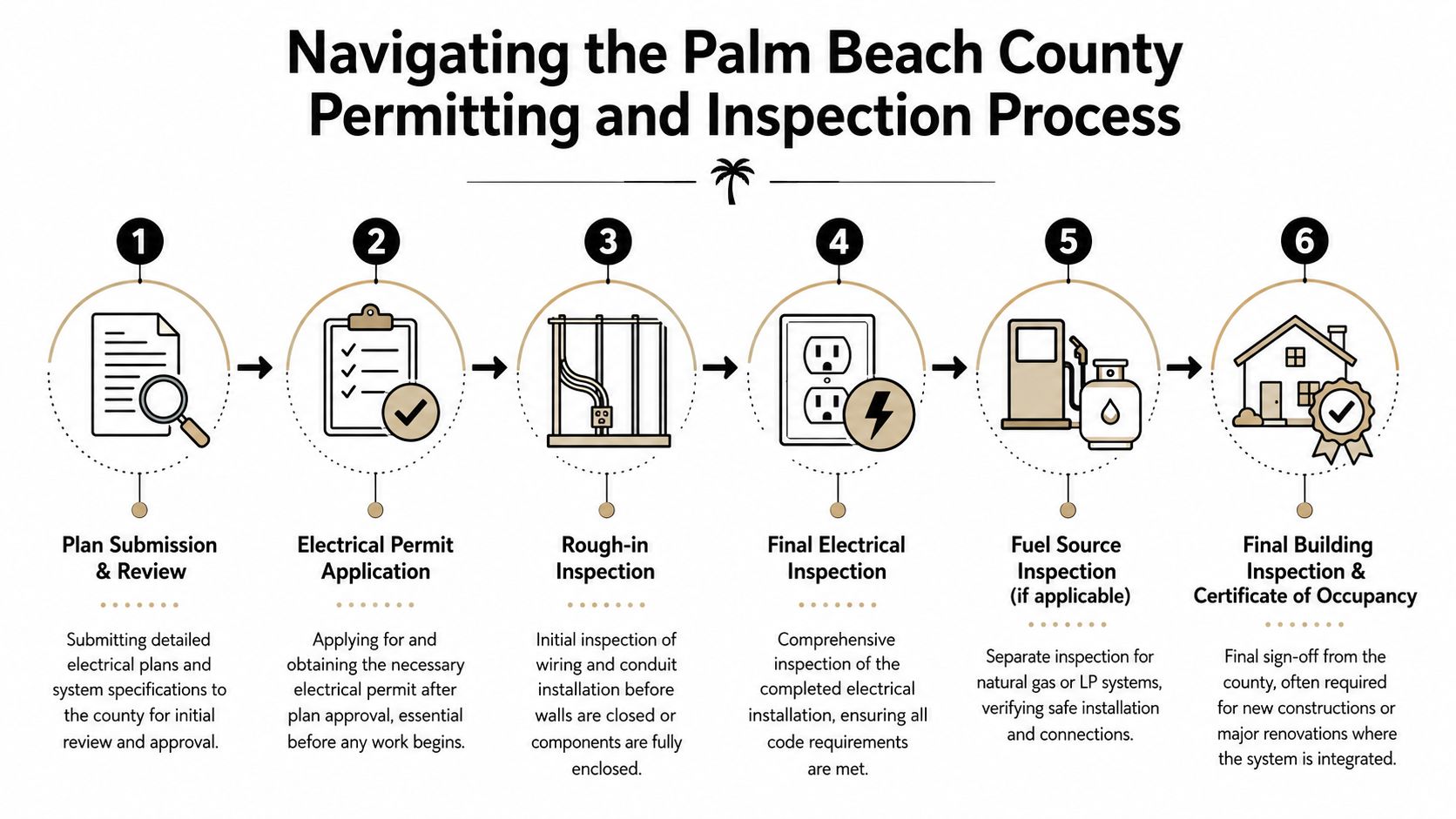
The process starts with plans that show the system type, equipment location, electrical routing, and the scope of work. The permit isn't just a fee, it's the county's formal record that the job exists and will be inspected. If the submittal leaves out critical details, the review stalls before work can even begin.
Once the permit is active, the rough-in inspection becomes the first major checkpoint. Inspectors are looking at the parts of the job that will disappear behind finishes or become harder to correct later. That includes conduit runs, penetrations, mounting, disconnect placement, and the physical path of the system from source to panel.
What happens near the end
The final inspection is where the whole system either proves itself or gets flagged. Inspectors want to see approved equipment, proper labeling, safe terminations, clear working space, and transfer equipment installed in the right configuration. If a fuel source is part of the project, that side of the work may trigger its own inspection sequence too.
A licensed electrician keeps the project moving because the permit package and field installation stay aligned. That matters most when revisions are needed, because an undocumented change can turn a near-finish into a restart. For a county process that punishes loose paperwork, precision is cheaper than reinspection.
For homeowners comparing backup approaches, hurricane backup generator installation in Florida is a useful reference point for how storm-focused systems are typically handled in a local permitting environment. The point is not speed alone. The point is getting a system that the county can sign off without backtracking.
The fastest way to lose time is to assume an inspector will “figure it out” in the field.
When the administrative side is handled well, the inspection day feels routine. That's the goal, because routine is exactly what you want when electrical backup is involved.
Common Violations and Your Practical Compliance Checklist
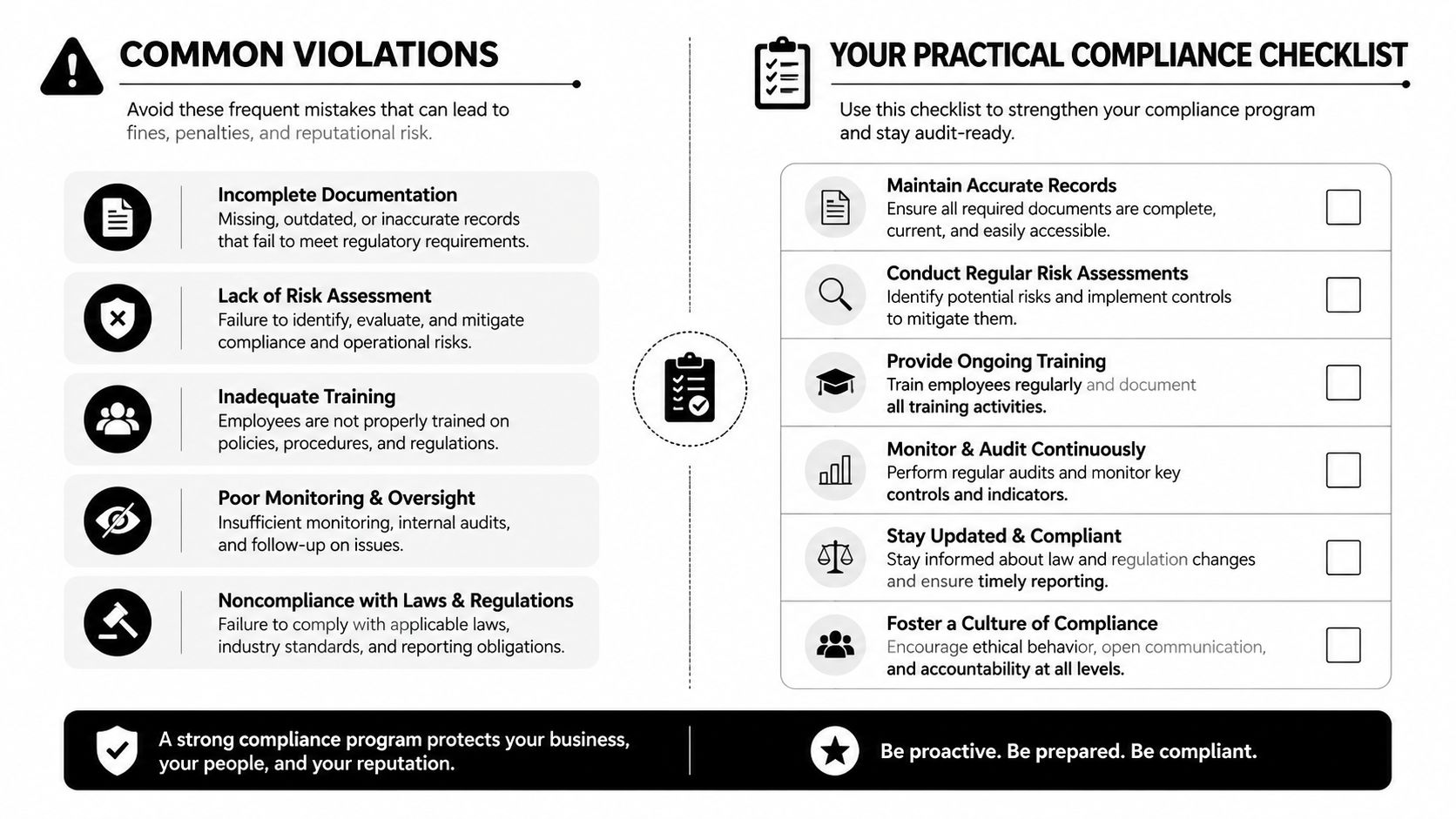
Most failed inspections trace back to a short list of avoidable mistakes. The field version of the problem is usually not “bad equipment.” It's equipment that was placed, wired, labeled, or documented in a way that doesn't match code expectations.
The mistakes that keep showing up
One common failure is improper set-back or placement. A generator or battery cabinet too close to openings, property lines, or combustible materials can turn an otherwise good system into a rejection. Another is incorrect sizing or protection, where the breaker, feeder, or inverter output doesn't line up cleanly with the load side of the installation.
Transfer equipment causes a lot of trouble too. If the interlock, automatic transfer switch, or disconnect arrangement isn't approved and installed correctly, the system can backfeed or behave unpredictably during outage conditions. That's more than a paperwork issue, it's a safety issue.
The practical checklist before work starts
- Verify the site location: Confirm clearances from windows, doors, vents, and combustible surfaces before any pad, mounting rack, or cabinet is installed.
- Match the system to the load: Make sure the generator or battery capacity fits the intended circuits, startup demands, and transfer method.
- Confirm the transfer equipment: Check that the design uses approved equipment and that the wiring path prevents backfeed.
- Review ventilation and exhaust: Generator projects need airflow and exhaust planning that won't trap heat or gases near the structure.
- Check fuel routing carefully: Gas piping, LP connections, and shutoff locations need to follow the approved plan from the beginning.
- Inspect labeling and signage: Disconnects, warning labels, and operating instructions should be visible and complete.
- Use listed components only: Every major part should be approved for its intended use and installed within its listing.
Battery-only systems create a different kind of temptation, because they look simpler and quieter than fuel-based backup. But simplicity doesn't erase the wiring rules, and grid-charged storage still has to be placed and connected with the same care as any other permanent electrical system PG&E Residential Storage Initiative. A good comparison point for homeowners who also think about household electronics is Perth home security battery tips, because even small backup systems show how important proper charging, placement, and dependable wiring really are.
The most useful habit is to walk the project like an inspector would. If a detail can't be defended with a permit note, a product listing, or a clear code basis, it needs to be fixed before the crew starts drilling holes.
Why Your Project Demands a Licensed Palm Beach County Electrician
Backup power isn't becoming simpler. In 2024, more than 45 million backup power systems were reportedly operating worldwide, and residential complexes were among the largest end users. The same data set notes that diesel generators, UPS units, and millions of new hybrid solar-battery systems all need specialized installation knowledge MarketGrowthReports. That's exactly why licensed field experience matters so much in Palm Beach County.
A homeowner can buy the equipment, but the installer still has to solve the code path, the permit path, and the inspection path. Those are separate problems. A generator that's mechanically sound can still fail because the paperwork is incomplete. A battery system that runs perfectly can still be non-compliant if the disconnects, labels, or clearances are wrong. A licensed electrician keeps all three aligned before the county ever shows up.
That also matters after the storm, when response time becomes part of the service itself. Lighthouse Energy Services handles residential, commercial, and industrial electrical work in Palm Beach County with true 24/7 availability, which is the kind of support backup power projects often need when an urgent correction can't wait until Monday. If you're still choosing an installer, the guide at how to find a good electrician in Palm Beach County is a good place to pressure-test credentials, responsiveness, and local experience.
A proper installation isn't about overbuilding. It's about doing the load math, getting the permits right, and leaving no weak point for the inspector or the next outage to expose. If you want backup power that's safe, legal, and ready when the grid fails, contact Lighthouse Energy Services and get the job handled by licensed professionals who know Palm Beach County requirements inside and out.