
For a residential Level 2 EV charger in Florida, the total installed cost typically ranges from $3,000 to $9,000. The biggest factors are usually your home's existing electrical panel and the distance to the charger location, not the charger hardware itself.
If you're pricing out an EV charger in Palm Beach County, you're probably finding a wide spread in estimates and wondering why one home gets a simple install while another turns into a much bigger electrical project. That difference is real. In the field, the charger unit is often the easy part. The hard part is whether the house can safely support a new 240-volt load, how far the wiring has to travel, what the local permit process requires, and what kind of construction we're working through.
That matters in this county more than many homeowners expect. A newer home in West Palm Beach with a garage panel is a different job from an older Boca Raton property with limited panel capacity, or a Jupiter home where the charger needs to reach a detached structure. Concrete block walls, long attic runs, exterior conduit, and local inspection requirements all change the labor.
The safest way to think about EV charging station installation cost is this. You're not just buying a charger. You're adding a high-demand appliance to your electrical system, and that work has to be done to code, sized correctly, and built for long-term use.
Table of Contents
- Understanding Charger Levels and Hardware Prices
- The Anatomy of Your Installation Bill
- Hidden Variables That Impact Your Final Cost
- Three Palm Beach Installation Cost Scenarios
- Maximizing Your ROI with Rebates and Smart Planning
- Your Checklist for an Accurate Quote from Lighthouse Energy
Understanding Charger Levels and Hardware Prices
The three charger levels in practical terms
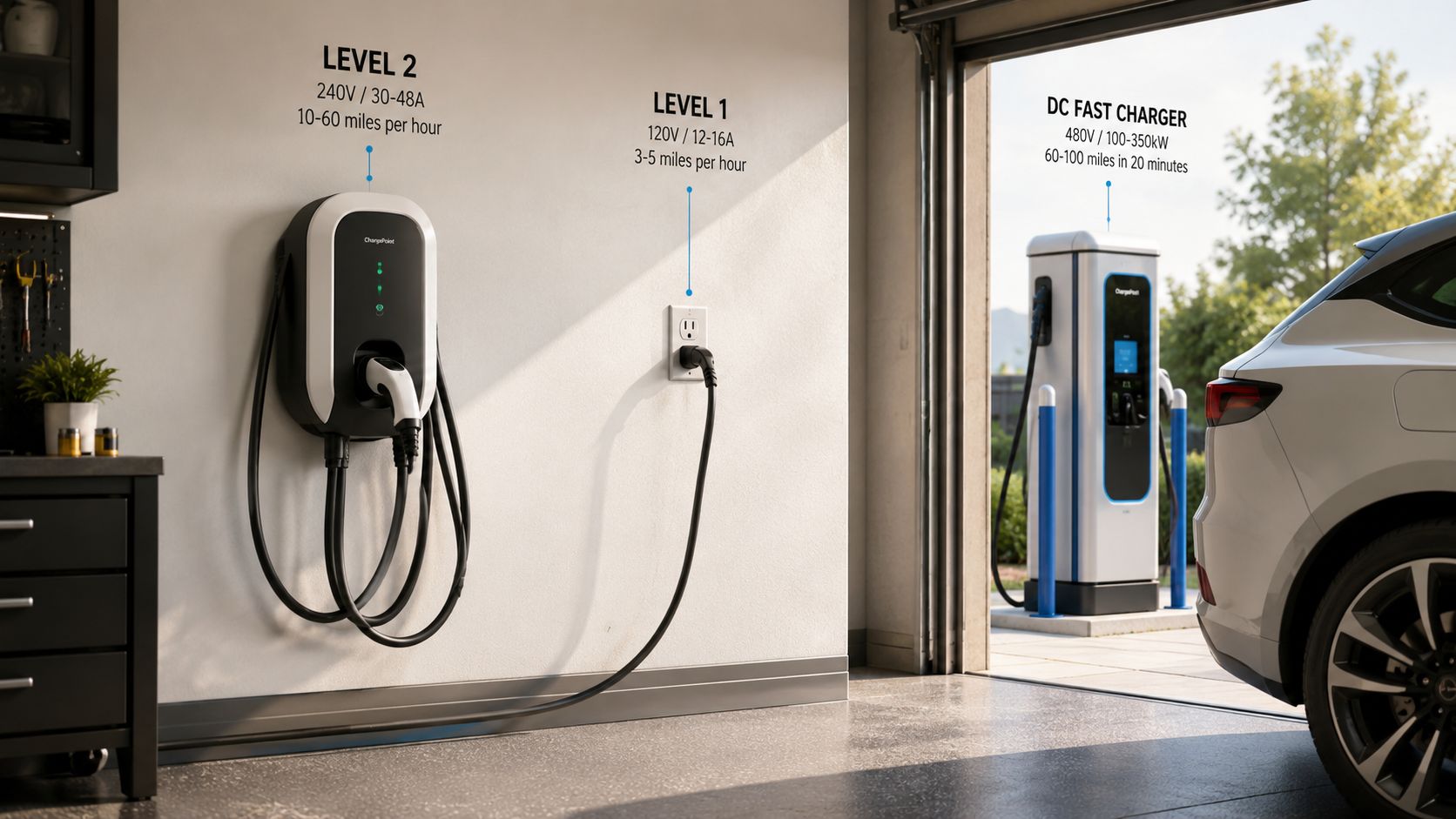
Most homeowners only need to understand one charger type well, but it helps to know the full lineup.
Level 1 uses a standard household outlet. It's the slowest option and usually works as a temporary or low-mileage solution. For some drivers, that's enough. For most households with a daily commute, it becomes frustrating fast.
Level 2 is the practical standard for home charging. It uses a 240-volt circuit and is the setup most Palm Beach County homeowners ask for because it fits real-life driving patterns. If you're evaluating a dedicated home setup, this is usually the category you're shopping in. For a closer look at what that installation involves locally, see this guide to Level 2 EV charger installation in West Palm Beach.
DC fast charging sits in a different world. It's mainly for commercial and public sites, not typical single-family homes. Commercial DC fast charging installations can run $80,000 to $250,000+ per site, and total project cost for a single high-power connector can exceed $125,000 to $250,000+ because the power levels require major electrical infrastructure and civil work, as outlined in this commercial EV charging cost guide.
Why the charger box usually isn't the real cost
Many homeowners often misunderstand the full scope. They shop online, see a charger price, and assume that number is most of the job.
It usually isn't.
For residential Level 2 installs, the charger unit itself typically costs $300 to $1,500, according to this breakdown of EV charging station installation cost components. In plain terms, that means the equipment on the wall is often the smaller line item. The electrical work behind it is what moves the price.
Practical rule: Buy the charger that fits your vehicle and charging habits, but budget around what your house needs, not around the box price.
A simple way to consider this:
| Charger level | Typical use case | Cost focus |
|---|---|---|
| Level 1 | Light daily driving, temporary setup | Minimal hardware, very slow charging |
| Level 2 | Most homes | Circuit capacity, wiring path, permits, labor |
| DC fast charging | Commercial or public sites | Utility infrastructure, transformers, civil work |
When people ask about ev charging station installation cost, they usually start with the wrong question. They ask, “Which charger should I buy?” The better question is, “What does my electrical system need to support it safely?”
The Anatomy of Your Installation Bill
What the invoice is really paying for
A Level 2 EV charger quote in Palm Beach County is built from several separate jobs on one invoice. The charger is only one line item. The rest of the price comes from putting in a dedicated 240-volt circuit, protecting that circuit correctly, mounting the equipment in a usable location, pulling permits, and getting the work approved.
That is why two homes with the same vehicle and the same charger can land at very different totals.
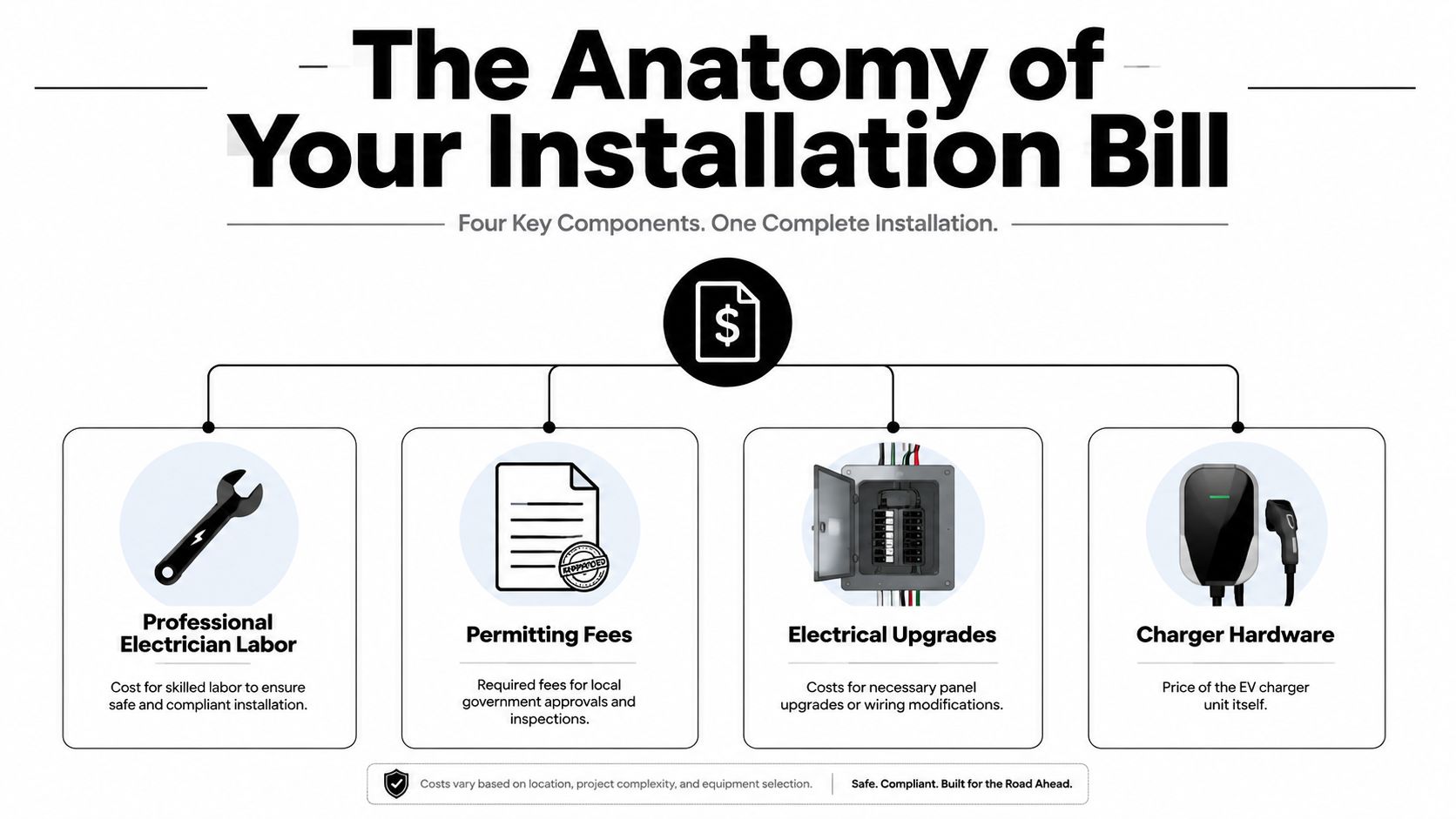
A clean install usually includes four cost buckets:
- Charger hardware: The wall unit, mounting hardware, and any manufacturer-specific accessories.
- Electrical labor and materials: New breaker, wire, conduit, fittings, disconnects if required, terminations, testing, and final commissioning.
- Permits and inspection: Permit fees, filing time, and correction work if an inspector flags anything that must be revised before approval.
- Service or panel work: Load calculations, breaker space management, subpanel work, or a full service upgrade if the house cannot safely support the new load.
In practice, labor and electrical infrastructure usually drive the bill harder than the charger box itself. A garage installation next to the main panel is one type of project. A charger on the opposite side of a large home with finished walls, block construction, and limited attic access is another.
Palm Beach County adds its own cost pattern. Municipal permitting is not uniform, and local housing stock is mixed. One street may have newer homes with accessible garage walls and modern panels. The next may have older service equipment, long runs around additions, pool equipment already filling the load calculation, and concrete block that limits easy routing. Those local conditions matter more than national averages.
Permit work also takes real time. Homeowners sometimes treat permits as a small administrative line, but permit requirements shape scheduling, inspection timing, and how the installation has to be documented. If you want a reminder of how much permit process can vary by city, How to apply for Phoenix permits shows the same basic reality. Local rules affect project cost and timeline.
Why panel capacity changes everything
Panel capacity is often the make-or-break issue.
An EV charger is a continuous load. That means the panel and service have to be evaluated for more than open breaker space. The calculation has to account for what the home is already using, especially in Palm Beach County where air conditioning, pool pumps, electric water heaters, and kitchen loads can push a service harder than the homeowner realizes.
A proper quote starts with the panel, the service size, and the load calculation. If you are already researching home electrical panel upgrade cost for older Palm Beach County homes, you are asking the right question. Many EV charger price swings trace back to the service equipment, not the charger brand.
The common cost drivers are straightforward:
- No breaker space: The panel may be full, even if the service has some remaining capacity.
- Limited service capacity: The home may need load management, a reduced-amperage charger setup, or a service upgrade.
- Aging equipment: Older panels can trigger replacement work before a new EV circuit should be added.
- Panel location: Distance from the panel to the parking area affects wire size, conduit, labor hours, and finish work.
This is the part homeowners should not guess at. A charger spec sheet does not confirm that the house can support the load safely. The right answer comes from an on-site evaluation, code-based load review, and a wiring plan that fits the way the home is built.
Hidden Variables That Impact Your Final Cost
Distance and access drive labor
The shortest path between the panel and the charger is rarely the path an electrician can use.
In Palm Beach County homes, the quote changes when the wire run has to cross an attic, move around structural framing, pass through masonry, or go outside in conduit. A charger mounted near the main panel in an attached garage is usually straightforward. A charger on the far side of the house, or in a detached garage or carport, is a different project entirely.
That's one reason homeowners looking into home electrical panel upgrade cost often discover that panel condition and panel location both matter. Capacity is only half the issue. Access is the other half.
A few physical conditions drive up labor faster than people expect:
- Long runs: More wire, more conduit, more fastening, more time.
- Detached structures: Underground routing or trenching may be necessary.
- Limited attic access: Tight or obstructed attic spaces slow everything down.
- Exterior routing: Outdoor conduit can be clean and durable, but it adds visible materials and labor.
Construction details that homeowners often miss
Palm Beach County isn't full of one construction type. That matters.
A newer wood-frame interior wall is easier to fish than a concrete block wall. An attached garage with exposed access is simpler than a finished interior where patching, trim removal, or careful cosmetic work may be needed after the electrical portion is done. A wall-mounted charger is usually more efficient than a pedestal setup in a parking area away from the building.
If the charger location is flexible, put it where the wiring path is simplest. That one decision can make the project cleaner, faster, and less expensive.
Here's a practical comparison:
| Site condition | What it usually means for the install |
|---|---|
| Attached garage near panel | Cleaner routing, less labor, fewer access issues |
| Panel on opposite side of house | Longer run through attic or exterior path |
| Detached garage or carport | Possible trenching, weather-rated equipment, more site work |
| Concrete block wall | More difficult penetrations and mounting work |
| Freestanding pedestal | Additional support and site preparation |
The cleanest quote comes from a realistic site walk, not from a generic online estimate. Materials can be priced quickly. Access conditions can't.
Three Palm Beach Installation Cost Scenarios
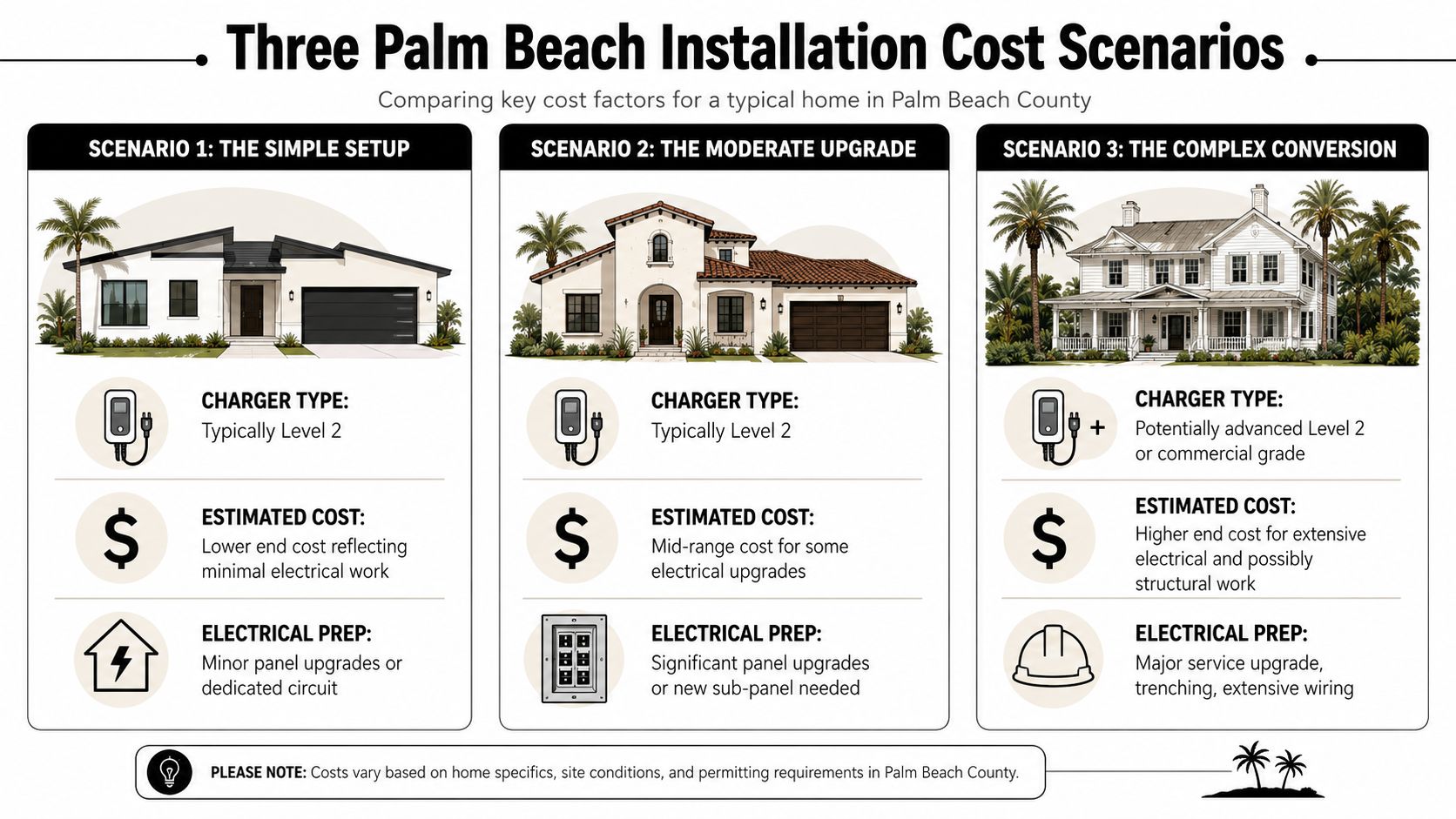
Scenario one in a newer attached garage
A homeowner in West Palm Beach has a newer house with a modern panel in the garage and open breaker space. The vehicle parks on the same wall where the charger will be mounted. The wiring path is short, direct, and easy to access.
This is the kind of job that tends to stay near the basic end of the residential range already noted earlier. The work is still professional electrical work, not a shortcut job, but there's no major detour. No long attic run. No detached structure. No service upgrade.
What usually works well here:
- Wall mounting near the panel: Keeps material and labor under control.
- Clear garage access: Speeds up installation and inspection prep.
- Dedicated circuit planning: Leaves the setup clean and easy to service later.
Scenario two with a longer run through the house
A homeowner in Boca Raton has a home that isn't especially old, but the electrical panel is on the opposite side of the house from the garage parking location. The panel has enough capacity, yet the route to the charger means a longer pull through attic space and possibly exterior transitions.
This is a common middle-case install. The charger hardware hasn't changed much, but the labor has. Routing takes more time, support methods matter more, and the finished look becomes part of the conversation because no one wants sloppy conduit where it doesn't belong.
In this scenario, the quote often reflects factors like:
- Longer conductor run
- More installation time
- Potential drywall or finish disruption
- Extra planning around heat, attic access, or exterior weather exposure
The homeowner often starts the process thinking, “I just need a charger in the garage.” The actual question is, “How do we get a code-compliant 240-volt circuit from that panel to this location without creating a mess?”
Scenario three in an older home with major electrical work
An older home in Jupiter has an aging panel with little to no usable capacity for a new EV circuit. The vehicle parks in a detached carport. The ideal charger location is not close to the service equipment, and the route may require exterior work or underground routing.
This is the project that produces the highest end of residential pricing. The charger is still only one small component. Scope involves service readiness plus difficult routing.
A high quote isn't always a sign that something is overpriced. Sometimes it means the house needs real electrical infrastructure before the charger can be installed safely.
This kind of project often includes several layers of work:
| Project condition | Why it raises cost |
|---|---|
| Older panel | May require replacement or upgrade before adding EV load |
| Detached parking area | Adds routing complexity and possible site work |
| Long path from service equipment | Increases labor and materials |
| Older construction methods | Creates access and mounting challenges |
These three examples are why ev charging station installation cost can't be guessed from the charger model alone. The property decides the project.
Maximizing Your ROI with Rebates and Smart Planning
Upfront savings are only part of the picture
A Palm Beach County homeowner can save money on day one and still choose the wrong setup.
Optimal ROI comes from matching the charger to the house, the panel capacity, and how the vehicle will be charged over the next several years. A basic garage charger used by one driver has a very different cost profile than a shared charger at a rental property, condo, or home with multiple EVs. Upfront rebates matter, but they are only one part of the decision.
Recurring costs are where planning gets tighter. Some chargers carry ongoing software or access fees. Outdoor installations may need more service over time because of salt air, rain exposure, and sun. If the property may add a second EV later, spending more now for better circuit planning can prevent expensive rework.
Use this filter before choosing equipment:
- Single-family home, one EV: A simple non-networked charger often keeps ownership costs lower.
- Seasonal home or rental property: Access control and usage tracking may matter more than the cheapest hardware.
- Outdoor install near the coast: Enclosure rating, mounting method, and corrosion resistance matter.
- Future second EV: Plan capacity now if the panel and budget allow it.
The best return usually comes from installing the right charger once, with a code-compliant path for how the property will be used two or three years from now.
Homeowners who want that work scoped correctly should start with a licensed EV charger contractor in West Palm Beach who understands local permitting, panel calculations, and the construction styles common across Palm Beach County.
When load management can reduce cost
There is another path that can lower installation cost in the right house. It involves using listed load-management equipment or a load-sharing configuration instead of forcing a full panel upgrade.
That option only works when the existing electrical service can support it under code and the charging pattern makes sense for the household. In practical terms, this can help in homes where the panel is tight but not obsolete, and where overnight charging is acceptable. I see this most often in older Palm Beach County homes that have limited spare capacity but do not need a full service replacement just to support one EV.
A lower-cost approach may make sense if all of these conditions are true:
- The existing service and panel are in acceptable condition
- A code-compliant load calculation supports the design
- The charger location is already practical
- The homeowner understands the charging speed and usage limits
This is not a shortcut. It is a design decision.
In some homes, load management is a smart way to avoid unnecessary infrastructure cost. In others, it creates compromises that become frustrating fast, especially if another EV is coming or the household already has heavy electric loads. Good planning means pricing the install for today without boxing the property into a more expensive fix later.
Your Checklist for an Accurate Quote from Lighthouse Energy
A homeowner in Palm Beach County calls for a charger quote. The first question is simple. Where will the car park, and what does the panel look like? If those two points are vague, the estimate will be vague too.
In Palm Beach County, small details change price fast. A garage panel in a newer West Palm Beach home is one type of job. A detached parking area, a condo approval process, or an older home with the panel on the opposite side of the house is a different job. Good quoting starts with accurate site information, not guesses over the phone.
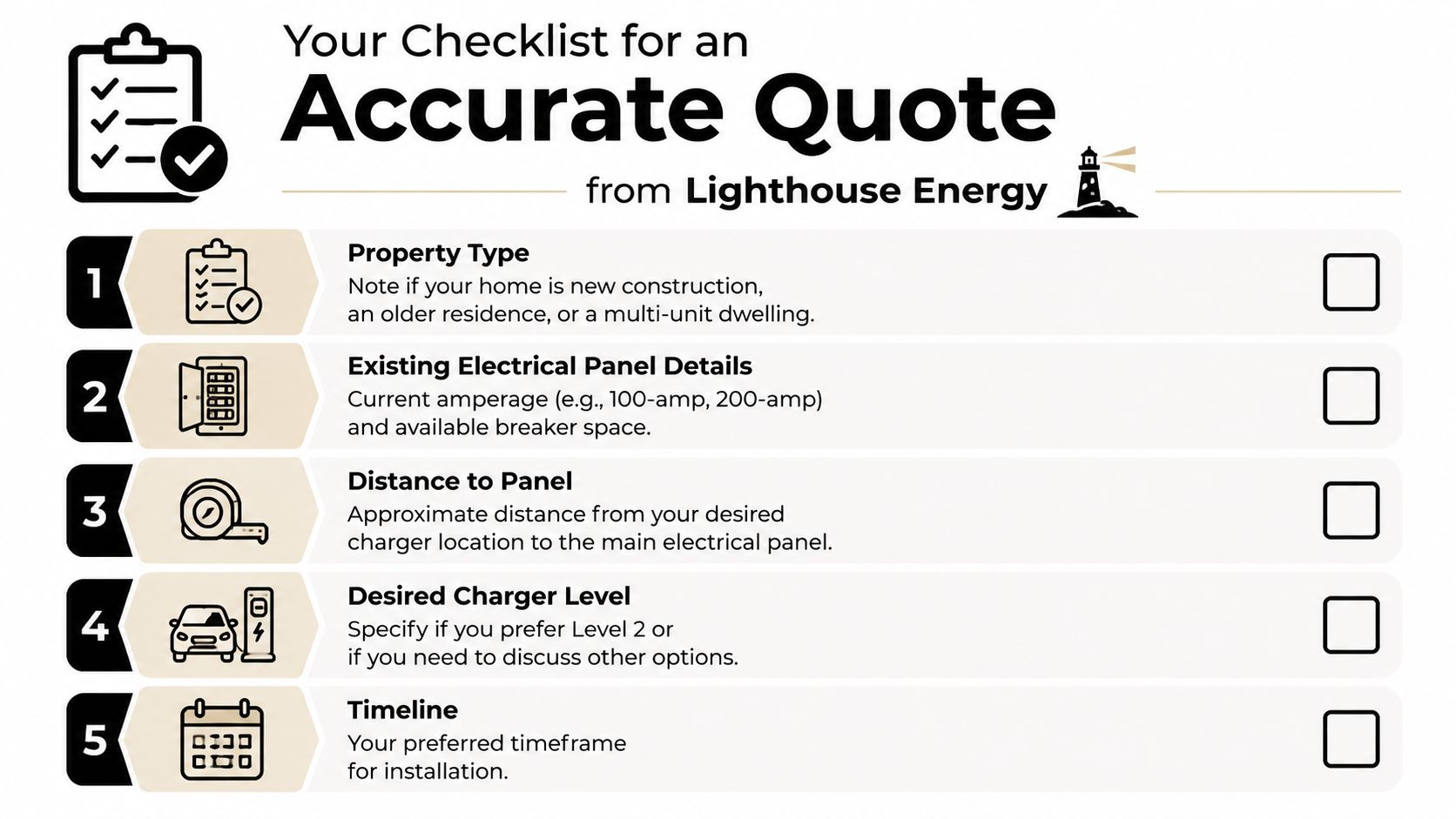
Gather these basics before you call:
- Property type: Single-family home, townhome, condo, older home, newer construction, or a home with detached parking
- Panel photos: Clear photos of the main electrical panel with the door open, breakers visible, and labels readable
- Parking location: The exact spot where the vehicle will sit during charging
- Distance estimate: A rough path from the panel to the charger location
- Vehicle and charger preference: Whether you already have a charger and what vehicle you need to charge
- Address and municipality: Permit requirements can vary across Palm Beach County cities and communities
For homeowners who want to see what a proper scope of work looks like, this page on hiring a licensed EV charger contractor in West Palm Beach shows what should be reviewed before anyone prices the job.
Photos save time. Good photos save money.
An electrician can often spot the biggest cost drivers from a few clear images. Panel condition, breaker space, wall type, surface mounting versus concealed routing, and charger placement all show up early if the pictures are good enough. That helps avoid the common problem of quoting a simple install and then finding a longer run, a full panel, or a mounting issue once the crew is on site.
Here is the information that makes a quote more accurate:
| What to provide | Why it matters |
|---|---|
| Clear panel photos | Shows breaker space, panel type, and whether existing equipment appears suitable for a new EV circuit |
| Charger location photo | Shows mounting surface, weather exposure, and access for routing |
| Address and municipality | Helps confirm permit and inspection steps |
| Parking pattern | Helps place the charger where the cable will reach without creating a daily hassle |
| Preferred timeline | Helps coordinate permit review, scheduling, and any utility or HOA constraints |
Some homes do not need a major installation. If there is already a properly located 240V circuit and the equipment is suitable, there may be a lower-cost path. That still needs to be checked for code compliance, circuit rating, outlet condition, and how the household plans to charge over time. A cheap shortcut that overheats a receptacle or creates nuisance tripping is not savings.
Bring photos, not guesses. An electrician can price from visible conditions. No one can quote accurately from “the panel is somewhere outside.”
If you are in Palm Beach County and want a charger installation done safely, neatly, and to code, Lighthouse Energy Services can help. From straightforward garage installs to panel upgrades and longer conduit runs, the job should be priced from the actual conditions at your home.