
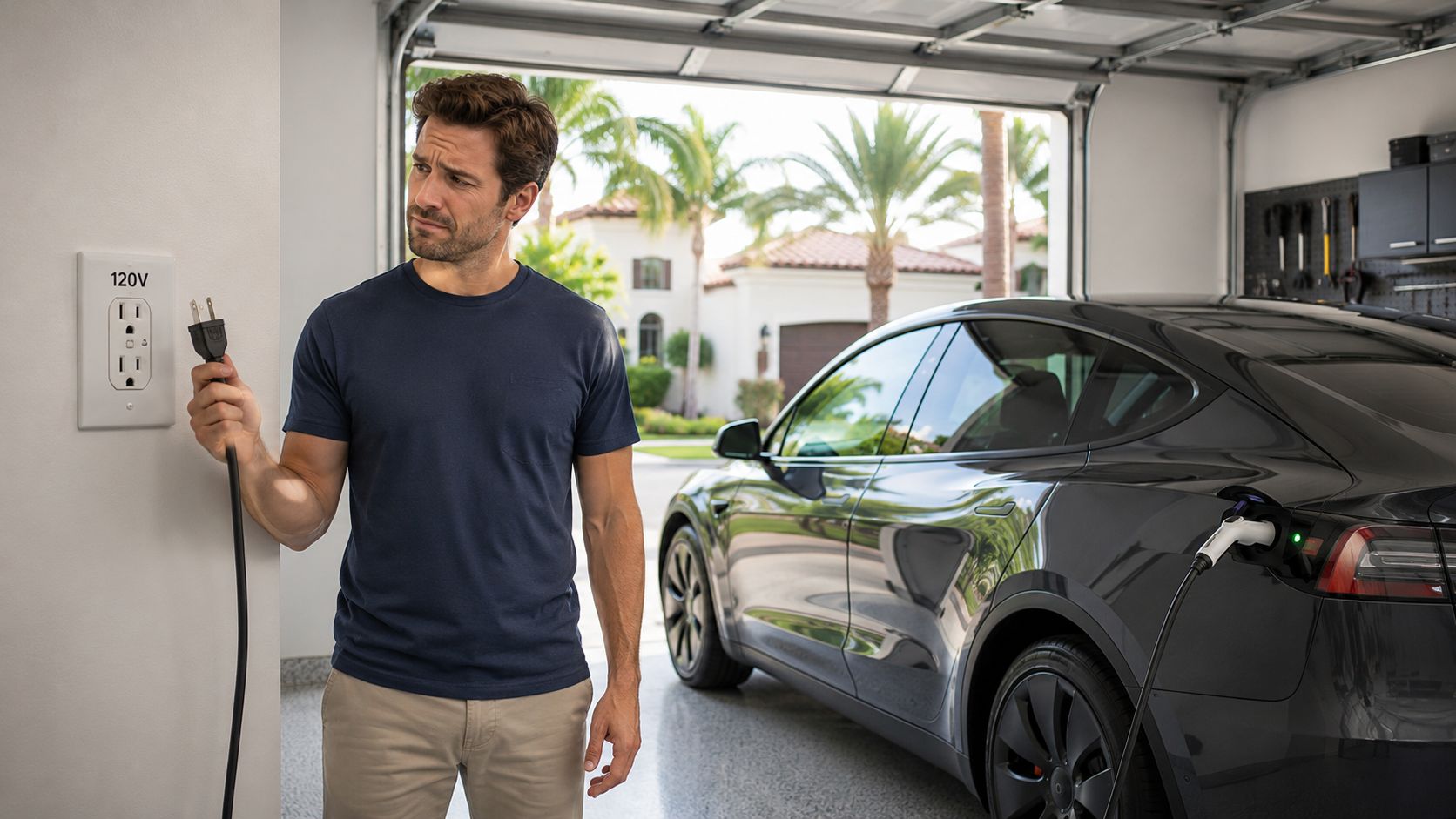
You bring home the EV, plug it into a regular wall outlet in the garage, and by the next morning you realize the charger that came with the car isn't going to fit your routine. That's the point where most West Palm Beach homeowners start looking into a Level 2 setup.
The part that usually gets missed is this. Level 2 EV charger installation in West Palm Beach FL isn't just about buying a charger and hanging it on the wall. It's an electrical project that has to fit your panel, your parking layout, Palm Beach County permit requirements, and in a lot of South Florida homes, the heavy load already created by air conditioning.
A clean install makes charging easy every day. A rushed install causes nuisance breaker trips, ugly conduit runs, failed inspections, HOA headaches, or a panel that was already too full before the EV charger was added.
Why a Level 2 Charger is a Game-Changer for West Palm Beach EV Owners
Most EV owners hit the same wall fast. The standard cord works, but it's slow enough that you start planning your driving around charging time. That gets old quickly if you commute, run kids around town, or want the car ready each morning without thinking about it.
A Level 2 charger changes the whole experience because it turns charging into a routine instead of a workaround. You park, plug in, and the car is ready when you need it. That's why this has become one of the most practical electrical upgrades for local homeowners.
Why it fits how people live here
In West Palm Beach, driving is spread out. People go from home to work, schools, errands, the Turnpike, and back again. Home charging matters more when you don't want to depend on public stations for everyday use.
The shift is visible locally. Florida's Turnpike added charging at the West Palm Beach service plaza in 2020, and Palm Beach County later installed 12 Level 2 chargers at the convention center. Nationally, the Department of Energy projects the U.S. will need 28 million charging ports by 2030, with 25.7 million (92%) expected to be private Level 1 or Level 2 home chargers and another 2.1 million (7.6%) public and private Level 2 chargers in common destination settings, according to Florida's Turnpike coverage of EV charging growth.
That tells you something important. A home Level 2 charger isn't a niche upgrade anymore. It's becoming standard infrastructure.
What works and what doesn't
What works is treating the charger like any other serious electrical load. It needs the right circuit, the right location, and a panel that can support it.
What doesn't work is assuming a nearby outlet means the job is simple, or assuming your home is ready because the panel “looks big enough.” If your house also needs other electrical improvements, it helps to look at electrical upgrades for your home as one coordinated plan instead of one isolated project.
Practical rule: The charger is only half the job. The house has to be ready for it.
Assessing Your Home for a Level 2 Charger
Before an electrician comes out, you can do a useful first pass yourself. You're not trying to replace a load calculation or inspection. You're trying to answer two practical questions. Where should the charger go, and can the existing electrical system likely support it?
That second question is where many West Palm Beach projects change direction.
Start with the parking spot
Walk to the exact place where the car sits most nights. Then look at the charge port on the vehicle. That tells you more than people think.
If the charger is mounted on the wrong side, the cable gets stretched across the garage, dragged around cars, or left where someone can step on it. If the install is outdoors, location matters even more because the equipment, conduit path, and mounting surface all need to suit weather exposure and code requirements.
A few things to note before the estimate:
- Parking consistency: Do you park in the same spot every night, or does the position change?
- Cable reach: Can the charger reach the vehicle's port cleanly without tension?
- Mounting surface: Is it going on block, framed wall, or a pedestal-style setup in a parking area?
- Access path: Is there a simple route from panel to charger, or will conduit have to cross finished spaces, attic runs, or exterior walls?
The panel question most homeowners ask wrong
A lot of people ask, “I have a 150-amp panel. Am I good?” That's not the key test.
Independent industry guidance notes that whether you need a panel upgrade depends on a full NEC load calculation and the home's total household load, not panel size by itself. It also notes that a 150-amp panel can support Level 2 charging in some cases, but only after a professional evaluation confirms enough spare capacity. That matters in South Florida because air conditioning is often one of the largest loads in the house, as explained in this guidance on EV charging and panel capacity.
In hot weather, a house can look fine on paper and still run close to its limit once the A/C, water heater, dryer, oven, and EV charger all overlap.
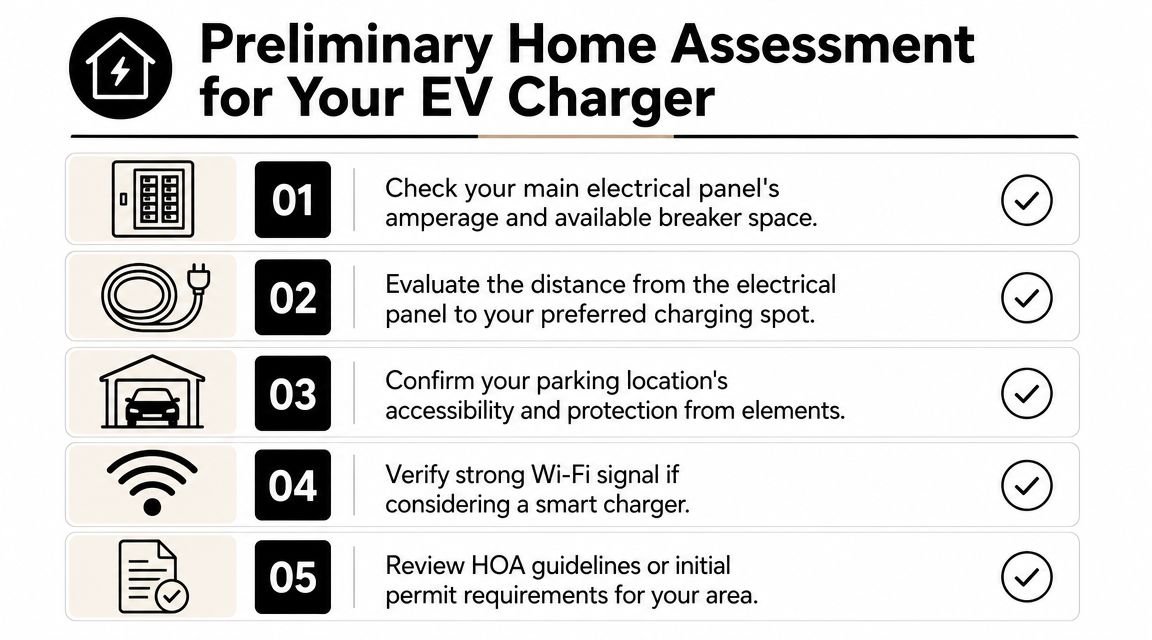
What to check before you call
You don't need to open the panel cover. Just gather basic information that helps the electrician make the first visit more productive.
- Find the main panel and note the service rating shown on the door label.
- Look for available breaker space or signs the panel is already crowded.
- List major electrical loads in the home, especially central A/C, pool equipment, electric range, dryer, and water heater.
- Decide on indoor or outdoor charger placement based on where you park.
- Check HOA or condo rules if the charger will be visible, shared-wall mounted, or installed in assigned parking.
Common mistakes at this stage
Some homeowners buy the charger first and only later discover the chosen model doesn't match the space, cable length, or circuit plan. Others choose the wall nearest the car rather than the wall that gives the cleanest code-compliant wiring path.
The better approach is to let the site conditions lead the plan. Good installs are designed from the panel outward, not from the online shopping cart backward.
Navigating Permits Costs and Upgrades in Palm Beach County
This is usually the part homeowners worry about most. What's it going to cost, how long will permits take, and what turns a straightforward install into a more expensive one?
The short answer is that a basic residential job is often manageable, but the final number depends heavily on the electrical capacity you already have and how difficult the wiring path is.
What a standard install usually costs here
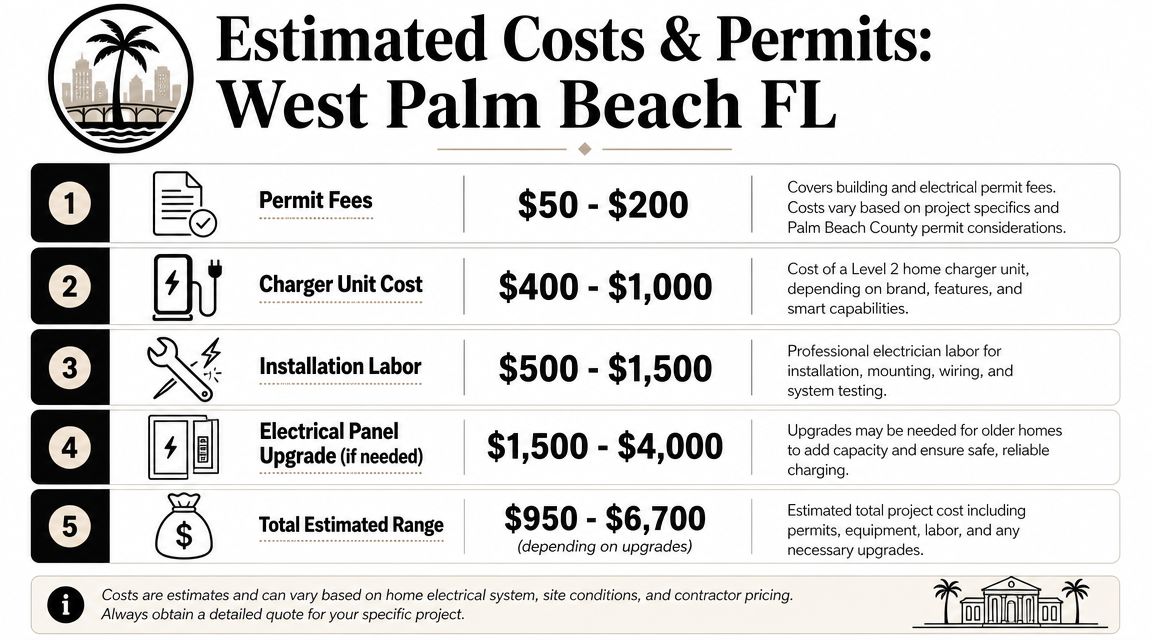
A local West Palm Beach cost guide estimates a standard residential Level 2 charger installation at about $1,243 to $1,354, with that price generally covering the charger, wiring, and permitting. The same guide notes that service upgrades and commercial-grade equipment can push the total higher, as shown in this West Palm Beach electrician cost reference.
That baseline is useful, but it assumes the existing setup cooperates. If the panel is full, the service is undersized for the added load, or the charger location requires a long and difficult conduit run, the budget changes.
Why permits matter in Palm Beach County
A proper Level 2 install usually requires a dedicated circuit and often a permit, especially in commercial settings or outdoor public-facing locations. Local guidance for Palm Beach County also points to issues like panel capacity, conduit routing, ADA concerns, and zoning review as part of the scope on some projects.
For a homeowner, that means the permit isn't paperwork for paperwork's sake. It confirms the work is reviewed under the Florida Building Code and the NEC. It also protects you when you sell the home, file insurance claims, or need service later.
Skipping the permit can save time at the start and create a bigger mess later. Failed inspections after unpermitted work are always more expensive than doing it correctly the first time.
What pushes the cost up
The biggest cost driver is usually not the charger itself. It's the electrical work around it.
Here are the common reasons a project goes beyond the base range:
- Panel capacity issues: The home needs a service upgrade, subpanel solution, or load-management plan before the charger can be added safely.
- Long wiring routes: Detached garages, finished walls, or difficult attic access increase labor and material.
- Outdoor installation details: Weather-rated equipment, conduit routing, and mounting conditions affect the total.
- HOA and condo documentation: Additional drawings, site details, and approval packages can add time before work even begins.
If you suspect your home may need capacity work, this guide to electrical panel upgrades helps clarify what electricians look for before adding a new major load.
Looking for savings without cutting corners
If you're trying to offset the cost, it makes sense to review energy-related programs available to local homeowners. A useful starting point is this overview of FPL rebates for South Florida homes, especially if your EV charger project is happening alongside other efficiency improvements.
The smart move is to use incentives to improve the job, not to justify a shortcut. Permit the work. Size the circuit correctly. Make sure the panel can carry the load. That's what keeps the charger reliable.
How to Choose a Licensed Electrician in West Palm Beach
A Level 2 charger looks simple once it's mounted. Behind that clean finished look is the part that matters: load calculation, breaker sizing, conductor selection, mounting method, conduit layout, permit handling, and final testing.
That's why the contractor matters more than the charger brand in many homes. A good installer prevents problems you may never see. A bad one leaves them inside the wall or panel.
What to ask before you hire anyone
You don't need a long interview. You need a few direct questions and clear answers.
Ask things like:
- Have you installed EV chargers in West Palm Beach and Palm Beach County before? Local permit experience matters.
- Will you perform a real load evaluation before quoting final work? If not, they're guessing.
- Who pulls the permit and coordinates inspection? The answer should be clear.
- How will you route conduit or cable to keep the install clean and code-compliant? Experienced electricians can explain the path clearly.
- What happens if the panel doesn't have capacity? You want options explained before work starts, not after a half-finished job.
DIY versus professional installation
Some homeowners are handy and assume this is close to installing a large appliance. It isn't. The risk isn't just that the charger won't work. The risk is a circuit that overheats, a failed inspection, or equipment warranties that become a headache later.
| Factor | DIY Approach | Professional Installation (Lighthouse Energy Services) |
|---|---|---|
| Load evaluation | Often based on guesswork or panel label only | Based on actual electrical review before installation |
| Permit handling | Homeowner has to navigate requirements alone | Permit and inspection process can be handled as part of the job |
| Conduit and wiring quality | Can end up functional but messy or non-compliant | Planned for code compliance, clean routing, and durability |
| Troubleshooting | Limited if charger faults or breaker trips | Licensed diagnosis available from an electrical contractor |
| HOA documentation | Usually incomplete or hard to assemble | Can be prepared in the format property management expects |
What local experience looks like in practice
The right contractor knows the difference between a simple garage install and a project that needs deeper planning. Condo and HOA jobs, for example, often require coordination before any tools come out. Outdoor installations need careful attention to equipment rating and placement. Older homes need a harder look at the panel and overall load.
If you're comparing local companies, start with a licensed contractor that already handles EV charger work and broader electrical service in the area, such as Lighthouse Energy Services in West Palm Beach. The value isn't branding. It's having someone who understands local code, service upgrades, and the practical realities of Palm Beach County homes.
Hire the electrician who talks first about load, location, permits, and inspection. Be cautious of the one who talks only about hanging the charger.
The Installation Process From Start to Finish
Most homeowners expect a lot more disruption than there is. A well-planned install is usually orderly. The crew confirms the location, protects the work area, handles the electrical work, tests the charger, and gets the project ready for inspection.
The exact sequence depends on the house, but the workflow should be consistent and disciplined.
What happens on installation day
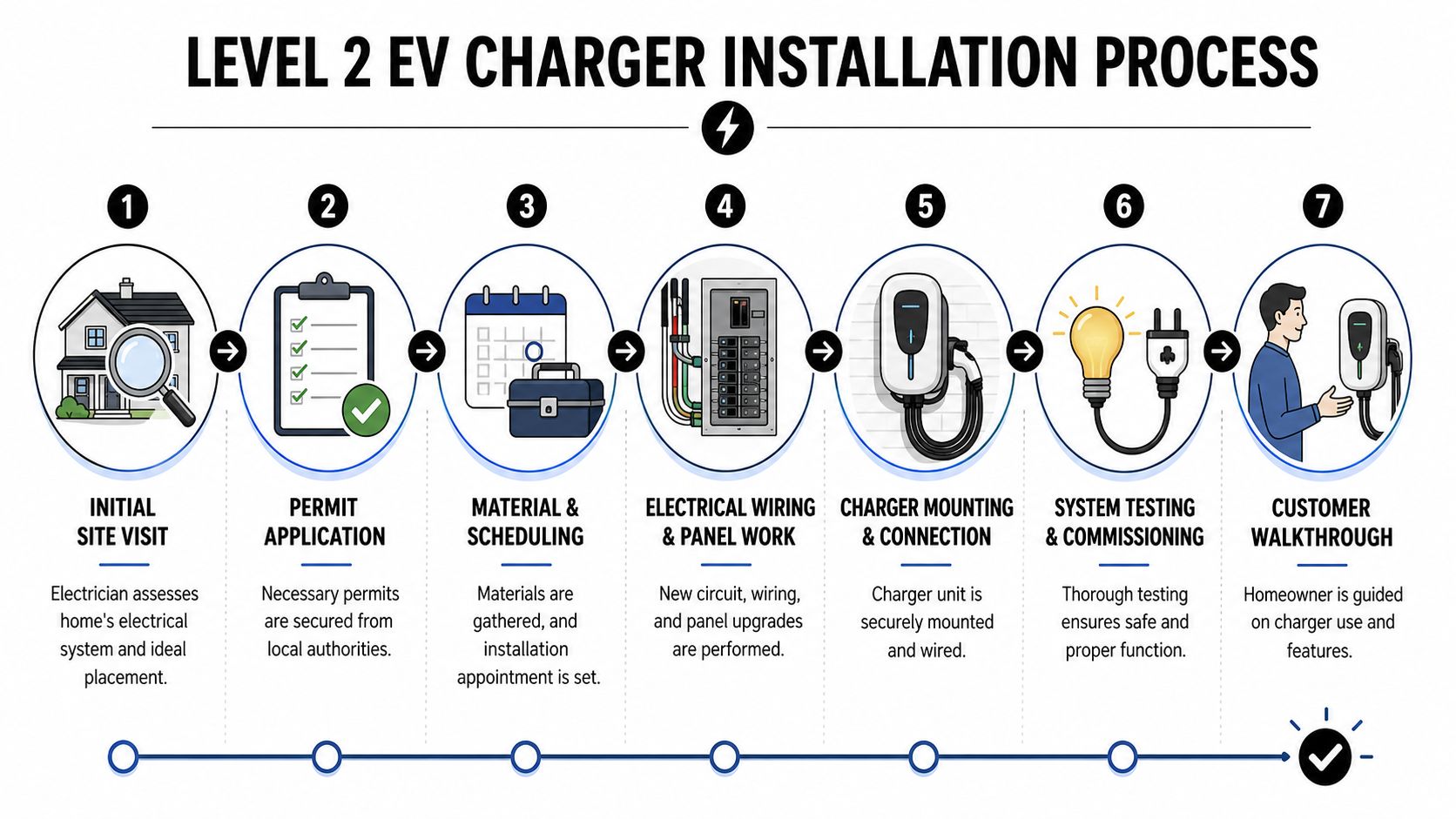
A professional workflow starts with a final confirmation of panel capacity, charger location, and wiring route. Local guidance for EVSE installation in Palm Beach County also notes that many jobs require permit and inspection compliance under the Florida Building Code and NEC, and that HOA or condo projects may require a written package with charger specs, site sketch, wiring route, contractor license, permit plan, and insurance documents before approval. That same workflow is described in this Palm Beach County EVSE installation overview.
Once the plan is confirmed, the work usually moves in this order:
- Site verification so the installer and homeowner agree on exact mounting height and location.
- Electrical rough-in with proper conduit or cable routing back to the panel.
- Panel work to install the dedicated circuit and breaker.
- Charger mounting on the wall or approved structure.
- Final connections and testing to verify proper operation.
What homeowners usually notice
In a straightforward garage install, most of the house stays usable. There may be a brief power interruption while panel work is completed, but the larger issue isn't typically outage time. It's access. The work area needs to be clear, the panel needs to be reachable, and the parking space needs to be available.
For condo or HOA properties, the schedule can depend more on approvals than on the electrical work itself. That's why experienced electricians ask for management requirements up front instead of after the permit package is already assembled.
Where jobs go sideways
A charger install tends to get delayed for three reasons:
- The mounting location wasn't thought through and the cable doesn't reach cleanly.
- Property management wants more documentation than the owner expected.
- The panel evaluation reveals limited spare capacity and the original quote has to be revised.
None of those are unusual. They're manageable when discovered early.
The smoothest installs are the ones planned on paper before the first hole is drilled.
Post-Installation Testing and Long-Term Care
The job isn't done when the charger is on the wall. It's done when the car charges properly, the circuit holds, and you know what normal operation looks like.
Start by plugging in the vehicle and confirming that both the charger and the car indicate active charging. Then check the vehicle app or dashboard so you can see that it's recognizing the home charger correctly. If your charger has smart features, make sure it connects properly and that any scheduled charging settings match how you use the car.
What to keep an eye on
Most chargers don't need much maintenance, but they do benefit from basic attention.
- Check the cable condition: Look for cuts, crushing, abrasion, or strain near the handle and wall unit.
- Keep the unit clean: Wipe off dust, cobwebs, and debris so vents and connectors stay clear.
- Watch for physical looseness: If the charger or conduit starts shifting, have it checked before it gets worse.
- Pay attention to breaker trips: One nuisance trip may be a fluke. Repeated trips mean the circuit needs diagnosis.
When to call for service
If charging stops, check the obvious items first. Confirm the breaker hasn't tripped, the connector is fully seated, and the car hasn't paused charging because of a schedule setting.
If those basics don't solve it, call the installer or another licensed electrician. Don't keep resetting a breaker and hoping the issue disappears. Persistent tripping, heat, or intermittent charging always deserves a proper electrical diagnosis.
Reliable home charging gives you the whole reason people install Level 2 in the first place. You come home, plug in, and stop planning your week around battery level.
If you're ready to install a home EV charger or want a licensed electrician to evaluate whether your West Palm Beach panel can support one, contact Lighthouse Energy Services. They handle residential electrical work across Palm Beach County, including charger circuits, panel evaluations, permitting, and troubleshooting when an existing setup isn't performing the way it should.