
You're probably in one of two spots right now. You either lost a generator job to a number that made no sense, or you won the job and spent the whole install realizing your estimate left out half the pain. That's where a lot of contractors get stuck with licensed electrician generator install work. The jobs look straightforward on paper, but the money gets chewed up by site conditions, permit friction, panel surprises, fuel coordination, and callbacks nobody priced.
The fix isn't to race lower. It's to bid cleaner.
A profitable generator bid comes from disciplined fieldwork, a tight scope, and a proposal that makes the homeowner understand why your number is safer than the cheap one. In Palm Beach County, that matters even more. Storm demand spikes, schedule pressure gets real fast, and the contractor who already thought through placement, permitting, and service expectations has a serious advantage before the first conduit body gets mounted.
Table of Contents
- Beyond the Price The Art of Profitable Generator Bids
- The Foundation Nailing the On-Site Assessment
- From Assessment to Actionable Scope of Work
- The Anatomy of an Accurate Estimate
- Beyond Parts and Labor Soft Costs Profit and Palm Beach County Specifics
- Presenting the Proposal and Sealing the Deal
- Conclusion Building a Reputation One Accurate Bid at a Time
Beyond the Price The Art of Profitable Generator Bids
A lot of generator estimates die before the customer ever compares equipment. They die because the contractor priced a box and forgot the job.
One contractor carries a low number by assuming a short conduit run, easy ATS placement, and no panel rework. Another contractor walks the site, notices the fuel path is awkward, the mounting location is tight, the meter access clearance is going to matter, and the homeowner expects a clean whole-home style solution even though the existing service setup says otherwise. The second contractor submits a higher bid. He loses if the homeowner only sees totals. He wins if the proposal explains the work in plain English and shows where the risk lives.
That's the art. Not fluff. Translation.
Practical rule: If you can't explain why your price is higher in one minute, the client will assume it's arbitrary.
Good bidding also starts before you visit the house. The companies that close more of these jobs usually answer faster, qualify better, and show up already knowing what questions to ask. If you want to tighten that front-end process, Transactional search strategies are useful because they focus on how buyers look for electricians when they're ready to hire, not when they're casually browsing.
Three habits separate profitable bids from desperate ones:
- Pre-qualify the expectation: Ask whether the homeowner wants essential circuits or a broader backup plan before you ever discuss equipment.
- Price the installation path: The route from source to panel usually decides margin more than the generator itself.
- Sell compliance and reliability: Homeowners don't buy transfer switches and permit coordination for fun. They buy confidence that the system will work when the grid doesn't.
Cheap bids win some jobs. Clean bids build a business.
The Foundation Nailing the On-Site Assessment
If your field assessment is shallow, your estimate is fiction. Generator work punishes assumptions fast.
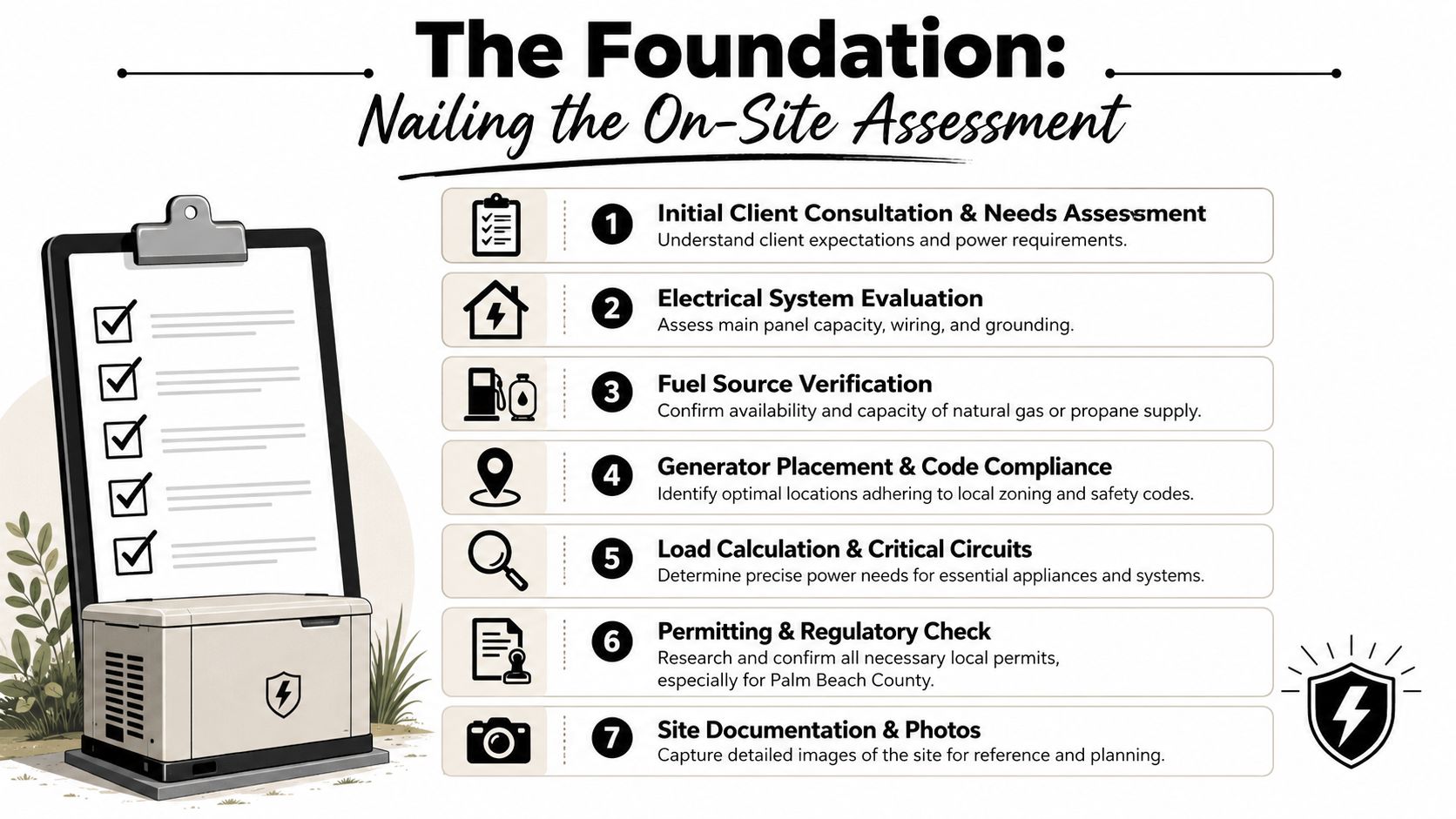
Start with the house not the generator
Walk the property like you're the installer, inspector, and service tech all at once. Don't start by asking which model they want. Start by figuring out what the house can support, what the site allows, and what the customer expects to stay on during an outage.
Your first pass should cover the basics:
- Panel condition and capacity: Look for available space, service condition, grounding issues, and whether the existing setup makes ATS integration clean or ugly.
- Load intent: Separate emotional wants from electrical needs. People say “whole house” when they really mean refrigeration, lights, internet, one air conditioning system, and a few convenience loads.
- Fuel path: Natural gas or propane affects layout, coordination, and scheduling.
- Placement reality: Don't just find a flat spot. Find a code-compliant, serviceable, and defensible spot.
- Access for installation: Gates, landscaping, wall penetrations, trench paths, and pad location all hit labor.
For a licensed electrician generator install, site placement is where newer estimators often get burned. Critical safety clearances mandate that the generator intake and exhaust must be at least 3 feet from any building opening, fence, or meter access, and the ignition source cannot be closer than 5 feet to the gas regulator, with a minimum 5-foot separation from the property line. The same source notes that site clearance violations account for approximately 35% of failed electrical inspections in new generator installations. It also states that installers must de-energize the panel, lock out and tag out the disconnect, and verify zero voltage with a multimeter before interlock work. That's all spelled out in this generator installation safety walkthrough.
Document setbacks access and hidden labor
In Palm Beach County, you also need to think beyond electrical. HOA review can slow placement decisions. Tight side yards can force longer runs. Decorative hardscape can turn a simple trench into a repair-and-restoration problem. If you don't photograph and note those conditions during the site visit, you'll eat them later.
Use a checklist that forces documentation, not memory:
- Take panel photos: Include deadfront, panel schedule, service labeling, and surrounding workspace.
- Capture generator location options: Show distances to doors, windows, fences, gas equipment, and property line conditions.
- Trace the route: Mark conduit path, wall penetrations, trench path, sleeve needs, and any obstacles that add labor.
- Record homeowner priorities: Note whether they care most about hurricane readiness, medical loads, food protection, or comfort loads.
- Flag approval dependencies: HOA, property management, access restrictions, and utility or fuel coordination all belong in the estimate notes.
A good site survey doesn't just tell you what to install. It tells you what can go wrong before it does.
The best field notes read like install instructions. If your estimator can hand the job to the crew and they already understand placement, routing, likely inspection issues, and customer expectations, the bid is working. If the crew has to rediscover the property from scratch, the bid wasn't finished.
From Assessment to Actionable Scope of Work
A vague scope is how profitable jobs turn into arguments.
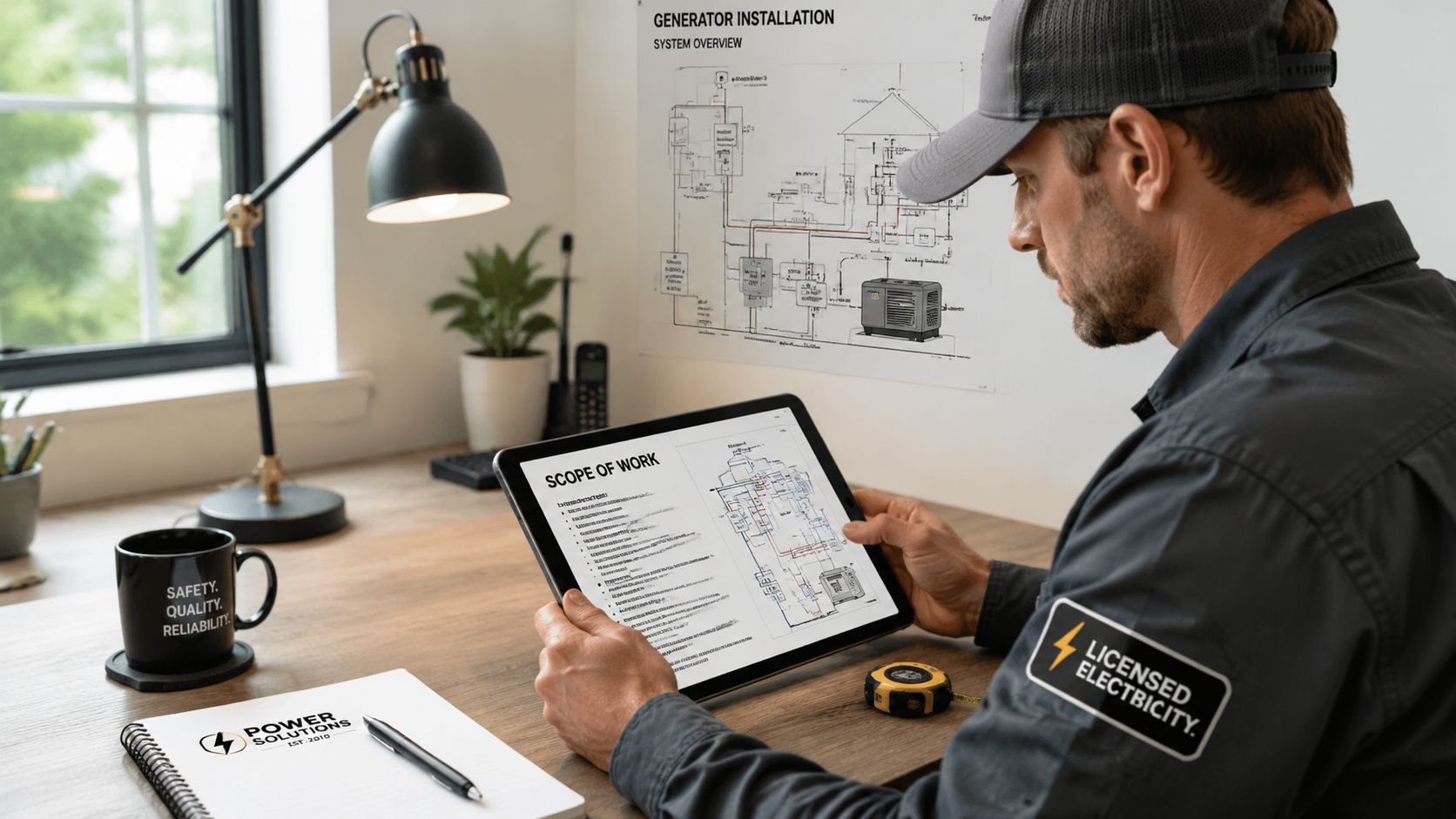
Turn notes into contract language
The homeowner doesn't need your field notebook. They need a scope of work that says exactly what you are and are not doing.
Bad scope item: “Install generator and hook up to house.”
Better scope item: “Provide and install standby generator, transfer equipment, required conduit and conductors, exterior mounting base, final terminations, startup coordination, and electrical permit. Route wiring from generator location to service equipment using the agreed path identified during site visit. Patch minor penetrations at electrical routing points only.”
That kind of wording does two things. First, it protects you from scope creep. Second, it reassures the client that you've thought through the installation beyond the equipment drop.
Your scope should address the work in logical buckets:
- Electrical equipment: Generator, ATS or other transfer equipment, breakers, conductors, conduit, fittings, disconnects, grounding and labeling.
- Site work: Pad or mounting surface, boring or trenching if included, wall penetrations, weather sealing, equipment anchoring.
- Fuel coordination: State whether gas piping is included, excluded, or handled by others under separate coordination.
- Restoration limits: Spell out what patching is included and what isn't.
- Permit and inspection responsibility: Identify who pulls what and who meets the inspector.
A strong scope also helps with generator sizing conversations. If a homeowner is still undecided between essential loads and a broader backup setup, give them a written option structure and point them to a plain-language resource on how to size a generator for your home. That keeps the sales conversation grounded in actual loads instead of guesswork.
Write testing and commissioning into the job
A professional generator scope ends with commissioning, not with “installed.”
That matters because post-install performance is part of the value. A licensed electrician must perform a full load test after final inspection, verifying voltage between 118–122V per leg and frequency between 59.8–60.2 Hz under anticipated load, running the generator for a minimum of 30 minutes to confirm thermal stability before system approval. The same guidance explains that the test also validates ATS function under real transfer conditions in this generator installation guide with load test requirements.
Put that in writing. Not all the technical detail if the client doesn't need it, but the commitment to real testing.
Field advice: If your scope doesn't mention startup, transfer verification, and load testing, you've left the most confidence-building part of the job invisible.
Here's a practical before-and-after:
| Scope style | Example |
|---|---|
| Vague | Test generator after install |
| Defensible | Start and commission generator after approval, confirm transfer operation, and perform load testing as required for final system verification |
The more detailed your scope, the less likely the customer will compare your proposal to a bare-bones quote and assume both cover the same work. They usually don't.
The Anatomy of an Accurate Estimate
Estimating gets easier when you stop trying to price the whole job in your head. Break it into material takeoff first, labor second, then add the business costs that keep the lights on.
Build the takeoff before you touch labor
A clean takeoff doesn't need to be fancy. It needs to be complete. Count everything that gets installed, consumed, mounted, sealed, labeled, or replaced.
Start with the obvious major components, then force yourself down to the small stuff. Fittings, straps, sealant, fasteners, expansion fittings where needed, warning labels, sleeves, breakers, and terminations are where “close enough” estimates lead to financial losses.
Here's a simple working table format:
| Item / Category | Quantity | Unit Cost | Total Cost |
|---|---|---|---|
| Generator unit | 1 | TBD | TBD |
| Transfer equipment | 1 | TBD | TBD |
| Mounting pad or base materials | 1 | TBD | TBD |
| Conductors | TBD | TBD | TBD |
| Conduit and fittings | TBD | TBD | TBD |
| Breakers and electrical protection components | TBD | TBD | TBD |
| Disconnects and accessories | TBD | TBD | TBD |
| Labels, sealant, anchors, misc. install materials | TBD | TBD | TBD |
Sample Generator Install Cost Breakdown (22kW Air-Cooled Unit) works well as an internal template title, but don't let the label fool you into reusing old assumptions. Every house rewrites the accessory list.
For contractors who want a tighter system for assembling line items and keeping estimate versions organized, Revlit's software for electricians is worth a look. A primary benefit of any quoting system is consistency. It helps you stop forgetting the same items on every generator job.
Price labor from friction not optimism
Labor is where experienced contractors make their money and inexperienced ones donate it.
Don't ask, “How long should this take?” Ask, “What on this property slows the install down?” A generator next to a friendly panel with easy access, short runs, and simple wall penetrations is one labor profile. A generator tucked behind landscaping with a difficult route, limited workspace, and fuel coordination is another.
Watch for these labor multipliers:
- Tight service area: Working room around existing gear affects speed and safety.
- Long routing path: More conduit, more pulling effort, more supports, more patching.
- Finish sensitivity: Upscale homes often require slower, cleaner work.
- Coordination burden: Fuel trades, inspections, HOA timing, and customer scheduling all consume labor even when no one is on a ladder.
- Return trips: Pricing should reflect the reality of permit, inspection, startup, and punch work.
Use your own historical jobs if you have them. If you don't, start building that database now. Track estimated hours against actual hours by task category. Not just “generator install.” Break it into layout, rough electrical, transfer equipment, terminations, startup, inspection return, and corrections. That's how your next estimate gets sharper.
A precise estimate also helps you explain pricing to homeowners researching the overall whole-house generator installation cost. You're not selling a mystery number. You're selling a defined package of labor, compliance, and risk control.
Beyond Parts and Labor Soft Costs Profit and Palm Beach County Specifics
A lot of electricians know their direct cost. Fewer know their real selling price.
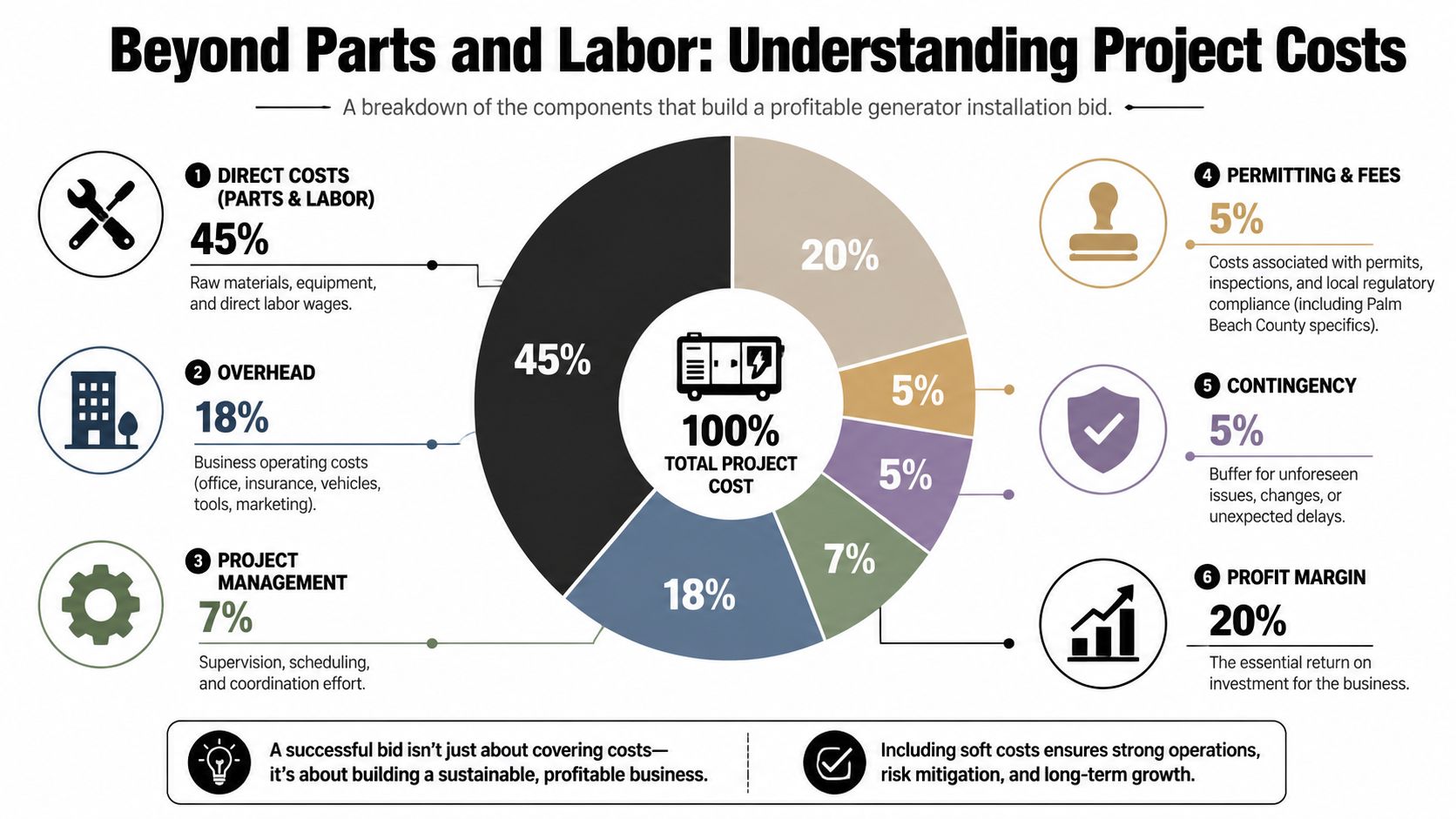
Palm Beach County changes the estimating conversation
Generator work isn't just material plus crew hours. You also need to carry the cost of office time, insurance, trucks, callbacks, permit handling, scheduling friction, and the overhead required to stay responsive when a storm line is on the radar.
On generator jobs, permitting isn't optional paperwork. In nearly all U.S. jurisdictions, connecting a generator to a home's electrical panel, specifically installing the automatic transfer switch and wiring it into the main panel, is classified as licensed electrical work and requires an electrical permit enforced by the AHJ. The same guidance explains that the permit process triggers a mandatory inspection and confirms safety requirements including correct placement at least 5 feet from doors, windows, and combustible walls and proper fuel line connections. That's outlined in this licensed generator installation permit overview.
For Palm Beach County work, your estimate should account for more than permit filing itself. Include the administrative handling, the inspection scheduling time, and the possibility that local site conditions or community requirements slow the release of the job. Even when the permit fee itself is passed through, the labor to manage compliance is yours unless you price it.
A practical pricing structure usually includes:
- Overhead recovery: Vehicles, office staff, insurance, phones, software, tools, training, and unbillable time.
- Project management time: Site verification, supplier coordination, permit handling, scheduling, inspection follow-up.
- Contingency: A reserve for site conditions you can reasonably foresee but not fully define at bid stage.
- Profit: Actual profit, not whatever is left if nothing goes wrong.
Service model is part of the bid
Many contractors frequently under-sell themselves. Homeowners in South Florida aren't only buying an install. They're buying response.
If your company answers the phone during urgent situations, keeps licensed professionals involved in scheduling and triage, or avoids extra after-hours charges, that isn't a marketing slogan. It's part of the operating model that must be built into pricing. One local example is Lighthouse Energy Services, which states that it offers true 24/7 availability and no extra charges for after-hours calls. If you choose that kind of service model, recover the cost inside your pricing strategy instead of hoping emergency volume covers it later. That's especially relevant for homeowners planning around hurricane backup generator installation in Florida.
The contractor who promises premium availability at discount pricing usually ends up delivering neither.
You also need a front office that can keep generator leads moving while crews stay in the field. For shops that need help handling inbound calls, scheduling, and lead capture, a virtual assistant for electricians can support the estimating pipeline. That only helps if your bid process is already disciplined, but it can reduce the drag that causes hot leads to cool off.
Don't apologize for profit. Profit is what pays for stocked trucks, trained labor, warranty support, and the second trip when the inspector wants a correction. The cheapest number on generator work often leaves no room for any of that.
Presenting the Proposal and Sealing the Deal
Most homeowners don't know how to compare generator proposals. That helps you if your proposal is clear. It hurts you if it looks like every other one-page quote.

Sell clarity not just equipment
A winning proposal reads like a professional plan, not a parts list. Keep it tight, but include enough detail that the customer understands what they're approving.
A strong proposal usually includes:
- Project summary: State the intended backup coverage in plain language.
- Detailed scope: List the electrical work, site work, permit handling, and commissioning steps.
- Exclusions: Say what isn't included so nobody fills in the blanks later.
- Price presentation: Show the total clearly. If you give options, make each option visibly distinct.
- Timeline and assumptions: Explain what depends on approvals, access, or coordination with others.
- Terms and warranty language: Keep it clean and readable.
The language matters. “Install generator system” is weak. “Provide permitted standby generator installation with transfer equipment, site placement review, startup, and final system verification” sounds like a contractor who knows what the job requires.
Homeowners relax when the proposal answers the questions they forgot to ask.
Handle price objections without cutting your legs off
When the client says your number is higher, don't race to discount. Ask what they're comparing.
If the lower bid doesn't spell out permit handling, restoration limits, startup, testing, or fuel coordination, you're not looking at the same scope. Walk the customer through that calmly. Most price objections aren't really price objections. They're comparison problems.
Use a simple response pattern:
- Acknowledge the concern: “I understand you're comparing totals.”
- Clarify the scope difference: “Our price includes the work needed to install, coordinate, and finish the system professionally.”
- Tie it to risk: “Generator jobs get expensive when details are left out at bid stage.”
- Offer options without gutting margin: Reduce scope if needed, not standards.
That last point matters. If the homeowner needs relief, offer a narrower backup package or phased work. Don't strip out the permit process, testing, or job management that keeps the installation legal and dependable.
Conclusion Building a Reputation One Accurate Bid at a Time
Generator work rewards contractors who think before they price. The money is made in the walkthrough, protected in the scope, sharpened in the estimate, and won in the proposal.
That's the accurate bidding blueprint for a licensed electrician generator install. Not lowballing. Not guessing. Not hoping the crew figures it out in the field. A good bid accounts for the panel, the placement, the fuel path, the permit burden, the testing, the customer's real expectations, and the service model behind the company name.
If you're training an estimator or tightening your own process, focus on three habits first:
- Inspect thoroughly
- Write scopes that remove ambiguity
- Price the business, not just the materials
Do that consistently and your close rate improves for the right reason. Customers trust the number because they can see what's in it. Your crews install from a plan instead of improvising. Your company keeps margin without playing games.
That kind of estimating doesn't just produce better jobs. It builds the reputation that keeps generator work coming back, season after season.
If you need a licensed team for generator installation, emergency electrical work, or hurricane-season readiness in Palm Beach County, Lighthouse Energy Services is available for residential and commercial projects with clear quoting, 24/7 response, and service handled by licensed electrical professionals.