
The lights flicker once, then go out. The Wi-Fi drops. The refrigerator goes quiet. In Wellington, that moment usually doesn't happen on a calm spring evening. It happens with a storm line moving in, the air heavy, and the forecast already talking about outages across Palm Beach County.
That's when homeowners start thinking past extension cords and portable fixes. They want a backup power system that starts automatically, carries the right loads, and survives the weather realities here. A proper home generator installation in Wellington, FL isn't just about buying a unit and setting it on a slab. It's about sizing, drainage, code clearances, fuel planning, electrical integration, and making sure the system will still perform after months of heat, humidity, and driving rain.
Table of Contents
- Sizing Your Generator for the Wellington Lifestyle
- Budgeting Your Generator Installation Costs
- Wellington Site Prep and Palm Beach County Permits
- What to Expect on Installation Day
- Hiring a Pro and Maintaining Hurricane Readiness
- Your Questions About Wellington Generator Installations Answered
Sizing Your Generator for the Wellington Lifestyle
A generator should match how you live during an outage. In Wellington, that often means more than a few lights and a refrigerator. Many homes need cooling, kitchen circuits, internet equipment for work, gate systems, well-chosen lighting, and sometimes a pool system or medical equipment.
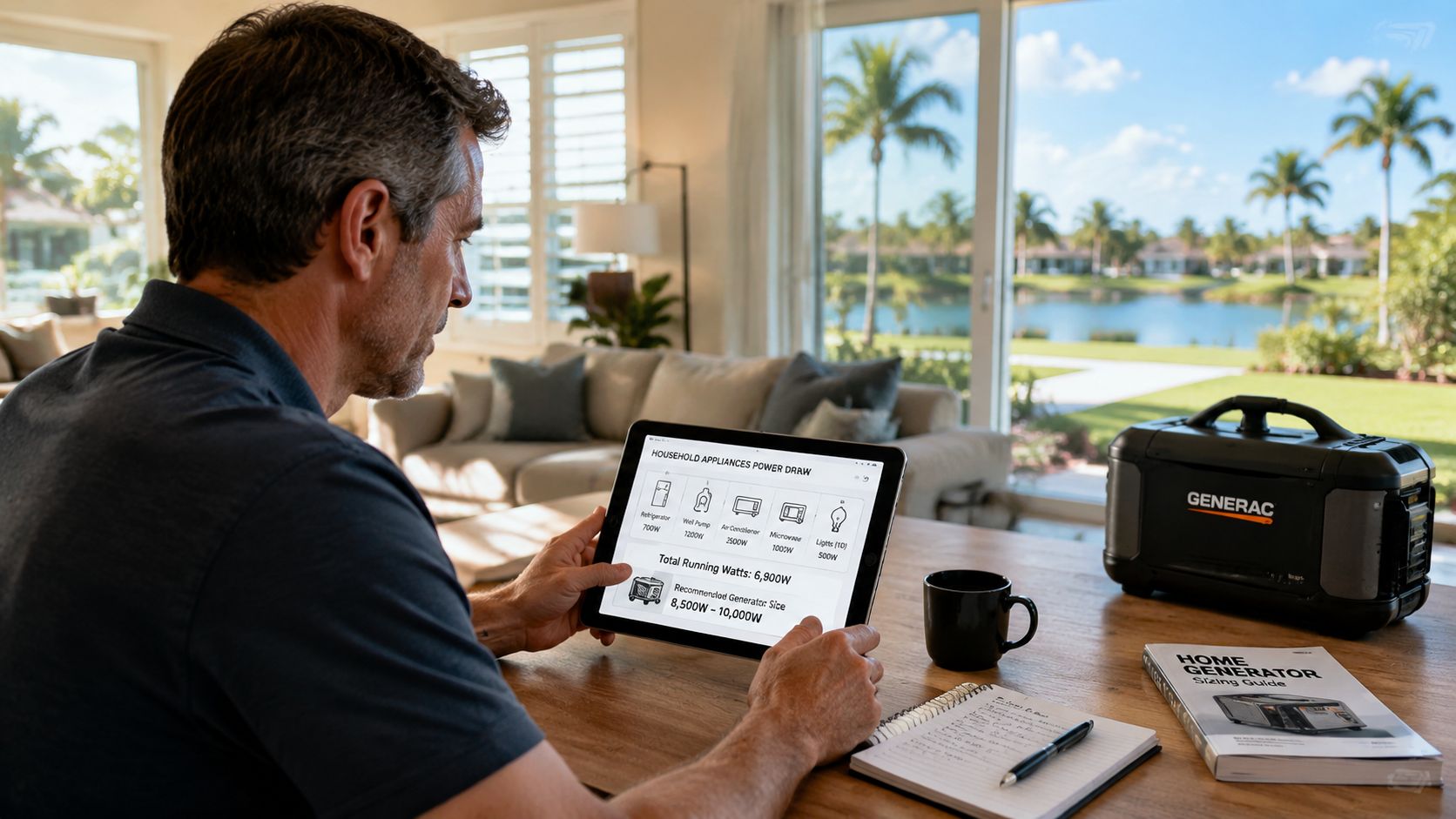
Start with the loads that matter
The cleanest way to size a system is to divide the house into three groups:
- Must stay on. Refrigerator, freezer, basic lighting, internet, security, garage door, and any medical or mobility-related equipment.
- Strongly preferred. One air conditioning system, kitchen circuits, laundry, water heater, home office, and a few convenience outlets.
- Nice to have. Pool pump, extra entertainment zones, secondary AC, and nonessential appliances.
That list tells you whether you need an essentials-only setup or true whole-home backup.
A smaller setup can make sense if your priority is preserving food, keeping a few rooms comfortable, and staying connected. A whole-home setup makes more sense when you want life to continue with very little interruption, especially if the home relies on central AC through long humid outages.
In Wellington, AC changes the conversation fast. A house that feels manageable without backup power for two hours can become miserable much longer than that. The same is true for larger homes with multiple refrigerated spaces, home offices, or families who work remotely.
Practical rule: Size for how you'll live on day two of an outage, not the first hour.
If you're unsure where your house lands, a detailed guide to sizing a home generator helps you think through essential loads versus full-home coverage.
Choose between portable and standby
Portable generators and standby generators solve different problems.
Portable units can help in short outages if you're comfortable managing cords, refueling, setup, and manual operation. They're a limited backup option, not one that functions automatically. They also won't give you the same automatic startup, transfer switching, or permanent integration with the home's electrical system.
Standby generators are permanently installed outside the house and tied into an automatic transfer switch. When utility power drops, the system detects it and starts the generator without you going outside in the rain. For homes in hurricane country, that convenience is really a safety feature.
A few practical trade-offs matter:
- Essentials-only mindset: A smaller standby system can be a smart middle ground if budget matters but you still want automatic power.
- Whole-home comfort: If you want AC, more circuits, and less lifestyle disruption, you'll need more capacity.
- Storm usability: Permanent standby systems are built around outage response. Portables depend much more on homeowner action at exactly the wrong time.
Pick the fuel source that fits your home
Most homeowners in this area end up deciding between natural gas and propane.
Natural gas is convenient where service is available because the generator can draw from the utility supply without the homeowner managing fuel deliveries. That simplicity is one reason many people prefer it for automatic standby systems.
Propane works well where natural gas isn't available or where the property layout favors a dedicated fuel supply. It gives flexibility, but it also means the tank size and refill planning matter more.
The practical decision usually comes down to:
- What utility service the property already has
- How much space is available for fuel equipment
- How long the homeowner wants to prepare for extended outages
- Whether the goal is selective backup or full-home support
For home generator installation in Wellington, FL, the best sizing job isn't the one that lands on the biggest machine. It's the one that matches real electrical demand, the home's fuel setup, and the level of comfort the family expects when the grid is down.
Budgeting Your Generator Installation Costs
Budget problems usually start before a homeowner signs the contract. A proposal can look reasonable until the line items for transfer equipment, gas work, permitting, delivery, startup, and site conditions show up. In Wellington, site conditions matter more than many online cost guides admit, especially on lots that hold water or sit in areas where drainage and elevation need closer attention.
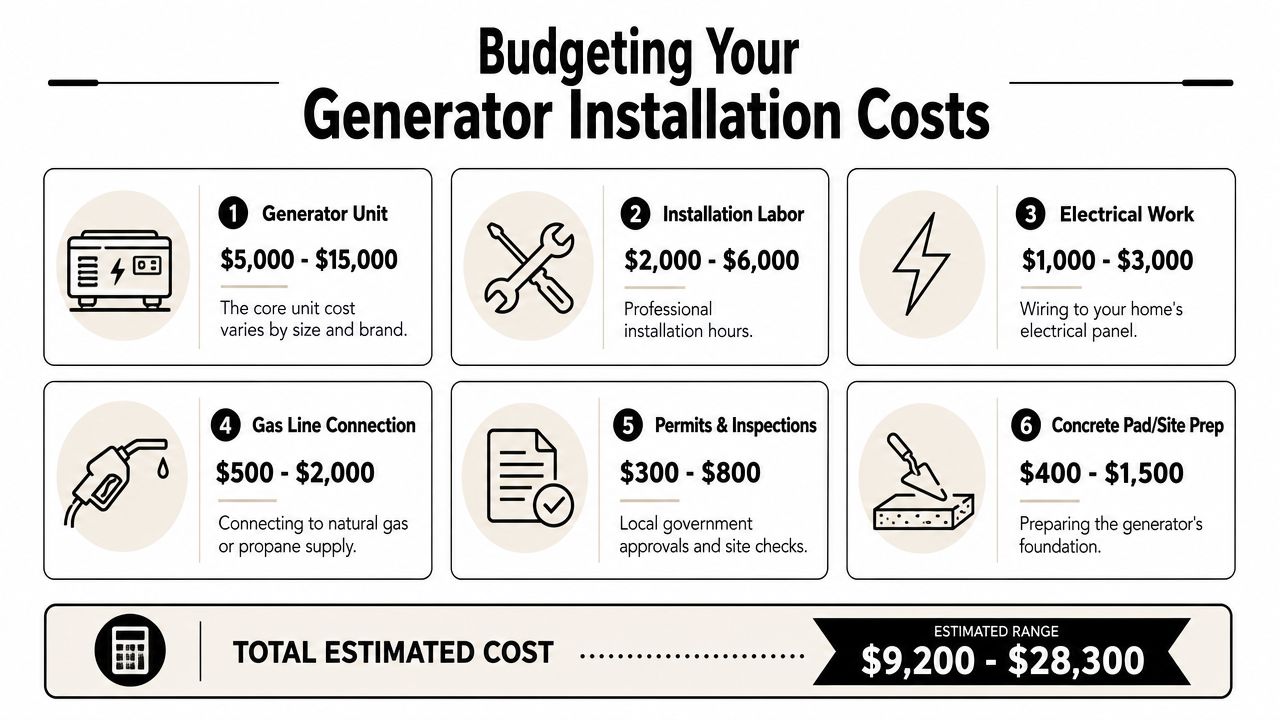
What the total budget usually includes
The generator itself is only one piece of the investment. Installed cost also covers electrical integration, fuel connection, labor, permits, startup, and the work required to create a stable, code-compliant location for the unit.
According to the Florida PACE generator cost overview, total project cost can range from about $3,000 for smaller 7 to 10 kW systems to more than $10,000 for 22 to 30+ kW units. The same source says installation labor often adds $2,000 to $6,000, mid-range 12 to 20 kW systems commonly fall between $5,000 and $10,000, and annual maintenance often runs $200 to $500.
Those numbers are useful for early planning, but they do not tell you what a specific Wellington property will require. A straightforward installation with clear access and existing fuel service lands in a different place than a job that needs trenching, panel upgrades, gas revisions, or extra drainage work under the generator location.
In this area, flood-zone-conscious site prep can change the budget in a legitimate way. Standard concrete-pad advice misses what we run into on Palm Beach County properties. Some homes need a better base, pea gravel for drainage, elevation adjustments, or a layout that keeps the generator out of standing water after heavy summer rain.
Estimated Home Generator Costs in Wellington 2026
| System Size (kW) | Ideal For | Estimated Total Cost (Installed) |
|---|---|---|
| 7–10 kW | Smaller essential-load backup | Around $3,000 and up, based on local entry-level pricing |
| 12–20 kW | Mid-sized homes with multiple essential systems | $5,000 to $10,000, based on commonly cited installed ranges |
| 22–30+ kW | Whole-home coverage including larger loads | Over $10,000, based on larger standby system pricing |
A more detailed look at whole-house generator installation cost factors can help you separate equipment pricing from labor, permitting, and property-specific conditions.
Budget for the system you will trust during a week of bad weather, not the one that only looks inexpensive on a sales sheet.
How financing changes the decision
For many Wellington homeowners, the hard part is not deciding whether backup power makes sense. The hard part is paying for the full job at once, especially if the house also needs fuel work or site correction to support a reliable installation.
Financing can make a properly scoped project possible without cutting the parts that keep the system dependable. That includes the transfer setup, the permitting path, and the base preparation that protects the unit in South Florida weather.
Keep these budget categories separate when you compare proposals:
- Equipment cost: Generator size and transfer equipment
- Installation labor: Electrical work, fuel connection, startup, and testing
- Site work: Pad or base preparation, drainage measures, access issues, and placement adjustments
- Permits and inspections: Local review and final approvals
- Ongoing service: Annual maintenance to keep the unit ready for storm season
Annual maintenance is a necessary part of the ownership cost.
A low number on the front page does not always mean a lower total cost. If a bid leaves out drainage, assumes an easy fuel tie-in, or treats a wet Wellington lot like a dry inland property, the price can change fast once the job is underway.
Wellington Site Prep and Palm Beach County Permits
A generator can be sized correctly, priced correctly, and still become a problem if the site work is wrong. In Wellington, I see more trouble from wet ground, poor drainage, and rushed permitting than from the generator itself.
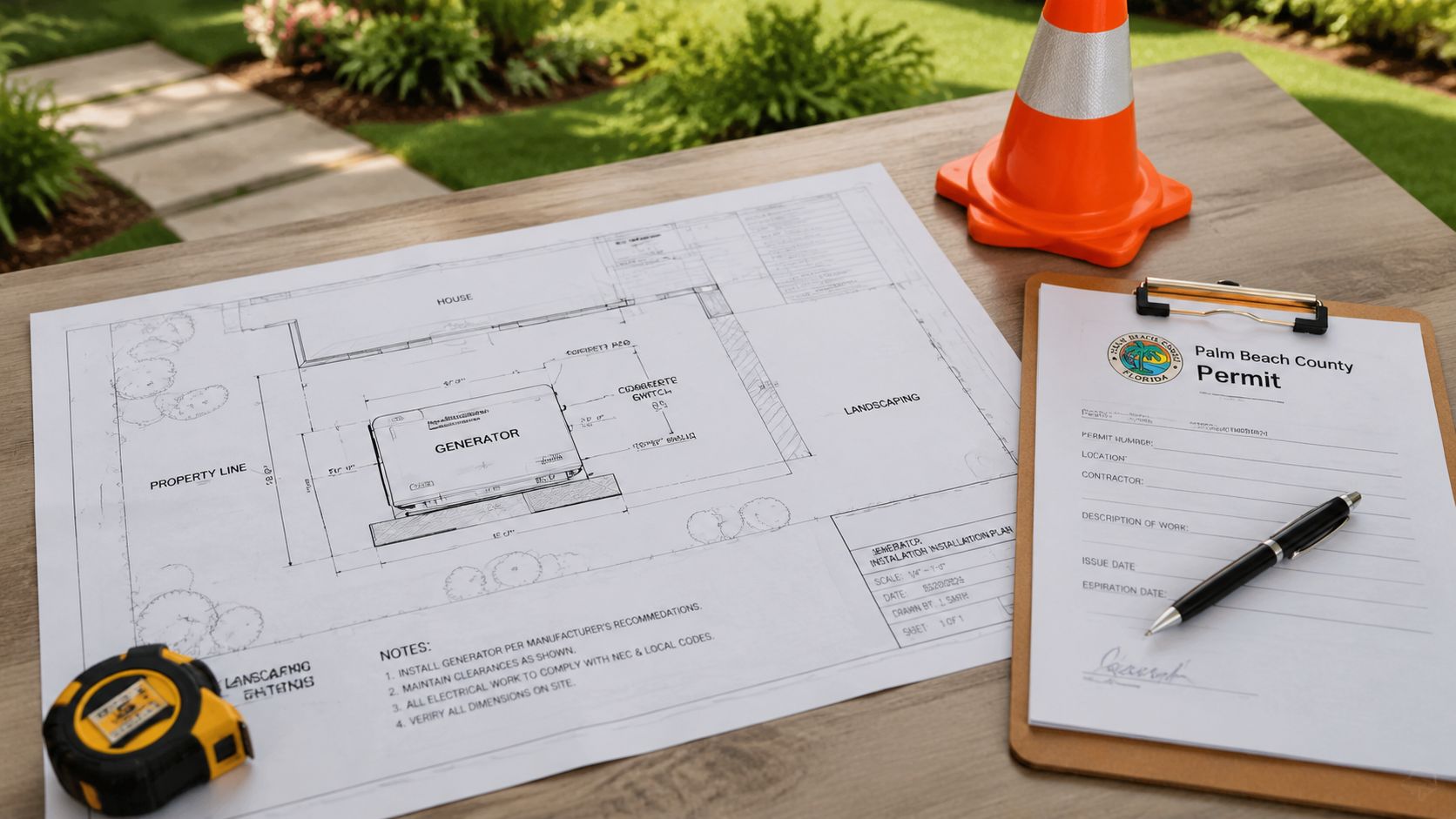
Permits need to start early
Palm Beach County generator projects usually involve more than one approval path. The electrical scope has to be reviewed. Fuel gas may need its own review. The placement has to satisfy clearance and safety rules before the inspector ever looks at the finished job.
That process matters because permit drawings force definitive decisions upfront. The plan has to show where the unit will sit, how it will be supplied, and whether the location can pass inspection without changes in the field. If those details are vague, the job slows down fast. Homeowners end up paying for revisions, relocation, or extra site work that could have been identified earlier.
Good permit preparation also protects the homeowner. It reduces the chance of setting a generator in a spot that later fails clearance, drainage, or access requirements.
Why Wellington site prep is different
Standard advice often says to pour a concrete pad and move on. On many Wellington properties, that is incomplete advice.
A lot here depends on grade, drainage, and whether the equipment area stays wet after heavy rain. On lower lots or flood-prone sections of the property, a flat slab alone can leave the unit sitting in moisture or surrounded by runoff. Over time, that can lead to settling, corrosion, mud around the service side, and a base that no longer drains the way it should.
That is why flood-zone-compliant site preparation matters. In the right conditions, a raised base, a precast platform, or a pea gravel bed with proper drainage control is the better choice than a simple poured pad. The goal is not just to hold the generator level on day one. The goal is to keep it stable and serviceable through wet season conditions in Palm Beach County.
Homeowners who are planning for storms should review the bigger picture of Florida hurricane backup generator installation before the site is finalized, because storm readiness starts with where and how the unit is set.
A generator base that works on a dry inland lot can fail early on a wet Wellington property.
Placement rules that affect safety and service access
Once the base design is right, the location still has to work in real life. Exhaust has to be kept away from doors, windows, and other openings. The unit also needs working room for airflow, service, and safe shutdown or repair.
I tell homeowners to look past the empty yard they see today. Shrubs grow. Fences get added. Drainage patterns change after landscaping. A spot that looks fine during a sales visit can become hard to service or hard to approve if nobody accounts for those changes.
Before the pad or gravel base is set, the layout should answer a few practical questions:
- Will water move away from the unit after a hard rain?
- Are doors, windows, vents, and property features far enough away for safe placement?
- Can a technician open the cabinet and service both sides without fighting walls, fencing, or plants?
- Will the generator still be accessible during storm prep, not just on a clear day?
The best Wellington installations are planned for inspection, weather, and maintenance at the same time. That is what keeps the system reliable years after the permit is closed.
What to Expect on Installation Day
A good installation day in Wellington usually starts before the truck pulls up. The layout has already been approved, the permit path is in place, and the crew arrives knowing where the unit sits, how the wiring will run, and how the fuel connection will be made. That preparation is what keeps the job orderly when the weather is hot, the yard is soft, or afternoon rain shows up halfway through the work.
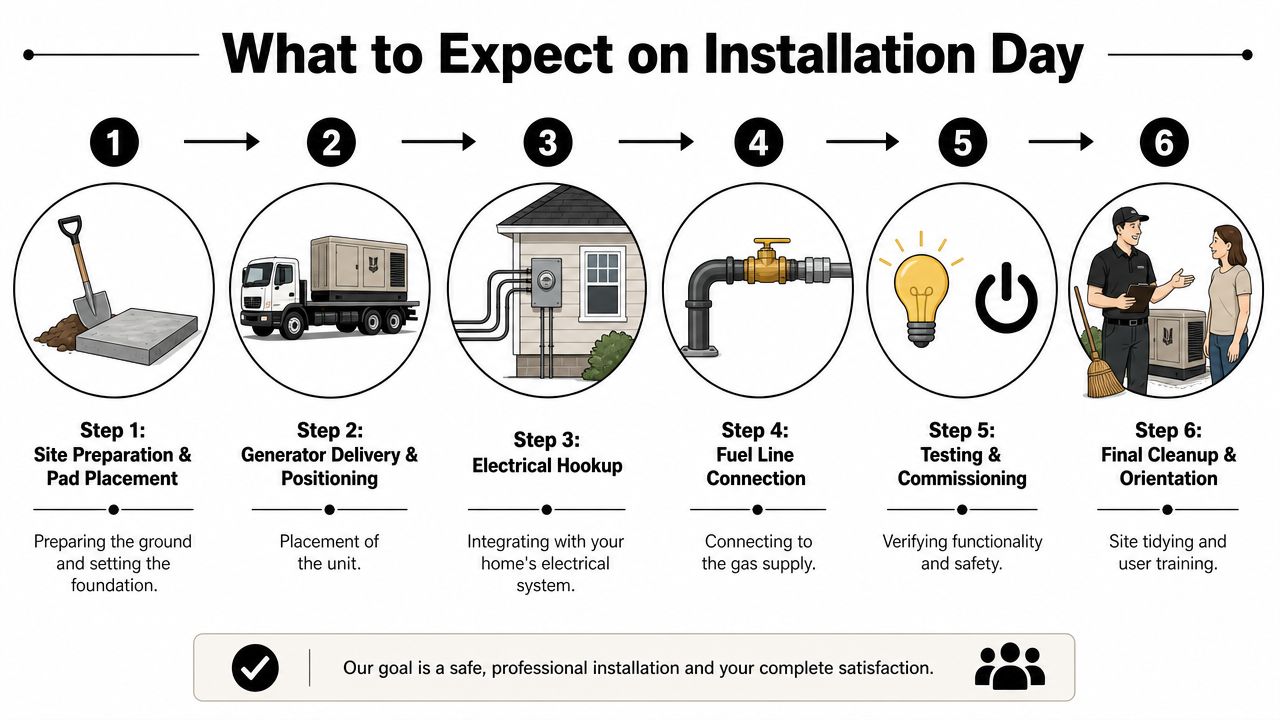
The crew starts with protection for the property and the system
The first hour is usually outside. Utility locations are verified before any digging starts, and the crew confirms that the approved placement still makes sense in the field. On Wellington properties, that check matters. A spot that looked fine on paper can hold water after a hard rain, and a generator that sits low or traps runoff will give trouble long after installation day.
If the base was prepared earlier, the crew checks level, drainage, and final elevation before setting the unit. If the property needs flood-zone-conscious support, the goal is not just a flat surface. The goal is a stable, well-drained base that does not leave the generator sitting in pooled water. On some lots, that means a raised pad approach. On others, it means a properly prepared pea gravel bed with controlled runoff around the equipment.
Once the generator is placed, clearances are verified again for safe exhaust, service access, and inspection approval.
Electrical work and fuel piping are coordinated, not rushed
After the unit is set, the electrical and fuel trades work in a defined sequence. The electrician handles the transfer equipment and ties the generator into the home's electrical system so utility power and generator power are isolated the way code requires. That is what allows the house to change over safely during an outage.
At the same time, the fuel connection is routed and secured based on the approved design. Good installations allow for equipment vibration and future service access. Fuel piping should not be forced into position or left under stress. If I see a crew fighting alignment to make a connection work, that is a warning sign.
Homeowners usually notice the pace here. Careful crews spend time checking terminations, conductor routing, bonding, and fuel tightness before they ever try to start the unit.
Startup testing is where the real quality shows
A generator is not finished because it is sitting on a pad and wired in.
The last part of the day is commissioning. The system is started, operating conditions are checked, and an outage is simulated so the generator can prove it will pick up the selected loads and transfer properly. That test should be controlled and deliberate. It should also include enough time to catch problems such as nuisance faults, transfer issues, abnormal vibration, or operating alarms.
I tell homeowners to pay attention to this part. If the contractor does not run the unit through an actual transfer test, you do not know how the system will behave when Florida weather takes the grid down.
A proper handoff usually includes:
- Owner walkthrough: what normal startup and shutdown sound like, what the status lights mean, and when to call for service
- Basic operating guidance: how the automatic transfer works and what to expect during a real outage
- Cleanup and closeout: removed packaging, safe trench and conduit conditions, and a site left ready for inspection or final approval
On a well-run job, installation day feels controlled from start to finish. That matters in Wellington, where moisture, drainage, and code compliance can shorten equipment life fast if the last details are treated like small details.
Hiring a Pro and Maintaining Hurricane Readiness
A Wellington homeowner usually finds out whether a generator was installed properly at the worst possible time. The lights drop, the wind is up, the yard is saturated, and the unit has to start after sitting dormant for weeks or months. That is why contractor selection matters as much as the brand on the nameplate.
In this part of Palm Beach County, I tell homeowners to look past sales language and focus on process. A qualified installer should be licensed, should pull permits, should understand utility and gas coordination, and should know how local drainage conditions affect long-term reliability. In Wellington, flood-zone-compliant site prep matters. A generator set on the wrong base, or surrounded by water after a summer storm, can have a much shorter service life than the homeowner expected.
What a qualified installer should handle
A good generator contractor does more than set equipment and connect wires. The job includes load planning, code-compliant placement, transfer equipment setup, fuel coordination, startup testing, and a site review after heavy rain concerns are considered.
That last point gets missed in generic advice.
Standard concrete pad talk does not address what we often deal with here. In low-lying areas or lots with poor drainage, the installer may need to build the site with proper elevation, a pea gravel bed, and a path for water to move away from the unit instead of collecting around it. If that detail is ignored, the generator may still pass a startup test and still become a problem later.
Maintenance is part of ownership
Annual maintenance is an integral part of the ownership cost.
Standby generators are designed to wait in the background, but they are still engines and electrical systems. They need periodic inspection, exercise review, battery checks, filter and fluid service when applicable, and confirmation that the transfer equipment and controls are operating normally. As noted earlier in the article, homeowners should budget for ongoing service, not just installation day.
Good maintenance is quiet, routine work. That is exactly what keeps storm-week problems from becoming emergency calls.
Staying ready for hurricane season
Hurricane readiness is not only about the generator itself. It is also about the condition of the site around it and the paperwork tied to the property. If a storm damages the home before or after backup power is installed, understanding the process for securing fair hurricane insurance payout helps homeowners think through recovery from more than one angle.
Before storm season, homeowners should:
- Keep clearance open: Do not let plants, storage bins, or new fencing crowd the unit.
- Watch drainage after hard rain: If water ponds near the base, correct it before the next storm cycle.
- Schedule service early: The week a named storm enters the forecast is the hardest time to get prompt maintenance.
- Know what normal looks and sounds like: Familiar status lights, exercise cycles, and startup sounds make problems easier to catch.
- Store records where they are easy to find: Permit paperwork, manuals, warranty information, and service history should not be buried in a closet during an outage.
A dependable standby system comes from two things. Careful installation by a contractor who understands Wellington conditions, and regular maintenance that keeps the unit ready for the day the grid does not cooperate.
Your Questions About Wellington Generator Installations Answered
A generator project usually starts as an electrical decision, but it quickly touches comfort, property rules, and storm recovery planning.
How loud is a standby generator
Most homeowners find that a standby unit is noticeable but not surprising once they've heard one operate properly. Sound perception depends on where the unit sits, how sound reflects off nearby walls, and whether landscaping traps or disperses noise. Placement matters as much as the machine itself. That's another reason site planning shouldn't be treated as an afterthought.
What if your neighborhood has an HOA
Start early and submit clear placement information. HOAs usually care about location, appearance, visibility from the street, and how the equipment fits within the property layout. A clean site plan and a realistic explanation of why the generator is needed can make review easier. If a storm damages the property before your power strategy is fully in place, understanding the process for securing fair hurricane insurance payout can also help you think more broadly about recovery, not just backup power.
How long can a standby generator run
That depends on the fuel source, the size of the connected fuel supply, and how much electrical load the house is demanding during the outage. Homes on natural gas often value the convenience of an ongoing utility feed. Homes on propane need a realistic plan around tank capacity and refill logistics. The practical takeaway is simple. Runtime is never just a generator question. It's a fuel-planning question too.
A well-planned home generator installation in Wellington, FL gives you more than backup power. It gives you a system that fits the property, respects local conditions, and performs the way you expect when weather turns bad.
If you want a licensed team to handle generator planning, code-compliant installation, and storm-ready electrical work in Palm Beach County, contact Lighthouse Energy Services. Their team has served the area since 2005, offers true 24/7 availability, and answers the phone with licensed electrical professionals who understand what reliable backup power requires.