
The call usually comes in the same way. A dock light has gone dark, the panel smells hot, or a breaker keeps tripping after a salty rain and nobody wants to touch it again. On a waterfront property, that's not just a nuisance. Moisture, corrosion, and bonding problems can turn a small fault into a shut-down dock, a damaged service panel, or a shock risk fast, which is why waterfront property electrical contractors have to think differently from inland service crews.
Table of Contents
- Understanding Waterfront Electrical Emergencies
- The First 10 Minutes of an Electrical Emergency
- Handling Electrical Fires and Shock Incidents
- Lockout and Tagout Basics for Property Managers
- Why Preventive Maintenance Beats Repeat Emergencies
- Matching Response Plans to Property Type
- Incident Reporting and Post-Event Follow-Through
Understanding Waterfront Electrical Emergencies
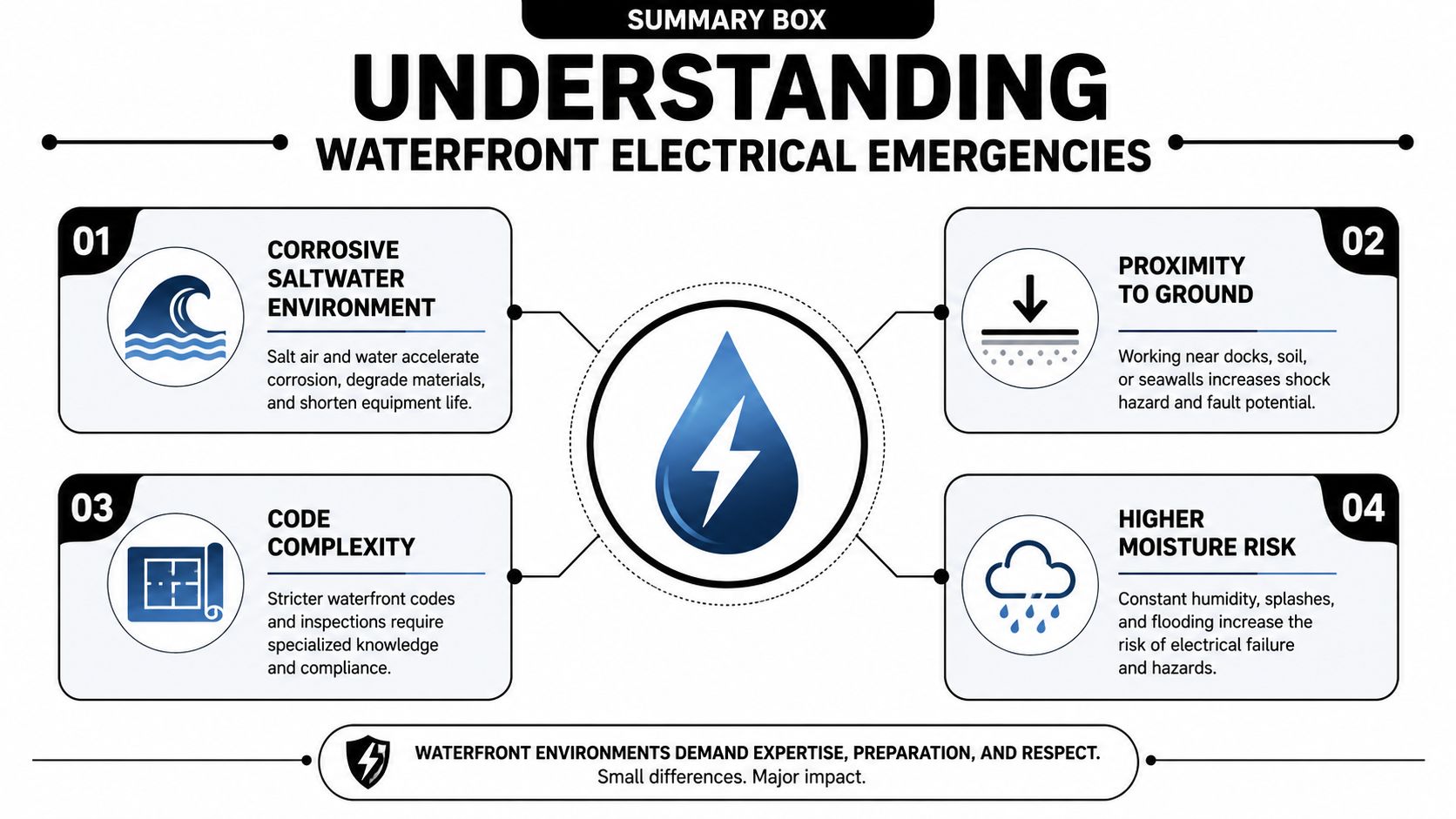
A dock call can look minor from a distance. A homeowner sees one dead pedestal light, an HOA manager gets a report of a tripped dock breaker, or a marina operator notices flickering at the end of a pier. Then the crew opens the enclosure and finds salt film, green corrosion, loose terminations, or moisture where it doesn't belong. That's the point where waterfront work stops being a standard troubleshooting job and becomes a condition-based repair.
Why waterfront faults escalate differently
Salt air, humidity, spray, and constant condensation change how equipment ages. A breaker that would survive for years inland may start acting up sooner on a dock because terminals, housings, and bonding hardware face a harsher environment every day. That's one reason a waterfront owner shouldn't treat repeated nuisance trips as random luck.
Practical rule: if the same circuit trips more than once on a waterfront site, assume the system is telling you something about corrosion, moisture intrusion, or a load problem until a licensed electrician proves otherwise.
Emergencies that threaten people or property right now require immediate attention. Arcing, smoke, burning odor, a hot panel, standing water near energized gear, or loss of power to a critical dock function all demand urgent action. A single dark light or a noncritical outlet issue can usually wait for a scheduled visit, but a live fault near water cannot.
The Bureau of Labor Statistics counted 712,580 electricians in May 2023, with a mean annual wage of $67,810 and mean hourly wage of $32.60; the Occupational Outlook Handbook projects 9% employment growth from 2024 to 2034 with about 81,000 openings per year on average, which fits a market where responsive licensed help stays in demand BLS occupational employment data. On waterfront sites, that demand is even more specialized because the contractor isn't just chasing a bad outlet, they're handling a wet, corrosion-prone system with code-sensitive exposure points.
The First 10 Minutes of an Electrical Emergency
The first minute matters more than the first diagnosis. If someone is standing in a flooded dock area, if a panel is sparking, or if you can smell burning insulation, the goal is to keep people back and keep the situation from getting worse. The right move is usually restraint, not improvisation.
Minute one through three, protect people first
If there's standing water near live equipment, no one should wade in to “check it.” If a circuit is smoking or arcing, stay clear of the panel and keep others away. A waterfront property often tempts people to reach for a breaker box on a wet wall or in a tight service space, but that's exactly where hesitation pays off.
If the main breaker is safely accessible from a dry location, and you can reach it without crossing a hazard zone, shut it off. If you can't do that safely, stop there and wait for the licensed electrician. The right question is not “Can I fix it myself?” The right question is “Can I isolate it without putting anyone at risk?”
Minute four through ten, call with useful details
When you call, give the dispatcher the location, whether water is present, whether there's smoke or odor, and whether the problem is at the dock, the main panel, or a feeder. That helps the truck arrive with the right parts and the right expectations. A waterfront emergency rarely gets solved with a vague “power issue” description.
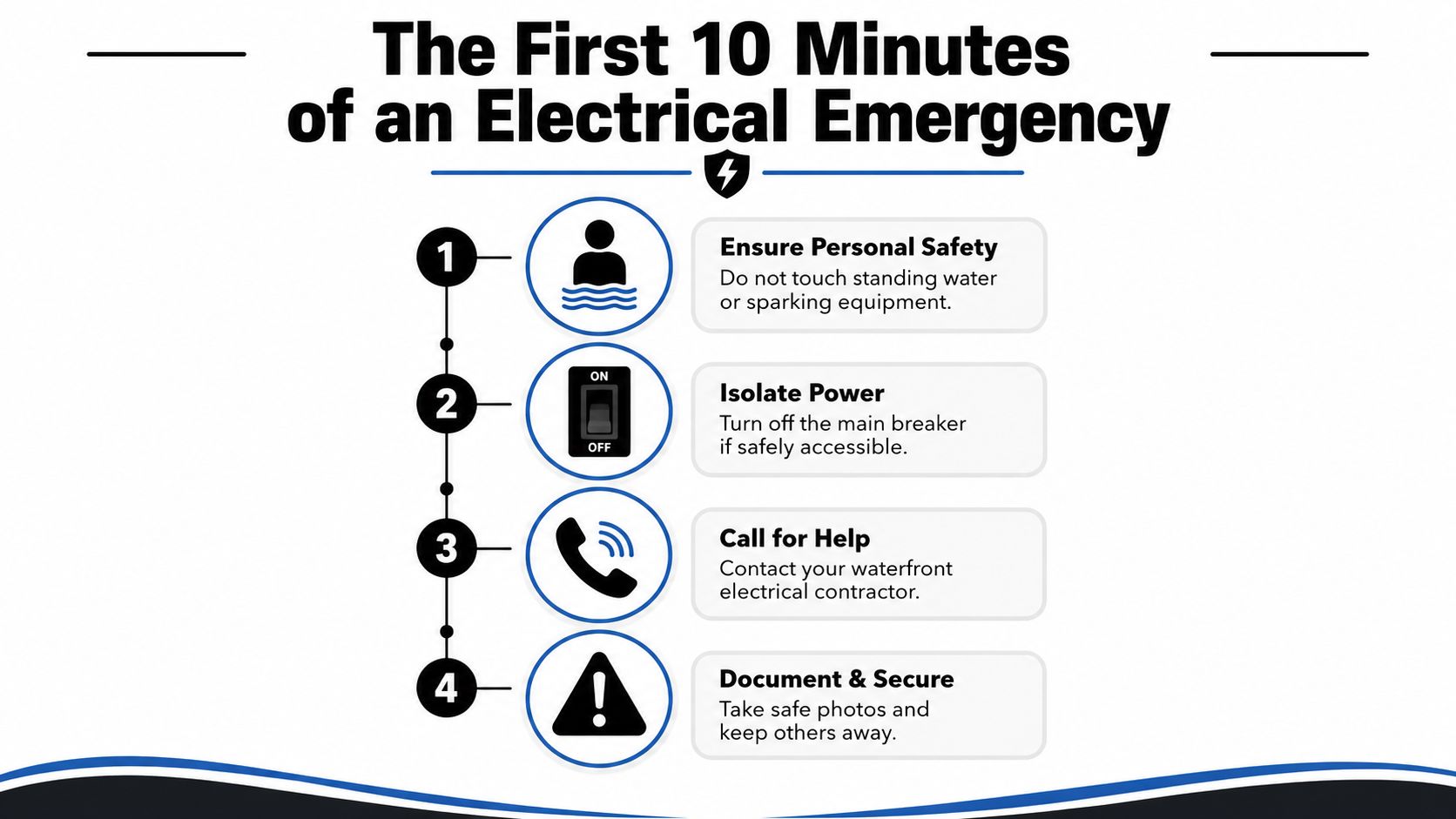
Keep people out of the area, take safe photos only if there's no risk, and don't restore power just to see whether the fault went away.
Document what you can without touching anything. If the condition changed after rain, tide, or a generator transfer, say that plainly. Waterfront faults often depend on moisture intrusion or deteriorated connections, so those details help the contractor narrow the cause before the van even pulls up.
Handling Electrical Fires and Shock Incidents
A small contained electrical fire and an active shock event are not the same problem. In both cases, distance is your friend. If a panel is smoking, hissing, or hot to the touch, don't open it. Don't spray water on it, don't lean over it, and don't let anyone stand in pooled water nearby.
For a small electrical fire that is clearly contained and you can reach safely, use the correct extinguisher class for electrical equipment. For a larger fire, any fire that is spreading, or any fire near live water-exposed gear, leave the area and call emergency services first. A property owner should never trade a controllable moment for a bad injury.
If someone has been shocked, don't touch them if they may still be in contact with the live source. Shut off power only if you can do it safely, then call 911 immediately if the person is unresponsive, having trouble breathing, or burned. After that, call the licensed electrician. Shock incidents are medical incidents first.
For fire suppression products designed around electrical hazards, it helps to know what a water-safe response system looks like before you ever need one. A practical place to start is to browse Fire Quit products and understand the role these tools can play in a dry, Class C context.
If the equipment is arcing, smoking, or making a snapping sound, treat it like an active fault, not a nuisance issue.
The boundary is simple. Owners can isolate the area, call for help, and keep others clear. The electrician handles diagnosis, repair, verification, and re-energization once the system is safe to test again.
Lockout and Tagout Basics for Property Managers
Property managers and marina operators need a repeatable shutdown process, especially when multiple tenants, slips, or common-area systems are tied to one source. Lockout and tagout, or LOTO, exists to stop someone from re-energizing a circuit while another person is still working on it. That matters on docks, in marina service rooms, in rooftop lighting circuits, and in equipment rooms where one panel can feed more than one zone.
A workable in-house primer
Start by identifying every energy source tied to the equipment. Then notify everyone who could be affected, because the biggest LOTO failure is an unannounced shutdown that gets reversed by someone who thinks it was accidental. After that, apply the lock, attach the tag, and verify that the equipment is dead before anyone starts work.
A safety program only works if staff can use it under pressure. For organizations that need a broader framework around training and documentation, health safety management systems are a useful reference point for building the procedures, records, and accountability that keep repeated mistakes from becoming routine.
| Step | What to do | Waterfront example |
|---|---|---|
| Identify | Find all power sources | Shore power, marina service room, rooftop circuit |
| Notify | Tell affected people | Tenants, slip holders, maintenance staff |
| Lock | Prevent re-energizing | Personal lock on the disconnect |
| Tag | Mark the reason | “Do not energize, dock maintenance in progress” |
| Verify | Prove zero energy | Test before touching conductors |
Verify before servicing. A lock without a verification step is a half-measure.
For managers who need a broader workplace checklist, the internal guide on preventing electrical hazards in the workplace fits well with dock shutdown planning. Use it for the training side, then keep the waterfront-specific steps focused on access control, tenant notice, and zero-energy verification.
Why Preventive Maintenance Beats Repeat Emergencies
Waterfront equipment fails in patterns. Salt creep gets into enclosures. Humidity weakens terminations. Corrosion attacks bonding hardware and connectors. Once one part of the system starts going, the next weak point usually isn't far behind, which is why emergency calls tend to repeat around the same assets.
NECA's systems-integration guidance treats each job as a staged process, with review, installation, startup verification, individual testing, and integrated testing handled in order because defects often show up late if nobody documents each handoff NECA systems-integration white paper.pdf?sfvrsn=5af2c18_5). On waterfront properties, that logic matters because a “fixed” panel can still hide loose bonding, compromised controls, or a connector that will fail again after the next wet cycle.
What recurring service should target
A waterfront maintenance plan should focus on the parts that fail before they fail loudly. Torque checks on terminations, thermal imaging of panels, replacement of corroded connectors, inspection of GFCI protection on dock circuits, and attention to sacrificial components all belong in the plan. The point isn't to over-service good equipment. It's to catch the exact defects that keep generating service calls.
| Asset | Residential | HOA/Marina | Commercial/Industrial |
|---|---|---|---|
| Dock pedestals | Visual inspection, GFCI test | Scheduled checks, labeling review | Load and enclosure review |
| Panels and breakers | Corrosion check, torque review | Thermal scan, signage, access control | Infrared scan, preventive correction |
| Bonding hardware | Inspect for looseness or rust | Replace degraded hardware | Documented integrity checks |
| Lighting circuits | Verify function and weather sealing | Common-area outage plan | Emergency lighting continuity |
For a maintenance-program mindset, Constructive-IT maintenance programs are a helpful reminder that scheduled service is about controlled failure prevention, not busywork. On the internal side, the home electrical inspection checklist is a practical companion for owners who want a documented review before the next storm, tide change, or occupancy surge.
A modest maintenance contract usually costs less than the friction of repeated emergency dispatches, especially when access issues, corrosion, and after-hours labor all show up on the same job.
One useful way to think about the budget is this. Emergency work pays for urgency, uncertainty, and disruption. Preventive work pays for inspection, correction, and predictability.
Matching Response Plans to Property Type
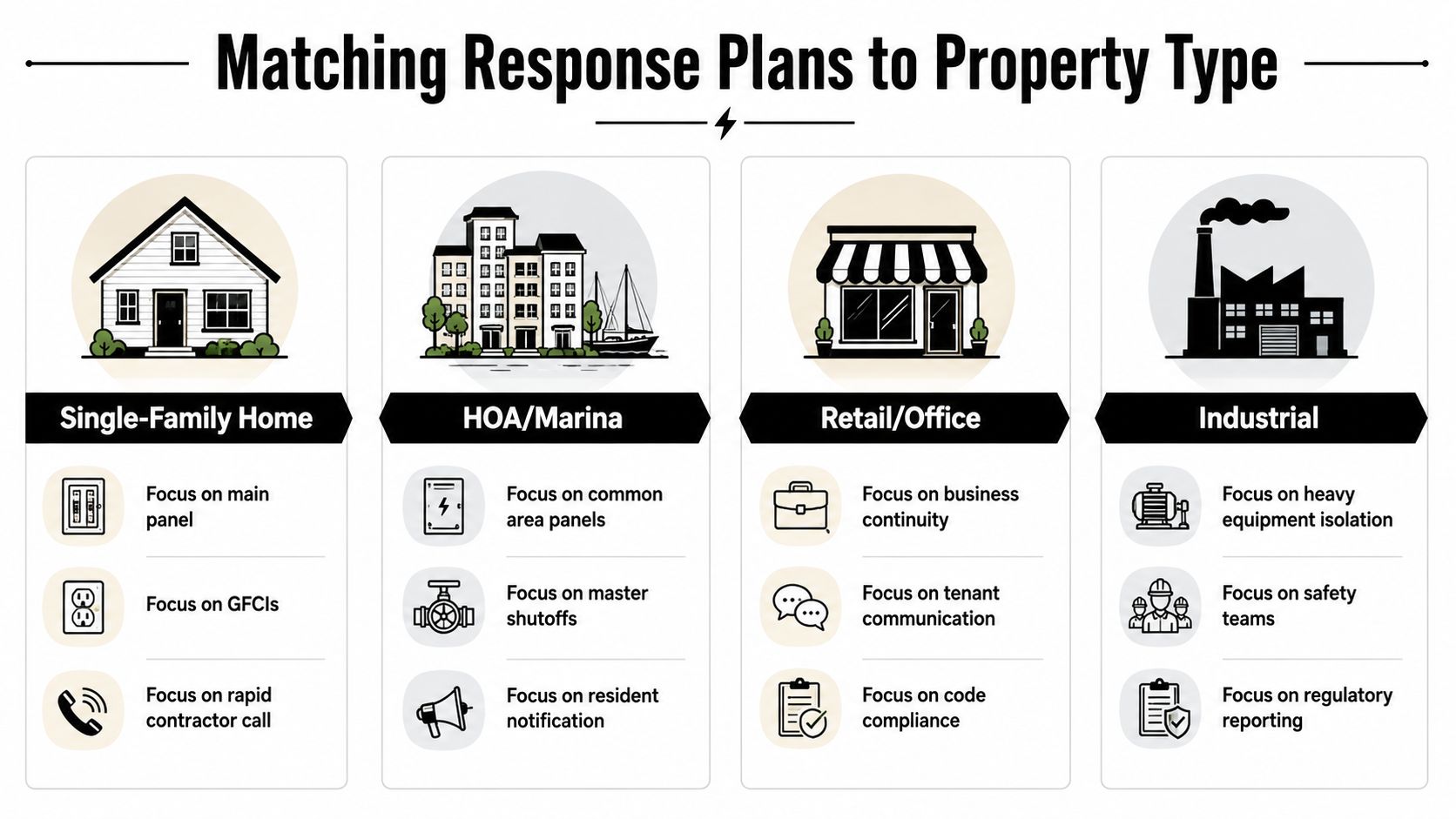
A single-family dock, a marina, and a warehouse by the water do not need the same response stack. The fault may be similar, but the shutdown consequences are different. A homeowner needs quick isolation and a clear contractor call. An HOA needs a plan that can cut a dock section without taking out upland residents. A commercial or industrial site needs continuity planning and code compliance layered on top.
What each property type should prioritize
| Component | Residential | HOA/Marina | Commercial | Industrial |
|---|---|---|---|---|
| Main isolation | Fast access | Zone-level shutoff | Building continuity plan | Equipment-by-equipment isolation |
| Notification | Family, guests | Residents, slip holders | Tenants, staff | Safety team, operations |
| Critical circuits | GFCIs, dock lights | Common-area lighting, pedestals | Life safety, access control | Heavy equipment, controls |
| Contractor response | Rapid dispatch | Scheduled and emergency coverage | After-hours coverage | High-capacity troubleshooting |
The internal page on marina electric is a natural fit for dock-heavy properties because the response problem there is usually broader than one fixture. It's about pedestals, feeder paths, and service rooms that have to stay dependable while exposed to weather and salt.
For retail and office buildings, tenant communication matters as much as the repair. For industrial sites, a fault can involve three-phase loads or a control system, so the response plan has to include the right people on the first call. On every waterfront property, the shared essentials are the same, clear access, clean labels, documented shutoffs, and a licensed electrician who can arrive ready to test, isolate, and restore.
Incident Reporting and Post-Event Follow-Through
After the site is safe, the paperwork becomes the next layer of protection. The responding contractor will usually want the location of the fault, what was operating when it happened, whether water was present, whether anyone smelled burning, and what was already shut off. If staff can answer those questions clearly, diagnosis moves faster.
Keep an incident log with the date, time, weather, observed symptoms, the names of anyone who responded, and whether the area was locked out before service. Add photos only if they were taken safely. Insurers usually care less about dramatic detail and more about clean documentation, a written cause-of-failure summary, and proof that the system wasn't re-energized before verification.
Before the repair closes out, ask for a written note on what failed and what should be watched next. That matters on waterfront properties because corrosion-related issues often have a pattern, not a one-off cause. If the contractor recommends follow-up testing or replacement of vulnerable parts, treat that as part of the repair record, not optional advice.
A good post-incident note tells the next technician what changed, what was found, and what still needs attention.
Most owners want two practical answers after an emergency. They want to know how quickly a 24/7 technician can arrive, and whether after-hours service costs more. The answer depends on dispatch load, location, and the urgency of the fault, but a property that already has a maintenance plan and clean documentation usually gets to resolution faster because the contractor is not starting from zero.
When the next waterfront fault shows up, Lighthouse Energy Services can help with emergency diagnostics, licensed repairs, and documented follow-up for residential, commercial, and marina-related electrical work. If you're managing a dock, a coastal building, or a waterfront home and want a calmer response plan before the next problem hits, visit Lighthouse Energy Services and set up the kind of support that makes the next call easier to handle.