
Between 2011 and 2024, overhead power line contact caused 42.8% of all 1,654 workplace electrical fatalities, and 70% of workplace electrical fatalities happened in non-electrical occupations according to ESFI workplace electrical fatality data. That should change how every property manager, plant supervisor, and business owner thinks about electrical safety.
Electrical danger doesn't stay inside a panelboard. It reaches loading docks, rooftops, parking lots, maintenance rooms, warehouses, HVAC platforms, and anywhere a worker uses temporary power, metal ladders, boom lifts, or extension cords. In Palm Beach County, add humidity, salt air, driving rain, storm cleanup, and urgent after-hours repairs, and small problems get ugly fast.
On commercial and industrial sites, the failures that hurt people are usually predictable. A breaker keeps tripping, so someone resets it without finding the cause. A cord jacket is split, but it still "works." A panel is blocked by storage because the room got crowded. A lift operator focuses on the task and forgets to look up. A maintenance employee gets asked to handle something that should've gone to a qualified electrician. That's how close calls become emergencies.
If you want to know how to prevent electrical hazards in the workplace, start with a hard truth. Safety isn't a binder on a shelf. It's the daily habit of finding risk early, shutting work down when conditions aren't right, and fixing root causes instead of working around them.
Why Electrical Safety Is Non-Negotiable for Your Business
Electrical incidents do not stay contained to the electrical room. They spread into operations, staffing, tenant relations, equipment life, and liability. On a commercial property, one bad decision around power can injure a worker, shut down a refrigeration rack, trip a production line, or leave part of a building offline during business hours.
I see the same management mistake across retail centers, warehouses, HOAs, medical offices, and light industrial sites in Palm Beach County. Electrical safety gets treated as a paperwork issue instead of an operating standard. Training gets signed off. A few warning decals go up. Then day-to-day shortcuts take over, especially during storm recovery, tenant buildouts, and after-hours service calls when people feel pressure to get something running fast.
Facility leaders set the risk level.
If supervisors allow blocked panel access, extension cords to become long-term wiring, rooftop disconnects to sit in poor condition, or unqualified staff to open live equipment, the property is already exposed. In South Florida, humidity, salt air, wind-driven rain, and corrosion speed up failures that might take longer to show up in other regions. A loose connection in a damp enclosure is not a minor defect. It is the kind of condition that turns into heat, arcing, nuisance outages, and emergency service.
That is also why repeated breaker trips should never be brushed off as an inconvenience. A breaker that keeps opening is usually telling you something is overloaded, failing, shorting, or misapplied. Property teams that keep resetting without finding the cause often turn a controllable problem into damaged equipment or an injury. We see that pattern often enough that we put together a practical guide to what repeated breaker trips usually mean and how to address them.
Safety protects people first. It also protects uptime.
Owners and facility managers usually feel the business impact before they see the root electrical problem clearly. Tenants complain about intermittent outages. HVAC equipment starts dropping out. Exterior lighting fails after rain. A service call that could have been planned becomes a night emergency. Energy waste shows up too. Heat from poor terminations, overloaded circuits, aging motors, and struggling equipment is not just inefficient. It is a warning sign. In real buildings, safer systems often run more efficiently because the same corrective work addresses both hazard and waste.
Clear marking still matters. Good labels and posted warnings help workers stop before they cross into a hazard area or touch equipment they should leave alone. If you need a practical refresher on the purpose of safety signs, use them the way they are meant to be used. As part of hazard control, not as a substitute for it.
Signs do not tighten lugs, dry out enclosures, replace damaged whips, or correct illegal temporary wiring. Inspection, maintenance, qualified troubleshooting, and clear work rules do that. That is the standard that keeps a property safer, especially in a Florida service environment where weather and moisture keep testing every weak point in the system.
First Steps Identifying Hazards and Assessing Risk
The first useful safety walk starts with a simple question. If someone got hurt here tomorrow, where would it most likely happen?
That question makes people stop looking only at electrical rooms and start looking at the whole property. The riskiest spot might be a back-of-house corridor with temporary power, a rooftop disconnect exposed to weather, or a service area where workers move long metal materials near overhead lines.

A structured assessment matters because it gives you a repeatable method instead of guesswork. A five-step electrical risk assessment can reduce incidents by up to 85%, and those walk-throughs can include thermography that detects 90% of degraded insulation. The same assessment process also flags faulty cords, which OSHA identifies as the top cause of electrocution in 25% of cases, as outlined in this electrical risk assessment guide.
What to look for on the walk-through
Start where power enters the building and move outward through actual work areas, not just formal electrical spaces.
- Damaged cords and plugs: Look for split jackets, crushed insulation, missing ground pins, taped repairs, and cords run through doors or under mats.
- Blocked electrical equipment: Panels, disconnects, and control cabinets need clear access. If janitorial supplies, inventory, or maintenance stock are in the way, that's an immediate correction.
- Improper temporary power: Temporary wiring tends to become permanent when nobody follows up. Check cords feeding office equipment, portable fans, breakroom appliances, seasonal lighting, and jobsite tools.
- Water exposure: In South Florida, moisture changes the whole risk profile. Check around condensate lines, rooftop equipment, washdown areas, irrigation zones, and exterior receptacles.
- Heat and corrosion: Humidity and salt air shorten the life of fittings, lugs, disconnects, and enclosure seals. Rust stains, white oxidation, or brittle gaskets usually mean you need a closer inspection.
Florida conditions change the answer
Palm Beach County sites have their own trouble patterns. Rooftop disconnects take sun, rain, wind, and salt. Exterior gear may look intact from the ground and still have corrosion inside. After a storm, line damage, water intrusion, and nuisance tripping often show up before anyone sees visible damage.
I also tell property managers to pay attention to "almost failures." If lights flicker in one tenant space, if a breaker trips during afternoon HVAC load, or if a disconnect feels hot, those are warning signs. They aren't annoyances. They're early evidence.
The safest buildings don't wait for smoke, sparks, or a shutdown. They react when the system starts acting differently.
Rank the hazards instead of chasing everything at once
Once you identify problems, sort them by likelihood and severity. That's the simple field version of a risk matrix.
Consider this practical approach:
| Hazard condition | Likelihood | Severity | Priority |
|---|---|---|---|
| Damaged extension cord in daily use | High | Medium to high | Fix now |
| Panel blocked by stored materials | Medium | High | Fix now |
| Corroded rooftop disconnect | Medium | High | Inspect promptly |
| Unlabeled breaker directory | Medium | Medium | Schedule correction |
| Old temporary wiring left in place | High | High | Fix now |
This approach keeps teams from spending all morning debating small issues while a major one sits untouched.
The top five risks most facilities can identify fast
If you want a strong first pass, find these before anything else:
- Anything near overhead lines
- Any cord or plug that looks compromised
- Any panel or disconnect that can't be safely accessed
- Any sign of moisture inside or around electrical equipment
- Any circuit that trips repeatedly
If you're dealing with chronic nuisance trips, this guide to circuit breaker tripping solutions is a useful starting point because repeated trips often point to a fault, overload, or equipment problem that shouldn't be ignored.
For anyone working across different equipment standards, plug compatibility is another place where unsafe improvisation starts. A practical reference like this guide to the 15 amp plug adapter NZ is helpful because it shows why matching devices, ratings, and intended use matters. The broader lesson applies everywhere. If people start adapting power without understanding what they're connecting, risk goes up quickly.
The Hierarchy of Controls A Smarter Approach to Safety
Most safety failures happen because people jump straight to the bottom of the list. They hand out gloves, post a warning, and think the hazard is controlled. That isn't how professionals manage electrical risk.
The better method is the hierarchy of controls. It forces you to ask a harder question first. Can we remove the hazard instead of asking someone to work around it?
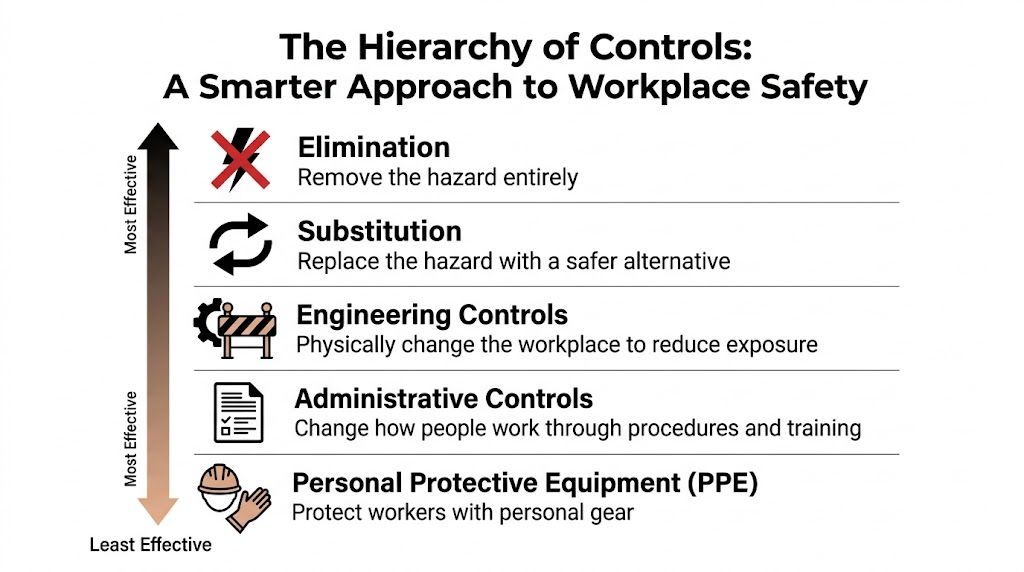
Start at the top, not the bottom
A lot of site safety improves when management changes the order of decisions.
| Control Level | Example |
|---|---|
| Elimination | De-energize equipment before service |
| Substitution | Replace higher-risk equipment or methods with safer alternatives |
| Engineering Controls | Install GFCIs, barriers, covers, better enclosures, or load-reducing upgrades |
| Administrative Controls | Training, procedures, signage, permits, and job briefings |
| PPE | Voltage-rated gloves, arc-rated clothing, face shields |
What each level looks like in the real world
Elimination
This is the gold standard. If equipment can be shut down, isolated, and verified dead, do that.
For property managers, elimination might mean scheduling electrical work after hours so a circuit can be safely de-energized instead of insisting that a tenant space stay live. For industrial sites, it may mean changing production timing so a repair can be done under controlled shutdown instead of in a rush.
Substitution
Substitution gets less attention in electrical work, but it matters. You can replace damaged portable tools with safer ones, swap temporary wiring setups for permanent branch circuits, or replace aged enclosures that no longer seal out moisture.
You can also rethink how work is performed. If workers routinely carry long conductive materials through an exposed exterior area, change the route, storage method, or task setup.
Engineering controls
Permanent improvements such as GFCI protection, better grounding, enclosure upgrades, physical guarding, dedicated circuits, improved lighting around equipment, and better weather protection all reduce exposure without depending on memory.
A smart example that gets overlooked is load reduction. Proactive efficiency upgrades can act as an engineering control, and devices such as Smartcool ECO3 can reduce HVAC electricity consumption by up to 25%, which helps reduce overload conditions that contribute to electrical fire risk, as noted in this OSHA-focused workplace electrical safety discussion. On buildings with heavy HVAC demand, that matters because the same upgrade that lowers strain on equipment can also reduce the conditions that lead to overheated circuits and repeated tripping.
One option used on some commercial sites is the Smartcool ECO3 installed by Lighthouse Energy Services. It reduces air conditioner electrical demand as an engineering control, which can support both operating efficiency and hazard reduction when HVAC load is part of the problem.
Field judgment: If the same electrical issue keeps coming back, PPE and reminders aren't enough. The site usually needs an engineering fix.
Administrative controls
This includes who is allowed to do the work, what checklist they follow, how permits are handled, and whether supervisors stop unsafe tasks. Administrative controls matter, but they don't physically remove voltage. That's why they support the top levels instead of replacing them.
Examples include:
- Job briefings: Everyone agrees on the steps before work starts.
- Labeling: Panels, disconnects, and hazard zones are clearly marked.
- Work restrictions: Unqualified staff don't open live equipment.
- Storm protocols: Outdoor electrical work gets paused when conditions change.
PPE
PPE has a role, but it's the last layer. Good gloves and arc-rated gear are important when the task requires them. They are not permission to take shortcuts.
A worker wearing the right gear can still get hurt if the system wasn't isolated, if the equipment condition is poor, or if the task should never have been energized in the first place.
What works and what doesn't
What works is using the hierarchy as a decision filter before the job begins. What doesn't work is reaching for PPE because it's easier than scheduling an outage, replacing bad equipment, or correcting the installation.
In my experience, owners get better results when they ask their team three questions before approving electrical work:
- Can we shut it off?
- Can we change the setup so people aren't exposed?
- If neither is possible, who is qualified and what controls are in place?
If those answers are weak, the job isn't ready.
Lockout Tagout and Safe Energized Work Policies
Every serious electrical safety program has one rule that can't bend. If equipment can be de-energized, it gets de-energized, locked out, tagged out, and verified before anyone puts hands on it.
That's not red tape. It's the life-saving ritual that separates controlled work from gambling.
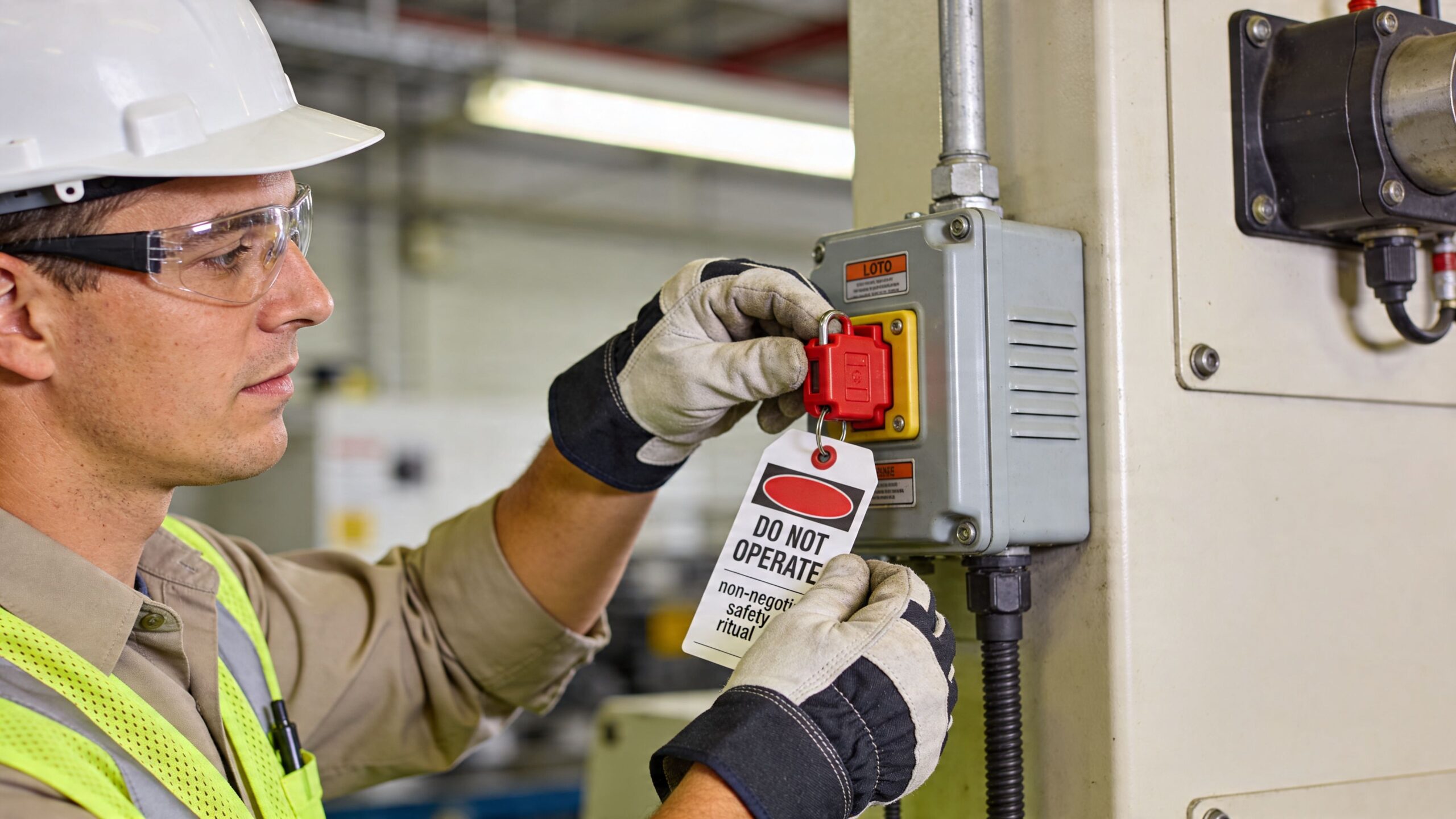
NFPA 70E describes a six-step process for creating an electrically safe work condition, and the results are hard to ignore. OSHA reports that lockout/tagout prevents 10% of all workplace fatalities annually, and NFPA data shows compliance can reduce electrical fatalities by 90% in facilities that implement it correctly, as summarized in this electrical safety manual based on NFPA 70E guidance.
What lockout tagout actually means on site
A real LOTO procedure isn't just hanging a tag on a switch. It includes the full chain of control:
- Notify affected people so no one is surprised by the shutdown.
- Shut the equipment down properly using normal operating controls.
- Isolate every power source feeding the equipment.
- Apply the lock and tag so nobody can re-energize it casually.
- Release stored energy where applicable.
- Verify absence of voltage before work starts.
That last step is where sloppy programs fail. I've seen plenty of sites say a circuit was "off" because a switch was open or a breaker handle was down. That's not proof. You have to verify that the equipment is de-energized.
The dangerous shortcuts
LOTO breaks down when the site normalizes shortcuts. The most common ones are familiar:
- "It's just a quick repair." Quick jobs hurt people because workers skip isolation.
- "That breaker should control it." "Should" isn't verification.
- "The tenant can't lose power right now." Operational pressure is one of the worst reasons to keep a hazard live.
- "Maintenance handles this all the time." Routine work isn't the same as qualified electrical work.
"Off" is a position on a handle. "Safe" is a verified condition.
Energized work is the exception, not the plan
Sometimes a facility has diagnostic tasks or limited conditions where energized exposure is part of the work. Those situations require much tighter control, more planning, and qualified personnel only. They are not for convenience.
If your current policy treats energized troubleshooting as normal maintenance, that's a management problem. Safe energized work policies should clearly define:
- Who is qualified
- What tasks are allowed
- What approvals are required
- What protective boundaries and PPE apply
- When the work must stop
Many property managers often need outside help. A licensed commercial electrician can help define what belongs in-house and what should be outsourced. If you need a baseline for that decision, this licensed commercial electrician complete guide is a practical reference.
The six-step mindset that saves people
The value of NFPA 70E isn't just technical compliance. It's discipline. The six-step process forces people to identify power sources, plan the job, identify hazards, reduce exposure, and prepare for what can go wrong before a tool comes out.
That's the difference between a safe outage and a false sense of control.
For facility owners, the policy should be simple. Nobody opens equipment, defeats guards, or works near exposed energized parts unless the job was planned, approved, and assigned to qualified personnel under a written process. If the task can be de-energized, that's the standard.
Training Your Team and Maintaining a Safe Facility
Electrical safety doesn't hold together on equipment alone. It holds together when the people on site know what they're looking at, what they're allowed to touch, and when to stop.
The training gap in a lot of workplaces is bigger than management thinks. Worker training gaps are a primary driver of electrical injuries. Studies show 90% of workers exposed to electrical hazards fail to identify or prevent them, only 29% are confident their company provides adequate electrical safety training, and that deficit contributes to about 4,000 electrical injuries annually in the U.S., according to this electrical hazard training analysis.

Train by role, not by assumption
Not everyone needs the same depth of instruction. That doesn't mean some workers need none.
A useful site program separates people into clear groups:
- Qualified electrical personnel: People authorized to perform electrical tasks within their training and scope.
- Maintenance and operations staff: People who work around equipment and need hazard recognition, shutdown awareness, and escalation rules.
- General staff and contractors: People who may encounter cords, panels, rooftop units, exterior service areas, or storm-damaged conditions.
The mistake is assuming a person is safe because they've "been around this stuff for years." Familiarity often lowers caution. Good training resets that.
What effective training covers
The best safety training is specific to the site. Generic videos don't tell a warehouse team where the exposed risks are on their loading dock, or tell a retail maintenance worker which disconnects feed rooftop package units.
At minimum, workers should know:
- Where electrical hazards exist on the property
- What signs of trouble look like, including heat, odor, corrosion, buzzing, water intrusion, or repeated trips
- What they must never do, including bypassing covers, using damaged cords, or attempting repairs outside their qualification
- Who to call and when to stop work
- How storm conditions change normal work rules
Maintenance is part of safety, not a separate budget line
A lot of owners split these into different buckets. Training is "safety." Inspections are "maintenance." In practice, they're the same prevention system.
A safe facility has a repeatable routine for:
- Panel and disconnect inspections
- Cord and plug checks
- Weather-exposed equipment review
- Label verification
- Cleaning and keeping access clear
- Following up on nuisance tripping, flicker, and heat complaints
If you only respond after failure, workers end up encountering the hazard first.
Owner takeaway: The safest sites build maintenance around early warning signs, not around the moment equipment finally quits.
Signage, labels, and housekeeping still matter
Administrative controls are only as good as daily discipline. Arc flash labels, disconnect identification, warning signs, and panel directories help people make better decisions faster. So does simple housekeeping.
An electrical room shouldn't become overflow storage. Exterior disconnects shouldn't disappear behind landscaping or debris. Temporary wiring shouldn't blend into permanent installation. If your site looks improvised, your safety program probably is too.
On Florida properties, I also recommend paying close attention to anything exposed to humidity, salt air, or repeated storm runoff. Corrosion doesn't wait for a convenient inspection cycle. It develops imperceptibly, then shows up all at once when a disconnect won't open cleanly, a termination overheats, or an enclosure loses integrity.
Responding to Electrical Emergencies and Knowing Your Limits
When an electrical emergency happens, the first bad decision usually comes from panic. People rush in, grab the victim, throw water on a fire, or start opening equipment because they want to help. That's how one victim becomes two.
For non-electrical workers, the rule is simple. Protect life by controlling the scene first, then call the right responders. That's especially important outdoors, where non-electrical workers are involved in 57% of overhead power line fatalities, and unqualified assignments near electrical hazards remain a major problem, as explained in this ESFI workplace safety guidance on avoiding common electrical hazards.
If someone suffers electric shock
Do not touch them until the electrical source is isolated. If they're still in contact with energized equipment, your body can become the path.
Take these actions in order:
- Stop the source if you can do it safely using a disconnect, breaker, or emergency stop.
- Keep others back from the area.
- Call emergency services immediately.
- Provide aid only after the scene is electrically safe and only within your training.
- Secure the equipment so nobody re-energizes it.
If there's an electrical fire
Do not use water. Water and energized equipment are a deadly combination.
Your response should be:
- Cut power if it can be done safely
- Evacuate the immediate area
- Use only the correct fire extinguisher if trained and if the fire is still manageable
- Call the fire department and your electrical professional
Draw a bright line around unqualified work
A lot of incidents start with good intentions. A maintenance tech tries to "just tighten something." A supervisor opens a panel to see what's tripping. A grounds worker moves a ladder without checking overhead clearance. Those actions are exactly why clear stop-work rules matter.
Call a licensed electrician immediately when:
- A panel, disconnect, or meter equipment is overheating
- You smell burning insulation or see arcing
- A circuit trips repeatedly without an obvious temporary cause
- Equipment got wet or flood-exposed
- Overhead lines are involved
- Storm damage affects service equipment, feeders, or outdoor gear
- Anyone would need to open energized equipment to diagnose the issue
For urgent situations outside normal hours, a property manager should already know who to call before the incident happens. This emergency electricians complete guide is useful for setting those expectations and deciding what counts as a true electrical emergency.
The right mindset is straightforward. If the task requires electrical judgment, voltage testing, energized exposure, service gear access, or storm-damage evaluation, it's beyond general maintenance.
Frequently Asked Questions About Workplace Electrical Safety
Do office and retail properties really need electrical safety programs?
Yes. The risk isn't limited to plants and construction sites. Office suites, retail centers, HOAs, and mixed-use properties all have panels, rooftop units, exterior lighting, wet locations, tenant equipment, and temporary power use. The formality of the program can vary, but every property needs clear rules, training, and inspection routines.
What's the most overlooked workplace electrical hazard?
Overhead exposure is high on the list, especially for people who don't consider themselves electrical workers. The other frequent blind spot is ordinary-looking equipment that has become unsafe over time, such as corroded disconnects, worn cords, loose receptacles, and repeat breaker trips that people learn to ignore.
How often should a facility inspect for electrical hazards?
Use a fixed schedule and also inspect after triggering events. Those include storms, renovations, tenant buildouts, flood exposure, equipment replacements, or any report of heat, odor, buzzing, flicker, or nuisance tripping. Calendar-based inspection matters, but condition-based follow-up matters just as much.
Is PPE enough if my team is careful?
No. PPE is one layer. It doesn't remove voltage, correct a bad installation, or make an unqualified person qualified. If a site leans on gloves and warning labels while leaving root problems in place, the program is weak.
What should property managers tell vendors and contractors before they start work?
Tell them where the electrical hazards are, what areas require authorization, who controls shutdowns, and which tasks require a qualified electrician. Don't assume a vendor's team understands your building layout, rooftop conditions, or post-storm hazards.
What's the best first move if our building has recurring electrical problems?
Don't normalize them. Document the symptoms, identify where and when they occur, and get the system evaluated before someone starts improvising. Repeated trips, overheated gear, unexplained outages, and water-exposed equipment are all warnings.
If your property in Palm Beach County needs a safer electrical maintenance plan, a code-conscious repair, or immediate help during an outage or hazard event, contact Lighthouse Energy Services. They provide residential, commercial, and industrial electrical service with 24/7 availability, and they handle the kind of troubleshooting, repairs, upgrades, and preventive work that help stop small electrical problems from turning into emergencies.