
You've just brought home a new Tesla in Boca Raton, and the question isn't whether you can plug it in tonight. The question is whether the outlet, panel, wiring, permit, and charger settings will support safe charging before tomorrow morning's commute. A Tesla charger installation electrician has to solve the whole electrical path, not mount a box on the garage wall.
Palm Beach County homeowners often focus on charging speed first. On the job, the better starting point is the installation type, because a hardwired Wall Connector and a plug-in NEMA setup can create different permitting, inspection, and licensing questions. The right choice depends on your panel, parking arrangement, length of ownership, and what electrical work your home needs.
Table of Contents
- Planning Your Tesla Charger Installation From Start to Finish
- Site Assessment and Panel Load Calculations
- Hardwiring the Tesla Wall Connector Step by Step
- Wall Connector vs NEMA 14-50 Outlet Compared
- Permits and Inspections in Palm Beach County
- Vetting and Hiring a Licensed EV Electrician
- Costs Timelines and Post-Installation Care
Planning Your Tesla Charger Installation From Start to Finish
A clean installation starts before anyone opens the panel. Confirm where the vehicle will sit, where the charger can be mounted, and whether the cable will reach without crossing a walkway or driveway. A garage wall near the panel may be simple. A detached garage, side-entry driveway, or exterior mounting point can change the conduit route, weather exposure, labor, and inspection details.
The charger decision comes next. A hardwired Tesla Wall Connector requires a dedicated circuit and direct termination at the unit. A NEMA 14-50 arrangement uses a receptacle and a portable charging connector. Don't choose between them after the electrician has already planned the circuit, because the outlet, breaker, conductor, protection, and permit description may differ.
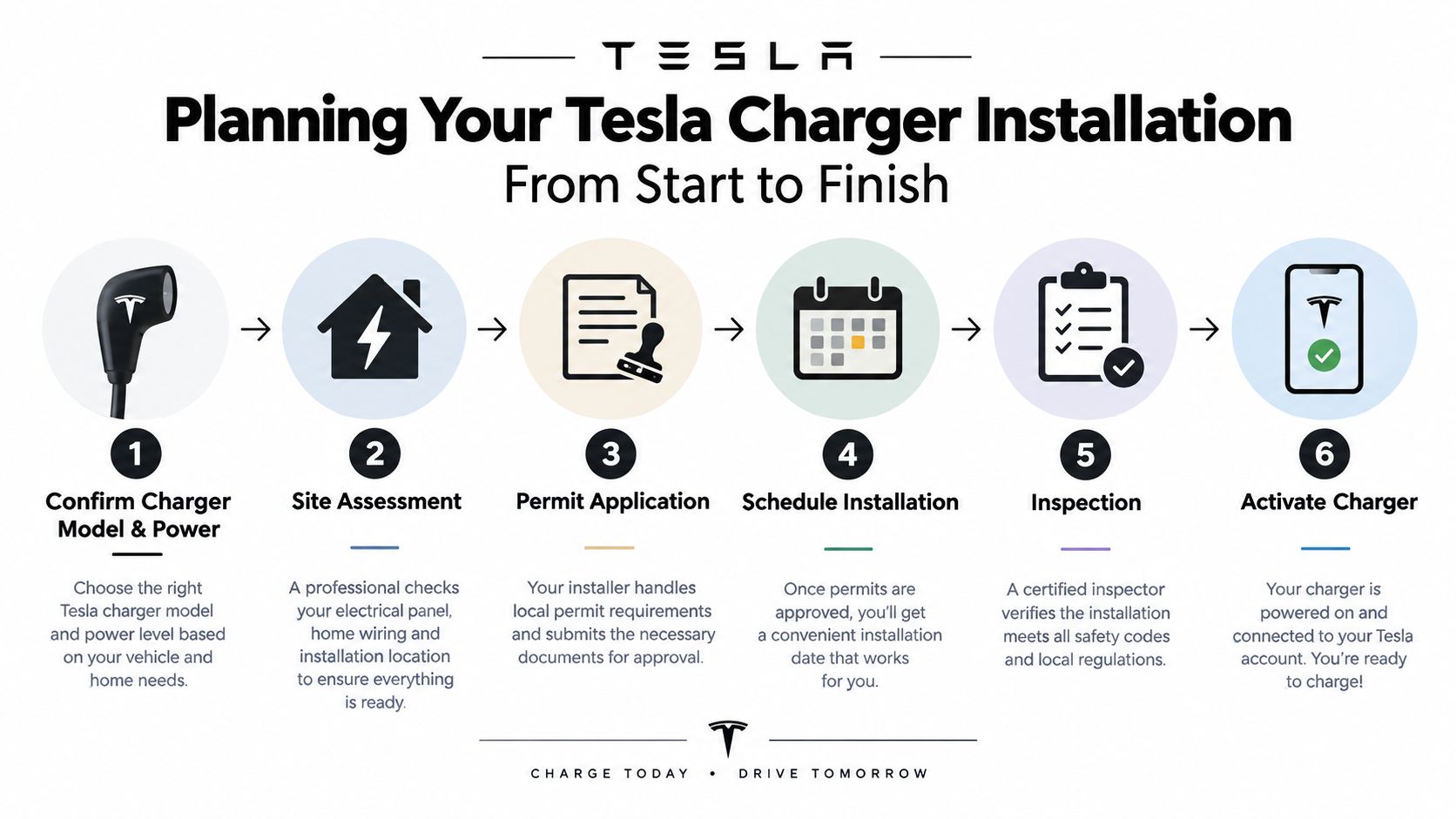
The installation sequence matters
For a Boca Raton or nearby Palm Beach County project, I'd normally organize the work in this order:
- Confirm the equipment and charging location. Decide whether the Wall Connector or plug-in configuration fits the vehicle, garage, and parking position.
- Inspect the service and calculate the load. The electrician verifies panel condition, available capacity, circuit routing, and grounding.
- Submit the permit. The proper local building office depends on whether the property sits under Palm Beach County or a municipality such as Boca Raton, Delray Beach, or Palm Beach Gardens.
- Complete the rough electrical work. This can include conduit, cable, breaker installation, and wall backing before final equipment connections.
- Pass the required inspection. The inspector checks the work against the permitted scope.
- Commission the charger. Tesla's installation process includes field validation and commissioning, not just energizing the breaker. Tesla's Wall Connector installation instructions describe a sequence that includes verifying power is off, mounting the bracket, preparing the wiring entry, connecting conductors, setting operating current, securing the cover, and powering up.
A registered apprentice can assist under supervision, but the permit responsibility belongs with the appropriately licensed electrical contractor or qualifier. That licensing line becomes especially important when a new circuit or outlet is involved.
Practical rule: Prepare the driveway, clear access to the panel, and confirm Wi-Fi reaches the charger location before installation day. The electrician can work faster when the vehicle area, wall, and electrical equipment are accessible.
The physical work may be completed in a straightforward visit when the panel and route are ready. Permit processing and inspection availability can add separate scheduling time, so don't promise yourself overnight charging until the electrical work, approval, and Tesla commissioning are complete.
Site Assessment and Panel Load Calculations
The first site visit should look more like an electrical evaluation than a sales walkthrough. The electrician starts at the proposed mounting point, measuring the route back to the panel and checking whether the cable will pass through finished walls, attic space, masonry, or exterior conduit. In Palm Beach County, salt air, irrigation overspray, heat, and direct sun can affect equipment placement and raceway decisions, especially when the charger sits outside the garage.
The panel tells the rest of the story. A qualified electrician checks the main service rating, bus-bar rating, breaker spaces, conductor condition, grounding arrangement, and existing demand from air conditioning, pool equipment, water heaters, ranges, and other large loads. The calculation should account for how the home operates, not just whether an empty breaker position appears available.
Why the load calculation controls the design
The electrician applies the applicable demand method, including the dwelling calculation approach described in NEC 220.82 where appropriate. In plain language, the calculation estimates the electrical demand the home can place on the service at the same time. A 200-amp service often has enough capacity for a Wall Connector circuit, but that isn't automatic. An older 125-amp service frequently requires closer review and may not support the added continuous load without a change in design.
Tesla specifies a standard double-pole 60 amp circuit breaker for maximum Wall Connector output, and the equipment-grounding conductor must travel with the circuit conductors and return to the main earthing point. Tesla also warns that the Wall Connector can fault without a proper ground connection, so conductor sizing and grounding integrity aren't paperwork details. They're operating requirements documented in Tesla's Wall Connector electrical installation guidance.
For homeowners who want a preliminary sense of demand before the appointment, an estimate electrical load needs worksheet can help organize appliance information. It doesn't replace the contractor's site inspection or the calculation submitted for permitting.
| Panel Capacity | Existing Load Risk | Charger Circuit | Action Required |
|---|---|---|---|
| 125 amp | Higher risk when HVAC, pool, and electric water-heating loads overlap | Reduced charging circuit, load management, or service changes may be considered | Complete a formal load calculation before selecting equipment |
| 200 amp | Often manageable, but depends on actual dwelling demand and panel condition | Dedicated Wall Connector circuit may fit | Verify capacity, grounding, breaker compatibility, and routing |
| Any capacity with damaged or obsolete equipment | Safety risk regardless of available spaces | Charger circuit should not be added to unsafe equipment | Correct or replace the panel before charger installation |
A panel upgrade becomes more likely when the service calculation fails, the panel is damaged or obsolete, the bus rating is unsuitable, or there's no compliant way to add the circuit. A load-management device such as a DCC-12 can be considered when the service is otherwise sound and the design supports managed charging, but it isn't a substitute for correcting defective equipment.
Older South Florida homes built before 1990 deserve extra scrutiny for FPE or Zinsco equipment. If the electrician finds one of these panels, the conversation should shift from “Where can we fit the breaker?” to “Is this panel safe and acceptable for additional continuous load?” Homeowners considering broader service work can review the factors involved in an electrical panel upgrade, but the property-specific decision belongs to the licensed electrician performing the assessment.
Hardwiring the Tesla Wall Connector Step by Step
The hardwired installation begins with the wall, not the breaker. The electrician positions the mounting bracket so the connector is convenient for the parking space, protected from vehicle impact, and supported by a stud, suitable framing, or masonry anchors. A neat mounting location reduces strain on the cable and keeps the equipment accessible for inspection and service.
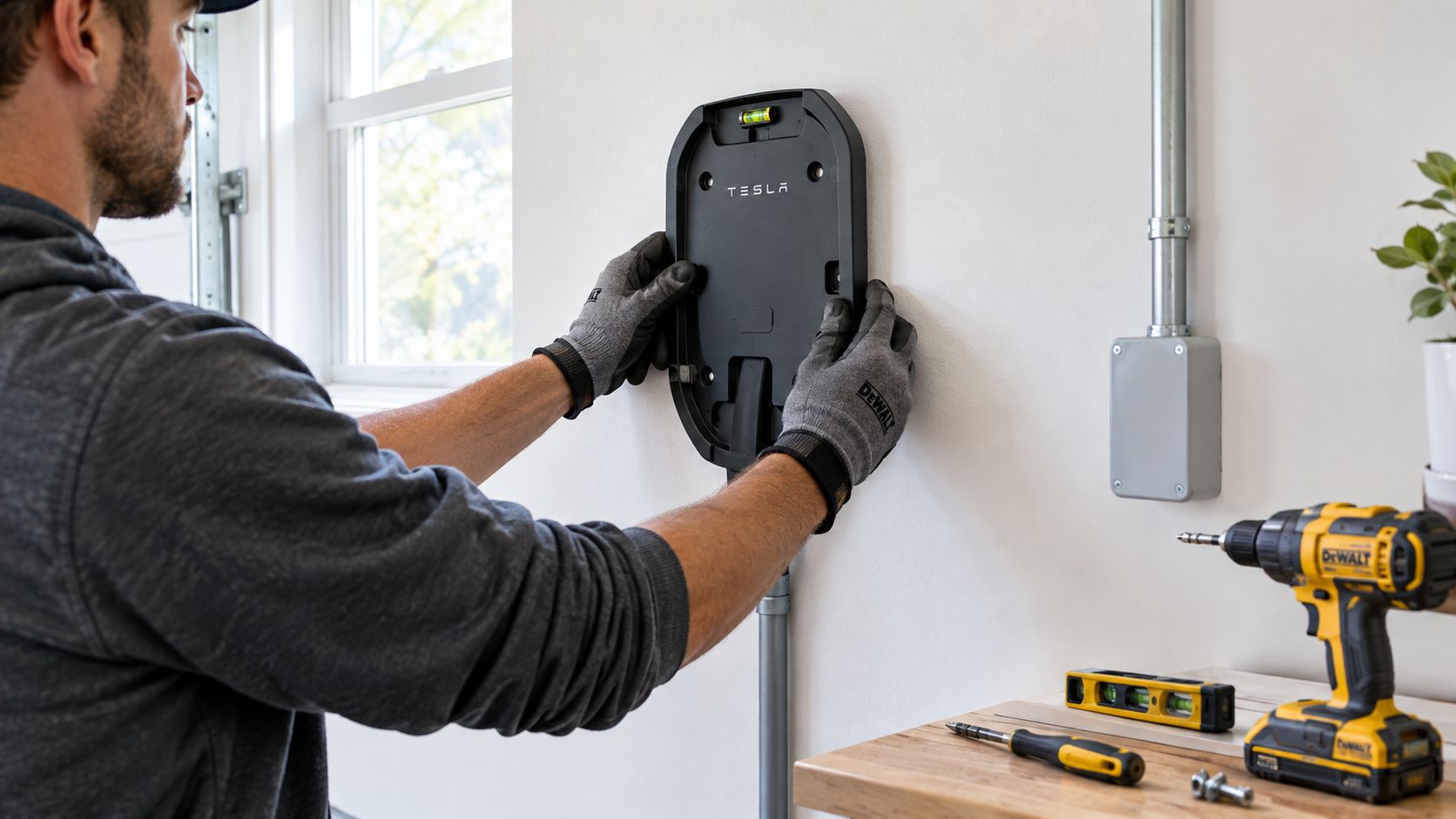
What happens behind the cover
The circuit route determines the wiring method. The electrician may use conduit or an approved cable assembly, depending on the construction, location, exposure, and local requirements. Six AWG copper is commonly considered for a 60-amp circuit, but the final conductor choice depends on ampacity rules, termination ratings, ambient conditions, run length, installation method, and the permitted design. Bigger wire isn't a substitute for a correct calculation.
At the panel, the dedicated two-pole breaker must match the circuit design and the Wall Connector's configured operating current. Tesla's installation sequence requires the installer to verify that power is off, mount the bracket, prepare the entry, connect conductors, set the operating current, secure the cover, and then restore power through the prescribed process. The breaker isn't selected because it fits an open space.
The 240-volt charging circuit generally uses the two ungrounded conductors and an equipment-grounding conductor. A neutral isn't used for the Wall Connector's 240-volt charging connection. The equipment-grounding conductor is still required, and it must run with the circuit conductors back to the proper grounding point. Tesla's documentation specifically identifies grounding as a fault point, so I treat the ground path and terminations as critical inspection items.
Commissioning is part of the installation
After the physical connections are complete, the electrician checks torque, conductor placement, breaker labeling, enclosure fit, and basic operation. Tesla's current support process requires commissioning by scanning the QR code in the installation quickstart guide. The installer then connects the unit to the homeowner's Wi-Fi through the Tesla app, confirms the amperage limit, and verifies that the charger and vehicle communicate correctly.
A charger that powers on but hasn't been commissioned can leave the homeowner with avoidable setup problems. The home EV charging station installation process should include mounting, circuit work, testing, and customer guidance rather than stopping when the indicator light appears.
Wall Connector vs NEMA 14-50 Outlet Compared
The choice is practical, not ideological. In a Delray Beach driveway, I'd ask how often the homeowner drives, whether the car parks in one location, whether the owner may move, and whether the panel can support the preferred circuit without expensive corrective work.
A hardwired Wall Connector is a permanent installation. It keeps the charging equipment fixed, avoids relying on a receptacle connection for routine high-load charging, and can provide the highest output the designed circuit supports. A NEMA 14-50 outlet offers flexibility because the portable connector can be removed or used elsewhere, but the receptacle still needs correct installation, protection, and inspection when new electrical work is added.
| Factor | Tesla Wall Connector, hardwired | NEMA 14-50 outlet |
|---|---|---|
| Equipment connection | Directly wired to the dedicated circuit | Portable charging equipment plugs into the receptacle |
| Best fit | Long-term ownership and a fixed parking location | Portability, changing parking arrangements, or future moves |
| Charging decision | Output is configured to the circuit and equipment | Output is limited by the portable equipment and circuit design |
| Service work | Requires direct wiring, grounding, and commissioning | Requires a correctly installed receptacle and dedicated circuit |
| Maintenance concern | Inspect enclosure, cable, terminals, and connectivity | Inspect receptacle condition, plug fit, heat, and connection quality |
| Permitting question | Hardwired EVSE work is regulated electrical work | A new 240-volt outlet is also electrical work, even if the charger plugs in |
The plug-in option isn't automatically DIY. Current guidance distinguishes a no-new-work plug-in scenario from adding a dedicated 240-volt outlet. A new circuit or outlet commonly triggers permit and electrician requirements, while local code interpretation determines the lawful path. That distinction is why the West Palm Beach EV outlet installation guidance should be treated as part of a local permitting conversation, not as proof that every plug-in setup is exempt.
The hardwired choice usually makes sense when the vehicle stays at the home and the wall location is permanent. The NEMA option can make sense when portability matters or when the homeowner already owns compatible portable equipment. Neither option should be selected before the electrician confirms the panel and permitted circuit design.
Permits and Inspections in Palm Beach County
A Palm Beach County charger project creates a paper trail, and the exact path depends on the property's jurisdiction and installation type. A home in unincorporated Palm Beach County generally goes through the county building process. A home inside Boca Raton, Delray Beach, Palm Beach Gardens, or another municipality may use that city's permitting office instead.
For a hardwired Wall Connector, the permit package should identify the dedicated circuit, equipment, mounting location, conductor method, protection, and load calculation. The job may involve a rough inspection before the wiring is concealed, followed by a final inspection after the Wall Connector is installed and labeled. The electrician should know which stage applies to the actual construction, rather than assuming every location follows the same administrative workflow.
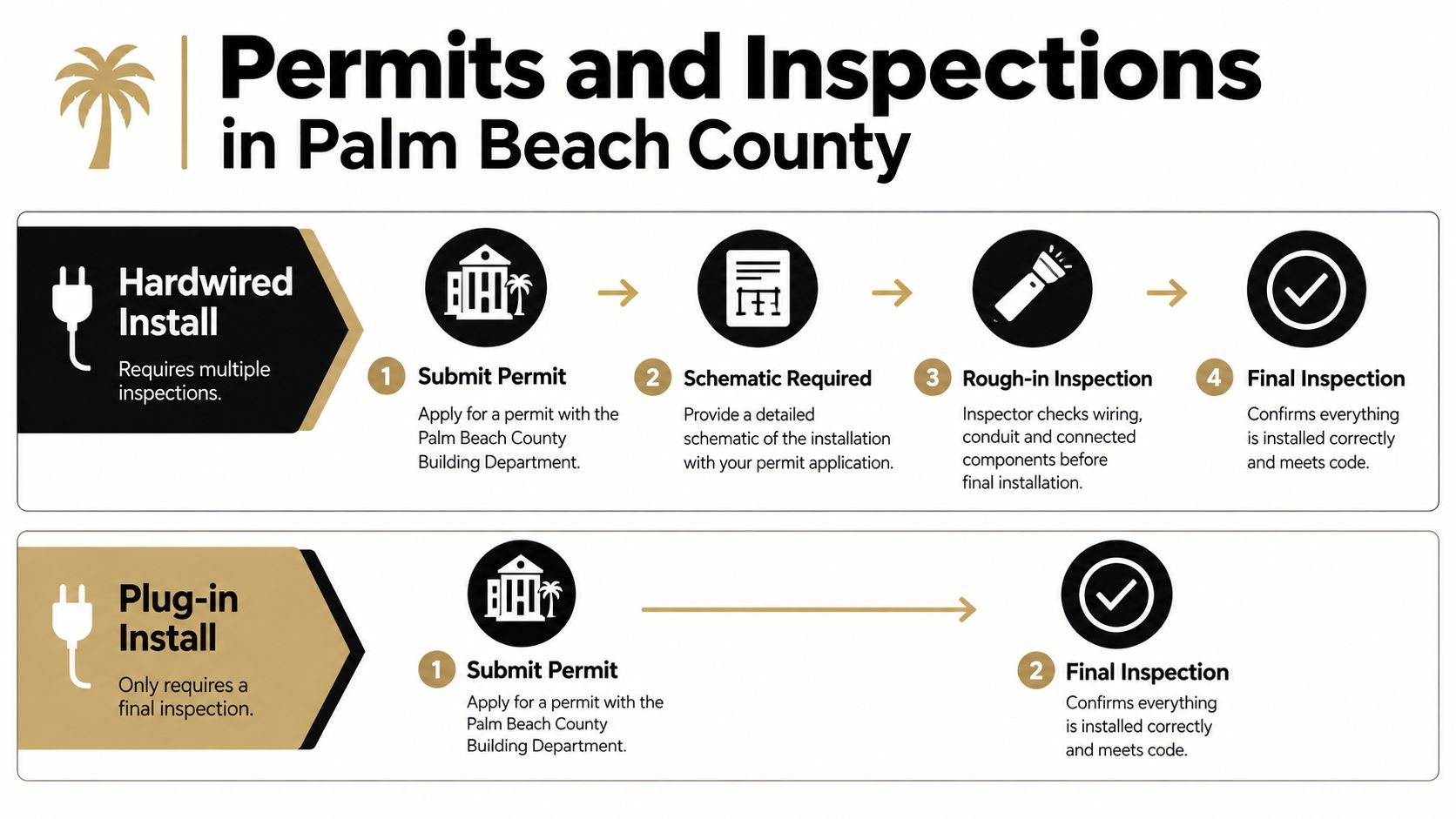
The plug-in distinction is easy to misunderstand
A NEMA 14-50 outlet may look like a simple appliance connection, but adding a new 240-volt circuit still changes the home's electrical system. The permit description may differ from a hardwired EVSE installation, and the inspection sequence may be simpler when there's no concealed wiring or equipment mounting to review. That doesn't mean the circuit escapes licensing or inspection requirements.
The responsible permit holder should be an appropriately licensed electrical contractor or electrical qualifier. A registered apprentice may work under supervision, but shouldn't pull the permit independently. Ask who is listed on the permit and whether that person matches the contractor named in the quote.
Inspectors commonly focus on practical safety details:
- Breaker identification: The panel directory should clearly identify the charger circuit.
- Continuous load sizing: The circuit must be designed for the charging load under the applicable code rules.
- Conductor selection: Wire size and installation method must match the circuit and terminations.
- Grounding: The equipment-grounding path must be continuous and correctly terminated.
- GFCI protection: The required protection for a 50-amp receptacle circuit should be addressed in the permitted design.
Tesla's installation support also emphasizes commissioning, Wi-Fi setup, and registration. Inspection approval and app setup serve different purposes. One confirms the electrical work, while the other confirms the equipment is configured and communicating properly.
Permit review and inspection availability vary by jurisdiction and workload. Don't schedule a vehicle delivery around an assumed approval date, and don't energize an unpermitted circuit because the charger appears ready.
Vetting and Hiring a Licensed EV Electrician
A business card and a polished estimate don't establish licensing. For a Tesla charger installation electrician in Palm Beach County, start by confirming an active Florida Certified Electrical Contractor license or the applicable Palm Beach County credential. Check the license record through the state's official license lookup and verify that the qualifier on the record matches the contractor named in your proposal.
The contractor should also explain who will pull the permit, who will perform the work, and who will meet the inspector. Trade licensing systems differ by jurisdiction, but the underlying principle is the same. This overview of trade licensing for construction workers provides useful general context for why credential verification matters, even though your Palm Beach County project must follow Florida and local requirements.
Use the quote as a technical test
Ask each contractor for a written scope that separates the electrical work from allowances and exclusions. A credible proposal should identify:
- Permit responsibility: Who applies, pays, posts, and closes the permit?
- Load calculation: Will the electrician document service capacity before recommending the breaker?
- Circuit construction: Does the price identify breaker, conductors, conduit, fittings, and terminations?
- Equipment scope: Are mounting, commissioning, Wi-Fi setup, and registration included?
- Inspection handling: Who schedules the inspection, and what happens if corrections are required?
- Insurance: Can the contractor provide current general liability and workers' compensation certificates?
Ask about recent EV charger work in practical terms. The electrician should be able to explain how they handle Wall Connector commissioning, grounding, long conduit runs, exterior exposure, and panels with limited capacity. A contractor who immediately quotes the same circuit for every home is skipping the judgment that protects your service equipment.
Get three written bids when the project is complex or panel work may be involved. Compare the assumptions, not just the totals. A low quote that omits permitting, load calculations, inspection coordination, or corrective panel work can become the most expensive option once the job is open.
Costs Timelines and Post-Installation Care
Homeowners often want a price before anyone sees the panel. That's understandable, but charger installation costs vary with the distance to the parking space, wall construction, conduit route, service capacity, permit requirements, and whether the existing equipment is safe to extend. A short, accessible run and a long exterior route are not the same installation, even when the charger model is identical.
I wouldn't publish a Palm Beach County price range without a site assessment. The available verified information supports the design factors, not a local 2026 price schedule. Treat any exact quote as property-specific, and ask whether it includes the charger, breaker, wire, conduit, permit, inspection, mounting, commissioning, and corrections.
| Install Scenario | Typical 2026 Cost Range, Palm Beach County | What Drives the Price | Typical Timeline |
|---|---|---|---|
| Wall Connector with accessible panel and short route | Obtain a written site-specific quote | Circuit length, wall access, breaker, permit, and commissioning | Depends on permit review and inspection availability |
| Wall Connector with long or exterior conduit run | Obtain a written site-specific quote | Conduit length, weather exposure, masonry, trenching, and protection | Longer preparation and scheduling may apply |
| NEMA 14-50 with a new dedicated circuit | Obtain a written site-specific quote | Receptacle type, GFCI requirements, conductor route, and panel space | Final inspection timing depends on local jurisdiction |
| Panel correction, upgrade, or load-management design | Obtain a separate electrical proposal | Service capacity, obsolete equipment, subpanel needs, and engineering scope | Additional permit and utility coordination may be required |
Delays usually come from decisions made early
A clean installation can often be scheduled promptly once the equipment, scope, and permit path are settled. Inspection timing depends on the local office, the permit review, and the availability of the required inspection slot. Expedited options may exist in some jurisdictions, but they should be confirmed before you build a move-in or commute plan around them.
After activation, keep the charger area accessible and watch for changes. If the router is replaced, the Wall Connector may need Wi-Fi reconnection through the Tesla app. Firmware and configuration updates should be handled through the manufacturer's normal process, while unexplained trips require diagnosis rather than repeated breaker resets.
Don't open energized equipment to retorque connections yourself. Ask the electrician about a future torque inspection, and perform a visual check of the faceplate, cable, strain relief, conduit, and mounting hardware. For broader household preparedness, homeowners can also review practical guidance on electric vehicle fire safety, while remembering that proper circuit design, grounding, protection, and inspection are the foundation of safe charging.
Lighthouse Energy Services evaluates panel capacity, completes the load calculation, installs dedicated EV charging circuits, mounts and commissions Tesla Wall Connectors, and coordinates the Palm Beach County permitting process. Request a site-specific quote by visiting Lighthouse Energy Services, and schedule the load assessment before comparing bids so each electrician prices the same scope.