
At 4:55 a.m., a property manager walks a Palm Beach County shopping center before tenants arrive. One cabinet sign has been dark for weeks. Another flickers across a single row of letters. The pylon sign still works, but a storm-damaged section is hanging slightly away from the cabinet. None of these problems looks urgent from a desk. In the parking lot, they represent lost visibility, tenant complaints, electrical risk, and a maintenance record that's already falling behind.
Sign lighting repair isn't a matter of replacing a lamp. A reliable repair identifies why the sign failed, checks the surrounding electrical system, and determines whether the cabinet can support another repair or needs a partial rebuild. In South Florida, heat, UV exposure, wind, rain, and salt-laden air turn small defects into recurring service calls. Signs also bring access, structural, and aircraft obstruction lighting concerns that ordinary troubleshooting can miss.
Table of Contents
- When a Dark Sign Becomes a Real Problem
- Common Causes of Sign Lighting Failure
- How a Technician Diagnoses the Problem
- Safety, Code, and Compliance in Palm Beach County
- Typical Timeline for a Sign Lighting Repair
- What Sign Lighting Repair Actually Costs
- Preventive Maintenance Plans That Pay Off
- Getting Fast Local Help From Lighthouse Energy Services
When a Dark Sign Becomes a Real Problem
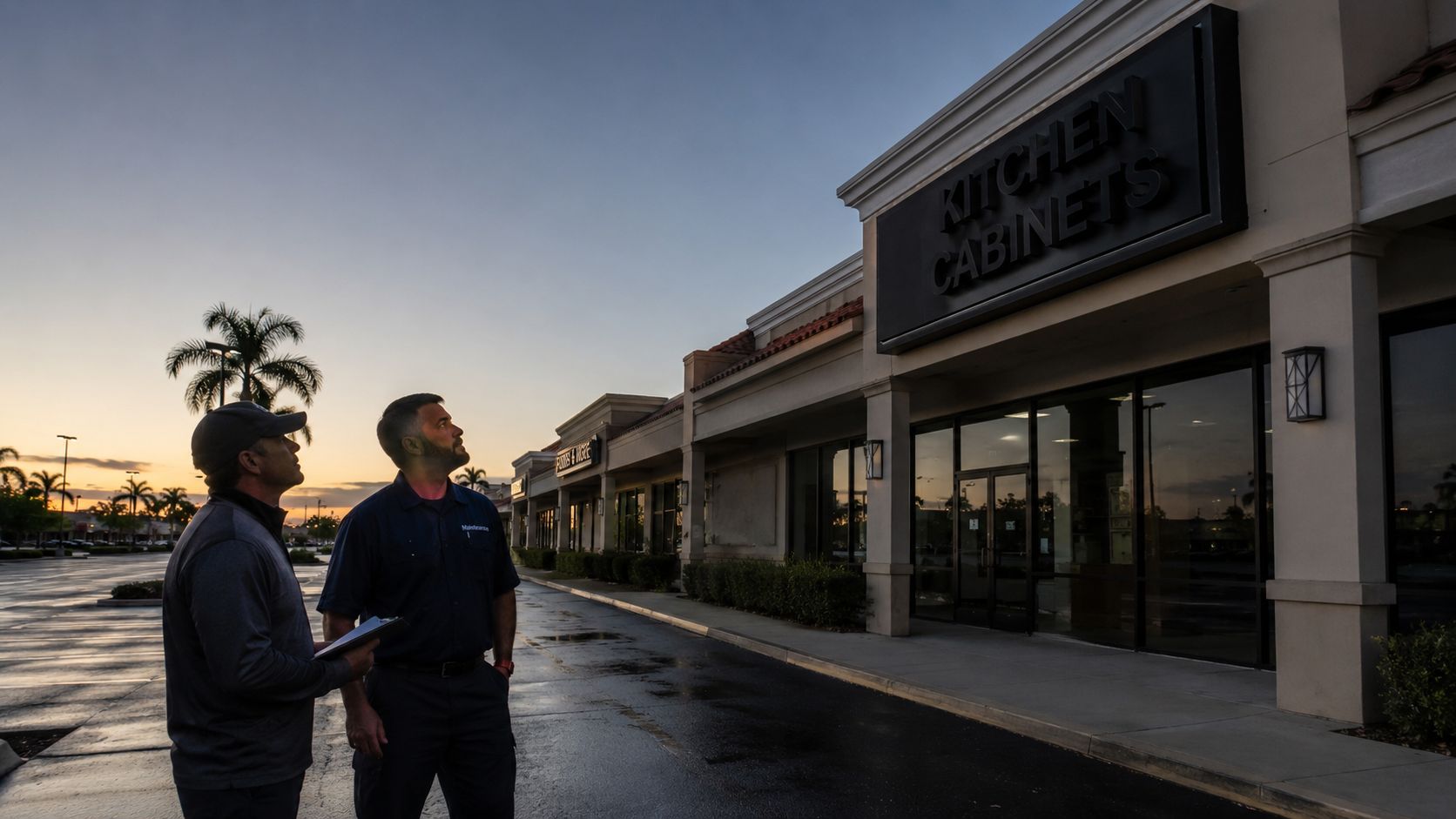
The manager calls the maintenance supervisor, who confirms that the tenant reported the outage earlier in the month. The tenant assumed the sign was waiting on a part. The property team assumed the tenant was handling it. Meanwhile, customers approaching before sunrise see a dark storefront instead of a business they recognize.
A dark monument sign can reduce the property's presence from the road. A dark channel-letter set makes a tenant's frontage look neglected and can weaken the value of a prominent lease position. A pylon sign with failed illumination may also attract complaints about property appearance or visibility before anyone asks why the lighting stopped working. Owners reviewing sign formats and installation choices can use this guide to storefront sign types and costs as useful background when deciding whether a repair belongs to the sign face, cabinet, support, or lighting system.
Why owners tolerate failing illumination
Property teams often accept dimming or flickering because the sign still produces some light. That decision usually creates a predictable chain:
- A weak connection causes one section to flicker.
- Moisture or corrosion increases resistance and damages nearby components.
- A failing driver or ballast starts tripping protection.
- A second section goes dark, and the repair becomes an emergency.
- The contractor returns because the original visit addressed the symptom rather than the cause.
Illuminated signs also operate beyond the hours posted on the front door. A large sign-industry survey found an average of 1.71 illuminated on-premise signs per business, with illumination operating for 13.9 hours per day, compared with an average business operating window of 10.8 hours. That difference, roughly 3.1 additional illuminated hours each day, exposes components to wear after normal trading hours and helps explain why maintenance remains a recurring operating issue. The sign-industry illumination study treats illumination as an ongoing business asset, not a one-time installation detail.
Field rule: A sign that's still partly lit can be more valuable to diagnose than one that's completely dark. Partial failure often reveals the circuit, component, or environmental condition that will cause the next outage.
Owners who manage several properties should treat one unexplained outage as a prompt to review other signs, service records, disconnects, and exposed wiring. The same maintenance gap may exist at parking-lot poles, exterior building lighting, and monument signs. A related parking lot lighting repair and LED upgrade service can help identify whether the sign problem is isolated or part of a broader exterior lighting issue.
Common Causes of Sign Lighting Failure
A technician can often narrow the fault by matching the visible symptom to the component most likely responsible. The table below is a starting point, not a substitute for de-energized testing and a licensed inspection.
| Component | Visible Symptom | Typical Cause | Usual Repair |
|---|---|---|---|
| LED modules | Checkerboard dimming, dark clusters, or uneven brightness | Failed modules, poor spacing, voltage drop, or moisture | Replace matched modules, correct spacing, repair wiring, and verify load distribution |
| LED driver or power supply | Entire section is dark, breaker or GFCI trips, or the driver shows heat damage | Capacitor failure, overload, incompatible replacement, or water intrusion | Test input and output, match ratings, replace the driver, and correct the enclosure condition |
| Fluorescent ballast | Lamps flicker, fail at one end, or refuse to start | Aging ballast, poor connection, or incorrect supply voltage | Verify primary and open-circuit voltage, then replace the ballast or convert the cabinet |
| Fluorescent lamp | Blackened ends, intermittent starting, or a dark tube | Lamp wear, socket damage, or ballast stress | Replace the lamp only after checking sockets and ballast condition |
| Neon transformer | One tube section is dark, buzzing, or intermittently illuminated | Transformer failure, high-voltage leakage, tube damage, or poor grounding | Isolate the high-voltage circuit, test safely, and repair or replace the failed part |
| Secondary wiring | A row goes dark after wind or works when the cabinet moves | Chafed insulation, loose terminations, or damaged raceway entries | Repair conductors, protect penetrations, and secure connections |
| Gaskets and seals | Moisture inside the cabinet, corrosion, or recurring trips after rain | Failed gasket, blocked weep holes, cracked face, or poor sealant | Replace seals, restore drainage, repair the face, and remove corrosion |
| Mounting and conduit | Intermittent operation during wind, loose cabinet, or exposed conductors | Movement, failed fasteners, conduit strain, or storm damage | Correct the mounting and conduit system before restoring illumination |
What South Florida weather changes
Palm Beach County signs endure repeated heat cycling. Components expand and contract, seals harden under UV exposure, and connection points loosen over time. Hurricane-season rain can enter through a face seam, conduit entry, or damaged gasket, then remain trapped inside a cabinet.
Salt air accelerates corrosion near the coast, but inland properties aren't automatically protected. Windborne moisture and poor cabinet drainage can create similar failures away from the shoreline. A technician should look for green or white corrosion, rust trails, water staining, swollen electrical components, and discoloration around terminals instead of treating each dark module as an isolated defect.
The repair decision at the truck
Replacing one failed part is appropriate when the cabinet is dry, the wiring is sound, the power supply is correctly matched, and nearby components test normally. It's poor practice when the replacement sits beside corroded terminations, a deteriorated seal, or a driver already showing thermal damage.
Modern LEDs commonly carry rated service lives of 50,000 to 100,000 hours, while fluorescent sign lamps are typically rated around 20,000 to 30,000 hours, and neon is often cited at 30,000 to 50,000 hours. At continuous 24/7 operation, those figures correspond to approximately 5.7 to 11.4 years for LEDs, 2.3 to 3.4 years for fluorescent lamps, and about 3.4 to 5.7 years for neon, based on the cited industry service-life ranges. This sign maintenance guidance also notes that power supplies often require replacement on a 5 to 7 year cycle. The practical lesson is that modern repair work often involves drivers, seals, power supplies, and moisture control, not just lamp swaps.
How a Technician Diagnoses the Problem
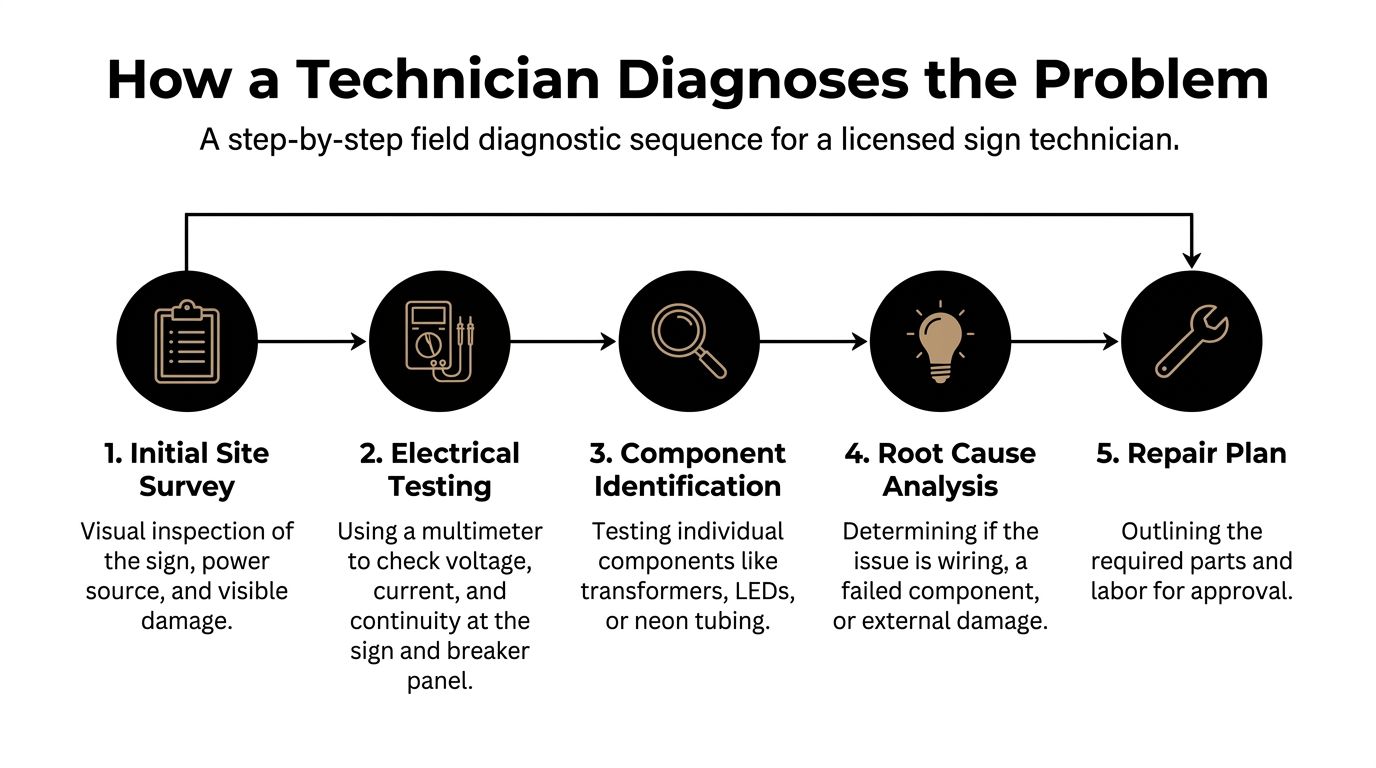
A proper visit begins before anyone removes a cover. From the ground, the technician records which letters, modules, or cabinet sections are dark, checks the timer or photocell, looks for storm damage, and confirms whether the sign is safe to access. From a bucket or lift, the inspection expands to face condition, conduit entries, mounting hardware, water marks, and heat discoloration around drivers.
Thermal imaging can help identify an overloaded or failing driver, but it doesn't replace electrical testing. A hot spot tells the technician where abnormal heating may be occurring. The meter and visual inspection establish whether the heat comes from the component, a loose termination, excess load, or restricted ventilation.
The electrical sequence
The primary side comes first. The technician checks the disconnect, breaker, GFCI behavior, grounding, and voltage at the sign's supply point. A dark sign may have a perfectly healthy lighting system with no incoming power, or it may have power present and a fault downstream.
For fluorescent signs, the recommended sequence is especially useful. At the primary input, a 120-volt sign should measure roughly 115 to 125 volts. Significant voltage between the grounded conductor and the metal cabinet indicates a grounding fault. If primary voltage is correct, the technician checks open-circuit voltage at the ballast leads. A near-zero result points toward wiring or socket trouble, while an incorrect result with the leads disconnected points toward a defective ballast. The fluorescent ballast troubleshooting guide explains this sequence and why it prevents unnecessary parts replacement.
The secondary side requires isolation. The technician checks driver or transformer output, measures current draw by circuit, and disconnects sections until the faulted run is identified. In an LED cabinet, voltage drop can make modules farther from the power supply visibly dimmer. Technical guidance on preventing voltage drop in illuminated cabinet signs recommends respecting wire-gauge maximum-length limits and choosing suitable constant-current or 24-volt modules to keep brightness uniform.
A technician may need to remove a module, open a raceway, or expose a splice to confirm the finding. The service report should document the tested voltage, failed component, visible damage, corrected wiring or sealing, parts installed, and any condition that remains outside the approved scope. That documentation explains the labor line and separates a one-visit repair from a return trip based on guesswork.
Safety, Code, and Compliance in Palm Beach County
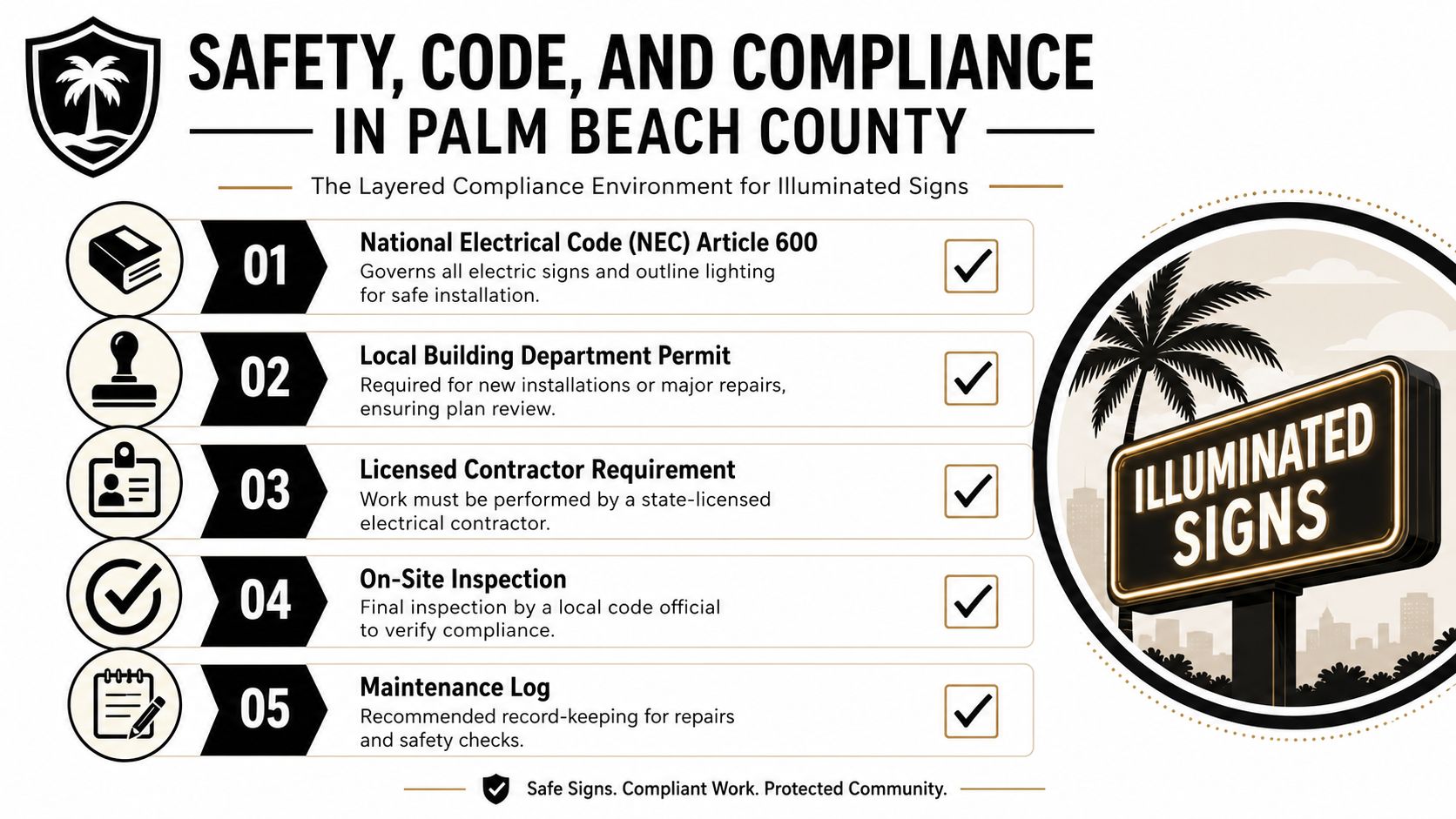
Illuminated signs sit at the intersection of electrical safety, building construction, structural attachment, and local permitting. NEC Article 600 governs electric signs and outline lighting, including wiring methods, disconnecting means, grounding, and component suitability. The Florida Building Code and local Palm Beach County requirements add another layer for mounting, access, structural work, and inspections.
Outdoor commercial signs need special attention because moisture and corrosion can compromise insulation, enclosures, and terminations. A repair that restores light but leaves a missing disconnect, exposed splice, damaged raceway, or inadequate support hasn't solved the property owner's risk. A sign cabinet also needs proper bonding and overcurrent protection, not just a replacement driver.
Aircraft obstruction lighting requires a separate review
A rooftop, tower, or pole sign may create an aircraft visibility issue that ordinary storefront sign service doesn't address. Under 14 CFR Part 77, the relevant question involves the structure's height and location, including whether it exceeds the 200-foot above-ground-level threshold or sits in an area affected by an airport approach path. Sites near Palm Beach International Airport or Boca Raton Airport may require a project-specific review rather than an assumption based only on sign height.
Where obstruction lighting applies, the design may call for L-810 or L-862 fixtures, with required red or white intensity specifications under the applicable aviation guidance. A failed marker light on a rooftop or tower should be treated as a compliance outage, not a cosmetic defect. The repair scope may include the fixture, monitoring equipment, wiring, controls, and documentation needed to show that the system was returned to service.
What should remain in the property file
A responsible repair file should include:
- Permit records: Keep the signed permit and inspection results where the work requires permitting.
- Electrical details: Retain load calculations, circuit information, and component ratings.
- Lighting verification: Record photometric or obstruction-lighting verification when the application requires it.
- As-built information: Update drawings when wiring routes, fixtures, disconnects, or controls change.
- Maintenance history: Note inspection dates, outages, parts, test results, and unresolved conditions.
Common field violations include missing disconnects, splices placed inside raceways, inadequate grounding, and a missing second means of support. If a sign falls or an obstruction light remains out, incomplete documentation makes it harder for an owner to demonstrate that the asset was installed and maintained responsibly.
Typical Timeline for a Sign Lighting Repair
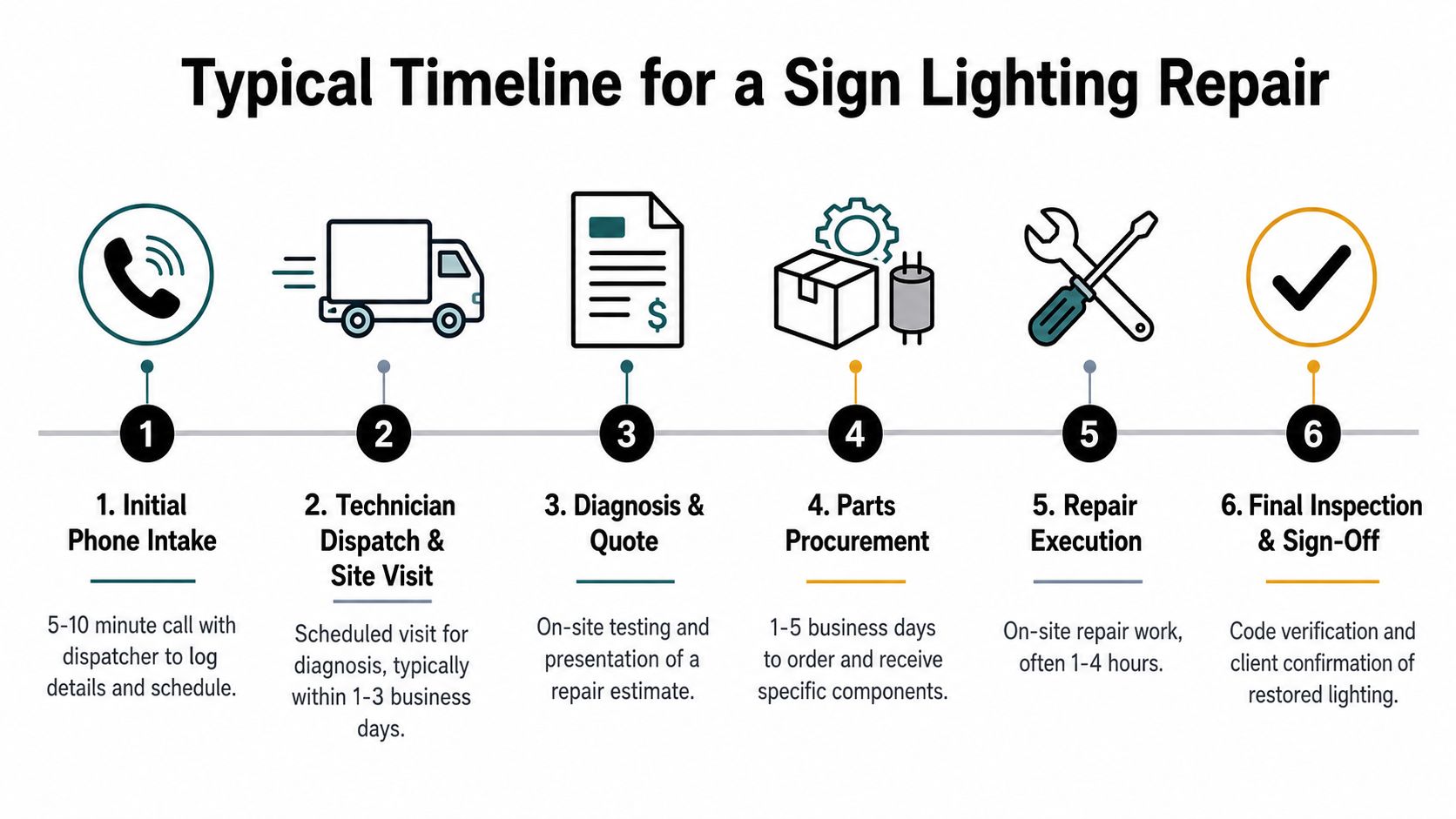
The first call should establish the facts, not just the address. A dispatcher needs the sign type, approximate height, affected letters or cabinet sections, whether the breaker is tripping, whether the problem began after a storm, and whether a bucket truck or lift will be necessary. A clear photo can prevent an avoidable trip with the wrong access plan or component.
From intake to diagnosis
A practical service sequence looks like this:
- Phone intake: The dispatcher records the symptom, access restrictions, tenant contact, and urgency.
- Dispatch: The contractor schedules a technician and confirms whether aerial access or traffic control is needed.
- Site diagnosis: The technician performs the visual and electrical tests described above.
- Scope approval: The property manager receives a repair recommendation, including any adjacent damage that should be addressed.
- Repair and verification: The technician installs the approved parts, checks illumination, tests protection, and records the result.
Stocked items such as common LED drivers, 12-volt and 24-volt modules, and replacement fluorescent lamps may support a same-day repair when the sign is accessible and the cabinet is in usable condition. Specialty neon transformers, matched-color LED modules, and FAA L-810 fixtures may require a parts-order loop. The cited maintenance guidance supports the broader expectation that power supplies follow a multi-year replacement cadence, so an older or uncommon component may not be immediately available.
Emergency access changes the plan
After-hours service makes sense when a dark sign affects a major entrance, a safety condition, or an aircraft obstruction marker. It doesn't make sense to rush a technician into a wind-exposed sign or wet cabinet without safe access and isolation. Multi-tenant properties can also add delay because a technician may need tenant approval, roof access, security escort, or a coordinated lift setup.
Ask for two timelines, the earliest safe diagnostic visit and the expected completion date if parts or permits are required. That distinction prevents a promise of immediate restoration when the actual repair depends on a specialty component or a code inspection.
What Sign Lighting Repair Actually Costs
A useful estimate separates labor, materials, access, and corrective work. A low parts price doesn't mean a low total invoice if the sign is high, the driver is buried behind a face, the circuit is corroded, or the technician has to return with a lift.
The following ranges are practical planning figures for common Palm Beach County service scenarios. They're estimates, not guaranteed prices, and the actual scope depends on access, sign construction, damage, and testing requirements.
| Repair Type | Low Estimate | High Estimate | What Pushes Cost Higher |
|---|---|---|---|
| LED module replacement | $185 | $350 | Difficult access, multiple modules, color matching, wiring repair, or water damage |
| Driver replacement with secondary-side troubleshooting | $275 | $650 | Hidden wiring faults, overloaded circuits, cabinet teardown, or failed adjacent components |
| Fluorescent cabinet repair | $400 | $800 | Ballast access, socket replacement, damaged wiring, or repeated lamp failure |
| Full fluorescent-to-LED retrofit | $1,400 | $2,200 | Cabinet size, rewiring, module spacing, disposal, testing, and warranty requirements |
| Bucket truck staging for signs over 20 feet | $300 per visit | $600 per visit | Traffic control, difficult setup, restricted access, or repeat visits |
A routine module swap may be the right answer when only a small section has failed and the cabinet remains dry. A driver replacement deserves deeper testing because the driver may have failed from overload, poor ventilation, water intrusion, or an incompatible load. Replacing it without checking the secondary circuit can produce another outage.
Repair versus retrofit
An aging fluorescent cabinet may justify a $400 to $800 repair when the face, housing, wiring, and ballast remain serviceable. A $1,400 to $2,200 LED retrofit may make more sense when the owner wants to eliminate recurring fluorescent maintenance and rebuild the internal lighting distribution. LED retrofits can remove lamp and ballast failure points, but they still depend on correct module spacing, conductor sizing, sealing, and power-supply selection.
Replacement becomes more compelling when several subsystems are failing, the cabinet has water damage, the sign uses obsolete ballasts, or component lead times exceed two weeks. A useful commercial decision rule is that when the repair quote exceeds 50% of a comparable new sign's installed cost, replacement often offers better reliability, warranty coverage, and fewer future truck rolls. That rule should be applied to a real replacement quote, not a guessed retail price.
Owners evaluating larger illuminated displays should also separate cabinet lighting from digital display infrastructure. A practical resource on commercial LED screen installation tips can help clarify that those systems involve different power, mounting, control, and service considerations.
Preventive Maintenance Plans That Pay Off
Break-fix service feels economical until the same sign requires repeated access, repeated diagnosis, and repeated tenant coordination. A loose ballast connection can cause flicker first, then heat damage. An ignored gasket can turn rainwater into corrosion inside the cabinet. The first repair may be inexpensive, but the next visit includes the cost of discovering what the first visit didn't address.
A preventive plan should be specific enough that the property owner can verify the work. For a semi-annual cabinet inspection, the technician should check:
- LED condition: Look for color shift, dark clusters, uneven brightness, and lumen loss.
- Power supplies: Inspect capacitor swelling, heat discoloration, ventilation, load suitability, and mounting.
- Fluorescent components: Check ballast temperature evidence, lamp ends, sockets, and wiring.
- Cabinet enclosure: Inspect gaskets, face seams, sealant, corrosion, drainage paths, and weep holes.
- Connections: Tighten and protect terminations, inspect raceway entries, and identify chafed conductors.
- Support system: Check fasteners, brackets, conduit strain, cabinet movement, and secondary support.
- Protection: Verify breaker and GFCI behavior, grounding, bonding, and disconnect accessibility.
- Documentation: Record photos, test results, parts, defects, and recommended corrective work.
Use different intervals for different exposure
High-rise and pylon signs deserve quarterly visual checks because wind movement, difficult access, and exposure can hide developing defects. Monument signs and channel-letter cabinets generally benefit from semi-annual full inspections, especially where cabinets sit near irrigation, landscaping, parking areas, or salt air. Annual thermographic scans can identify failing drivers and overheated terminations before a tenant panel goes dark.
A maintenance log also gives the property owner a defensible record. It supports insurance conversations, helps preserve listed equipment by documenting proper servicing, and provides an audit trail for aircraft obstruction lighting when a rooftop or tower system must remain operational.
For broader exterior assets, owners can align sign inspections with a commercial lighting maintenance program so technicians review related circuits, site lighting, and controls during planned visits. The goal isn't to replace every part on a schedule. It's to find the part or condition that will create the next expensive access event.
Getting Fast Local Help From Lighthouse Energy Services
Call before the sign becomes a complete outage. The right time to schedule service is after a tenant reports a dark cabinet, when an LED row flickers, after storm damage to a monument or pylon sign, when the sign circuit breaker trips, or whenever a rooftop or tower obstruction marker goes out.
Have these details ready:
- Sign description: Identify the cabinet, channel letters, monument, pylon, neon, LED, or fluorescent system.
- Access information: Provide the approximate height and explain whether a bucket truck, lift, roof key, escort, or traffic control will be needed.
- Visible symptom: State whether the sign is fully dark, partially dim, flickering, noisy, tripping protection, or wet inside.
- Photos: Send a wide image of the sign and a close view of the affected section if it's safe to take one from the ground.
- Service history: Share the last repair date, known parts, storm exposure, and any previous recurring fault.
- Compliance details: Flag rooftop, tower, airport-adjacent, or aircraft-marker lighting immediately.
Lighthouse Energy Services provides 24/7 electrical response in Palm Beach County, including licensed electricians and bucket-truck capability for tall signs. Service trucks may carry common drivers, LED modules, and neon transformers, while specialty parts still require ordering and approval. A written report can document the diagnosis, parts, test results, remaining defects, and any code or insurance file requirements.
For an urgent outage or unsafe condition, use the emergency electrical repair service in Palm Beach County. For scheduled work, ask for a diagnostic visit and a written scope that separates the immediate repair from recommended cabinet, wiring, structural, or compliance corrections. Typical repairs can often be quoted the same day after testing, but access, weather, permits, and specialty components determine the final completion plan.
Lighthouse Energy Services handles sign lighting repair, exterior electrical troubleshooting, elevated access needs, and aircraft obstruction lighting support across Palm Beach County. Call when a sign goes dark, flickers, trips its circuit, or creates a rooftop compliance concern, and visit Lighthouse Energy Services to request a documented repair assessment.