
You flip the wall switch, hear the click, and still get darkness. The bulb may have failed, but so might the fixture, breaker, GFCI, AFCI, wiring, or switch itself. In Palm Beach County homes, especially those with shared circuits or multi-way lighting, replacing the switch first can leave the actual fault untouched.
A safe diagnosis starts by isolating the failure point. Begin with checks that don't require opening the wall, then stop if you find heat, noise, burning odor, discoloration, repeated trips, or wiring you can't confidently identify. Modern switches are generally highly dependable when installed correctly, and one engineering review notes that most electrical problems come from installation errors or poor workmanship rather than the switch mechanism itself (engineering guidance on switch reliability).
Table of Contents
- Why Your Light Switch Stopped Working Right Now
- Safety First Before You Touch Anything
- Quick Checks That Solve Most Dead Switches
- Common Reasons a Switch Fails and Warning Signs to Watch
- How to Test and Replace a Single Pole Switch Safely
- When to Call a Licensed Electrician in Palm Beach County
Why Your Light Switch Stopped Working Right Now
You flip a hallway, bedroom, or bathroom switch and get no light. Before replacing the wall device, isolate the fault. A normal-feeling toggle does not prove the switch is defective. The failure may be at the bulb, fixture, breaker, GFCI, AFCI, wiring, or another connection feeding the circuit.
If nearby lights or outlets stopped working at the same time, investigate the branch circuit first. A shared connection or protective device can interrupt several points while leaving the switch itself unchanged.
The switch is only one part of the circuit
A basic lighting circuit includes a power source, protective device, conductors, switch, fixture, and lamp. Any failure along that path can look like a dead switch. Three-way lighting adds another switch and additional conductors, so one loose connection or failed device can make the whole lighting path appear inactive.
The timing of the failure also helps narrow the cause. Sudden loss after a storm, appliance use, or a breaker trip points toward an upstream issue. Intermittent operation, flickering, delayed response, or a toggle that feels loose suggests wear or a poor connection at the switch or its terminals.
Switches use a quick-break action to separate contacts promptly and limit arcing as the circuit opens or closes. That design supports reliable operation, but repeated mechanical and electrical wear can still damage the mechanism over time. The history of light switches and quick-break design provides useful background on how this feature developed.
Practical rule: Diagnose the circuit before buying a replacement switch. A new device will not restore power after a tripped breaker, GFCI, or AFCI, and it will not correct a loose upstream connection.
Start with checks that do not require opening the electrical box. Confirm whether the bulb and fixture work, check whether other outlets or lights are affected, and identify any protection device that has tripped. A three-way setup requires checking both switch locations before assuming either device has failed.
Stop and arrange qualified service if you find heat, buzzing, burning odor, discoloration, unexplained wiring, or a multi-way circuit you cannot identify confidently. That approach prevents wasted switch replacements and helps expose hazards outside the wall switch.
Safety First Before You Touch Anything
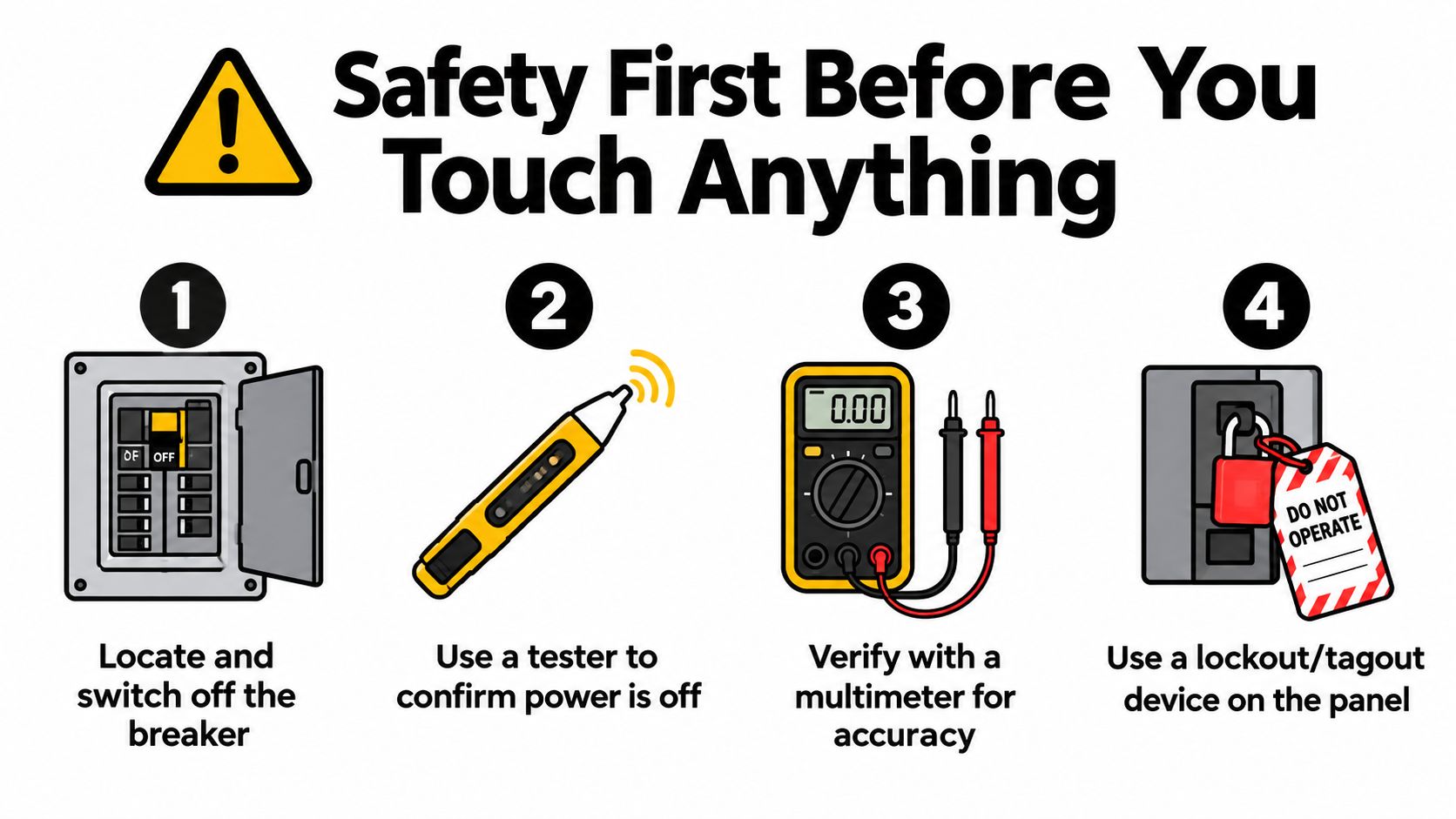
Electrical troubleshooting starts with controlling energy, not with a screwdriver. Turn the light off, keep hands dry, and make sure you have stable footing before checking the bulb or fixture. If the switch is hot, buzzing, crackling, sparking, discolored, or associated with a burning smell, don't keep testing it. Move away from the device and arrange qualified service.
What you can check without opening the box
A non-contact voltage tester can provide a useful preliminary indication near a switch or cable, but it isn't a substitute for proving a circuit dead with a properly used meter. Testers can give misleading results because of weak batteries, incorrect technique, or induced voltage. If you aren't trained to use a multimeter safely, leave live-circuit testing to an electrician.
Before removing a plate or device, identify the correct breaker and switch it off. Prevent someone else from restoring power while you work, then verify that the light is off and confirm the absence of voltage with appropriate equipment. A wall switch can share a box or circuit with other energized conductors, so turning off the light alone isn't enough.
For broader preparation, use this home electrical inspection checklist to organize visible warning signs and service questions. If you're working around a disposal or another kitchen appliance, separate air switch installation tips can help you understand why appliance controls and lighting controls may have different installation requirements.
Stop conditions matter more than confidence
Call a licensed electrician if you find scorched insulation, melted plastic, loose conductors, aluminum wiring you don't know how to handle, water intrusion, or a breaker that trips again after reset. Don't touch exposed copper, force a stuck device, or make assumptions based on wire color alone.
In Palm Beach County, a professional should also handle complex three-way and four-way circuits, shared neutrals, recurring protection-device trips, and any repair where you can't positively identify the circuit. Safety isn't improved by rushing because the room is dark.
Quick Checks That Solve Most Dead Switches
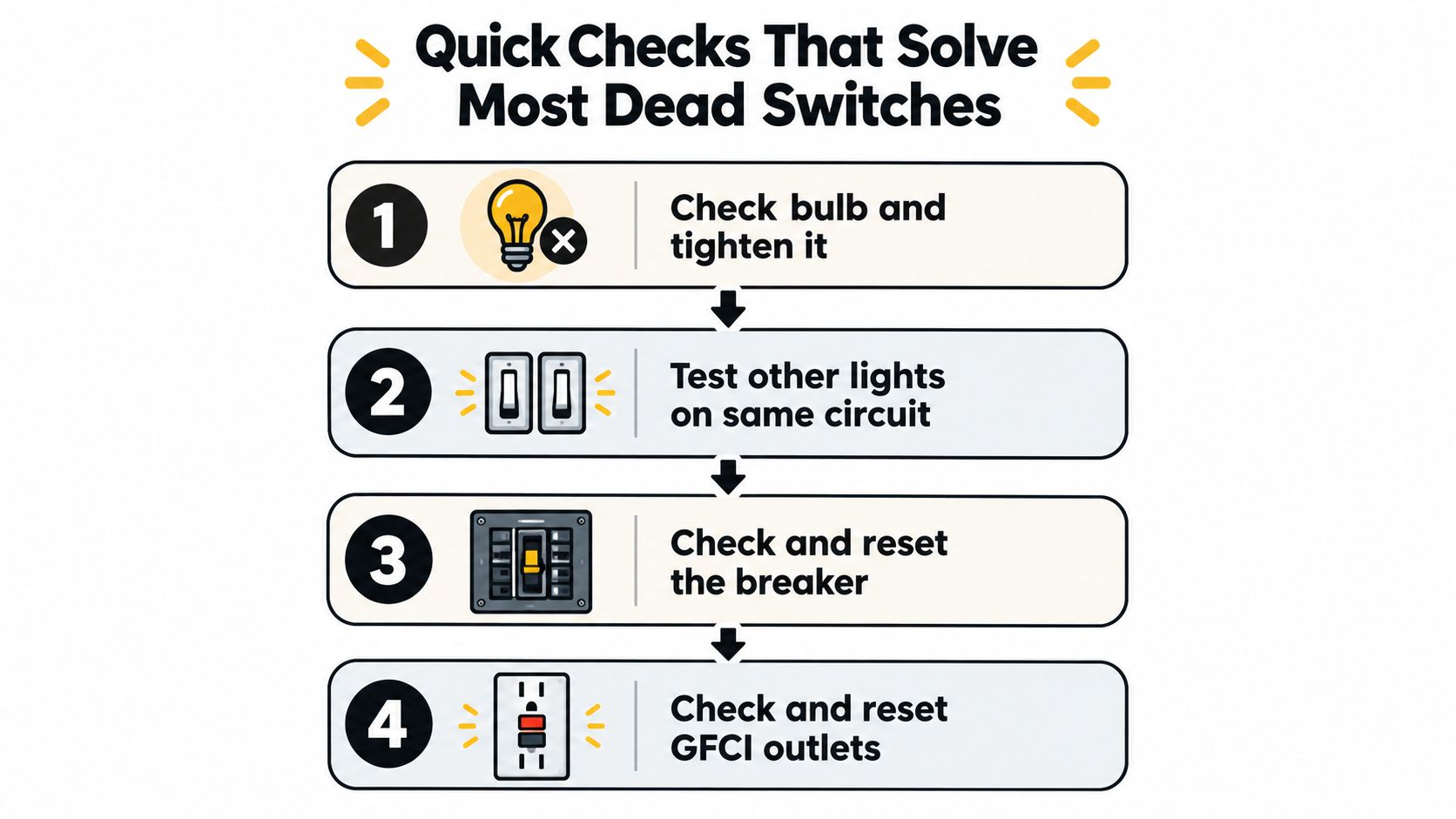
Start at the load and work backward toward the source. This sequence keeps you from disturbing sound wiring while you determine where the failure lives.
Check the bulb and fixture
Install a bulb you know works, using the correct type for the fixture. Confirm that the bulb is seated properly, but don't force it into a damaged socket. If the replacement bulb also stays dark, inspect the fixture for a loose shade, damaged socket, moisture, or a local pull chain that may be off.
If only one fixture is affected, the fault may be in the lamp, socket, switch, or wiring serving that point. If several lights or outlets in the same area are dead, broaden the search immediately.
Look for a circuit-wide failure
Test nearby lights and outlets that you believe share the circuit. A dead group suggests a source or protection issue. A single dead fixture points more narrowly toward that fixture, its switch, or a connection between them.
At the electrical panel, look for a breaker that doesn't sit in its normal position. Reset it by moving it fully to off, then back to on. Don't repeatedly reset a breaker that trips again. Repeated operation can indicate a fault or overload that needs investigation.
Find upstream protection devices
Check accessible GFCI outlets in areas such as kitchens, bathrooms, garages, exterior locations, and utility spaces. Press reset only once if the device has tripped and appears safe. An upstream GFCI can interrupt power to a light or receptacle that isn't beside it.
AFCI protection can also interrupt a lighting branch. If the breaker includes a test or reset function, follow its labeling. If it won't reset, trips immediately, or trips again when the light is used, stop there. This guide to a GFCI outlet that keeps tripping explains why repeated resets aren't a repair.
Account for multi-way switching
With three-way lighting, try both wall switches in every position. The light should respond to the combined positions, not just one particular toggle. A four-way arrangement has additional intermediate switching, so one failed device or loose connection can disrupt the whole path.
Don't assume a switch is bad because its toggle feels normal. At this stage, you should know whether the problem is isolated to one fixture, affects a circuit, follows a protection device, or involves multi-way control. That answer determines whether opening the box is sensible.
Common Reasons a Switch Fails and Warning Signs to Watch
A switch that clicks but leaves the light dead can have several causes. Mechanical wear, electrical stress, or poor connections may affect the switch, but the fault could also be at the bulb, fixture, breaker, GFCI/AFCI protection, or another switch in a three-way circuit. Identify that path before replacing anything.
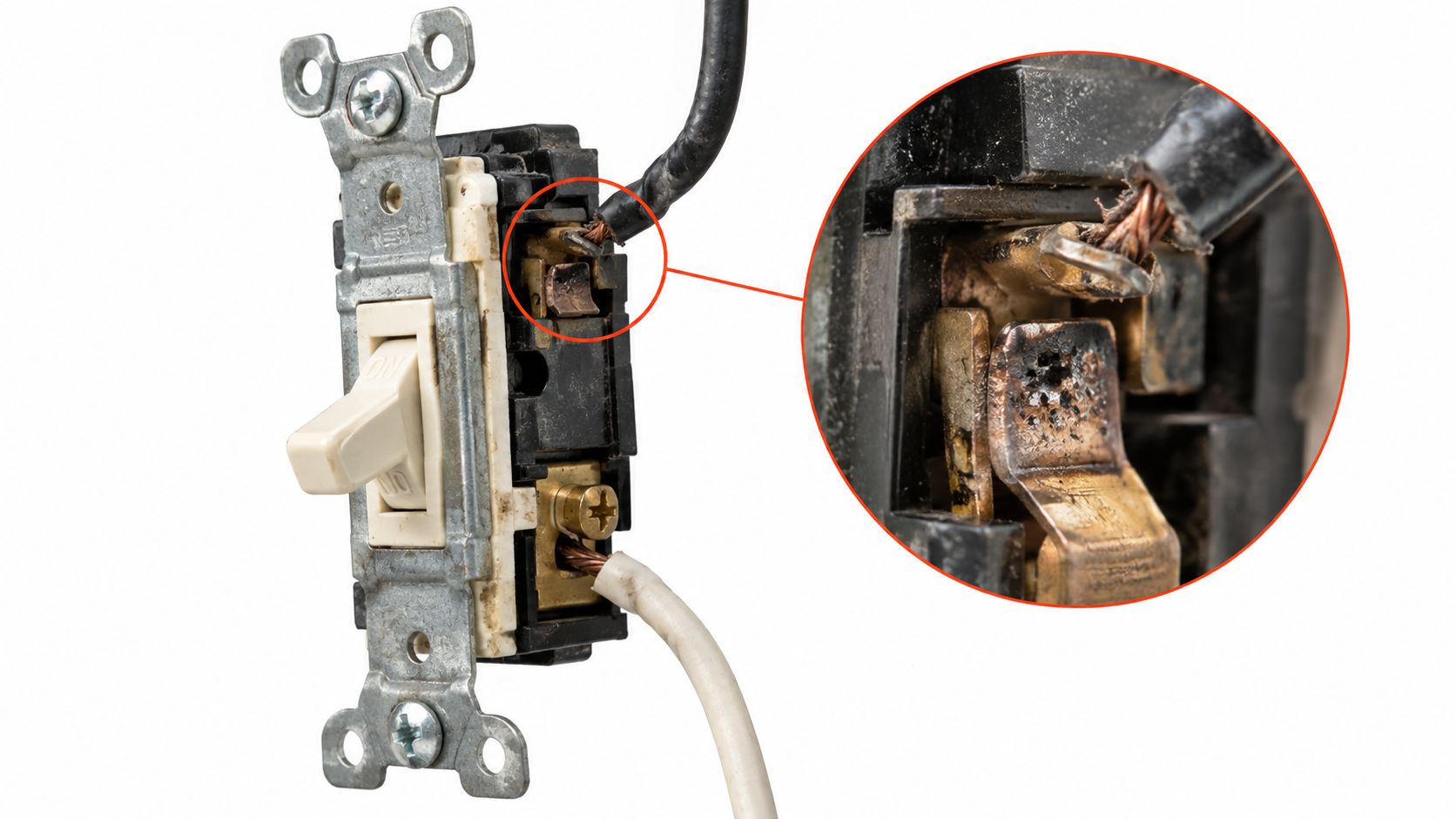
Internal contacts can wear or pit over time. The toggle may still feel normal while the contacts carry current unreliably. Loose terminal screws and backstab connections create another failure point. A conductor that is not secured can develop resistance, heat, and arcing at the switch, a wire connector, the fixture terminal, or another junction.
Heat and arcing leave clues
A healthy switch should not buzz, crackle, pop, or become hot during ordinary use. Warmth, flickering, delayed response, and intermittent operation point to resistance, damaged contacts, a loose connection, or a load that does not match the device. Discoloration around the wall plate or switch body deserves attention, especially when paired with an odor or a change in performance.
Dimmer switches need a compatibility check. The dimmer must suit the lamp type and the connected load. A mismatch can produce heat, flicker, unreliable operation, or breaker trips. Continued use can worsen contact damage.
Read the symptom before choosing the repair
Use the symptom to narrow the fault:
- A clean click with a dead light: Isolate the bulb, fixture, breaker, protection device, and wiring before condemning the switch.
- An intermittent response: Suspect worn contacts or a loose connection. Do not force the toggle.
- Heat, buzzing, crackling, odor, or marks: Turn off the circuit and leave the box closed until an electrician can inspect it.
- A failed dimmer after a lighting change: Check lamp and load compatibility instead of installing another identical device.
- A dead multi-way circuit: Confirm the three-way or four-way arrangement before disconnecting any conductors.
The repair depends on the location of the fault. A new switch will not correct a loose conductor or incompatible load. If a replacement becomes warm, noisy, or discolored, turn off the circuit and stop using it.
How to Test and Replace a Single Pole Switch Safely
A single-pole switch is a reasonable repair only after the external checks are complete and there are no warning signs. If you're unsure whether the switch is single-pole, stop. A three-way switch has a different terminal arrangement and shouldn't be replaced by copying a single-pole procedure.
De-energize and document
Switch off the breaker and verify that the light is dead. Use a suitable tester to confirm the box is de-energized, remembering that other conductors in the same box may still be live if they belong to another circuit. If you can't prove the box is safe, don't continue.
Remove the cover plate carefully. Before disconnecting anything, take a clear photograph and label the conductors so you preserve the original arrangement. Don't rely on memory, wire position, or insulation color alone. If you see heat damage, brittle insulation, crowded conductors, aluminum wiring, or unexpected splices, stop and call a professional.
Test the device with power off
After confirming the circuit is de-energized, isolate the switch conductors as appropriate and set the multimeter to continuity or resistance mode. On a healthy single-pole switch, continuity should change when the toggle moves between positions. If the reading doesn't change, the switch has failed and replacement is indicated, provided the wiring and load are otherwise suitable.
A continuity result doesn't prove that the circuit wiring is correct. It only evaluates the switch under the test conditions. Loose terminals, an open conductor, a failed fixture, or an upstream protection device can still be the cause.
Compare DIY and professional repair
A careful homeowner may be able to replace a clearly identified single-pole switch with a correctly rated device, secure terminal connections, and an undamaged box. The trade-off is that a small installation error can create a future heat or arcing problem, especially when the original fault wasn't the switch.
Professional service takes longer than swapping a device yourself, but it reduces the risk when symptoms are ambiguous. Choose a licensed electrician for three-way wiring, repeated breaker or GFCI trips, heat damage, unknown conductors, or any circuit that remains dead after a replacement. Don't restore power until the device is secured, the box is properly closed, and the circuit has been tested.
When to Call a Licensed Electrician in Palm Beach County
You reset the breaker, replace the bulb, and the switch still does nothing. Before replacing another switch, identify whether the fault is at the bulb, fixture, breaker, GFCI, AFCI, switch, or three-way wiring. A simple bulb change or one careful breaker reset may be reasonable for a homeowner. Opening the box requires more: fault complexity, warning signs, and the ability to verify power is off.
Call a licensed electrician if the breaker trips again, a GFCI or AFCI will not reset, several lights or outlets are affected, or the light is controlled from multiple locations. Stop immediately for heat damage, a burning odor, arcing sounds, sparks, discoloration, loose wiring, aluminum conductors, or an unfamiliar installation. These signs can point to a wiring, load, or protection problem beyond the wall switch.
Why recurring failure changes the answer
A switch that fails again after replacement, becomes warm, or coincides with repeated trips deserves diagnosis rather than another device swap. The underlying issue may involve workmanship, wiring, load compatibility, or circuit protection. Repeated failure is a reason to isolate the full circuit.
Before hiring anyone, review how to verify a contractor license. Ask who will perform the work, what testing the visit includes, and whether the repair addresses the cause. For burning odors, visible damage, exposed conductors, or a device that cannot be safely de-energized, contact emergency electrical service in your area and leave the circuit off.
Use this checklist:
- Safety first: Turn off the circuit and verify power before opening a box.
- Isolate the fault: Check the bulb, fixture, breaker, GFCI, AFCI, switch, and switching arrangement.
- Respect warning signs: Heat, noise, odor, sparks, and discoloration call for professional service.
- Fix the cause: Do not keep swapping switches when the circuit remains unreliable.
Lighthouse Energy Services handles residential, commercial, and industrial electrical repairs in Palm Beach County, with 24/7 response, phones answered by licensed electrical professionals, and no extra after-hours charges. If the switch remains dead or unsafe to access, visit Lighthouse Energy Services to request troubleshooting and repair.