If you're a homeowner in Palm Beach County, you know the feeling of opening a summer FPL bill and wondering how it got so high. Before you start thinking about expensive upgrades, the good news is that you can make a serious dent in that bill this month, without spending a dime.
The fastest path to savings isn't a major project; it's about changing a few key daily habits. Most people don't realize just how much electricity slips through the cracks. It's time to stop those small, consistent energy leaks that really add up.
Master Your Thermostat Settings
In South Florida, your air conditioner is the undisputed king of your energy bill. Getting your thermostat settings wrong is like trying to cool your house with the front door wide open. The goal is to find that sweet spot between staying comfortable and being efficient.
The Department of Energy has a great guideline for our hot, humid climate: try setting your thermostat to 78°F or higher when you’re home. For every single degree you raise it, you can save up to 3% on your cooling costs. When you head out for work or an errand, bumping it up to 82°F or even 85°F keeps the AC from running when nobody's there to enjoy it.
Pro Tip: A common mistake I see is people turning their AC completely off when they leave. It actually takes a massive amount of energy to cool down a sweltering, humid house from scratch. It’s far more efficient to just let the temperature rise a few degrees while you’re away.
Conquer "Vampire Loads"
Ever notice the little lights on your TV, coffee maker, or game console, even when they’re off? That’s “vampire load,” and it’s a silent energy drain. These electronics are in standby mode, constantly pulling a small amount of power, and it can account for a shocking 10% of your total electricity use.
The easiest fix is to plug your home office or entertainment center devices into a power strip. When you're done for the night, one flick of the switch cuts them all off completely. No more paying for power you aren't even using.
Make Friends with Your Fans
Ceiling fans are your secret weapon for feeling cooler without actually dropping the thermostat. The air movement creates a wind-chill effect on your skin, making the room feel several degrees cooler than it really is. This lets you comfortably set your thermostat a bit higher.
But here’s the crucial part: fans cool people, not rooms. A fan spinning in an empty room is just wasting electricity. Get in the habit of turning it off every time you leave. This simple change reduces your AC's workload, which is what really drives your bill down.
Perform Simple Appliance Maintenance
Your major appliances can’t work efficiently if they’re struggling against dirt and grime. A few minutes of basic upkeep can make a surprising difference in how much power they consume.
Refrigerator Coils: Those coils on the back or bottom of your fridge are designed to release heat. When they get caked with dust and pet hair, the compressor has to work overtime. Just vacuum them clean once or twice a year.
Dryer Vent: A clogged lint trap isn't just a fire hazard; it chokes off airflow and makes your dryer run longer to get clothes dry. Clean the filter after every single load, and have the main vent duct professionally cleaned once a year.
Dishwasher Filter: Check and clean your dishwasher's filter. A clean filter helps it get the job done on the first cycle, so you don't have to waste water and electricity running it again.
These are all simple DIY tasks. However, if you're dealing with issues like flickering lights when an appliance kicks on or breakers that trip frequently, it could signal a bigger electrical problem. It's always good to know when to call a professional, and you can learn more from our guide on essential home electrical repair tips. By tackling these quick fixes first, you build a strong foundation for even greater savings in the future.
Your Air Conditioner: The Biggest Drain On Your Wallet
Living here in Palm Beach County, that constant hum of the air conditioner is just a fact of life. But it's also the single biggest reason your electricity bill can feel so punishing. In our sweltering climate, your AC unit is often responsible for up to 50% of your total summer energy use. That makes it the first—and best—place to look for serious savings.
If you really want to lower your power bill, you have to get a handle on this one appliance. Sure, bumping up the thermostat a degree or two helps, but the most impactful savings come from making the system itself more efficient. It’s about looking past the thermostat and focusing on how the machine actually uses (and wastes) power.
Start with the Basics: Clean Filters and Professional Tune-Ups
Before you even think about major upgrades, don’t overlook the simple stuff. A dirty, clogged air filter forces your AC to work much, much harder to cool your home. It’s like trying to breathe through a straw. Just swapping it out can boost the unit’s efficiency by 5-15% almost instantly.
Next, get a professional tune-up on the calendar. Think of it as an annual checkup for the hardest-working appliance in your house. A good technician will clean the coils, verify refrigerant levels, and calibrate everything to run at its best. This not only saves money month after month but also spots small issues before they turn into a full-blown system failure in the middle of a July heatwave.
This infographic shows just how much these small changes, along with tackling phantom power draws, can add up.
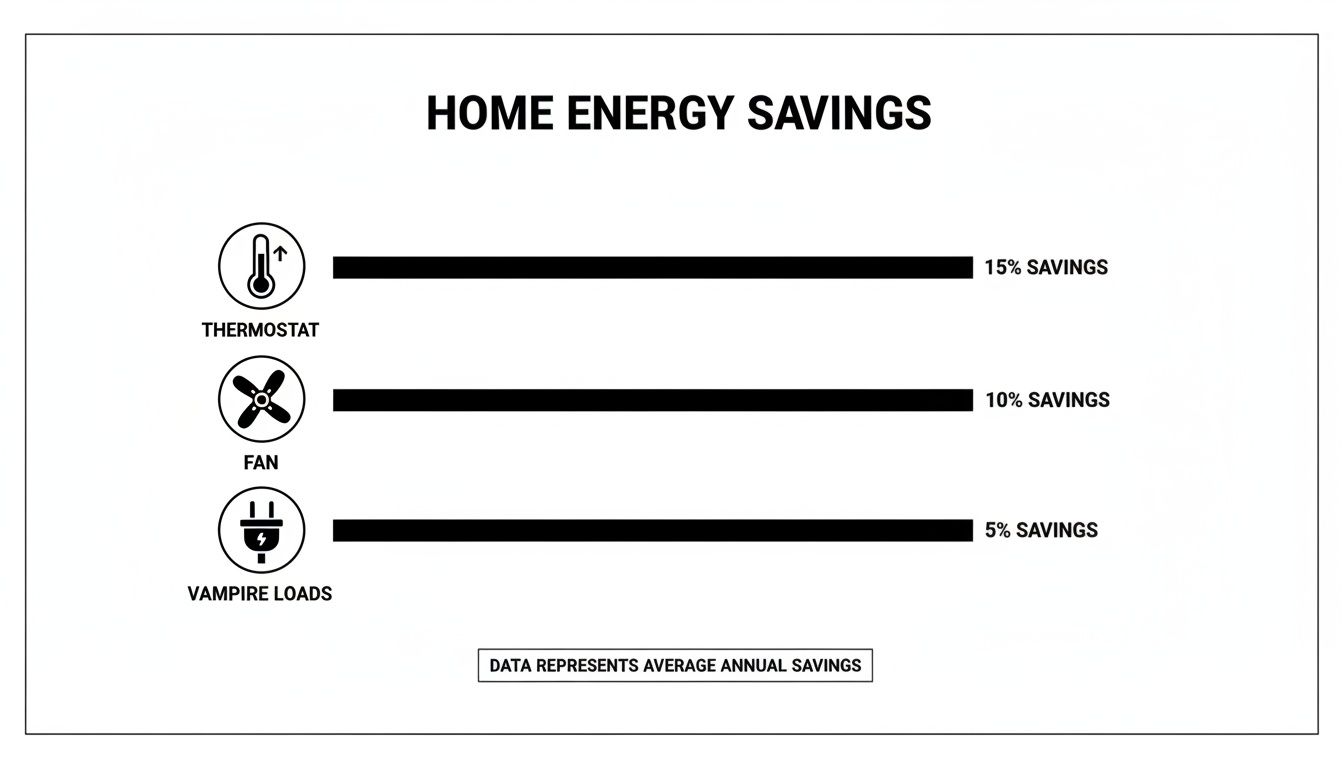
As you can see, optimizing your thermostat, using fans, and managing what's plugged in are all key pieces of the puzzle.
The Smartcool ECO3: A Major Leap in AC Efficiency
Once your system is clean and tuned up, it's time to make it smarter. This is where a device like the Smartcool ECO3 comes into play. It’s an intelligent optimization module that we install directly onto your existing AC system. It doesn’t replace your thermostat; it works with it, making your compressor run far more efficiently behind the scenes.
In simple terms, the ECO3 watches your compressor’s cycles and intelligently shortens its run times. It figures out the absolute minimum the compressor needs to run to keep you cool and comfortable, effectively cutting out wasted energy.
By preventing unnecessary compressor activity, the Smartcool ECO3 can reduce your air conditioner's electricity consumption by up to 25%. This isn't just a minor adjustment—it's a massive cut aimed squarely at the biggest energy hog in your home.
A Real-World Palm Beach County Example
Let's put that into real numbers for a typical 2,000-square-foot home in Boca Raton. Over the summer, that AC unit runs for hours on end, easily chewing through 3,000 to 5,000 kWh of electricity each year. A 25% improvement saves you between 750 and 1,250 kWh annually. With local FPL rates hovering around 14 cents per kWh, that’s a real saving of $105 to $175 back in your wallet every single year.
Now, imagine you’re a property manager for a Jupiter HOA or a commercial building in West Palm Beach. Those savings multiply across every single unit, potentially cutting community or operating bills by thousands of dollars.
The Winning Combination for Maximum Savings
The absolute best results come from stacking your strategies. A Smartcool ECO3 performs even better when your home is properly sealed and your attic can breathe. Good ventilation is crucial for getting rid of trapped heat, which lightens the load on your AC even further. You can learn more about how that works by checking out our guide on the cost and benefits of attic fan installation.
When you combine regular maintenance, smart tech like the ECO3, and proper home sealing, you create a truly efficient cooling system. You're not just chipping away at your bill; you're fundamentally changing how your home consumes power. And getting it all done by a professional, licensed electrician ensures it's done right, safely, and with no surprise fees.
Smart Lighting and Appliance Upgrades That Pay for Themselves
Once you've gotten your air conditioner running as efficiently as possible, the next place to look for big savings is your home’s lighting and major appliances. Think of these as long-term investments that start paying you back from the moment you install them through lower energy use. This isn't about spending a lot of money; it's about spending it strategically on upgrades that make a real dent in your daily electricity consumption.
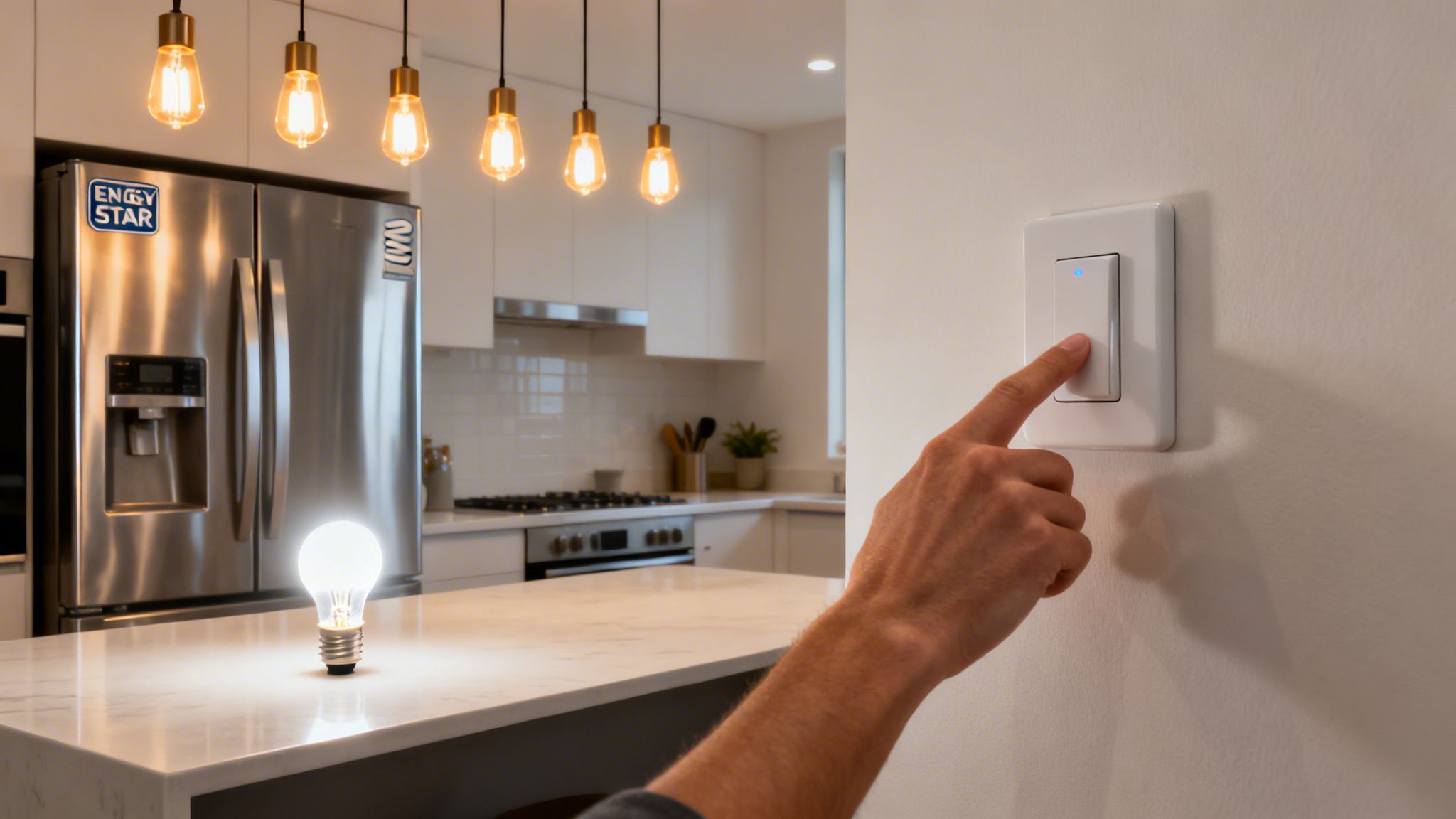
One of the easiest yet most powerful upgrades is something many people still overlook: their light bulbs. If you’re still using old incandescent bulbs, you’re basically lighting your home with tiny, inefficient heaters. Making the jump to modern LED lighting is one of the smartest moves you can make to lower your electricity bill.
The No-Brainer Case for LED Lighting
Switching to LED lighting is a true game-changer. Why? Because these bulbs use up to 75% less energy and can last an incredible 25 times longer than the old bulbs they replace. For a typical Palm Beach County home, that small change adds up to very real, very noticeable savings. With global electricity consumption projected to hit record highs by 2026, making our own homes more efficient is more important than ever—you can read more on these global energy trends and what they might mean for future costs.
Just consider a home with about 30 light bulbs running for a few hours each day. Swapping them all out for LEDs can save between 300 and 500 kWh over a year. At our local rates, that’s an extra $40 to $70 back in your pocket annually.
A simple table really puts the savings into perspective.
Annual Cost to Power Your Home Lighting
Here's a quick comparison showing the estimated annual cost to light a typical home with old-school incandescent bulbs versus modern, energy-efficient LEDs.
| Bulb Type | Number of Bulbs | Annual Energy Use (kWh) | Estimated Annual Cost (@ $0.14/kWh) |
|---|---|---|---|
| Incandescent | 30 | 657 kWh | $92 |
| LED | 30 | 99 kWh | $14 |
As you can see, the difference is stark. Over a decade, that simple switch could easily save you nearly $800.
For our commercial clients, the results are even more striking. I've seen retailers and warehouse owners in Palm Beach retrofit their entire facility to LEDs and see a complete return on their investment in just 6 to 12 months.
Beyond the Bulb: Smart Lighting Controls
To squeeze even more savings out of your lighting, don't just stop at the bulbs—look at the switches. Installing smart lighting controls adds another layer of efficiency that does the work for you.
- Dimmers: These are great for setting the mood, but they're also secret energy savers. Even running a light at 75% brightness can cut the electricity used by that fixture by about 20%.
- Motion Sensors: These are a must-have for areas where lights get left on accidentally—think hallways, laundry rooms, and closets. A motion sensor ensures the light is only on when it's needed, which can slash energy waste in that specific area by 30-50%.
A qualified electrician can get these upgrades installed quickly, integrating them right into your existing setup for maximum savings without any hassle.
Choosing Your Next Generation of Appliances
When it's finally time to replace a major appliance like your refrigerator, dishwasher, or washing machine, don't just shop for cool features—shop for efficiency. The key is to look for that little blue ENERGY STAR label.
An appliance with the ENERGY STAR certification has been independently verified to save energy without sacrificing performance. For example, a new ENERGY STAR refrigerator uses about 9% less energy than a standard model that just barely meets the minimum federal requirements. Since your fridge runs 24/7, that 9% adds up to a surprising amount of savings over the appliance’s lifetime.
When you start combining these upgrades—efficient LED bulbs, smart switches, and ENERGY STAR appliances—you create a home that works smarter, not harder. Every upgrade pays for itself over time, continuously trimming your home electricity bill while making your home more modern and reducing your carbon footprint.
Sealing Your Home to Stop Wasting Energy
Once you've tuned up your AC and other major appliances, the next place to find serious savings is by plugging the hidden leaks in your home's "envelope." Think of it this way: your air conditioner works hard to make your home cool and comfortable. But if you have gaps and cracks around windows and doors, you're basically paying to air-condition the outdoors.
All that expensive, cool air escapes, forcing your AC to run nonstop just to keep up. It's a losing battle.
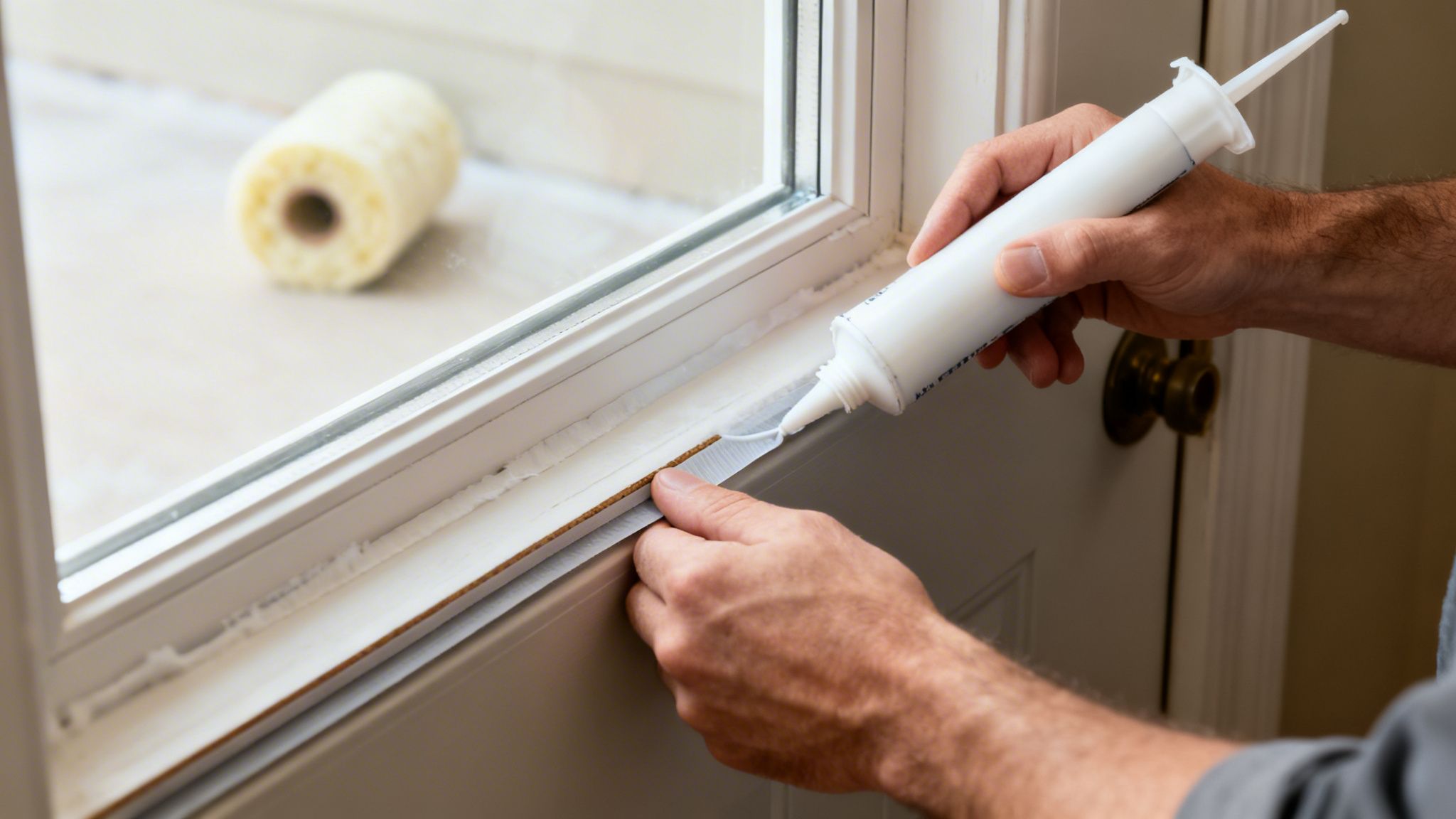
This is precisely why air sealing and proper insulation are so crucial, especially here in sunny South Florida. Every tiny gap is a highway for cool air to escape and hot, humid air to creep in. Sealing these leaks is hands-down one of the most effective DIY projects you can do to slash your energy use.
Conduct Your Own DIY Energy Audit
So where do you even start? You don’t need any fancy thermal cameras to find the worst offenders. A little detective work on a weekend afternoon will point you right to the problem spots.
Here's a quick checklist of common culprits I see in homes all over Palm Beach County:
- Windows and Doors: Run your hand along the frames. Can you feel a draft? Check the exterior for old, cracked caulk and inspect the weatherstripping to see if it’s brittle or compressed.
- Electrical Outlets and Switches: This is a classic trick. On a breezy day, hold a thin piece of tissue paper near an outlet on an outside wall. If it flutters, you’ve got an air leak.
- Attic Hatch: These are notoriously leaky and poorly insulated. Feel around the edges—if it feels warmer than the surrounding ceiling, it’s leaking conditioned air into your sweltering attic.
- Plumbing and Ductwork: Look where pipes and HVAC ducts go through walls or floors. These penetrations often have large, unsealed gaps around them.
Once you’ve got your list of leaky spots, it's time to seal them up. This simple step stops the constant cycle of your AC re-cooling the same air over and over.
Practical Steps for Sealing Air Leaks
The good news is that fixing most of these leaks is a straightforward job. It just takes a trip to the hardware store and a bit of your time. For a small investment, you'll feel a real difference in your home's comfort and see it on your FPL bill.
For stationary gaps—think window and door frames or where a pipe enters a wall—caulk is your go-to solution. Get a good quality exterior-grade caulk to create a durable, flexible seal that will block air and water for years.
For the moving parts, like the edges of the doors and windows themselves, you'll need weatherstripping. It comes in many forms, from simple peel-and-stick foam tape to more robust V-strip vinyl. The goal is to create a snug seal when everything is closed.
According to the U.S. Department of Energy, a combination of air sealing and adding insulation can save homeowners up to 15% on their heating and cooling costs. For a typical Palm Beach County residence, that’s a significant reduction.
The Critical Role of Attic Insulation
While plugging small gaps is important, your attic insulation is the single biggest player in protecting your home from Florida’s heat. All day long, the sun beats down on your roof, turning the attic into an oven that can easily top 150°F.
Without enough insulation, all that heat radiates straight down into your living space.
This is what makes your air conditioner work overtime. Think of proper attic insulation as the shade of a big oak tree for your entire house—it blocks the heat before it ever gets in, keeping your home naturally cooler.
The performance of insulation is measured by its R-value. The higher the number, the better it resists heat. For our climate zone (Zone 2), you want an R-value of at least R-30 in your attic, though R-38 is even better. I've seen countless older homes that are drastically under-insulated. Adding more is a foundational investment that will reduce your home electricity bill for many years to come.
When to Call A Licensed Electrician for Energy Savings
Many of the best ways to lower your electricity bill are simple weekend projects. But some of the most powerful upgrades—the ones that deliver major, long-term savings—are best left to a professional. Knowing when to step back and call a licensed electrician is crucial, not just for convenience, but for your family’s safety.
Tackling complex electrical work yourself is a huge gamble. A single mistake can lead to fire hazards, fry expensive appliances, or result in code violations that create problems down the road. It’s just not worth the risk.
Projects That Demand Professional Expertise
So, when is it time to call in a pro? If your home’s electrical panel is old, still uses fuses, or has breakers that constantly trip, it's a clear sign you need an expert. An outdated panel can’t safely handle the demands of modern, energy-efficient appliances, making it a serious fire risk and a bottleneck for your home’s performance.
Here are a few upgrades that should always be handled by a licensed electrician:
- Electrical Panel Upgrades: This is a big one. Replacing an undersized or outdated service panel is a complex job that’s absolutely critical for safety and efficiency.
- Dedicated Circuit Installation: High-powered equipment like a new EV charger or even some modern electric dryers need their own circuit to run safely without overwhelming your system.
- Advanced Smart Home Wiring: Plugging in a smart display is easy. But hardwiring smart switches, integrated dimmers, and other advanced devices into your walls requires real electrical know-how.
A perfect example of a job for the pros is installing the Smartcool ECO3. This innovative device wires directly into your air conditioner to optimize its compressor cycles. With a professional installation, you can achieve a potential 25% reduction in AC energy costs and ensure your system's warranty remains intact.
The Value of Getting It Done Right
Improper electrical work is one of the most dangerous DIY projects a homeowner can attempt. A licensed electrician brings the training, tools, and experience needed to navigate your home's complex wiring safely and correctly.
Think of hiring a professional not as an expense, but as an investment in your home’s safety and long-term energy performance. A job done right ensures your new upgrades actually deliver the savings you expect.
At Lighthouse Energy Services, our licensed professionals are available 24/7 to handle these crucial upgrades. We believe in honest, upfront pricing with no surprise fees for after-hours calls. When you contact us, you’ll speak directly with an expert who can diagnose the issue and get your service scheduled.
For homeowners from Jupiter to Boca Raton, having a trusted local electrician makes all the difference. We understand the specific needs of homes in our area and know the local building codes inside and out. If you’re thinking about any of these projects, our guide on hiring an electrician for your home is a great place to start. It will give you the confidence you need to move forward with your energy-saving upgrades.
Your Top Questions About Lowering Your Electric Bill, Answered
When it comes to cutting your home electricity bill, the sheer amount of advice out there can feel overwhelming. We get it. As electricians working with homeowners across Palm Beach County every day, we hear the same questions time and again.
So, let's cut through the noise. Here are the straightforward answers you need to start saving money.
What’s the Single Biggest Thing I Can Do to Lower My Electric Bill in Florida?
Your air conditioner. Full stop.
Here in Florida, your AC is the undisputed king of energy consumption, often gobbling up 50% or more of your electricity during our long summers. It's the biggest piece of the pie, so it’s the best place to find real savings.
Sure, setting your thermostat to 78°F and keeping up with regular filter changes and maintenance are great habits. But if you want to make a serious dent, you have to improve the efficiency of the machine itself. Installing a device like the Smartcool ECO3, for example, optimizes your AC's compressor cycles and can slash its energy use by up to 25%. It's a targeted upgrade that delivers consistent savings right where it counts the most.
Are Smart Thermostats Actually Worth the Money?
For most families, yes, a smart thermostat is a fantastic investment. They go way beyond old-school programmable models by actually learning your household's daily rhythms. They automatically adjust the temperature when you’re out or asleep, so you're not paying to cool an empty house.
Plus, you get all that great data on your phone and the ability to tweak the temperature from anywhere. It's perfect for our hectic, unpredictable schedules.
When you pair a smart thermostat with an AC that’s already running efficiently, you create a powerful combination. It can easily knock another 10-15% off your annual cooling costs. The convenience and control, plus the real savings, mean most people see them pay for themselves in a year or two.
How Do I Find Local Rebates for Energy-Efficient Upgrades?
This is a great question because leaving free money on the table is never a good idea. Finding local incentives can significantly lower the upfront cost of energy-saving projects.
Here’s where we always tell our clients to look:
- Your Utility Provider: Start with your power company’s website. Florida Power & Light (FPL) has a whole section dedicated to residential programs, offering rebates on everything from new AC units to insulation and smart thermostats.
- National Databases: Websites like the ENERGY STAR rebate finder and the DSIRE database are goldmines. Just pop in your zip code, and they’ll show you a list of available programs.
A quick pro-tip: A good local contractor should be on top of all the current rebates. We always make it a point to guide our customers through the application process for any qualifying equipment we install. It just makes the whole process that much easier.
Besides My AC, What Else Is Driving Up My Bill?
Once you’ve got the AC handled, the next biggest energy hogs are almost always your water heater, your washer and dryer, and your refrigerator. The good news is you can tackle them with a few simple tweaks.
First, head to your water heater and set the temperature to 120°F. Any hotter is usually just wasting energy to heat water you’ll never use. While you’re thinking about hot water, start washing your clothes in cold water. Heating the water is one of the biggest energy draws for any washing machine.
As for your other major appliances:
- Dryer: Get into the habit of cleaning the lint trap after every single load. It’s a small thing, but a clean trap helps clothes dry faster, which means shorter run times.
- Refrigerator: Check the rubber seals around the doors to make sure they’re tight. Then, take a look at the coils on the back or bottom—if they're covered in dust, a quick vacuum can make the unit run more efficiently.
- "Vampire" Loads: Don't forget all the electronics lurking in the background, sipping power even when they're "off." Plugging your TV, game consoles, and computer setups into a smart power strip is an easy fix. One click, and you cut them all off from the source.
Ready to take control of your electricity bill with a team you can trust? The licensed electricians at Lighthouse Energy Services have helped homeowners all over Palm Beach County make their homes more efficient. From installing the Smartcool ECO3 to handling complete panel upgrades, we're here to help 24/7. Get your free quote today by visiting us at https://lighthouseenergyco.com.