
A standard home electrical inspection in 2026 typically costs $100 to $200 nationwide, with a national average around $150. Broader estimates from $75 to $500 reflect differences in inspection scope, home age, accessibility, and specialty testing.
You're probably asking because a sale is approaching, an insurer wants documentation, or something in the house has started acting strangely. Maybe the breaker trips when the air conditioner and kitchen appliances run together. Maybe you've found an older panel, warm switch plate, or wiring that doesn't look like anything installed today.
In Palm Beach County, the quote matters, but the scope matters more. A low price can be reasonable for a small, accessible condo with a modern panel. It can also mean the electrician is only performing a quick visual check. Older South Florida homes, coastal exposure, crowded panels, inaccessible attics, and questionable past renovations demand more time and better documentation.
The practical way to compare the home electrical inspection cost is to ask one question first: What decision will this inspection help me make? A routine safety check, a buyer's pre-purchase evaluation, an insurance compliance report, and an infrared scan aren't interchangeable services.
Table of Contents
- What a Home Electrical Inspection Actually Covers
- Average Home Electrical Inspection Cost in 2026
- Key Factors That Drive Your Final Price
- Matching the Inspection Type to Your Reason for Calling
- Realistic Quote Examples for Palm Beach County Homes
- DIY Safety Checks Versus a Licensed Electrician
- Practical Ways to Keep Your Inspection Affordable
- Choosing a Trusted Local Electrical Inspector
What a Home Electrical Inspection Actually Covers
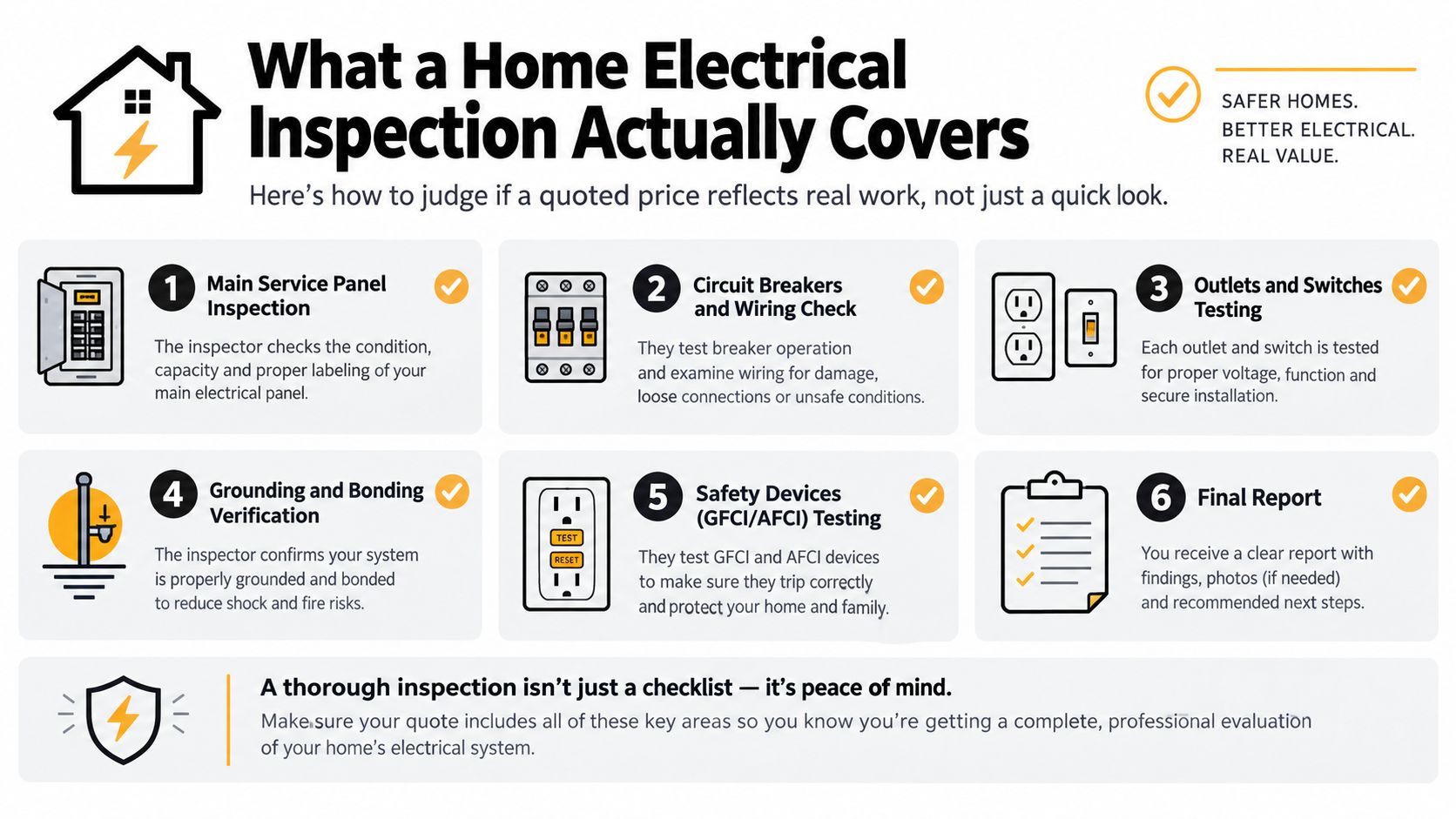
A professional inspection starts where electrical service enters the home, not at the first convenient outlet. The electrician examines the main service panel, confirms its amperage rating, checks breaker compatibility, looks for scorching or corrosion, and identifies problems such as double-lugged breakers or missing labels. In a South Florida home, moisture and salt-air exposure can make panel condition especially important.
The inspection then follows power through the property. At receptacles and switches, the electrician tests polarity, grounding continuity, and operation. Kitchens, bathrooms, garages, exterior outlets, and other locations where electricity meets moisture receive particular attention because GFCI protection is a central safety checkpoint. AFCI protection may also be reviewed where applicable to the installation and inspection purpose.
Practical rule: A quote should tell you whether the electrician will test circuits and safety devices, or merely look at visible components.
Grounding and bonding deserve more than a passing glance. The electrician may inspect bonding at accessible water piping, grounding electrode connections, service conductors, and the relationship between the panel and the grounding system. Fault current needs a reliable path back to the source so protective devices can operate as intended.
The visible wiring review
The electrician checks accessible wiring, junction boxes, cable condition, box fill, splices, and signs of overheating. Older homes may contain aluminum branch wiring or legacy wiring methods that require additional investigation. The inspector shouldn't open finished walls without authorization, but accessible attic, crawl-space, garage, and panel areas can reveal whether renovations were completed cleanly.
The visit should finish with a written report. A useful report identifies deficiencies, photographs significant findings, distinguishes urgent hazards from maintenance items, and explains recommended corrections. If you're preparing for a sale or insurance review, ask whether the report is designed for that purpose before scheduling.
For broader household risk planning, read this guide from My Policy Quote alongside a dedicated electrical assessment. You can also use this home electrical inspection checklist to prepare questions and document areas the inspector needs to access.
Average Home Electrical Inspection Cost in 2026
For most homeowners, the realistic starting point is $100 to $200, with national averages clustering near $150. HomeGuide cites an average of $145, while broader consumer pricing references commonly place the average around $175. Angi and HomeAdvisor pricing guidance also centers typical inspections around $150, and a quote-based review found an average of $125 from 589 licensed-inspector quotes, with a range of $66 to $183. See the HomeGuide electrical inspection cost data for the national baseline.
Those figures describe a standard inspection, not every service sold under the same name. A broader market range of $75 to $500 includes differences in home size, age, access, documentation, and specialty testing. Standard inspections often remain within $100 to $200, while full-home work commonly reaches $250 to $400, and specialty or infrared inspections can approach $500 or more, as outlined in HomeAdvisor's electrical inspection pricing guide.
| Source | Low Range | Average | High Range | Notes |
|---|---|---|---|---|
| HomeGuide | $100 | $145 | $200 | Standard inspection pricing, with broader estimates based on scope |
| Angi | $125 | $150 | $175 | Typical national pattern for routine service |
| HomeAdvisor | $100 | $150 | $400+ | Wider range when inspection depth and property complexity increase |
| Quote-based analysis | $66 | $125 | $183 | Based on 589 licensed-inspector quotes |
A Palm Beach County quote should be judged against that framework, not against a single advertised average. A small condo with easy panel access may fall near the routine baseline. A larger home with corrosion, older wiring, multiple panels, or limited attic access belongs closer to the higher end.
What the base fee should include
Ask whether the quoted price includes panel inspection, receptacle and switch testing, GFCI and AFCI checks, grounding review, visible wiring assessment, and a written report. Travel, permit research, thermal imaging, destructive access, and repair work may be separate.
If you manage projects or need to organize labor and material estimates, Exayard for electrical estimating can provide useful estimating context. For homeowners, the more important step is getting the inspection scope in writing. Keep inspection pricing separate from repair decisions, and review expected repair categories through this guide to electrical repair cost.
Key Factors That Drive Your Final Price
The size of the house affects how many circuits, devices, panels, and accessible areas the electrician must review. A compact property with one panel and straightforward access usually takes less time than a large home with several additions and detached structures. More equipment means more testing and more documentation, not more rooms to walk through.
Age is often the bigger pricing trigger. Older homes may require additional time to identify aluminum branch wiring, knob-and-tube remnants, deteriorated insulation, obsolete panels, or undocumented alterations. Pricing references commonly list $50 to $200 add-ons for age-related or specialty checks, while more involved assessments can reach $300 to $600. These figures are summarized in this electrical inspection cost analysis.
Accessibility changes the bill. A blocked panel, tight crawl space, unfinished attic, locked electrical room, or heavy storage around equipment slows the visit. If the inspector can't safely reach a component, the report may have to identify it as unverified rather than inspected.
| Factor | Typical Price Impact | Why It Changes the Quote |
|---|---|---|
| Home size | Base fee to higher scope pricing | More circuits, devices, panels, and documentation |
| Older construction | $50 to $200 add-on | Legacy wiring and older equipment require extra evaluation |
| Attic or crawl-space access | $50 to $200 add-on | Difficult access increases labor and safety time |
| Specialty wiring assessment | Up to $300 to $600 | Aluminum or legacy wiring may require focused documentation |
| Urgent scheduling | $50 to $200 surcharge | Same-day or emergency work disrupts normal scheduling |
| Complex property | $400 or more total | Multiple systems and structures expand inspection scope |
Panel condition can also change the assignment. A fuse box, damaged enclosure, obsolete equipment, or a panel with visible corrosion may require a more detailed review. The electrician may need to document labeling, breaker fit, conductor condition, and signs of overheating instead of recording a simple pass-through observation.
Permit history is another hidden variable. Unpermitted additions or remodels can turn a routine inspection into a code-compliance review, especially when the inspector must trace circuits and compare visible work with available records. If the inspection is connected to a planned electrical panel upgrade, ask for a separate inspection price and project estimate so the two services aren't blended.
Matching the Inspection Type to Your Reason for Calling
The right service depends on the decision in front of you. Paying for a basic inspection when an insurer needs a formal hazard report creates a second appointment and another fee. Paying for an advanced scan when you only need routine maintenance may waste money.
| Inspection Type | Typical Cost | Best For | Key Coverage |
|---|---|---|---|
| Basic safety inspection | $100 to $200 | Routine maintenance or a quick pre-sale review | Visible wiring, panel condition, receptacles, switches, and safety-device testing |
| Full pre-purchase inspection | $250 to $400 | Buyers evaluating a property before closing | Broader system review, circuit identification, panel assessment, and documentation |
| Insurance compliance inspection | $150 to $300 | Renewal requests or coverage questions | Written documentation of hazards and insurer-relevant equipment |
| Infrared thermal scan | $250 to $500 | Suspected heat issues or high-risk equipment | Thermal review of panels and accessible electrical components |
A basic safety inspection fits a homeowner who wants a professional review of visible components, outlets, switches, panel condition, and protective devices. It's also a sensible starting point before listing a home when no specific defect has been identified.
A full pre-purchase inspection makes more sense when you're buying an older, renovated, unusually large, or electrically complicated property. Request circuit mapping and a clear report. A buyer shouldn't assume that a general home inspection has performed the same electrical testing as a licensed electrician.
An insurance compliance inspection is document-driven. If an insurer asks about a panel type, aluminum wiring, ungrounded receptacles, or other hazards, tell the electrician exactly what documentation is required. The inspector should know the requested format before arriving.
An infrared scan is a targeted diagnostic service. It can help identify abnormal heat patterns that a visual inspection won't show, but it isn't a substitute for ordinary electrical testing. Use it when there is a reason to investigate heat, load, or connection concerns.
Realistic Quote Examples for Palm Beach County Homes
A quote makes more sense when you compare it with the property behind it. The following examples are practical anchors for Palm Beach County homeowners, not universal price promises. Access, documentation requirements, and the electrician's confirmed scope can move each figure.
A 1,200-square-foot Boca Raton condo built in the late 1990s has a modern panel, straightforward access, and no reported electrical symptoms. A basic safety inspection at $150 flat is reasonable because the electrician can reach the equipment and test the relevant devices without extensive tracing or specialty work.
A 2,400-square-foot Jupiter home built in 1978 presents a different assignment. The property has a 150-amp panel and partial aluminum branch wiring, so a buyer requesting a full pre-purchase inspection should expect a more detailed visit. A $375 quote can make sense when it includes aluminum wiring evaluation, circuit mapping, panel documentation, and a buyer-ready report.
A 3,000-square-foot West Palm Beach fixer-upper with a Federal Pacific panel requires still more attention when the purpose is insurance compliance. A $425 quote is understandable if the electrician removes the panel cover, documents visible hazards, evaluates the surrounding system, and prepares the insurer's written report.
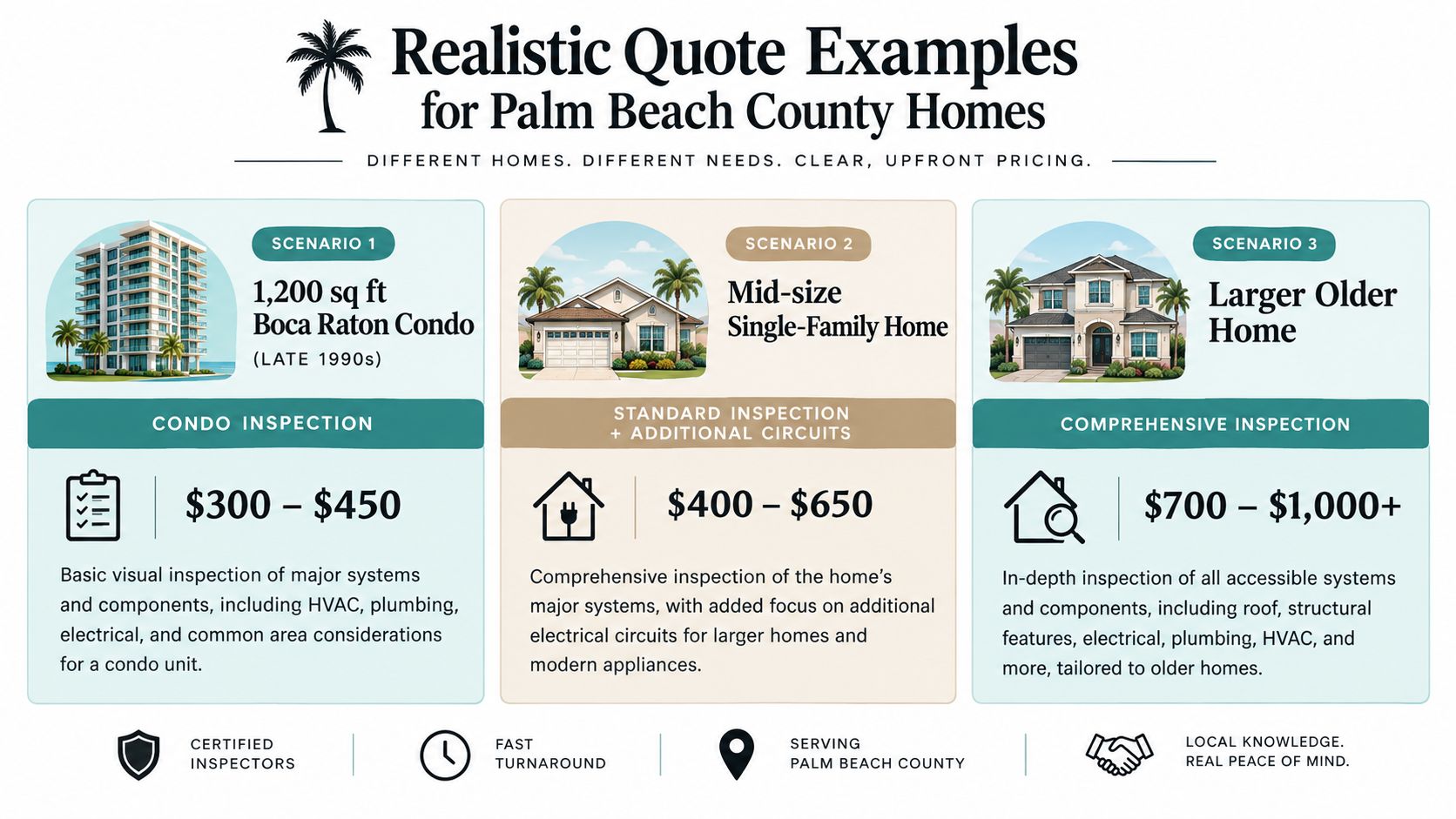
The important comparison isn't just the dollar amount. Ask what the electrician is doing, whether the report meets the buyer's or insurer's requirements, and which areas remain outside the scope. A cheaper quote may cover fewer circuits, omit thermal testing, exclude difficult access, or provide little documentation.
Compare scope, not slogans: Two electricians can quote different prices and both be honest. The problem starts when one homeowner compares a basic visual check with a full documented evaluation as though they're the same product.
DIY Safety Checks Versus a Licensed Electrician
Homeowners can perform useful observations, but a personal walk-through isn't an electrical inspection. You can press the test button on a GFCI device, look for discolored covers, listen for buzzing, and note breakers that trip repeatedly. Those checks can help you report symptoms accurately, but they don't verify the entire system.
A licensed electrician can test polarity and grounding, inspect terminations, evaluate accessible wiring, review panel condition, and prepare documentation for a transaction or insurer. Some assignments may also require load calculations, torque verification, or thermal readings. A homeowner shouldn't remove a panel cover or disturb wiring to imitate that work.
| Task | DIY Safe | Licensed Required | Why It Matters |
|---|---|---|---|
| Press the built-in GFCI test button | Yes, with dry hands | No | Confirms whether the device trips during a basic user test |
| Look for warm covers or burning odors | Yes, without touching damaged equipment | No | Identifies warning signs that need professional attention |
| Test outlet polarity and grounding | Limited observation only | Yes | Requires electrical testing equipment and interpretation |
| Remove a panel cover | No | Yes | Exposes energized components and creates shock and arc hazards |
| Perform load calculations | No | Yes | Requires system knowledge and proper measurements |
| Produce an insurance or sale report | No | Yes | Buyers and insurers often need professional documentation |
Safety preparation doesn't include opening equipment, tightening terminals, replacing breakers, or probing unknown wiring. If you notice heat, smoke, a burning smell, sparking, or persistent buzzing, stop using the affected equipment and arrange professional service.
Homeowners who want to understand a specific circuit can review information about proper 20A receptacle wiring, but educational material doesn't authorize electrical work. In Palm Beach County, panel work and other regulated electrical work should be handled through the appropriate licensed professional and permitting process.
A roughly $150 routine inspection can provide safety findings and documentation, while skipping it leaves hidden defects undiscovered. The cost of an inspection is controlled and visible. The cost of an emergency caused by an overlooked panel or connection is not.
Practical Ways to Keep Your Inspection Affordable
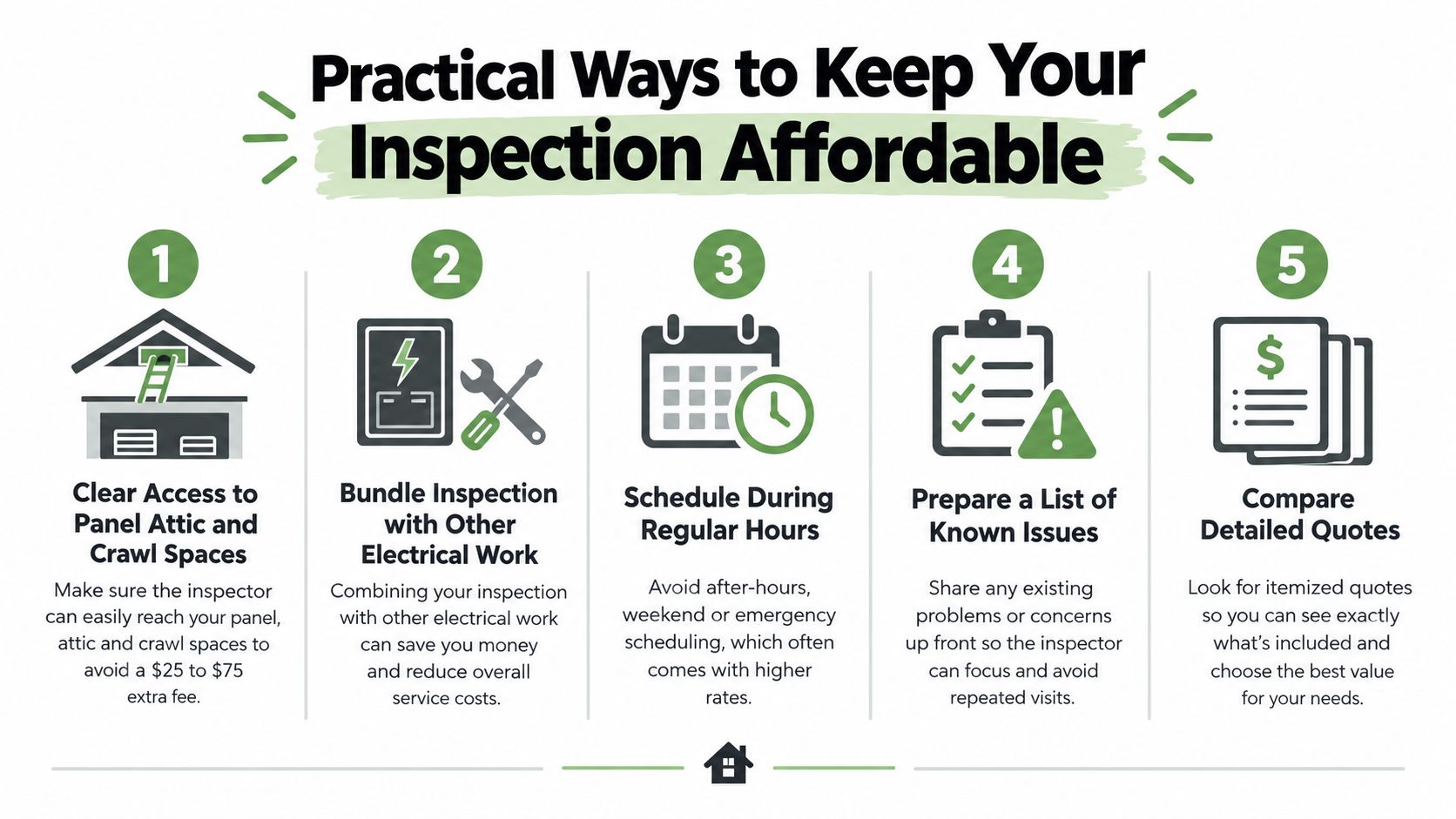
You can lower the final bill without cutting the inspection short. Reduce wasted time, give the electrician accurate information, and insist on a defined scope before the appointment.
- Clear access first: Move storage away from the panel, attic hatch, crawl-space entrance, exterior equipment, and subpanels. Blocked access can add $25 to $75 in labor according to the provided pricing guidance.
- Bundle related work: If you already need a fixture repair, receptacle replacement, or diagnostic visit, ask whether both services can be handled during one scheduled trip.
- Choose normal hours: Same-day, evening, weekend, and emergency appointments can carry surcharges. Schedule ahead when the inspection isn't responding to an active hazard.
- Prepare the facts: Share the panel model, home age, permit history, past reports, repair invoices, and the reason for the inspection. Good information helps the electrician plan the right visit.
- Compare written scopes: Request itemized quotes that separate the inspection, report, permit-related charges, and any repair estimate. A flat-rate proposal is easier to compare than an open-ended hourly promise.
For a multi-unit property, an owner or manager can ask whether several inspections can be coordinated in one visit. Don't assume a discount applies, but grouping access and paperwork may reduce duplicated travel and setup time.
Confirm whether the quoted price includes the report and whether any permit or records research is separate. The cheapest appointment isn't a bargain if it leaves out the document you need.
Choosing a Trusted Local Electrical Inspector
Start with licensing, not online advertising. Verify the electrician's Florida license through the Department of Business and Professional Regulation, and ask who will perform the inspection. If an apprentice or additional worker will be present, clarify supervision and responsibilities before the appointment.
Insurance is equally important. Request proof of liability coverage and workers' compensation coverage. An uninsured contractor can expose you to financial and legal problems if someone gets hurt or property is damaged during the visit.
Local familiarity matters because Palm Beach County properties have their own practical complications. Inspectors should understand local permitting expectations, service conditions, coastal corrosion, older aluminum branch wiring, and the documentation often requested during real estate or insurance decisions. Ask how the electrician handles inaccessible areas and unpermitted past work.
What a credible report looks like
Request a sample report with personal information removed. A useful report should show more than a checklist. Look for:
- Panel documentation: Equipment condition, breaker identification, labeling, and visible deficiencies.
- Testing records: GFCI and AFCI results, receptacle observations, and noted grounding or polarity issues.
- Photographs: Clear images of significant hazards, corrosion, damaged components, or questionable workmanship.
- Priority guidance: A distinction between immediate safety concerns, recommended corrections, and routine maintenance.
- Separate repair pricing: Inspection findings should not be disguised as an automatic sales pitch for repair work.
A one-page form may be appropriate for a narrow compliance visit, but it's a warning sign when an inspector claims to have evaluated a complex home and provides no meaningful detail. Ask how long the report takes, what areas aren't included, and whether you can discuss findings after delivery.
Obtain at least three written quotes when the timing allows. Compare access assumptions, testing methods, report format, specialty services, and repair separation, not just the total. Lighthouse Energy Services offers residential electrical safety checks that review core system components and provide written findings for Palm Beach County homeowners. The right inspector explains the scope plainly, arrives prepared, and doesn't pressure you into approving repairs before you understand the report.
Lighthouse Energy Services provides residential electrical inspections, written reporting, repairs, upgrades, and emergency troubleshooting throughout Palm Beach County. Visit Lighthouse Energy Services to request a clear inspection scope and quote for your home's age, access, panel condition, and reason for calling.