
A lot of homeowners in Palm Beach County start thinking about generator replacement the same way. The weather report turns ugly, the shutters are half done, fuel is on your mind, and then the old standby unit coughs, throws a fault, or doesn't sound quite right during its weekly exercise. That's a bad time to find out your backup plan isn't dependable.
Home backup generator replacement usually happens too late. The unit still starts sometimes, so it gets pushed down the list. Then a storm track shifts east, utility power becomes uncertain, and the one machine you expected to protect your food, air conditioning, security system, and medical equipment becomes another problem to solve under pressure.
That urgency is one reason the market keeps growing. The home standby generator market was valued at USD 3,154.66 million in 2024 and is projected to exceed USD 9,100 million by 2034, with a projected 11.4% CAGR, as backup power moves from a nice-to-have to a household essential, according to home standby generator market data. In practice, that tracks with what homeowners already know. Reliable backup power isn't a luxury when storms can knock out service for days.
Power protection also isn't just about the generator itself. During shorter interruptions, many homeowners also want internet equipment to stay alive so phones, alarms, and basic communication keep working. A practical companion resource is SwiftNet Wifi power outage support, which explains how to keep modem and router service up when utility power drops.
Table of Contents
- Your First Line of Defense Against the Storm
- Is It Time to Replace Your Home Generator
- Sizing Your New Generator The Right Way
- The Replacement Process and Hidden Costs
- Safety Checklist and Code Compliance
- When to Call Lighthouse Energy Services
- Home Generator Replacement FAQs
- Can I replace just the generator and keep everything else?
- Do I need a permit for generator replacement?
- Is an automatic transfer switch worth it?
- How long does generator replacement take?
- What's the biggest mistake homeowners make?
- Should I replace before the old one completely fails?
- What if fuel isn't available during a major storm?
- Does replacing a generator improve home value?
- Can I use the same generator size I already have?
- What should I ask the electrician before approving the job?
- Is generator replacement ever a bad investment?
Your First Line of Defense Against the Storm
In Palm Beach County, generator failure rarely happens on a calm Tuesday afternoon when everyone has time to think. It happens when a named storm is offshore, stores are crowded, and the house needs to be ready before sunset. The homeowner hears a rough start, sees the unit shut down, and suddenly has to decide whether to pour money into an aging system or replace it before the next outage.
That decision carries more weight than it used to. Homes rely on powered refrigeration, cooling, lighting, gate access, chargers, internet, and medical devices. During hurricane season, losing backup power can quickly turn a manageable outage into a health and property problem.
Why this decision matters more now
A backup generator used to be an upgrade some families wanted. In Florida, it's become part of a serious resilience plan. The market trend reflects that shift, but the local reality is even simpler. More homes have electronics, more homes depend on central air, and more homeowners understand that extended outages can disrupt daily life fast.
A standby generator is there for the day everything else stops working. If it's unreliable, it's not backup power. It's a false sense of security.
The mistake I see most often is treating replacement like an appliance swap. It isn't. A generator ties into the home's electrical system, transfer equipment, fuel supply, grounding, and code requirements. If any one of those pieces is wrong, the unit may not perform when you need it most.
What homeowners usually overlook
Focus often lands on the box sitting outside, with brand, kilowatts, and unit price being common inquiries. Those matter, but two hidden risks cause more trouble than the generator cabinet itself:
- Electrical infrastructure problems that only show up once an electrician checks the panel, grounding, and transfer setup
- Fuel access failures during major storms, when supply assumptions break down
This guide is built around those two issues, because they're where homeowners get surprised. A generator replacement should protect your family, not hand you a new set of preventable problems.
Is It Time to Replace Your Home Generator
An old generator can fool you. It may still start on its exercise cycle and still carry part of the house, but reliability often drops before total failure. The practical question isn't whether the engine can still run. The question is whether you'd trust it during a multi-day outage with heat, humidity, and no margin for mistakes.
A well-maintained whole-house backup generator typically lasts 10 to 30 years, with most units designed to operate for 10,000 to 30,000 hours. The same source notes that whole-house backup generators usually add 3% to 5% to a home's resale value, according to whole-house generator lifespan and value guidance. That matters because replacement isn't only about avoiding failure. It can also protect the property's marketability.
Signs the unit is aging out
Think of an older generator like an aging vehicle. If it starts hard, idles rough, leaks, or needs repeated attention, ownership becomes less about reliability and more about hoping it makes it one more season.
Watch for these signs:
- Hard starting behavior that wasn't there before, especially after regular maintenance
- Load handling problems where the unit struggles with equipment it used to carry normally
- Frequent nuisance shutdowns tied to fault codes, sensor issues, or controller complaints
- Noticeable fuel inefficiency or longer crank times
- Repair fatigue where every service visit seems to uncover the next problem
Any one issue may be repairable. A pattern is different. A pattern usually means the replacement conversation is overdue.
Repair still makes sense sometimes
Not every problem means the generator is finished. A minor control issue, battery problem, or maintenance lapse can make a healthy system look worse than it is. The key is whether the core machine is still dependable and whether the repair restores confidence, not just function.
A reasonable way to think about it is this:
| Condition | Better path |
|---|---|
| Isolated service issue and strong overall performance | Repair |
| Repeated failures, poor starting, declining output | Replace |
| Unit no longer fits household load priorities | Replace |
| Parts or service support becoming difficult | Replace |
Practical rule: If you hesitate when someone asks, “Would you trust this unit for the next big storm?” you're already close to replacement time.
Replacement is also a property decision
Home backup generator replacement isn't just mechanical. It's financial. Buyers in storm-prone areas notice whether a house has dependable standby power, and they also notice whether the system looks current, professionally installed, and code-compliant.
That doesn't mean every old unit must go immediately. It does mean the decision should be based on risk, service history, and confidence under real outage conditions, not on whether the engine happened to run last week.
Sizing Your New Generator The Right Way
The most expensive sizing mistake is assuming that if you add up appliance wattages, you're done. That shortcut creates undersized systems, nuisance trips, low voltage problems, and unhappy homeowners who can't understand why a “big enough” generator still struggles.
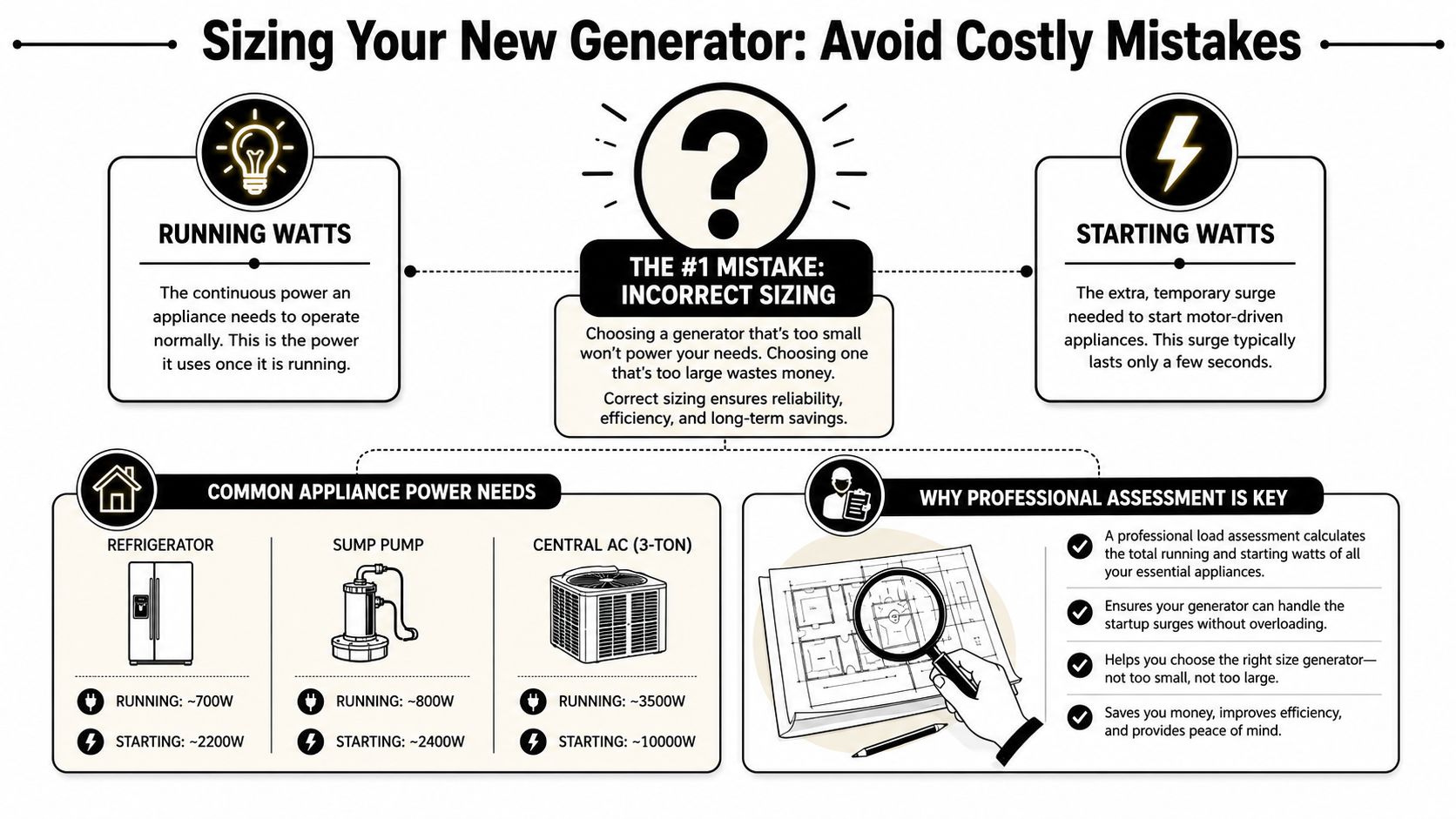
The issue is startup demand. Motors don't just run. They have to start.
Running watts and surge watts
A simple way to think about it is a car engine pulling away from a stop. Cruising speed takes one level of effort. Getting the vehicle moving takes more. Your generator sees the same thing with motor-driven loads.
High-torque appliances such as HVAC compressors can demand 200% to 300% of their rated running wattage during startup. A 5kW air conditioner with a running load of 5,000W may require 10,000 to 15,000W of surge capacity to start, based on generator wattage sizing guidance. That's why a system that looks adequate on paper can fail the moment the air conditioning cycles on.
What proper sizing looks like
A proper load assessment separates the house into categories, not just a grand total.
- Base running loads include lighting, refrigeration, electronics, and smaller essential circuits.
- Motor loads include air conditioning equipment, pumps, and anything else with heavy startup demand.
- Priority loads decide what must run during an outage and what can wait.
The generator also needs headroom above the calculated minimum so voltage stays stable when loads start and shift. Without that margin, the engine can bog down, transfer equipment can take abuse, and homeowners end up blaming the unit for a sizing problem that started on paper.
What doesn't work
Undersizing causes obvious problems, but oversizing without a plan isn't ideal either. It can add cost without solving the actual issue if the electrical design and load management weren't thought through.
For a deeper look at load calculation and planning, review this guide on how to size a generator for your home.
A good replacement starts with the loads you need carried during an outage. It doesn't start with guessing, and it doesn't start with buying the same size as the old unit just because that's what's already there.
The Replacement Process and Hidden Costs
Most homeowners ask the right first question and the wrong second one. They ask, “What does a new generator cost?” Then they stop there. The more important question is, “What will this house require to accept a new generator safely and legally?”
That's where budgets get blown.
What the replacement process usually includes
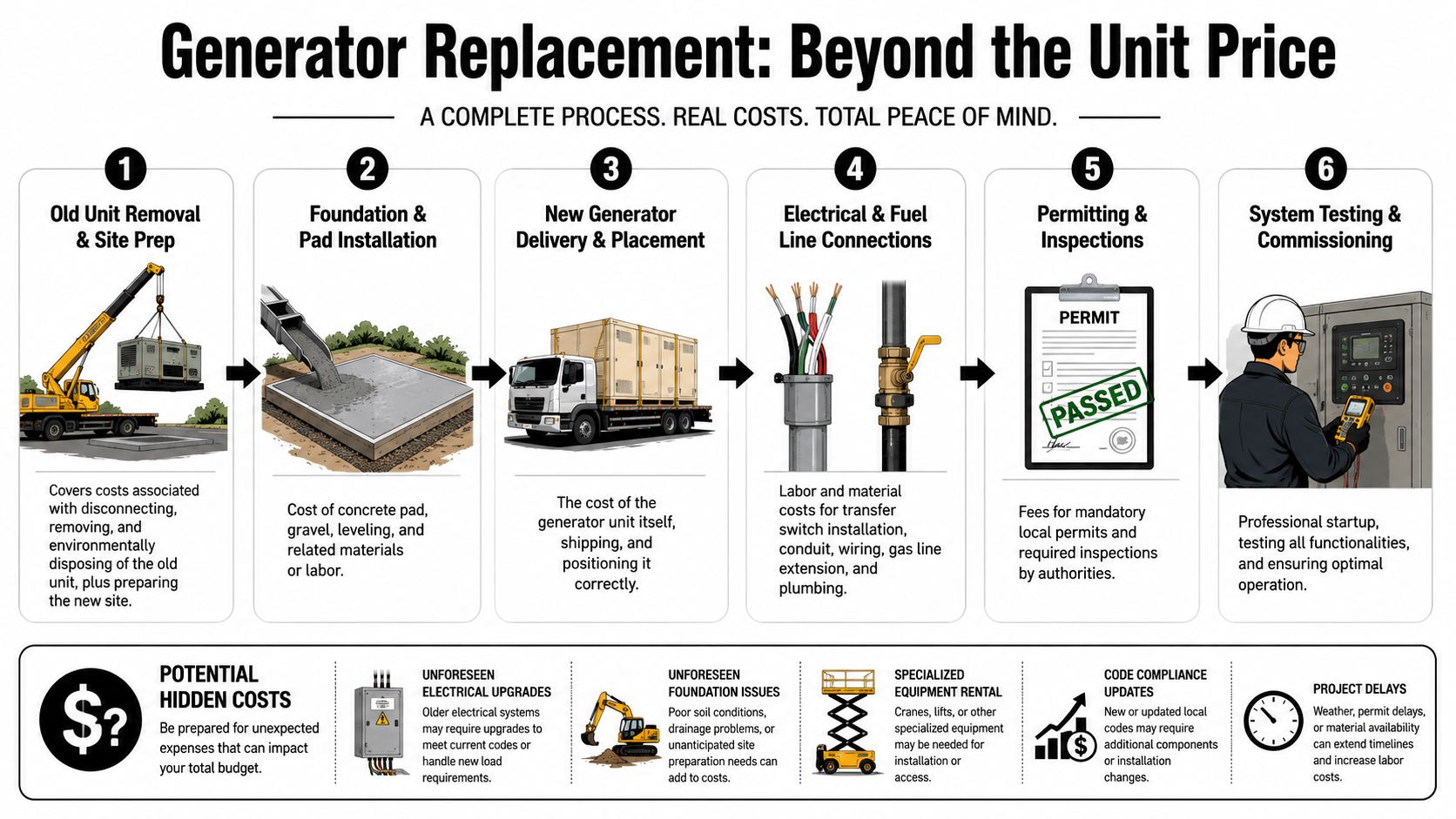
A professional replacement project is more than dropping a new unit where the old one sat. It normally involves:
Site review and system evaluation
The electrician checks service equipment, transfer method, grounding, bonding, available space, and fuel arrangement.Old unit removal
The existing generator gets disconnected and removed safely.Pad, placement, and access review
The new unit has to sit in a location that supports service access, ventilation, and code-compliant clearances.Electrical tie-in and transfer equipment work
Panel condition and code issues usually show up during this work.Fuel connection and startup coordination
Mechanical and electrical trades have to align.Testing under real operating conditions
The system should be exercised and checked with expected house loads.
The hidden electrical cost most guides skip
This is the biggest surprise in home backup generator replacement. The generator may be the visible purchase, but the home's existing electrical system may be the actual work.
Data shows 60% of older homes in major markets require panel upgrades or neutral isolation modifications to meet NEC 2023 grounding/bonding codes before a transfer switch can be safely installed, and that hidden work can add $2,500 to $6,000, according to generator panel upgrade and code cost data.
That number gets homeowners' attention because it changes the project from “replace the box outside” to “modernize the infrastructure that supports it.”
Why these upgrades happen
Older homes often have one or more of these issues:
- Service panel limitations that don't leave a clean path for transfer equipment
- Neutral bonding conflicts that have to be corrected so the generator system behaves properly
- Grounding electrode problems where the existing setup doesn't support a safe, code-compliant installation
These are not cosmetic issues. They affect fault clearing, equipment protection, and transfer safety.
If the panel, grounding, or bonding is wrong, the generator replacement isn't ready. Installing the new unit first doesn't fix the underlying hazard.
Budget for the whole system, not just the machine
Homeowners who want a realistic budget should evaluate the full installation path, not the brochure price of the generator itself. This overview of whole-house generator installation cost is useful because it frames the project as a system, not a single product.
If you own an older Palm Beach County home, expect the electrician to spend time at the panel. That's not upselling. That's where safe replacement often starts.
Safety Checklist and Code Compliance
Generator replacement isn't DIY territory once it touches transfer equipment, service equipment, or fuel. A lot of dangerous installations look clean from the outside. The underlying problems show up inside the electrical path, where mismatched components, poor placement, or bad terminations create shock, fire, and carbon monoxide risk.
Placement and exhaust
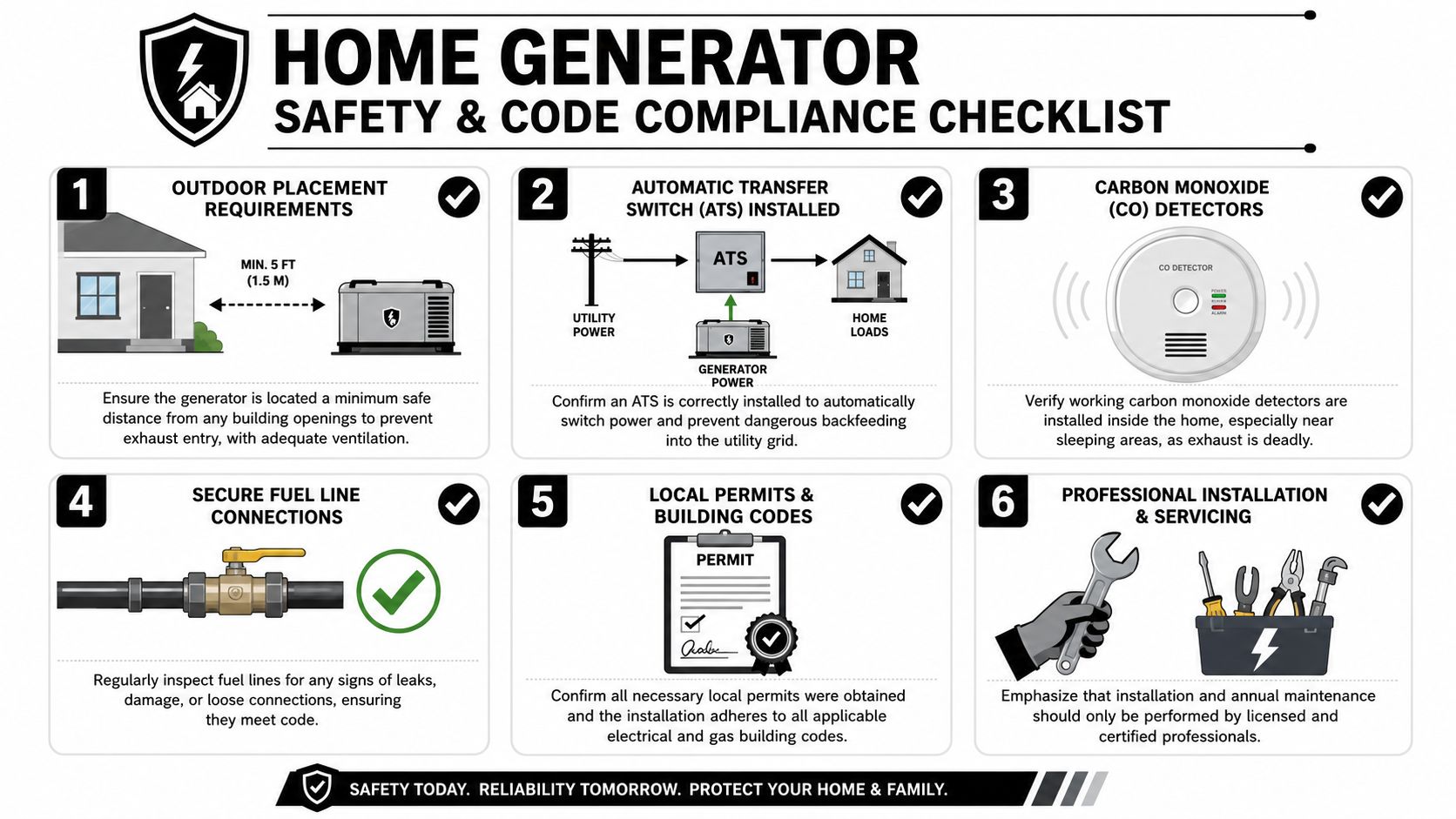
One of the first checks is location. The generator has to be installed where exhaust won't enter the home and where the equipment has proper ventilation.
The installation guidance used in major markets notes that carbon monoxide exhaust should be directed away from the home with a minimum 20 feet clearance, and the system should operate only in covered, well-ventilated shelters, as outlined in home backup generator installation guidance.
That's not a detail to gloss over. Bad placement can make an otherwise good system unsafe.
Transfer switch and electrical matching
The transfer switch is one of the most important pieces in the entire installation. It isolates the home from utility power and manages the switch to generator power safely. If it's wrong, the whole system is wrong.
The same guidance notes that replacement cost for a 22-kilowatt home backup generator system typically ranges from $7,000 to $12,000, and the transfer switch alone accounts for 25% to 35% of total project cost. It also states the transfer switch must match the generator's outlet configuration to prevent thermal overload and comply with NEC Article 702.
A mismatch creates exactly the kind of failure you don't want during an outage. Heat builds at connection points, contact damage starts, and arcing risk goes up.
Safety checklist for homeowners
Use this checklist before approving a replacement plan:
- Verify placement so the unit has proper clearance and exhaust won't migrate toward doors, windows, or vents.
- Confirm transfer method and make sure the switch is correctly matched to the generator connection.
- Ask about grounding and bonding instead of assuming the existing setup is acceptable.
- Require permits and inspections for both electrical and fuel-related work.
- Test under load before calling the project complete.
The cleanest-looking generator install can still be the most dangerous one if the transfer equipment is wrong.
A smart pre-install review
Homeowners who want to catch issues early should use a structured electrical review before replacement work begins. This home electrical inspection checklist is a useful reference for the kinds of conditions that often affect generator projects.
Code compliance isn't red tape. It's what keeps the system from becoming a hazard the first time utility power drops.
When to Call Lighthouse Energy Services
Call a licensed electrician when the replacement involves the service panel, transfer switch, feeder modifications, grounding changes, permit requirements, or fuel and electrical coordination. In other words, call before the project starts, not after a handyman has mounted a unit and left the risky part for someone else to sort out.
That matters in Palm Beach County because generator replacement isn't only electrical work. It also has to move through local rules, site constraints, and inspection expectations from communities across the county, from Boca Raton to Jupiter. The closer you get to storm season, the less room you have for avoidable delays.
Work that shouldn't be treated casually
Certain tasks are too risky to improvise:
- Installing or replacing an automatic transfer switch
- Modifying the main panel or service equipment
- Correcting bonding and grounding issues
- Coordinating startup when fuel and electrical work intersect
- Handling permit and inspection corrections after failed rough-in or final review
Those are safety-critical tasks. They affect whether the generator backfeeds, whether breakers and conductors are protected, and whether the system will transfer cleanly under stress.
Why credentials matter
A contractor's paperwork doesn't replace skill, but it does tell you whether the company takes legal and financial responsibility seriously. Homeowners who want a quick refresher on why those basics matter can read Restore Heroes' contractor guide. It's a useful reminder that licensing, insurance, and accountability aren't extras on a project like this.

What good local support looks like
For Palm Beach County homeowners, the right electrical contractor should offer clear pricing, strong field experience, and real availability when storms put pressure on scheduling. Phones should be answered by people who understand electrical work, not by a generic answering service reading from a script.
Generator replacement is one of those jobs where the difference between “installed” and “ready” is enormous. A system is only ready when it's safe, code-compliant, tested, and supported by a licensed team that can respond when something doesn't look right.
Home Generator Replacement FAQs
Can I replace just the generator and keep everything else?
Sometimes, yes. Often, no.
If the transfer equipment, panel condition, grounding, bonding, and fuel setup are all still appropriate for the new unit, some components may remain in place. But that decision has to follow an inspection, not wishful thinking. Home backup generator replacement fails when homeowners assume older infrastructure will automatically match newer equipment.
A good replacement review checks compatibility first. If the old setup forces compromises, keeping it usually costs more in reliability than it saves in labor.
Do I need a permit for generator replacement?
In most cases, yes. Generator replacement usually involves electrical work, and it may also involve fuel work, placement requirements, and inspections. Permit requirements can vary by municipality, but homeowners should assume a legal replacement needs oversight.
If someone suggests skipping permits to save time, that's a warning sign. Unpermitted work creates problems with inspections, insurance questions, resale disclosures, and future service.
Is an automatic transfer switch worth it?
For most whole-house standby systems, yes.
An automatic transfer switch gives the home a controlled, code-compliant way to separate from utility power and shift to generator power. That's different from a temporary arrangement or a manual workaround. During a storm or overnight outage, automation also matters because the system can respond even when the homeowner isn't standing there.
Manual solutions have their place in smaller or more limited backup plans, but for a whole-house replacement the transfer method should be chosen for safety and reliability first.
How long does generator replacement take?
The field work can move quickly once everything is ready, but the full timeline depends on conditions at the house. Panel issues, grounding corrections, permit timing, pad or placement changes, and fuel coordination can all affect the schedule.
The best approach is to start before hurricane pressure builds. Waiting until a storm is already on the map limits product availability, inspection windows, and contractor scheduling.
What's the biggest mistake homeowners make?
They focus on generator size and ignore infrastructure.
Sizing matters, but many projects go sideways because the home's existing panel, transfer setup, grounding, or fuel plan wasn't evaluated early enough. A replacement should be designed as one system. If the house can't support the new unit properly, the project isn't ready to proceed.
Should I replace before the old one completely fails?
Usually, yes.
Planned replacement gives you options. Emergency replacement gives you stress, limited choices, and a higher chance of rushed decisions. If the generator is already showing reliability issues, replacing on your schedule is far better than replacing during a county-wide storm scramble.
What if fuel isn't available during a major storm?
This is one of the most overlooked risks.
A generator only protects the house if fuel can reach the property or remain available through the outage. During major weather events, delivery systems can get strained, roads can become difficult, and assumptions about fuel continuity can break down. That's why homeowners should ask direct questions before replacement:
- What's the fuel source? Natural gas, propane, or another approved arrangement.
- What's the backup plan? If one fuel path becomes unreliable, is there any contingency?
- What does the provider promise during outages? Don't assume priority service exists unless you've confirmed it.
A beautiful installation won't help if the unit has nothing to burn.
Does replacing a generator improve home value?
It can, especially in outage-prone areas where buyers care about resilience. The broader value isn't just resale. A current, well-installed standby system can also reduce disruption, protect refrigerated food and comfort, support communication, and make the property more livable during utility failures.
That value is strongest when the replacement is documented, professionally installed, and clearly maintained.
Can I use the same generator size I already have?
Not automatically.
The old unit may have been oversized, undersized, or selected for a different set of household loads. Homes change. Air conditioning changes. Appliances change. Family priorities change. A fresh load review is the right move, even if the old generator “mostly worked.”
What should I ask the electrician before approving the job?
Ask practical questions, not sales questions.
A strong list includes:
- What loads will the generator carry during an outage?
- Does the panel need upgrades or correction work?
- Is the transfer method fully code-compliant?
- Will permits and inspections be handled properly?
- Are there any fuel supply concerns for this property?
- What testing will be done before the job is considered complete?
Those answers tell you more than a glossy brochure ever will.
Is generator replacement ever a bad investment?
It can be, if the project is rushed, badly sized, installed on weak infrastructure, or approved without thinking through fuel access. The machine itself may be fine and still fail to deliver dependable backup power because the planning was incomplete.
A good investment protects the family and works when the utility fails. A bad investment is a generator that looks impressive in the yard and disappoints the first time the weather turns.
If you're in Palm Beach County and need a licensed team to evaluate a failing standby unit, correct hidden panel issues, or plan a safe replacement before the next storm, Lighthouse Energy Services can help. The company has served the area since 2005, offers true 24/7 availability, answers calls with licensed electrical professionals, and handles generator-related electrical work with transparent pricing and local experience from Boca Raton to Jupiter.