
You've chosen the panels, compared solar proposals, and started thinking about lower electric bills. Then the installer looks inside the breaker box and says the project can't move forward until the electrical service is evaluated. That surprise is common because solar readiness isn't determined by the home's total amperage alone. The panel's busbar rating, breaker arrangement, physical condition, permitting path, and utility requirements can decide whether the installation proceeds smoothly or gets redesigned.
For homeowners in Palm Beach County, an electrical panel upgrade for solar is often less about adding a larger box and more about coordinating several pieces in the right order. A licensed electrician needs to confirm the code path before the solar design is finalized, then coordinate the electrical work with local permitting, inspection, and utility interconnection. Doing that review early protects the budget and keeps a capacity issue from appearing after contracts are signed.
Table of Contents
- Why Your Current Panel Might Block Solar Installation
- Choosing the Right Upgrade Path for Your Home
- Realistic Costs and Timelines in Palm Beach County
- Navigating Permits and Utility Interconnection
- Why You Need a Dedicated Electrical Contractor
- Your Pre-Installation Readiness Checklist
Why Your Current Panel Might Block Solar Installation
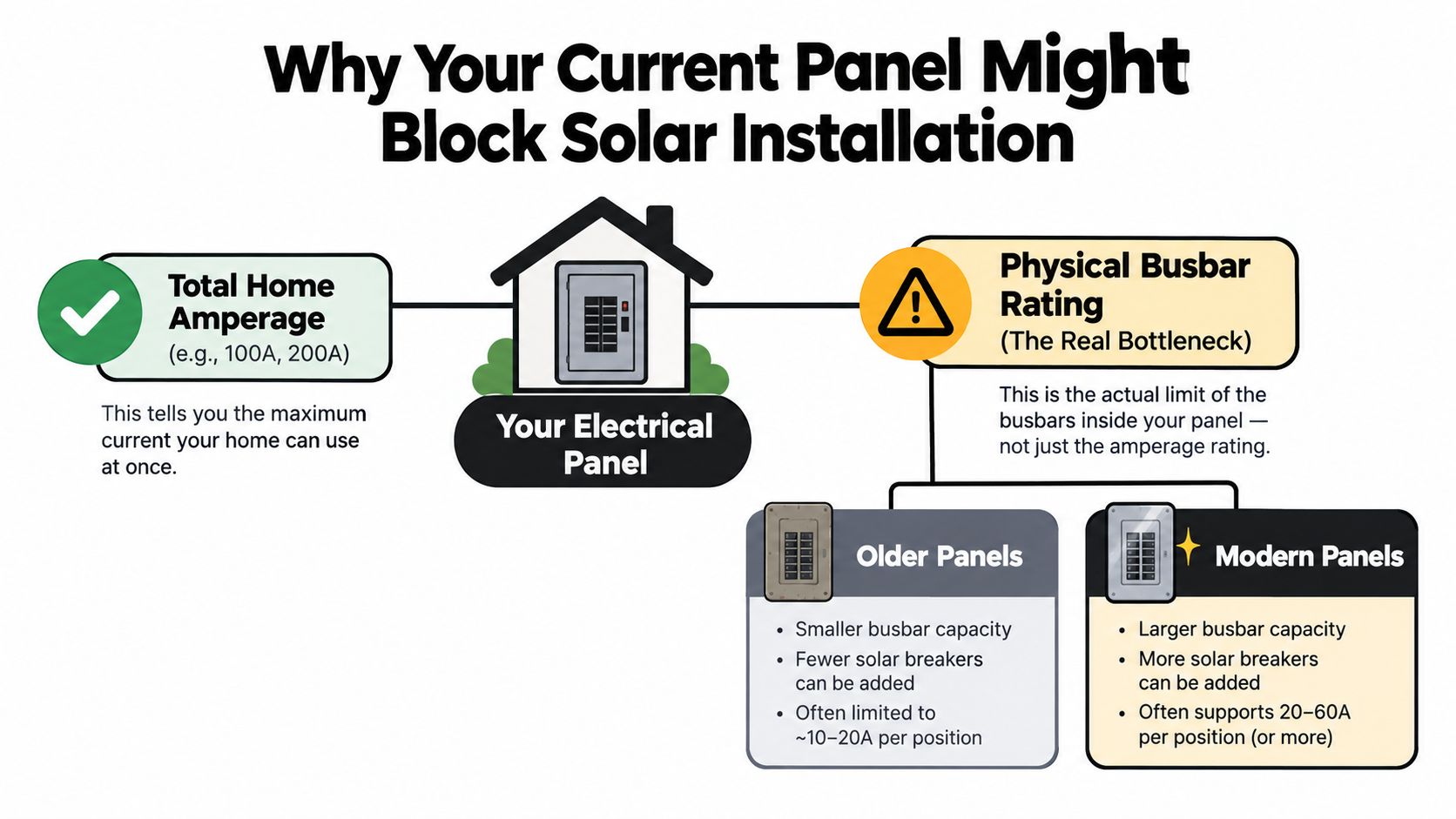
A homeowner may have a 200-amp service and still fail the solar electrical review. The problem is often inside the panel, where the busbar distributes current to the branch breakers. Solar adds power through a dedicated backfed breaker, so the panel must safely handle power entering from both the utility side and the solar side.
The key calculation comes from the NEC 120% rule, referenced in NEC Article 690. The panel's main breaker rating plus the solar backfed breaker generally can't exceed 120% of the busbar rating. For example, a 200-amp panel with a 200-amp main breaker can typically accept only a 40-amp solar backfeed unless the design uses another code-compliant solution, as explained in this solar panel upgrade guide.
The busbar matters more than the service label
A panel label might say 100 amps or 200 amps, but that number describes the service equipment and main overcurrent protection. It doesn't automatically tell you how much solar backfeed the busbar can accept under the applicable configuration. The electrician must verify the busbar rating, main breaker size, proposed solar breaker, breaker position, and the panel's listing and condition.
That's why total home amperage and solar backfeed capacity aren't interchangeable. A home can have modest day-to-day demand and still need a different interconnection method because the busbar calculation fails. Conversely, a smaller solar design may fit an existing panel if the available breaker space and code calculations support it.
Practical rule: Never approve a solar design based only on the panel's 100-amp or 200-amp label. Ask for the busbar and breaker calculation in writing.
How electricians identify the roadblock
Start with the panel directory and equipment label, but don't stop there. An electrician should inspect the enclosure, busbar, breaker arrangement, service conductors, grounding and bonding, available spaces, and signs of overheating or corrosion. In coastal Palm Beach County, the physical condition of exterior equipment deserves close attention because moisture and salt exposure can affect service components.
A panel upgrade may be appropriate when the combined breaker ratings exceed the busbar limit, when the panel lacks a suitable breaker position, or when the equipment can't support the proposed connection. The available solutions may include a main breaker derate, a panel replacement, a busbar adjustment, or a supply-side connection where permitted. For homeowners who want broader background on residential service components, this guide to residential electric service for HighFlow provides useful terminology to discuss with an electrician.
The timing matters as much as the calculation. In the SolarAPP+ dataset of 25,890 main-panel-upgrade cases, about 18% of PV-only permits and 10% of PV-plus-storage permits were associated with a main panel upgrade, according to SolarAPP+ electrical panel upgrade data. Treating this review as an early design checkpoint is far less disruptive than discovering the issue after permit drawings and equipment selections are locked.
Choosing the Right Upgrade Path for Your Home
Once the electrical review finds a capacity problem, the right answer isn't automatically “replace the panel with a larger one.” The best path depends on the existing service, the proposed solar connection, the available breaker space, the utility's requirements, and whether the homeowner plans to add batteries or other large electrical loads.
Start with the least disruptive compliant option
A main breaker derate can sometimes solve a 120% rule issue without replacing the entire service. The electrician changes the main breaker to a lower rating, provided the service conductors, calculated load, panel listing, and utility requirements support that change. This can preserve the existing enclosure, but it reduces the protected service capacity available to the home. A heavily electrified house with central air conditioning, electric cooking, pool equipment, or future charging needs may not be a good candidate.
A subpanel can provide additional breaker space and improve circuit organization, but it doesn't automatically increase the existing service's capacity or correct an overloaded busbar. It's useful when the main problem is space rather than the service rating. The electrician still has to verify that the solar connection itself complies with the applicable calculation.
A full service change is more involved. Depending on the property, it can require a new panel, meter base, service entrance conductors, grounding components, and service mast work. The utility may need to disconnect and reconnect the service, and the local authority will inspect the completed installation. This path costs more and creates more coordination, but it can resolve multiple limitations at once.
Design for the battery you may add later
Battery planning should happen before the panel is closed up. A critical-loads subpanel can separate selected circuits, such as refrigeration, lighting, communications, or designated air-conditioning equipment, from larger nonessential loads. A battery gateway or related transfer equipment may also require dedicated space and a defined connection point.
Installing the pathway, space, and wiring provisions during the electrical upgrade can be more efficient than opening finished walls later. It doesn't mean every homeowner needs storage equipment now. It means the electrician accounts for the future design instead of treating a later battery as an afterthought.
Ask the contractor to show you three things on the proposal:
- The existing limitation: Is the issue the busbar, breaker space, service conductors, panel condition, or utility requirement?
- The proposed correction: Is the plan a derate, subpanel, panel replacement, or complete service change?
- The future provision: Where would a battery, gateway, critical-loads panel, or additional electrical load connect?
The cheapest physical option isn't always the least expensive project overall. A derate may reduce immediate work but leave less flexibility. A full service change may create more disruption today while avoiding another service intervention when the home adds storage or electrifies more equipment.
Realistic Costs and Timelines in Palm Beach County
Palm Beach County homeowners should separate equipment and labor costs from permitting, utility coordination, inspection, and site-specific service work. National guidance places typical residential panel upgrade costs around $2,500 to $4,500, while California-focused references cite broader ranges of about $3,000 to $8,000, depending on panel condition, location, and utility requirements, as summarized in solar panel upgrade cost guidance. Those figures are planning benchmarks, not a Palm Beach County quote.
Local pricing can change when the panel sits far from the meter, the meter base needs replacement, the service mast requires work, or exterior equipment shows corrosion. Municipal requirements can also vary between jurisdictions such as Boca Raton, Jupiter, and other communities in the county. The contractor should identify those conditions during the site visit rather than adding them after the solar contract is signed.
| Upgrade Component | Cost Impact | Local Consideration |
|---|---|---|
| Panel or load-center replacement | Moderate to substantial | Condition, rating, breaker space, and enclosure location affect labor |
| Meter base replacement | Additional project cost | Utility coordination may be required before reconnection |
| Service mast or entrance work | Additional to substantial | Exterior routing, attachment points, and weather exposure matter |
| Main breaker derate | Often less disruptive | Must satisfy load calculations, equipment listings, and solar backfeed rules |
| Subpanel installation | Variable | Adds space, but doesn't automatically increase service or busbar capacity |
| Permitting and inspection work | Project soft cost | Requirements differ by local jurisdiction |
| Utility coordination | Schedule and possible fee impact | Disconnect, reconnect, meter, and interconnection steps must be sequenced |
For a homeowner comparing proposals, this home electrical panel upgrade cost guide can help organize the questions behind each line item. A quote that lists only “upgrade panel” doesn't tell you whether the price includes the meter equipment, service conductors, mast work, permit handling, inspection corrections, or utility coordination.
The electrical work can control the solar schedule
A panel upgrade often becomes the critical path because the solar final inspection may depend on the upgraded panel being energized and approved. The solar crew may be ready, but the project can't reach operation if the electrical permit, utility service work, or inspection sequence remains open.
Interconnection economics can also shift with the chosen path. Lawrence Berkeley National Laboratory reported median network-upgrade cost signals of about $52 per kilowatt for complete solar projects and $43 per kilowatt for active solar projects, while withdrawn projects reached about $102 per kilowatt, according to the California DG Stats technical data. Those figures describe network-upgrade signals, not a guaranteed Palm Beach County homeowner charge, but they show why the interconnection route deserves attention during design.
Navigating Permits and Utility Interconnection
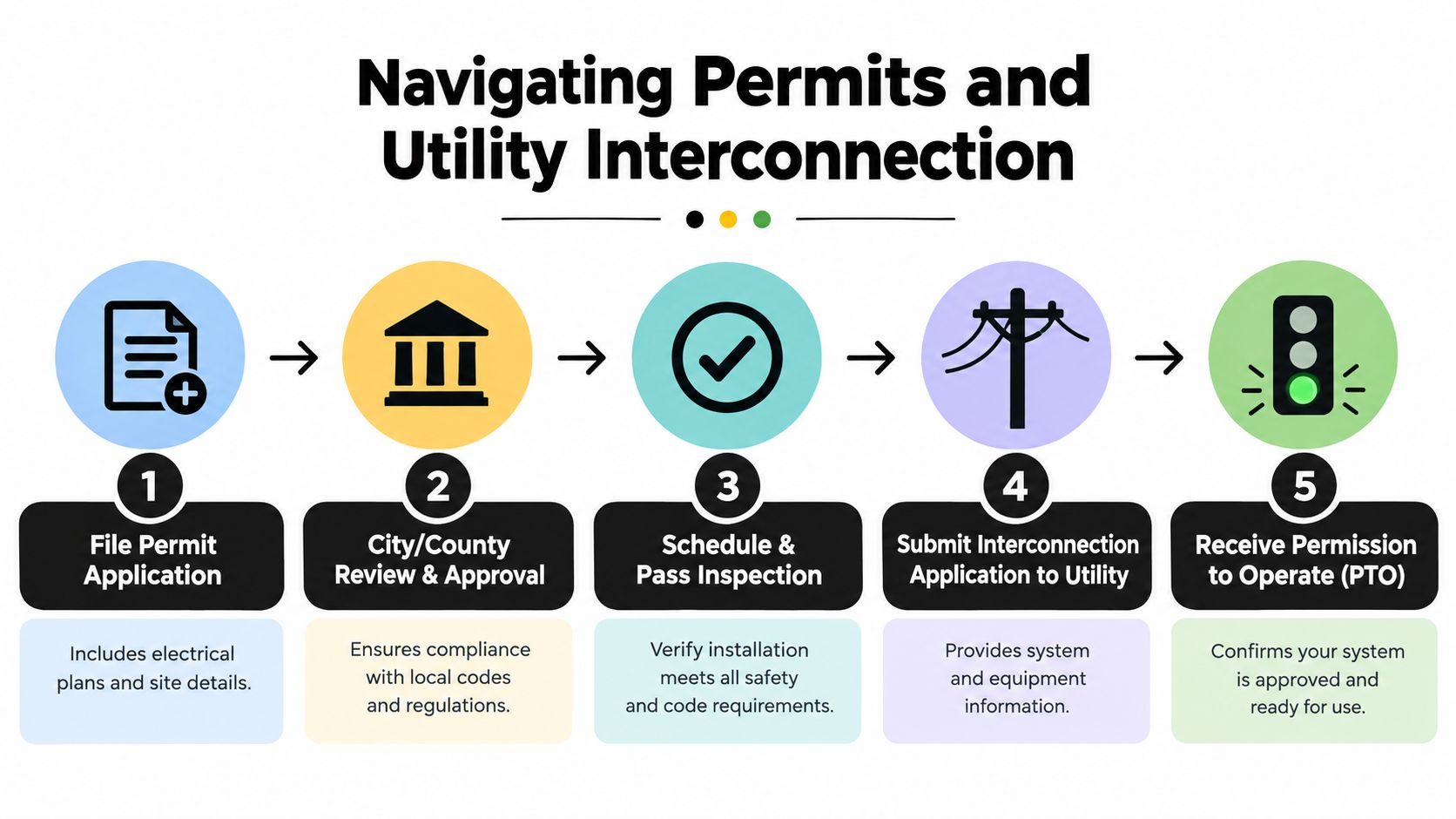
The electrician can complete a technically sound installation and still leave the homeowner waiting if the permit and utility sequence wasn't planned. Solar projects commonly involve electrical and building approvals, inspections, utility interconnection paperwork, and final authorization before the system can operate in parallel with the grid.
Palm Beach County's workflow can vary by jurisdiction. Some automated permitting systems can issue same-day approvals, while manual municipal review can take one to four weeks in some places, according to electrician permit process guidance. That difference affects scheduling, especially when a panel upgrade must be reviewed separately from the solar work.
The sequence matters
A practical sequence usually looks like this:
- Electrical screening and design: Confirm the panel, busbar, main breaker, service conductors, solar breaker, and proposed point of interconnection.
- Permit submission: File the electrical and related project documents with plans that match the actual equipment and connection method.
- Municipal review: Respond to comments before installation. A change to the panel or interconnection method can require revised drawings.
- Panel upgrade and inspection: Complete the electrical work, schedule inspection, and address any correction notice before the service is finalized.
- Solar inspection and utility submission: After the approved electrical work is documented, complete the solar inspection and submit the interconnection package.
- Permission to Operate: Wait for the utility's authorization before operating the system in grid-parallel mode.
The exact order can differ, but the dependencies don't disappear. A utility may require approved electrical documentation before changing service equipment, while the local authority may require the solar permit to identify the panel upgrade. The solar final may then depend on the panel being energized and approved.
Define the point of interconnection early
The Point of Interconnection, or POI, identifies where the solar system connects to the home's electrical system. The POI affects the breaker calculation, equipment layout, conductor routing, disconnect requirements, and utility review. A design that looks simple at the sales stage can become more involved once the electrician confirms that the existing panel cannot accept the proposed backfeed.
The best risk control is early screening. In the SolarAPP+ dataset cited earlier, the main-panel-upgrade path appeared often enough that permitting teams should treat it as a standard pre-installation decision point, not a rare exception. If the constraint appears after design lock-in, the contractor may need to redraw plans, revise permits, reschedule inspections, and update utility documents.
A panel upgrade that's identified before permit submission is a design decision. The same upgrade found after installation scheduling becomes a project delay.
Permission to Operate is also not the same as passing a municipal inspection. The inspection confirms code compliance for the installed work. PTO confirms that the utility has accepted the interconnection package and authorized operation under its process. Homeowners should ask who owns each submission and what document marks completion.
Why You Need a Dedicated Electrical Contractor
Solar sales teams can explain system production, equipment placement, and financing, but solar readiness depends on electrical work that must stand on its own. The person evaluating the panel should understand load calculations, service equipment, busbar limitations, grounding, bonding, disconnects, utility requirements, and local inspection expectations.
A dedicated, licensed electrical contractor brings that responsibility into the project before the solar design becomes fixed. That matters because a rushed visual assessment may miss a full panel, damaged equipment, incompatible breakers, undersized service conductors, or a busbar limitation that changes the interconnection method.
What a serious electrical evaluation includes
A proper review should document the existing installation instead of relying on a photograph. The electrician should examine:
- Panel identification: Manufacturer, model, service rating, busbar rating, breaker arrangement, and available spaces.
- Load calculation: Existing demand and planned additions, considered against the proposed service and main breaker.
- Connection method: The solar breaker location, backfeed rating, supply-side possibilities, and required disconnects.
- Physical condition: Heat damage, corrosion, loose connections, deteriorated insulation, and enclosure problems.
- Service equipment: Meter base, service entrance conductors, grounding electrode system, and exterior routing.
- Permit responsibility: Which contractor files, schedules, responds to corrections, and closes the electrical permit.
The electrician should also explain what the proposed work will interrupt. A service change can require a planned outage, utility coordination, inspection, and access to the meter and panel. That is different from swapping a breaker in an existing enclosure.
Local coordination is part of the workmanship
A contractor with Palm Beach County experience knows that local workflow can matter as much as the physical installation. The crew must coordinate with the relevant municipality, the utility, the solar installer, and the inspector. If one party assumes another party is handling a required submission, the homeowner becomes the person waiting in the middle.
Homeowners comparing providers can review electrical contractors in South Florida and ask direct questions about licensing, insurance, emergency availability, written proposals, inspection corrections, and solar-related service work. Lighthouse Energy Services performs panel replacement by evaluating the existing panel and load capacity, then installing a properly sized panel for current and future electrical needs.
Ask before signing: “Who is responsible for the load calculation, permit revision, utility coordination, failed inspection correction, and final closeout?”
A low initial price doesn't protect the project if the contractor later discovers excluded meter work or service-mast repairs. Transparent scope matters more than a short proposal. The work should be designed for the actual house, not for a generic 100-amp versus 200-amp sales script.
Your Pre-Installation Readiness Checklist
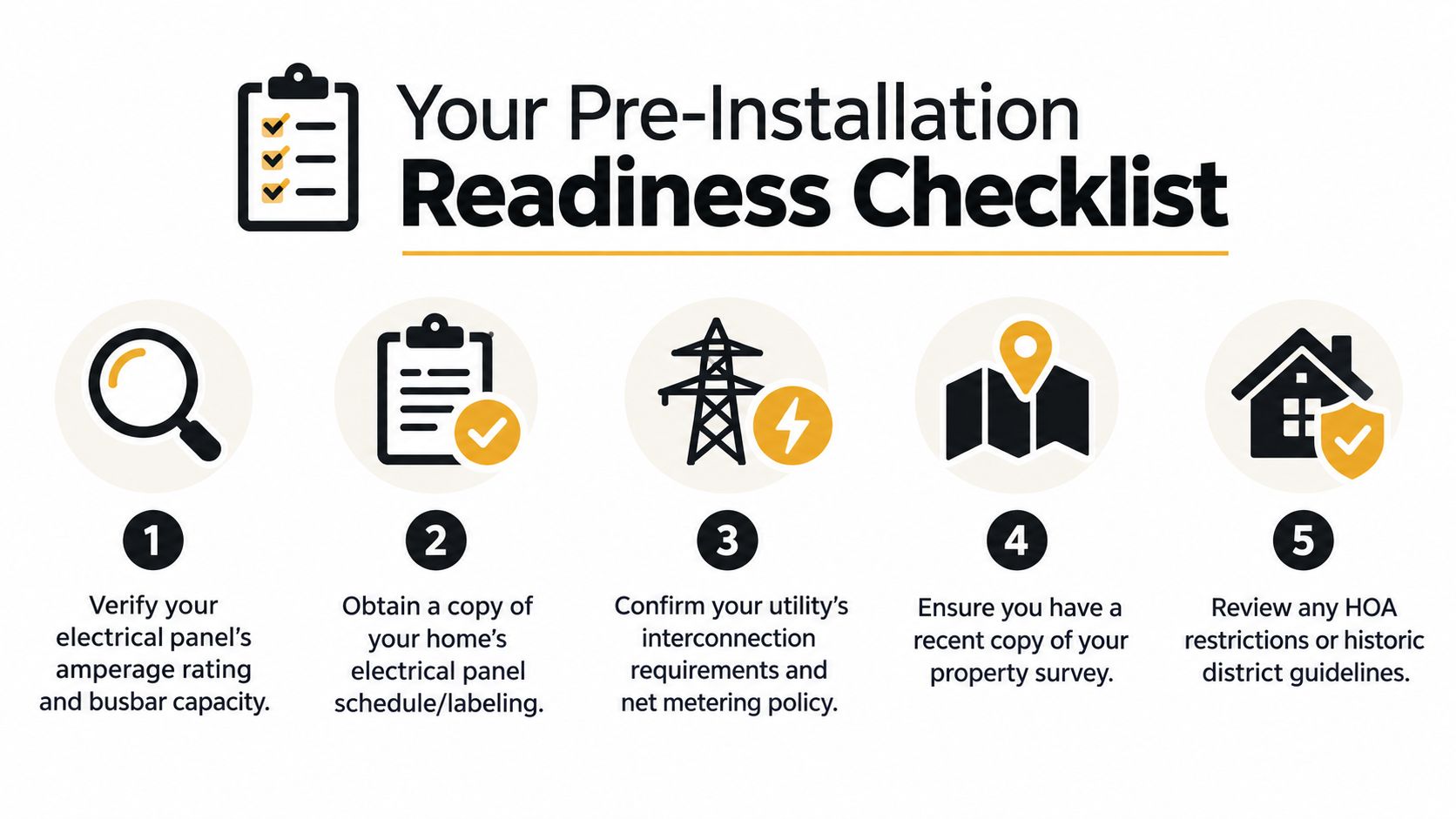
Before signing a solar contract, get the electrical facts on paper. You don't need to calculate the NEC rule yourself, but you should receive a clear explanation of the panel's rating, busbar capacity, main breaker, proposed solar breaker, and any correction required for interconnection.
Confirm the electrical scope
Use this checklist during the site evaluation:
- Verify the panel: Ask the electrician to identify the service rating, busbar rating, main breaker, available spaces, panel condition, and proposed solar breaker.
- Request the load calculation: Make sure the report accounts for existing major loads and planned additions, including storage or other electrification.
- Get the upgrade scope in writing: Confirm whether the proposal includes the panel, meter base, service entrance conductors, mast, grounding work, permits, inspections, and utility coordination.
- Ask about battery readiness: Find out whether a critical-loads subpanel, gateway location, raceway, wiring provision, or spare capacity can be included now.
- Confirm the connection method: Ask whether the design uses a breaker connection, derated main, subpanel arrangement, or supply-side interconnection where permitted.
The contractor should also confirm licensing and insurance before work begins. Ask who will perform the installation, who will pull the permit, and who will return if the inspector requests corrections. A useful home electrical inspection checklist can help you organize those questions and the documents you receive.
Prepare the property and the solar design
Clear the area around the panel and meter before installation day. Remove stored items, trim access-blocking vegetation, secure pets, and make sure the electrician can reach exterior equipment without moving household contents. Ask how long the planned outage may last and what equipment needs to be shut down beforehand.
Electrical readiness is only one part of the roof project. Before solar equipment is scheduled, review the roof's condition, penetrations, flashing, and replacement timing with a qualified roofing professional. These solar readiness roofing tips can help you decide whether roof work should happen before the solar array.
Finally, gather the property survey, panel schedule, utility information, permit records, and any HOA or historic-district requirements. Ask the solar and electrical contractors to use matching equipment details in their plans. That simple check can prevent a permit revision caused by one document showing a different panel, breaker, or interconnection method.
Lighthouse Energy Services evaluates residential electrical panels, load capacity, service equipment, and upgrade requirements for solar preparation throughout Palm Beach County, with licensed electrical professionals available 24/7 for planned work and troubleshooting. Visit Lighthouse Energy Services to request a clear electrical assessment and proposal before your solar design is finalized.