
Saturday afternoon, the boat is connected to shore power, the lift is halfway up, and the dock breaker keeps tripping. You reset it once. It trips again. The pedestal looks weathered, but the boat's air-conditioning, battery charger, cord, and onboard wiring are all part of the same fault path.
That's why searching for a dock electrician near me shouldn't mean finding someone who only replaces an outdoor receptacle. In Palm Beach County, safe marine electrical work is a diagnostic job. The electrician must determine whether the problem starts at the pedestal, in the shore cord, inside the vessel, or somewhere in the shared dock system.
Table of Contents
- What a Dock Electrician Actually Does on the Water
- Checking Credentials, Licensing, and Insurance Before You Hire
- Typical Costs, Timelines, and What Drives the Price
- Emergency Triage and Response Expectations
- Code and Compliance Basics for Waterfront Properties
- Why a Repeatedly Tripping Breaker Is a Warning, Not a Nuisance
- Your Next Step and What to Have Ready When You Call
What a Dock Electrician Actually Does on the Water
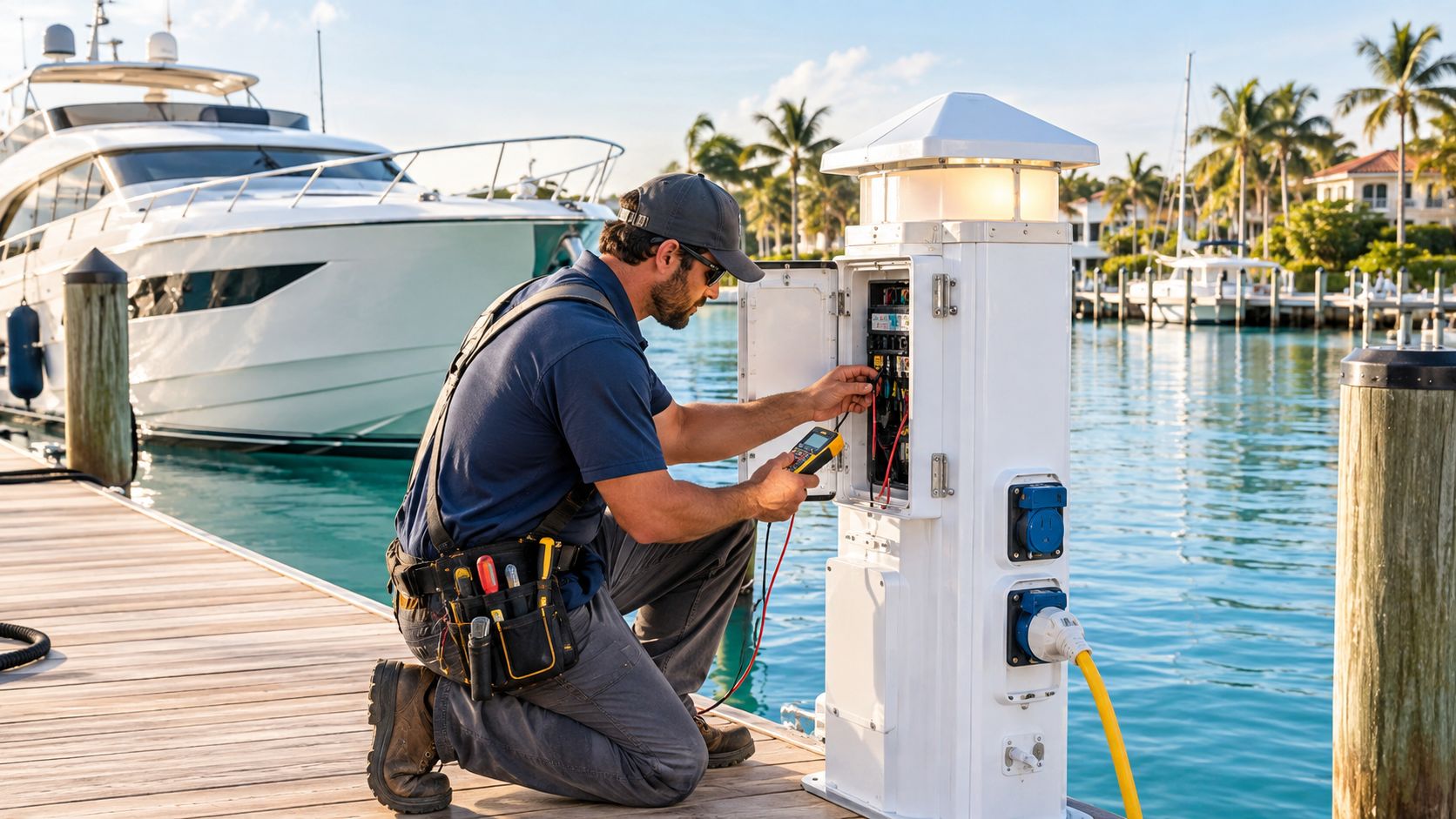
A dock electrician works where electricity, saltwater, metal hardware, moving equipment, and people meet. A typical assignment may involve a shore-power pedestal, dock lighting, a boat lift, pumps, a subpanel, emergency disconnects, bonding connections, and wiring exposed to years of humidity and corrosion.
The first inspection should follow the fault, not the most obvious equipment. A pedestal with a tripped breaker may be perfectly serviceable while a vessel leaks current through an appliance, charger, adapter, submerged equipment, or damaged shore cord. The electrician isolates those sections instead of repeatedly resetting the breaker and guessing.
The work extends beyond the pedestal
A proper waterfront service call can include:
- Shore power equipment: Receptacles, inlets, cords, adapters, disconnects, and pedestal breakers need inspection for overheating, pitting, looseness, and water intrusion.
- Dock distribution: Subpanels may serve lifts, pumps, lighting, outlets, and control equipment. Each circuit needs correct protection, labeling, and grounding.
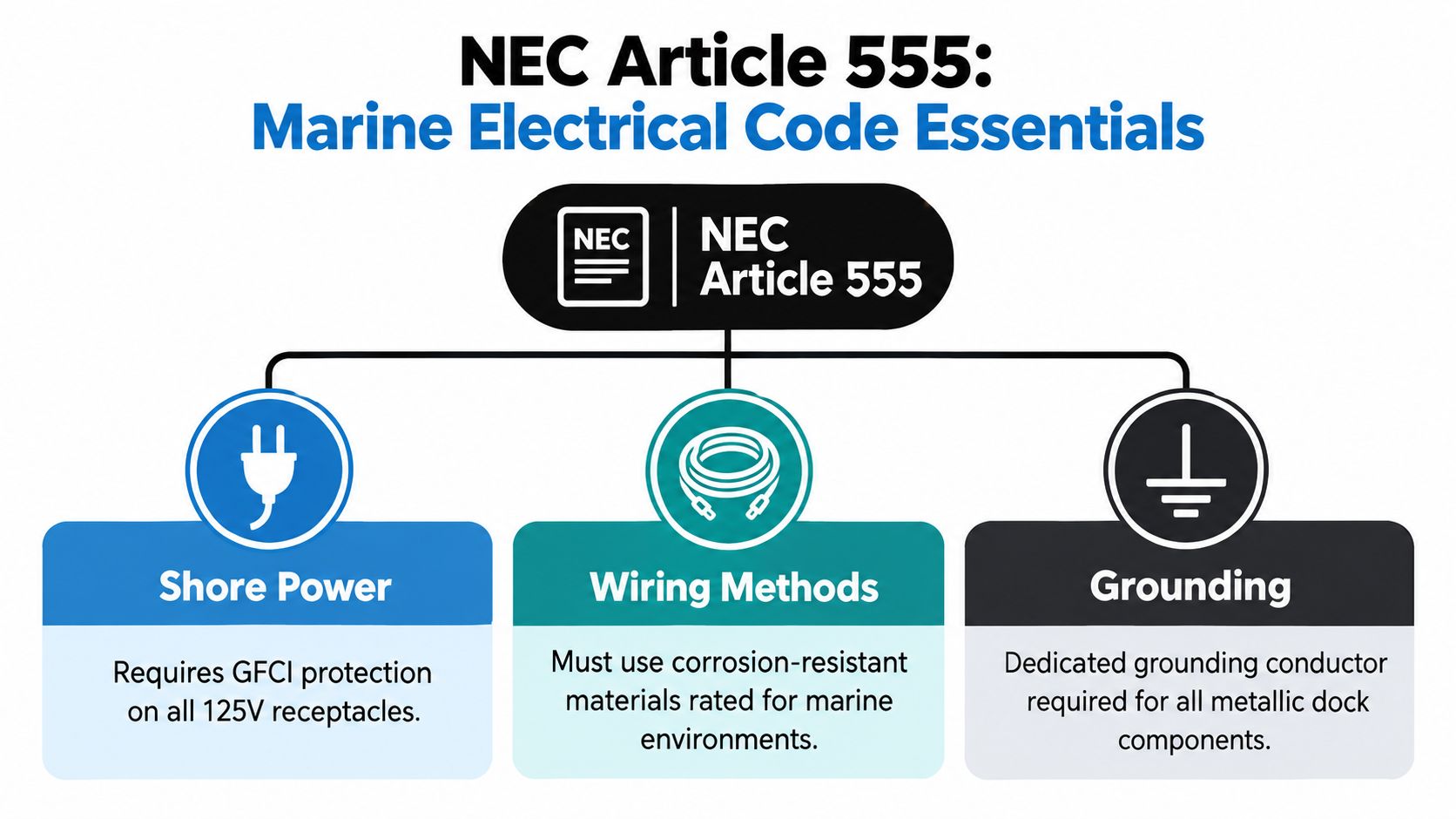
- Bonding and grounding: Metallic dock components and marine systems require careful attention to conductive paths, connections, and corrosion.
- Weather-exposed wiring: Salt air attacks terminals, enclosures, fasteners, and cable connections long before a visible outage appears.
- Boat-side diagnostics: The vessel must be tested separately from the dock so the source of leakage is identified rather than assumed.
A general residential electrician may be excellent at indoor panels and branch circuits yet lack experience with galvanic isolators, marine-rated enclosures, shore-power configurations, and wet-location troubleshooting. Those differences matter when a fault can energize metal hardware or create a dangerous condition in the water.
Practical rule: Hire for marine experience and diagnostic discipline, not just proximity and a familiar-looking service truck.
For new work, the design also matters. Pedestal placement, feeder capacity, emergency shutoff access, conduit routes, and future lift or pump circuits should be planned together. Property owners considering a new system can review the requirements involved in dock power pedestal installation before requesting proposals.
Checking Credentials, Licensing, and Insurance Before You Hire
A referral can help you find a contractor, but it doesn't verify the contractor. Before work starts, ask for the actual Florida electrical contractor license number and confirm that it is active through the state's licensing database. Make sure the licensed entity named in the proposal is the entity sending the crew.
Ask questions that reveal relevant experience
“Do you work on docks?” is too broad. Ask questions that require a specific answer:
- How many waterfront or marina jobs has your team completed recently?
- Does your company perform the work with its own employees, or will another contractor handle the electrical portion?
- Who will diagnose the vessel-side equipment if the pedestal tests properly?
- Can you document grounding, bonding, leakage, and ground-fault testing?
- Will you obtain required permits and arrange inspection when the scope calls for it?
The answers should mention real tasks, such as testing shore cords under load, inspecting corroded terminations, tracing a feeder, checking emergency disconnects, or separating boat leakage from shore equipment. A vague answer about “outdoor wiring” doesn't establish marine competence.
Verify coverage before anyone boards the dock
Request a current certificate of insurance showing general liability and workers compensation coverage. Dock work creates exposure around water, energized equipment, slips, ladders, vessels, and public access. If an uninsured worker is injured or damages a vessel, the property owner may face consequences that weren't reflected in the original quote.
Marine or pollution-related coverage may also be relevant for larger commercial, industrial, or marina projects. The right insurance depends on the scope, but refusal to provide documentation is a clear reason to pause. If you need a broader checklist for evaluating bonded contractors in other property-service contexts, this guide to finding a bonded contractor in Phoenix illustrates why verification matters before work begins.
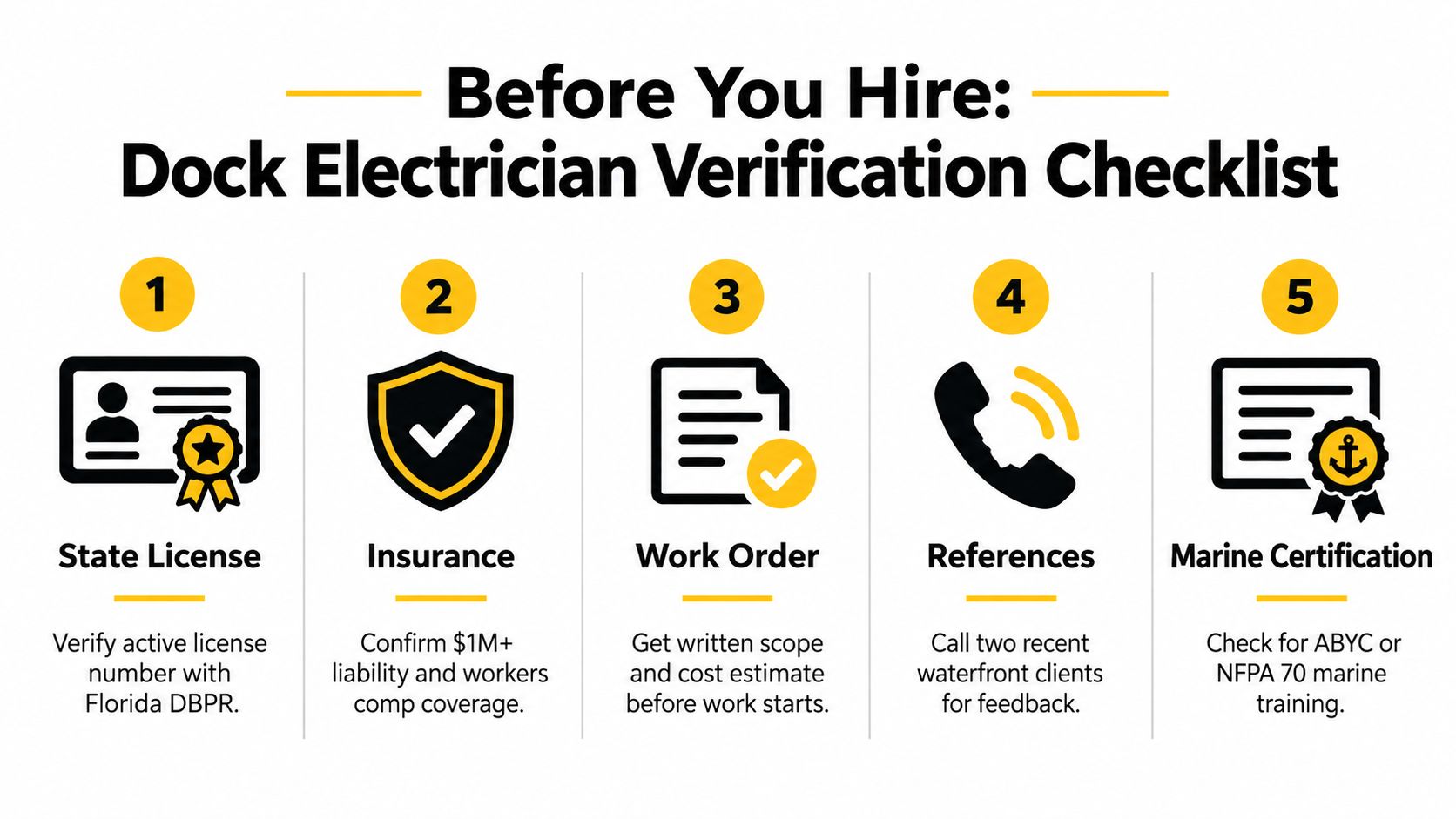
Stop the hiring process if the contractor:
- Avoids license details: They won't provide a license number or the business name doesn't match the proposal.
- Rejects written scopes: They want to start with cash and “figure it out” without documenting the work.
- Uses storm pressure: Door-to-door offers immediately after a storm deserve extra scrutiny.
- Refuses insurance proof: A verbal assurance isn't a certificate of insurance.
- Can't explain testing: They propose replacing the breaker before determining why it trips.
For a commercial dock, warehouse, or marina, the electrician should also understand higher-capacity distribution and coordinated service work. A contractor offering commercial marina electrical service in South Florida should be able to explain how the dock connects to the wider facility, not just how to change a receptacle.
Typical Costs, Timelines, and What Drives the Price
Dock electrical pricing is highly scope-dependent. Corrosion, difficult access, long feeder runs, damaged conduit, permitting, vessel isolation, and after-hours troubleshooting can all change the final cost. A phone quote based only on “the breaker keeps tripping” usually isn't a reliable project price.
South Florida labor conditions provide useful context. The U.S. Bureau of Labor Statistics counted approximately 12,400 electricians in the Miami–Fort Lauderdale–West Palm Beach metropolitan area in May 2023, with a mean annual wage of $55,030. Florida had approximately 46,690 electrician jobs with a mean annual wage of $52,380, while the national figures were approximately 712,580 electricians and a mean annual wage of $67,810. These figures describe the labor market, not a customer invoice, but they help explain why specialized, available marine response isn't priced like a basic indoor outlet change. BLS occupational employment data also projects electrician employment to grow 9% from 2024 through 2034, with approximately 81,000 openings annually, including openings connected to retirements, occupational changes, construction, and infrastructure work.
| Job Type | Typical Cost Range | Expected Timeline | Permit Required |
|---|---|---|---|
| Pedestal or shore-power receptacle replacement | Varies by equipment, corrosion, and feeder condition | Often same day if parts are available | Depends on scope and jurisdiction |
| New subpanel for a lift or pump | Varies with feeder length, panel capacity, and grounding work | One visit for simple work, longer if permitting is required | Often required for new circuits or equipment |
| Rewire of an older dock | Broadly variable because concealed damage may appear during removal | Several visits may be necessary | Commonly required for substantial alterations |
| Emergency troubleshooting | Diagnostic and after-hours charges depend on response and testing scope | Initial safety response first, permanent repair may follow | Depends on the corrective work |
Understand the quote structure
A diagnostic fee makes sense when the source is unknown. The electrician is paying for travel, isolation, instrument testing, access, and technical judgment before anyone knows which component needs repair.
An hourly or time-and-materials arrangement can suit an evolving corrosion problem. A flat project quote works better when the scope is visible, such as replacing a defined pedestal and repairing known terminations. Ask whether the proposal includes permits, parts, corrosion remediation, testing, cleanup, and a return visit if temporary repairs are needed.
For systems involving shore-power distribution, ask the contractor to explain the feeder, pedestal, and vessel connection as a complete system. The shore-power distribution system should be evaluated as more than a single outlet.
Emergency Triage and Response Expectations
A tripping dock breaker is urgent, but panic leads people to make unsafe choices. Don't touch wet equipment, stand in water while operating a disconnect, open a pedestal, or keep reconnecting the boat to see whether the fault disappears.
Start with observation. Determine whether power is out only at the dock or throughout the property. Note the exact sequence, such as whether the breaker trips immediately, trips when a charger starts, or trips when a lift motor runs. Look for sparks, smoke, a burning smell, unusual heat, damaged cords, or standing water near electrical equipment.
Use a safe first response
- Keep people clear: Move swimmers, children, guests, and workers away from the dock equipment and nearby water.
- Stop repeated resets: A breaker that trips again has identified a condition requiring diagnosis.
- Disconnect only if safe: If the area is dry and the disconnect is accessible without contact with damaged equipment, shut down power. Otherwise, wait for a professional.
- Record what changed: Note recent storms, new appliances, boat work, lift repairs, cord changes, or flooding.
- Call a qualified responder: Describe the dock, vessel, symptoms, panel location, and any visible hazard.
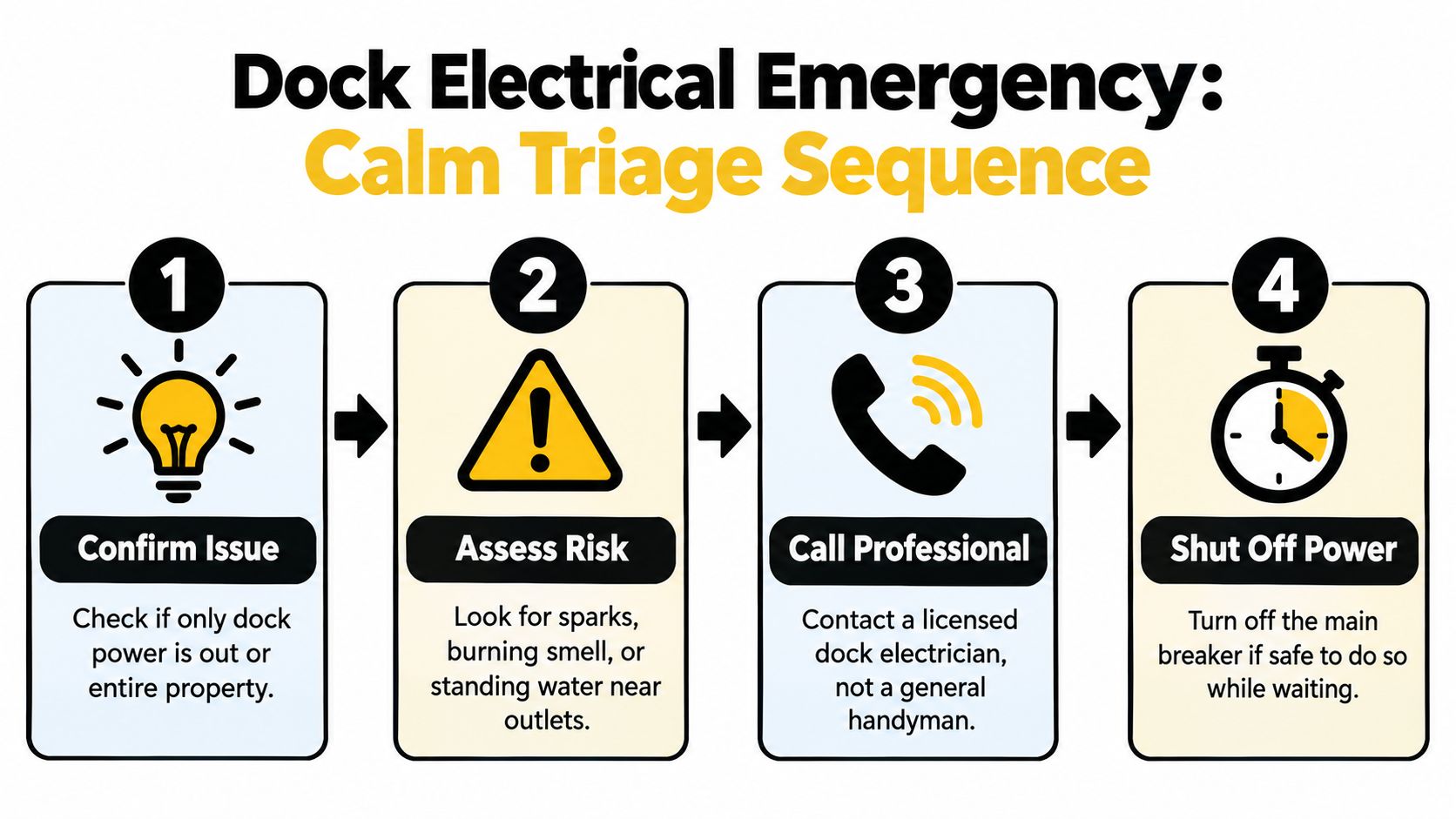
A genuine 24/7 contractor should explain who answers the phone, whether a licensed professional can assess the call, how quickly a technician can arrive, and what the initial diagnostic charge includes. An answering service can take details, but it can't replace technical triage.
Emergency work also has stages. The first visit may isolate the hazard, secure damaged equipment, or provide a temporary safe condition. Permanent restoration may require replacement parts, corrosion repair, permit coordination, or a return appointment. A clear contractor will separate those stages instead of presenting a temporary fix as a completed repair.
Lighthouse Energy Services is one local reference point for the service model property owners should look for. Its published service approach includes 24/7 response, licensed professionals answering calls, transparent pricing, and no extra charge because the call comes after hours. Those are useful questions to ask any contractor serving Palm Beach County.
Code and Compliance Basics for Waterfront Properties
Waterfront electrical systems deserve a system-level inspection, not just a new outlet cover. NEC Article 555 addresses marina and docking-facility conditions, including ground-fault protection, grounding, bonding, disconnects, and equipment exposed to wet or corrosive environments.
The protection levels matter. For applicable marina receptacles, ground-fault protection is set at no more than 30 mA. Larger feeders and branch circuits can use equipment protection set at no more than 100 mA, depending on the circuit arrangement and applicable requirements. Those settings serve different protective purposes, so changing a device without understanding the system can create a dangerous mismatch. The relevant grounding and protection provisions are summarized in this NEC Article 555 reference.
What a field inspection should examine
- Emergency disconnects: They should be readily accessible and clearly marked so a person can shut down power without searching through a wet or obstructed area.
- Equipotential bonding: Bonding helps reduce hazardous voltage differences between conductive components that people may touch.
- Enclosures and wiring: Components must suit the exposure. Salt, spray, condensation, and flooding can damage seals and terminations even when the circuit still works.
- Repair quality: Replaced or repaired wiring, devices, and enclosures must be evaluated against current requirements rather than assumed safe because older equipment has operated for years.
- Permits and inspections: New circuits, service changes, feeders, panel work, and substantial alterations may require local permitting and inspection. Routine maintenance is not the same as an alteration.
An older dock may have been grandfathered in some respects, but grandfathered doesn't mean recently inspected, maintainable, or safe after flooding and corrosion. A property manager should request a written scope, test results, identified deficiencies, photos where useful, and a clear statement of what was repaired versus what remains outstanding.
NFPA reports more than 50 deaths and over 30 injuries associated with leakage current in or around marinas. The figure covers the serious consequences of leakage around water and supports the need for correctly selected protection, maintained bonding, and competent testing. NFPA's marina safety guidance provides further context.
For vessel owners, maintenance habits matter too. A practical reference on marine 50-amp circuit-breaker care can help identify visible cord and connection issues, but a qualified marine electrician is still needed for system testing, leakage diagnosis, and code-related corrections.
Why a Repeatedly Tripping Breaker Is a Warning, Not a Nuisance
A breaker that trips repeatedly is reporting a fault. Resetting it, replacing it without testing, raising its protection threshold, or bypassing ground-fault protection leaves the underlying hazard in place and can keep the boat energized under unsafe conditions.
The boat is often the source, not the pedestal. Industry data cited by NFPA attributes approximately 90% of marina ground-fault protection issues to docked vessels rather than shore equipment (NFPA marina safety guidance). That figure does not establish the cause on a particular call, so the electrician should isolate the vessel, shore cord, adapter, receptacle, and pedestal as separate parts of the circuit.
A disciplined diagnostic sequence
Start by de-energizing the connection and inspecting the shore-power receptacle, cord, inlet, panel, enclosure, bonding connections, and nearby equipment. Salt corrosion, heat damage, water intrusion, loose terminations, damaged insulation, and arcing marks can identify where testing should focus.
Use calibrated instruments to check polarity, equipment-grounding continuity, insulation condition, voltage under load, emergency disconnect operation, and ground-fault protection. A no-load test may miss a fault that appears only when the vessel's charger, air-conditioning system, pumps, or other equipment starts operating.
The electrician should then isolate the vessel from the dock and repeat leakage testing under full operating load. Correct the identified fault and retest before re-energizing. The NFPA marina safety guidance explains why leakage current near water requires testing the complete connection, not repeated resets.
For preventive service, permanently connected vessels should receive an annual marine-electrical inspection. Users should test GFCI or GFPE devices monthly with the device's test button, following the manufacturer's instructions, and record corrective action. A useful service record lists the test date, instrument used, measured leakage, trip threshold, polarity, grounding continuity, defects, repairs, and retest result.
Repeated trips are evidence. Treat them as a request for isolation testing, not permission to keep pressing reset.
Your Next Step and What to Have Ready When You Call
Before calling a dock electrician near you, gather the details that make safe triage faster:
- Dock information: Location, approximate age, construction type, panel location, and whether the dock has flooded or sustained storm damage.
- Recent history: Last inspection, recent electrical additions, boat repairs, new appliances, lift work, or cord replacement.
- Symptoms: Which breaker trips, how quickly it trips, what was operating, and whether the issue affects one pedestal or the entire dock.
- Vessel details: Connection type, shore cord condition, adapters in use, and onboard systems that were running when the trip occurred.
- Site hazards: Standing water, sparks, heat, smoke, damaged enclosures, exposed conductors, or public access near the equipment.
Ask the contractor who will perform the work, whether the company carries required licensing and insurance, how it separates boat-side from dock-side faults, whether testing is documented, and whether the quote covers permits and follow-up repairs. Choose a Palm Beach County contractor that combines real waterfront experience with a response process you can verify.
If the system is older or its installation history is unknown, schedule an inspection even when everything appears to work. Working lights and a running lift don't prove that grounding, bonding, leakage protection, and emergency shutdowns remain dependable after years of salt exposure.
Lighthouse Energy Services provides Palm Beach County waterfront owners with emergency diagnostics, dock power repairs, installations, feeder and distribution work, and preventive electrical inspections with 24/7 availability. Visit Lighthouse Energy Services to request emergency response or schedule a marine-electrical assessment before the next breaker trip becomes a larger safety problem.