
A Palm Beach County parking lot usually doesn't fail all at once. One pole starts flickering near the drive aisle. A corner goes dim after rain. Tenants mention they don't feel comfortable walking to their cars at closing time. Then someone notices the lights don't match anymore. One fixture is yellow, another is white, and two are out.
That's the point where property managers have to make a real decision. Keep patching an aging system, or stop spending money on repeated service calls and move to an LED upgrade that fixes the underlying problem.
Parking lot lighting repair and LED upgrades aren't just about brighter fixtures. They affect safety, curb appeal, maintenance planning, utility costs, and code compliance. In Palm Beach County, the decision also has to account for hurricane exposure, salt air, heavy rain, and the wear that comes with year-round heat and UV.
A good lighting plan starts with knowing what's failing, what can be repaired safely, and what should be replaced before it becomes a bigger liability.
Your Guide to Parking Lot Lighting Solutions
A common call starts the same way. A property manager leaves after sunset, sees half the lot lit unevenly, and realizes the problem has moved beyond appearance. Tenants notice dark gaps. Security cameras don't see as clearly as they should. The property looks neglected even if the rest of the site is well maintained.
That's where most parking lot projects split into two paths. The first is targeted repair for a fixture, circuit, pole, photocell, or connection that's failed. The second is an LED upgrade when the system is old enough that one repair just leads to the next. The mistake is treating those as the same job. They're not.
In Palm Beach County, the right answer depends on age, condition, and exposure. A retail strip near the coast deals with different wear than an inland office park. Salt air, wind, moisture intrusion, and corrosion change what's practical. If the lot has mismatched fixtures and repeated outages, it usually makes more sense to evaluate the whole exterior system instead of replacing parts one by one. Property managers comparing broader site strategies often start with commercial exterior lighting services so they can look at parking areas, walkways, building-mounted lights, and entry points together.
What owners usually want to know first
The audience isn't asking for technical theory. They want clear answers to a few questions:
- Is this still repairable: Can the current system be restored safely, or are parts and fixtures at the end of their useful life?
- What will this do to my budget: Will another round of repairs solve the issue, or just postpone a larger replacement?
- Will the lot look better: Fixture style, mounting height, and light distribution matter, which is why visual planning resources like exterior LED post lighting design tips can help when owners want both performance and a cleaner appearance.
- How disruptive is the job: Managers need to know whether work can be phased around tenant traffic and business hours.
A parking lot lighting project goes better when the decision is based on site condition, not just the price of the next fixture.
Is It a Quick Fix or a Major Failure
Some parking lot problems are small. Others only look small from the ground.

A single outage might be a lamp, driver, photocell, breaker issue, or failed connection. But when several poles act up at once, the problem can move upstream into wiring, controls, corrosion, or damage in the handholes and bases. The symptom matters because it points to the likely level of repair.
What common symptoms usually mean
Flickering lights often suggest a failing component inside the fixture or unstable power to that pole. On older HID systems, that can mean end-of-life lamp behavior or ballast trouble. On LED fixtures, it can point to driver problems or moisture intrusion.
Lights that are dim but not fully out usually mean the fixture is still energized but not operating correctly. Dirt on lenses can reduce output, but uneven dimness across a lot often means the system has aged inconsistently.
Buzzing, humming, or delayed startup is common on older technology and usually tells you the fixture is wearing out. If tenants are hearing the lights before they're seeing usable output, repair may only be buying a little time.
Whole sections of the lot going dark usually push the issue beyond a simple fixture swap. That can involve breakers, controls, underground feeds, damaged conductors, or storm-related faults.
What a property manager can check safely
A non-electrician can do a useful first pass without opening anything or getting near energized equipment.
- Look from a distance: Check whether failures are isolated to one pole or spread across a row.
- Note timing: Does the outage happen only at dusk, after rain, or intermittently?
- Check for visible damage: Leaning poles, cracked fixture heads, open handhole covers, and exposed conductors all matter.
- Review recent events: Storms, vehicle strikes, landscaping work, and paving can all affect lighting circuits.
- Document patterns: A quick site map with pole numbers and symptoms saves time when the electrician arrives.
When it's time to call immediately
Don't wait on these:
- A pole is leaning or shifting: That can indicate structural or foundation trouble.
- A fixture is hanging open: Water entry and exposed parts turn a lighting problem into a safety hazard.
- Breakers trip repeatedly: Resetting over and over is not diagnosis.
- The outage affects pedestrian paths or entries: That increases risk fast.
- There's corrosion visible at the base or hardware: In coastal South Florida, small visible corrosion can mean larger hidden deterioration.
Practical rule: If the issue involves pole stability, exposed wiring, repeated tripping, or storm damage, skip troubleshooting from the ground and get a licensed electrician on site.
Inspection frequency matters too. Industry best practices recommend monthly visual inspections and annual professional inspections, and in Florida's harsher weather conditions, bi-weekly visual checks are advised, especially during hurricane season, to catch pole instability and salt-air corrosion early, as outlined in parking lot lighting maintenance guidance.
The LED Upgrade Process from Start to Finish
A good LED upgrade starts in the parking lot, not at a desk. In Palm Beach County, I want to know what the site looks like after a summer storm, how close it sits to salt air, whether tenants operate after dark, and which areas create the most liability if lighting drops out. Those answers shape the scope before anyone talks about fixture models.
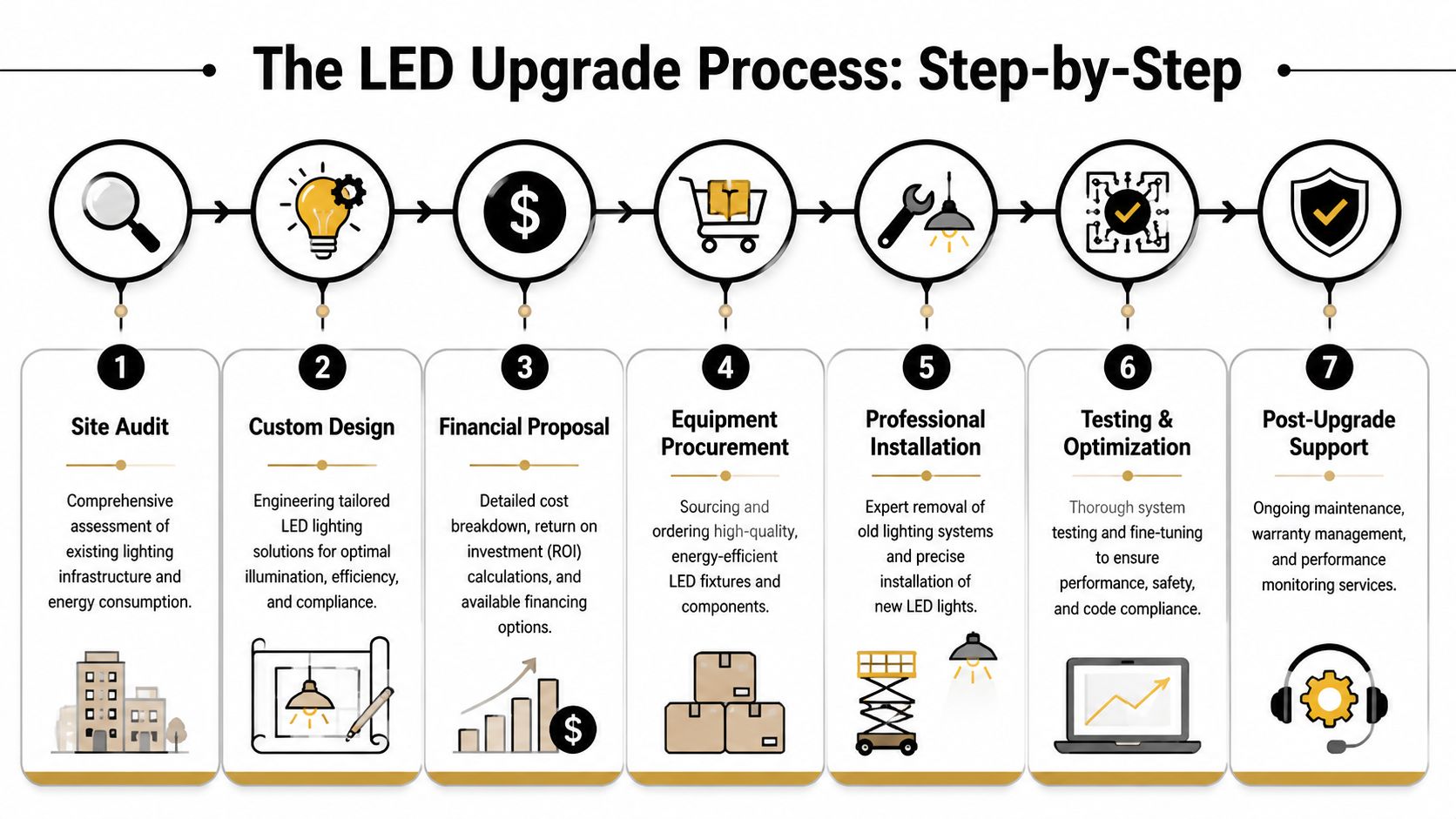
Site audit and lighting design
The first step is a field audit with measurements, photos, and a pole-by-pole review. We identify fixture type, mounting method, pole height, circuit layout, controls, and any visible deterioration at the handhole, tenon, or base. On coastal properties, corrosion changes the job fast. A fixture replacement can turn into arm replacement, wiring repair, or a decision to retire a pole that no longer makes sense to keep.
Lighting design should match how the property operates. A medical office needs dependable visibility at entries and walk paths during early and late hours. A warehouse yard may need stronger vertical light at gates and loading areas. A retail center usually needs balanced coverage that improves visibility without creating glare for drivers or neighboring properties.
The goal is usable light, not just more light.
Product and system selection
Projects either hold up for years or create repeat service calls based on these initial decisions. Fixture selection has to match pole spacing, mounting height, wind exposure, and site activity. In South Florida, that also means checking fixture housing, finish, gasket quality, and hardware durability. Salt air and storm exposure punish cheap materials.
Optics matter as much as wattage. A higher-output fixture with the wrong distribution can create bright circles under poles and dark gaps between them. Property managers then end up paying for a second round of corrections.
Controls should fit the schedule of the property. Some lots do fine with photocells. Others save more by adding time schedules, zoning, or dimming during low-traffic hours. For owners comparing fixture replacement with controls and broader retrofit scope, commercial lighting installation services for parking lots and site lighting are the right place to review those options together.
Code review before installation
Before ordering equipment, the electrical system has to be checked against the actual load and field conditions. That includes voltage, conductor condition, grounding and bonding, overcurrent protection, and enclosure integrity. The National Electrical Code addresses these installation requirements for luminaires, wiring methods, grounding, and equipment protection in NFPA 70, the National Electrical Code.
Pole height and mounting details also need to be verified before material is approved. If the submittal assumes one tenon size and the field condition is different, the crew loses time and the property manager pays for change orders or return trips.
Installation and commissioning
The installation process is typically straightforward. A significant variable is what we discover after removing old fixtures. We frequently encounter brittle conductors, failed photocells, corroded lugs, water in handholes, or mounting hardware that required replacement years ago. A professional proposal accounts for these potential issues rather than assuming every pole will be in perfect condition.
Phasing matters on occupied sites. Work should be sequenced so drive lanes, entries, and pedestrian routes are never left dark at closing time. On larger properties, that may mean dividing the lot into zones and completing one section at a time.
Commissioning finishes the job correctly:
- Controls are tested under real operating conditions.
- Fixtures are aimed and adjusted where the photometric plan calls for it.
- Each circuit is checked for proper operation after the new load is connected.
- Any pole, base, or wiring defect outside fixture scope is documented so the owner can decide whether to repair it now or plan a separate phase.
What works and what doesn't
What works is treating the lot as a system. Fixtures, poles, controls, wiring, and site use all affect the result. That approach usually costs more than a simple fixture swap, but it avoids the common Palm Beach County problems. Glare complaints, corrosion failures, mismatched light levels, and repeat lift-truck service calls.
What does not work is buying by wattage and unit price alone. Property managers save money with LEDs when the upgrade reduces energy use, cuts maintenance, and holds up in local conditions. If the lot has storm exposure, salt-air corrosion, or a mix of failing poles and outdated fixtures, the lowest fixture price is rarely the lowest project cost.
One practical option is using a contractor that handles both repair work and retrofit scope on the same property, such as Lighthouse Energy Services, when the site has immediate outages along with a planned LED conversion.
Calculating Costs and ROI for Your LED Upgrade
A Palm Beach County property manager usually feels the cost question after the second or third nighttime outage, or after a quote comes in that looks low until the exclusions start showing up. The primary decision is not fixture price alone. It is whether the upgrade lowers total ownership cost over the next five to ten years in a coastal, storm-exposed environment.
That changes how the numbers should be reviewed.
What actually drives project cost
Two parking lots can have the same pole count and very different budgets. Pole height, access, existing branch circuits, corrosion at handholes, control gear condition, and whether the site stays open during work all change labor and material cost.
A practical LED upgrade budget usually includes:
- Fixtures and mounting components: Fixture quality matters in Palm Beach County. Salt air, wind load, surge exposure, and thermal performance all affect service life.
- Labor and lift access: A 25-foot pole in an open lot is different from a tight drive aisle with landscaping, parked cars, and tenant operating hours.
- Electrical correction work: Failed photocells, brittle conductors, water intrusion, damaged fuses, and corroded splices are common add-ons once fixtures come down.
- Controls and surge protection: These are often skipped in low bids, then paid for later through nuisance failures.
- Pole or arm repairs where needed: If the fixture is new but the support is compromised, the project is only half done.
For benchmark budgeting, the installed cost of commercial outdoor LED area lighting varies widely by fixture output, pole condition, controls, and access requirements. The U.S. Department of Energy and Better Buildings program both frame LED economics around total system cost rather than lamp-for-lamp swap pricing, which is the right way to budget exterior upgrades on aging commercial properties (U.S. Department of Energy Better Buildings guidance).
Where the return really comes from
Energy savings are usually the first line on the spreadsheet, but they should not be the only one. On older metal halide or high-pressure sodium systems, the return often comes from three places at once: lower kWh use, fewer lift-truck service calls, and fewer emergency complaints from dark areas.
Rebates can help, but they should be treated as a bonus, not the basis of the job. Utility programs change. Eligibility can depend on fixture type, controls, and documentation. Florida Power & Light publishes current commercial lighting incentives through its business rebate program, and those numbers should be verified before the quote is approved (FPL business energy rebates).
The maintenance side is where many owners undercount the savings. HID systems do not just burn more power. They also create repeat costs through lamp cycling, ballast failures, inconsistent light color, and after-hours dispatches. In Palm Beach County, coastal corrosion and storm exposure make that pattern worse.
A simple ROI framework that works in the field
Use a five-line calculation:
- Current annual energy cost for the parking lot lighting circuit
- Projected annual energy cost after LED conversion
- Current annual maintenance cost, including lift rental or bucket truck charges
- Expected annual maintenance cost after upgrade
- Net project cost after any verified rebate
Then divide net project cost by annual savings.
That gives a simple payback number. It is not perfect, but it is good enough to compare a full conversion against a phased plan.
Here is the part many quotes miss. If the existing system has active corrosion, failing poles, or recurring underground faults, payback on fixtures alone can look better on paper than it will in practice. A realistic ROI model includes the repair work required to keep the new system online.
Annual Cost Comparison Traditional HID vs. Modern LED Lighting
| Cost Factor | Traditional Metal Halide (400W) | Modern LED (150W) |
|---|---|---|
| Energy use | Higher ongoing electrical consumption | Lower electrical consumption |
| Maintenance demand | More frequent lamp and component attention | Reduced routine replacement needs |
| Light quality over time | Output often degrades unevenly | More consistent site appearance |
| Rebate opportunity | Typically limited in upgrade context | May qualify for FPL rebate programs |
| Budget predictability | More surprise service calls | Easier long-term planning |
How to tell if the quote will hold up
A strong quote states what is included, what is excluded, and what happens if field conditions are worse than expected. That matters more than a low fixture number.
Ask these questions:
- Does the proposal include allowance for failed photocells, fuse kits, and minor wiring repairs?
- Are surge protection and controls included or excluded?
- Is corrosion resistance addressed for a coastal site?
- Are wind ratings and fixture mounting suited for hurricane exposure?
- Does the contractor identify whether poles, bases, and arms are being reused at owner risk or inspected as part of the scope?
For multi-building properties, phasing often makes financial sense. Start with the darkest zones, the highest maintenance areas, or the sections with the oldest HID equipment. That approach improves safety sooner and spreads capital cost over planned budget cycles without pretending the remaining sections are problem-free.
The best ROI is usually not the cheapest quote. It is the upgrade that cuts power use, reduces repeat service calls, and survives Palm Beach County conditions long enough to deliver the savings that were promised.
Meeting Safety Standards and Illumination Codes
Bright isn't the same as compliant. A parking lot can look improved after an upgrade and still have poor coverage where it matters most.
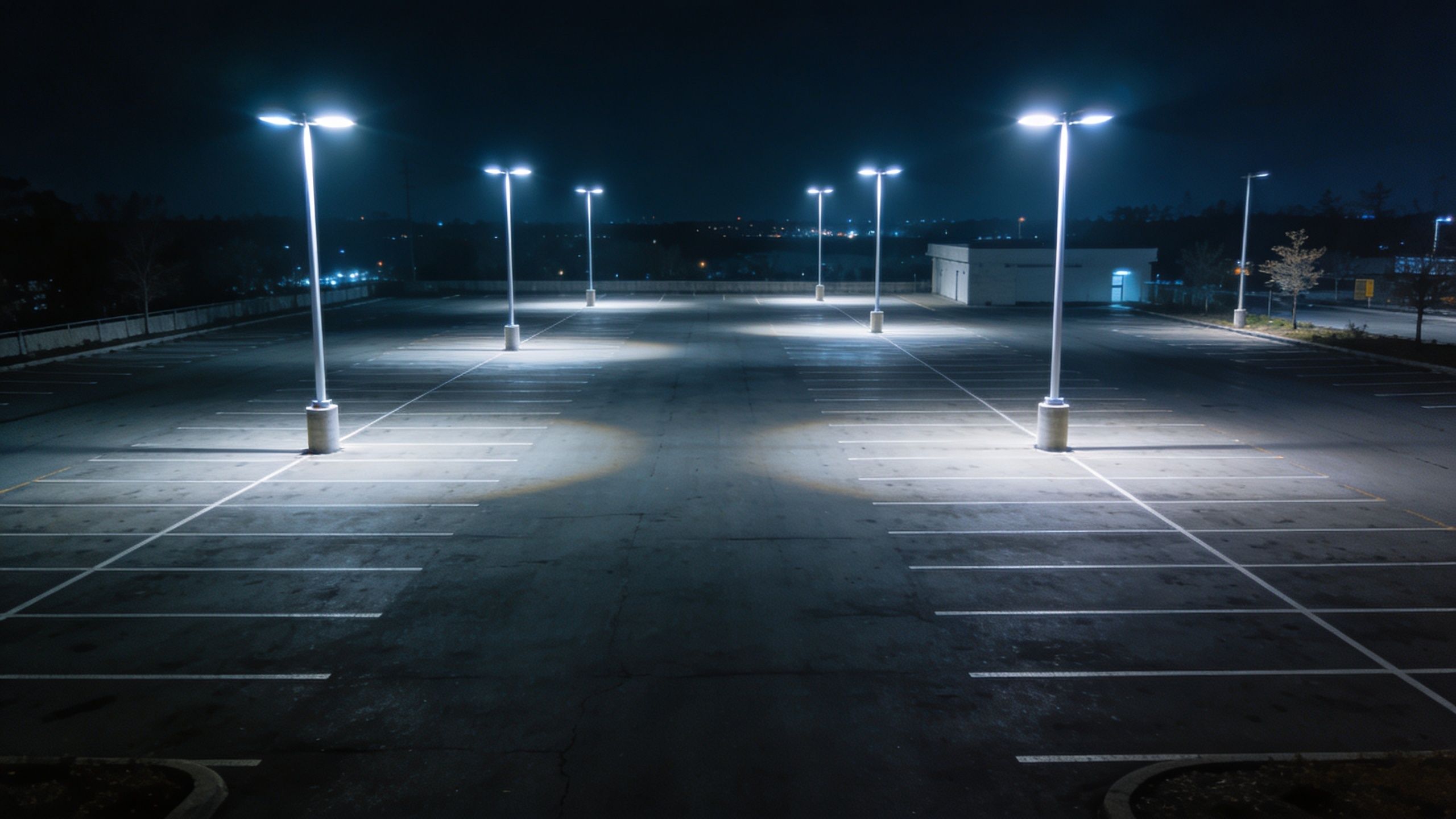
The primary safety issue is uniformity. If one area is very bright and the next section drops into shadow, drivers and pedestrians both lose visibility. Cameras lose detail too. That's why engineered parking lot lighting repair and LED upgrades focus on the whole pattern, not just the brightest point under the pole.
Why uniform lighting matters
The IES recommends minimum light levels and uniformity ratios for parking lots, including a 4:1 average-to-minimum ratio, and 65% of U.S. commercial lots fail to meet these photometric standards, according to this parking lot lighting repair reference.
In plain terms, that means many lots have too much variation between bright and dark areas. For a property manager, that's not just a design problem. It's a risk problem.
What that means on a real property
The weak points are usually predictable:
- Remote corners: Light falls off between poles and creates spaces people avoid.
- Pedestrian routes: Sidewalks, curb cuts, and crossings often need better continuity than the main drive aisle.
- Building edges and dumpster enclosures: These locations can disappear into shadow even when the center of the lot looks fine.
- Mixed fixture generations: A lot patched over time rarely produces balanced output.
A photometric plan is less about making the lot look bright and more about proving the light is distributed where people actually move.
Compliance is part of risk control
A quality contractor should review the site layout, fixture output, mounting conditions, and local requirements before ordering equipment. That's how you avoid spending money on a system that still leaves dark pockets or creates glare at the property line.
The cheapest approach is often a handyman-style swap. Replace old heads with whatever fits and hope the lot looks better at night. That's also how owners end up with poor uniformity, tenant complaints, and a parking area that feels unsafe even after an upgrade.
For Palm Beach County properties, compliance matters most where people enter, exit, and walk. If the lot supports retail traffic, office tenants, staff arriving before dawn, or customers leaving after dark, lighting design becomes part of daily site safety, not just maintenance.
Protecting Your Investment with Proactive Maintenance
A Palm Beach County parking lot can look fine on the night an LED upgrade is finished and still lose performance faster than expected if no one owns the maintenance plan. Salt air, wind-driven rain, irrigation overspray, vehicle strikes, and deferred small repairs shorten fixture life long before the LEDs themselves are supposed to fail.
Post-upgrade maintenance should be budgeted in the same manner that managers budget for sweeping, landscaping, and gate service. The fixture may be rated for long service life under controlled conditions, but the expected lifespan on a coastal commercial property depends on heat, corrosion, driver quality, and how quickly minor damage gets addressed.
A practical plan is not complicated. It needs to be consistent.
- Inspect the lot on a schedule: Night walks catch outages, dark spots, photocell issues, and aiming problems that daytime inspections miss.
- Check after storms: Hurricane season brings loose tenons, damaged lenses, water intrusion, and poles hit by debris or vehicles during cleanup.
- Clean fixtures and photocells: Dirt, salt residue, and insect buildup cut light output and can trigger nuisance switching.
- Watch pole bases and handholes: Rust, standing water, and damaged covers are early warnings of larger electrical and structural problems.
- Keep repair records in one place: Many property teams use facility maintenance software to track repeat failures, warranty items, and response times across multiple sites.
The payoff is straightforward. Planned service costs less than repeated night calls, rushed lift rentals, and tenant complaints after half a row goes dark. It also protects the ROI of the upgrade because the system keeps delivering the light levels you paid for instead of drifting downward year by year.
Documentation matters too. If one area starts failing early, service history helps separate a product issue from a site issue like voltage problems, corrosion, or chronic impact damage. That saves time when warranties are in play.
Some problems should not wait for the next scheduled visit. A dark entrance, exposed wiring in a handhole, a leaning pole, or storm damage near pedestrian paths needs immediate attention from a licensed electrician. For after-hours situations, this guide to emergency electrician service in Palm Beach helps managers judge what requires a same-night response.
Well-maintained lighting ages predictably. If yours does not, the right move is to inspect the system early, before a maintenance issue turns into a safety claim or a larger capital repair.
Your 24/7 Partner for Palm Beach County Lighting
Property managers don't need a lecture when a parking lot goes dark. They need a clear diagnosis, a safe repair, and an upgrade path that makes financial sense if the system is past the point of patchwork.
That is the true value of approaching parking lot lighting repair and LED upgrades correctly. You protect tenant safety, reduce recurring maintenance headaches, improve nighttime visibility, and make the site easier to operate. In Palm Beach County, you also need work that accounts for weather exposure, coastal corrosion, and the practicalities of keeping businesses open while repairs happen.
Emergency response matters too. Some lighting issues can wait for a scheduled quote. Others can't. Leaning poles, failed circuits near entrances, storm damage, and dark pedestrian areas need fast attention from a licensed electrician, not a callback hours later. For managers dealing with urgent after-hours electrical problems, this Palm Beach emergency electrician guide outlines what deserves immediate service.
If your lot has a few failing lights, get it inspected before the next outage spreads. If the system is old, mismatched, or costing too much in repairs, price the upgrade against what you're already spending. The right answer isn't always a full replacement. But the wrong answer is letting a deteriorating parking lot become normal.
If your parking lot lights are flickering, failing, storm-damaged, or overdue for an LED upgrade, contact Lighthouse Energy Services. Their team serves Palm Beach County with licensed electrical troubleshooting, repairs, installations, and true 24/7 response so you can address safety issues fast and plan long-term lighting improvements with clear pricing.