
The store is full, the line is forming, and then half the sales floor goes dark. A breaker trips. The back counter still has power, but the POS terminal at the front starts acting erratic. A refrigerated case is humming on the same circuit as equipment that should never have shared a line in the first place. Staff members are trying to keep customers calm while someone calls an electrician and hopes a real technician, not an answering service, picks up.
That scenario is common in Florida retail. Heat, humidity, long operating hours, old tenant buildouts, and fast patchwork fixes all catch up eventually. When they do, the issue usually isn't “just lighting.” It's a mix of load management, code compliance, emergency response, and maintenance discipline.
Retail lighting and electrical repair Florida work has to be handled with business consequences in mind. The goal isn't only to restore power. It's to keep checkout moving, maintain safe egress, protect inventory, avoid repeat failures, and use repair visits as a chance to fix the deeper problem instead of resetting the same breaker next week.
Keeping Your Florida Retail Business Running Smoothly
Many retail owners reach out after experiencing a similar night. During a busy shift, a fixture begins flickering, a staff member identifies a dead receptacle near a display, and a circuit fails under the evening load. That is when the actual cost becomes apparent. Employees stop selling to focus on troubleshooting. Customers lose confidence quickly when lighting appears unstable or checkout equipment loses power.
Florida has plenty of electrical capacity in the market, but that doesn't mean every contractor is set up for live retail work. The state's electricians industry supports 21,305 businesses and 87,887 skilled workers as of 2026, with an average annual growth rate of 4.5% since 2021, according to IBISWorld's Florida electricians industry profile. That scale matters because retailers need contractors who can handle repairs, fixture work, troubleshooting, and compliance without turning a service call into an all-day disruption.
What works in a retail setting is straightforward:
- Fast diagnosis: Find whether the failure is a load issue, device failure, ballast or driver problem, loose connection, grounding fault, or panel problem.
- Controlled repair sequencing: Keep sales areas operating where possible instead of shutting down the whole space.
- Clear priorities: Safety lighting, checkout power, refrigeration, signage, and customer-facing fixtures don't all carry the same urgency.
- Long-view planning: Every emergency call should feed into a maintenance and upgrade plan.
Retail electrical work isn't just about fixing what failed. It's about protecting hours of operation, customer flow, and code compliance at the same time.
If you manage a store in Palm Beach County or anywhere in Florida, the practical question isn't whether electrical issues will happen. It's whether your setup is ready when they do.
Diagnosing Common Retail Electrical and Lighting Failures
The first step is reading the symptom correctly. In retail, the visible problem is often only the surface issue.
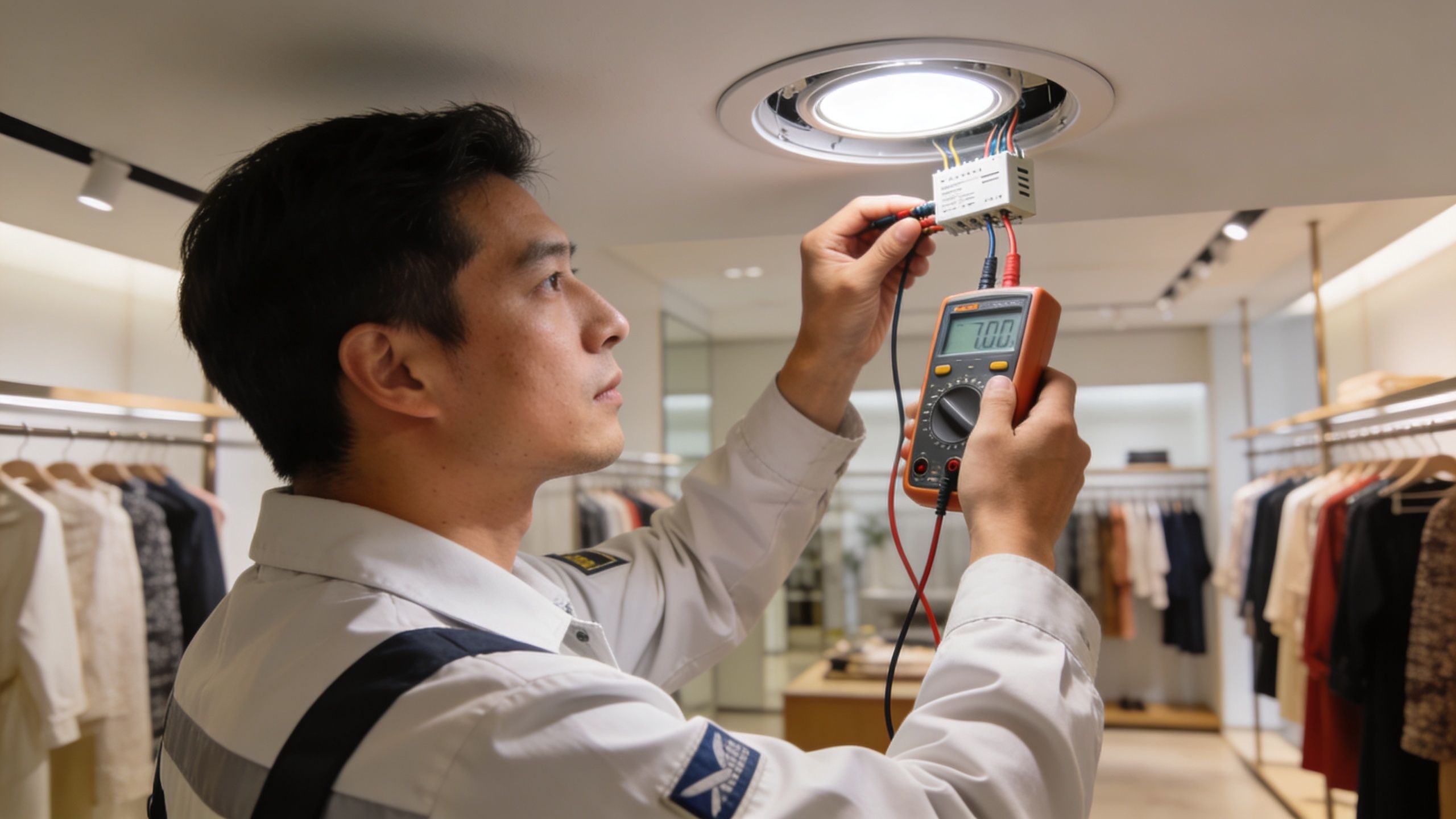
When lights flicker, buzz, or die early
Flickering fixtures usually point to one of a few causes. In older systems, failing ballasts are common. In newer LED systems, the problem may be a failing driver, a poor splice, incompatible dimming hardware, or voltage instability upstream.
Buzzing is another useful clue. If staff hears noise above a display aisle or checkout lane, that often means ballast trouble in fluorescent fixtures or a component inside the fixture housing starting to fail. Dead lamps that keep coming back after spot replacement usually mean the lamp wasn't the actual issue.
Florida conditions make this worse. Humidity is hard on lighting components, especially in spaces with long operating hours and rooftop heat gain.
When breakers trip and devices act strangely
A breaker that trips once during a storm may be one event. A breaker that trips repeatedly under normal store use is a warning. Shared circuits are a frequent cause. A POS station, receipt printer, phone charger bank, small appliance, and nearby display lighting can end up on the same branch circuit after years of tenant modifications.
That's when you start seeing symptoms like:
- POS issues: Screens reboot, terminals freeze, or card readers behave unpredictably.
- Partial outages: One area of the store loses power while another stays live.
- Warm receptacles: Not normal. That points to load stress, poor termination, or a worn device.
- Intermittent failures: Equipment works in the morning and fails later when the building load rises.
If breaker trips are becoming routine, a technician should trace the actual cause, not just reset the panel. Practical troubleshooting matters more than guesswork in these situations. A useful reference for recurring trip causes is this circuit breaker tripping solutions guide.
Practical rule: If a store only loses power during busy periods, look at the load profile before replacing hardware. The problem is often circuit design, not a bad breaker.
When outlets, signs, or exterior lights fail
Dead receptacles near checkout counters, stockrooms, and display walls often come from loose terminations, damaged devices, failed GFCI protection in the circuit path, or panel-level issues. Exterior sign and pole lighting failures have their own pattern. They may be tied to photocell failure, water intrusion, corroded connections, or neglected branch circuits.
Retail managers don't need to diagnose the repair. They do need to describe the symptom clearly. The most useful service call details are when the failure happens, what else loses power at the same time, whether weather affects it, and whether any recent equipment was added before the problem started.
Navigating Florida Electrical Codes and Retail Compliance
Retail code requirements matter most when a store is busy, wet, crowded, or operating long hours. Those are exactly the conditions where shortcuts tend to fail.
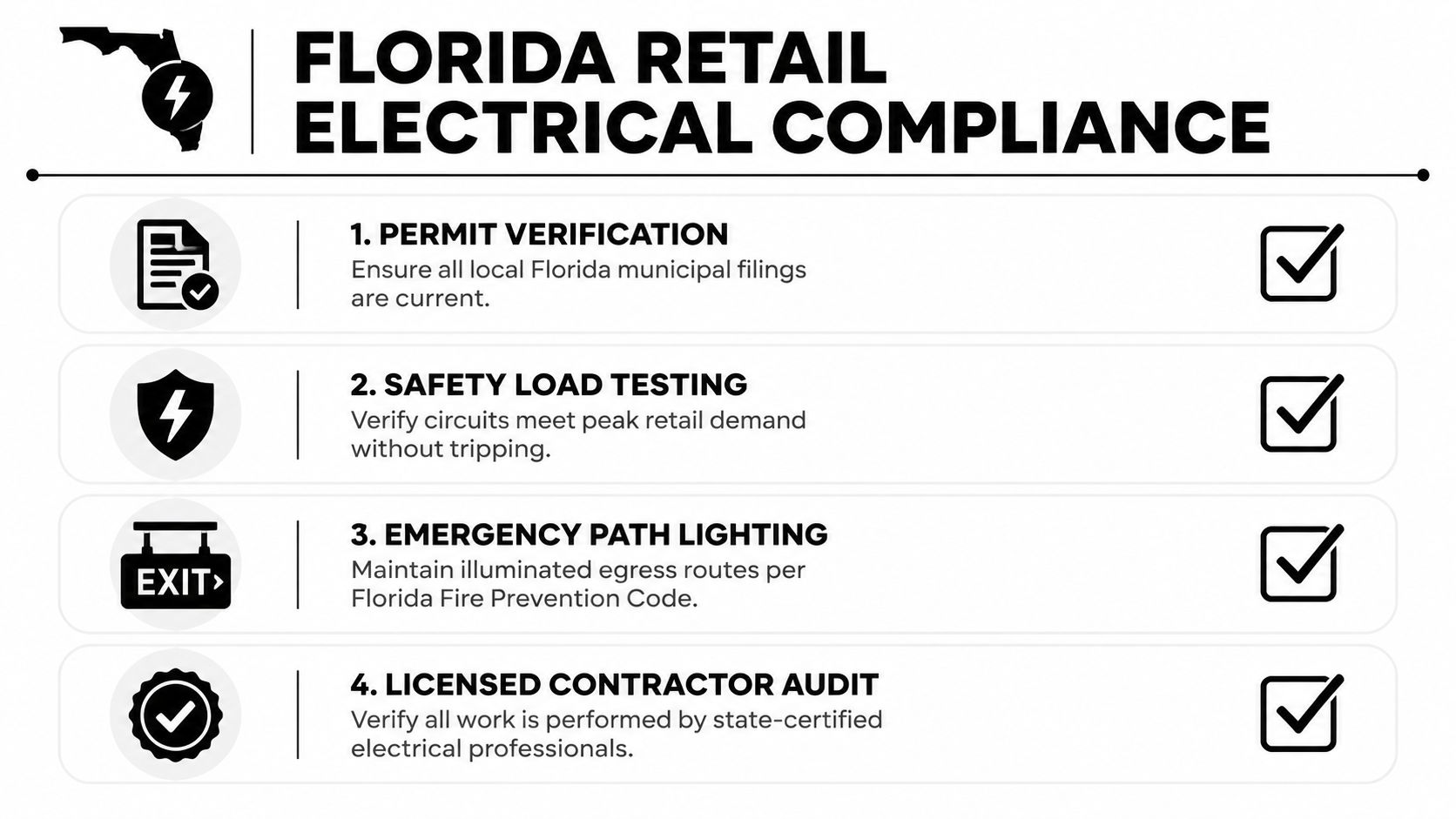
Why dedicated circuits and load rules matter
Checkout systems and high-draw equipment should not be treated like convenience loads. In a retail environment, they're operational infrastructure. According to A-Lumination's commercial electrical repair guidance, NEC 2023 Article 210.23 requires derating for continuous loads over 3 hours, and post-inspection repairs that correct grounding and bonding deficiencies can reduce arc-fault incidents by 60%.
That matters for retailers because the practical failure isn't only a trip. It can be a POS interruption, nuisance shutdown, or unstable power to customer-facing equipment.
A few code-sensitive trouble spots show up repeatedly:
- Checkout counters: POS terminals, printers, scanners, routers, and charging accessories end up sharing power with devices they shouldn't.
- Wet or service areas: GFCI protection has to be correct and coordinated with the actual use of the space.
- Small-format retail spaces: AFCI requirements and branch circuit layout need careful review, especially after remodels.
- Tenant improvements: New displays or appliances often get added without revisiting panel capacity or subpanel needs.
Compliance is risk control, not paperwork
Permits, inspections, and documented repairs protect the store when something goes wrong. If a trip leads to spoiled inventory, customer injury, or a fire investigation, everyone suddenly cares about whether the work was permitted, whether the grounding was correct, and whether a licensed contractor performed the installation.
For managers who oversee multiple sites, keep a simple compliance file with these items:
- Permit records for remodels, lighting replacements, panel work, and added circuits.
- Panel schedules that match the store's actual layout.
- Service notes showing what was tested and repaired.
- Emergency lighting records and any inspection history tied to life-safety systems.
If you want a broader operations view beyond the electrical scope alone, this guide to NFPA and OSHA codes is a useful companion for facility teams handling emergency lighting responsibilities.
A code-compliant store is easier to troubleshoot because the wiring layout makes sense, the protection is where it should be, and the last contractor left a trail you can follow.
What doesn't work
Retailers get into trouble when they rely on piecemeal fixes. Replacing a breaker without checking load. Swapping a receptacle without inspecting the circuit. Adding a display freezer with an extension approach that was never intended to be permanent. Those choices save time once, then create repeat service calls and higher risk later.
Good retail lighting and electrical repair Florida work starts with compliance because compliance usually reveals the underlying operating problem.
The Real Value of 24/7 Emergency Electrical Response
Electrical problems rarely happen at a convenient hour. In retail, they usually hit when the building is under stress, when customers are present, or after normal office hours when it's hardest to get a real answer.
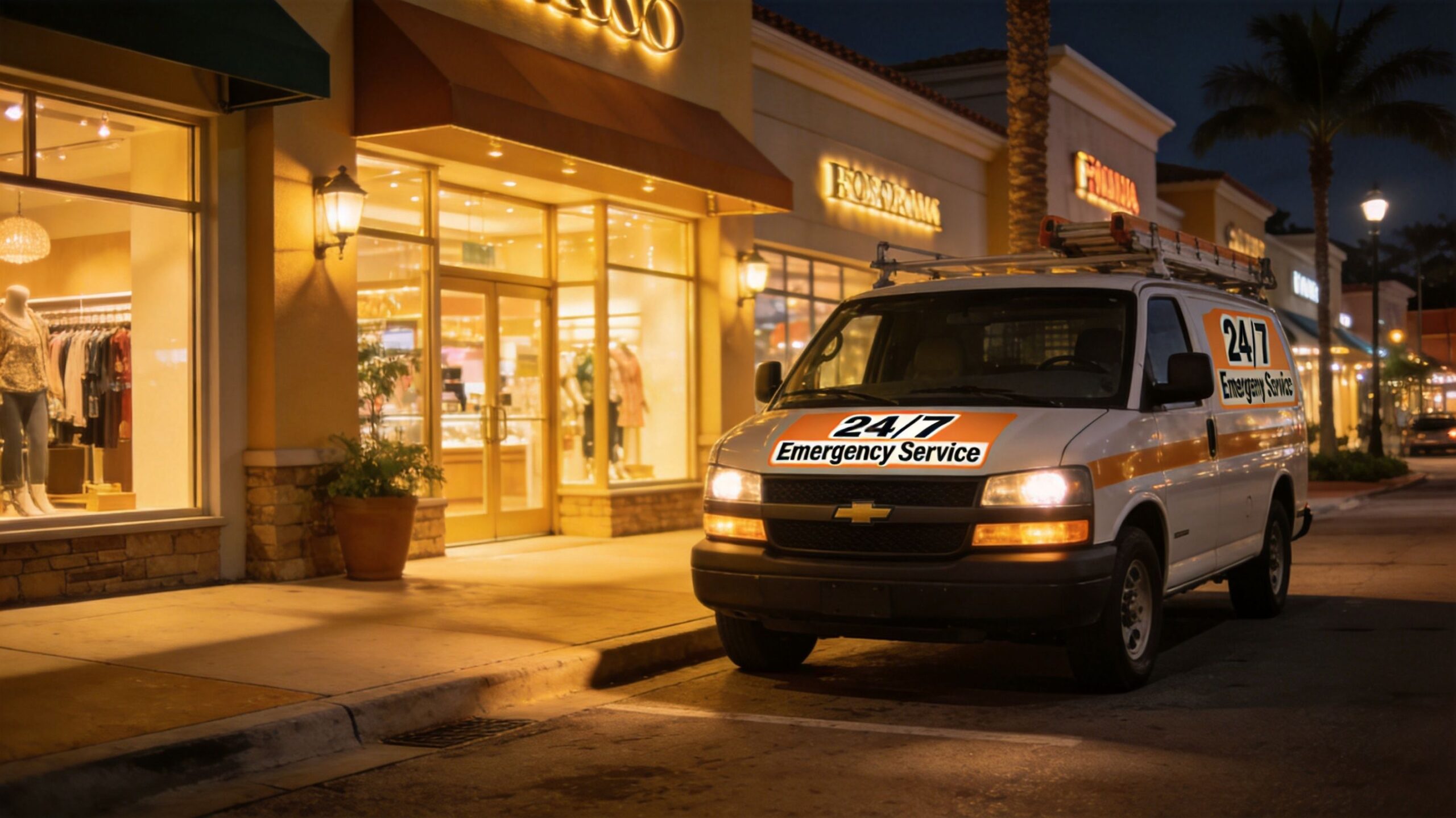
According to Future Select Electrical's retail shopping center page, 68% of retail electrical emergencies occur after 5 PM, and the service gap can cost retailers over $10,000 per hour in lost sales during an outage. That's why “24/7 available” and “actual nighttime retail response” are not the same thing.
What a real emergency partner does differently
A real emergency electrical response plan covers more than dispatch. It starts with triage. The person answering needs enough technical knowledge to separate a dangerous condition from a localized nuisance issue and decide whether the store should stay partially open, shut down a zone, or close until repairs are made.
That response should include:
- Immediate phone triage: Identify panel issues, burning odor reports, partial outage patterns, and equipment involved.
- Retail priority thinking: Restore sales-critical loads first when that can be done safely.
- Safe isolation: Keep one failed circuit or damaged fixture from becoming a larger shutdown.
- Follow-up planning: Emergency restoration should lead to a documented permanent repair path.
One practical reference for managers building an after-hours response plan is this emergency electricians complete guide.
Downtime is more expensive than the invoice
The invoice from an emergency electrician is visible. The hidden loss is usually larger. Sales stop. Staff time gets diverted. Customers walk out. Exterior lighting problems can also create security and safety issues at entrances and parking areas. If checkout fails but half the lights stay on, that's still an operational outage.
The worst emergency calls are the ones that restore power for the night and leave the root cause untouched. You get open again, but the same failure is waiting for the next busy shift.
There's also a major difference between a contractor with an answering service and one where licensed electrical professionals handle the first call. In the first setup, the store manager repeats symptoms to someone who can only take a message. In the second, the first conversation can narrow the fault, identify immediate hazards, and prepare the tech with the right materials before arrival.
Why retailers should decide before the outage
Don't wait until a panel trips on a Friday night to decide who handles your emergencies. Vet the contractor ahead of time. Ask who answers after hours, what the response process looks like, and how they handle live retail spaces where you may need one zone repaired while another stays open.
That planning doesn't eliminate failures. It does shorten confusion, reduce bad decisions under pressure, and protect your operating hours when the store can least afford a delay.
Boosting Profitability With Energy-Efficient Upgrades
A Florida store can reopen after an emergency repair and still keep losing money every month through old fixtures, bad controls, and unnecessary cooling load. Profit improves when the electrical plan covers operating cost, maintenance frequency, and how the space sells product.
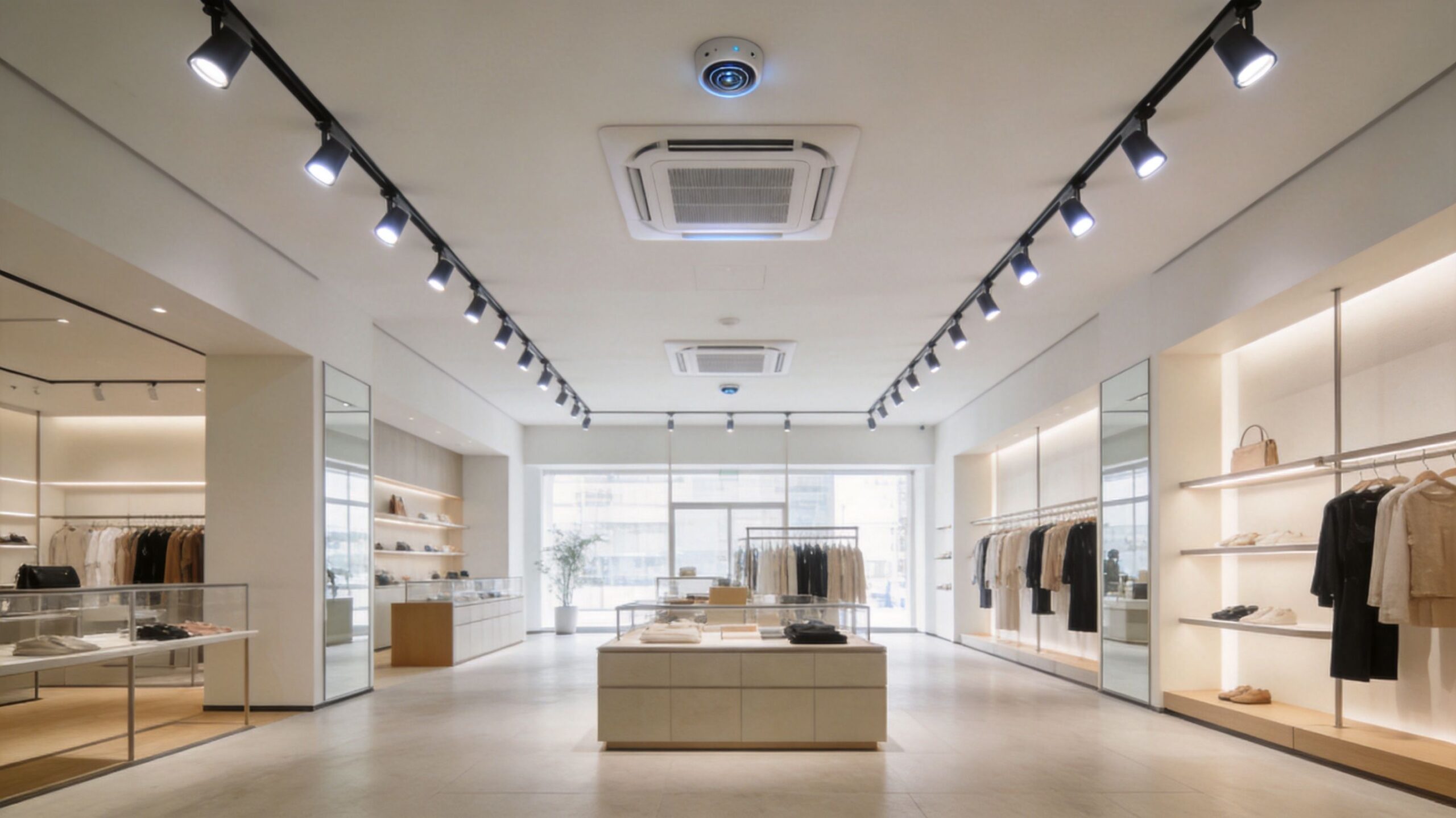
Why lighting upgrades pay off in Florida
Florida puts retail electrical systems under steady pressure. Stores run long hours. Air conditioning works hard for much of the year. Humidity shortens the life of weak components, and older fluorescent systems usually bring ballast failures, uneven light, and rising maintenance labor.
Earlier research cited in this article noted that LED retrofits can reduce lighting energy use by as much as 70% compared with older fluorescent or HID systems. In many stores, payback lands in the 18 to 24 month range, depending on hours, fixture count, utility rates, and whether the existing system is already costing you service calls.
The utility bill is only part of the return. Sales floors perform better when light levels are even, color is accurate, and shadows are controlled. In apparel, cosmetics, grocery, and specialty retail, poor lighting changes how merchandise looks. That affects buying behavior fast.
What to upgrade first
Start where the store is already paying a penalty.
If a zone has frequent lamp outages, bad ballasts, driver failures, or dark spots over shelving, that area moves to the front of the line. If exterior fixtures are unreliable, that becomes an operations and appearance problem. If controls are missing or set up poorly, the store may be burning power before opening, after closing, or in low-traffic back-of-house areas that do not need full output all day.
A practical sequence usually looks like this:
- Replace failing fluorescent or HID systems first: These areas cost the most in repeat maintenance and usually deliver the fastest visible improvement.
- Correct control issues second: Occupancy sensors, scheduling, and compatible dimming cut waste, but only when they match the drivers and the store's operating pattern.
- Handle exterior, parking, and sign lighting: These systems affect visibility, safety, and how the store reads from the road at night.
- Review branch circuits and panel capacity during the retrofit: Upgrade work is the right time to catch overloaded circuits, mislabeled panels, and old fixture wiring that will keep causing trouble.
- Look at cooling load with the lighting plan: Lower heat from efficient fixtures can reduce strain on HVAC equipment, which matters in Florida.
Field experience matters here. I have seen retailers buy inexpensive fixtures that looked fine on paper, then spend more fixing glare, replacing failed drivers, or reworking mounting and beam spread after the install. Cheap equipment is expensive when the sales floor suffers or the crew has to come back twice.
The profit opportunity beyond lighting
LEDs are the obvious first move, but they are not the whole plan. A store that cuts lighting wattage, improves controls, and ignores other major electrical loads leaves savings behind.
Empire Electric notes on its commercial lighting service page that Smartcool ECO3 installations can cut AC electricity consumption by up to 25%, with a 12 to 18 month payback period for a typical 5,000 sq ft Florida retail store. That matters because lighting and cooling are connected. Every watt a fixture wastes as heat adds to the air conditioning burden.
One option in Palm Beach County is commercial lighting installation and upgrade work that can be paired with Smartcool ECO3 where the building load profile supports it. That approach makes sense during remodels, ceiling work, fixture replacement, or circuit changes, when labor and disruption can be consolidated into one project window.
What works in the field
Stores get better results when upgrades are scoped around actual operating conditions, not just a fixture catalog.
What works
- Auditing the existing fixtures, controls, switching, and circuit conditions before ordering materials
- Choosing fixtures with the right color temperature, beam spread, and driver compatibility for the merchandise and ceiling height
- Using retrofit work to correct wiring defects, bad lampholders, and mislabeled circuits while access is open
- Grouping lighting, controls, and selected cooling-efficiency measures into one plan so labor is spent once
- Tracking maintenance reduction as part of ROI, not just the monthly utility bill
What does not work
- Swapping lamps while leaving failing ballasts, poor sockets, or damaged fixture wiring in place
- Mixing controls and drivers that do not communicate properly
- Over-lighting the store to chase brightness while creating glare and customer discomfort
- Treating HVAC load as outside the electrical conversation
- Buying strictly on unit price without checking warranty support, replacement parts, and service access
Good upgrade plans lower energy use, reduce repeat service calls, and make the store easier to operate. They also protect margin in a way emergency repairs never can.
For contractors trying to explain that value clearly online, this electrician's guide to winning local jobs is a useful look at how service companies position practical expertise for local buyers.
Your Florida Retail Electrical Contractor Hiring Checklist
Most contractor problems begin before the first truck rolls. They start when a retailer hires a company that can wire a space, but doesn't understand live store operations.
The right contractor for retail lighting and electrical repair Florida work should be able to troubleshoot a tripping circuit, coordinate off-hours work, protect customers during repairs, and speak clearly about code, permits, and long-term maintenance. If they can't do all of that, you'll end up hiring again.
Questions worth asking before you sign
Use these questions in interviews, quote reviews, or renewal conversations with your current provider:
- After-hours response: Who answers the phone at night, and can they discuss the electrical issue?
- Retail experience: How do you isolate work areas without creating unnecessary disruption to customers and staff?
- Permitting and compliance: Who handles permit verification and inspection coordination for panel, circuit, and lighting work?
- Documentation: Will you provide panel updates, repair notes, and a clear explanation of root cause?
- Pricing clarity: Are after-hours rates, material allowances, and return-trip conditions spelled out in the quote?
- Scope range: Can the same contractor handle receptacle repairs, fixture replacement, circuit additions, subpanel work, and energy retrofit planning?
A contractor's public reputation also says something about how they earn local work. For a view into how electricians compete and present themselves in local markets, this electrician's guide to winning local jobs is useful background when you're comparing companies online.
Preventative Maintenance vs. Reactive Repair Cost Analysis
| Factor | Preventative Maintenance Plan | Reactive Emergency Repairs |
|---|---|---|
| Scheduling | Work is planned around store hours and low-traffic periods | Work happens when failure forces it |
| Problem visibility | Issues are found during inspection and testing | Issues are discovered after disruption |
| Operational impact | Lower disruption to checkout, merchandising, and staff routines | Higher disruption during peak periods |
| Repair quality | More time to fix root causes and coordinate parts | More pressure to restore service fast |
| Budget control | Easier to forecast and approve | Harder to predict because failures arrive unplanned |
| Upgrade planning | Can combine maintenance with retrofits and circuit improvements | Usually limited to immediate restoration |
Red flags that deserve attention
Some warning signs show up early. Quotes that don't mention permits where they're likely required. Vague language around emergency response. No discussion of root cause. No distinction between temporary restoration and permanent repair.
If a contractor talks only about “getting you back on” and never about why the failure happened, that's not a maintenance partner. That's a reset button.
Good contractors don't just say yes quickly. They ask better questions first.
Florida Retail Electrical FAQs
How often should a retail store schedule electrical and lighting maintenance
Set the schedule based on risk, not habit. A newer store with stable loads and modern fixtures may only need periodic inspections. An older Florida retail space with long operating hours, rooftop HVAC, signage, refrigerated cases, or recurring breaker trips needs more frequent attention because the cost of one failure during business hours is usually higher than the cost of planned service.
A good rule is simple. If you are seeing repeat lamp failures, warm panels, nuisance trips, ballast or driver failures, or flickering that keeps coming back, stop treating those as isolated calls. Put the store on a maintenance plan and address the underlying electrical issues before they turn into downtime.
Is spot-replacing failed lamps a good strategy
Spot replacement works for a small store with only a few fixtures out. It gets expensive fast in larger retail spaces.
Once failures start showing up across a sales floor, group replacement usually makes better business sense because labor, lift time, and after-hours access can be handled in one planned visit instead of repeated service calls. It also helps keep light levels consistent, which matters for merchandising, customer comfort, and security camera coverage.
What's a realistic ROI for a full LED retrofit
The payback depends on fixture type, operating hours, utility rates, controls, and how much maintenance the old system is already requiring. Stores that still have older fluorescent, metal halide, or high-wattage exterior lighting usually see the strongest return because they cut both energy use and service calls.
The mistake is looking only at the utility bill. A solid retrofit plan can also reduce driver and lamp replacement frequency, lower heat load in some areas, improve light quality at displays and checkout, and give the store a better platform for controls, signage, and exterior safety lighting.
Should POS systems be on dedicated circuits
Yes. Point-of-sale equipment, network gear, security systems, and any equipment that supports transactions should be treated as priority loads.
If terminals share circuits with convenience outlets, display lighting, or breakroom equipment, one small problem can interrupt sales. Dedicated circuits, proper load review, and surge protection reduce that risk and make troubleshooting much faster when something does go wrong.
What should a manager do during an electrical outage before the electrician arrives
Start with safety. Find out whether the outage is limited to one area or affects the whole store, note any burnt smell, buzzing, visible damage, or warm equipment, and keep staff away from anything that looks compromised.
Do not keep resetting a breaker. One reset may be part of basic checking. Repeated resets can turn a minor fault into damaged equipment or a fire risk.
Have a short report ready for the electrician: what went down, when it started, what was running at the time, and whether checkout, refrigeration, signage, or exterior lighting are affected. That information helps the crew arrive with the right parts and a better plan.
What electrical problems cost retailers the most
The expensive problems are not always the dramatic ones. Partial failures often do more damage because the store stays open while sales, safety, and staff efficiency all get worse.
A dim sales floor, dead exit sign, unstable POS circuit, failing panel component, or parking lot lighting outage can create lost revenue, higher shrink risk, customer complaints, and rushed emergency labor all in the same day. The lowest-cost repair is usually the one found during inspection, before it forces a same-day call.
Can one contractor handle repairs, emergency response, and energy upgrades
Yes, and that usually saves time if the contractor is set up for retail work. The same team that handles emergency troubleshooting should also be able to inspect panels, correct code issues, improve lighting performance, and plan upgrades that lower energy and maintenance costs over time.
If you need a contractor who can handle retail repairs, emergency troubleshooting, lighting upgrades, and long-term electrical planning in Palm Beach County, Lighthouse Energy Services is one option to evaluate. They provide commercial electrical service with true 24/7 availability, handle repairs and installations, and can help retailers address both urgent failures and energy-saving improvements with clear, practical scope.