
What Is an Electrical Wiring Diagram House PDF (and Where to Get One Fast)?
An electrical wiring diagram house PDF is a downloadable blueprint that maps out every circuit, outlet, switch, and connection in a residential electrical system. Here are the most reliable places to find one:
- Municipal guides – Cities like Calgary publish free homeowner wiring guides that include code-compliant diagrams
- Black+Decker’s Complete Guide to Wiring – A 339-page PDF (42.76 MB) covering NEC-compliant diagrams for common projects
- Electrical Wiring Diagram Books PDF – A 109-page reference document with over 142,000 views
- Your local building department – Often provides room-specific wiring diagrams as part of permit packages
Most homeowners need these diagrams for one of three reasons: planning a renovation, understanding their existing system, or preparing for an inspection.
Getting the right diagram matters. A wiring diagram that doesn’t match your local code — whether that’s the NEC in the US or the Canadian Electrical Code — can lead to failed inspections, safety hazards, or costly rework. Most new homes run on a 100A or 200A service, and even small projects like adding an outlet require understanding how your circuits are laid out.
I’m Bruce Kemp, a licensed electrical contractor with hands-on experience in everything from estimating and permit preparation to pulling wire and working with city inspectors — and I’ve used electrical wiring diagram house PDFs at every stage of that process. In this guide, I’ll walk you through how to read, use, and find the right diagrams for your home.
Understanding the Electrical Wiring Diagram House PDF
To the untrained eye, an electrical wiring diagram house PDF might look like a bowl of alphabet soup mixed with some very geometric spaghetti. However, once you understand the “language” of the wires, it becomes a clear roadmap of your home’s energy. At its core, every residential circuit relies on three main types of conductors: hot, neutral, and ground.
- Hot Wires: Usually black or red, these carry the “live” current from the panel to your devices.
- Neutral Wires: Typically white, these complete the circuit by carrying the current back to the panel.
- Ground Wires: Bare copper or green, these provide a safe path for electricity to travel if there is a fault, preventing shocks.
When you look at a House Wiring Diagram of a Typical Circuit, you’ll see how these wires interact. For example, in many South Florida homes, you’ll notice “daisy-chaining,” where power runs from one receptacle to the next in a sequence. We often use “pigtailing” methods—connecting multiple wires with a wire nut and a short lead—to ensure that if one outlet fails, the rest of the circuit stays live. This is a hallmark of quality Residential Electrical work that we prioritize at Lighthouse Energy.
How to Interpret an Electrical Wiring Diagram House PDF
Interpreting a diagram requires looking at “wiring zones.” A single PDF might be divided into different sheets, often at a 1:50 scale, detailing specific areas like the kitchen or master bathroom. You aren’t just looking at lines; you are looking at conductor paths that link switches to lights and fixtures.
For more complex structures, you might encounter an [PDF] Electrical Riser Diagram – Fort Pierce, FL. A riser diagram provides a vertical representation of the electrical system, showing how power moves from the main service entrance up through different floors or subpanels. Understanding these paths is essential for Electrician House Wiring because it helps identify where the main power feed enters the home and how it branches out to serve various loads.
Standard Symbols and Components in Residential Wiring
If you want to master the electrical wiring diagram house PDF, you have to learn the symbols. Think of them as the emojis of the electrical world. Instead of drawing a literal picture of a lightbulb, architects use a circle with lines through it.
According to the [PDF] electrical symbol legend – Royal Palm Beach, standard symbols include:
- Duplex Receptacle: A circle with two parallel lines (representing a standard wall outlet).
- GFCI Outlet: Marked with “GFCI,” these are mandatory in damp areas like kitchens and bathrooms.
- Three-Way Switch: Represented by an “S” with a subscript “3,” allowing you to control a light from two different locations (like the top and bottom of a staircase).
- AFCI Breaker: Indicated in the panel schedule, these protect against arc faults that cause fires.
Modern diagrams also specify the type of cable used. In South Florida residential construction, you’ll most commonly see NM (Non-Metallic) cable, often called Romex. Larger appliances might require conduit or specialized AC-90 cabling. If your panel is older and lacks the space for these modern protections, it might be time for Electrical Panel Upgrades to ensure your home meets current safety standards.
Common Components in a Modern Service Panel
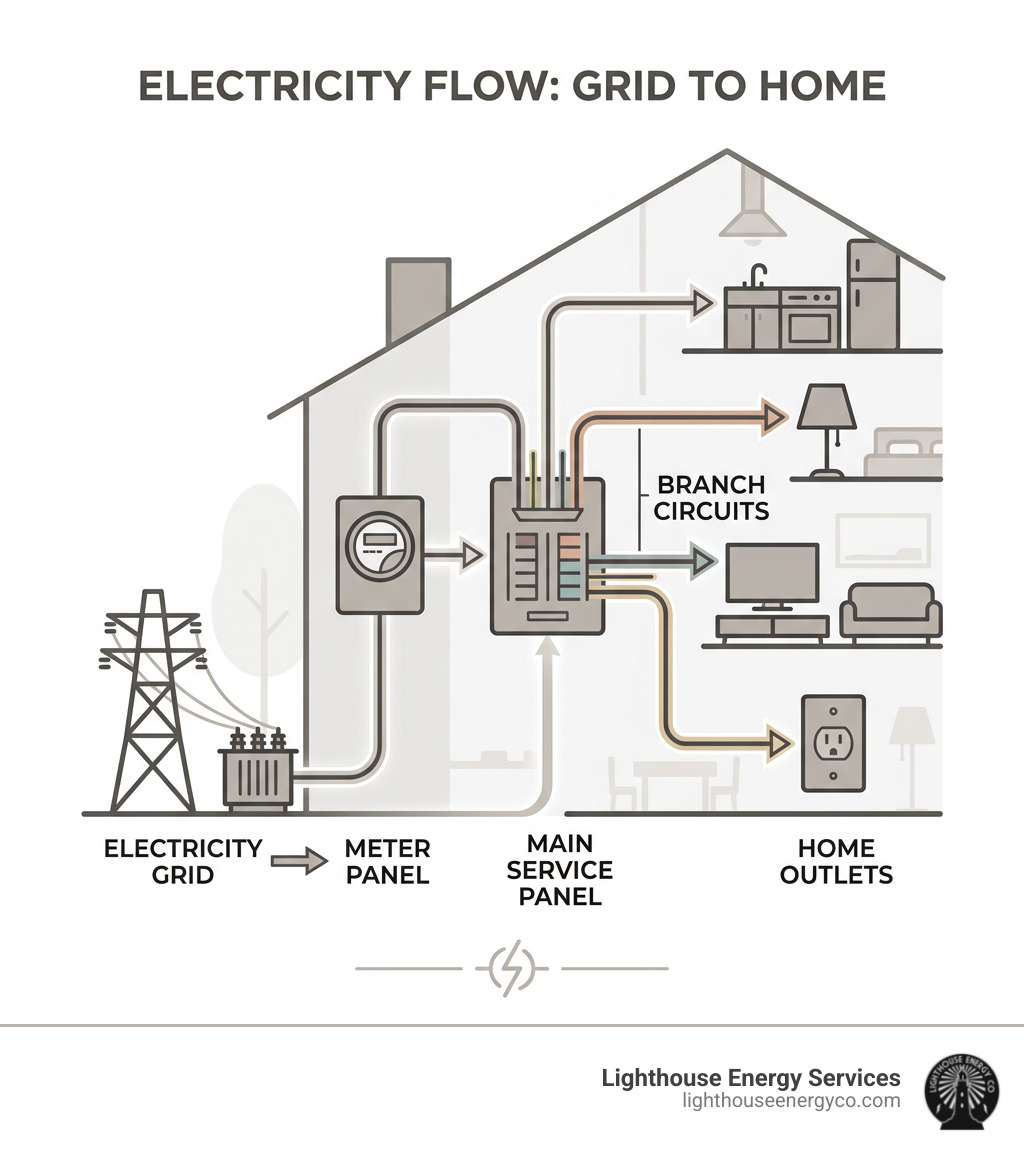
The service panel is the “brain” of your home’s electrical system. Within an electrical wiring diagram house PDF, the panel section will detail:
- Main Breaker: The primary switch that shuts off power to the entire house (usually 100A or 200A).
- Bus Bars: Two metal bars that carry power down the panel to the individual breakers.
- Branch Circuits: The individual circuits that feed specific rooms or appliances.
- Grounding Electrode System: The physical connection to the earth (usually via ground rods) that keeps the system stable.
For a deep dive into how these components should be organized, the Electrical Panel Upgrades Guide is an excellent resource for homeowners in Palm Beach and Broward County.
Planning Your Layout: Circuits, Loads, and Code Requirements
Planning a wiring layout isn’t just about where you want your TV; it’s about math. You have to calculate the total “load” to ensure you don’t trip breakers every time you turn on the microwave. For a single dwelling over 80m², the minimum service calculation is often 24,000W.
Most modern homes in our service area—from Jupiter to Miami—require a 200A service to handle high-demand items like EV charging stations and central AC. If you are doing a Whole House Rewiring, you must adhere to the National Electrical Code (NEC). For example, code dictates that you should have no more than 12 outlets on a single branch circuit.
When pulling permits in South Florida, cities like Boca Raton have specific requirements for One & Two Family | Boca Raton, FL dwellings. These local codes ensure that your wiring can withstand our unique climate and high humidity.
Where to Find a Reliable Electrical Wiring Diagram House PDF
You don’t have to start from scratch. There are several high-quality, free resources where you can download an electrical wiring diagram house PDF:
- The Complete Guide to Wiring (PDF) – 42.76 MB @ PDF Room: This is essentially the “Bible” for DIYers, offering step-by-step visuals for almost every household project.
- densem.edu – Electrical Diagram For House: A great academic resource for understanding the theoretical flow of home power.
- Black+Decker Resources: Often available through library portals, these guides are updated to the latest NEC standards.
- Lighthouse Energy Insights: When starting New Home Electrical Wiring, we provide our clients with detailed plans that serve as a permanent record of their home’s infrastructure.
Frequently Asked Questions about House Wiring
How many outlets can be on a single 15-amp branch circuit?
While the technical limit in many residential codes is 12 outlets, we generally recommend fewer (around 8 to 10) to avoid nuisance tripping. If you have high-draw electronics, you might even consider Residential Low Voltage Wiring for data and communication to keep the load off your primary power circuits.
What is the difference between GFCI and AFCI protection?
This is the “Safety Duo” of modern wiring. GFCI (Ground Fault Circuit Interrupter) is designed to prevent electrocution by detecting tiny leaks in current (as low as 4-6mA) and shutting off power instantly. AFCI (Arc Fault Circuit Interrupter) is designed to prevent fires by detecting “arcs”—sparks caused by damaged wires or loose connections. While Industrial Control Wiring uses similar principles, residential systems have specific requirements for where these must be installed (e.g., AFCIs in bedrooms and GFCIs in bathrooms).
Why does the 2023 NEC require a neutral wire at switch boxes?
In the old days of Knob and Tube Wiring, switches didn’t always need a neutral. However, modern smart switches, dimmers, and timers require a small amount of “always-on” power to run their internal computers. The 2023 NEC requires a neutral at almost every switch location to support these smart home technologies.
Conclusion
Navigating an electrical wiring diagram house PDF can feel overwhelming, but it is the most important document you can have when maintaining or upgrading your home. Whether you are troubleshooting a dead outlet in West Palm Beach or planning a massive renovation in Fort Lauderdale, having a clear map of your electrical system ensures the job is done safely and efficiently.
At Lighthouse Energy, we specialize in making sense of these complex systems for homeowners across South Florida. From Palm Beach County to Miami-Dade, our team of qualified electricians is available 24/7 to ensure your home’s wiring is “done right, and done right now.” We don’t hide fees, and we don’t cut corners on code compliance.
Ready to start your next project? Get expert help with your New Home Electrical Wiring today and let us handle the diagrams, the permits, and the heavy lifting.