
You've bought the charger, cleared space in the driveway, and may even have the mounting bracket ready. Then the electrician asks for the panel information and mentions an EV charger installation permit. Suddenly, the project isn't just about hanging a box on the wall. It's about whether your electrical service can safely support Level 2 charging, which approvals apply to your property, and whether Florida Power & Light needs to be involved before the work can be completed.
In Palm Beach County, the permit is usually the easy part when the application reflects the actual electrical conditions. Problems start when someone treats a new 240-volt circuit like a weekend home-improvement task. The practical path is to check capacity first, prepare the right documents, identify the governing jurisdiction, and schedule inspections in the correct order.
Table of Contents
- What an EV Charger Installation Permit Actually Covers in Palm Beach County
- Which Permits and Approvals Your Project Will Trigger
- Documents and Drawings You Need Before You Apply
- Load Calculations and Utility Coordination Behind the Permit
- Submitting the Application and What to Expect on Fees and Timeline
- Common Reasons EV Charger Permits Get Delayed or Rejected
- When to Hire a Licensed Electrician and How Lighthouse Energy Services Fits In
What an EV Charger Installation Permit Actually Covers in Palm Beach County
A Level 2 charger normally requires a dedicated 240-volt circuit. That means new conductors, a correctly sized breaker, a wiring method suited to the route, and equipment installed where it can be inspected. The electrical permit gives the local authority a chance to review those safety details before the charger is energized.
The permit generally covers:
- The branch circuit: From the service panel or approved distribution point to the charger.
- Circuit protection: Breaker rating and compatibility with the charger's continuous load.
- Conductor selection: Wire gauge, insulation rating, termination method, and voltage requirements.
- Physical installation: Conduit, supports, exterior protection, trenching, mounting, and working clearances.
- Final inspection: Verification that the completed work matches the approved application.
The distinction between charger types matters. A Level 1 unit plugged into an existing, code-compliant 120-volt receptacle may not require a separate charger installation permit if no wiring is altered, although the property's governing authority should confirm that exception. A hardwired Level 2 unit, or a Level 2 receptacle fed by a newly installed 240-volt circuit, is different. The new circuit is electrical work and should be permitted before conductors are pulled.
Practical rule: Don't start the installation and hope the paperwork catches up. The approved drawings need to describe the work before the concealed wiring is covered.
Why the permit protects the property
A permit is not just an administrative charge. It creates a record that the circuit was reviewed and inspected. That record can matter when you file an insurance claim, sell the home, document improvements, or troubleshoot a future electrical problem.
The permit is tied to the property address and the licensed contractor responsible for the work. If the charger is installed by a contractor, ask who will pull the permit and who will schedule the final inspection. These home EV charger installation requirements provide useful background on the electrical decisions that should be settled before installation.
For a second practical perspective on circuit planning, equipment placement, and installation requirements, review these tips from Access Electrical and Lighting. The important takeaway is simple: the permit follows the electrical scope, not the marketing name printed on the charger box.
Which Permits and Approvals Your Project Will Trigger
A Palm Beach County homeowner may expect one electrical permit and discover the delay is elsewhere. The wiring can be straightforward, while a service upgrade, utility review, HOA approval, or municipal requirement determines whether the Level 2 charger can proceed.
For a new 240-volt circuit or hardwired charger, an electrical permit is generally the starting point. In unincorporated Palm Beach County, applications typically go through Palm Beach County Planning, Zoning, and Building's online permitting system. A property inside a municipality may follow a separate process because cities such as West Palm Beach, Boca Raton, or Jupiter can administer their own building requirements.
Match the approval path to the property
| Property Type | Electrical Permit | HOA / ARC | Utility Coordination | Additional Reviews |
|---|---|---|---|---|
| Single-family home | Usually required for new Level 2 wiring | May apply in planned communities | Needed if the service, meter, or available capacity changes | Building review may apply to structural or exterior work |
| Townhome or condominium | Usually required | Common for exterior or common-area work | May apply where equipment connects to shared infrastructure | Association, fire-access, or common-ownership review may apply |
| Multifamily property | Required for charger circuits | Often required | May be needed for shared service or new metering | Building, accessibility, parking, and fire-access reviews may apply |
| Retail or office site | Required | Usually not an HOA issue | Often relevant for larger loads or service changes | Site-plan, building, accessibility, and parking reviews may apply |
| Public-facing charging area | Required | Depends on ownership | Frequently relevant | Accessibility, traffic flow, equipment protection, and site approvals may apply |
The charger's location can create a second approval track. Exterior conduit, a front-facing wall installation, common-area equipment, or work that changes a shared property's appearance may require HOA or architectural review. That approval is separate from the county or municipal electrical permit.
A service upgrade creates another decision point. If the existing panel cannot support the added charging load, the project may require utility coordination, new metering, or changes to the service equipment. In that situation, the utility process, rather than the electrical inspection, can become the schedule bottleneck.
Commercial and shared charging projects also raise access and site-use questions. Public or business installations can involve building, electrical, accessibility, parking, fire-access, and sometimes mechanical reviews. The approval scope expands because drivers must be able to reach and operate the equipment safely.
Start by confirming the property's jurisdiction. Then identify the electrical, HOA, utility, site, and accessibility approvals that apply. One electrical permit does not automatically authorize every part of the project.
Documents and Drawings You Need Before You Apply
A clean application tells the reviewer what exists, what will change, and how the new load connects to the property. A charger manufacturer's brochure alone isn't enough. The reviewer needs a usable picture of the site and the electrical system.
Start with the site drawing
The drawing doesn't need to be an architectural masterpiece, but it must be legible and complete. Show the home or building, the electrical panel, the proposed charger location, the conduit route, and any trenching across a driveway, walkway, or yard. Mark whether the charger will be wall-mounted or pedestal-mounted, and identify areas where vehicles or landscaping could damage the equipment.
If the run passes through an exterior wall, attic, garage, or underground route, show that transition. A vague line from “panel” to “charger” leaves too many code questions unanswered.
Document the available electrical capacity
The load calculation is the document that answers the question most homeowners care about: Can the existing service handle the charger? List the major existing loads, including air conditioning, water heating, cooking equipment, pool equipment, and other 240-volt appliances. Then add the proposed EV circuit and apply the applicable demand calculation method.
Include a panel schedule with:
- Main service rating: The existing main breaker and service information.
- Circuit inventory: Existing breakers and the loads they serve.
- Available spaces: Open breaker positions and any tandem breakers already installed.
- Proposed circuit: Breaker size, conductor size, circuit voltage, and charger connection method.
Attach the manufacturer's equipment specification sheet. It should identify the charger's voltage, current requirements, environmental rating, and installation limitations. The equipment information must agree with the drawing. A charger shown with one breaker size and specified with another creates an avoidable correction.
Common submission problems include:
- Missing load calculation: The reviewer can't verify service capacity.
- Outdated utility information: Existing service or meter details don't match the property.
- No surge protection note: The application omits a required or expected protection detail.
- Mismatched specifications: The charger cut sheet conflicts with the circuit shown.
- Incomplete site plan: The drawing doesn't show the route, mounting point, or trench.
A complete packet makes the permit review about the actual installation instead of a request for missing information.
Load Calculations and Utility Coordination Behind the Permit
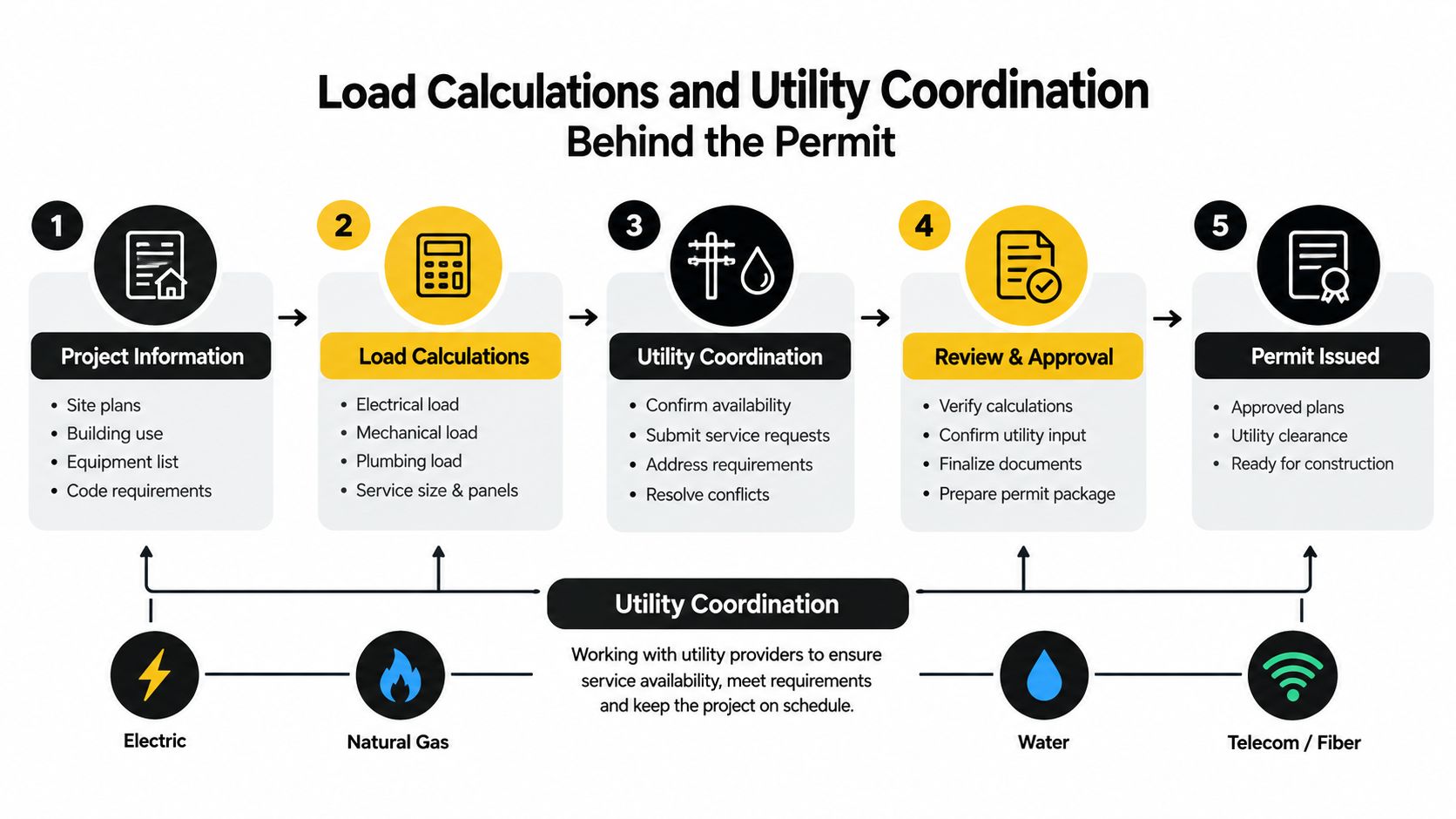
A 200-amp service doesn't automatically mean a 50-amp EV breaker will fit. The electrician has to evaluate the home's calculated demand, existing equipment, service conductors, panel condition, and the charger's continuous load characteristics. A house with modest existing demand may accommodate Level 2 charging without a service upgrade, while a home with substantial air-conditioning, pool, water-heating, and appliance loads may not.
The calculation typically starts with the service and existing loads, then adds the proposed EV load under the applicable NEC Article 220 method. The question isn't whether empty breaker spaces exist. A panel can have open spaces and still lack sufficient service capacity.
Where the project changes direction
The load review usually leads to one of several paths:
- Existing service is adequate: The electrician installs the dedicated circuit and proceeds with the normal permit and inspection process.
- The panel is unsuitable but service capacity remains available: A subpanel or panel replacement may solve the distribution problem without changing the utility service.
- Calculated demand is too high: The project may require a service upgrade and coordination with the utility.
- The charger is detached from the main building: The electrician must evaluate the feeder, grounding, disconnecting means, and route to the detached garage or accessory structure.
Utility coordination becomes the bottleneck when the work affects the service, meter, service conductors, or available capacity. A new meter arrangement, load letter, or utility work order may need to precede final building approval. On a full panel, a load-side connection may be practical if code conditions permit. A line-side connection may be considered in other designs, but it requires careful equipment, disconnect, and utility review.
Don't choose between these options from a panel photograph. The correct approach depends on the calculated load and the physical service configuration. If the project may involve replacing the panel or changing the service, review the expected electrical panel upgrade cost factors before approving the charger installation alone.
Submitting the Application and What to Expect on Fees and Timeline
The Palm Beach County submission process is straightforward when the documents are ready. The licensed contractor identifies the property, selects the correct scope, enters the electrical work, uploads the site drawing, load calculation, panel schedule, and equipment specifications, then pays the assessed fees. The application is routed for review based on the property's jurisdiction and the type of work described.
A typical online sequence looks like this:
- Confirm jurisdiction: Verify whether the property is handled by Palm Beach County or a municipal building department.
- Select the contractor: Enter the licensed electrical contractor responsible for the work.
- Describe the scope: State whether the project includes a new branch circuit, hardwired charger, receptacle, subpanel, panel replacement, trenching, or service change.
- Upload documents: Add the drawings, calculation, panel information, and manufacturer specifications.
- Pay the fee: Submit payment through the applicable permitting portal.
- Respond to corrections: Provide revised drawings or missing documents if the reviewer requests them.
- Schedule inspections: Arrange the rough, service, and final inspections that apply to the approved scope.
Fees and timing vary with the scope
Exact charges depend on jurisdiction, valuation, trade scope, plan review, and whether the work includes service or structural changes. Avoid relying on a generic online price. The contractor should confirm the fee assessment before submission, especially for commercial work.
| Permit Type | Fee Range | Review Time | Inspection Lead Time |
|---|---|---|---|
| Residential Level 2 circuit | Varies by jurisdiction and scope | Depends on completeness and reviewer workload | Depends on appointment availability after issuance |
| Residential charger with panel work | Higher than a standalone circuit | May require additional electrical review | Includes the inspections applicable to the panel work |
| Small commercial charger project | Varies with site and electrical scope | Often involves more than one review discipline | Depends on electrical, building, and site requirements |
| Service upgrade with charger | Includes service-related approvals | Utility coordination can extend the schedule | Requires inspection sequence for the approved service work |
The inspection sequence may include a rough inspection before concealed wiring is covered, a service or equipment inspection where applicable, and a final inspection after the charger is installed and labeled. A charger shouldn't be placed into service just because the equipment is mounted. The permit needs its final sign-off.
For budgeting, separate permitting from installation, trenching, panel work, and service changes. A practical overview of EV charging station installation cost considerations can help you ask for a scope that distinguishes those categories rather than combining everything into one unclear figure.
Common Reasons EV Charger Permits Get Delayed or Rejected
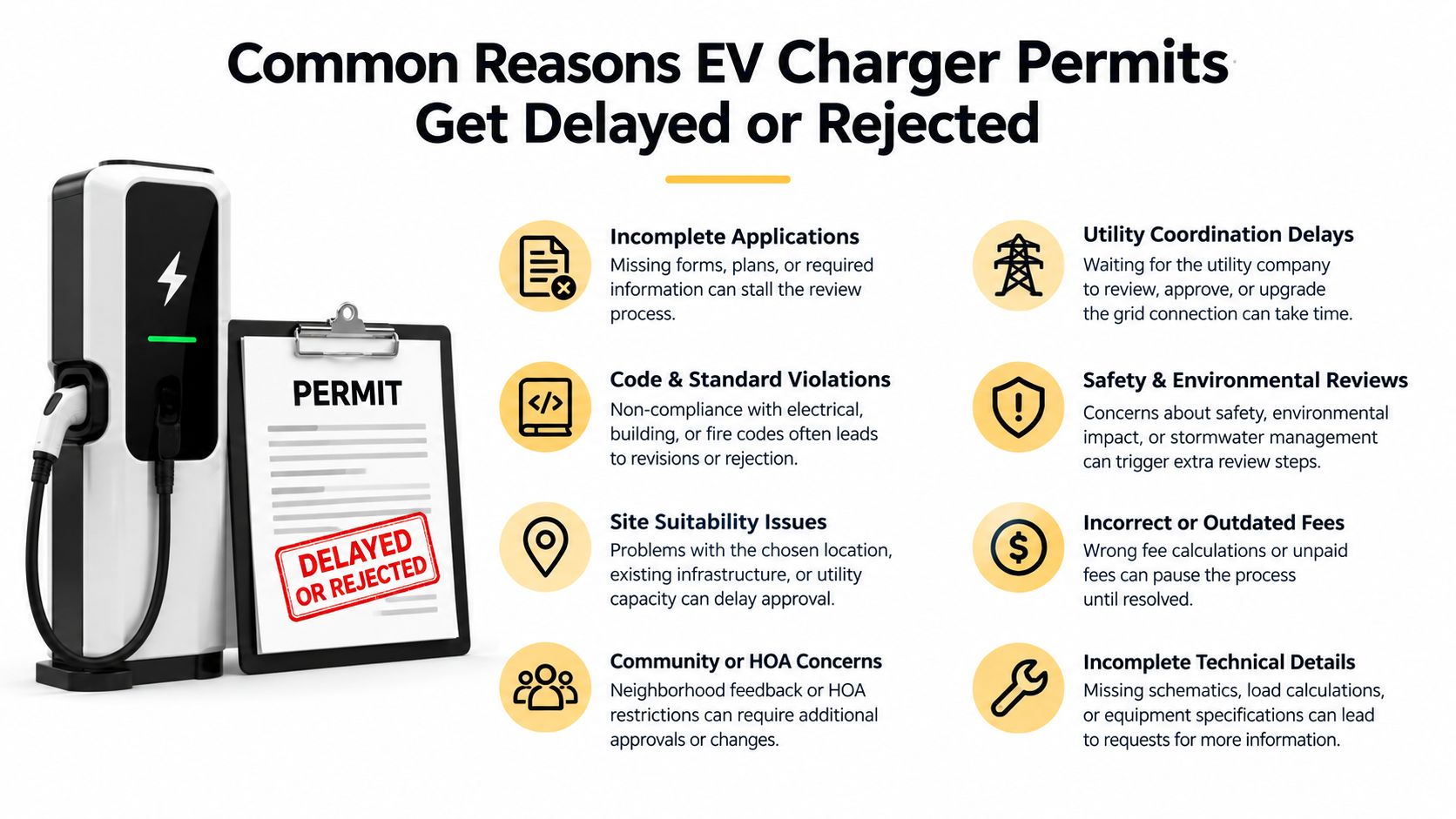
A permit application can look complete to a homeowner and still fail the first review. The most common problem is an application that describes the charger but doesn't describe the electrical path clearly enough for the reviewer to verify it.
Electrical omissions that create corrections
- The site plan doesn't show the charger: A hand sketch that omits the mounting point, panel, or conduit route leaves the reviewer without the installation context.
- The load calculation skips major equipment: Leaving out air conditioning, pool equipment, water heating, or another existing load can invalidate the capacity conclusion.
- The conductors don't match the load: The wire size, insulation, breaker, and charger specifications must work together.
- The route ignores physical protection: Exterior conduit, attic runs, driveway crossings, and underground sections need details appropriate to the location.
- The charger blocks required clearances: Equipment placed in front of panel working space or access routes can't be approved just because the vehicle can reach it.
- Flood exposure isn't addressed: Low-mounted equipment in a flood-prone location may need a different installation approach and elevation review.
Commercial and multifamily projects create another layer of risk. Shared chargers may affect accessible routes, parking circulation, impact protection, and common ownership. Government guidance from the federal alternative fuels permitting resource describes the core permitting workflow as confirming the required electrical or building permits, preparing a site drawing, completing load calculations, and submitting equipment information. Faster review doesn't eliminate those technical requirements.
Administrative errors matter too
An expired contractor license, an unsigned owner-builder disclosure, or a blank utility work order field can stop an otherwise sound application. These mistakes force a correction cycle, and the project waits while the missing information is supplied and reviewed.
A permit isn't a weekend project when the packet is incomplete. Before submitting, compare the drawing, load calculation, panel schedule, charger specifications, contractor information, and utility details line by line. Consistency is often the difference between a clean review and repeated corrections.
When to Hire a Licensed Electrician and How Lighthouse Energy Services Fits In
DIY work is limited to the narrowest situation: a 120-volt charger plugged into an existing dedicated, code-compliant receptacle, with no new wiring and no change to the electrical system. Even then, the property owner should confirm local requirements before treating the installation as exempt.
The decision changes as soon as the project involves a Level 2 charger, a new 240-volt circuit, a subpanel, a panel replacement, a service upgrade, or a long exterior run. Those projects require electrical design decisions that a mounting guide won't answer. The electrician must determine whether the panel has capacity, whether the conductors are protected along the route, whether a disconnect is needed, and whether the utility must review service changes.
What a qualified contractor contributes
A licensed electrical contractor can:
- Prepare the load calculation: The calculation accounts for existing equipment rather than relying on empty breaker spaces.
- Choose the circuit design: The breaker, conductors, conduit, disconnecting means, grounding, and charger connection must align.
- Identify utility involvement: Service-side changes and meter work can be recognized before they disrupt the schedule.
- Prepare the permit packet: Drawings and equipment documents can be submitted as one coordinated scope.
- Manage inspections: Rough-in, service, and final inspections are scheduled for the approved work.
Lighthouse Energy Services handles EV charger permit preparation, ePZB submission, installation, and final inspection coordination through its licensed electrical contractor. When a service upgrade is involved, the company also coordinates the utility-side steps that can otherwise leave a finished charger waiting for approval.
Before signing any proposal, use this checklist:
- Verify licensing and insurance.
- Ask who pulls the permit.
- Request a written scope of work.
- Confirm that the load calculation is included.
- Ask whether utility coordination is part of the price.
- Get the expected inspection sequence in writing.
- Confirm how the contractor handles corrections or failed inspections.
The right contractor doesn't just install the charger. They determine whether the existing electrical system can support it, identify the approval path, and keep the permit record aligned with the finished work.
Lighthouse Energy Services can evaluate your panel, prepare the EV charger installation permit documents, coordinate utility requirements, and schedule the required inspections in Palm Beach County. Visit Lighthouse Energy Services to request a project review and get a clear scope before installation begins.