
A transformer feed starts flickering during a hot afternoon, a rooftop unit shuts down, or a building's service entrance trips and won't reset. Your regular electrician may diagnose the symptoms, but the equipment can quickly move beyond ordinary commercial wiring. That's when choosing the right high voltage electrical contractor becomes a safety decision, an uptime decision, and a purchasing decision.
The right contractor won't just promise to “take a look.” They'll identify the voltage class, review the single-line diagram, establish an isolation plan, confirm utility responsibilities, and define exactly who's qualified to perform each task. They'll also explain what can be repaired immediately, what needs an outage, and what documentation your facility should retain.
Table of Contents
- What a High Voltage Electrical Contractor Actually Does
- Voltage Classes, Equipment, and the Work Behind the Label
- Services and Project Types Worth Hiring Out
- Safety Codes and Certifications That Separate Pros from Pretenders
- Your Vetting Checklist Before You Sign the Work Order
- When to Make the Emergency Call and What to Expect
- Why Local Credentials Matter in Palm Beach County
- Choosing the Right Contractor and Your Next Step
What a High Voltage Electrical Contractor Actually Does
A property manager discovers that a failed service transformer has taken part of a building offline. The crew that normally handles lighting, receptacles, and standard panels can inspect the downstream equipment, but the transformer primary, medium-voltage terminations, and utility coordination require a different level of preparation. Sending an unqualified crew into that area can create more than a warranty problem. It can expose workers and occupants to energized conductors, stored energy, arc flash, and unintended backfeed.
A high voltage electrical contractor is a specialist licensed, trained, insured, and equipped to work on electrical systems outside the scope of ordinary residential and light commercial crews. In industrial settings, buyers often use the term for work beyond 480 volts, while utility-related practice commonly treats systems above 600 volts as a distinct high-voltage environment. The exact boundary depends on the governing code, employer program, jurisdiction, and equipment involved.
The label covers work such as:
- Medium-voltage distribution: Cable pulling, splicing, stress-cone installation, terminations, and testing.
- Switchgear service: Inspection, cleaning, mechanical maintenance, retrofit work, and commissioning.
- Transformer projects: Installation, replacement, connections, testing, and coordination with the utility.
- Protection and controls: Relay setup, trip testing, coordination studies, and functional verification.
- Utility-scale systems: Substations, overhead or underground feeds, grounding networks, and transmission-related infrastructure.
The trade is defined by more than a voltage number. Legal authorization, documented training, insurance requirements, safety procedures, and equipment-specific competence all matter. A contractor might be comfortable with industrial distribution but not qualified for utility transmission work, or experienced with new installations but poorly prepared for energized troubleshooting.
Practical rule: Ask the contractor to state the voltage class, equipment scope, governing standards, and qualified supervisor in writing. A vague answer is a qualification problem, not a communication style.
The history of the trade helps explain that distinction. In 1891, engineers demonstrated long-distance high-voltage AC transmission in Germany by moving 300 horsepower over 175 km at 15 kV with about 75% efficiency, proving that generation could be separated from cities and delivered across regional networks (IEEE historical milestones). In 1954, the Gotland HVDC Link became the first commercial high-voltage direct-current transmission link, reinforcing the shift from experimental systems to specialized infrastructure. Modern contractors still work within that same broad discipline of insulation, clearances, protection, grounding, and coordinated power delivery.
Voltage Classes, Equipment, and the Work Behind the Label
The voltage number on a proposal tells only part of the story. A home typically has 120/240-volt service. Commercial buildings may distribute power at 480 volts for large motors, air-handling equipment, and other heavy loads. Industrial facilities can use medium-voltage systems from 4.16 kV to 35 kV, while transmission networks operate at still higher levels.
Higher voltage requires greater approach distances, stronger insulation systems, specialized test instruments, deliberate grounding methods, appropriate PPE, and controlled switching procedures. Capacity increases the consequences of poor isolation, incorrect testing, or an installation that does not suit the environment.
The equipment tells you more than the label
A contractor's actual capability becomes clearer when the equipment scope is specific:
- Switchgear controls, protects, and isolates sections of a distribution system. A hospital may use it for generator paralleling, while a manufacturing plant may rely on a main-tie-main lineup to maintain continuity during maintenance.
- Pad-mount transformers reduce utility voltage for a facility. Their location, enclosure, primary terminations, and grounding arrangement shape the work plan.
- Oil and vacuum circuit breakers interrupt fault current, but each type requires its own inspection, testing, and maintenance approach.
- Protective relays detect abnormal conditions and command breakers to trip. Incorrect settings can cause nuisance outages or allow equipment damage to continue.
- Medium-voltage cable and terminations connect equipment across the site. Contamination, moisture, poor stress control, and incorrect preparation can weaken insulation.
- Capacitor banks support power-factor correction and may retain energy after disconnection.
- Grounding systems provide a controlled path for fault current and help limit dangerous potential differences.
A proposal that says only “high voltage repairs” is incomplete. The contractor should identify the equipment, testing method, outage requirements, isolation plan, and final deliverables. For a wider explanation of coordinated three-phase work, review this guide to three-phase electrical installation.
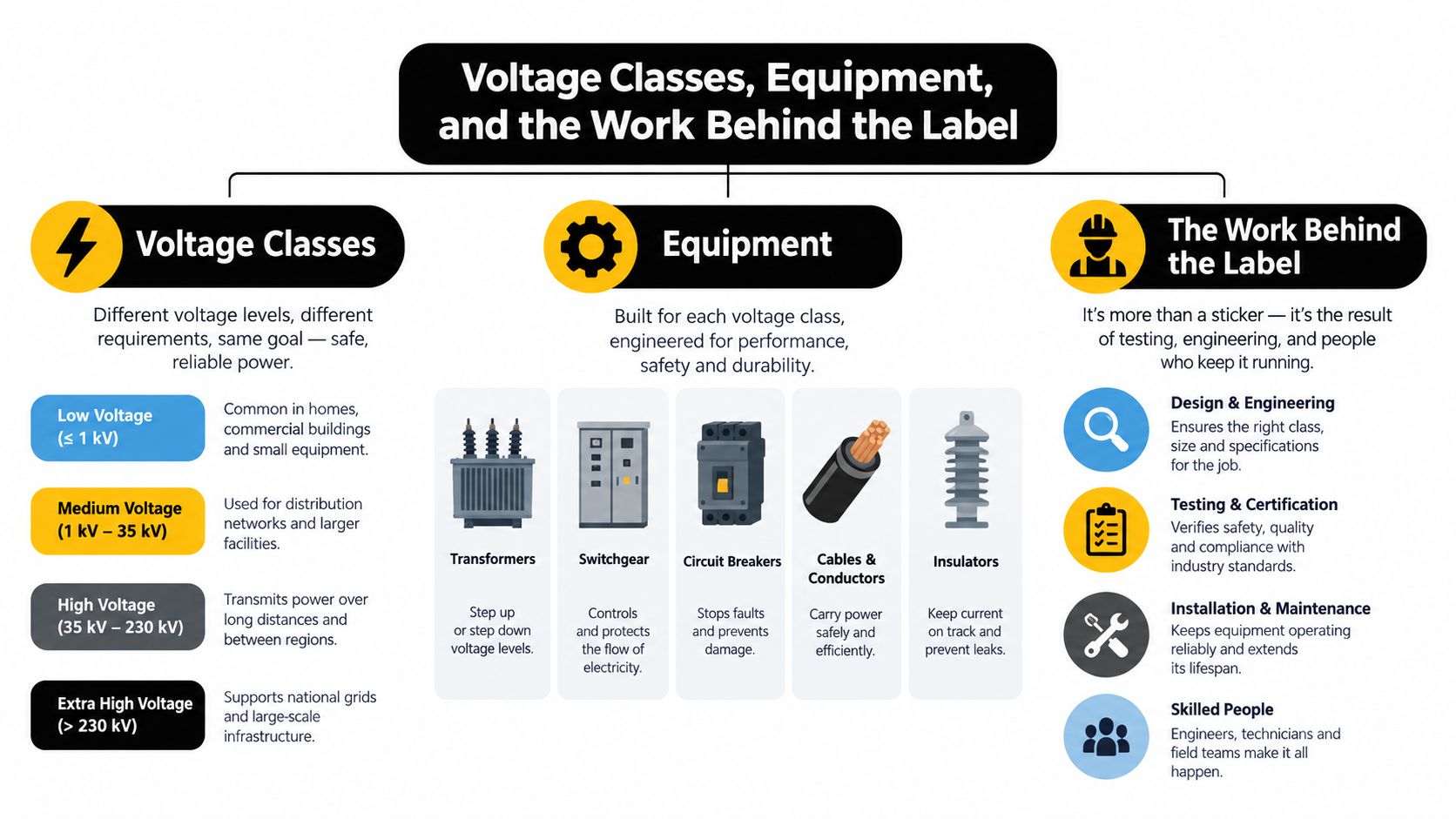
The phrase high voltage depends on the standard being applied. Industry guidance for utility-type and industrial work treats workers exposed to energized parts at 50 volts or higher as subject to electrical safety work practices. High-voltage training programs commonly define qualified industrial distribution work as roughly 600 volts up to 72.5 kV (NFPA 70E training guidance). Ask the contractor to state which definition governs the project, rather than accepting a broad marketing label.
Lower-voltage outdoor power has different risks, but the same matching principle applies. An outdoor extension cable guide NZ can help clarify cable selection and weather exposure. It cannot replace high-voltage design or qualified work. A buying decision should follow the equipment and duty, not the label alone.
Services and Project Types Worth Hiring Out
Buyers usually don't start with a voltage number. They start with a failed feeder, a planned expansion, a utility requirement, or a maintenance deadline. The contractor's job is to connect that business need to a safe technical scope.
A new commercial or industrial building may need a medium-voltage service installation, including duct banks, transformer placement, cable terminations, grounding, testing, and utility coordination. An operating facility may instead need a switchgear retrofit that adds capacity without replacing an entire lineup. A property manager planning additional HVAC load should expect the contractor to review available capacity, fault duty, protection settings, shutdown sequencing, and the physical condition of existing equipment.
Common project types include:
| Service | Typical Client | Desired Outcome |
|---|---|---|
| Medium-voltage service installation | Commercial developer or industrial owner | A coordinated, tested connection for new electrical capacity |
| Switchgear replacement or retrofit | Facility manager or plant engineer | Modern protection and reliable switching with controlled downtime |
| Transformer changeout | Property owner or utility-connected facility | Safe restoration or increased capacity |
| Cable pulling and termination | General contractor or industrial operator | Properly installed and tested medium-voltage feeders |
| Relay coordination study | Plant engineer or data center operator | Selective protection and fewer unnecessary trips |
| Infrared and partial discharge testing | Maintenance department | Early warning of overheating, insulation, or connection problems |
| Planned shutdown maintenance | Hospital, plant, or commercial campus | Documented service while the system is safely isolated |
| Emergency restoration | Facility owner after equipment failure | Fault isolation, temporary power, and permanent repair planning |
Some services naturally overlap. A transformer changeout may require cable termination, relay testing, grounding verification, infrared inspection, and utility scheduling. A switchgear replacement may also require a revised arc-flash study and updated labels. That's why a buyer should favor a contractor capable of scoping the complete work package rather than coordinating several disconnected trades.
The cheapest quote often excludes the work that makes the system dependable, such as testing, commissioning, documentation, and outage coordination.
Industrial sites looking for a wider electrical scope can review industrial electrical services, then ask each bidder to separate high-voltage tasks from ordinary power, controls, and equipment work. This makes omissions easier to spot before the contract is signed.
Safety Codes and Certifications That Separate Pros from Pretenders
A polished proposal doesn't prove high-voltage competence. The paperwork does. Start by asking how the contractor handles arc-flash analysis, energized work, deenergization, approach boundaries, PPE, and job briefings.
OSHA guidance and NFPA 70E-based practice use an incident-energy or arc-flash boundary analysis to determine exposure. 1.2 cal/cm² is commonly used as the threshold at which arc-rated PPE becomes necessary inside the boundary (OSHA arc-flash guidance). The required boundary and PPE depend on available fault current, protective-device clearing time, and working distance. A contractor reworking switchgear or transformers should therefore ask for the current study, not assume that an old label remains accurate.
The assessment should be reviewed periodically, with the interval not exceeding 5 years, and after major system modifications, according to the same OSHA guidance. A new transformer, altered utility service, changed breaker settings, or replaced switchgear can change the incident-energy result.
Documents worth requesting
A serious bidder should be able to provide or discuss:
- Energized work permit: Why energized work is necessary, who authorizes it, and what controls apply.
- Job safety analysis: Hazards, sequence, boundaries, tools, PPE, rescue planning, and responsibilities.
- Single-line diagram review: Confirmation that the drawings match the field configuration.
- Lockout and switching procedure: Specific isolation points, verification steps, grounding, and release authority.
- Training records: Current arc-flash and electrical safety training, not only an old course certificate.
- Medical and respirator documentation: Where the task requires respiratory protection, the contractor should be able to demonstrate program compliance.
A journeyman or master electrician license may be important, but it doesn't automatically demonstrate competence for every energized task above 600 volts. Buyers should also ask about power-line worker training, structured apprenticeship completion, manufacturer-specific switchgear and relay training, and supervised experience with the equipment being serviced.
The risk is substantial. OSHA reports that falls from elevations accounted for 8,102 deaths, representing 10% of fatalities in power generation, transmission, and distribution work, and averaging 540 deaths per year. OSHA also reports that the sector's fatality rate is almost three times the national average (OSHA industry hazards). Earlier CDC data on line mechanics recorded an annual fatality rate of 62.3 deaths per year between 1980 and 1985, with 59% caused by electrocution and 14% by falls from elevations, as reported in the same OSHA material. Verify the contractor's state license through the relevant licensing database, and confirm that the named qualifier is responsible for supervision.
Your Vetting Checklist Before You Sign the Work Order
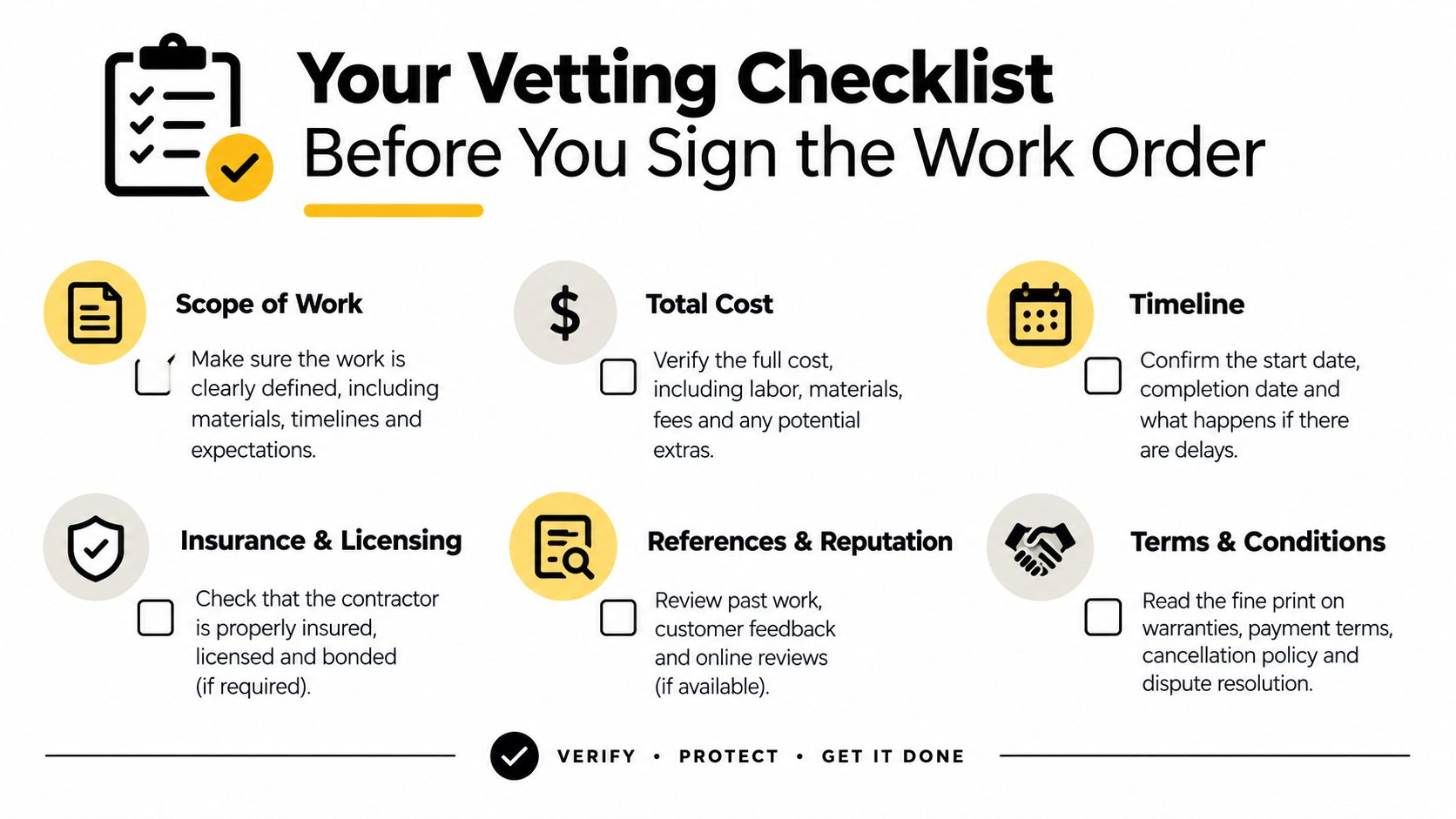
Bring a worksheet to the bid meeting. The contractor's answers should be specific enough that another qualified professional could understand who will do the work, how the system will be isolated, what tests will be performed, and what documents you'll receive.
Questions that expose real capability
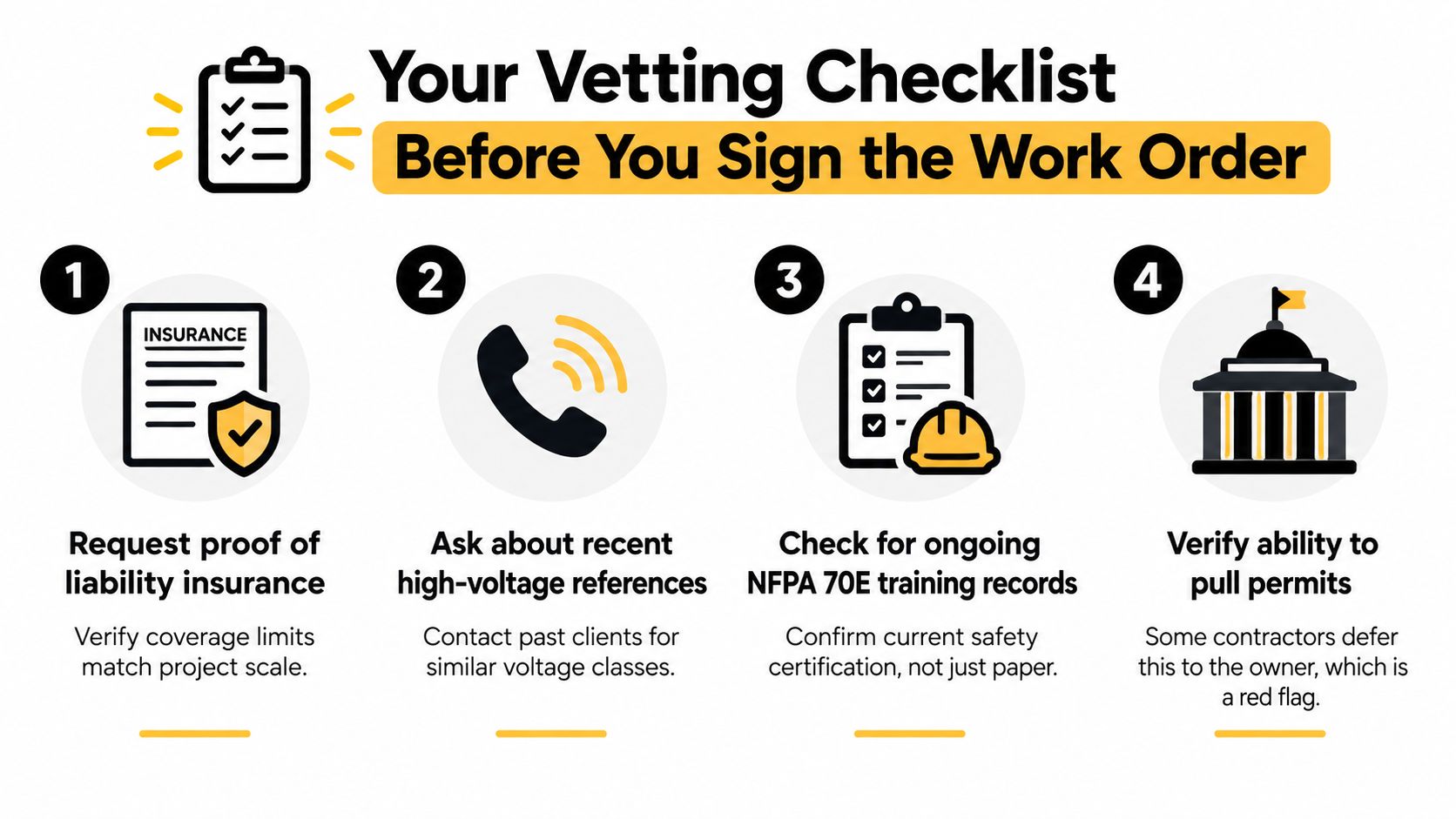
Ask for the license number, then verify its status independently. Request the written safety program, certificates of insurance, recent references for the same voltage class, and examples of commissioning or testing reports. A contractor who walks the site before quoting can identify access restrictions, equipment condition, utility boundaries, outage windows, and drawing discrepancies that a phone estimate will miss.
Ask who will supervise energized or potentially energized work. Confirm whether subcontractors will touch the equipment, whether they hold equivalent qualifications, and who remains accountable if the crew changes. You should also ask what happens if the field condition differs from the bid, because high-voltage work often reveals concealed damage or undocumented modifications after isolation.
Commercial terms deserve the same attention as technical credentials:
- Warranty: Define what equipment, labor, testing, and follow-up visits are covered.
- Response commitment: Separate a live dispatch promise from a message-taking service.
- Change orders: Require written approval before extra work proceeds, except for immediate actions needed to make the site safe.
- Permits and inspections: State who pulls permits and who attends inspections.
- Deliverables: List test results, updated drawings, labels, settings files, photos, and closeout records.
For a broader facilities perspective on contractor selection and risk controls, this Facility Management Insights guide on contractor risk offers useful context.
Red flags that should end the conversation
- Vague scope: “Repair high voltage equipment” without naming the gear, tests, isolation, and exclusions.
- Cash discount pressure: A request to bypass documentation or normal contracting controls.
- No written safety policy: The absence of a formal program is unacceptable for this risk profile.
- Insurance reluctance: Refusal to provide certificates or clarify coverage.
- No site visit: Especially concerning when the bidder claims to understand a complex distribution system remotely.
When to Make the Emergency Call and What to Expect
At 2 a.m., a water treatment plant loses a feeder. Operators report a burning smell near the transformer vault, and a breaker has tripped. The correct first move isn't repeated resetting. It's to keep people away, preserve the equipment state, and call a contractor with genuine emergency capability.
Before the crew arrives, the facility should:
- Clear the affected area: Keep workers away from vaults, switchgear, transformers, and damaged conductors.
- Avoid reset attempts: A trip may indicate a serious fault, and reclosing can increase damage or exposure.
- Provide system information: Make the single-line diagram, equipment tags, recent fault indications, and switching history available.
- Coordinate access: Ensure security, facilities staff, and the utility contact can support the response.
A competent response begins with lockout, fault isolation, and verification, not immediate component replacement. The crew identifies all possible sources, including backfeed and stored energy, then determines whether temporary power is practical. Utility coordination may be necessary before testing or re-energization, particularly where the failed equipment sits at the service boundary.
The call generally falls into one of three categories:
- Emergency outage: Loss of critical power, smoke, fire evidence, exposed conductors, or equipment damage requiring immediate control.
- Urgent fault: Abnormal noise, heat, odor, partial loss of service, or repeated trips where the site remains operational but failure could spread.
- Planned after-hours repair: A scheduled outage chosen to avoid production or occupancy disruption.
True 24/7 service means a live dispatch process, qualified personnel, appropriate test equipment, and the ability to make the area safe before a permanent repair is designed. An answering service alone doesn't guarantee any of those things. A temporary repair may restore limited operation, but permanent work can require engineering review, replacement parts, testing, permits, and a planned outage. For local urgent electrical response, emergency electrician service provides a starting point for organizing the call.
Why Local Credentials Matter in Palm Beach County
State licensing and local authorization are related, but they aren't interchangeable. In Palm Beach County, a commercial buyer should verify the contractor's state Certified Electrical Contractor license under the responsible qualifier, county registration, local business tax requirements, permit authority, and insurance documentation required by the owner or public agency.
Local conditions also affect the technical scope. Coastal humidity and salt exposure can influence outdoor equipment choices, hardware, enclosure selection, and maintenance intervals. Lift stations, docks, rooftop equipment, and exposed service gear may call for corrosion-resistant hardware and appropriately rated enclosures. Hurricane-related restoration adds another layer, because the contractor must understand storm damage assessment, temporary stabilization, utility coordination, and post-storm documentation.
Compare the credential profile
| Credential | Typical Contractor Profile | Lighthouse Energy Services |
|---|---|---|
| State electrical authorization | May hold a state license, but verify the named qualifier and scope | State EC licensing under a master electrician |
| Palm Beach County registration | May rely on the owner or another party to manage local requirements | Full Palm Beach County contractor registration |
| Local project familiarity | Experience varies by municipality and utility territory | Palm Beach County-based operating knowledge |
| Emergency dispatch | May route calls through a general answering service | Round-the-clock dispatch serving county sites |
| Site response | Depends on crew availability and location | Company states that most county sites can be reached within an hour |
| Project documentation | Scope and closeout practices vary | Written scopes identify the qualifier and applicable standards |
A locally established contractor may also understand inspection sequencing, utility inspector expectations, and the practical order for HOA, municipal, and building approvals. That familiarity can reduce avoidable delays, but it doesn't replace the buyer's duty to verify current credentials and insurance.
Lighthouse Energy Services fits the local profile described above with state EC licensing under a master electrician, Palm Beach County registration, and round-the-clock dispatch. Ask for current documentation rather than relying on any website description, because licensing and insurance details can change.
Choosing the Right Contractor and Your Next Step
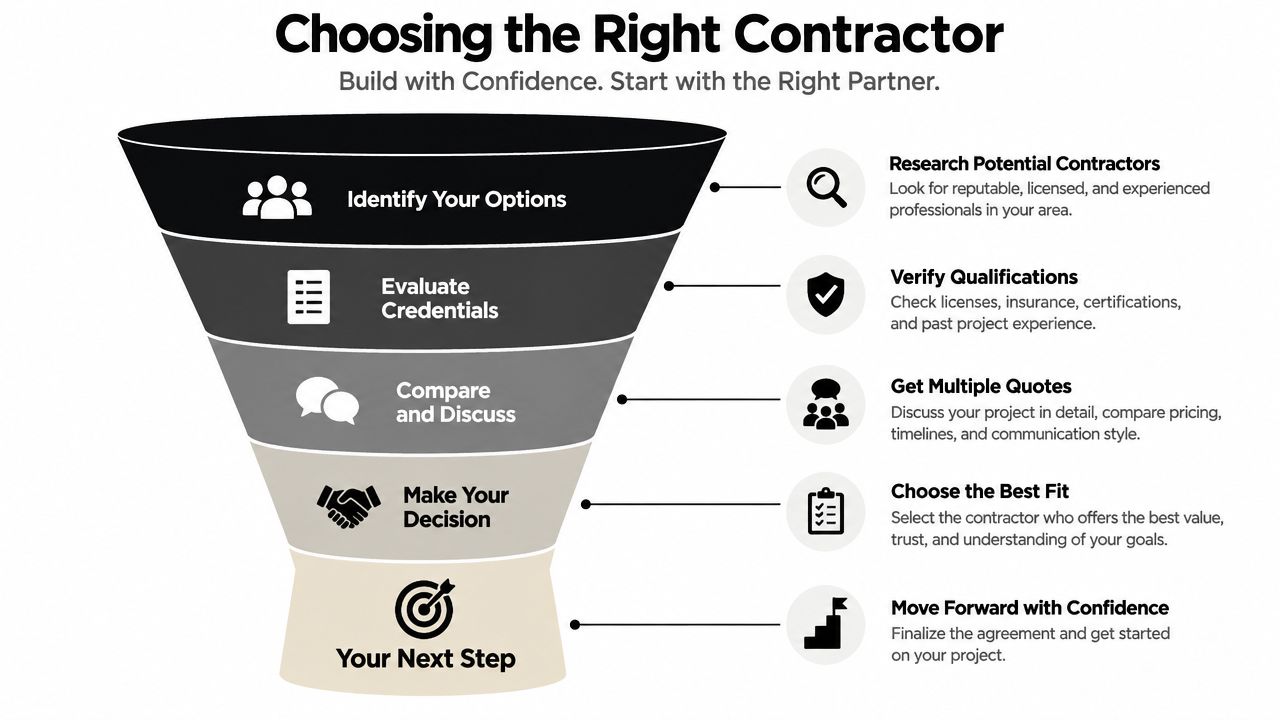
The decision becomes clearer when you filter vendors in the right order.
First, define the exposure. If the work is above 600 volts, involves arc-flash labeling, requires utility coordination, or affects medium-voltage equipment, treat it as specialist work. Then match the contractor's qualifications to the actual risk, not to a generic claim of electrical experience.
Next, examine the proposal. A useful bid itemizes equipment, voltage class, isolation requirements, testing, commissioning, schedule, permits, exclusions, and closeout documentation. Three comparable bids are more valuable than three lump-sum totals. Press each bidder on who holds the license, who supervises the crew, and whether subcontracted workers can touch energized or potentially energized equipment.
Response capability deserves its own filter. A high-voltage failure rarely waits for normal office hours, so ask how calls are dispatched, who answers, what information the technician needs, and what the contractor can do before replacement parts arrive. If the property has rooftop systems or exposed electrical equipment, it's also sensible to review adjacent hazard planning, including this lightning protection safety guide.
Before you call, record the symptoms, affected equipment, voltage class if known, breaker or relay indications, odor or heat observations, recent modifications, and whether the outage affects life-safety or critical operations. Don't open covers, remove barriers, or attempt repeated resets to gather more information.
Lighthouse Energy Services offers commercial and industrial electrical work, emergency diagnostics and repairs, planned upgrades, and local dispatch in Palm Beach County. Its stated process includes direct access to licensed electrical professionals, written scopes, and same-day site visits for emergencies. Call before the next fault, not after it.
Contact Lighthouse Energy Services with your equipment details, voltage information, and current symptoms so a licensed professional can help define the next safe step. Ask for a written scope that identifies the responsible qualifier, testing requirements, outage plan, and emergency response expectations before work begins.