
A Monday-morning main breaker trip is never just an inconvenience. It can shut down tenant operations, interrupt refrigeration or HVAC, delay production, and expose a documentation problem that nobody noticed during routine inspections. The same thing happens when a new tenant brings in heavier equipment, an owner plans EV charging or solar, or an inspector finds that the panel directory and fault-current markings are missing.
A commercial electrical service panel is more than a metal enclosure filled with breakers. It controls how safely a building receives power, distributes it, adds future loads, and demonstrates compliance. The right question isn't only whether the panel has enough amperage. You also need to ask whether its ratings, labels, fault-current information, arc-flash documentation, and physical condition support the building you operate today and the loads you plan to add next.
Table of Contents
- What Facility Managers Need to Know About Their Commercial Panel
- Anatomy of a Commercial Electrical Service Panel
- How Commercial Panels Differ From Residential Panels
- Sizing a Commercial Panel and Calculating Real Load
- Code Requirements, Permits, and the 2026 Arc-Flash Shift
- Warning Signs Your Commercial Panel Needs Attention
- Upgrade, Replace, or Expand for Electrification
- Costs, Timelines, and Hiring the Right Electrical Contractor
What Facility Managers Need to Know About Their Commercial Panel
Start with the panel as a building asset, not a repair item. It sits at the point where utility power enters the property and where every major electrical decision becomes practical or impossible. A panel can appear functional while leaving little usable capacity, carrying outdated documentation, or creating a poor foundation for electrification projects.
Seven questions should guide your evaluation
What components are inside the panel? The main disconnect, bus bars, branch breakers, neutral equipment, grounding paths, and service conductors all affect performance and safety.
Is it commercial equipment or residential equipment being stretched beyond its purpose? Voltage, phase, enclosure design, breaker construction, access, and inspection expectations can differ substantially.
What is the load? The nameplate rating doesn't tell you how much continuous load the service can carry safely.
Does the installation satisfy current requirements? NEC adoption varies by jurisdiction, so your contractor must verify the locally adopted edition and amendments, not rely on a generic checklist.
What warning signs are appearing? Heat, noise, odors, discoloration, repeated trips, and flickering can point to conditions that deserve immediate attention.
Should you repair, expand, replace, or redesign? EV chargers, solar, battery storage, HVAC, and tenant improvements can change the answer.
Can the contractor document the work? Demand load calculations, equipment ratings, fault-current information, permits, inspection records, and updated labels in writing.
A planned commercial electrical maintenance program helps identify deterioration before a failure forces an emergency decision. Facility teams that manage drawings, inspections, work orders, and project records digitally can also benefit from organized Microsoft solutions for AEC, especially when several tenants, contractors, and renovation projects share the same property.
Facility manager rule: Never approve a panel change based on amperage alone. Require the contractor to explain capacity, short-circuit ratings, labeling, permits, and future load headroom.
Anatomy of a Commercial Electrical Service Panel
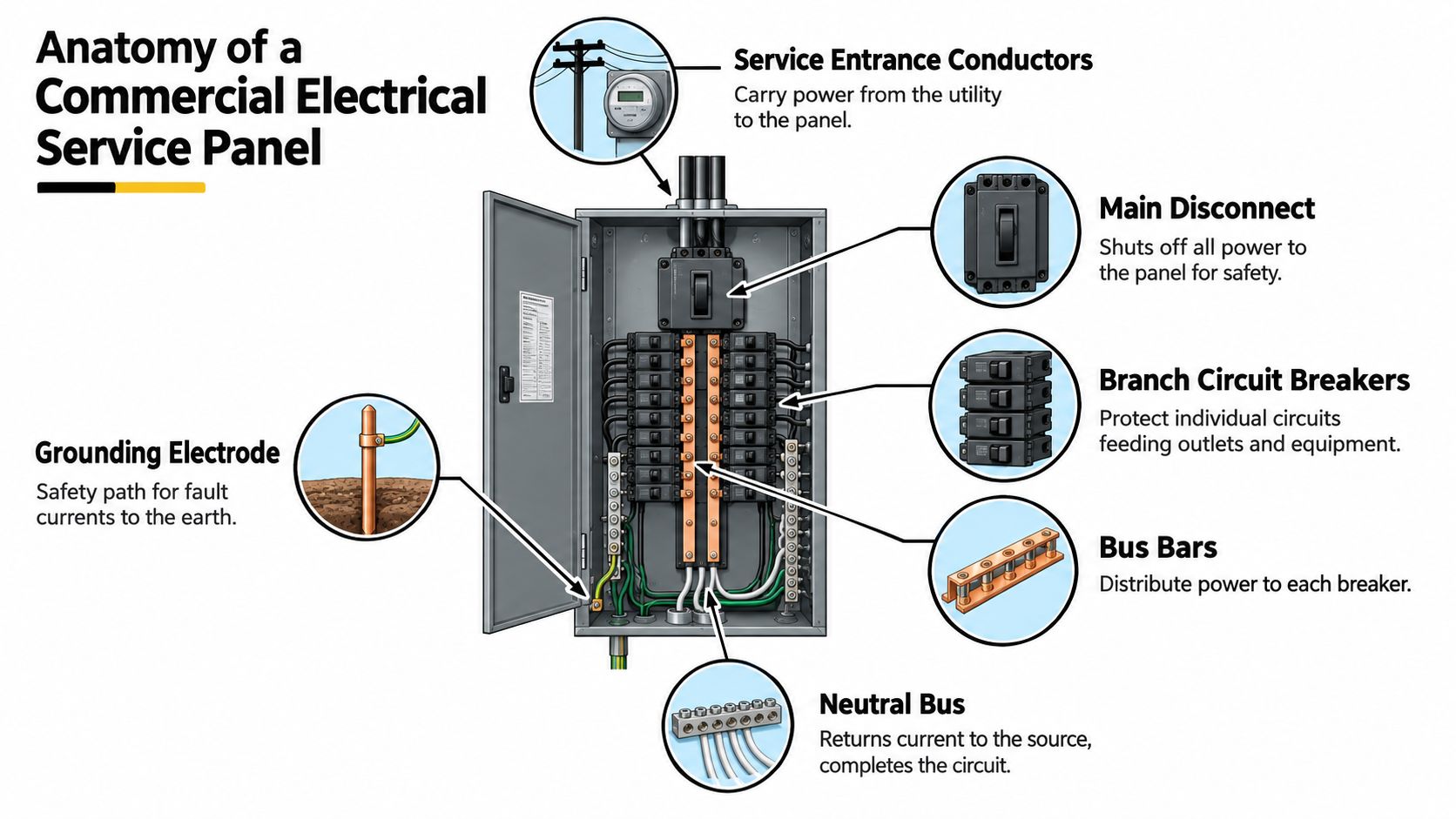
A commercial panel is the building's controlled entry point for electrical power. Service entrance conductors bring power from the utility connection into the service equipment. The main disconnect lets qualified personnel shut down the panel for maintenance, emergency response, or controlled isolation.
From there, bus bars distribute power across the breaker positions. Their ampacity, physical condition, and short-circuit capability set limits on what the equipment can safely support. Branch circuit breakers protect circuits serving lighting, receptacles, HVAC equipment, pumps, kitchen equipment, controls, and other building loads.
The parts inspectors and electricians rely on
The neutral bus provides the return path for applicable current and completes the circuit. The grounding electrode system and bonding connections provide a path for fault current and help keep exposed metal at a safer electrical potential. Treat both as part of the complete service, not as optional accessories.
Inspectors and electricians also rely on accurate markings. NEC 408.4(A) requires each panelboard circuit to be clearly identified in the circuit directory inside the door. A directory labeled “miscellaneous” does not help a technician isolate a rooftop unit, tenant suite, emergency system, or production circuit during an incident.
A commercial panel's capacity story includes more than the main breaker. Confirm the bus rating, feeder and conductor terminations, equipment short-circuit rating, available fault current, bonding, working space, and labeling. Those details determine whether the panel can accept future loads such as EV charging, solar, battery storage, or expanded HVAC without becoming a compliance or capacity bottleneck.
Common failure points include loose terminations, overheated breaker connections, corrosion, damaged insulation, poor bonding, blocked working space, and directories that no longer match field conditions. Require the contractor to compare schedules with the installation, inspect bus and breaker condition, verify conductor terminations, and document equipment ratings before recommending repair, expansion, or replacement.
The panel door may look fine while connections behind it tell a different story. Inspect the equipment, markings, and records together.
How Commercial Panels Differ From Residential Panels
A commercial panel isn't a larger residential panel. Commercial installations often support three-phase distribution, larger service equipment, motor loads, tenant systems, and more demanding coordination between service, feeders, and branch circuits. That changes the design, the equipment selection, the working clearances, and the documentation expected from the contractor.
| Attribute | Residential Panel | Commercial Service Panel |
|---|---|---|
| Typical voltage arrangement | Often 120/240V single-phase | Commonly 120/208V or 277/480V three-phase for larger facilities |
| Typical service scale | Designed around household loads | Commonly built across larger ampacity ranges, including 100A, 200A, 400A, 600A, and 800A practice sizes |
| Phase | Usually single-phase | Frequently three-phase for offices, warehouses, retail, and industrial occupancies |
| Breaker and enclosure approach | Compact equipment for dwelling circuits | Equipment selected for larger feeders, commercial fault duty, access, and coordination |
| Mounting and access | Often wall-mounted in a utility area | May be wall-mounted, recessed, or part of switchboard and distribution equipment |
| Documentation posture | Dwelling-focused schedules and markings | Load calculations, equipment ratings, directories, permits, fault-current markings, and arc-flash documentation can all matter |
Three-phase power is valuable because it distributes building loads across phases and supports motors and larger equipment more effectively. A facility with rooftop units, pumps, compressors, elevators, or industrial machinery needs an electrical design that accounts for starting current, phase balance, feeder capacity, and equipment coordination. A qualified contractor handling a three-phase electrical installation should explain how the service and downstream distribution will serve those loads.
The voltage choice also changes the way equipment is supplied. A 277/480V system can serve large lighting and mechanical loads efficiently, but it demands appropriate equipment, qualified workers, clear labeling, and careful separation of voltage systems. Don't let a contractor treat a commercial service panel as a catalog swap. The panel must match the building's distribution architecture and the loads connected to it.
Sizing a Commercial Panel and Calculating Real Load
The panel rating tells you the maximum equipment ampacity, not the amount of continuous load you should plan to operate through it. A commercial load calculation must account for connected equipment, demand, continuous operation, phase arrangement, conductor sizing, breaker ratings, and the service's available fault current.
The common planning baseline for continuous loads is the 80% rule. Continuous loads must be sized so they don't exceed 80% of a breaker's rating. For example, a 400-amp panel supports about 320 amps of continuous load, as described in this commercial panel upgrade guidance.
Use a load calculation, not a breaker-count estimate
A contractor should identify:
- Lighting and receptacles: Include actual building use, tenant equipment, and planned additions.
- Mechanical systems: Account for HVAC, pumps, fans, compressors, and their operating characteristics.
- Specialty equipment: Review kitchen equipment, refrigeration, elevators, data infrastructure, and manufacturing machinery.
- Future projects: Include known EV charging, solar, battery storage, electrified HVAC, and tenant improvements.
- Phase balance: Distribute loads correctly rather than filling one phase while leaving another lightly used.
- Equipment ratings: Confirm the panel, breakers, feeders, and disconnects can work together.
Common commercial service entrance ratings range from 400 amperes to 4,000 amperes or more, according to neutral industry references summarized in the same commercial panel planning resource. Smaller commercial properties may use 100A or 200A equipment, while larger offices, warehouses, and industrial facilities often use larger services and 277/480V three-phase distribution.
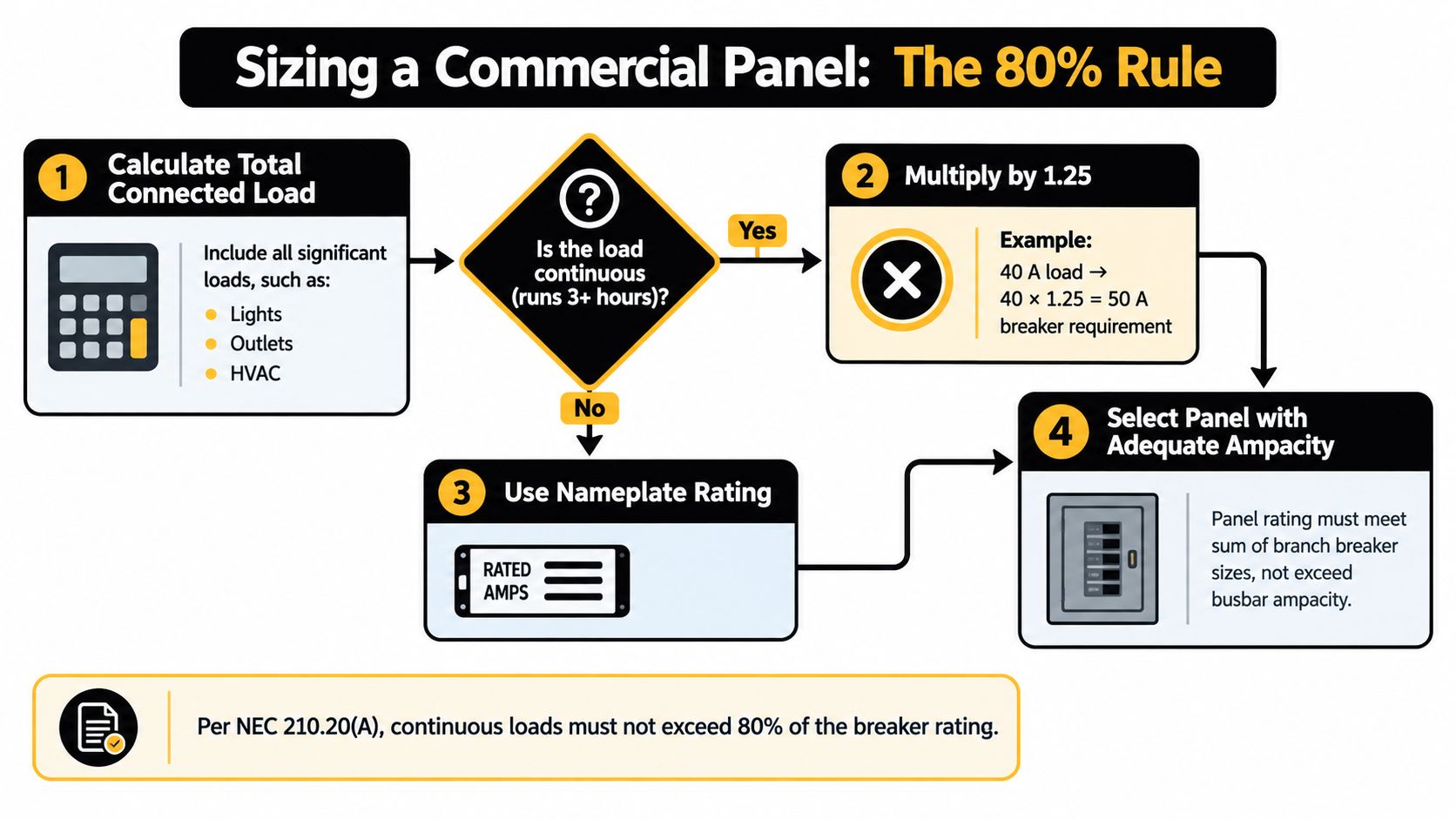
Ask for the connected-load schedule, demand assumptions, continuous-load treatment, phase balance, panel bus rating, main breaker rating, and spare capacity calculation. If the recommendation only says “you need a larger panel because you have more equipment,” send it back. You need to know whether a panelboard replacement solves the constraint or whether the service entrance, feeders, transformer, or utility connection also require work.
Code Requirements, Permits, and the 2026 Arc-Flash Shift
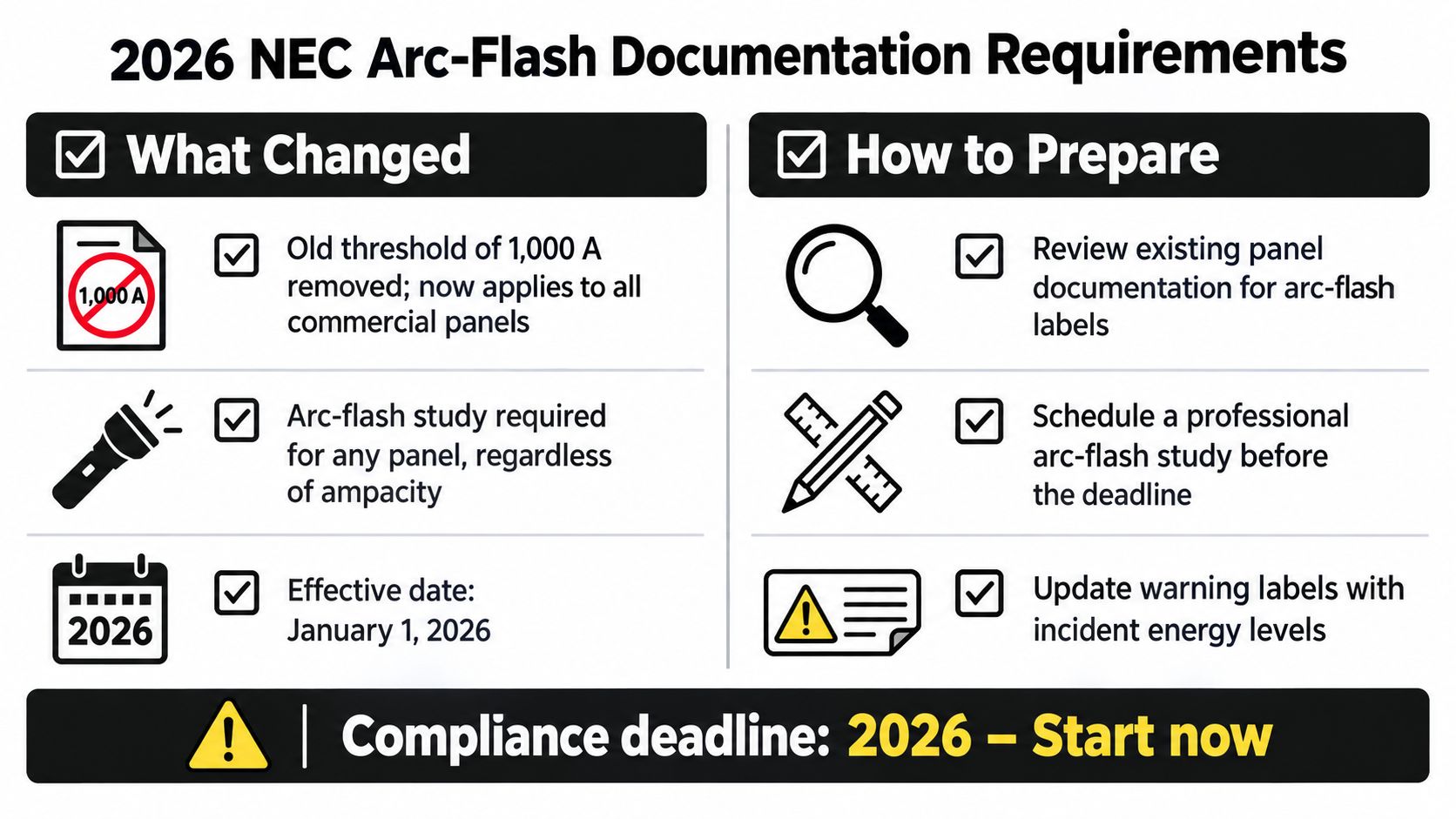
For a facility manager, the 2026 NEC coverage change affects more than large service equipment. The old 1,000-amp threshold for non-dwelling arc-flash documentation is being removed for many commercial applications, bringing more switchboards, switchgear, enclosed panelboards, meter socket enclosures, and motor control centers into the documentation scope. Review the 2026 commercial arc-flash labeling update with your electrical contractor, then confirm which requirements your local authority has adopted.
Do not dismiss a panel because its service rating is below 1,000 amps. The label package should identify nominal voltage, available fault current or PPE level, and the assessment date, based on the applicable code requirements and completed assessment. Treat arc-flash documentation as a capacity and compliance issue, not merely a labeling task. Fault current can limit equipment choices and affect future EV charging, solar, battery storage, and other electrical additions.
Fault-current marking deserves equal attention
NEC 110.24 requires the maximum available fault current to be field-marked at the service entrance, with the amperes value and the calculation date. That information gives qualified workers a direct warning before they open or service equipment. It also requires the owner and contractor to account for short-circuit ratings, equipment selection, and work procedures.
NEC 408.4(A) separately requires clear circuit identification inside the panelboard door. A circuit directory identifies what each circuit supplies. Fault-current and arc-flash markings describe the hazards and electrical conditions associated with the equipment. Keep both current after modifications.
Demand this documentation: Ask for the arc-flash assessment basis, label schedule, nominal voltage, available fault current or PPE information, assessment date, equipment short-circuit ratings, and updated circuit directory.
Commercial service work requires permits. The exact process depends on the authority having jurisdiction and the locally adopted code cycle, since jurisdictions adopt NEC editions on different schedules. Require the contractor to identify the permit path, coordinate utility requirements, arrange inspections, and provide closeout records. Do not accept a proposal that leaves those responsibilities undefined.
Warning Signs Your Commercial Panel Needs Attention
Electrical panels usually provide warning signs before they create a major outage. The mistake is treating every symptom as a nuisance or resetting a breaker repeatedly without finding the cause. A commercial facility needs a clear escalation rule.
Read the symptom before resetting anything
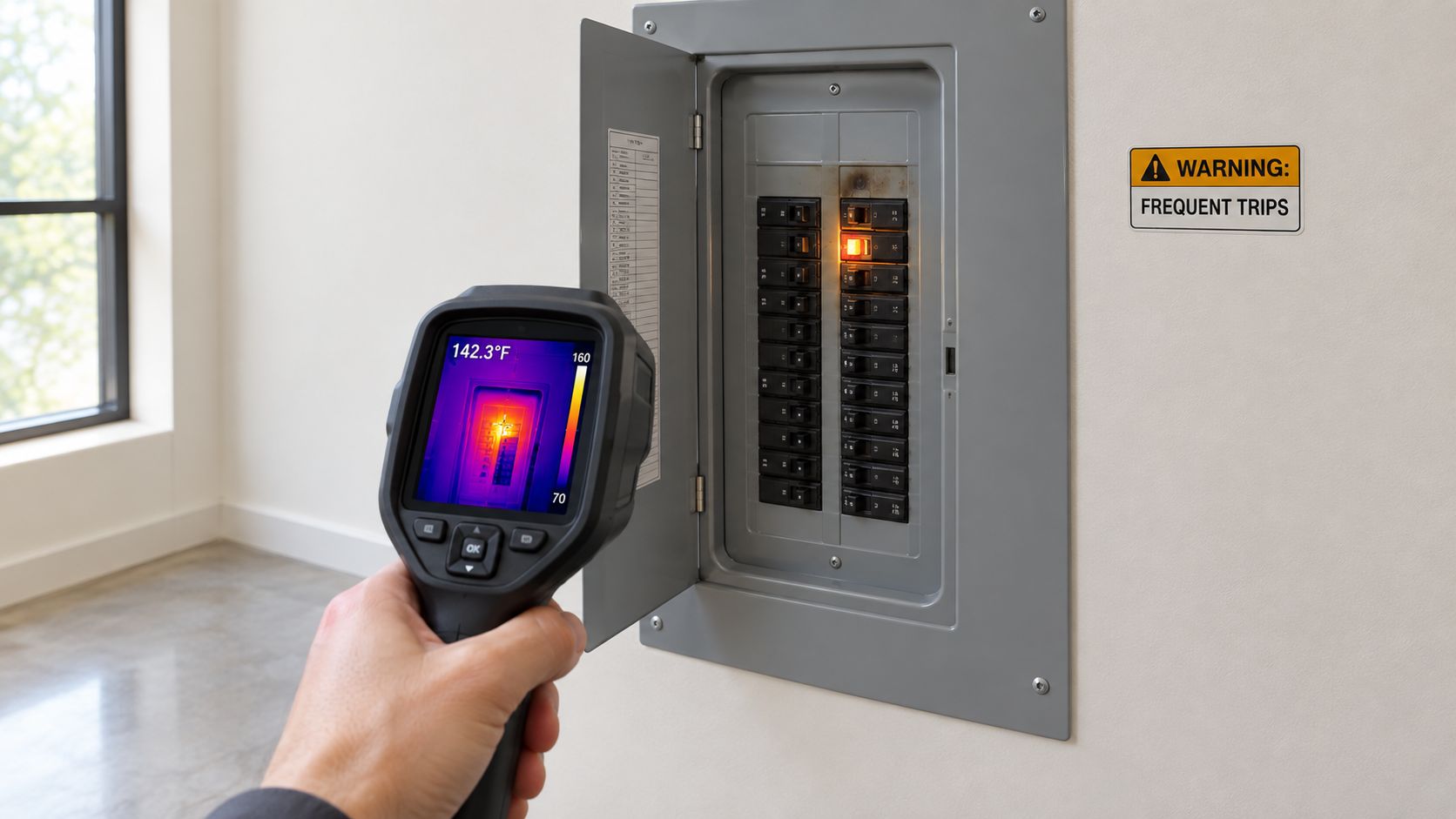
- Frequent breaker trips: The circuit may be overloaded, the breaker may be failing, or connected equipment may have a fault. Repeated resets require diagnosis.
- Warm or discolored breaker faces: Heat can indicate a loose termination, excessive load, damaged breaker, or deteriorating bus connection. Keep personnel away and arrange prompt inspection.
- Buzzing or crackling: These sounds can point to vibration, loose hardware, or arcing. Treat them as an electrical hazard, not normal panel noise.
- Burning odor or scorch marks: Shut down the affected equipment if it can be done safely, restrict access, and call for emergency service.
- Flickering lights under load: A loose connection, phase issue, voltage problem, or undersized distribution path may be involved.
- Fuses or obsolete equipment: Fuse-based systems and older breaker equipment deserve a documented condition assessment before repairs or expansion.
- A main breaker that won't stay reset: Stop trying to force it back on. The fault may be downstream or inside the service equipment.
A single trip caused by a known temporary equipment fault may be a maintenance issue. A trip that returns, produces heat, affects multiple tenants, or coincides with odor, noise, or visible damage is a safety concern.
Facility teams with critical processes can pair panel inspections with broader plant-level electrical fault detection practices. That approach doesn't replace a licensed electrical diagnosis, but it supports earlier identification of abnormal conditions across the facility.
Upgrade, Replace, or Expand for Electrification
A facility can have acceptable present-day demand and still fail the next electrification project. EV charging, solar, battery storage, and electrified HVAC can expose limited service capacity, insufficient breaker space, or equipment ratings that do not match the proposed fault-current conditions. Review the panel before finalizing equipment design, not after.
Solar and battery installations may require panel changes, DC and AC disconnects, production metering, interconnection equipment, and grounding work, as outlined in this commercial electrical maintenance and repair guidance. The connection point can determine whether the project needs a larger service, revised distribution, or another interconnection arrangement.
Choose the scope by risk and future use
Replace the panelboard when the service entrance and feeders have adequate capacity, the replacement matches the existing system, the short-circuit rating is sufficient, and the project adds little or no service demand. Confirm the available fault current and required markings before ordering equipment.
Expand the distribution when the existing service equipment is in sound condition but lacks breaker positions or local capacity. A new feeder and subpanel can serve added loads without replacing the complete service, provided the load calculation, conductor ratings, overcurrent protection, and available fault current support the design.
Upgrade or redesign the service when the incoming conductors, main disconnect, transformer arrangement, service rating, or fault-current rating cannot support planned loads. Older buildings require a condition assessment, because nameplate amperage does not reveal deteriorated connections, obsolete equipment, limited short-circuit ratings, or room for future electrification.
Plan for EV charging and solar generation together. Ask the contractor to reserve practical capacity for later chargers, battery equipment, HVAC conversion, or production changes instead of filling every available position today.
Resilience test: “We have enough amps” is incomplete. The system must support the new load, withstand the available fault current, carry compliant markings, and leave usable capacity for the next project.
Require one review covering load growth, fault-current marking, short-circuit current ratings, arc-flash documentation, disconnect locations, and maintenance access. That produces a service decision based on the building's operating future, rather than a narrow panel replacement.
Costs, Timelines, and Hiring the Right Electrical Contractor
A panel replacement scheduled as routine maintenance can become a service shutdown once the contractor finds undersized feeders, missing fault-current markings, limited working space, or outdated equipment. Price and schedule depend on the actual installation. A like-for-like panelboard replacement differs sharply from a service upgrade involving utility coordination, new feeders, permits, equipment changes, outage planning, and inspection. Require a site review before accepting a price.
What a professional proposal should show
Request a written quote with separate line items for:
- Equipment and materials: Panelboards, breakers, disconnects, feeders, conduit, grounding and bonding components, labels, and accessories.
- Engineering and documentation: Load calculations, fault-current evaluation, arc-flash assessment, updated directories, and record drawings where applicable.
- Permits and inspections: Identify who obtains permits, coordinates with the authority, and handles corrections.
- Utility coordination: State whether service interruptions, meter work, transformer changes, or utility approvals are included.
- Shutdown planning: Explain the outage window, temporary power needs, tenant notifications, and restart testing.
- Testing and closeout: Require torque verification, functional checks, labeling, inspection records, and final documentation.
Costs vary by location, equipment, accessibility, service size, outage complexity, and code corrections. Use this commercial electrical panel upgrade cost guide for planning, then demand a site-specific proposal. Permit work, labeling, fault-current marking, arc-flash documentation, and shutdown coordination should appear as defined scope, not disappear under “standard installation.”
Screen the contractor before signing
Verify the contractor's commercial license, insurance, workers' compensation coverage, and experience with comparable properties. Ask for examples of service upgrades, tenant buildouts, three-phase distribution, emergency troubleshooting, and arc-flash documentation. Residential-only experience does not prepare a contractor for every multi-tenant or industrial requirement.
Ask who answers after hours, whether emergency response costs extra, and how completed work is documented. Lighthouse Energy Services provides residential, commercial, and industrial electrical work, including panel upgrades, repairs, installations, and emergency troubleshooting, with service availability in Palm Beach County. Request an evaluation that reviews present demand, future EV or solar loads, fault-current marking, and usable capacity.
A credible schedule lists each operational milestone: load review, permit submission, utility coordination, shutdown, inspection, labeling, and closeout documents. It should also identify tenant notices, temporary power, restart testing, and the person responsible for each approval. This gives facility staff a workable outage plan instead of a vague promise.
If the panel trips, shows heat or discoloration, lacks fault-current markings, or blocks EV, solar, battery, HVAC, or tenant improvements, arrange a commercial evaluation before approving new equipment. Ask the contractor to identify the bottleneck and recommend repair, expansion, or service redesign with code documentation and room for the next load.