You buy the EV, plug into the garage outlet, and realize the charge needle barely moves overnight. That's the moment most West Palm Beach homeowners start looking for a real solution, because daily driving needs quickly expose the limits of a standard receptacle and the margin for error inside an older electrical system.
A proper Electric Vehicle Charger Installer in West Palm Beach FL does more than hang a box on the wall. The job starts with the panel, the circuit path, the permit trail, and the property type, because the difference between a clean install and a costly redo is usually decided before the charger ever goes up.
Table of Contents
- Why West Palm Beach Homeowners Are Installing EV Chargers Now
- Understanding EV Charger Types and Which One Fits Your Property
- The Complete EV Charger Installation Process
- Electrical Panel Capacity and Load Calculations Explained
- HOA and Condo Installation Rules Most Guides Ignore
- Why Lighthouse Energy Services Leads West Palm Beach EV Installations
- Frequently Asked Questions About EV Charger Installation
Why West Palm Beach Homeowners Are Installing EV Chargers Now
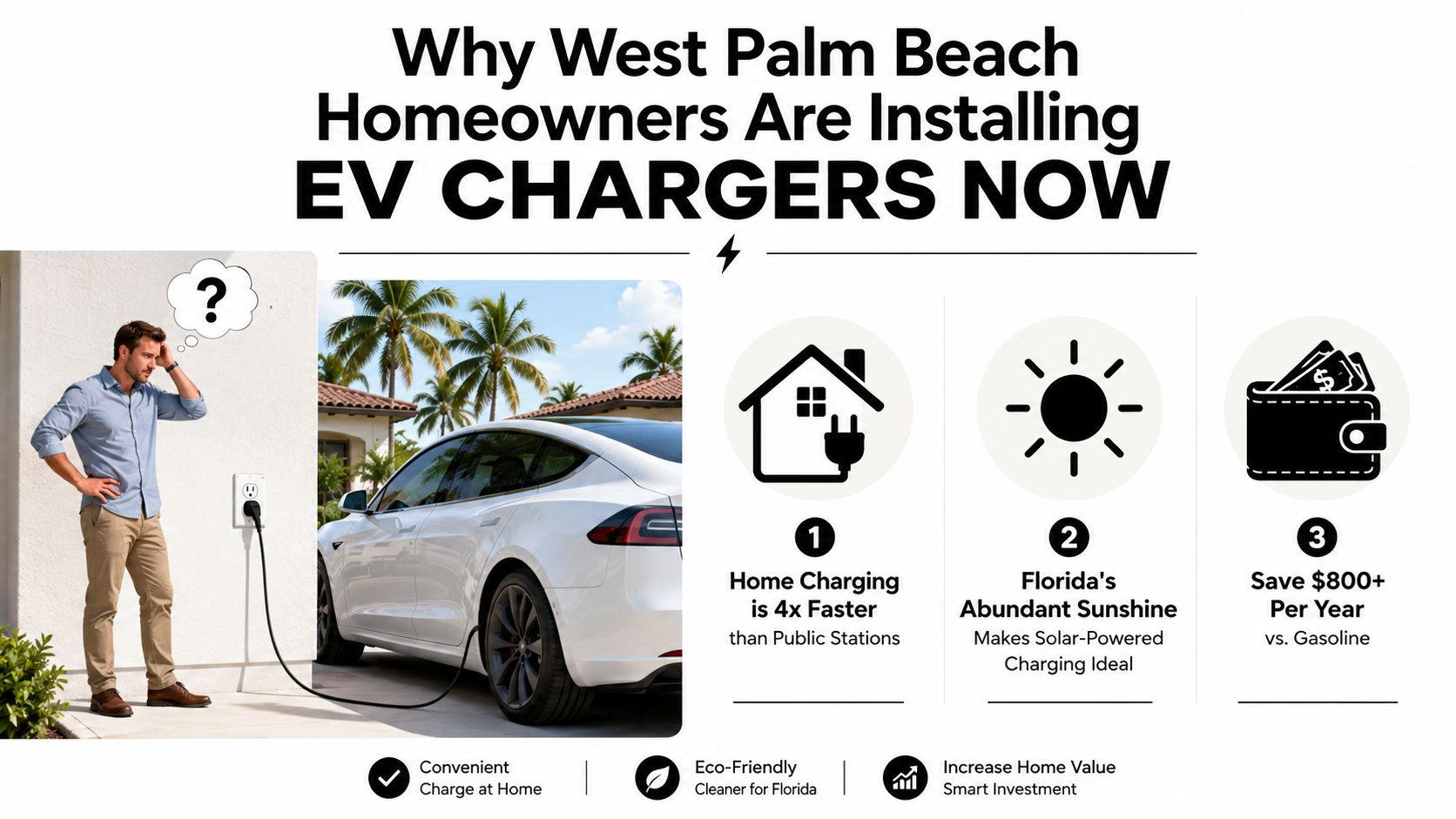
A homeowner in West Palm Beach usually doesn't think about charging until the first week with a new EV gets inconvenient. The car is sitting in the driveway, the nearest public charger is busy, and the standard outlet in the garage is doing exactly what it was designed to do, which is provide slow, general-purpose power, not serve as a daily fueling solution.
That's why home charging keeps winning in real life. West Palm Beach already has a sizable charging ecosystem, with 451 total charging stations listed by ChargeHub, including 325 Level 2 stations (72%), 126 Level 3 stations (28%), and 109 free stations (24%). ChargeHub also lists major networks like Tesla, Blink, and ChargePoint, which tells you the market is mature, not experimental. West Palm Beach charging station inventory
Why the local market is pushing installs indoors
The pressure isn't just convenience. In Palm Beach County, Florida Power & Light reported registered fully electric and plug-in hybrid vehicles rising from 23,401 in 2023 to 30,039 in April 2024, about a 28% gain in a little over a year. The same reporting said Palm Beach and St. Lucie counties together were up roughly 30% year over year, while Florida statewide reached nearly 300,000 total electric and plug-in hybrid vehicles, up by about one-third in the prior year. Palm Beach County EV registration growth and local fast-charging rollout
Practical rule: if the vehicle is used every day, a home charger stops being a luxury and starts being part of the house's electrical load planning.
That local growth also shows up in infrastructure. The same reporting noted 15 FPL EVolution public fast-charging sites across Palm Beach and St. Lucie counties, including a West Palm Beach location at 520 Hibiscus St. That doesn't replace home charging, it reinforces the point that EV ownership here is spreading into everyday routines, not weekend-only use.
For homeowners, the key decision is whether to keep depending on public stations or put charging where the car sleeps. A dedicated home station reduces friction, but it also adds a continuous load to the electrical system. That's why the installer matters more than the wall box itself. A sloppy install can mean nuisance tripping, overheated conductors, failed inspection, or a panel that no longer has headroom for other appliances.
Understanding EV Charger Types and Which One Fits Your Property
A homeowner often starts with a simple question. Which charger fits the property without creating a future electrical headache?
Level 1 charging uses a standard 120V outlet, which is why it looks easy on paper. For someone who drives very little and only needs a short-term setup, that can be workable for a while, but it usually falls short for daily EV use because the charging pace is slow and the outlet was not originally intended for repeated demand like this.
Level 2 is where most residential projects land. It uses a dedicated 240V circuit and fits the realities of home ownership, commute schedules, and overnight charging. For many West Palm Beach properties, that is the practical middle ground, because it gives usable charging speed without pushing the project into commercial-grade equipment or unnecessary site work.
Level 3 belongs in a different conversation. DC fast charging needs a much heavier infrastructure footprint and is generally tied to public, multi-vehicle, or commercial applications. At a house, it usually is not the right match because the utility demand, equipment cost, and site requirements go well beyond what a typical driveway or garage supports.
EV Charger Levels Compared for Residential Use
| Feature | Level 1 | Level 2 | Level 3 |
|---|---|---|---|
| Power source | Standard 120V outlet | Dedicated 240V circuit | High-capacity DC equipment |
| Typical use | Temporary or light-duty home charging | Most home and many multi-unit installs | Public or commercial fast charging |
| Electrical demand | Lowest | Moderate to high | Very high |
| Installation complexity | Low if an outlet already exists | Moderate, often requires new circuit work | High, usually not residential |
| Best fit | Light drivers, short-term needs | Most homeowners and property managers | Commercial sites and public stations |
A West Palm Beach homeowner usually gets the best long-term result with Level 2 because it fits the way people use the vehicle. The charger can be sized to the panel, the circuit can be protected correctly, and the installation can be planned around garage, driveway, or shared-parking realities without overbuilding the site. That matters even more in properties where a shared meter, limited breaker space, or HOA approval can change the install path before any conduit goes up.
The right charger is the one the electrical system can support safely every day, not the one with the flashiest marketing language.
For a practical residential example of Level 2 planning, see this guide to Level 2 EV charger installation in West Palm Beach. The main question is not which charger looks strongest on paper. It is which one matches the service capacity, parking layout, and approval path of the property.
The Complete EV Charger Installation Process
The best installs start with a site visit, not a sales pitch. A licensed electrician looks at the panel, checks the available breaker spaces, traces the wire path, and decides whether the charger can be mounted close to existing infrastructure or whether the run gets longer and more complicated.
From there, the work usually splits into two tracks. If the panel has room and the run is straightforward, the job can stay relatively simple. If the panel is full, the service is undersized, or the garage layout forces a longer conduit route, the estimate needs to account for that before the first hole is cut.
What a professional sequence actually looks like
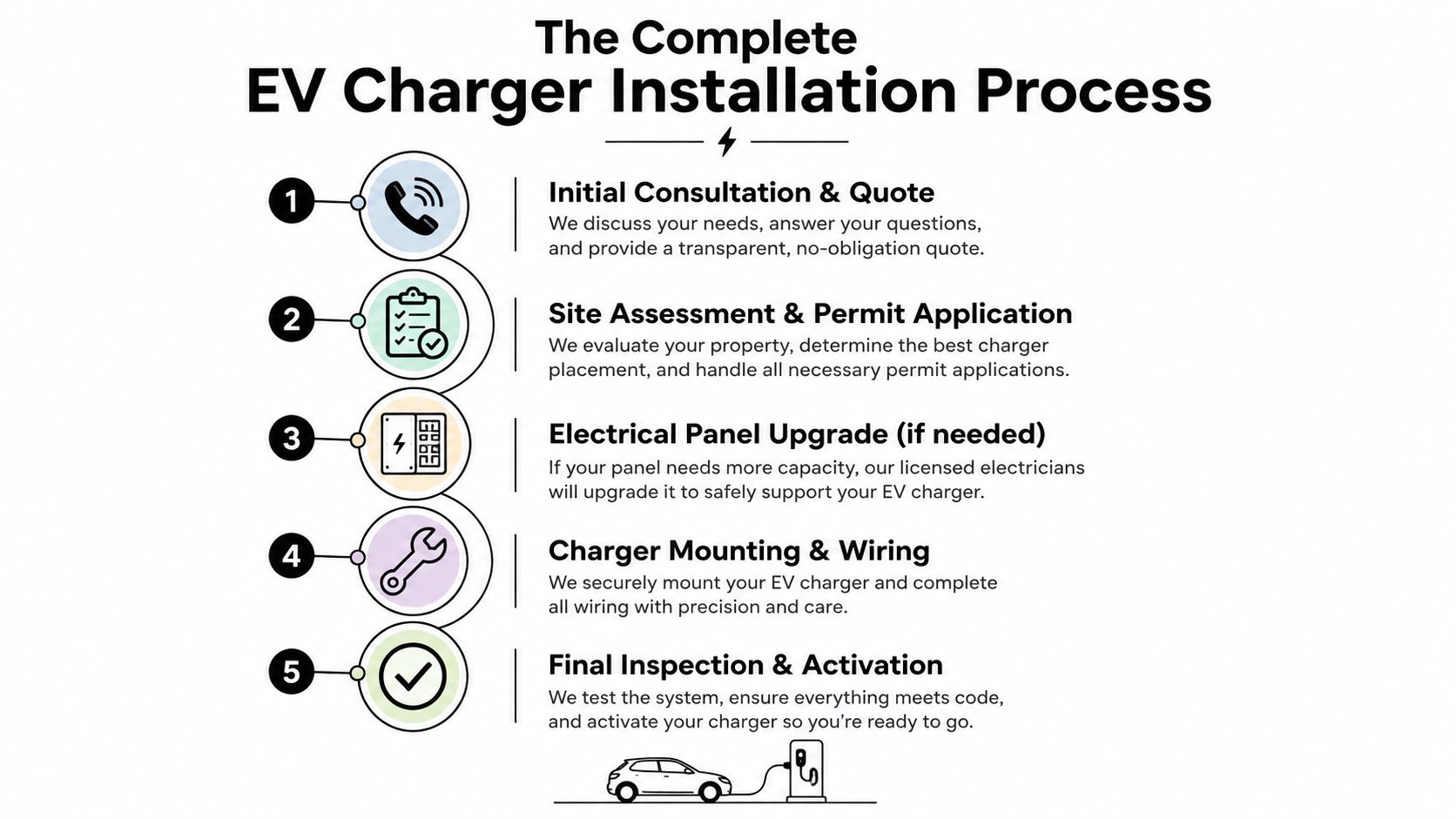
Initial Consultation and Quote. The electrician confirms the vehicle, charger type, mounting location, and distance from the panel. That first conversation should identify obvious red flags before money changes hands.
Site Assessment and Permit Application. The panel, load, and route get reviewed in detail. If the install needs official approval, the paperwork should be started before the physical work begins.
Electrical Panel Upgrade if Needed. Cost can jump significantly. If the existing service can't support the charger safely, the upgrade has to happen first.
Charger Mounting and Wiring. The unit gets mounted, conductors are pulled, terminations are landed, and the circuit is labeled.
Final Inspection and Activation. The system is tested under load and verified before daily use begins.
A smooth install usually comes down to information, not luck. The homeowner knows the charger location, the installer knows the panel condition, and the permit path is handled in the correct order. A rushed quote that skips the assessment often turns into change orders once the electrician opens the panel or starts the conduit run.
A good installer tells you where the job can get harder before the job gets harder.
For shoppers comparing quotes, ask whether the price includes permit handling, breaker work, conductor sizing, testing, and inspection support. If an estimate only covers the wall mount and the charger itself, it's not a complete installation quote.
Electrical Panel Capacity and Load Calculations Explained
This is the point where many homeowners get surprised. The charger may look simple on the wall, but the panel has to carry that load continuously, and continuous load rules are stricter than people expect.
Florida guidance tied to NEC load rules says a typical 40 A continuous Level 2 EVSE generally needs a 50 A dedicated branch circuit, while a hardwired 48 A charger is commonly installed on a 60 A breaker with 6 AWG conductors so the circuit stays inside the 80% continuous-load limit. If the panel or service can't absorb that demand, the project stops being a standard charger install and becomes a panel or service upgrade. Florida EV charger load guidance
How to think about the math before you call
The easiest way to sanity-check your home is to list the big loads already in the house. Air conditioning, water heating, electric dryers, ovens, pool equipment, and the new charger all compete for the same service capacity.
Practical rule: if the panel is already crowded, the electrician is not “finding room,” they're determining whether the service itself still has enough headroom.
A few situations usually push the job toward an upgrade. Older panels with limited breaker spaces, service equipment that's already near capacity, and obsolete equipment that should be replaced for safety all change the cost picture. If the charger is being added to a home that already runs several major electric loads, the installer has to calculate whether the system remains balanced after the new circuit is added.
For a deeper breakdown of panel costs, this overview of home electrical panel upgrade cost is a useful reference point. The important thing is not the sticker price alone. It's whether the service can carry the extra amperage without turning the charger into the weak link in the system.
A homeowner can do a rough precheck by asking one question. Is there enough room in the panel and enough service capacity for a new continuous load, or is the panel already close to full? If the answer is unclear, that's not a reason to guess. It's a reason to inspect the panel before committing to the charger model.
HOA and Condo Installation Rules Most Guides Ignore
The hardest EV charging projects aren't always the houses with old panels. They're the condos, townhomes, and shared garages where the electrical work is only half the problem and the approval path is the other half.
An owner with an assigned parking space usually wants to know three things first. Can the association approve it, who owns the wiring path, and how will the charging energy be tracked if the parking area is shared? Those questions need answers before anyone starts buying equipment or booking electrical work.
Approval sequencing matters more than most people think
Getting the HOA or condo board involved early prevents wasted money. In many cases, the board, property manager, or architectural review process needs to approve the concept before a contractor finalizes the site plan. If the electrician designs a route without knowing whether the board will allow it, the owner can end up paying for a plan that never gets used.
Shared-meter situations add another layer. If the charger is not connected to a simple private garage feeder, billing and usage tracking become real issues, especially in common areas or mixed-use parking layouts. For that reason, property managers often need submetering or another way to separate what one resident uses from what the association pays.
For boards and managers that need a billing framework, Axis Meter Solutions submetering for condo boards is worth reviewing because metering is often the difference between a workable project and an accounting headache.
The biggest mistake is assuming every EV charger install is just a homeowner's private project. In multi-unit housing, the charger can touch common wiring, shared parking rules, load allocation, and community approvals all at once. That means the proper sequence is usually approval first, site assessment second, then equipment selection and installation.
An experienced electrician should be able to talk through assigned spaces, shared garages, outdoor parking, and who is responsible for feeder work or panel access. If that conversation never happens, the quote is incomplete.
Why Lighthouse Energy Services Leads West Palm Beach EV Installations
EV charger work looks straightforward until the panel is opened and the actual condition of the system shows up. That's where a licensed electrical contractor matters, because the job can turn into a breaker replacement, load correction, or wiring change very quickly.
Lighthouse Energy Services is established in 2005, and the company says its team has more than 100 years of combined expertise. It also says phones are answered by licensed electrical professionals, not call centers, and that it operates with true 24/7 availability and no extra charges for after-hours calls. For a charger job, that kind of response model matters because panel issues and permit questions don't always show up on a neat weekday schedule. Lighthouse Energy Services company profile
Why those details matter on EV work
A charger install is only as good as the diagnosis behind it. If the electrician misreads the panel capacity, sizes the conductor incorrectly, or skips the load conversation, the job can fail inspection or create avoidable electrical risk. That's why transparency in the quote matters just as much as the wiring itself.
Lighthouse Energy Services serves Palm Beach County from Boca Raton to Jupiter, and it handles residential, commercial, and industrial electrical work. That range helps on EV jobs because the surprises are often not about the charger, they're about the broader electrical system around it.
The company also installs the Smartcool ECO3 device, which is designed to optimize air conditioners and reduce electricity consumption. That's not the same as EV charging, but it shows the team works on load management and whole-home electrical efficiency, not just the charger hardware.
If you want one contractor to assess the panel, explain the code requirements, and install the charging circuit safely, Lighthouse Energy Services is one practical option to evaluate. The value is in the combination of response speed, licensing, and the ability to handle the follow-on work if the installation turns into a panel or service conversation.
Frequently Asked Questions About EV Charger Installation
Most residential EV charger installs move faster when the panel is ready and the route is simple. The timeline stretches when permits, panel upgrades, or condo approvals are involved, because each layer adds a review step before the charger can be energized.
Florida and utility incentives can change over time, so the safest answer is to check what's currently available before purchase. A licensed electrician can help separate equipment cost from installation cost, which is important because the charger price and the wiring price are not the same thing.
On installation day, the power may be off briefly while the electrician lands the new circuit, tests the breaker, and verifies the charger. You usually don't need to be home for the entire process, but someone should be available if the installer needs access to the panel, garage, or a locked parking area.
Maintenance is simple once the system is installed correctly. Keep the connector clean, watch for heat at the receptacle or breaker, and call a licensed electrician if you notice nuisance trips, damaged insulation, or a charger that no longer holds a stable charge.
If you're weighing a charger install in West Palm Beach, get the panel checked before you buy equipment. Lighthouse Energy Services can assess the load, handle the permitting and wiring details, and install a code-compliant charging circuit that fits your property, so you can move from guesswork to a clean plan with Lighthouse Energy Services.