
Friday at a South Florida marina can go wrong in a hurry. One dock loses shore power, a few pedestals go dark, and suddenly boat owners are asking who's responsible for the charging, lighting, and safety gear that just shut down. If you manage waterfront property, you already know the problem isn't finding an electrician. It's finding a commercial marina electrician in South Florida who understands corrosion, dockside load, permits, and what happens when a repair looks fine but fails under real current.
That's the difference between a routine service call and a waterfront liability. Marine and marina electrical work sits inside a specialized labor market, not a casual handyman lane. There are only about 7,900 marine electricians in the United States, and employment is projected to grow 5.1% from 2022 to 2032, with the country expected to need about 5,400 new marine electricians over that period (CareerExplorer job market data). In a market like Palm Beach, Broward, and Miami-Dade, that scarcity matters.
Table of Contents
- Introduction to Hiring a Commercial Marina Electrician
- Where to Find Local Commercial Marina Electricians South Florida
- Essential Licenses and Certifications to Verify
- Key Questions to Ask and Red Flags to Watch
- Estimating Costs and Comparing Electrician Bids
- Setting Emergency Response and 24/7 Service Expectations
- Crafting Contracts and Planning Ongoing Maintenance
Introduction to Hiring a Commercial Marina Electrician
A marina doesn't fail politely. It fails at the pedestal, at the feeder transition, or at the point where salt air has been eating a connection long before anyone notices. That's why the first mistake most managers make is treating dock power like ordinary commercial wiring. It isn't.
South Florida makes the job harder. Heat, humidity, salt, and tidal exposure punish terminations, bonding, and enclosures, and failures are often hidden until load rises. Industry guidance for marine electrical systems emphasizes routine inspection of shore-power connections, dock wiring, and bonding systems because these are the parts most exposed to water intrusion and galvanic corrosion, the leading causes of hidden failures in waterfront installations (marine electrical guidance).
Practical rule: If an electrician talks only about replacing the obvious damaged part, and not about why it failed, you're probably paying for a repeat call.
What you want is a technician who can think in layers, pedestal first, then grounding and bonding, then dock-to-boat faults under load. That order matters because a visual repair alone can leave an overheating connection in place. In a marina, a connection can look fine and still break down once current starts flowing.
The rest of this guide is built for property managers who need a clean shortlist, a defensible hiring process, and fewer surprises after the invoice lands.
Where to Find Local Commercial Marina Electricians South Florida
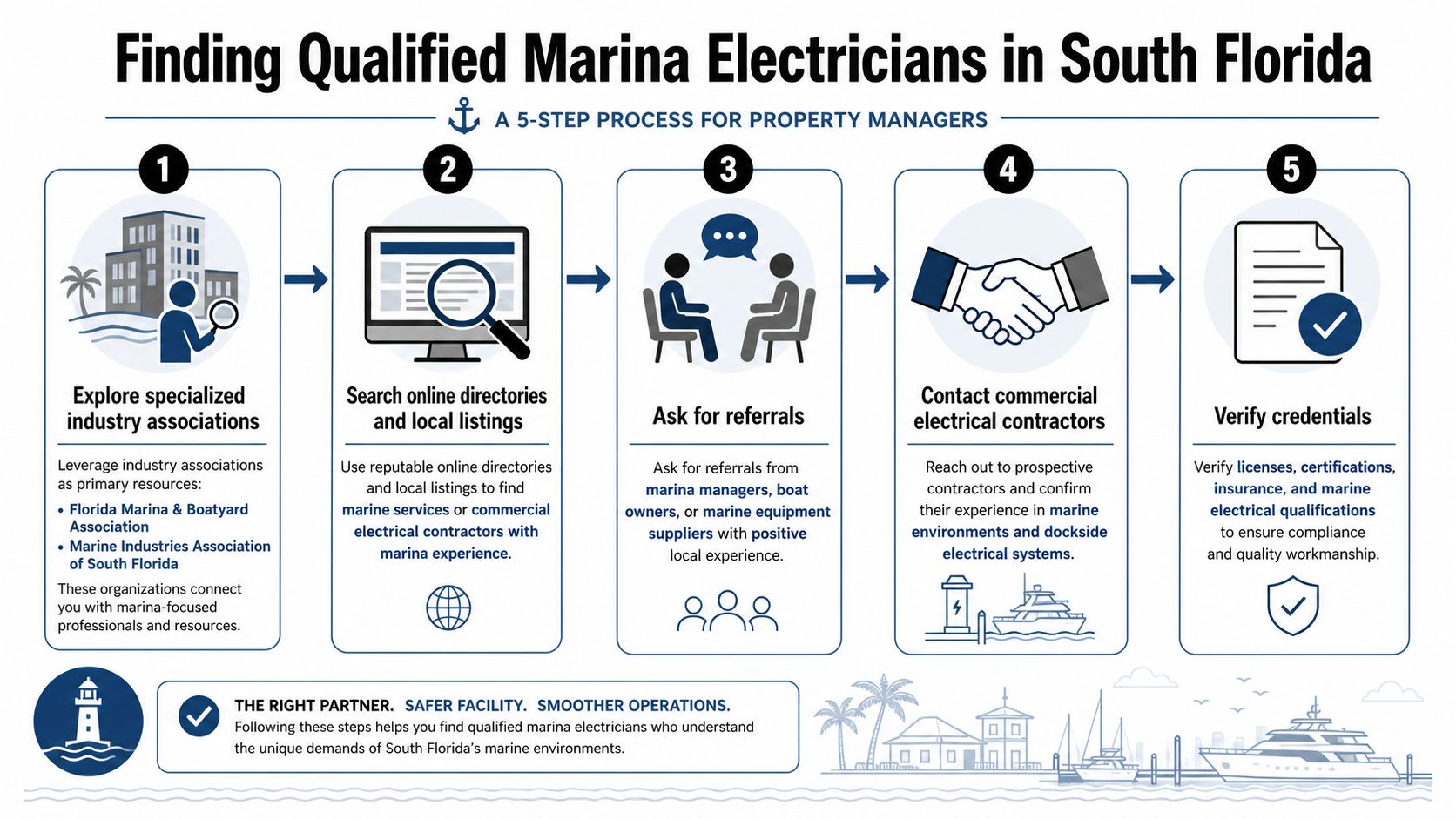
A marina manager in South Florida needs electricians who already understand dockside failure points. Start with industry associations, then ask for coastal referrals, then verify the names with direct outreach. Palm Beach, Broward, and Miami-Dade should be your first calls, because those counties give you a much better chance of finding crews that have worked around salt air, tidal exposure, and waterfront permitting.
Use the local marine network first
The strongest shortlist comes from people who live with waterfront risk every day. Ask marina managers, dockmasters, equipment suppliers, and property managers who have already dealt with inspections, storm damage, corrosion at the dock, or pedestal failures. Those referrals matter because they come from real dockside performance, not polished sales copy.
South Florida also has a limited pool of electricians who know marine work well, so the names that are worth keeping usually circulate through local relationships. That is why a local referral carries more weight than a broad web search. You want the contractor other managers call after a breaker trip, a bonding fault, or a failed shoreline connection, not the one with the loudest marketing.
For a quick first screen, review local business profiles for proof of marina work, then listen for dock-specific language. If a contractor only talks about general wiring, they are probably not the right fit for a pedestal issue, a shore-power retrofit, or a corrosion-related repair. If you need a general commercial starting point, use the local electrician intake process at Lighthouse Energy Services commercial electrician contact and ask direct questions about marina experience.
Filter by project type, not just geography
A contractor who handles condo electrical work can still be the wrong choice for a marina. Dock lighting, shore-power feeds, pedestals, and marine-rated enclosures demand field experience with exposed equipment and hidden failure points. Marina faults usually show up where water, heat, and metal meet, not inside a neat interior panel room.
Ask for examples of dockside work, then ask what failed and how they tested the repair. The second answer tells you more than the first.
Use boat-owner referrals with care. Owners usually know who showed up quickly, not who documented the failure correctly or explained the root cause. Property managers need repeatable work, clear troubleshooting, and documentation that stands up if a dispute or inspection follows. If a contractor cannot explain how they isolate a feeder transition problem, keep looking.
Permitting and inspection relationships matter too. Before a bid becomes a job, a contractor should already have a clean reputation with local permitting offices and marina stakeholders. In South Florida, sloppy paperwork and poor access planning create delays, liability exposure, and hidden costs long after the first visit.
Essential Licenses and Certifications to Verify
Marina electrical work is where credential gaps become expensive fast. A license alone isn't enough if the contractor can't handle marina-specific permits, insurance requirements, and the paperwork that comes with higher-capacity dock power. That matters even more when you're adding EV charging or expanding shore power, because a major gap in most content is clarity on permitting, code implications, and insurance exposure in those upgrades (marine electrical permitting gap).
Verify the license, then verify the scope
Start with the active Florida electrical license, then confirm that the contractor's scope matches commercial waterfront work. If the permit is for dock power, the electrician should be comfortable with bonding, grounding, and marine enclosures, not just generic building wiring. Ask for the exact name on the license, the issuing authority, and the insurance certificate that matches the business name on the proposal.
Don't accept vague answers about “working under another license” or “handling it informally.” That's how marina managers end up with messy inspections and weak liability protection. The credential check has to match the actual project scope, not the contractor's sales pitch.
A good compliance checklist looks like this:
- License status: Confirm the license is active and matches the company name on the bid.
- Insurance: Ask for current proof of coverage before any site visit turns into work.
- Permit responsibility: Make the contractor state who pulls permits and who handles revisions.
- Marine scope: Confirm experience with dock power, feeders, bonding, and weather-rated gear.
- Upgrade triggers: Require written acknowledgment of any load or code issues that surface during the job.
If a contractor won't put permit responsibility in writing, you're already behind.
Treat EV and high-capacity upgrades as a different category
Adding EV charging or greater capacity shore power isn't a standard service call. It changes the load picture, the inspection path, and the liability profile. That's why managers should insist on documentation before the first wire is pulled. If the contractor can't explain how they'll handle capacity, inspection readiness, and maintenance intervals, the project isn't ready for release.
The point isn't to slow down the job. It's to avoid a fast installation that creates a slow-motion shutdown later. In marina work, missing compliance detail usually shows up when you can least afford it, right after an outage, an inspection, or a complaint from a tenant or slip holder.
Key Questions to Ask and Red Flags to Watch
A good marina electrician doesn't just say yes. They explain how the system will be tested, why the materials fit the environment, and what they'll do if corrosion has already damaged the termination point. The interview should feel technical, not friendly. Friendly is nice, but it won't keep a dock live.
Ask the questions that expose real competence
Start with the failure points that matter most. Ask how they test pedestal condition, how they verify grounding and bonding continuity, and whether they load-test after any repair. If they only mention a visual inspection, they're not doing the whole job. A repair that passes the eye test can still overheat under load.
Then ask about materials. You want to hear tinned conductors, marine-rated enclosures, and NEMA 4X-style weather protection in salt-air zones. Those choices reduce nuisance faults and premature failure because corrosion-driven resistance increases at terminations and metallic interfaces. If the answer is vague, that's a problem.
Good answers usually sound specific. Bad answers sound like they're trying to keep the conversation moving.
- Good response: “We'll inspect the pedestal, test bonding continuity, then verify the circuit under load before we close it out.”
- Concerning response: “If the outlet looks fine, it's probably fine.”
- Good response: “We only release a repair after confirming it under operating conditions.”
- Concerning response: “We can come back if it trips again.”
Watch for the operational red flags
Missing load calculations is a major warning sign. So is a reluctance to discuss after-hours service or emergency access. Marina failures don't schedule themselves, and a contractor who won't say how they handle a midnight outage may leave you waiting while boats sit dark and unsecured.
Another red flag is overconfidence around visible damage. If a contractor focuses only on the burnt faceplate or corroded cover and ignores the feeder transition or bonding path, they're guessing. In waterfront work, guessing gets expensive.
Rule of thumb: Hire the person who talks about testing, not the person who only talks about replacing parts.
If you're comparing two similar bids, the one with clearer test procedures and more detail about post-repair verification is usually the safer choice, even if it costs more. Marina downtime costs more than a clean, well-documented repair.
Estimating Costs and Comparing Electrician Bids
Commercial marina pricing in South Florida should reflect specialization. You are paying for dockside skill, corrosion awareness, and the ability to work around live operations, not just wire pulling. Florida's marine electricians earn an average of $60,190 per year, with hourly rates from $22.07 to $44.58 (Florida marine electrician salary data). That premium matches the risk and the technical demands of waterfront work.
Normalize bids before you compare them
Do not compare totals until you have normalized the scope. One quote may include inspection, load testing, cleanup, and permitting support, while another only covers the visible repair. A cheap bid can become the expensive one if it leaves out documentation, emergency availability, or a second visit after a failed test.
The broader Florida electrician market sits at $61,590 per year, or $29.57 per hour. That is a useful reality check. Marina work should not be priced like standard residential service, because the labor is more specialized and the liability is higher.
Read the proposal for hidden cost drivers
The hidden cost usually lives in access, corrosion, and after-hours response. If crews need to work around active slips, wet conditions, damaged gear, or permit delays, the job takes longer and requires tighter planning. That cost is real, and South Florida marina managers should expect it.
Ask every bidder to separate labor, materials, permit handling, emergency call-outs, and post-repair testing. If they bundle everything into one vague figure, you cannot tell what you are buying. You want the proposal to explain how they will prevent a repeat failure, not just how they will make the lights come back on.
For some managers, the right choice is a contractor who includes long-term maintenance planning in the original scope. One option in that category is Lighthouse Energy Services, which provides commercial electrical work and emergency diagnostics for property owners in Palm Beach County. For emergency repair planning in the county, see Palm Beach County emergency electrical repair services. That kind of capability matters when you need repair and follow-through without hiring a different vendor every time.
Setting Emergency Response and 24/7 Service Expectations
A marina emergency clause should read like an operational promise, not a marketing line. If you're managing dock power, a delayed callback is a business problem, a safety problem, and a liability problem. The contract has to say who answers, how fast they respond, and what happens if they miss the window.
Put the response promise in writing
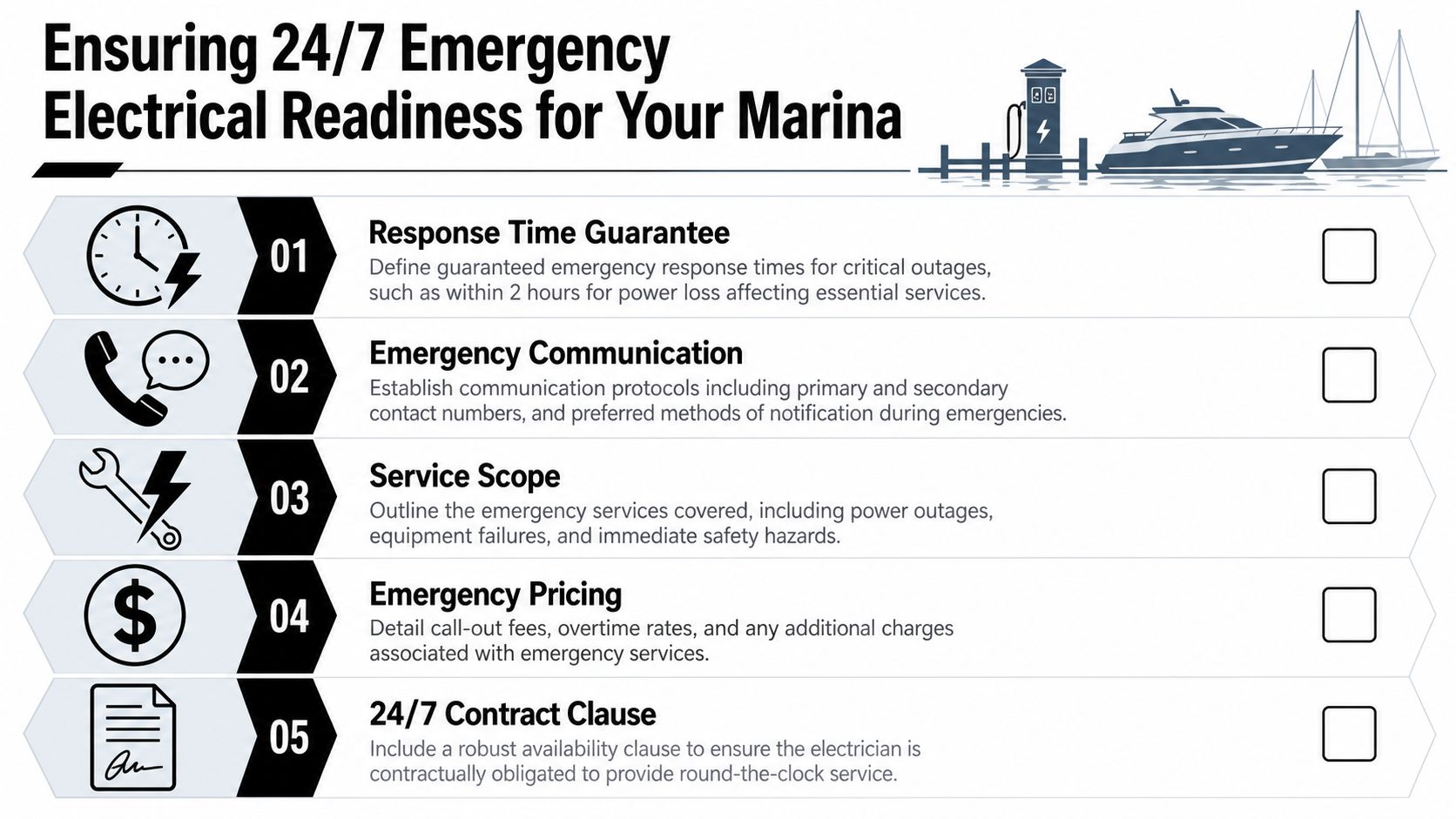
Your contract should define what counts as an emergency, who gets called first, and what “available” means. If the electrician says they're 24/7, make them spell out the workflow for after-hours calls, on-site triage, and escalation. Don't settle for “we'll do our best.”
Operational standard: If the outage affects essential dock services, the clock starts when the call is answered, not when someone feels like returning it.
The emergency clause should also identify the equipment they're expected to handle. That includes power loss, damaged pedestals, failed dock lighting, and immediate safety hazards. If the contractor can't name the scope clearly, they're leaving room for disagreement during the worst possible moment.
Use the service agreement to lock in pricing transparency as well. After-hours fees, overtime charges, and call-out minimums should be visible before the first emergency happens. That way you don't argue about money while you're trying to restore power.
If you need a service model that's built around urgent response, the emergency repair page at Lighthouse Energy Services emergency electrical repair shows the kind of availability language marina managers should expect from a serious electrical contractor.
Test the response system before you need it
A contract is only useful if the contractor can execute it. Ask who answers the phone, who dispatches, and whether the person taking the call understands dockside failures. Marina managers don't need a call center script. They need a technician who can isolate the problem quickly and work safely around water exposure.
This is where your internal contact tree matters too. Give the electrician a primary and secondary contact, and make sure the marina team knows who has authority to approve emergency work. If that chain breaks down, the response gets slower and the liability gets bigger.
Crafting Contracts and Planning Ongoing Maintenance
A good marina contract protects the property before the next fault shows up. It should define warranty terms, scope boundaries, change-order rules, and what happens when hidden corrosion appears during the repair. Marina owners who only think in terms of today's outage end up paying for tomorrow's repeat issue.
Build the contract around inspection and documentation
Spell out how pedestals, feeders, grounding, and bonding will be inspected, then require written closeout notes after each visit. That documentation matters when a future problem shows up and you need to know whether the failure is new or part of an older corrosion path. The contract should also say who approves any change in scope once concealed damage is discovered.
For maintenance planning, don't chase visible upgrades first. A phased, risk-based audit plan can cut failure rates by 30% when marinas stop overinvesting in visible improvements and start prioritizing corrosion-exposed components (risk-based audit guidance). That's the right order for South Florida, where exposed metal and saltwater do more damage than a fresh coat of paint ever fixes.
A practical maintenance sequence looks like this:
- Pedestals and outlets first. Inspect for heat damage, discoloration, and loose terminations.
- Grounding and bonding next. Verify continuity before the season gets busy.
- Feeder transitions after that. Focus on the points where exposure and load meet.
- Emergency shutdown paths last. Confirm staff can isolate a fault fast.
Tie the maintenance plan to the contract
If the contractor is staying on for ongoing service, build the inspection cadence into the agreement. Include routine checks, emergency response terms, and a process for recommending upgrades when a component starts failing early. That keeps the marina from making ad hoc decisions under pressure.
A strong maintenance agreement doesn't just preserve equipment. It gives managers a record they can use when vendors, insurers, or tenants start asking hard questions.
If you want a local example of how ongoing electrical maintenance can be structured for commercial properties, Lighthouse Energy Services commercial electrical maintenance in West Palm Beach is a useful reference point for the kind of recurring service language marina operators should demand.
The bottom line is simple. Hire for marine experience, write the contract for outages and corrosion, and keep the maintenance plan focused on the parts that typically fail first. That's how South Florida marinas stay open, safe, and harder to surprise.
A CTA for Lighthouse Energy Services.