
You bought the EV for a reason. Quiet ride, no gas station stops, and the simple convenience of plugging in at home. Then the practicalities hit. You're watching charge levels, timing errands around public stations, and realizing that even in a city with a strong charging network, home charging is what makes EV ownership easy.
That's especially true in West Palm Beach. The city currently has 451 public EV charging stations and has added municipal charging in key parking garages, which confirms what local homeowners already see on the road: EV adoption is here and growing in a serious way, according to ChargeHub's West Palm Beach charging data. Public charging helps. It doesn't replace waking up every morning with a full battery.
A proper home setup is more than hanging a charger on the wall. In Palm Beach County, the work has to be sized correctly, permitted correctly, installed correctly, and supported after the install if something goes wrong. That's where many homeowners get bad advice. They're told only about the charger. They're not told enough about panel capacity, code updates for coastal conditions, permit requirements, inspection steps, or what happens when a charger starts faulting months later.
Table of Contents
- Your Guide to Home EV Charging in West Palm Beach
- Decoding EV Chargers and Assessing Your Home
- Permits and Palm Beach County Code Compliance
- The Professional Installation From Quote to Power On
- EV Charger Installation Costs and Financial Incentives
- Beyond Installation Maintenance Safety and Repairs
- West Palm Beach Homeowner EV Charger FAQs
- Can I install my own EV charger to save money
- Is Level 1 enough for home charging
- Should I choose a plug-in or hardwired charger
- Will my older home need extra work
- How long does the installation take
- What if I live in an HOA
- What should I keep after the job is done
- When should I call an EV charger electrician in West Palm Beach FL
Your Guide to Home EV Charging in West Palm Beach
A lot of homeowners start in the same place. They use public charging for a few weeks, then realize it adds friction to a car that was supposed to simplify life. If you commute daily, share parking with family, or don't want your battery decisions dictating your evening, a home charger stops being a luxury and starts being basic infrastructure.
West Palm Beach supports that decision. The local network is active, visible, and expanding, but home charging still gives you the part public charging can't: control. You charge on your schedule, on your property, with equipment chosen for your car and your house.
A good EV charger installation should feel boring once it's done. Plug in, charge, move on with your day.
That's not what happens when the setup is rushed. The problems usually show up in familiar ways:
- The charger is oversized: It looks powerful on paper, but your panel can't support it safely.
- The install location is chosen badly: The cable barely reaches, the conduit path is ugly, or the charger gets exposed to more weather than necessary.
- Permits are treated like paperwork instead of safety control: That's when inspection delays and rework start.
A homeowner looking for an EV charger electrician in West Palm Beach FL doesn't just need someone who can pull wire. You need someone who understands local permitting, load calculations, equipment placement, and the long-term reality of owning an outdoor electrical device in a humid coastal environment.
Decoding EV Chargers and Assessing Your Home
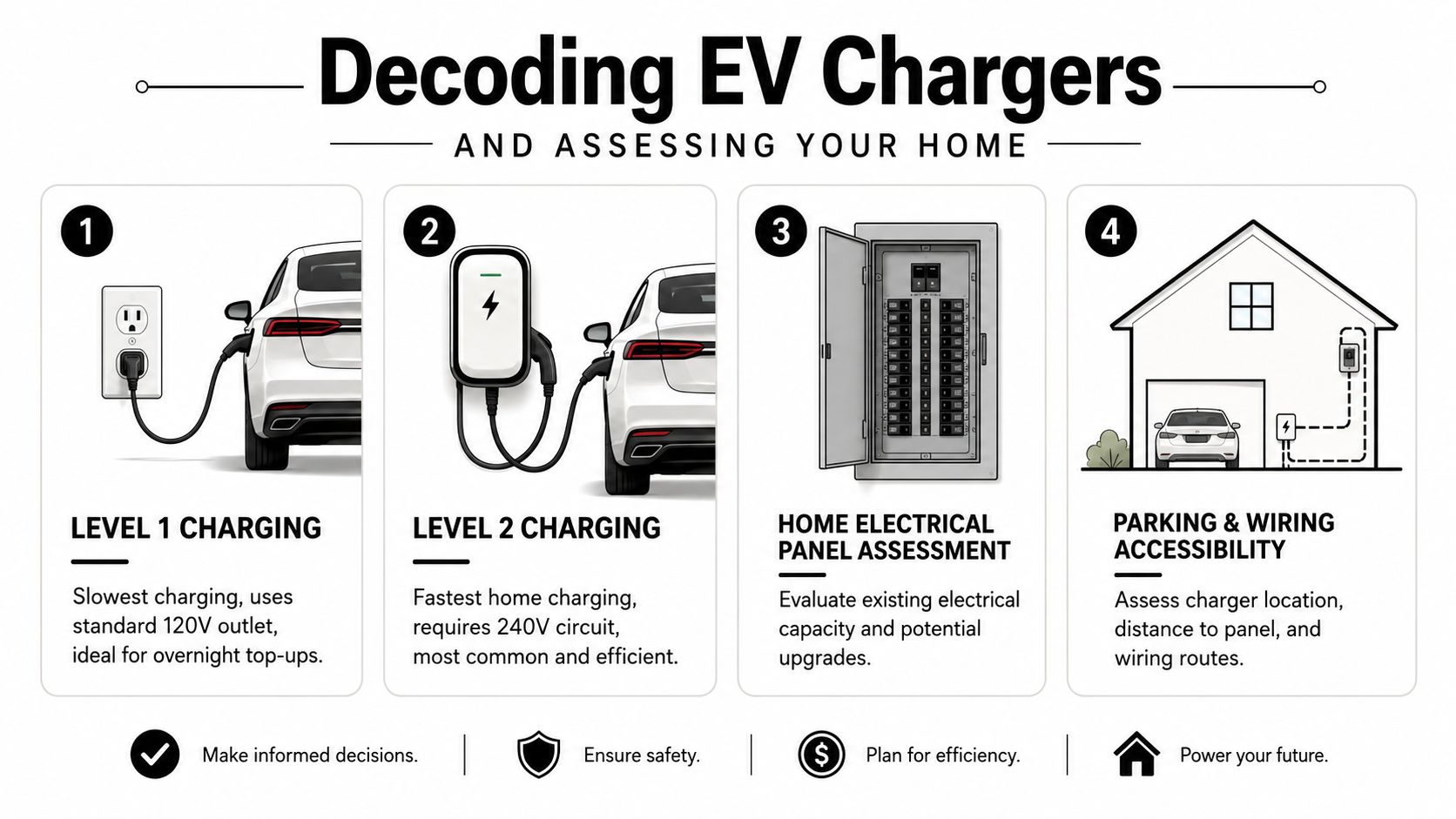
Most homeowners don't need a deep engineering lesson. They need to know which charger makes sense, where it should go, and whether their electrical system can handle it without problems.
What most homeowners actually need
A Level 1 charger uses a standard household outlet. It's the slow option. For some drivers, that's enough if the car sits overnight and daily mileage is modest.
A Level 2 charger uses a dedicated 240V circuit. That's the setup most homeowners ask for because it's far more practical for regular use. It's the difference between topping off slowly and charging in a way that fits normal family schedules.
Here's the simple comparison.
| Feature | Level 1 Charger | Level 2 Charger |
|---|---|---|
| Power source | Standard 120V outlet | Dedicated 240V circuit |
| Installation | Usually no new equipment circuit | Requires professional electrical installation |
| Charging speed | Slow | Faster and more practical for daily use |
| Best fit | Light driving, occasional top-ups | Most homeowners with regular EV use |
| Electrical impact | Minimal if outlet is in good condition | Requires load evaluation and proper breaker sizing |
If you already suspect your panel may be tight on capacity, it helps to understand what a service change can involve before anyone starts quoting. This overview of home electrical panel upgrade cost gives homeowners useful background before the site visit.
What to check before the electrician arrives
You can save time and get a more accurate quote by doing a quick walkthrough first.
- Pick the parking position: Don't estimate from the center of the garage. Park where the car is parked, then look at where the charge port is on the vehicle.
- Locate the main electrical panel: A charger next to the panel is usually simpler than one across the house or at the far edge of a driveway.
- Measure the route, not the straight line: Electricians price wiring runs by the true path, including turns, wall penetrations, exterior routing, and elevation changes.
- Take a photo of the panel directory: That gives a first look at breaker usage and whether spare space may be available.
- Look at exposure: Outdoor installs in West Palm Beach need more attention to rain, humidity, and corrosion than an interior garage wall does.
Practical rule: The cheapest-looking charger location often becomes the expensive one if the wiring path is long or the car doesn't park there consistently.
Home assessment isn't about doing the electrician's job. It's about seeing your property the way a professional has to see it. Distance, access, weather exposure, panel condition, and daily parking habits matter more than the charger brand name.
Permits and Palm Beach County Code Compliance
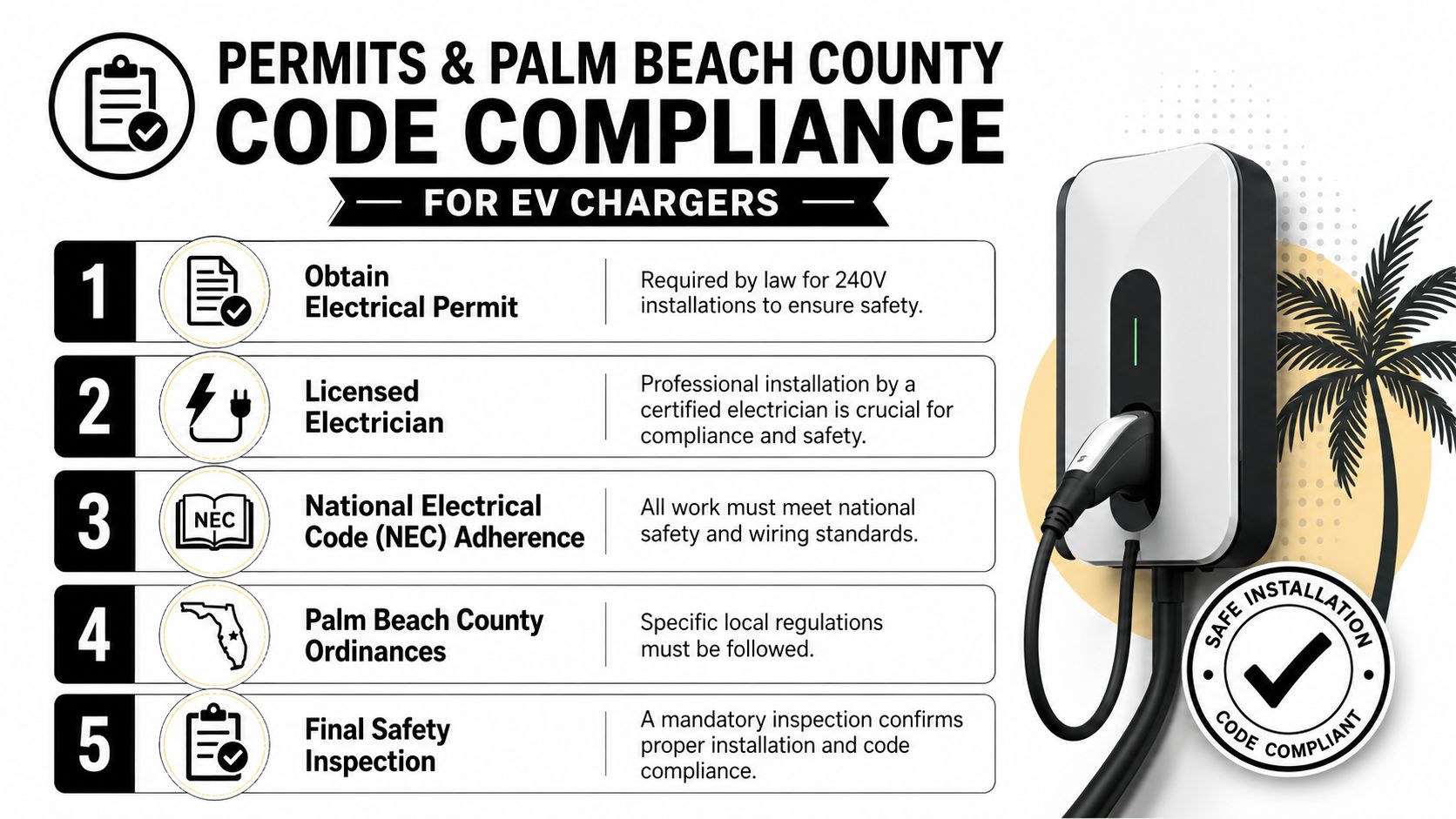
Homeowners get into trouble when they rely on shortcuts. In West Palm Beach and Palm Beach County, all new 240V dedicated circuits for EV chargers require a licensed Certified Electrical Contractor to file the permit, and common failures include underestimating distance to the panel, ignoring future expansion, and missing ADA or signage requirements, as outlined in this Florida-specific guide to EV charger installation permits and pitfalls.
Why a 240V EV charger is not DIY work
A 240V charger isn't like swapping a light fixture. You're adding a dedicated high-load circuit to a system that may already be carrying air conditioning, water heating, cooking equipment, and general household demand. If that circuit is sized wrong, protected wrong, or installed wrong, the consequences aren't cosmetic. They're safety issues.
The permit requirement exists for a reason. It forces a licensed contractor to evaluate the service, document the work, and coordinate inspection. If a homeowner skips that and installs a charger anyway, the problem often doesn't show up until a breaker nuisance-trips, a panel overheats, or the sale of the house exposes unpermitted work.
What the permit path usually includes
For a compliant install, the process usually follows a disciplined sequence instead of guesswork.
Load and panel assessment
The electrician checks whether the home has enough available capacity for the charger you want.Utility coordination when needed
Service limitations, demand concerns, or unusual site conditions may require utility review.Installation documents
This can include one-line information, panel schedules, wiring path details, and mounting information.Inspection stages
Depending on the job, there may be pre-inspection, rough-in, and final inspection steps before sign-off.
For homeowners who want a clearer picture of what a properly managed residential project includes, this page on EV charger installation at home outlines the practical sequence from review through inspection coordination.
Local code issues that catch homeowners off guard
Older homes in West Palm Beach need extra attention. A house that has handled normal family loads for years may still need updated calculations, breaker changes, or protection upgrades before a charger can be added cleanly.
Coastal conditions matter too. Updated Florida code and utility guidance have made equipment selection and placement more specific for homes near salt air and high humidity. If the charger is outdoors, enclosure type and corrosion resistance are not details to sort out later.
Common trouble spots include:
- Older panels with limited capacity: The charger itself may be fine, but the service isn't ready for it.
- Historic or tight-lot homes: Routing conduit cleanly can be harder than homeowners expect.
- Driveway installs near shared or visible areas: Accessibility rules, markings, and placement matter.
- Future second EV planning: If one charger is installed with no thought for expansion, the next project gets more expensive.
Permits don't slow a good job down. They keep a bad job from being hidden.
A seasoned EV charger electrician in West Palm Beach FL earns their value here. Not by filing paper, but by preventing expensive corrections after the walls are patched and the charger is already mounted.
The Professional Installation From Quote to Power On
A quality installation has a rhythm to it. The quote should make sense. The scope should be clear. The work should look clean. And when the power comes on, nothing about the system should feel improvised.
What to look for before you hire
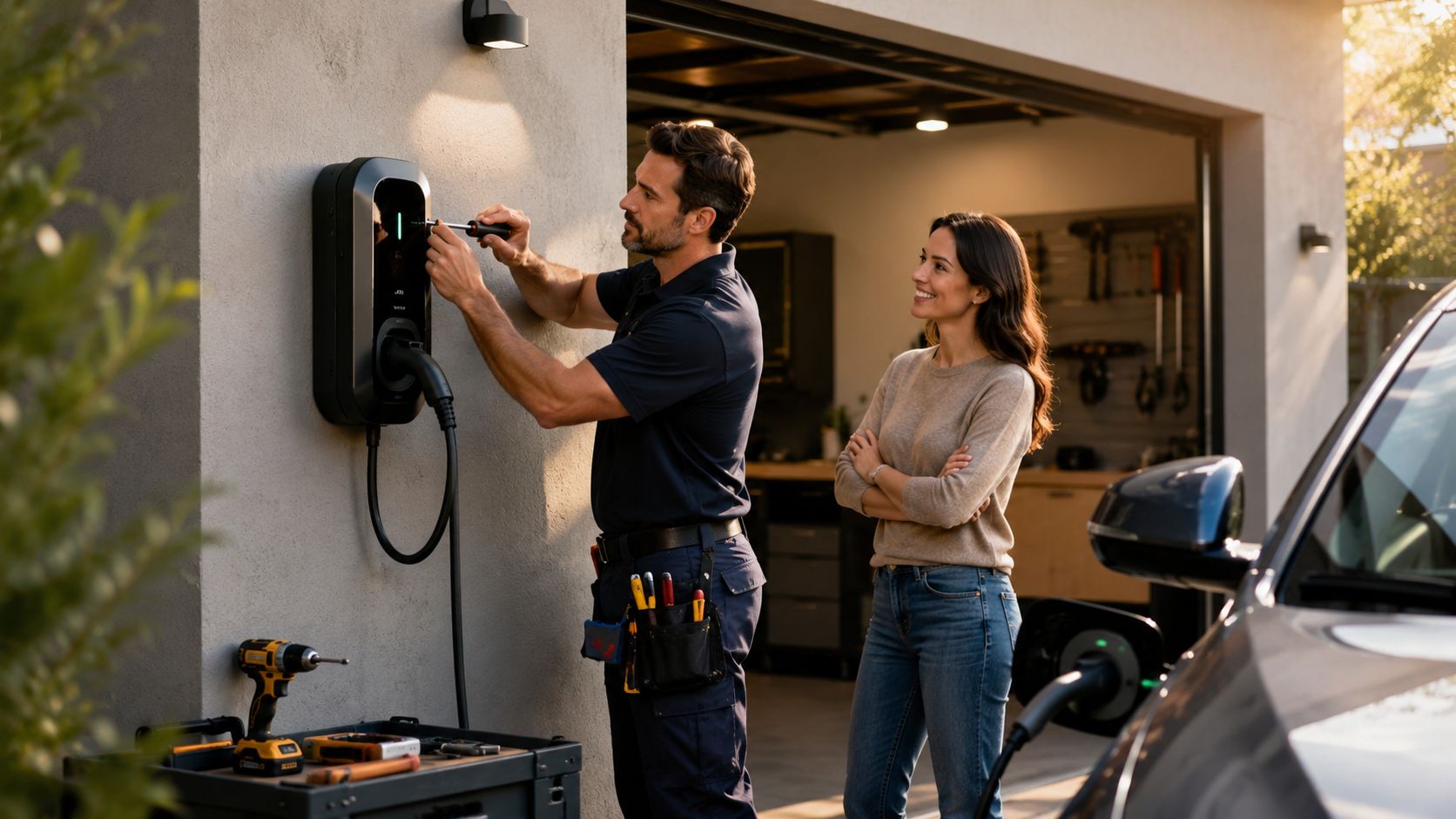
Start with licensing and insurance, then get more specific. Ask whether the electrician handles EV charger work regularly, whether permit filing is included, and whether the quote identifies the charger location, wiring path, breaker size, and any assumptions about panel capacity.
This isn't very different from how homeowners should find the right kitchen contractor. In both cases, the main risk isn't just price. It's unclear scope, hidden change orders, and poor coordination around inspection and finish quality.
A solid quote usually answers these questions up front:
- Where will the charger be mounted
- Will it be hardwired or plugged into a receptacle
- Is panel work included
- Who pulls the permit
- What inspection steps are expected
What happens on installation day
The first job is confirming the load calculation. That step matters because the most common technical pitfall is oversizing the charger beyond the home's panel capacity, which can lead to code violations and fire risk. Florida benchmarks also indicate that 95%+ first-time inspection pass rates are tied to electricians following a strict installation protocol, according to this article on Florida EV charger installation best practices.
From there, the physical work is straightforward when planned well:
- Circuit creation: A new dedicated breaker is installed for the charger.
- Conduit and wiring: The electrician routes the circuit from the panel to the charger location.
- Mounting: The charger is secured at a usable height and in a practical position for the vehicle.
- Connection: Hardwired connections are often the better choice in Florida conditions because they reduce weak points at the plug connection.
- Testing: The charger is energized, checked, and paired with the vehicle if needed.
What a finished job should include
At the end, you should know exactly how to use the system. That includes startup, shutdown, basic resets, and what normal indicator behavior looks like. You should also know where the breaker is and what records to keep.
One factual option for homeowners who want permit submission, physical installation, and inspection coordination handled together is Lighthouse Energy Services. That's useful for people who don't want to manage several moving parts themselves.
If the installer can't explain your charger in plain English before leaving, the job isn't finished.
The cleanest installs are usually the least dramatic. The cable reaches comfortably. The breaker is labeled. The wall finish is respected. The final paperwork is in order. That's what professional electrical work is supposed to look like.
EV Charger Installation Costs and Financial Incentives
Most homeowners ask about price first, and that's fair. In Florida, Level 2 home EV charger installations typically range from $800 to $1,800 for standard jobs, with higher costs when panel upgrades are needed, according to the regional EV planning report from the Broward MPO EV market report.
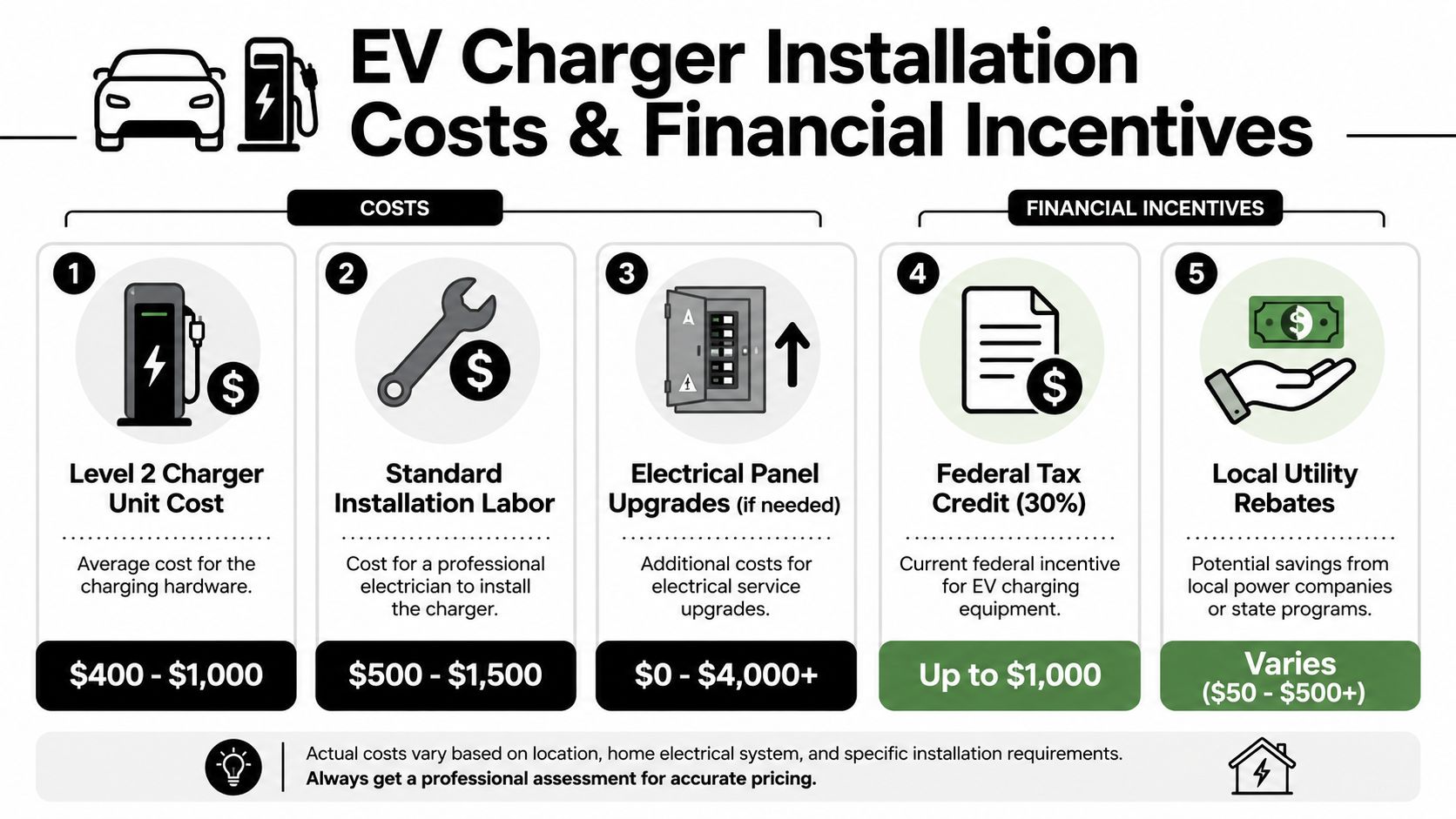
That range usually applies to standard residential conditions. Short wire run. Straightforward mounting. No major service changes. Once the job gets more complex, the price changes for reasons that are usually visible once you know what to look for.
What drives the price up or down
The charger install itself is only part of the scope. A quote moves based on labor difficulty, material volume, and panel conditions.
Key cost drivers include:
- Distance from panel to charger location: Longer runs mean more wire, more conduit, and more labor.
- Mounting conditions: Garage wall installs are typically simpler than detached structures or exposed exterior placements.
- Surface type and access: Masonry, finished walls, attic routing, or trenching all change the labor.
- Weather-ready equipment choices: Outdoor locations may require tougher hardware and more careful placement.
For homeowners pricing local options, this page on affordable EV charger installation in West Palm Beach FL gives a practical starting point for understanding what gets included.
Where homeowners usually spend more than expected
The biggest surprise is often the panel. Not because anyone is upselling, but because the existing service doesn't have the room or available capacity to add a charger cleanly.
Another surprise is route complexity. Homeowners often estimate from point A to point B as if the wire can travel through open air. It can't. It has to follow a legal, protected, buildable path.
There's also the broader infrastructure context. The same regional report notes that FPL has deployed new EVolution fast chargers at Palm Beach County locations including Rosemary Square in West Palm Beach, which reflects how quickly charging infrastructure is expanding in the area. For residential work, that growth doesn't change your permit, but it does reinforce why qualified local electrical labor is in demand.
As for incentives, the right move is to verify what applies at the time you're ready to proceed. Programs change. Eligibility changes. Equipment requirements change. A contractor can point you toward the categories to review, but homeowners should still confirm current tax credit and utility program details before counting on them in the final budget.
Beyond Installation Maintenance Safety and Repairs
The install isn't the end of the job. It's the beginning of owning another electrical device that sits in a hot, humid, sometimes salty environment and gets handled regularly. That matters more in West Palm Beach than many homeowners expect.
One issue that doesn't get enough attention is post-installation support. Data indicates that 15% to 20% of home EV chargers experience faults within the first three years, including breaker trips, communication issues, and cable degradation, as explained in this discussion of EV charger repair needs in West Palm Beach. A lot of contractors talk about installation. Fewer make it clear what happens when the charger stops working later.
What to check after the charger is installed
You don't need to service the internals yourself, but you should keep an eye on the parts you can see.
- Inspect the cable jacket: If it's cracking, nicked, or flattening where it bends, get it checked.
- Look for corrosion or discoloration: Outdoor equipment in coastal air can age faster.
- Keep the unit clean: Dirt buildup around connectors and vents doesn't help reliability.
- Watch for repeated nuisance trips: A breaker that trips once may be an event. A breaker that trips again and again is a problem.
If your charger is mounted outside, check the enclosure and mounting hardware after major weather. Water intrusion and loose fittings tend to get worse, not better.
When to reset it and when to call for service
A simple reset is reasonable if the issue is clearly minor. Check the breaker. Power-cycle the charger if the manufacturer allows it. Confirm the connector is fully seated and the vehicle isn't reporting a car-side setting issue.
Call for service when the problem repeats or anything looks abnormal. That includes heat at the breaker, a burning smell, visible corrosion, damaged cable insulation, or error states that return after reset.
Don't keep using a charger that's acting wrong just because it still works sometimes.
Long-term ownership really separates a basic install from a supported one. If the charger fails on a weekend, after a storm, or before a workday, you need an electrician who handles diagnostics and repair, not just new installations.
West Palm Beach Homeowner EV Charger FAQs
Can I install my own EV charger to save money
If it's a new 240V dedicated circuit, no. That work requires a licensed contractor to file the permit in Palm Beach County. Even aside from the legal issue, a bad load calculation or breaker mismatch is how homeowners create expensive and unsafe problems.
Is Level 1 enough for home charging
Sometimes, yes. If your driving is light and the car sits long enough between uses, Level 1 may work. Most homeowners who drive daily prefer Level 2 because it gives them more flexibility and less waiting.
Should I choose a plug-in or hardwired charger
Hardwired is often the better call for Florida conditions, especially outdoors. It gives a cleaner, more durable connection and avoids relying on a receptacle in a demanding environment.
Will my older home need extra work
It might. Older homes often need closer review of panel capacity, breaker space, and code-related upgrades before a charger can be added. That's especially true when the service has already been extended over the years by renovations or added appliances.
How long does the installation take
The physical installation may be completed in a matter of hours for a straightforward setup. The full project timeline can be longer because permitting, scheduling, and inspection all have to happen in the right order.
What if I live in an HOA
Tell the board early. You may need approval for visible exterior equipment, conduit routing, or parking-related changes. The cleaner the plan and documentation, the smoother those conversations usually go.
What should I keep after the job is done
Keep the permit record, inspection approval, charger model information, and any installer documentation. If the home is sold later, organized records make life easier.
When should I call an EV charger electrician in West Palm Beach FL
Call before you buy hardware if you're unsure about panel capacity, charger placement, or permit requirements. That prevents the common mistake of purchasing a charger that doesn't fit the home as installed.
If you want a site-specific quote, permit-ready plan, or help diagnosing an existing charger problem, contact Lighthouse Energy Services. A licensed electrician can review your panel, your parking setup, and your charger goals so the system is safe, compliant, and built to last in West Palm Beach conditions.