
You brought the EV home, plugged it into a regular outlet, and then you realized. The car is great. The charging routine isn't.
That's where most homeowners in Palm Beach County start. The vehicle is already in the driveway or garage, but the house wasn't built around daily EV charging. A standard outlet may work in a pinch, but it usually doesn't fit real life once you're commuting, running errands, or sharing the car with another driver.
Local guides often stop at generic advice like “install a Level 2 charger” or “check your panel.” That's not enough here. In Palm Beach County, the hard part is often everything around the charger itself: the permit, the utility coordination, the HOA paperwork, the town-level inspection process, and the small code details that turn a simple project into a failed inspection if they're missed.
Table of Contents
- Your New EV is Here What Comes Next
- Choosing the Right Charger and Location for Your Home
- Navigating Palm Beach County Permits and Electrical Upgrades
- Budgeting Costs Incentives and Handling HOA Approvals
- What to Expect During Installation and Inspection
- Why You Must Hire a Licensed Palm Beach County Electrician
Your New EV is Here What Comes Next
Most new EV owners go through the same progression. The first few days feel easy enough because the car is new and the battery starts full. Then the charging routine settles in, and you realize the factory cord on a standard outlet is more of a backup plan than a permanent one.
A proper home setup usually means Level 2 charging on a dedicated circuit. That's the setup that fits daily use, keeps charging predictable, and avoids the constant habit of trying to “catch up” overnight.
Palm Beach County is already a strong place to own an EV. The area currently has 451 total EV charging stations and 196,000+ public ports, with 26% of stations (116 locations) offering free charging, according to ChargeHub's West Palm Beach charging data. That helps with errands, travel days, and range anxiety.
But public charging convenience doesn't replace home charging. It supplements it.
Practical rule: If you park at home every night, your house should be your primary charging station.
The homeowners who are happiest with their setup usually want three things:
- Reliable overnight charging: They don't want to plan around battery percentage every evening.
- A clean installation: No exposed shortcuts, no extension-cord thinking, no guesswork.
- A permit that closes out properly: They want the job inspected and signed off, not left hanging.
That's where local details matter. In Palm Beach County, EV charger installation isn't just about mounting a unit on the wall. It can involve panel capacity review, permit paperwork, scheduling with the town or city inspector, and in many neighborhoods, an HOA approval process before work even starts.
For condo owners and townhouse owners, the paperwork can be harder than the wiring. For single-family homes, the electrical side usually decides whether the job stays simple or expands into a panel upgrade.
A charger that looks straightforward on a product page can become complicated fast once the site conditions are real. Garage layout, distance from the electrical panel, exterior wall access, existing service capacity, and local permit rules all affect what works and what doesn't.
Choosing the Right Charger and Location for Your Home
The right charger isn't always the biggest one available. It's the one that fits your vehicle, your parking habits, and your home's electrical system without forcing unnecessary upgrades.
Start with how you actually drive
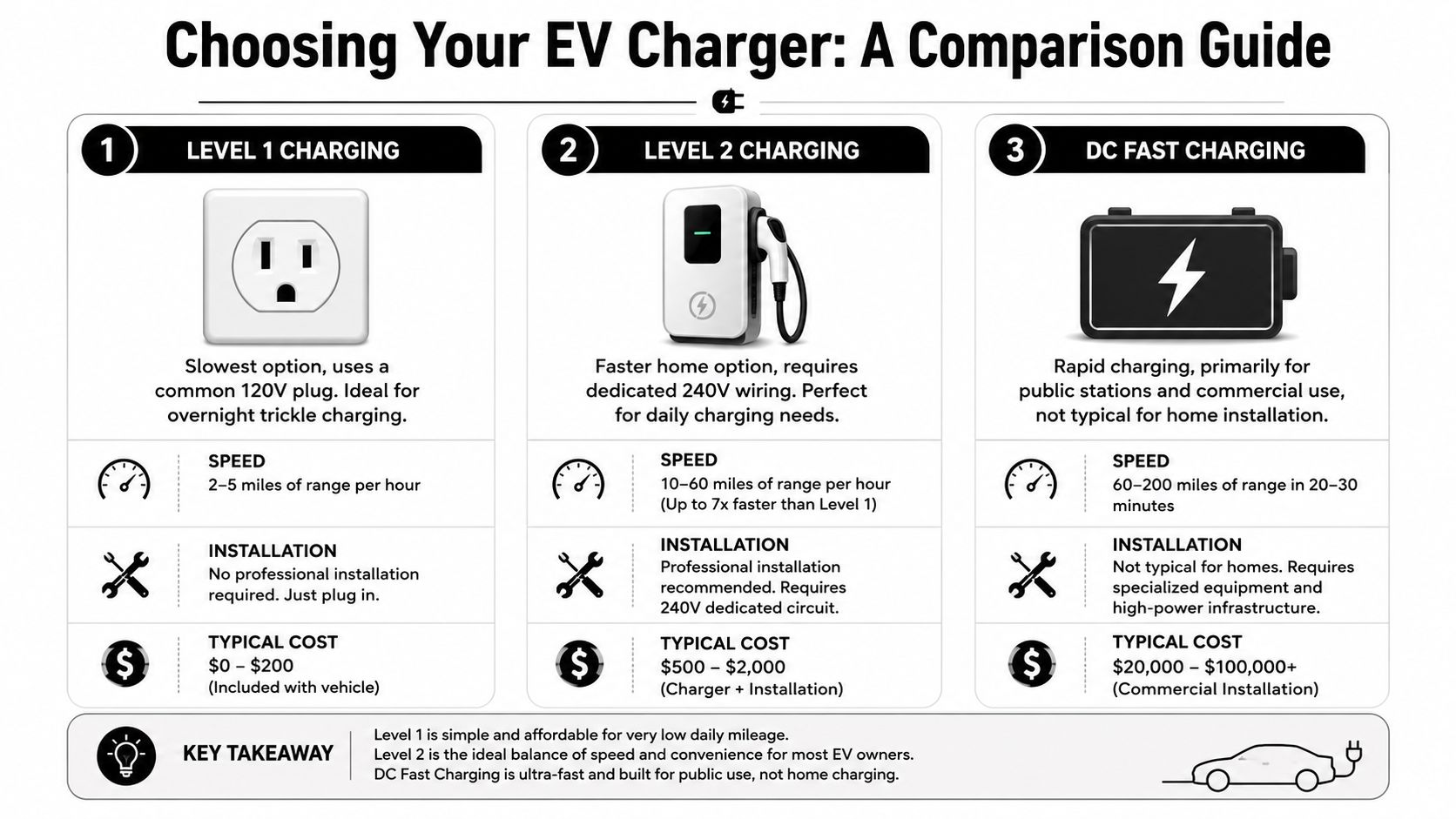
Level 1 charging uses a common household outlet. It's slow, but it can work for very light driving or temporary use. Most Palm Beach County homeowners who commute, make multiple trips a day, or drive larger EVs quickly outgrow it.
Level 2 charging is the usual home solution. It requires a dedicated 240-volt circuit and a charger or receptacle that matches the design. DC fast charging is a different category and generally belongs in commercial or public infrastructure, not a typical residence.
When choosing a home charger, look at these decisions first:
- Amperage: More output isn't automatically better. A higher-amperage charger may require more panel capacity and heavier wiring. If your driving pattern doesn't need it, a moderate setup can be the smarter choice.
- Smart vs. basic: Smart chargers can add app controls, scheduling, and communication features. Basic units are simpler and often easier for homeowners who just want plug-in reliability.
- Plug-in vs. hardwired: Plug-in units can be convenient in the right application. Hardwired chargers often make more sense where durability, cleaner installation, or code interpretation favors a permanent connection.
Some homeowners also care about cable length and wall placement more than they expect. If the charging cable barely reaches the port, daily use becomes annoying fast. A clean plan solves that before installation day.
For homeowners comparing garage layouts and charger placement ideas, this guide to garage EV charger installation in West Palm Beach is a useful local reference.
Pick the location before you buy the charger
The best charger location is usually the one that balances convenience with electrical practicality. Those two things don't always point to the same wall.
A location close to the main panel often reduces complexity. Shorter wire runs usually mean less conduit, less disruption, and fewer installation obstacles. A charger on the opposite end of the house, in a detached structure, or near a parking pad outside may still be workable, but it tends to increase planning demands.
Common placement options include:
| Location | What works well | What often causes problems |
|---|---|---|
| Inside garage | Protection from weather, clean mounting surface, easier daily use | Tight parking clearance, poor cable reach |
| Exterior wall | Good for driveway charging, useful when garage storage limits access | Exposure to weather, conduit routing, visibility issues |
| Carport or side pad | Can be practical for certain home layouts | Longer runs, mounting challenges, added protection needs |
The charger should fit the way you park every day, not the way you wish you parked.
A few location mistakes come up repeatedly:
- Buying the charger first: Homeowners pick a unit based on reviews, then find out the mounting location or circuit requirements don't fit the house.
- Ignoring parking position: The charge port may be front, rear, left, or right. That matters.
- Underestimating outdoor exposure: Outdoor installations can work well, but the equipment selection and mounting details need to match the conditions.
A good site plan feels boring in the best way. The charger is easy to reach, the conduit route is clean, the cable isn't dragged across a walkway, and nothing about the installation looks improvised.
Navigating Palm Beach County Permits and Electrical Upgrades
The common failing of generic EV articles is their treatment of this step. They treat the permit as a formality and the panel review as a quick yes-or-no check. In practice, this is the part that decides whether your project moves smoothly or turns into weeks of back-and-forth.
What the electrical review actually looks like
Before anyone installs an EV charger, the house needs an electrical review. That starts with the panel, but it doesn't end there. The electrician needs to determine whether the existing service can handle the added continuous load and whether the circuit can be installed safely and legally.
That review usually includes:
- Available panel space: Is there room for the breaker and the proper circuit arrangement?
- Service capacity: Can the existing electrical service support the added load without overloading the system?
- Physical routing: Is there a practical path for conduit or cable from the panel to the charger location?
- Site conditions: Are there obstacles like finished walls, long exterior runs, or detached structures?
If you want a plain-English primer on how electricians think through load demand, BIM Heroes' guide to load calculations is a useful background read before you look at proposals.
Sometimes the charger install is straightforward. Sometimes it reveals that the panel is already crowded, the service is marginal, or the route to the garage is more involved than expected. That's when a panel upgrade or reconfiguration enters the conversation. If you're trying to understand the broader scope of that kind of work, this breakdown of home electrical panel upgrade cost helps frame what can drive complexity.
A charger install can be simple. A charger install on an overloaded or outdated panel usually isn't.
Why permits and utility coordination slow projects down
Palm Beach County adds another layer that national advice usually skips. Local EVCS provisions require early coordination with zoning teams to verify required parking spaces, ADA compliance, and signage before construction begins, and projects must coordinate with the utility to determine service availability and demand charges, often requiring load-flow and panel/transformer assessments, according to South Florida Engineers' Palm Beach County EV charging permitting overview.
That language sounds commercial, but homeowners feel the same logic in smaller ways. The local authority having jurisdiction may have its own application expectations, review process, and inspection habits. One town may be straightforward. Another may want clearer drawings, additional documentation, or different permit handling.
For residential jobs, the practical headaches usually look like this:
- Town-specific permit handling: Countywide assumptions don't always match the municipality where the house sits.
- Inspection sequencing: Rough work and final approval may require careful scheduling depending on the installation type.
- Disconnect and labeling requirements: These details often get overlooked by inexperienced installers.
- Functional testing: Smart charger communication features and final operation still have to work as installed.
The permit is not optional. It protects the homeowner, documents the work, and gives the installation an independent code review through inspection. Skipping it may save time at the front end, but it creates risk when there's an insurance question, a home sale, or a problem with the equipment later.
The most efficient projects are the ones that are planned like electrical projects, not gadget installs. That means drawings when needed, proper circuit design, utility awareness, clean permit documentation, and a realistic schedule for inspection.
Budgeting Costs Incentives and Handling HOA Approvals
Your EV may be sitting in the driveway, but the key question is whether the budget on paper matches what the house, the town, and the HOA will require.
What you're really paying for
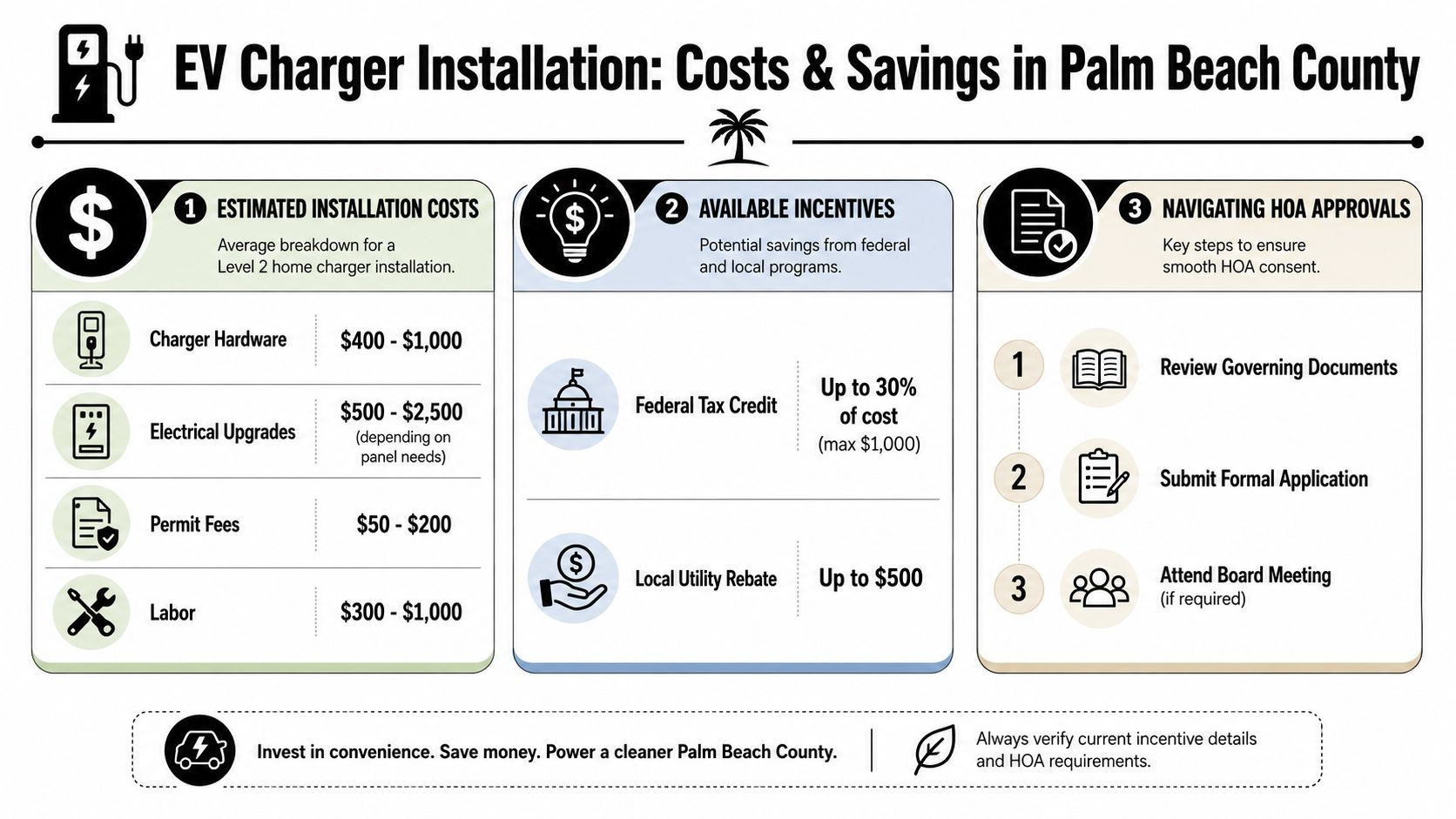
The charger itself is only one line item. Homeowners often price the unit they want and overlook the electrical work that makes it legal, safe, and usable every day.
One local reference states that residential Level 2 installations average $1,300 per connector for equipment alone, excluding labor and permitting, according to this Palm Beach County EV charging funding and policy reference. That figure is helpful for one reason. It separates hardware cost from installed cost.
In Palm Beach County, the final price usually moves based on the house, not the charger brand. A garage wall with the panel on the other side is a different job from a detached parking area, a condo garage, or a driveway that needs a long conduit run. If the panel is full, undersized, or located far from the parking spot, the budget changes fast.
A realistic home budget should account for:
- Charger equipment: The unit itself, whether owner-supplied or contractor-supplied.
- Installation labor: Routing wire, mounting equipment, making terminations, testing, and cleanup.
- Permit and inspection costs: Required parts of the job, with fees and timelines that vary by town.
- Electrical upgrades: Panel changes, load management equipment, service work, or a new circuit path.
- Finish and access conditions: Attic work, block walls, exterior conduit, trenching, patching, or long runs.
Broad public funding for EV infrastructure gets a lot of attention, but that money does not usually lower the cost of a standard home charger in a direct, immediate way. The same source also notes larger infrastructure funding and statewide EV charging goals. For a single-family homeowner, the practical step is to check current tax credits, utility rebates, and manufacturer paperwork before work starts, because those programs change and missing a form can cost you the benefit.
How to approach the HOA without creating delays
In Palm Beach County, HOA approval is often slower than the electrical work.
That is especially true in condos, townhome communities, and developments with assigned parking. The board may be less concerned with the charger itself than with where conduit will be visible, who pays if common elements are affected, how electricity is metered, and who is responsible when the unit fails five years from now.
Florida law gives owners meaningful protection. Under § 718.113(9) F.S., unit owners may apply to install EV charging stations in their parking spaces, and associations may not unreasonably exclude those requests, as noted earlier. In practice, that still leaves plenty of room for delays if the application is incomplete or the installation touches common property.
A strong HOA package usually includes four things:
- A clear location plan: Show the parking space, charger location, conduit path, and any wall penetrations.
- A defined power source: State whether the charger will be fed from the unit meter or a shared electrical system.
- Proof of licensed, permitted work: Boards want to know a qualified electrician will pull permits and close out inspection.
- Responsibility in writing: Identify who maintains the charger, who repairs damage, and what happens if the owner moves.
If you want a general refresher on how boards interpret community rules, Towne and Country insights on HOA rules are useful context before you file.
I tell homeowners to treat the HOA request like a permit package, not a casual email. A one-page product sheet and a note saying "I want a charger" usually stalls out. A marked-up site sketch, electrical scope, contractor information, and maintenance responsibility statement gives the board far fewer reasons to table the request.
That matters in Palm Beach County because each town and each community tends to have its own friction points. One board may focus on appearance. Another may insist on indemnity language, licensed and insured contractor documentation, or architectural review before electrical approval. Getting those questions answered up front is usually cheaper than revising the job after approval conditions are added.
What to Expect During Installation and Inspection
A well-run EV charger project should feel organized, not chaotic. Homeowners usually worry most about how invasive the work will be and whether the inspection will turn into a problem.
The normal project flow
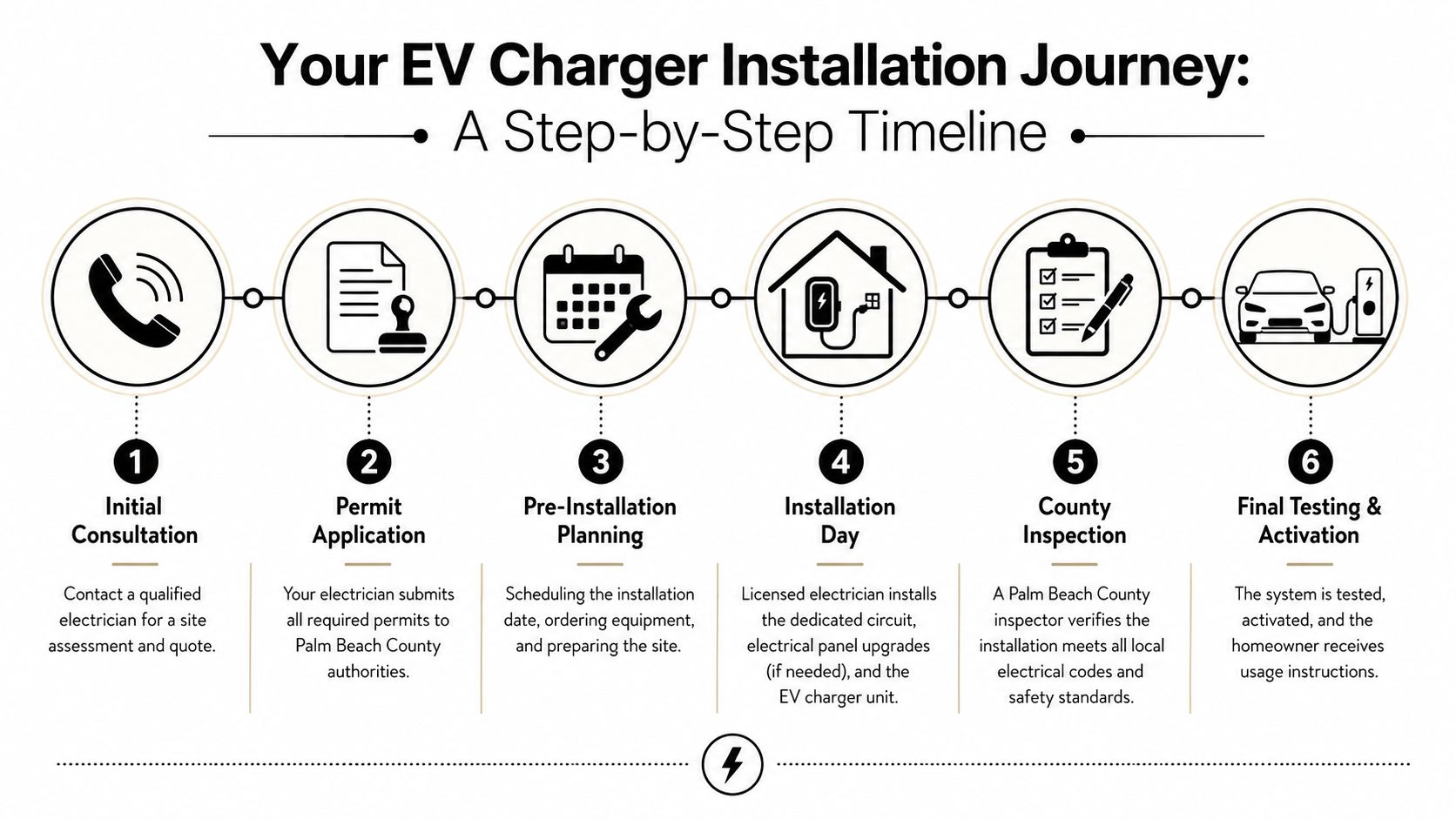
The process usually moves in a clear sequence:
Site visit and assessment
The electrician reviews the panel, the parking layout, and the route to the charger location. If there's an HOA or condo issue, that gets identified early.Proposal and scope approval
You should know whether the plan is for a receptacle or hardwired charger, whether panel work is included, and what permitting is required.Permit submission
The permit package goes to the correct local authority. At this stage, town-specific handling can affect timing.Installation day
The crew runs the circuit, mounts the charger or receptacle, makes up the panel connections, labels equipment, and completes required testing.Inspection and final sign-off
The inspector verifies compliance before the permit closes out.
Some installs are neat and fast. Others involve attic work, block walls, exterior conduit, or panel changes that add labor and coordination. What matters most is that the work sequence stays orderly and documented.
What inspectors usually focus on
Palm Beach County inspections aren't there to create hassle. They exist to verify that the installation is safe, code-compliant, and complete.
Inspectors commonly look at:
- Dedicated circuit and breaker sizing
- Proper wiring method and termination
- Mounting and working clearances
- Disconnects, labeling, and accessibility
- Final operation of the installed equipment
A clean inspection usually starts long before the inspector arrives. It starts with correct planning, proper materials, and an installer who understands local expectations. Homeowners can help by making the area accessible, keeping vehicles out of the work zone, and asking for a quick walkthrough once testing is done.
Ask the electrician to show you the breaker, the shutdown method, and the normal charging routine before the job is considered finished.
That last walkthrough matters. You should know what was installed, how to use it, and what to do if the charger faults or loses power.
Why You Must Hire a Licensed Palm Beach County Electrician
A common Palm Beach County scenario goes like this. The charger is on the wall, the car is in the garage, and then the permit issue starts. One town wants the work filed one way, another wants added documentation, and the HOA asks for a site sketch before they will even discuss exterior conduit or equipment placement.
That is why licensing matters here. An EV charger draws sustained power, ties into your home's service equipment, and has to satisfy local code, local permitting rules, and the inspector who signs off on the job. A handyman or general contractor may be able to mount equipment. That does not mean the installation is legal, safe, or likely to pass the first time.
In Palm Beach County, the problem is rarely just the wire pull. Trouble usually starts with the details homeowners do not see until the job stalls. Owner permits can be limited or handled differently depending on the municipality. Some homes need load calculations that support the added charger demand. Homes in HOA communities may need written approval for visible conduit, exterior equipment, or any change near shared walls and common areas. If the paperwork and scope do not line up, the installation can sit in limbo.
A licensed local electrician helps prevent that by handling the job as a full code and permit process, not just an equipment install. That includes checking whether the existing panel can support the charger, identifying when service changes are needed, pulling the correct permit, and correcting issues before inspection instead of after a failed visit.
Insurance and contractor status matter too. If you want a plain-English explanation of why that matters on home projects, Riverside Sealing & Striping's guide gives a useful overview.
Before you hire anyone, ask a few direct questions:
- Are you licensed for residential electrical work in Florida?
- Do you regularly pull EV charger permits in Palm Beach County municipalities?
- Who is responsible for permit paperwork, inspection scheduling, and correction items if the inspector calls something out?
- Have you looked at the panel load and service size, not just the charger location?
- Have you dealt with HOA approval packages for exterior conduit or mounted equipment?
Good electricians answer those questions clearly.
If you want a broader screening process, this guide on how to find a good electrician is a practical place to start.
Lighthouse Energy Services serves Palm Beach County and handles residential electrical upgrades and EV charger installation as part of that work. The company was established in 2005, and the team has more than 100 years of combined experience. That matters on jobs where the charger itself is simple but the town requirements, panel limits, or HOA conditions are not.
Hire the electrician who can get the work approved, documented, and safely put into service. In this county, that is what separates a finished installation from a charger that sits on the wall waiting for problems to be fixed.