If your power is out in West Palm Beach, the first move is not to start flipping breakers until you know whether you're dealing with a utility outage, a tripped main, or a real in-home hazard. Florida has seen outages on a massive scale, including 6.7 million customers during Hurricane Irma and 487,800 customers without power in Palm Beach County during Hurricane Wilma, so keep the power off until you sort out which kind of problem you have (Florida outage data and storm restoration context).
It's 1 a.m. The hallway is dark. The kitchen outlet strip is half-dead. You catch that sharp hot-plastic or ozone smell near the panel, and then you notice the neighbor's porch light is still on. That's the moment people panic and make bad decisions.
Don't.
Your first job is simple: confirm whether this is outside your house, inside your panel, or active damage somewhere in the wiring. A calm five-minute check protects your family better than a rushed service call.
Table of Contents
- When the Lights Go Out in West Palm Beach
- What Counts as a True Electrical Emergency
- What to Do in the First Five Minutes
- How Lighthouse Energy Services Responds
- Transparent Pricing With No After-Hours Surcharge
- Common Emergencies We Handle Across Palm Beach County
- Service Area, Credentials, and How to Reach Us
- Quick Answers From a West Palm Beach Emergency Electrician
When the Lights Go Out in West Palm Beach
A lot of homes in West Palm Beach have a mix of old and newer electrical work. That's why a nighttime outage can be confusing. One room dies, another still has power, the refrigerator is running, and the panel area smells wrong. You need a fast triage, not guesswork.
Start with the four checks that matter
Use this order:
Check the neighbors
Step outside and look for porch lights, street lighting, or nearby homes with power. If the whole block is dark, this may be utility-side. If your neighbors have power and you don't, the problem is more likely on your side.Check the main breaker
Open the panel only if the area is dry, clear, and you don't smell active burning coming from the enclosure. Look for a tripped main or a breaker sitting in the middle position. Don't start resetting branch breakers one by one yet.Use your nose and ears
A burning smell, buzzing, sizzling, or crackling near the panel matters more than flickering lights. Smell is often the first warning that insulation, a breaker connection, or a bus connection is overheating.Decide whether to stay put
If you see smoke, hear arcing, or suspect water has reached electrical equipment, get people out of that area immediately. If the hazard is severe or spreading, leave the home and make the emergency calls from outside.
Practical rule: If you don't know whether the panel is safe to touch, treat it as unsafe.
Why this order works
People lose time by treating every outage like an emergency electrician problem. It isn't. Some outages are utility events. Some are a tripped main caused by an overloaded circuit. Some are true behind-the-meter failures, and those need a licensed electrician fast.
The point is to separate inconvenience from danger. Overreacting wastes time. Underreacting risks fire and shock.
What Counts as a True Electrical Emergency
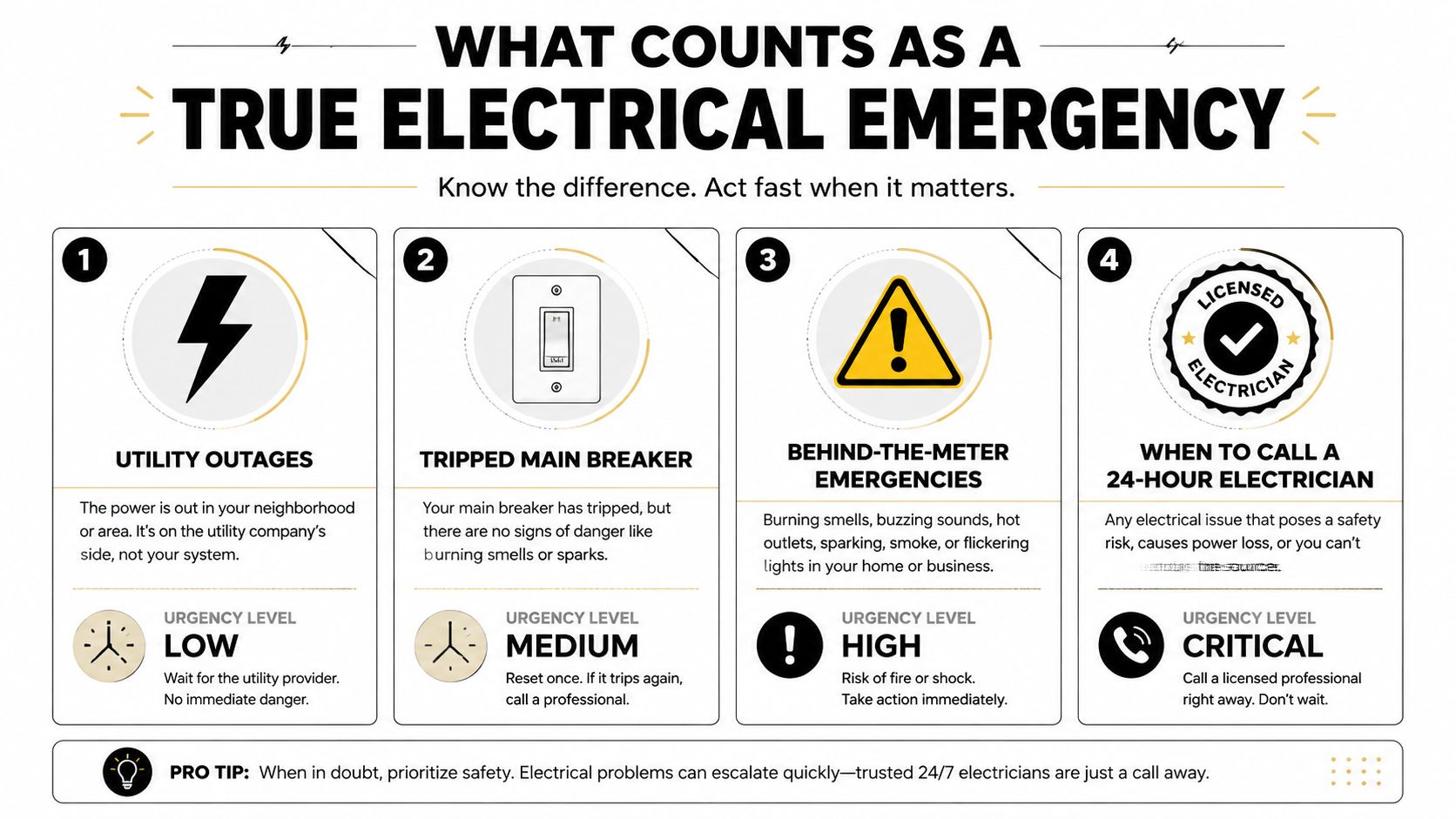
A true electrical emergency is a hazard, not just a loss of convenience. If the issue can injure someone, start a fire, or damage the service equipment, stop trying to “see if it comes back on.”
Four signs that change this from outage to emergency
Visible sparking or arcing
If an outlet, switch, breaker, or panel is sparking, that's not a “wait until morning” issue. Arc-flash hazards are serious enough that OSHA defines the arc-flash boundary at the point where incident energy reaches 1.2 cal/cm2, and arc burns often get worse when the arc ignites clothing (OSHA arc-flash guidance).
A burning or hot-plastic smell that stays
If you reset a breaker and the smell returns, stop. Heat and odor mean something is still failing under load.
Water touching electrical components
Storm intrusion, slab leaks, roof leaks, and standing water near outlets or a panel all change the situation. Water and damaged equipment are a bad combination.
Storm damage to service equipment
A bent mast, damaged meter base, pulled service conductors, or a main that won't stay reset after a storm points to real electrical damage, not just a temporary outage.
What usually is not a true emergency
Flickering lights by themselves often suggest utility trouble, especially if nearby homes are showing the same behavior. A single tripped breaker after plugging in too much load may also be straightforward. If you're dealing with repeat trips, this guide on what causes a circuit breaker to keep tripping can help you understand the likely cause before the electrician arrives.
Call 911 first for active fire, visible smoke, or a downed line touching the home or yard. The electrician handles the system behind the meter once the scene is safe.
What to Do in the First Five Minutes
These first five minutes matter more than the next fifty. Move in order. Don't improvise.
Do this first
- Check the scope of the outage: If nearby homes are dark too, report it to the utility. That points to a grid or feeder issue, not a house wiring repair.
- Go to the panel only if the area is dry: If the floor is wet, stop there.
- Try one main breaker reset only: Firmly off, then firmly on. If it trips again, leave it off.
- Keep everyone back from hazards: Children, pets, and curious adults included.
Do not do this
- Don't keep resetting breakers: Repeated resets can feed a fault again and again.
- Don't touch metal equipment near water: That includes panels, appliances, disconnects, and extension cords.
- Don't investigate downed lines yourself: NFPA safety guidance for electrical emergencies says to keep people at least 10 ft away from downed lines, avoid anything touching the wire, and call the utility immediately (NFPA electrical safety guidance).
- Don't assume low voltage means low danger: The injury risk depends on energy exposure, not the number you think you're seeing.
If there's fire, smoke coming from a wall, or someone has been shocked, call 911 before you call the electrician.
The exact point to place the emergency call
Call the 24 hour emergency electrician in West Palm Beach when any of these are true:
- The main won't hold
- You smell burning
- Part of the home is dead and neighbors still have power
- Water has reached electrical equipment
- You hear buzzing, sizzling, or crackling from the panel or walls
At that point, stop troubleshooting. You've done enough.
How Lighthouse Energy Services Responds
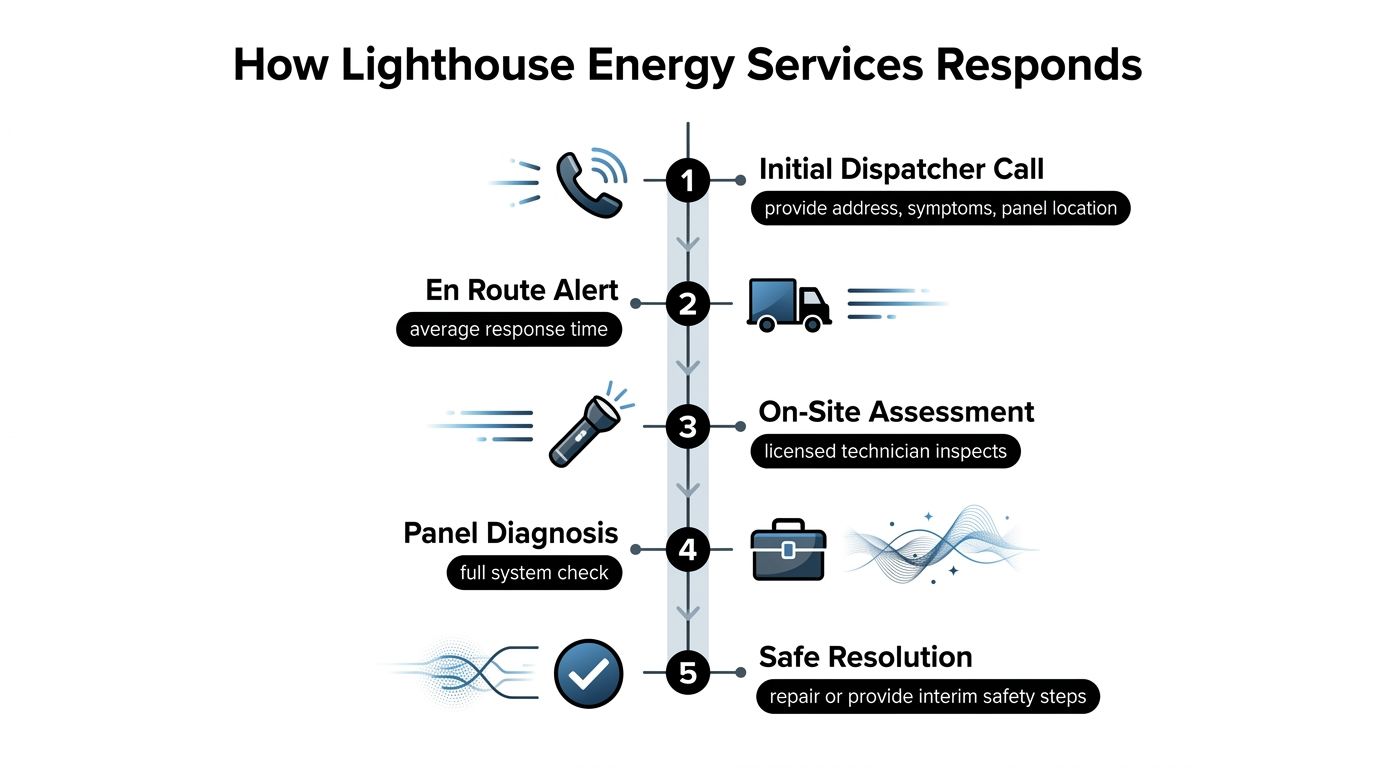
When you call at night, the useful information isn't “everything's out.” The useful information is what you saw, what you smelled, whether the main tripped, and whether water or storm damage is involved.
What to tell dispatch
Give the dispatcher four things right away:
- Your address
- The symptoms
- Where the panel or service equipment is located
- Whether anyone is in immediate danger
That lets the call get routed correctly. If it's a simple outage, you'll be told that. If it sounds like a service fault, a panel issue, or storm damage, it gets escalated.
What the electrician does when arriving
A real emergency response starts with safety, not repair. The electrician should inspect the area, identify affected circuits or service components, and establish a safe work condition before touching live equipment.
That means isolating the load, locking out and tagging out the affected equipment where applicable, and verifying the absence of voltage with a properly rated test instrument before proceeding. OSHA and NFPA 70E both push this approach because the fastest safe path back to service is usually de-energization and verification first, not live repair (safe work condition guidance for energized equipment).
What the diagnosis usually looks like
The sequence is usually straightforward:
- Visual inspection of panel, meter area, disconnects, and visible wiring.
- Circuit isolation to identify whether the fault is on a branch circuit, feeder, main breaker, or service side.
- Meter verification to confirm where voltage is present and where it stops.
- Written findings so the homeowner gets a clear yes-or-no answer on re-energizing.
If you need a local option for emergency electrical repair in Palm Beach County, Lighthouse Energy Services is one available provider for residential and commercial response.
A good emergency electrician gives you a go-or-no-go decision before starting repairs. If the house isn't safe to re-energize, the right answer is “leave it off.”
Transparent Pricing With No After-Hours Surcharge
People hate emergency service because they expect a mystery bill. Fair enough. Emergency electrical pricing should be plain before any repair starts.
Here's the standard I recommend. The company should tell you the diagnostic charge, any trip charge, and the labor basis before the truck rolls or as soon as the tech arrives. The hour on the clock shouldn't turn into a penalty.
What a clean pricing model looks like
You want these rules in writing:
- Written quote before repair: Diagnosis first, price second, work third.
- Approval before change orders: If the job gets larger after opening equipment, you approve the revision before more work happens.
- Clear line between emergency repair and upgrades: Safety repair now. Optional upgrades later.
- No after-hours surprise: Night, weekend, and holiday shouldn't create hidden add-ons if the company says it offers flat emergency pricing.
If you want to vet how a company explains fees, this page on West Palm Beach electrician pricing with no hidden fees shows the kind of structure homeowners should look for.
Typical Emergency Repair Cost Ranges in West Palm Beach
| Scenario | Typical Range | What is Included |
|---|---|---|
| Nighttime panel fault | Quoted after diagnosis | Safety inspection, fault isolation, panel testing, written repair recommendation |
| Storm-damaged service mast | Quoted after diagnosis | Site safety review, temporary shutdown guidance, coordination steps for utility-side clearance, repair scope |
| Commercial breaker trip | Quoted after diagnosis | Circuit isolation, load check, breaker and panel evaluation, go-or-no-go restart decision |
No, that table doesn't give you made-up numbers. That's the point. If a company hasn't diagnosed the fault yet, any exact price is just sales talk.
One thing that helps during after-hours calls
If you manage properties or need fast occupant communication, tools like always‑on Facebook Messenger can help keep tenants or staff updated while dispatch is underway. It doesn't fix the electrical issue, but it does reduce chaos when multiple people are reporting the same outage.
Common Emergencies We Handle Across Palm Beach County
Not every emergency call gets triaged the same way. A storm-damaged mast, a waterlogged panel, and a restaurant breaker failure all demand different first moves.
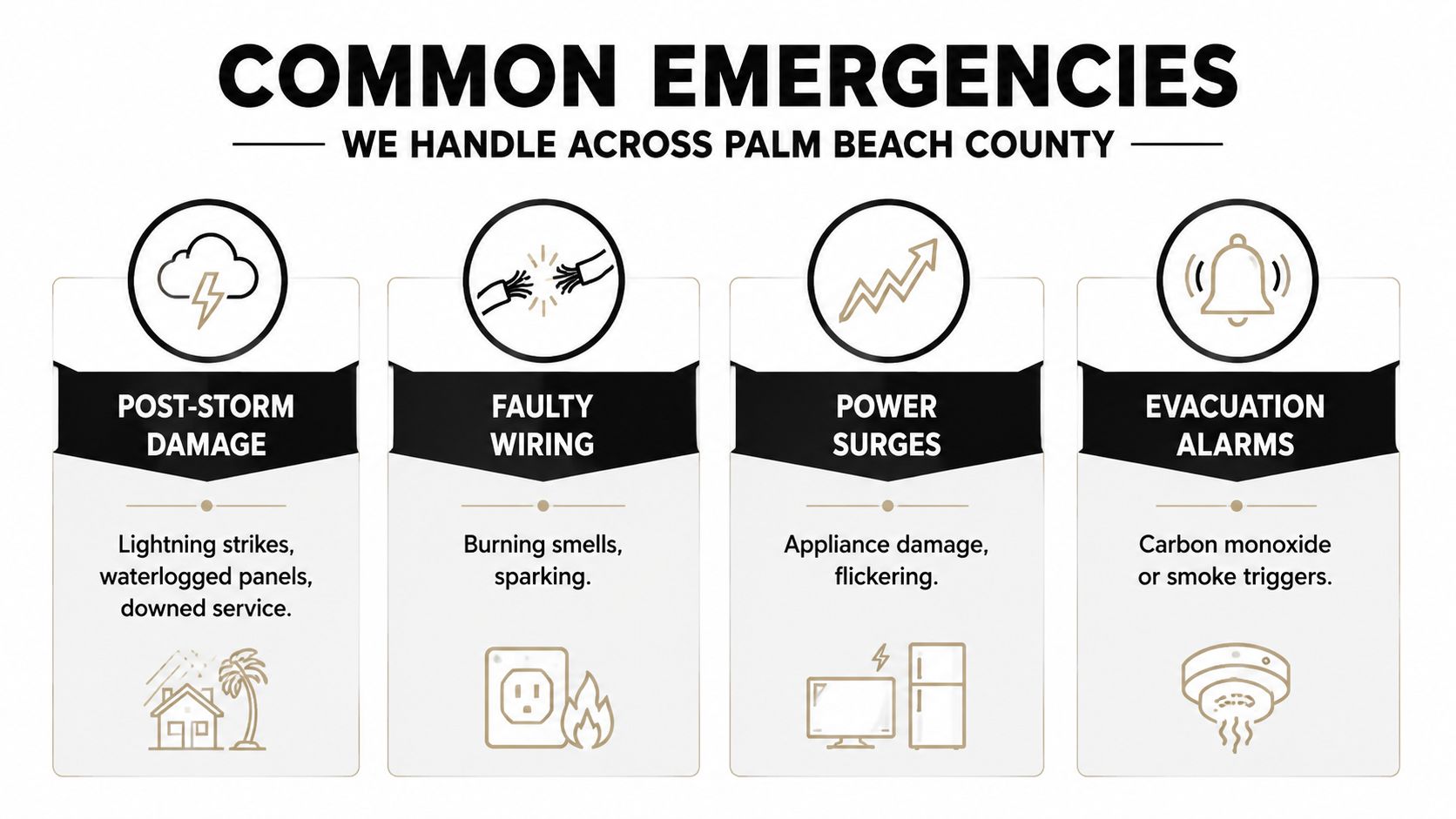
Post-storm damage
This is South Florida. Storm calls are not rare edge cases. They're a core part of emergency electrical work.
During Hurricane Irma, Florida lost power to 6.7 million electricity customers, which was 64% of all customer accounts in the state, and about 100,000 customers were still without power on September 19. Palm Beach County was among the counties reported as 95% restored or higher after the storm. That tells you something important. Local electrical crews often work in the narrow window after major utility restoration, when homes are getting power back but some service masts, meter bases, and panels are still unsafe to energize (Florida storm outage and restoration data).
Warning sign: Bent mast, torn weatherhead, scorched meter can, partial power after the storm.
Immediate action: Stay clear and wait for utility-side hazards to be cleared before any service rebuild.
Likely fix: Mast rebuild, service equipment replacement, meter base repair, panel evaluation.
Panel faults
A panel fault usually announces itself before total failure. You get repeat trips, warm breakers, dead sections of the house, or a buzz from inside the panel.
Warning sign: Main breaker won't reset, one leg appears dead, panel smells hot.
Immediate action: One reset attempt only, then leave it off.
Likely fix: Fault isolation, breaker replacement, bus damage assessment, conductor repair, or panel replacement if the equipment is compromised.
Water intrusion
This one gets underestimated. People see a little water in the garage or around an exterior panel and assume they can dry it out later.
Don't. Utility guidance in Florida tells customers to treat water-damaged electrical areas as unsafe and to call a licensed electrician when wiring, service equipment, or the meter area is damaged or the home is unsafe. It also advises customers to check breakers and compare conditions with neighbors before deciding whether the issue is utility-side or inside the home. That's the smarter way to sort the hazard, especially since NFPA data indicate electrical failure or malfunction is involved in an estimated 77% of home electrical fires, and 90% of those fires involve operating equipment as the heat source (storm restoration and safety guidance).
Warning sign: Exterior panel got soaked, meter base flooded, water near receptacles.
Immediate action: Keep power off and stay off wet surfaces.
Likely fix: Lockout, dry-area verification, corrosion check, component replacement where needed.
Commercial outages
Commercial calls are about safety and continuity. A retail store may lose POS systems. An office may lose HVAC controls. A restaurant may be one breaker away from losing refrigeration.
Warning sign: Partial outage tied to one panel, one disconnect, or one overloaded circuit group.
Immediate action: Shut down affected loads and prevent staff from resetting equipment repeatedly.
Likely fix: Circuit tracing, failed breaker or disconnect replacement, load balancing, temporary isolation until permanent repair.
Service Area, Credentials, and How to Reach Us
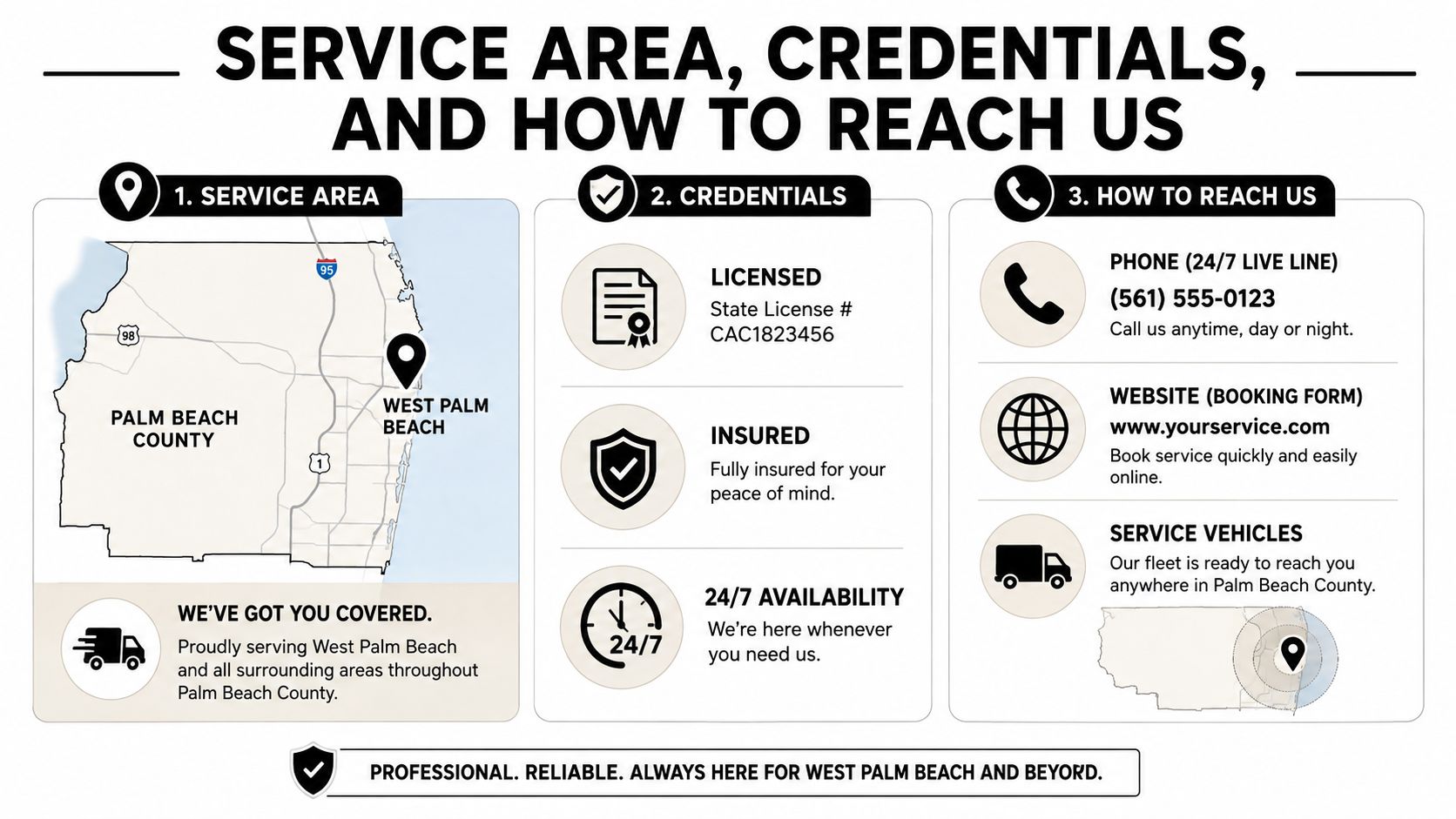
A 24 hour emergency electrician in West Palm Beach is only useful if the crew covers your area, answers at night, and arrives prepared to make the situation safe.
Where service should realistically cover
For Palm Beach County emergency work, the core service area should include:
- West Palm Beach
- Palm Beach
- Lake Worth
- Boynton Beach
- Wellington
- Royal Palm Beach
- Riviera Beach
- Jupiter
- Palm Beach Gardens
- North Palm Beach
That kind of coverage matters because electrical failures don't respect city lines. Homeowners move. Property managers oversee multiple buildings. Small businesses often need one electrician who can cover the county.
If you manage local visibility for a service business, these service area optimisation tips are useful for understanding how coverage should be communicated clearly online. As a customer, that same clarity helps you tell whether a company is local enough to respond.
Credentials that matter during an emergency
This is what you should ask about:
- Florida EC license: You want a properly licensed electrical contractor, not a general handyman.
- Insured and bonded field team: If work is happening on service equipment or inside a live-risk environment, that protection matters.
- OSHA-aware safety training: Emergency troubleshooting should follow real electrical safety practice.
- Stocked service vehicles: Common breakers, connectors, meter-related parts, and repair materials should already be on the truck.
The best way to make the call
When you call, don't give a story. Give facts.
Say where you are, whether neighbors still have power, whether the main holds, whether you smell burning, and whether water is involved. That gets you a useful ETA and the right level of dispatch.
Save the number before you need it. Then if the panel goes dark at 1 a.m., you're not making decisions while standing barefoot in a wet garage.
Quick Answers From a West Palm Beach Emergency Electrician
How much does a 24 hour emergency electrician cost in West Palm Beach
A fair emergency call should be priced flat and explained before repair starts. You should get a written quote after diagnosis, and any trip or diagnostic charge should be spelled out clearly before you approve work.
How fast can you actually get here
Inside West Palm Beach, response is usually fastest when the problem is isolated to one home or business. During large storm events, waits can run longer because weather-driven outages dominate emergency demand and damage patterns across the region.
Are storm calls answered on weekends and holidays
They should be. Electrical emergencies don't care about the calendar, and storm-related service needs are exactly when real 24/7 dispatch matters most.
Do you service commercial buildings and small businesses
Yes, and that matters more than many homeowners realize. Electrical injury data show why licensed response counts beyond storms: approximately 10,000 patients in the United States present to emergency departments each year with electrical burns or electric shock, fatalities dropped from about 1,000 per year in the early 2000s to 565 in 2015, about 4% of burn center admissions are due to electrical burns, 81% of electrical injury patients in one study were male with a mean age of 31.8 years, and another analysis found 63.5% of injuries were home accidents while 13.6% involved high-voltage exposure (electrical injury and burn data summary). The practical takeaway is simple: homes, shops, warehouses, and offices all need licensed after-hours electrical help when the hazard is real.
Lighthouse Energy Services provides 24/7 emergency electrical troubleshooting and repair for homes and businesses across Palm Beach County, including the exact kind of outage triage and panel safety decisions covered here. If your main won't hold, you smell burning, or storm damage has made the house unsafe to re-energize, visit Lighthouse Energy Services and get the right help before you attempt another reset.