
Why Low Voltage Wiring is the Foundation of Your Smart Home
Residential low voltage wiring is the infrastructure operating at 50 volts or less that powers your home’s data, communication, security, and smart automation. Unlike standard 120V/240V wiring for appliances, low voltage systems use thin cables to transmit signals and power to devices like security cameras, smart thermostats, Wi-Fi routers, and entertainment systems.
Quick Answer: What is Residential Low Voltage Wiring?
- Voltage Level: Operates at 50 volts or less (typically 12V, 24V, or 48V)
- Primary Uses: Internet/networking, security systems, smart home devices, audio/video equipment, doorbells, thermostats, and landscape lighting
- Key Benefits: Safer than high-voltage, more energy-efficient, easier to install, supports modern smart home technology
- Common Cable Types: Ethernet (Cat6/Cat6a), coaxial (RG-6), speaker wire, thermostat wire, alarm wire
- DIY-Friendly: Generally safe for homeowners to work with, though professional installation ensures optimal performance and code compliance
This hidden network is more critical than ever. High-speed internet, home automation, and security systems are now standard expectations, fueling the demand for low voltage wiring. The market is projected to reach $155.52 billion by 2026, driven by the growth of smart home devices and the Internet of Things (IoT).
Whether building, renovating, or upgrading, understanding low voltage wiring is key to making informed decisions about your home’s connectivity. It’s the foundation that ensures everything from your doorbell camera to your audio system works reliably.
I’m Bruce Kemp, an electrical contractor with decades of experience in commercial and residential systems. I’ve specialized in residential low voltage wiring for smart homes, security, and data networks, from simple doorbell installs to complex whole-home automation. This has given me deep insight into what works—and what doesn’t—in modern homes.
What is Low Voltage Wiring and How Does It Differ?
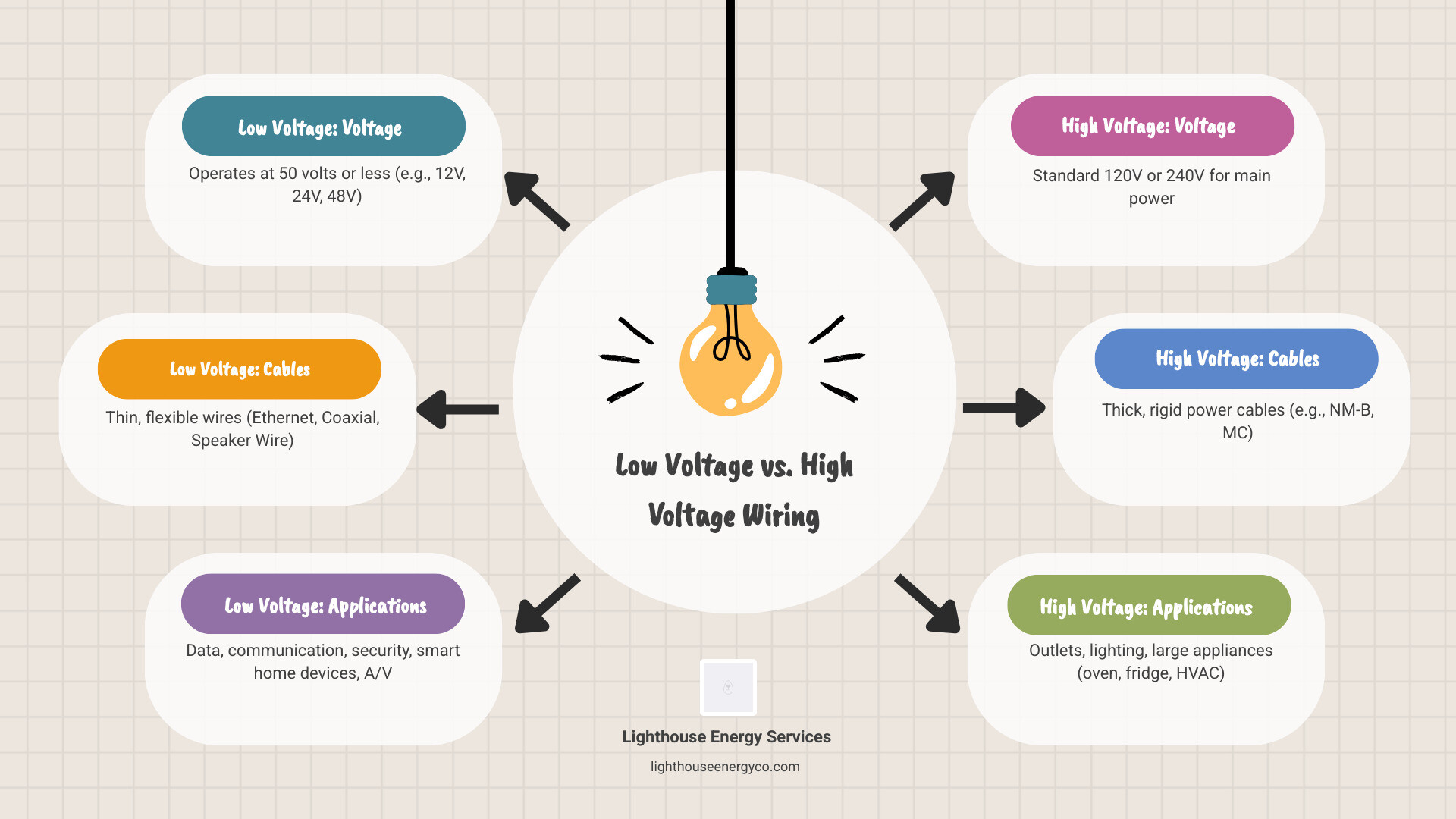
Simply put, low voltage wiring is any electrical system running on 50 volts or less, compared to the 120V or 240V of standard outlets. High-voltage wiring is a powerful river for your large appliances; residential low voltage wiring is a network of streams for transmitting signals and low power to smart devices.
Transformers “step down” power from your home’s main supply to the safer, lower levels needed by smart technology, like the chunky plug on your laptop cord. The key difference is safety. The lower current dramatically reduces the risk of electric shock or fire, making it the standard for smart home gadgets.
Defining Residential Low Voltage Wiring
In homes, low voltage wiring typically operates at 12V, 24V, or 48V. Its job isn’t to power a microwave but to carry data and control signals for your home network, security cameras, smart thermostats, and video doorbells. While some simple projects like installing a smart doorbell are DIY-friendly, we recommend professional installation for whole-home systems to ensure code compliance and optimal performance. The reduced shock risk offers peace of mind, especially in homes with children and pets.
Low Voltage vs. High Voltage
To understand why residential low voltage wiring matters, let’s compare it to traditional high-voltage wiring:
| Feature | Low Voltage Wiring | High Voltage Wiring |
|---|---|---|
| Voltage Range | 50 volts or less (e.g., 12V, 24V, 48V) | Typically 120V, 240V, or higher |
| Primary Function | Transmits signals, data, and low power | Delivers substantial power |
| Safety | Significantly safer; lower risk of shock/fire | Higher risk of shock and fire; requires strict precautions |
| Energy Efficiency | Often more energy-efficient (e.g., 12V LED lighting) | Less focused on signal efficiency, more on power delivery |
| Installation Cost | Generally less expensive and easier to install | More complex, requires licensed electricians, higher cost |
| Applications | Smart home devices, networks, security, audio/video | Large appliances, lighting, outlets, HVAC main power |
| Wire Gauge | Thinner wires (e.g., 12-24 AWG) | Thicker wires (e.g., 14-6 AWG) |
| Regulations | Governed by NEC Article 725 (Class 2 circuits) | Governed by main NEC sections for power circuits |
High-voltage wiring is your home’s powerhouse for large appliances. Low voltage is its nervous system, a delicate network enabling devices to communicate. The thinner cables, simpler installation, and inherent safety make it ideal for smart home technology.
The Core Benefits for Your Home
Investing in quality residential low voltage wiring provides a smart return on your home’s future. Here’s what you gain:
Improved safety is the top benefit. With voltages below 50V, the danger of shock or fire drops dramatically, offering peace of mind, especially for families with children or pets.
Energy efficiency is another win. Low voltage systems are designed for efficiency. For instance, 12V LED lighting can use 20-40% less electricity than 120V lighting, leading to savings on your utility bills.
Cost savings on installation may be surprising. Low voltage wiring is generally more affordable to install because the cables are thinner, more flexible, and easier to route, often without the need for heavy-duty conduit.
Flexibility for future upgrades is crucial. A well-designed low voltage system grows with you. Running extra conduits or higher-grade wiring during the initial installation saves money and headaches when you add new devices later.
Increased home value is a clear payoff. Today’s buyers expect smart home capabilities. A home with professionally installed residential low voltage wiring is more attractive, signaling it’s modern and ready for today’s technology, which can increase resale value.
Common Applications in a Modern Residence
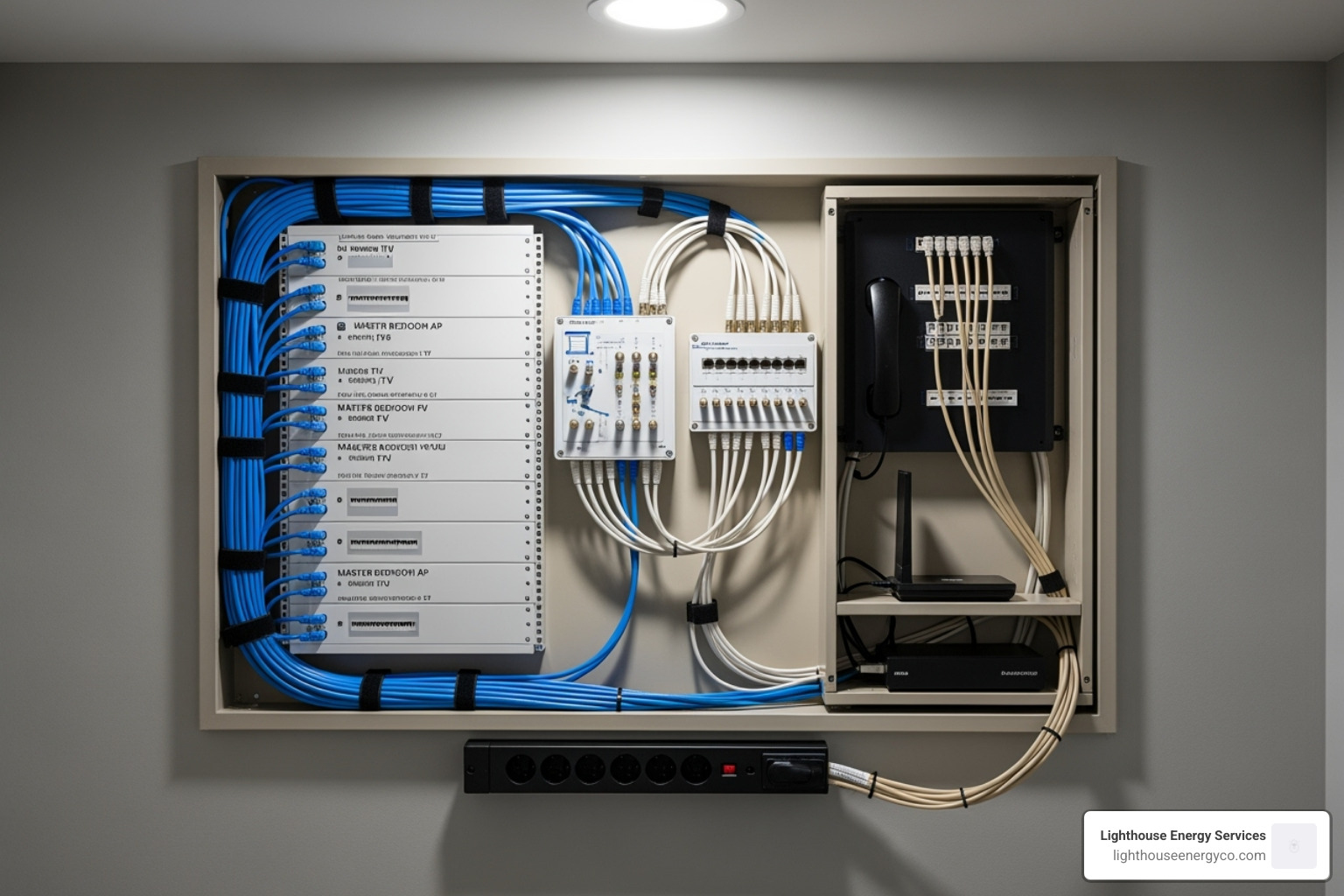
Most of the technology you use daily—from your doorbell camera and security system to your Wi-Fi and smart thermostat—relies on residential low voltage wiring. This is where structured cabling is essential. Instead of a tangled mess, a structured system provides an organized infrastructure where all low voltage cables terminate at a central hub. This approach ensures your technology works correctly and is easy to troubleshoot or upgrade.
Let’s review the most common ways residential low voltage wiring powers your home.
Data, Networking, and Communication
The backbone of your digital home is Ethernet ports. Hardwired connections using Cat6 or Cat6a cables offer superior speed and reliability for streaming 4K movies, online gaming, or working from home. Even Wi-Fi access points require low voltage wiring, connecting via Ethernet and often receiving power through the same cable using Power over Ethernet (PoE). VoIP phones and modern intercom systems also depend on low voltage cabling for power and clear signal transmission.
Entertainment and Audio-Visual Systems
A proper home theater setup uses multiple low voltage connections for video, audio, and control systems to create an immersive experience. In-wall speaker wire (typically 12-18 AWG) connects your amplifier to speakers throughout the home for a clean look and excellent sound, while surround sound systems require a dedicated connection for each speaker. Many homes still use coaxial cable (RG-6) for reliable cable TV, satellite, or antenna signals.
Security, Automation, and Lighting
The intelligence and safety of your smart home are powered by low voltage systems.
Security cameras, whether CCTV or modern IP cameras, use low voltage wiring for power and data, allowing for continuous monitoring and mobile alerts. Popular smart doorbells operate on low voltage (typically 16-24V) and connect to existing doorbell wiring. Alarm system sensors on doors, windows, and in hallways connect via low voltage alarm wire to create a protective web around your home.
Smart thermostats use low voltage thermostat wire (e.g., 18/5) to communicate with your HVAC system for precise climate control from anywhere. Finally, modern 12V landscape lighting is safer and more energy-efficient than old high-voltage options. These systems are easier to install and modify, enhancing both curb appeal and security.
A Guide to Installing Residential Low Voltage Wiring
Installing residential low voltage wiring requires a thoughtful plan. While safer than high-voltage work, a proper installation is crucial for long-term reliability. New construction offers the easiest path, as cables can be run before drywall goes up. Retrofitting an existing home requires more patience for fishing cables through finished walls. In either case, a clean, organized installation is non-negotiable to avoid performance issues and future troubleshooting nightmares.
Planning Your Structured Cabling System
Before pulling a single cable, you need a solid plan for a manageable, scalable, and reliable structured cabling system.
First, create a detailed wiring plan. Map out where you need connectivity now and in the future, marking locations for Ethernet jacks, cameras, and speakers on a floor plan.
Future-proofing is critical. Run conduits to key locations for easy future cable additions. Install higher-grade cables like Cat6a, which supports speeds up to 10 Gbps, to prepare for next-generation technology. The small upfront cost is minimal compared to upgrading later.
Label every cable at both ends with its type and destination (e.g., “Cat6 – Kitchen Island”). This simple step saves hours of frustration during future troubleshooting.
Finally, establish a central distribution panel in a utility space. This “nerve center” houses your modem, switches, and other equipment, keeping your residential low voltage wiring organized and manageable.
Best Practices and Code Compliance
Proper installation techniques and code compliance are essential for performance and safety.
Always separate low voltage cables from high-voltage wiring. The National Electrical Code (NEC) recommends at least 2-12 inches of separation to prevent electromagnetic interference.
Avoid sharp bends in your cables, especially data lines like Ethernet. Sharp corners can damage internal conductors and degrade signal quality.
Using conduit protects cables from physical damage and makes future upgrades much simpler, as new wires can be pulled through without opening walls.
Most residential low voltage wiring falls under NEC Article 725 as Class 2 circuits. These codes establish safety requirements for cable types and installation methods to prevent fire hazards. Following these rules is essential for protecting your home.
Common Problems and How to Solve Them
Even well-planned systems can have issues. Here are common problems and their solutions.
Voltage drop can occur over long cable runs, reducing power to devices like cameras. Solutions include using thicker wire (lower AWG), shortening runs, or moving the power source closer.
Signal interference (crosstalk) degrades network performance. Prevent it by maintaining separation from power lines and using shielded cables for sensitive applications.
Poor connections are a common source of failure. Ensure every termination is secure, properly made with the right tools, and protected from moisture.
Quality components are a must. Invest in reliable products from reputable manufacturers to avoid poor performance and premature failure.
Key Low Voltage Cable Types and Their Uses
Choosing the right cable for your residential low voltage wiring is like picking the right tool for a job—the wrong one leads to poor performance. Each cable type is engineered for a specific purpose, ensuring your home’s technology infrastructure works as intended.

Category Cables (Ethernet)
Category cables, or Ethernet cables, are the standard for home networking. They form the backbone of your digital life.
Cat6 (Category 6) is the recommended choice for most homes. It supports speeds up to 1 Gbps with 250 MHz bandwidth, which is ample for streaming, remote work, and general internet use.
For future-proofing or high-performance needs, Cat6a (Category 6 Augmented) is a worthwhile investment. It delivers 10 Gbps speeds at 500 MHz bandwidth over longer distances. We often install Cat6a in new construction to prepare the home for future technologies. It’s the most cost-effective way to ensure your network won’t become obsolete.
Think of Cat6 as a highway that handles today’s traffic, while Cat6a is a superhighway ready for whatever comes next.
Coaxial, Speaker, and Specialty Wires
Beyond networking, several other cables are essential for a modern home.
Coaxial cable (RG-6) is the standard for video from cable TV, satellite, or antennas. Its shielding protects the signal from interference, ensuring a clear picture.
Speaker wire carries audio signals from your amplifier to your speakers. It comes in various gauges (typically 12 AWG to 18 AWG), with a lower number indicating a thicker wire. We use 14 or 16 gauge for most in-wall runs and thicker 12 gauge for longer distances to prevent signal loss.
Thermostat wire (e.g., 18/5) carries control signals between your thermostat and HVAC system. Smart thermostats often require extra conductors to power their advanced features.
Alarm wire (typically 22/4 or 22/2 gauge) connects all components of your security system, including sensors and keypads, ensuring reliable communication when it matters most.
The Future of Home Connectivity & When to Call a Pro
Home technology is evolving rapidly, and residential low voltage wiring is the invisible infrastructure making it possible. The low voltage cable market is projected to reach $155.52 billion by 2026, a clear sign that smart, connected homes are the new standard. This growth is driven by the Internet of Things (IoT), as every smart device needs a reliable wired foundation to communicate and function properly.
The Rise of IoT and Power over Ethernet (PoE)
The growing number of IoT devices in our homes—from smart speakers to automated shades—is constantly increasing. Each one needs a network connection, and many also need power.
Power over Ethernet (PoE) is a game-changer. It allows a single Ethernet cable to provide both data and power, simplifying installation dramatically. This is ideal for devices in hard-to-reach places like ceiling-mounted Wi-Fi access points or outdoor security cameras. Instead of running two separate lines, one cable does it all, making installations cleaner, simpler, and more cost-effective.
Why Professional Installation Matters
While some simple low voltage tasks are DIY-friendly, modern smart home systems are sophisticated ecosystems. Getting security, audio, lighting, and networking to work together seamlessly requires professional expertise.
A professional electrician ensures code compliance. The National Electrical Code has specific rules for low voltage systems to prevent fire hazards and ensure reliability. We know these codes inside and out.
Experienced troubleshooting is crucial when issues arise. Spotty Wi-Fi or offline cameras can have many causes, from voltage drop to signal interference. Professionals have the diagnostic tools and expertise to find and fix the root cause quickly.
Most importantly, a professional installation guarantees you get the performance you paid for. We optimize cable routing, ensure proper terminations, and test every component. At Lighthouse Energy Services, “done right, and done right now,” means you get a system that works reliably, day after day. Explore our professional electrical services to see how we can help.
Future-Proofing Your Home
The best time to prepare for tomorrow’s technology is today. With the smart home revolution just beginning, your home’s wiring needs to be ready for what’s next.
New technologies are on the horizon, from fiber optic cables that transmit data and power to the expansion of 5G home internet. A home with a solid residential low voltage wiring infrastructure will handle these advances gracefully.
This means running extra conduit, choosing Cat6a cable over Cat6, and planning for future device locations. This forward-thinking approach costs little extra during an initial build or renovation but saves thousands later by avoiding the need to open up finished walls. It’s an essential investment in your property’s value.
Conclusion
Think of residential low voltage wiring as the quiet hero behind your walls, the invisible network that makes your modern home smart, safe, and connected. It’s the foundation for your security systems, high-speed internet, and the automation that simplifies daily life.
As we’ve covered, this infrastructure is no longer optional—it’s essential. Investing in a quality installation delivers tangible returns: improved safety, lower energy bills, the flexibility to upgrade, and increased home value. Buyers today expect a connected, future-ready home.
Whether you’re building, renovating, or upgrading, getting the wiring right is critical. At Lighthouse Energy Services, we help Palm Beach County homeowners design and install low voltage systems that work flawlessly. Our qualified electricians are available 24/7, offering transparent pricing and ensuring every job is “done right, and done right now.”
Your home deserves an infrastructure built for tomorrow’s innovations. We’re here to make that happen.