
You buy the EV, bring it home, and then a significant question shows up that night. Are you going to live off the cord that came with the car, hunt for public chargers around town, or install something at home that suits your routine?
For most homeowners in West Palm Beach, the answer gets clear fast. You want to pull into the garage or driveway, plug in, sleep, and wake up ready to go. That's what makes a home charger less of an upgrade and more of a daily convenience tool.
Your Guide to Home EV Charging in West Palm Beach
If you're looking into residential EV charger installation in West Palm Beach FL, you're already past the curiosity stage. You either have an EV now, one is on order, or you're trying to make sure your home is ready before the car arrives.
That timing matters. Charging works best when the house, panel, parking layout, and charger all match the way you live.
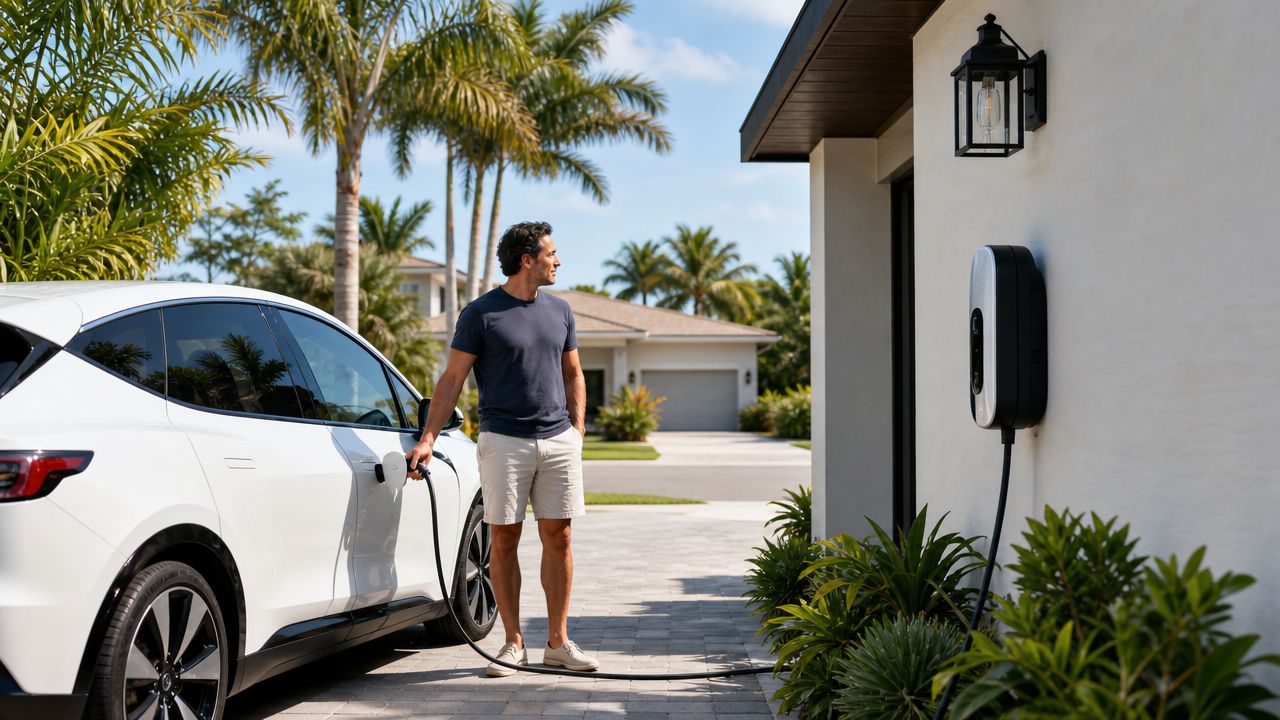
The bigger picture supports that approach. The U.S. Department of Energy estimates that 64% of all EV charging happens at single-family homes, and its outlook projects 25.7 million private home chargers by 2030 as part of 28 million charging ports needed nationwide. The same DOE data also shows West Palm Beach has 451 total charging stations, including 325 Level 2 stations and 126 Level 3 stations, with 72% of the area's stations being Level 2 and 24% free to use. Those numbers make one thing clear. Home charging is the foundation, and public charging is the backup or supplement, not the other way around. You can review those figures in the Department of Energy EV charging charts and figures.
Why homeowners usually want Level 2
A standard outlet can work in some situations, but it usually feels slow once the novelty wears off. If you drive every day, commute across Palm Beach County, or share the car with someone else, waiting on a basic plug setup often becomes frustrating.
A properly installed Level 2 charger changes the experience. It turns charging into a routine instead of a chore.
Practical rule: If you have off-street parking and plan to keep the EV for the long haul, it usually makes sense to plan the charger installation early instead of treating it like a later add-on.
What makes West Palm Beach a little different
Local homes vary a lot. Some have newer electrical service and attached garages. Others have older panels, detached parking, long wiring runs, or condo-style restrictions that generic online advice never addresses.
In this area, the charger itself often isn't the hard part. The hard part is making sure the installation is safe, permitted correctly, and matched to the property.
Selecting the Right Charger for Your Lifestyle
Most homeowners don't need every feature on the market. They need the charger that fits their car, parking setup, and normal week.
That decision usually comes down to three things. Charging speed, connector type, and whether smart features will help you.
Level 1 vs Level 2 in real life
Level 1 is what you get from a standard household outlet. It can work for light driving or as a temporary plan, especially if the vehicle sits for long stretches.
Level 2 is the setup most homeowners ask for once they want dependable overnight charging. It uses a 240-volt circuit and needs professional installation.
| Feature | Level 1 Charger | Level 2 Charger |
|---|---|---|
| Charging source | Standard household outlet | Dedicated 240-volt circuit |
| Best fit | Light daily driving, temporary use, backup charging | Regular driving, overnight charging, multi-car households |
| Installation | Usually no new equipment if you're using the factory cord and outlet is suitable | Requires professional installation and code-compliant wiring |
| Charging experience | Slower, often acceptable only if mileage needs are modest | Faster and better suited to everyday convenience |
| Home electrical impact | Lower load, but still needs a safe outlet in good condition | Higher load, so panel capacity and circuit design matter more |
Connector choices that matter
Most residential charger installations come down to J1772 or NACS connector compatibility. Those are the connector types local installers commonly work with as part of the standard setup process.
If you already own the EV, the car usually answers this question for you. If you're buying soon, think ahead. Some homeowners choose a charger that supports their current vehicle directly. Others choose a setup that gives them flexibility if a future vehicle uses a different connector standard.
Buy for the car you park at home now, but don't ignore the next car if you know this house will be your base for years.
Which features are worth paying for
A lot of charger marketing is noise. The features that help are the ones that solve a household problem.
Consider these first:
- Scheduled charging: Useful if you want charging to happen during certain hours.
- Usage tracking: Helpful if you want visibility into how much charging the vehicle is using.
- App controls: Convenient, but only if you'll really use them.
- Load awareness: Important when the home has tighter electrical capacity.
When the panel drives the charger choice
Sometimes homeowners pick a charger first and only later find out the panel can't support the plan comfortably. That creates rework, extra cost, or a rushed compromise.
If your service is already close to its practical limit, it makes sense to review whether a 150-amp to 200-amp service upgrade belongs in the conversation before you commit to a charger model.
A good selection process isn't about buying the fanciest unit. It's about choosing one your house can support without strain.
The Professional Installation Process Explained
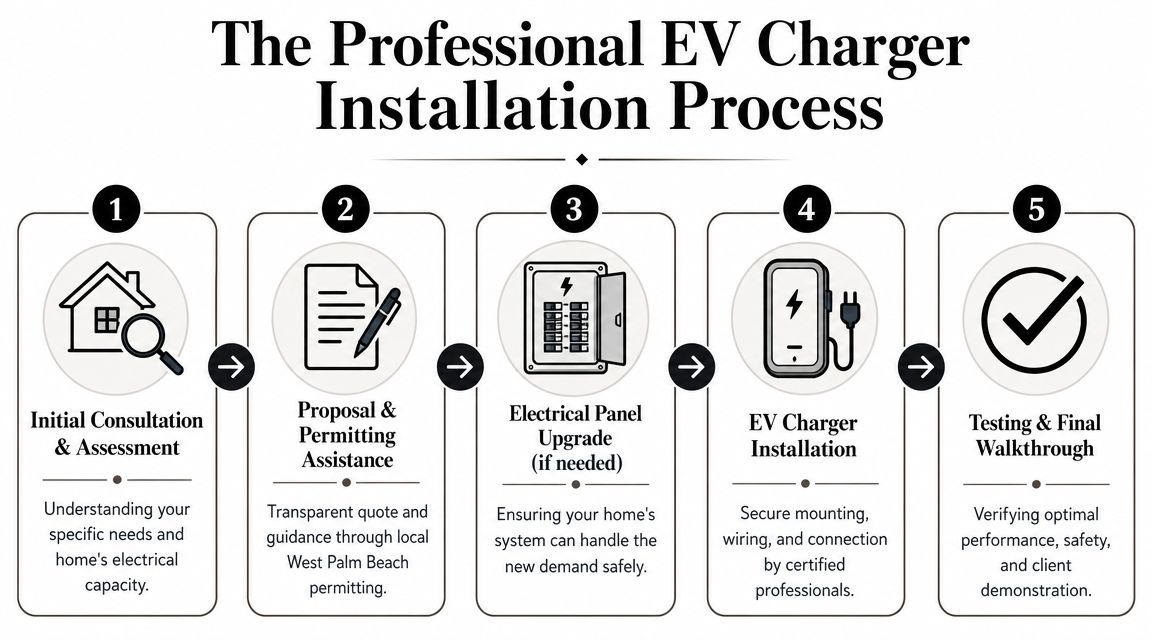
The install should feel organized, not mysterious. A professional residential Level 2 EV charger installation in West Palm Beach follows a standard method: electrical system assessment, code compliance checks, connector selection such as J1772 or NACS, physical installation, and post-installation testing. That's the workflow described by local installers in this West Palm EVSE installation overview.
The first visit is about the house, not the charger box
A homeowner may focus on the unit that goes on the wall. An electrician starts somewhere else. The panel, the route from the panel to the charger location, the parking position, and the condition of the existing electrical system all come first.
That initial assessment usually answers questions like these:
- Panel capacity: Is there room and electrical capacity for a dedicated 240-volt circuit?
- Parking layout: Will the cord reach the charge port cleanly without creating a trip hazard?
- Mounting surface: Is the charger going on masonry, drywall, wood, or an exterior wall that needs weather-conscious installation?
- Wiring path: Is there a straightforward route, or will the run need more labor and material?
What actually gets installed
For a typical Level 2 setup, the electrician isn't just hanging a charger on the wall. The work often includes a new breaker, a dedicated circuit, properly sized conductors, and conduit protection where needed.
If the charger is outdoors or in a partly exposed location, placement matters. In South Florida, heat, rain exposure, and daily wear can all affect how long the installation stays clean and trouble-free.
A sound install usually follows this pattern:
- Evaluate the existing electrical service
- Confirm the charger type and connector fit
- Run the dedicated circuit
- Mount and terminate the charger
- Test operation and verify safe charging
A clean wiring route and a practical charger location matter just as much as the brand on the box. Poor placement causes everyday annoyance even when the electrical work is technically correct.
Why code compliance matters so much
The quality of experienced local work becomes evident. A charger pulls real load, often for long periods, and that means the installation can't rely on shortcuts.
An electrician should be thinking about breaker sizing, conductor sizing, overcurrent protection, routing, mounting height, and local inspection expectations. If the home needs corrections before the charger can go in safely, it's better to find that out early than after equipment has already been purchased.
What happens before the electrician leaves
The last part is testing and walkthrough. The charger should power up correctly, communicate properly if it's a smart unit, and begin charging as intended.
Homeowners should also get a simple explanation of use, shutdown, and any normal indicators or app setup. If nobody explains how the system works before they leave, the job isn't fully finished.
Navigating Costs, Permits, and Timelines in Palm Beach County
Expectations frequently diverge from reality. Homeowners see a charger on the wall and assume the whole job is a same-day task from start to finish. Sometimes the physical work is quick. The full project usually isn't.
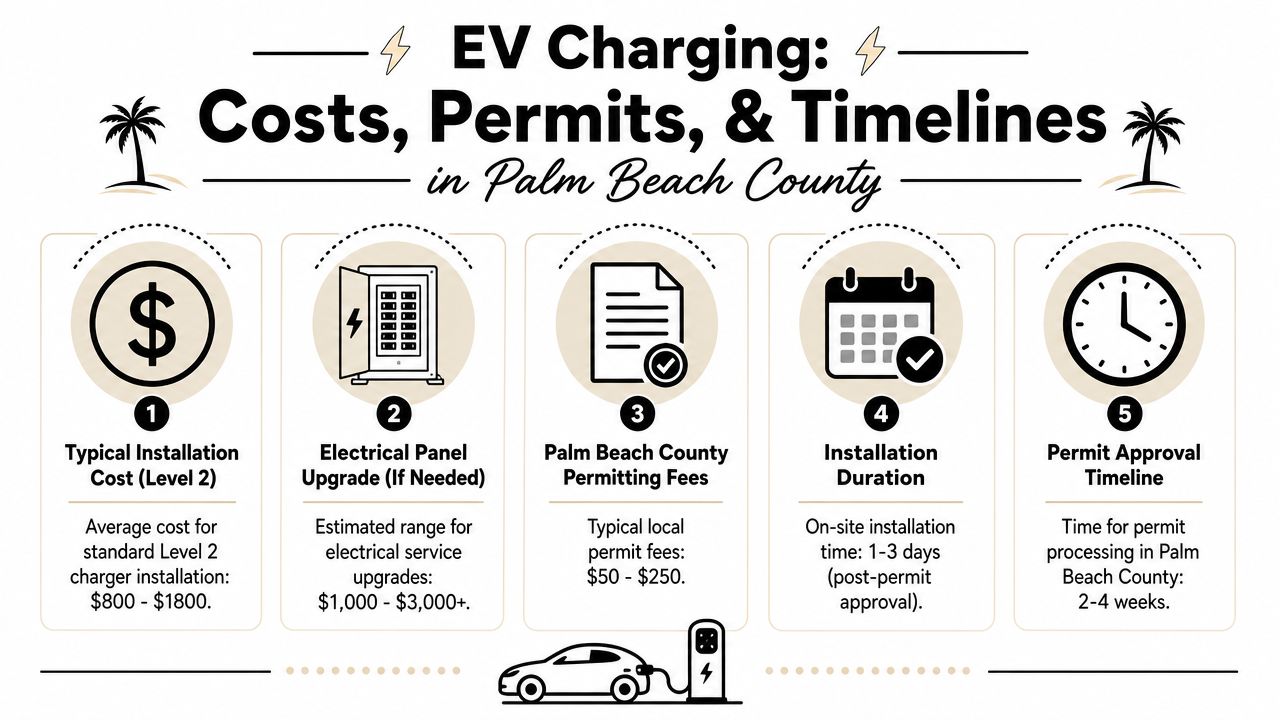
The key local fact is this: installation labor is typically reported at 2 to 4 hours, but the full timeline can stretch to several weeks or even a few months when permits, approvals, inspections, or electrical upgrades are involved. That's the practical timeline described in this West Palm Beach EV charger service overview.
What affects your price most
The charger hardware is only one line item. On many homes, the bigger swing factors are electrical conditions and administrative requirements.
Common cost drivers include:
- Distance from panel to charger location: Longer runs usually mean more labor and material.
- Panel condition and available capacity: If the panel is full or undersized, the scope changes.
- Indoor or outdoor placement: Exterior installs can require different mounting and protection methods.
- Permit and inspection requirements: These add time and paperwork even when the physical work is simple.
- Property access issues: Tight attic access, finished walls, detached garages, and shared parking all complicate the job.
If the house needs broader electrical work, a charger project often becomes part of a larger electrical panel upgrade discussion rather than a standalone install.
Why the timeline stretches
The labor itself may only take a few hours, but the project clock starts earlier. First there's the site assessment and quote. Then permit coordination, scheduling, utility-related considerations in some cases, and inspection timing.
The delay usually isn't because anyone is "still installing the charger." It's because the project has to move through local process steps before the electrician can close it out properly.
Homeowners are often surprised by this. The slow part is usually the paperwork and coordination, not the actual mounting and wiring.
FPL and local charging options
West Palm Beach homeowners should also look at the local utility side of the equation. ChargeHub reports that Florida Power & Light's EVolution Home program offers residential customers electrical upgrades plus a Level 2 EV charger for a flat monthly fee ranging from $31 to $38. That utility-backed option matters because it can change how some homeowners compare up-front purchase versus ongoing monthly service.
The area has also moved into a more structured EV environment over time. FPL installed Level 3 charging stations at the West Palm Beach Service Plaza in 2020, and the City of West Palm Beach later contracted with Blink Charging to upgrade charging in three city garages. Those local milestones are detailed in this Florida Turnpike charging infrastructure update.
The practical takeaway
Ask early about permits, inspections, and panel capacity. Those are the items most likely to shape cost and timeline.
If a quote looks unusually simple, make sure it still accounts for code compliance, permitting responsibility, and final inspection.
Charger Rules for HOAs, Condos, and Apartments
Single-family homes are usually the cleanest jobs. Condos, apartments, and HOA-managed communities are where charger projects get stuck.
The problem usually isn't the charger itself. It's the approval path, the parking assignment, and whether the property's electrical system can support a dedicated circuit in the first place.
Where these projects tend to stall
A regional installer that serves apartments and condos asks owners to submit panel photos and installation videos before quoting. That tells you a lot about how these jobs go in South Florida. Access, infrastructure, and pre-planning often drive the project more than the charger model.
That matches the bigger local reality. In South Florida, a major challenge is whether the property can support a dedicated circuit and whether the HOA or condo board approves the location. Pre-installation assessment and clear communication matter more here than they do in a detached home. That issue is described in this South Florida EV services and pricing overview.
What to bring to the board or property manager
An approval request goes better when it looks like a construction plan instead of a casual email. The board wants to know where the charger goes, how the wiring gets there, who pays for the power, and who is responsible if something has to be removed later.
Bring a package that answers practical questions:
- Site details: Show the exact parking space and proposed charger location.
- Electrical plan: Identify where the power will come from and whether a dedicated circuit is feasible.
- Contractor information: Include the licensed electrician's information and scope of work.
- Metering or billing approach: Explain how charging electricity will be measured or assigned.
- Access and restoration: Clarify who handles wall penetrations, conduit routing, and future repairs if needed.
HOA rules aren't all the same
Some communities have straightforward architectural review rules. Others have broader restrictions on visible conduit, equipment placement, common elements, or contractor scheduling.
If you need a plain-language primer before you start that conversation, this homeowner's guide to HOA regulations is a useful place to understand how boards typically approach rules and approvals.
In multifamily properties, the successful projects are usually the ones that arrive with a complete plan. Boards slow down vague requests.
A real-world mindset for condos and shared parking
Think of the charger as part electrical project, part property-management project. A technically correct install can still fail if the board doesn't like the location, access route, or billing setup.
That's why condo and apartment installs need more patience up front. The more decisions you settle before formal submission, the smoother the approval process tends to be.
Why a Licensed Electrician Is Your Most Important Choice
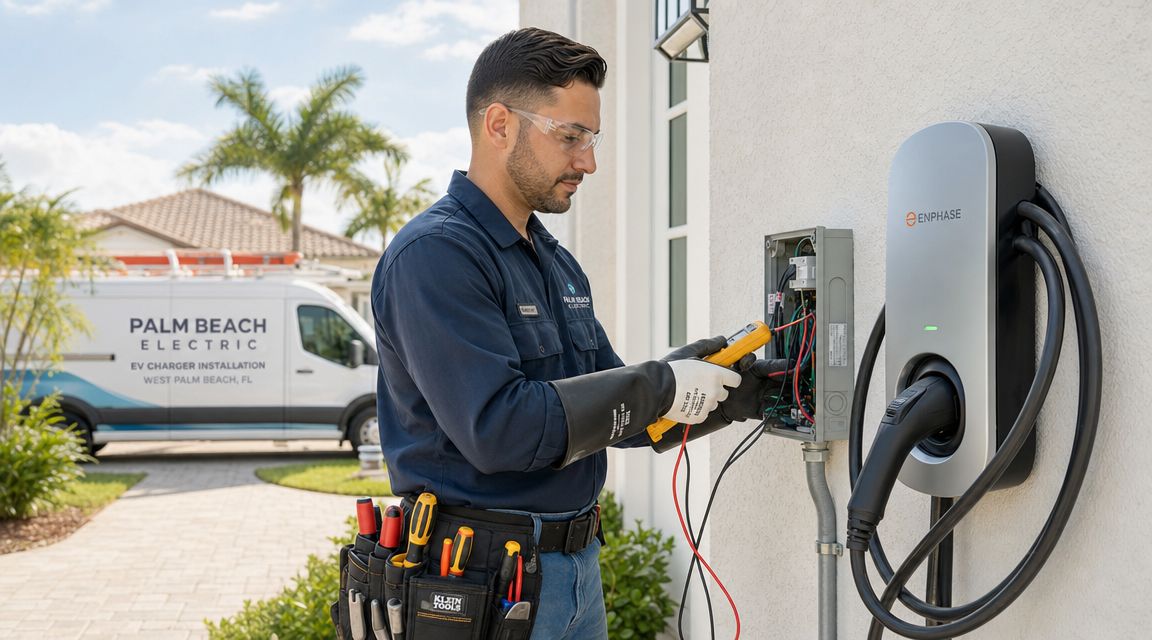
A home EV charger isn't a gadget install. It's a permanent electrical addition that may draw substantial power for long periods, often overnight and often every day. That's exactly why the person doing the work matters more than the branding on the charger.
West Palm Beach has moved into a more structured charging environment. Milestones like FPL's 2020 Turnpike charging buildout and the city's charging upgrades in public garages helped normalize EV readiness locally, and that has made professional, code-compliant residential installations the expected standard, as noted in the earlier infrastructure update.
What goes wrong with shortcut work
The usual problems aren't dramatic on day one. They're the quiet ones. Loose terminations, poor breaker choices, undersized wiring, bad outdoor placement, and installations that don't line up with local code expectations.
Those mistakes can lead to nuisance tripping, unreliable charging, failed inspections, or expensive rework. In the worst cases, they create a safety hazard.
What a licensed electrician should bring
You want someone who can look at the whole system, not just install a device. That includes load considerations, panel condition, circuit design, permit handling, and final testing.
A homeowner comparing companies should look for:
- License and permitting capability: The contractor should be able to handle the project correctly from proposal through inspection.
- Clear scope of work: You should know what's included and what triggers additional electrical work.
- Local experience: West Palm Beach homes, garages, and multifamily properties all come with recurring patterns.
- Actual access to an electrician: Questions come up before and after install, and they need real answers.
One local option for that type of work is Lighthouse Energy Services in West Palm Beach, which handles residential electrical projects including EV charger installations, panel work, and troubleshooting.
Peace of mind is part of the installation
When the charger is installed correctly, you stop thinking about it. You plug in, the car charges, and your electrical system does what it's supposed to do.
That's the key value of licensed work. Not just getting the charger on the wall, but getting rid of the doubt.
Frequently Asked Questions About Home EV Charger Installation
Do I always need an electrical panel upgrade
No. Some homes already have the capacity and space for a dedicated EV circuit.
The only reliable way to know is to have an electrician inspect the panel, review the home's existing loads, and determine whether the service can support the charger safely. In many homes, the charger can be added without major changes. In others, the panel becomes the main issue.
Can I install my own EV charger
For a hardwired Level 2 charger, DIY is a bad gamble. You're dealing with a dedicated 240-volt circuit, breaker sizing, conductor sizing, routing, mounting, and local code requirements.
Even if a homeowner is comfortable with basic electrical work, EV charging equipment isn't the place to test that confidence. A failed inspection or unsafe installation costs more than doing it correctly the first time.
What maintenance does a home charger need
Most residential units don't require much day-to-day maintenance, but they do benefit from regular visual checks.
A simple routine helps:
- Inspect the cable: Look for cuts, crushing, kinks, or worn insulation.
- Check the plug or connector handle: Make sure it seats properly and isn't damaged.
- Keep the area clean: Dirt, standing water, and clutter around the charger create problems over time.
- Watch for changes: If the unit starts tripping breakers, showing error lights, or charging inconsistently, call an electrician.
What if my charger will be outside
That's common in West Palm Beach. Outdoor installation can work well when the charger and wiring method are appropriate for the location.
The important part is placement. The unit should be mounted where the cord reaches comfortably, the equipment is protected from unnecessary exposure, and the installation won't create a daily hassle.
Can I take the charger with me if I move
Usually, yes. But whether it makes sense depends on the equipment type and how the installation was done.
A plug-in style setup can be easier to remove. A hardwired charger may require an electrician to disconnect it safely and either install a replacement device, cap the circuit appropriately, or prepare the location for the next owner.
Is a condo installation very different from a single-family home install
Yes. In a condo or HOA setting, the electrical work is only part of the project.
You may need approval for location, conduit route, contractor access, parking rights, and how the charging power will be assigned or measured. Those projects usually succeed when the homeowner treats approval and electrical planning as one combined process.
What should I have ready before I request estimates
A little preparation saves time. Have these ready if you can:
- Vehicle details: Make and model of the EV, or the one you're buying.
- Parking photos: Show the panel, the parking space, and the proposed charger wall.
- Usage pattern: Explain whether this is a daily commuter car, occasional-use vehicle, or part of a multi-car household.
- Property restrictions: Mention any HOA, condo, or shared-access limitations right away.
The more complete the information, the more accurate the recommendation usually is.
If you're ready to talk through a charger install, panel capacity, or a tricky condo or HOA setup, Lighthouse Energy Services is one option to contact for a site-specific evaluation in Palm Beach County. A good next step is simple: show the panel, show the parking spot, and get a clear plan before you buy equipment.