
Why Your Home Needs an Outside 200 Amp Breaker Box
An outside 200 amp breaker box is the main distribution point for your home’s electrical system, managing power from the utility grid to every part of your property. If you’re considering an upgrade, key factors include a NEMA 3R rating for weather protection, sufficient circuit capacity (e.g., 30-space or 42-space), and high-quality bus bar material like tin-plated copper.
Modern homes demand more electrical capacity for EV chargers, smart systems, and high-draw appliances, making 200 amp service the new standard. As a licensed electrical contractor with decades of experience in South Florida, I’ve learned which features matter most for reliability and safety in outside 200 amp breaker box systems.
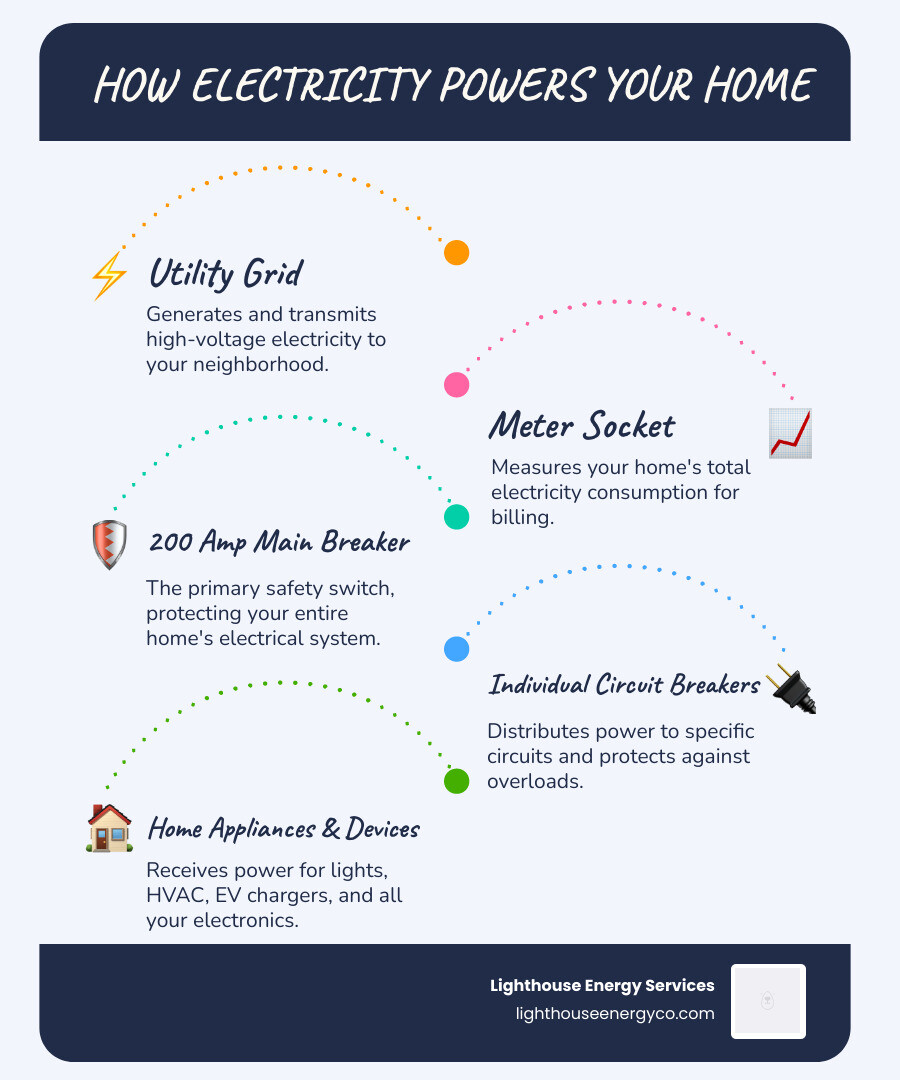
Why a 200 Amp Service is the New Standard
Modern life is power-hungry. From smart thermostats and coffee makers to electric vehicle chargers, the daily electrical draw in most homes has skyrocketed. This is why 100 amp service, once sufficient, now struggles to keep up. Factoring in electric ranges, tankless water heaters, and home offices, the demand often exceeds what a 100-amp panel can safely provide.
A 200 amp service provides the necessary electrical backbone to handle modern demands without tripping breakers or risking overloads. It’s about having the capacity your lifestyle requires. If your home’s total load exceeds 100 amps, an upgrade is necessary. Even if you’re at the threshold, planning for the future is smart. As smart homes and EV adoption grow, installing a 200 amp service now prevents a more costly upgrade later when you add solar panels or a second EV charger.

The Benefits of Upgrading
Upgrading to a 200-amp service doubles your home’s power capacity. This means you can support simultaneous appliance use—run the dishwasher, charge your car, and use the AC without issues like dimming lights or tripped breakers.
An updated outside 200 amp breaker box also increases property value. Potential buyers see a home that’s ready for modern living and won’t require an immediate, expensive electrical upgrade.
Most importantly, an upgrade offers improved safety. Overworked, undersized panels are a fire hazard due to overheating wires. A properly sized outside 200 amp breaker box ensures your system can safely handle your actual electrical load, eliminating that danger.
Is 200 Amps Right for You?
To determine if you need 200 amps, we consider three factors:
First, home size. Larger homes naturally have more lighting, outlets, and appliances, requiring greater electrical capacity.
Second is your electrical load assessment. We calculate the total power draw of your appliances, including high-demand items like electric heating, a hot tub, or an EV charger. If your total load exceeds 100 amps, a 200-amp service is necessary.
Third, we consider future expansion plans, such as a room addition, a pool, or converting from gas to electric appliances. Sizing your system correctly now is more cost-effective than upgrading twice. An inadequate panel can lead to overloaded circuits and safety hazards. If you’re unsure about your needs, we can help. For a comprehensive assessment, check out more info about our electrical services.
Key Features of an Outside 200 Amp Breaker Box
Choosing an outside 200 amp breaker box is a critical decision for your home’s electrical system. It’s engineered to handle significant power while withstanding the elements. Here’s what to look for.
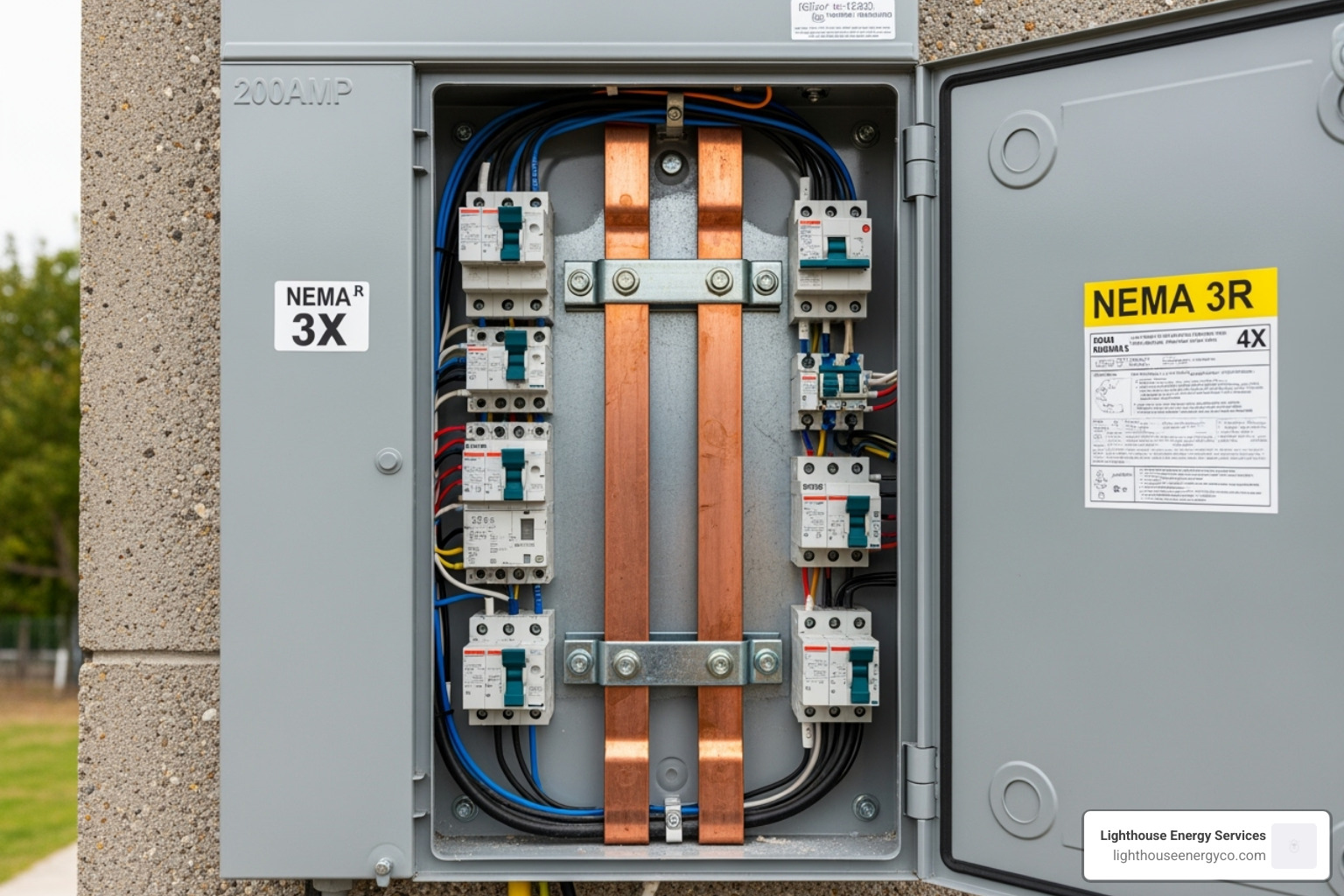
The NEMA 3R rating is essential for outdoor installations. This rating ensures the enclosure protects internal components from rain, sleet, snow, and ice. The rain-tight design prevents moisture intrusion, which is critical for electrical safety.
Inside the panel, the bus bar material affects performance and longevity. Bus bars distribute power to the circuit breakers. While tin-plated aluminum is a common cost-effective option, tin-plated copper is the superior choice. Copper conducts electricity more efficiently and resists corrosion better, offering greater reliability.
Understanding Spaces and Circuits
Panel specifications like “30-space/60-circuit” or “42-space/84-circuit” refer to their capacity.
Spaces are the physical slots for circuit breakers. A single-pole breaker (for standard lights and outlets) uses one space for one circuit. A double-pole breaker (for 240-volt appliances like a dryer) uses two spaces for one circuit.
The circuit count can be higher than the space count because many panels accept tandem breakers, which fit two circuits into a single space. This expandability is great for future-proofing. Choosing between a 30-space or 42-space panel depends on your current needs and future plans.
Main Breaker vs. Main Lug Panels
A main breaker panel includes a master switch (e.g., 200 amps) that controls all power to your home. It serves as an emergency shutoff and is required for most primary service installations.
A main lug panel lacks this built-in disconnect. Incoming wires connect directly to terminals (lugs). These are typically used as sub-panels where the main disconnect is located elsewhere, such as at the meter. For your primary outside 200 amp breaker box, a main breaker panel is almost always the correct and safer choice. If you’re unsure, Contact us for technical details and product options.
Key Features for your outside 200 amp breaker box
Modern panels include features that improve safety and simplify installation.
- Plug-on neutral design: Simplifies wiring by allowing neutral wires to plug directly into the neutral bar, speeding up installation and reducing loose connections.
- Feed-thru lugs: Allow power to be fed to a downstream sub-panel without a separate junction box, saving time and materials on future additions.
- Pre-installed ground bar: Proper grounding is essential for safety. Some panels include this, while others require a separate purchase, so always check the specs.
- Convertible mains: These panels can be configured as either main breaker or main lug, offering flexibility for different installation scenarios.
These features contribute to a safer, more efficient, and easier-to-maintain electrical system.
Installation, Codes, and Safety
Installing an outside 200 amp breaker box is a job for professionals. This equipment handles your home’s entire electrical load, and improper installation can lead to fire, electrocution, or costly damage. Homeowner’s insurance may not cover damages from unlicensed electrical work.
Professional Installation and Permitting
A licensed electrician ensures your installation meets all requirements of the National Electrical Code (NEC), a set of mandatory safety standards. The NEC specifies everything from wire sizing to grounding. For a 200-amp service, this means using 2/0 AWG copper wire or 4/0 AWG aluminum wire for service entrance conductors.
Your electrician will also handle local permits and inspections. An inspector provides the final approval, verifying that the installation is safe and up to code. This process protects you and adds value to your home by documenting that the work was done correctly.
Upgrading from a 100 Amp Service
Upgrading from a 100-amp to a 200-amp service involves more than just swapping the panel. The entire service entrance often needs upgrading.
The service entrance conductors—the main power cables—must be sized for 200 amps. Existing wires for a 100-amp service are too small and must be replaced with 2/0 copper or 4/0 aluminum. Your meter base, which houses the utility meter, must also be rated for 200 amps.
We coordinate with your utility company to schedule the power shut-off and reconnection, ensuring a smooth and safe upgrade. While you can install a 200-amp panel before the full service upgrade, new high-draw appliances cannot be used until the upgrade is complete. For a seamless process, Expert advice on upgrading your breaker box.
Safety First When Near an outside 200 amp breaker box
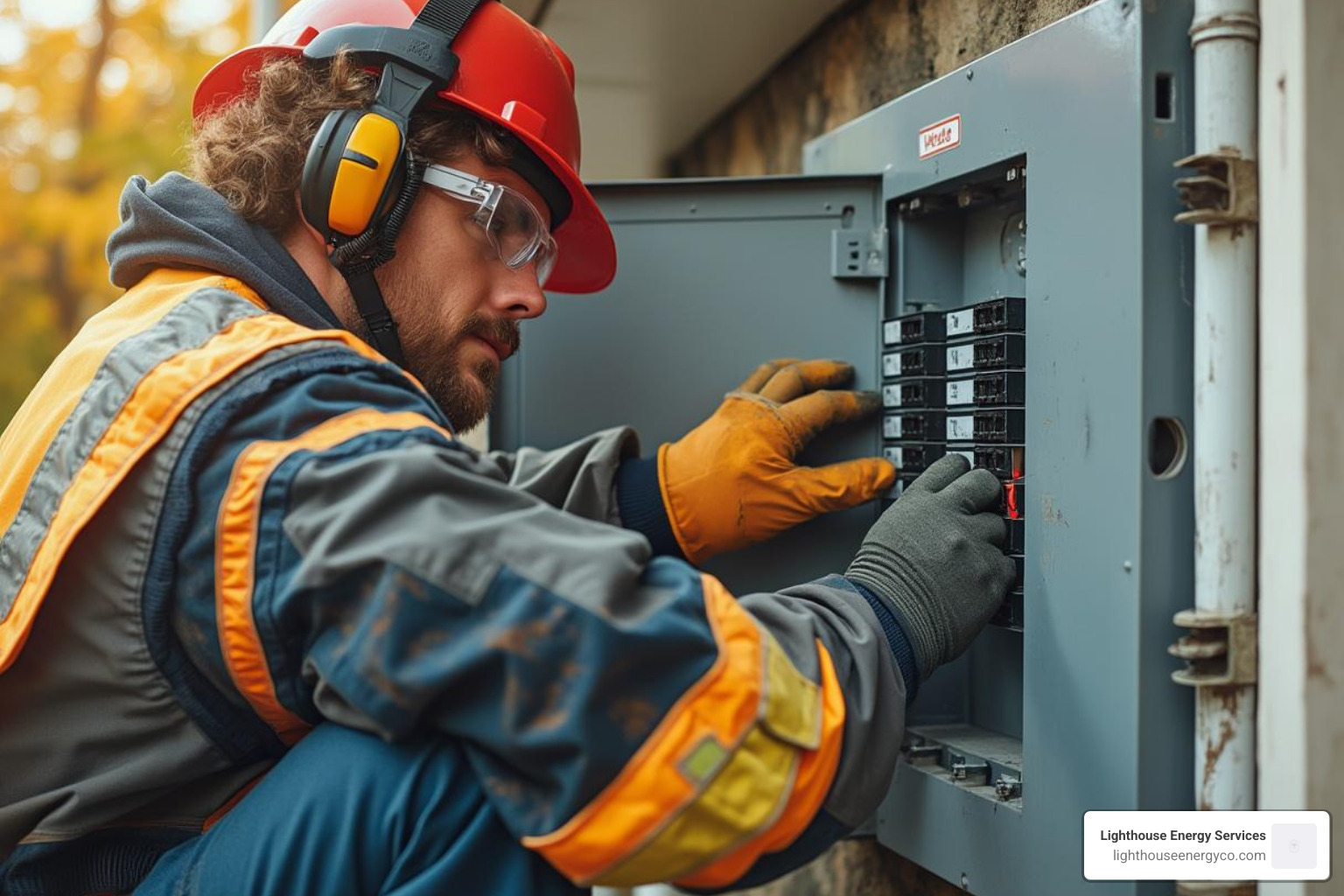
The electrical power in a 200-amp panel is lethal. Never attempt DIY work on your breaker box unless you are a licensed electrician. The main power must be disconnected by the utility company before work begins.
Licensed electricians use specialized personal protective equipment (PPE), including insulated gloves and arc-rated clothing, and are trained to verify that power is off before starting work. Every installation we complete follows NEC guidelines for wire sizing, secure connections, and proper grounding to ensure a safe system that will last for decades.
Frequently Asked Questions
Homeowners often have the same questions when considering an electrical panel upgrade. Here are the answers to the most common ones.
Can I replace a 100 amp box with a 200 amp box myself?
Absolutely not. Replacing a service panel is a dangerous job that should only be performed by a licensed electrician. You are dealing with live power from the utility company, and a mistake can be fatal or cause a fire.
Furthermore, DIY electrical work is illegal in most areas, will not pass inspection, and can void your homeowner’s insurance. A professional is required to calculate loads, size wires correctly (2/0 AWG copper or 4/0 AWG aluminum), upgrade the meter base, pull permits, and coordinate with the utility company. The risk and complexity make this a job exclusively for qualified professionals.
What’s the real difference between indoor and outdoor breaker boxes?
The primary difference is their NEMA rating, which indicates their level of environmental protection. An outside 200 amp breaker box requires a NEMA 3R rating. This means the enclosure is built to be weather-resistant, protecting the internal components from rain, sleet, and snow. They feature gaskets, drainage, corrosion protection, and UV resistance to withstand the elements for decades.
Indoor panels typically have a NEMA 1 rating, offering basic protection from dust in a controlled environment. They provide no protection against weather and should never be used outdoors. Using an indoor panel outside is a serious safety hazard that will fail inspection.
What is the average cost to install a 200 amp outdoor panel?
The average cost to install a 200 amp outdoor panel ranges from $1,000 to $3,000. The final price depends on several factors.
The panel itself costs between $180 and $350. Labor rates make up most of the cost and vary by location and project complexity.
Other factors that affect the price include:
- Upgrading service entrance conductors and the meter base to handle 200 amps.
- The complexity of the installation, such as running new wiring through trenches or conduit.
- Permit and inspection fees, which vary by municipality.
- Addressing any pre-existing wiring issues to bring the system up to code.
While it’s a significant upfront cost, a 200-amp upgrade is an investment in your home’s safety, capacity, and value. For an accurate quote, contact us for a detailed estimate based on your specific needs.
Conclusion: Powering Your Property with Confidence
Upgrading to an outside 200 amp breaker box is a smart investment in your home’s future. It provides the safety, reliability, and capacity needed for modern life, from EV chargers to smart home systems. This upgrade not only improves your home’s functionality but also increases its property value.
By choosing a quality panel and insisting on professional installation that complies with all electrical codes, you are protecting your family and your home. A proper upgrade is a long-term solution that provides peace of mind for years to come.
Here in Palm Beach County, Lighthouse Energy Services is committed to doing the job right. Our qualified electricians provide honest, professional work with no hidden fees, 24/7. We ensure every installation is “done right, and done right now.”
Ready to give your home the electrical system it deserves? Schedule your electrical panel upgrade today. We proudly serve communities throughout South Florida, including Boca Raton, Fort Lauderdale, Jupiter, Miami, West Palm Beach, and the surrounding counties. Let’s power your property with confidence.