
Why Licensing Matters for Commercial Electrical Work
A licensed commercial electrician is a professionally trained and certified tradesperson specializing in the electrical systems of commercial buildings like offices, retail stores, and industrial facilities. They are distinct from residential electricians, as they handle higher power demands, more complex networks, and stricter building codes.
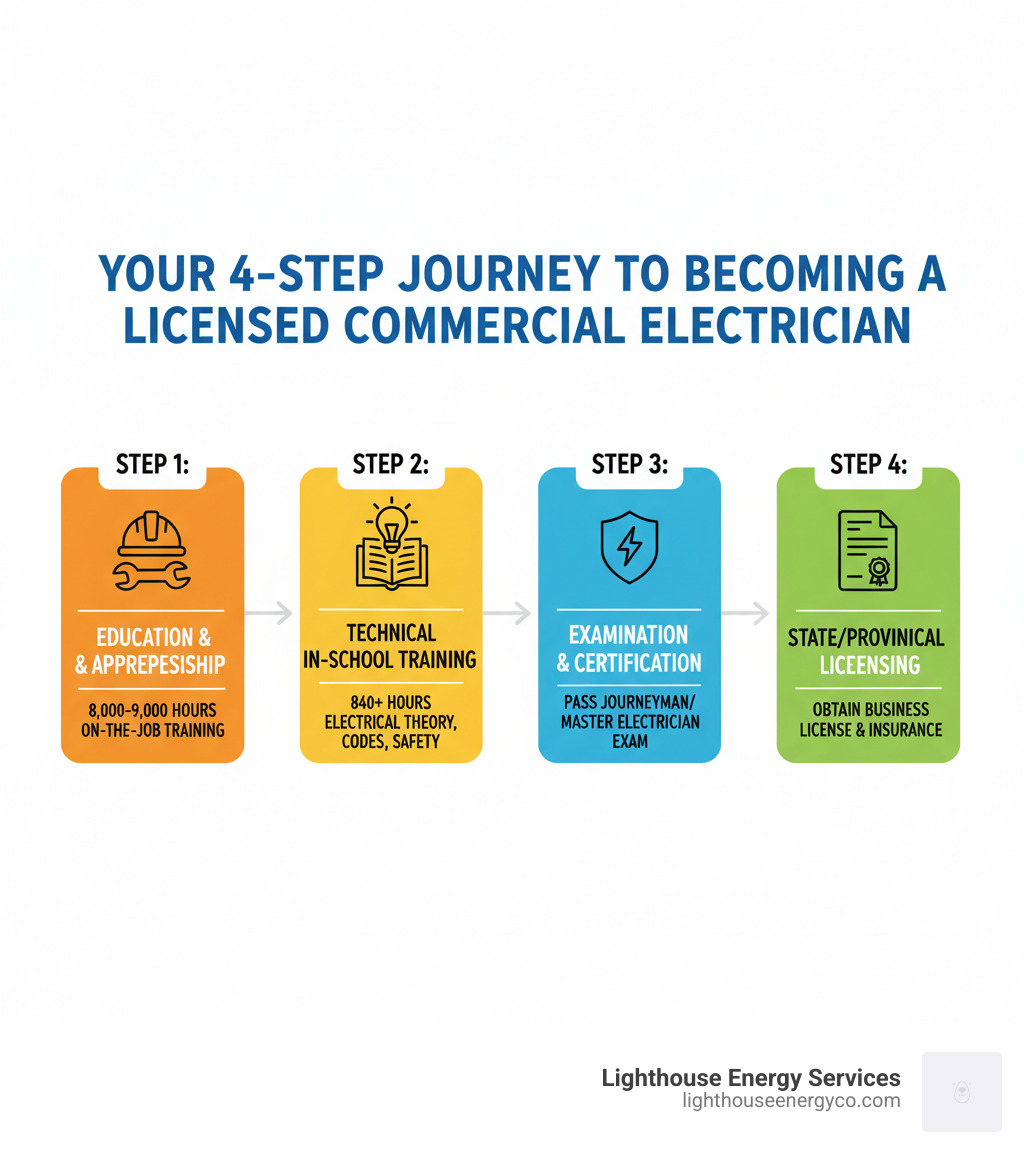
Key Requirements to Become a Licensed Commercial Electrician:
- Complete an apprenticeship – 4-5 years (8,000-9,000 hours) of on-the-job training.
- Attend technical training – 840+ hours of classroom instruction on electrical theory, codes, and safety.
- Pass a certification exam – Journeyman or Master Electrician exam.
- Obtain state/provincial licensing – A business license to operate as a contractor (e.g., ECRA/ESA in Ontario, DBPR in Florida).
- Maintain insurance and continuing education – To keep the license valid.
The path to becoming a licensed commercial electrician is about mastering the complex systems that power everything from data centers to hospitals. Commercial buildings require significantly more power than homes, so electricians need a higher level of training.
Working with high-voltage systems is hazardous without proper knowledge. Licensing exists to protect both the electrician and the businesses they serve. The stakes are high: power surges cause nearly $30 billion in losses annually in North America, and unlicensed work can lead to fires, voided insurance, and lawsuits.
I’m Bruce Kemp, and with decades of experience as a licensed commercial electrician and contractor, I’ve learned what it takes to succeed in this field. This guide shares that roadmap with you.
What is a Commercial Electrician?
A licensed commercial electrician specializes in electrical work for businesses and non-residential buildings. While residential electricians wire homes, we focus on the larger, more complex systems that keep businesses running—from small retail shops to massive industrial warehouses. Our job is to install, maintain, and repair these systems while ensuring safety and compliance with regulations that are much stricter than in residential work.

The Key Distinctions
Commercial and residential electrical work are worlds apart. The challenges on a commercial job site are in a different league due to several key factors:
- Power Loads: Commercial buildings use substantially higher power for HVAC, lighting, computer networks, and heavy machinery. They almost always use more efficient three-phase power distribution, unlike the single-phase power in homes.
- Conduit Use: In commercial work, all wiring is run through protective conduit (metal or plastic tubes) as required by code. This shields wires from damage, a stricter standard than typical residential wiring.
- Wiring Complexity: We deal with multiple circuits, sophisticated control systems, and intricate networks that require careful planning to avoid system failures and safety hazards.
- Building Codes: Commercial electrical codes are more detailed and stringent because more people and equipment are at risk. This requires specialized training and a higher level of expertise.
Types of Properties They Serve
A licensed commercial electrician works in a wide variety of settings, each with unique electrical needs:
- Retail Stores & Restaurants: Require reliable power for lighting, security, POS systems, and heavy-duty kitchen equipment.
- Office Buildings: Need power for workstations, server rooms, and extensive data and communication cabling.
- Warehouses & Industrial Facilities: Demand robust systems for machinery, large-scale lighting, and industrial-grade equipment, often using 480-volt circuits.
- Healthcare Facilities: Require the highest reliability, with backup power systems and specialized circuits for medical equipment that meet strict healthcare codes.
- Educational Institutions: Need safe, efficient electrical systems for classrooms, labs, and administrative offices.
- Data Centers: The most demanding environments, requiring redundant power, advanced cooling, and protection against the smallest power fluctuations to prevent data loss.
The Path to Becoming a Licensed Commercial Electrician
Becoming a licensed commercial electrician is a journey of several years, but it’s a rewarding career where you earn while you learn. Unlike professions requiring expensive degrees upfront, electricians get paid from day one of their apprenticeship, building valuable skills and experience.

Step 1: Education and Apprenticeship
Your journey starts with a high school diploma or GED. Many aspiring electricians then attend trade school programs for a head start on foundational theory and hands-on skills, making them more attractive candidates for apprenticeships.
The core of your training is the apprenticeship program, where you work alongside experienced electricians. Most apprenticeships require 8,000 to 9,000 hours of on-the-job training (about four to five years). For example, in Ontario, the Industrial Electrician apprenticeship is 9,000 hours total. You’ll start with basic tasks and gradually move to complex assignments like reading blueprints and troubleshooting circuits. For those in Canada, an overview of skilled trades legislation governs these programs.
Step 2: Technical In-School Training
While working on job sites, you’ll also attend classroom training to understand the “why” behind the practice. This in-school training covers essential topics, including:
- Electrical theory
- Electrical codes and regulations (NEC or Canadian Electrical Code)
- Blueprint reading and specifications
- Motor controls, transformers, and power distribution
- Grounding, bonding, and protective devices
- Building systems, PLCs, and fire alarm systems
This knowledge turns you into a problem-solver, not just a technician following instructions.
Step 3: Examination and Certification
After completing your training, you’ll take the journeyman exam, a comprehensive test of your theoretical and practical knowledge. Passing this exam certifies you as a skilled tradesperson who can work independently.
To run your own business as a licensed commercial electrician, you must obtain state or provincial licensing, such as an ECRA/ESA license in Ontario or a DBPR license in Florida. This authorizes you to contract electrical work and proves you meet competency and insurance standards. Many electricians also pursue a master electrician certification, the highest level in the trade.
Learning is ongoing, with continuing education required to stay current with new technologies and code updates. In Canada, the Red Seal Program for national standards offers a credential recognized across all provinces, providing valuable career flexibility.
Scope of Work: What Commercial Electricians Do
The daily work of a licensed commercial electrician is diverse, ranging from diagnosing a tripped breaker at a restaurant to installing EV chargers at a corporate office. Our responsibilities fall into four main areas: installation, maintenance, repair, and upgrades, all while focusing on energy efficiency and code compliance.
Core Services of a Licensed Commercial Electrician
We provide solutions for businesses facing outdated infrastructure, expanding power needs, or technology upgrades. Common services include:
- Panel Upgrades: Replacing outdated electrical panels to handle modern power loads safely.
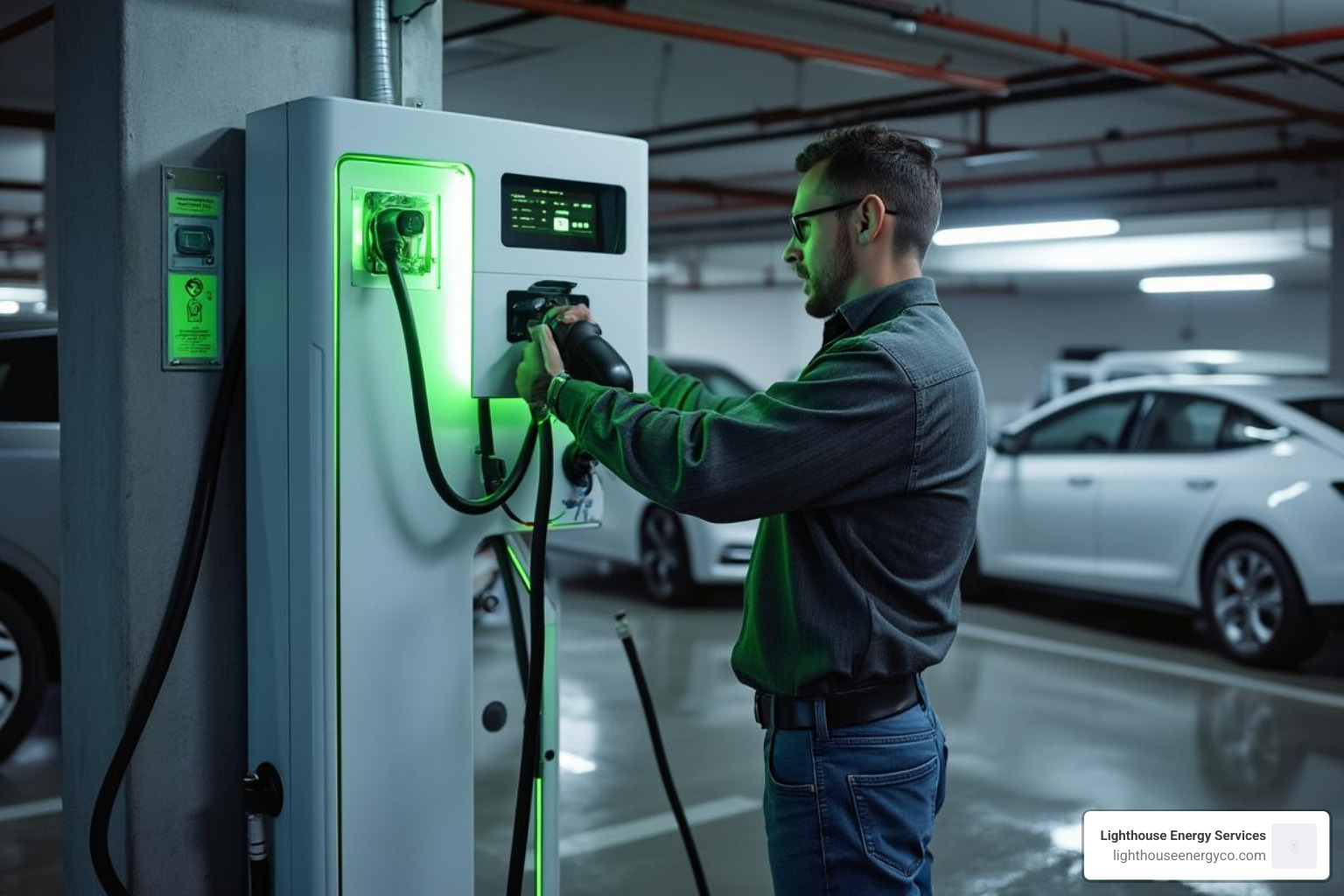
- EV Charger Installation: A fast-growing service involving complex wiring and load calculations for electric vehicle charging stations.
- Surge Protection: Installing whole-building surge suppression to protect valuable electronics from power surges, which cause nearly $30 billion in losses annually in North America.
- Specialty Lighting Systems: Designing and installing systems for retail displays, security, and energy efficiency.
- Data and Communication Cabling: Installing structured cabling for internet, phone systems, and security cameras.
- Emergency Generator Setup: Installing backup generators and automatic transfer switches for businesses that require continuous power, like hospitals and data centers.
- Code Corrections and Compliance: Bringing older buildings up to current electrical standards to ensure safety.
- Other Services: Including equipment hook-ups, industrial wiring, and bucket truck services for exterior work.
Contributing to Energy Efficiency and Sustainability
A licensed commercial electrician also helps businesses save money and reduce their environmental impact. This is one of the most satisfying parts of the job.
LED retrofitting is a quick win, often cutting lighting energy costs by 60-75%. When combined with smart lighting controls like occupancy sensors and daylight harvesting, the savings increase dramatically. We also conduct energy audits to identify and fix electrical waste.
For businesses adopting renewable energy, we handle the electrical integration of solar panel installations. Another technical service is power factor correction, which optimizes how a business uses electricity, often reducing utility bills for facilities with large motors. Through these services, we help businesses operate more efficiently and sustainably.
Why Businesses Must Hire a Licensed Professional
When it comes to your business’s electrical system, hiring an unlicensed worker is a catastrophic risk. The initial “savings” disappear quickly when faced with a fire, lawsuit, or voided insurance claim. Electrical work requires years of training and a deep understanding of complex codes—that’s why licensing exists to protect you.
| Feature | Hiring an Unlicensed Individual (Risks) | Hiring a Licensed Professional (Benefits) |
|---|---|---|
| Safety | High risk of fire, shock, and injury from improper installations | Trained in safety protocols, proper wiring methods, and hazard prevention |
| Code Compliance | Work rarely meets commercial building codes | All work meets or exceeds National Electrical Code and local requirements |
| Insurance Coverage | Your policy likely won’t cover damages from unlicensed work | Full liability coverage protects your business from financial loss |
| Legal Protection | Open to lawsuits, fines, and legal liability | Licensed professionals carry bonding and insurance for your protection |
| Quality & Reliability | No guarantee of proper installation or functionality | Backed by years of training, certification, and professional standards |
| Long-term Costs | Frequent failures, equipment damage, and costly repairs | Reliable systems that operate efficiently for years |
| Business Continuity | Unexpected outages and dangerous conditions halt operations | Properly installed systems minimize downtime and keep your business running |
Legal and Safety Implications
The consequences of unlicensed electrical work are severe. The most immediate dangers are fire hazards and electrical shock risks from improper installations or incorrect load calculations. This can lead to code violations, resulting in hefty fines and shutdown orders until a licensed electrician redoes the work correctly.
Critically, most commercial insurance policies are voided by unlicensed work. If faulty wiring causes a fire, you could be personally liable for all damages. This also opens your business to potential lawsuits if an employee or customer is injured. Unlicensed work creates an unsafe work environment and threatens business continuity. With nearly $30 billion lost every year in North America to power surges alone, a professionally installed system is your best defense against costly downtime.
How to Verify You’re Hiring a Licensed Commercial Electrician
Protect your business by doing your homework. A legitimate licensed commercial electrician will welcome your scrutiny.
- Ask for their license number. It should be on their vehicles, cards, and estimates.
- Verify the license using official tools. For Ontario, use the Find a Licensed Electrical Contractor Near You tool. In Florida, check the DBPR website. Ensure the license is active.
- Confirm they have insurance and bonding. Ask for a current certificate of insurance. This is your financial safety net.
- Check references and reviews. Speak with other commercial clients to gauge reliability and quality.
- Get a detailed written estimate. It should clearly outline the scope of work, materials, and costs.
- Ensure they will obtain all necessary permits. A professional understands and follows the permitting process. If someone says permits aren’t needed, it’s a major red flag.
At Lighthouse Energy Services, we are fully licensed, insured, and available 24/7. We provide transparent, professional service to keep your business safe and operational.
Frequently Asked Questions about Commercial Electricians
Business owners often have questions about commercial electrical work. Here are answers to the most common ones to help you make informed decisions.
What’s the difference between a licensed contractor and a certified electrician?
This is a critical distinction. A certified electrician (journeyman or master) is the skilled individual who performs the hands-on work. They are qualified professionals, typically employed by a contractor.
A Licensed Electrical Contractor is the business entity legally authorized to offer electrical services, enter into contracts, and assume all legal and financial responsibility for the work. When you need work done, you must hire a Licensed Electrical Contractor. They carry the required insurance and bonding to protect your business. A certified electrician working independently without a contractor’s license is doing so illegally and puts your property at risk.
How often do commercial properties need electrical inspections?
For safety and compliance, industry standards recommend a full electrical installation condition report at least every 5 years for most commercial properties. However, a full shutdown can be disruptive. As an alternative, many businesses opt for inspecting 20% of their electrical system each year. This spreads the process over five years, minimizing disruption while ensuring the entire system is reviewed.
Regular inspections catch deteriorating connections, overloaded circuits, and code violations before they become emergencies. This preventive maintenance saves money, prevents downtime, and keeps your employees and customers safe.
How do electricians test systems in a 24/7 facility without causing downtime?
We work with many businesses that cannot afford to shut down, like hospitals and data centers. We use modern technology and careful planning to perform maintenance without interrupting operations.
- Thermal Imaging: We use infrared cameras to scan running electrical systems for “hot spots”—signs of overloading or poor connections that could lead to failure. This is completely non-invasive.
- Remote Monitoring: Advanced systems can track your electrical performance in real-time and alert us to anomalies, allowing for proactive maintenance.
- Planned Sectional Shutdowns: When hands-on work is necessary, we schedule it during your lowest-traffic hours. We can often isolate specific sections, allowing the rest of your facility to operate normally.
- Power Quality Analysis: We use specialized equipment to check for issues like harmonics and voltage sags that can damage sensitive equipment, all while your system is live.
Our goal is to ensure your electrical system is safe and reliable while keeping your business running. As a licensed commercial electrician service available 24/7, we understand the demands of round-the-clock operations.
Conclusion
The journey to becoming a licensed commercial electrician is demanding, built on years of training, rigorous exams, and a commitment to safety and evolving technology. This specialization is crucial because commercial electrical work is a world apart from residential, involving higher power loads, complex systems, and stricter codes.
For business owners, hiring a licensed commercial electrician is a fundamental measure of protection. It safeguards your property from fire, ensures your insurance remains valid, and keeps your business compliant with the law. Most importantly, it is an investment in the reliability and continuity of your operations.
The risks of using unlicensed labor are immense—from the nearly $30 billion lost to power surges annually to the potential for fires, lawsuits, and devastating business interruptions. Hiring a licensed professional is not an expense; it’s essential protection.
At Lighthouse Energy Services, we embody these professional standards. Our team of licensed commercial electricians serves businesses 24/7 throughout Palm Beach County and South Florida, including Boca Raton, Fort Lauderdale, Jupiter, Miami, and West Palm Beach. We know emergencies don’t keep business hours, and we promise to get the job done right, right now, with no hidden fees.
Whether you need a panel upgrade, EV charger installation, or an emergency repair, we are here to help keep your business safe, efficient, and running smoothly.
Ready to power your business with confidence? Reach out to your partner for commercial electrical services today.