
When an outlet suddenly stops working, the fix is often surprisingly simple. In most cases, it comes down to a tripped circuit breaker or a tripped GFCI (Ground Fault Circuit Interrupter) outlet—both safety features doing their job. A few quick, tool-free checks can often get the power back on in minutes.
Initial Checks for a Dead Electrical Outlet
Before you even think about grabbing a screwdriver, it's smart to run through a quick diagnostic routine. A dead outlet is usually a symptom of a protective device kicking in, not a sign of some major electrical failure. By ruling out the easy stuff first, you can save yourself a ton of time and stress.
Investigate the Circuit Breaker Panel
Your first stop should be the electrical nerve center of your home: the circuit breaker panel. You'll typically find this metal box tucked away in a garage, basement, or utility closet. Its entire purpose is to protect your home’s wiring from overloads and short circuits.
A circuit breaker "trips" by automatically shutting off the power when it senses a problem. Scan the rows of switches for one that’s out of line. Sometimes it’s obvious—flipped all the way to "OFF"—but often it's more subtle, stuck in a neutral middle position.
To reset it properly:
- First, push the breaker’s handle firmly all the way to the "OFF" position. You have to do this to re-engage the internal spring.
- Then, flip it back to the "ON" position.
If your outlet starts working again, problem solved! But if that breaker trips again right away, or keeps tripping, you're looking at a more persistent issue. If you find yourself in that boat, it's worth understanding why your circuit breaker keeps tripping.
Locate and Reset GFCI Outlets
If the circuit breaker wasn't the culprit, your next bet is a tripped GFCI outlet. These are the special outlets with the little "TEST" and "RESET" buttons you see in kitchens, bathrooms, laundry rooms, and garages—anywhere electricity and water might meet.
Here’s something many people don't realize: a single GFCI outlet is often wired to protect several standard outlets "downstream" on the same circuit. This means a tripped GFCI in your garage could easily be the reason an outlet in your upstairs bathroom is dead.
Hunt around your home for any GFCI outlets and press the "RESET" button firmly on each one. If you hear a distinct click and the button stays put, you’ve likely just restored power to your dead outlet.
This simple flowchart helps visualize that initial troubleshooting process.
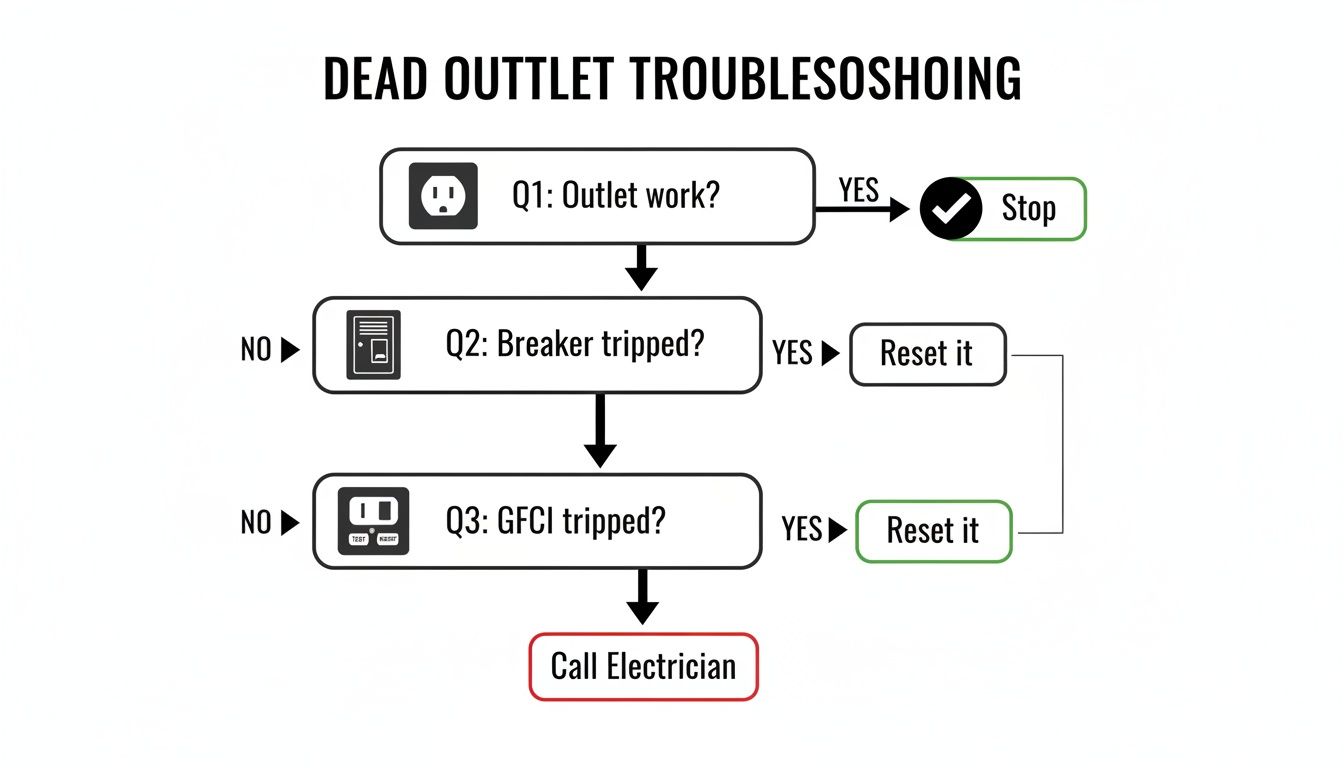
As you can see, checking the breaker and GFCIs should always be your first move. A faulty outlet isn't just an inconvenience; it can be a genuine safety hazard. According to the U.S. Consumer Product Safety Commission, electrical receptacles were involved in over 24,000 emergency room visits for young children over a 10-year period, a stark reminder of why keeping outlets in good working order is so critical.
Essential Tools and Safety for Outlet Repair
Alright, let's talk about safety. When you're dealing with electricity, there are absolutely no shortcuts. Before you even think about touching that dead outlet, we need to make sure you're set up to do this the right way. This isn't just about avoiding a little zap—it's about preventing a serious fire.
It might sound dramatic, but faulty electrical outlets are a leading cause of house fires. The numbers don't lie: between 2007 and 2011, U.S. fire departments responded to nearly 48,000 home electrical fires. These incidents tragically resulted in 455 deaths and over $1.5 billion in property damage. A dead outlet isn't just an inconvenience; it can be a warning sign of a much bigger problem lurking behind your walls.
Your Non-Negotiable Safety Check
First thing's first: kill the power. Head to your electrical panel, find the breaker that controls the outlet you're working on, and flip it firmly to the “OFF” position.
Now for the most important part of this entire process—verifying the power is truly off. This step is not optional.
An Old-Timer's Rule: Never trust that you flipped the right breaker. Always test the outlet with a voltage tester before your hands or tools go anywhere near it. I've seen too many close calls because someone got confident. Assume every wire is live until you prove it isn't.
You have a couple of great tools for this job:
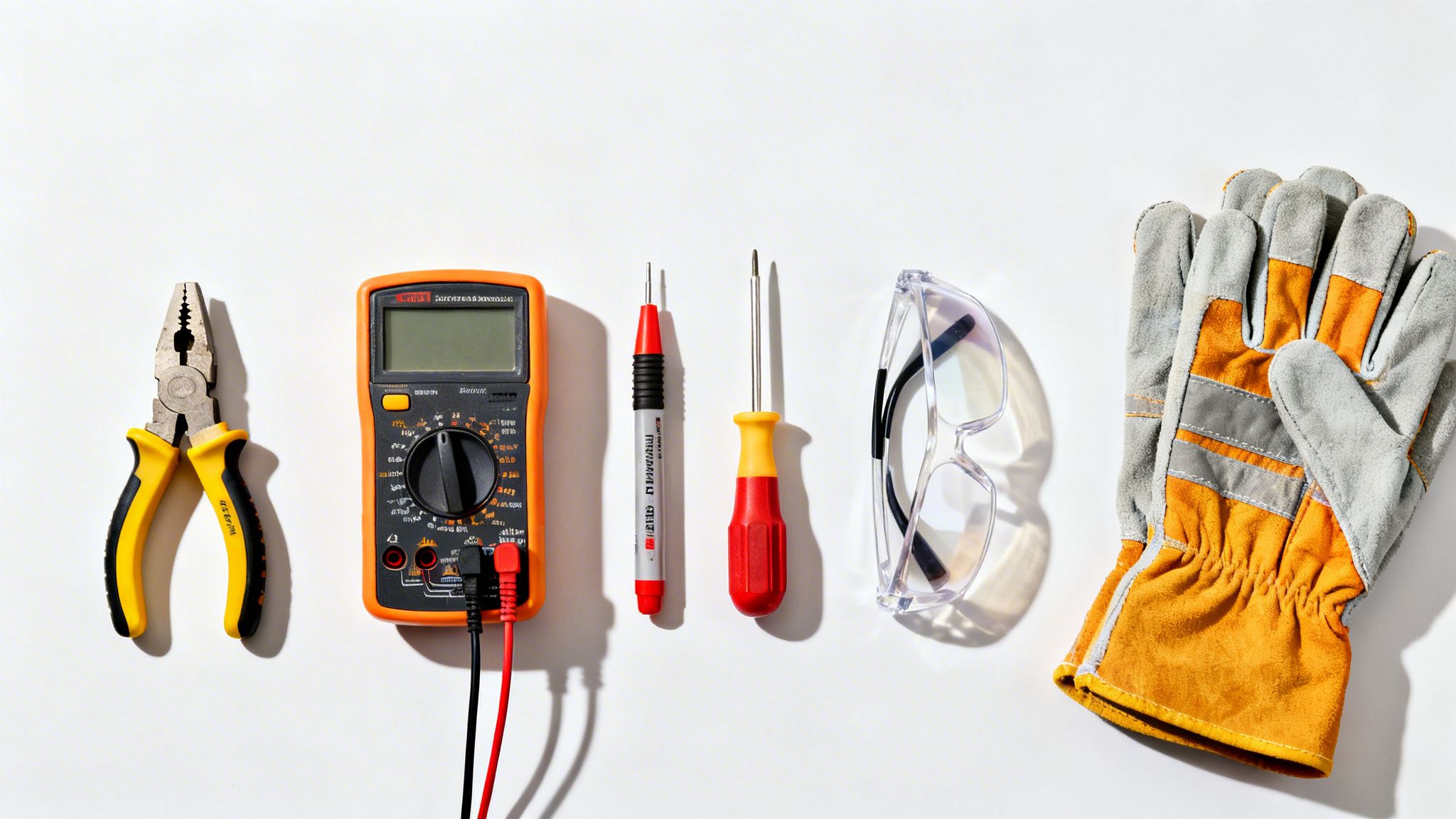
- Non-Contact Voltage Tester: This is your best friend for a quick safety check. It’s a simple pen-shaped tool that beeps or flashes when it detects voltage, so you don't even have to make contact with a bare wire. If it stays silent, you’re one step closer to being safe.
- Multimeter: For more detailed diagnostics, a multimeter is invaluable. It gives you precise voltage readings, which helps you figure out if power is getting to the electrical box but failing at the outlet itself.
The Essential Toolkit for Safe Outlet Repair
Having the right gear on hand is the difference between a smooth, safe repair and a dangerous, frustrating one. Trying to improvise with the wrong tools is how mistakes and accidents happen. Here’s a rundown of the absolute essentials I keep in my bag for any outlet job.
| Tool/Gear | Primary Use | Safety Note |
|---|---|---|
| Voltage Tester | Confirms power is OFF before you begin. | The most important safety tool you own. Test it on a known live outlet first. |
| Multimeter | Provides exact voltage readings for diagnostics. | Essential for troubleshooting complex issues beyond a simple replacement. |
| Insulated Screwdrivers | For removing the faceplate and outlet screws. | The insulated handles provide a critical layer of protection against shock. |
| Needle-Nose Pliers | Bending wires into secure J-hooks for terminals. | Look for a pair with comfortable, insulated grips. |
| Wire Strippers | Removing wire insulation without damaging the copper. | A clean strip ensures a solid, safe connection. |
| Safety Glasses | Protects your eyes from debris, dust, and sparks. | Non-negotiable. Wear them from start to finish. |
With these tools, you're equipped to handle most basic outlet repairs safely and effectively.
If you find anything that looks burnt, melted, or just plain confusing, it’s always better to stop and get a professional opinion. For a complete picture of your home's wiring, a full electrical home safety check can uncover hidden issues before they become emergencies.
Diagnosing the Problem Inside the Outlet Box
Alright, with the breaker off and the outlet confirmed dead, it's time to get your hands dirty and look inside the box. This is where you’ll find the root cause of most dead outlets. Go ahead and unscrew the faceplate, then take out the two longer screws that hold the outlet itself to the box.
Now, gently pull the outlet straight out. Don't yank it—you just need enough room to see the wires connected to the sides and back.
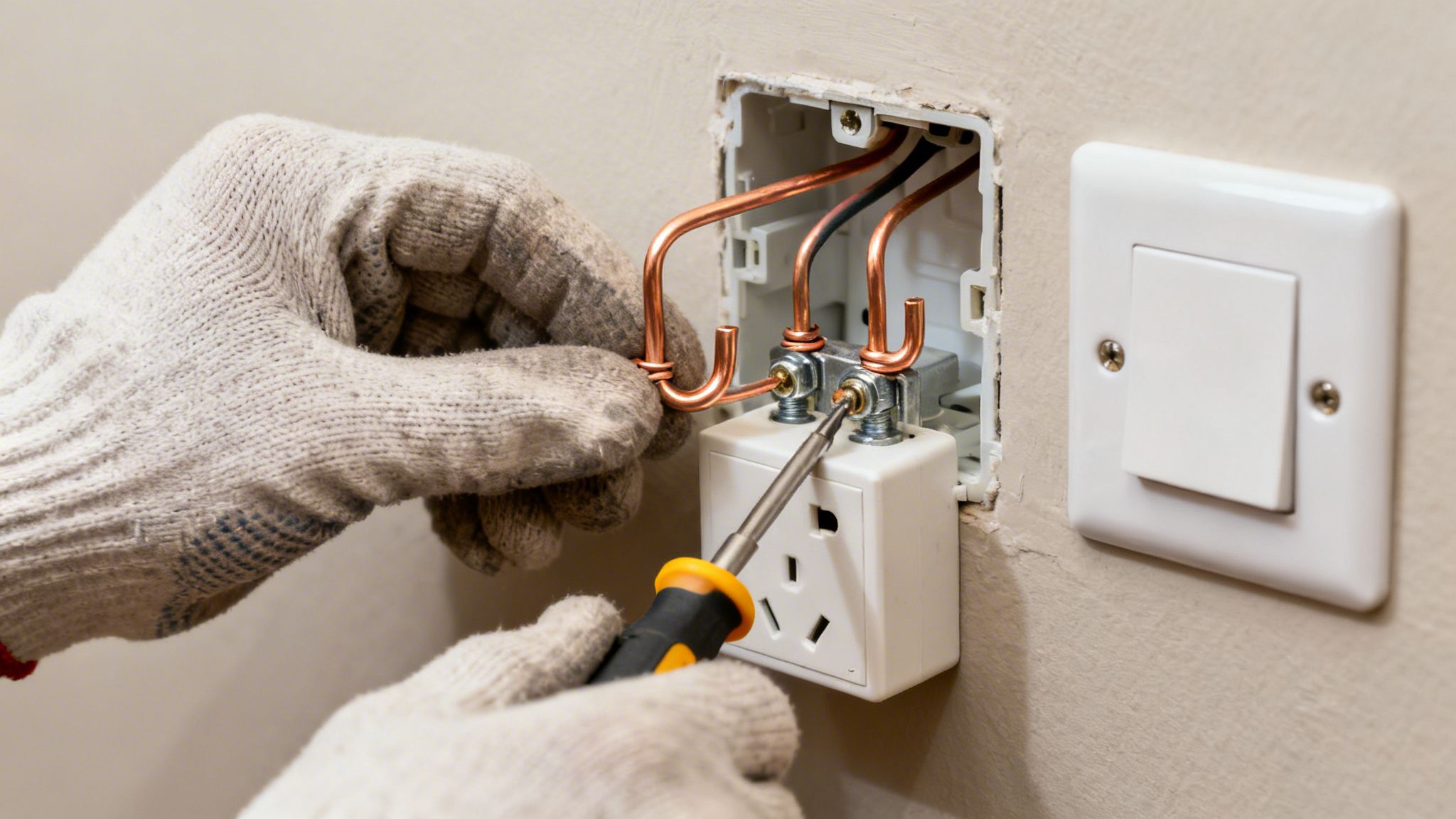
Think of yourself as a detective at a crime scene. The clues are right there, you just have to know what to look for. Take your time here; a careful inspection is the fastest way to a reliable fix.
Conducting a Visual Inspection
Your first move is always a thorough visual check. You'd be surprised how often the problem is something simple that has occurred over years of use.
Keep an eye out for these classic culprits:
- Loose Wires: This is, without a doubt, the number one reason I see for outlet failure. Wires expand and contract with temperature changes, and over time, they can work themselves loose from the screw terminals. Give each wire a light tug to check if it's snug.
- Backstabbed Connections: If you see wires pushed directly into small holes on the back of the outlet, you’ve likely found your problem. These "backstab" connections are notoriously weak and are a common point of failure. I always recommend moving them to the more secure screw terminals.
- Corrosion: In damp areas like basements, kitchens, or garages, moisture can cause corrosion. Look for any green or white crusty buildup on the copper wires or terminal screws, as this will absolutely kill a solid electrical connection.
A Critical Warning Sign: If you see any black soot, scorch marks, or signs of melted plastic on the outlet or wire insulation, stop what you're doing immediately. This is evidence of arcing—a tiny, uncontrolled lightning storm inside your wall—and it’s a serious fire hazard. The outlet is toast and must be replaced.
Using a Multimeter for Deeper Diagnostics
If your eyes don't spot an obvious flaw, it’s time to bring out the multimeter to get some hard data. With the power still off, switch your multimeter to the continuity setting (it usually has a symbol that looks like a sound wave or diode).
First, let's test the outlet itself for internal failure. Touch one probe to a brass-colored screw (hot side) and the other probe into the corresponding shorter slot on the front of the outlet. If you don't hear a beep, the connection inside is broken. You’ve just confirmed a burnt-out outlet.
Next, we check for power to the box. Flip the breaker back on, and be extremely careful from this point forward. Set your multimeter to AC voltage (V~ or VAC). Carefully insert one probe into the hot slot (the shorter one) and the other into the neutral slot (the taller one).
A reading of approximately 120V is good news; it means power is making it to the box. The problem is simply a faulty outlet that needs replacing.
However, a reading of 0V confirms no power is reaching the outlet at all. This tells you the issue is "upstream" in the circuit—maybe a loose wire at the previous outlet in the chain or a problem back at the panel. Knowing this is key to figuring out your next move.
How to Properly Replace a Faulty Outlet
So, you've tracked the problem down to the outlet itself. Good job. Now for the satisfying part: replacing it. This is a project most homeowners can handle, but the secret isn't just swapping the old part for a new one—it's about making connections that are safe and built to last.
First things first, after you've confirmed the power is off at the breaker, go ahead and unscrew the old outlet from the wall. Gently pull it out, but don't disconnect anything just yet. This is your road map. You'll see a black wire, a white wire, and a bare copper (or green) one.
Spotting the Problem and Getting Wires Ready
Take a close look at how the wires are connected. Are they wrapped securely around the screws on the side, or are they just poked into little holes in the back of the outlet?
If you see them pushed into the back, you’ve likely found the culprit. We call this “backstabbing,” and it's a notoriously unreliable shortcut. The spring clips inside get weak over time, creating a loose connection that causes outlets to fail. This is probably the #1 reason I see for a single dead outlet on an otherwise working circuit.
To disconnect the wires, simply loosen the screw terminals. If they're backstabbed, look for a tiny slot next to the wire hole. You'll need to push a small flathead screwdriver in there to release the wire. Whatever you do, don't just rip the wires out—you could damage the copper, making your job much harder.
Here's the standard color code you'll be working with:
- Black Wire (Hot): This is the power carrier. It goes to the brass-colored screw.
- White Wire (Neutral): This wire completes the circuit. It connects to the silver-colored screw.
- Bare Copper/Green Wire (Ground): Your safety wire. This goes to the green screw.
I've always used a simple way to remember this: "Black to Brass to save your… well, you know." And "White goes to the light" (silver) is an easy one, too. Ground is always green, like the grass.
Making Rock-Solid Connections on the New Outlet
Forget about the push-in holes on your new outlet. The only right way to do this is by using the screw terminals. To get a professional-grade connection, you'll want to create a small "J-hook" on the end of each wire.
Grab your needle-nose pliers and bend the exposed copper into a hook. The trick is to orient the hook so that when you tighten the screw (clockwise), it pulls the loop in tighter, clamping it down. If you hook it the wrong way, tightening the screw can actually push the wire out. This small detail makes a huge difference in safety and reliability.
Attach each wire to its proper home: black to brass, white to silver, and the bare copper ground to the green screw. Now, tighten them down firmly. Give each wire a gentle tug to make sure it's completely secure. A loose connection is a serious fire hazard, as it can cause arcing and dangerous heat buildup.
Once everything is tight, carefully fold the wires back into the box like an accordion. Screw the new outlet in place, attach the faceplate, and then you can head back to the panel to restore the power.
Feeling confident? If you're looking to tackle a bigger project, like expanding a single outlet to a double, our guide on wiring up a double socket is a great next step.
Knowing When to Call a Professional Electrician
The mark of a smart homeowner isn't just knowing how to do a repair; it's knowing when to put the tools down and call for backup. While you can handle many outlet fixes yourself, some symptoms are clear red flags for serious, hidden dangers. Recognizing these signs is the most important part of keeping yourself and your home safe.
Your own senses are the best first line of defense. If you hear a distinct buzzing, humming, or crackling sound from an outlet or even your main breaker panel, that’s not something to ignore. That noise is often the sound of arcing—a tiny, uncontrolled lightning storm happening inside your walls. It’s creating intense heat and is a major fire hazard.
The same goes for any unusual smells. A sharp, acrid smell of hot plastic or that metallic "ozone" scent means a component is actively overheating and melting. Don't wait. Turn off the breaker for that circuit if you can identify it safely, and call a professional immediately.
Danger Signs You Cannot Ignore
Beyond strange sounds and smells, certain problems are clear indicators that the issue is bigger than a simple dead outlet. If you encounter any of these, stop what you’re doing and make the call.
When you open up the outlet's electrical box and find anything charred, blackened, or melted, you've found the evidence of a dangerous heat event. This isn't just a faulty $3 outlet; it’s a symptom of a much larger issue on the circuit that needs an expert diagnosis.
Another huge red flag is a circuit breaker that won't stop tripping. If you reset it and it snaps off again right away—or trips multiple times in a day—that breaker is doing its job. It's screaming at you that there's a persistent problem, like a short circuit or ground fault, that could cause a fire or electrocution if left unchecked.
A single dead outlet can be the canary in the coal mine. Ignoring the warning signs is like putting electrical tape over the check engine light in your car. You haven’t solved anything, and a much bigger, more expensive failure is likely just around the corner.
When the Problem Is Deeper Than the Outlet
Sometimes, troubleshooting points to a problem that runs deeper than the device in front of you. If your home was built in the 1960s or '70s and you pull the outlet to find aluminum wiring, it's time to stop. Aluminum wiring isn't inherently bad, but it expands and contracts differently than copper and requires very specific, specialized connectors and techniques to be made safe. Using standard copper-rated outlets on it is a known fire risk.
You might also find that it's not just one outlet—an entire room or section of your house is dark, but none of the breakers are tripped. This could signal a major circuit failure or even an issue with the main electrical service coming into your home.
Don’t hesitate to call a pro if you run into:
- Recurring Issues: The same outlet failing over and over.
- Physical Damage: Any sign of burning, melting, or scorching on the outlet, plug, or wiring.
- Persistent Breaker Trips: A breaker that won't stay on.
- Outdated Wiring: Discovering you have aluminum instead of copper wiring.
These scenarios go far beyond a simple "how to fix electrical outlet not working" project. They demand complex diagnostics and a deep understanding of electrical systems. At Lighthouse Energy Services, our licensed professionals are available 24/7 because we know these issues don’t stick to a 9-to-5 schedule. Making the smart decision to call us protects your home and family from serious electrical hazards.
Common Questions About Non-Working Outlets
When you're staring at a dead outlet, a lot of questions can run through your mind. After you’ve checked the basics, you might still be stumped by what's going on behind the drywall. As an electrician, I hear the same questions all the time, so let's clear up some of the most common mysteries.
Why Did My Outlet Stop Working with Nothing Plugged In?
It's a baffling one, right? An outlet works fine, then suddenly it's dead, and you haven't touched a thing. In my experience, this is almost always a sign that the problem isn't with that outlet, but with another one somewhere else on the same circuit.
Think of it like a string of old Christmas lights—if one goes out, the rest of the line can go dark. Outlets in a home are often wired in a series. A loose wire or a worn-out connection in an "upstream" outlet (one closer to the breaker box) will knock out the power for all the outlets that follow it.
The culprit could also be a hidden GFCI. You might have a GFCI outlet in the garage that’s secretly protecting an outlet on your back patio. It’s also common for an AFCI (Arc Fault Circuit Interrupter) breaker to trip. These smart breakers detect tiny, dangerous electrical arcs anywhere along the circuit and cut the power to prevent a fire.
What Is the Difference Between GFCI, AFCI, and a Standard Outlet?
Knowing what you’re looking at is half the battle. Each type of outlet or protection has a very specific job.
Standard Outlet: This is the most basic type. Its only function is to deliver power. Beyond its plastic housing, it has no built-in safety mechanisms to protect you.
GFCI Outlet (Ground Fault Circuit Interrupter): This one is a true lifesaver. It constantly monitors the electrical current. If it senses even a tiny imbalance—like electricity finding a path to the ground through you or through water—it shuts off the power in a fraction of a second. That's why building codes require them in kitchens, bathrooms, garages, and outdoors.
AFCI Protection (Arc Fault Circuit Interrupter): This is your fire prevention specialist, and it's usually built right into your circuit breaker. It’s designed to listen for the specific electronic "noise" of a hazardous arc fault, which often happens with old or damaged wiring and is a major cause of house fires.
Can I Replace a Two-Prong Outlet with a Three-Prong Outlet?
Please don't just swap a two-prong outlet for a three-prong one. It's a common but incredibly dangerous DIY mistake. That third, round prong is for the ground wire, an essential safety line that protects both you and your electronics from electrical surges and faults. Homes with old two-prong outlets usually don't have that ground wire in the wall box.
By installing a three-prong outlet without a ground wire, you're creating what we call a "false ground." Sure, your three-prong plugs will fit, but there's no actual grounding protection. This creates a serious shock hazard and can fry sensitive electronics during a power surge.
The only truly safe fix is to have an electrician run a new ground wire to the outlet box. As an alternative, you can install a GFCI outlet in that spot. It will provide shock protection and must be labeled with the sticker that says "No Equipment Ground."
My Plugs Are Loose and Fall Out. Is This Dangerous?
Yes, absolutely. A loose plug is an immediate fire hazard that needs to be fixed right away.
When your plugs feel wobbly or fall out of the socket, it means the metal contacts inside the outlet have worn out and lost their grip. This poor connection doesn't let electricity flow smoothly. Instead, it creates resistance, which generates a dangerous amount of heat.
This can quickly lead to arcing, where electricity literally jumps the gap. Arcing produces intense heat that can easily melt the plastic on the outlet and your plug, potentially starting a fire inside your wall. Don't wait—a worn-out outlet needs to be replaced.
If you're dealing with any of these situations or your troubleshooting has led to a dead end, don't take any chances. The experienced team at Lighthouse Energy Services is available 24/7 to help. Our licensed pros can diagnose the issue safely and make sure your home's electrical system is up to code. For fast, reliable service in Palm Beach County, contact us today.