
You've probably already hit the point where the factory charging cord isn't cutting it. You get home in West Palm Beach, plug into a standard outlet, and by morning the battery is only partly recovered. That setup can work for some drivers, but for a lot of homeowners it turns into a daily inconvenience fast.
EV charger installation in West Palm Beach FL isn't just about mounting a box on the garage wall. Key considerations include electrical capacity, permit compliance, charger placement, and making sure the equipment will keep working in a South Florida environment. If the installation is rushed, or worse, treated like a DIY appliance hookup, the weak point usually isn't the charger. It's the panel, the wiring, or the approval process that got skipped.
West Palm Beach also isn't an empty market. ChargeHub's West Palm Beach listing shows 451 total charging stations, including 325 Level 2 stations and 126 Level 3 stations. It also shows 109 free stations, with free charging making up 24% of the city's total. That matters because local homeowners aren't deciding whether EV charging exists. They're deciding whether to make charging easier, more reliable, and more convenient at home than relying on public infrastructure.
Your First Big Decision Choosing Between Level 1 and Level 2
The first decision is simple on paper and important in real life. Do you stay with Level 1 charging from a standard household outlet, or do you install a Level 2 charger on a dedicated 240 volt circuit?
For some West Palm Beach homeowners, Level 1 is fine. If you drive lightly, work from home, or have a second gas vehicle for longer trips, the slower pace may not bother you. But if you commute, run errands across Palm Beach County, or want the car ready again the same day, Level 2 usually changes the experience from “managing the battery” to just plugging in and moving on.
Level 1 vs daily life
Level 1 is the lowest-friction way to start because the equipment usually comes with the vehicle. There's no big installation decision on day one, and no immediate permit process if you're only using an existing outlet exactly as intended.
The downside is practical, not theoretical. Slow charging means every unexpected trip matters more. If you come home low and need to head back out later, you may not have enough time to recover meaningful range.
Practical rule: If charging speed changes how you plan your week, you've already outgrown Level 1.
Level 2 and why most homeowners end up there
Level 2 is the setup most homeowners ask for once they've lived with an EV for a bit. It's faster, more consistent, and usually better aligned with how people drive. It also tends to be the more future-ready option if you replace your current vehicle with another EV later.
There's also a property-use argument that matters. A dedicated charger is a permanent electrical improvement, not just an accessory. In a market where EV ownership keeps becoming more normal, a properly installed Level 2 charger can make a home more functional for the next buyer, even if they don't need it today.
Level 1 vs. Level 2 Home Charging At a Glance
| Feature | Level 1 Charger | Level 2 Charger |
|---|---|---|
| Power source | Standard household outlet | Dedicated 240 volt circuit |
| Installation | Usually plug-in use of existing outlet | Professional electrical installation required |
| Charging speed | Slower overnight top-up | Much faster home charging |
| Best for | Low-mileage drivers, occasional use | Daily commuters, multi-driver homes, long-term EV ownership |
| Upfront complexity | Low | Higher because of panel review, permits, and inspection |
| Impact on routine | May require planning around charge time | Usually supports a plug-in-and-forget routine |
| Future-proofing | Limited | Better for newer EVs and changing driving needs |
What works and what doesn't
What works is matching the charger to the household, not buying the biggest unit because it sounds impressive. A homeowner with short daily drives may be perfectly happy with Level 1 for now. Another homeowner may need Level 2 immediately because the vehicle is the main commuter car.
What doesn't work is forcing a Level 1 setup to do a Level 2 job. That's when people start using extension cords, overloading marginal garage circuits, or assuming they can “make it work” until later. That's the point where convenience turns into risk.
If your EV is now part of your daily transportation, the decision usually gets clear pretty quickly. A dedicated Level 2 charger gives you margin. Margin is what makes home charging feel reliable instead of fragile.
Preparing Your Home for a Fast Charger
A fast home charger starts with the electrical system you already have. Before anyone talks about brands, apps, or smart features, the first question is whether your panel can support the added continuous load safely.
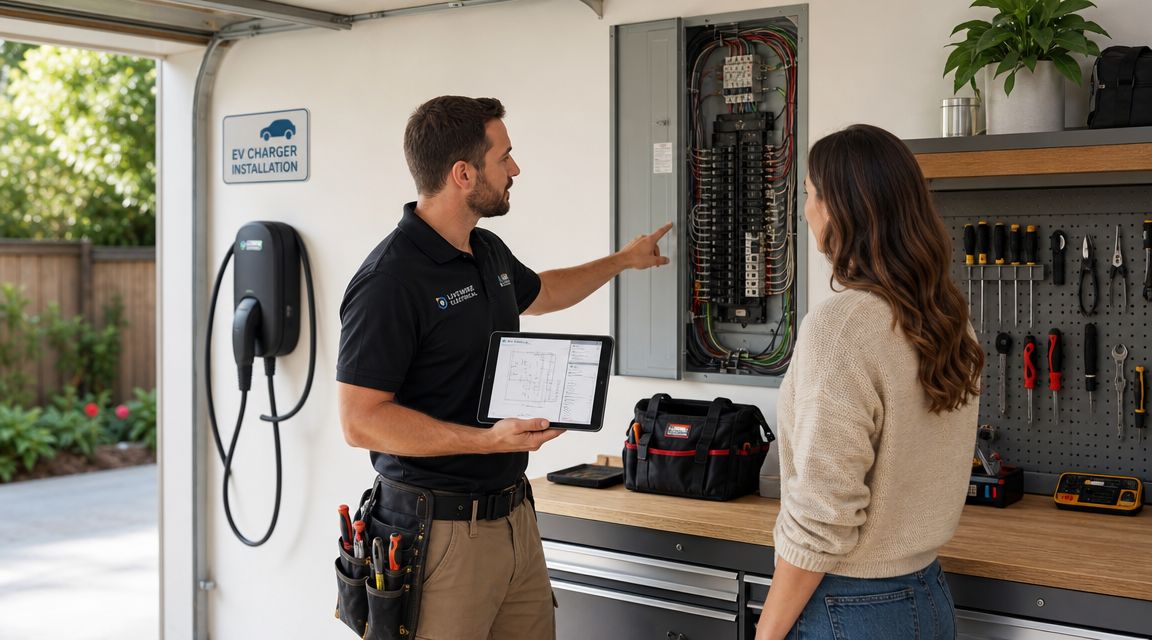
What an electrician checks first
A proper site assessment looks at three things right away:
- Panel capacity: Is there enough available capacity for a new dedicated EV circuit, or is the panel already crowded?
- Breaker space: Even if the service is adequate, does the panel have room for the required breaker?
- Distance to charger location: The farther the run, the more conduit, wire, labor, and wall or ceiling routing the job may need.
Think of a load calculation like a weight limit for the house's electrical system. The panel may seem fine during normal use, but EV charging adds a sustained demand, not a quick on-and-off appliance cycle. If the service is already carrying air conditioning, water heating, cooking loads, pool equipment, and general household circuits, adding a charger without checking the math is where bad decisions start.
The common residential baseline
For many homes, the baseline for a Level 2 charger is straightforward. This residential EV charger installation guide notes that a typical setup uses a 240 volt dedicated circuit, and many installations use a 60 amp breaker with 6 gauge conductors for a hardwired 48 amp charger, following the 80% continuous-load rule.
That doesn't mean every home should get that exact setup. It means that if you're asking for a hardwired charger with strong charging output, that's a common target and a useful reference point during planning.
The charger is only one part of the system. The panel, breaker, conductor size, grounding, terminations, and location all have to match the load.
Location matters more than people expect
The cheapest charger location is rarely “where it looks best.” It's usually where the cable reaches the vehicle comfortably and the wiring path is shortest and cleanest. If the panel is on the opposite side of the house, or the car parks outside while the panel is deep inside a finished garage, labor can rise because the route gets more complicated.
A good layout usually balances four practical points:
- Reach to the charge port without stretching or draping the cable awkwardly.
- Protection from impact so the charger isn't mounted where a bumper or door can hit it.
- Reasonable conduit path back to the panel.
- Weather exposure if the unit is outdoors or under a partially exposed carport.
When the panel is the real project
A lot of homeowners think they're buying a charger installation when they are buying a panel evaluation. If the panel lacks capacity or breaker space, the project can shift from a simple branch circuit install to a broader electrical upgrade.
If that happens, you need a real discussion about options. Sometimes load management can help. Sometimes a subpanel makes sense. Sometimes the correct answer is a service or panel upgrade. If your home is already near its limit, a professional assessment of whether it's time to upgrade from 150 amps to 200 amps can clarify whether the charger is exposing a larger issue that was already there.
What doesn't work is squeezing an EV circuit into a marginal panel because the charger manufacturer says the unit is compatible. Compatibility on a spec sheet is not the same thing as a safe installation in your house.
The West Palm Beach Installation Process from Permit to Power-On
Most homeowners think the longest part of the job will be the wiring. It usually isn't. The actual physical installation is often the easy part. The process that controls the schedule is paperwork, approvals, and inspection.
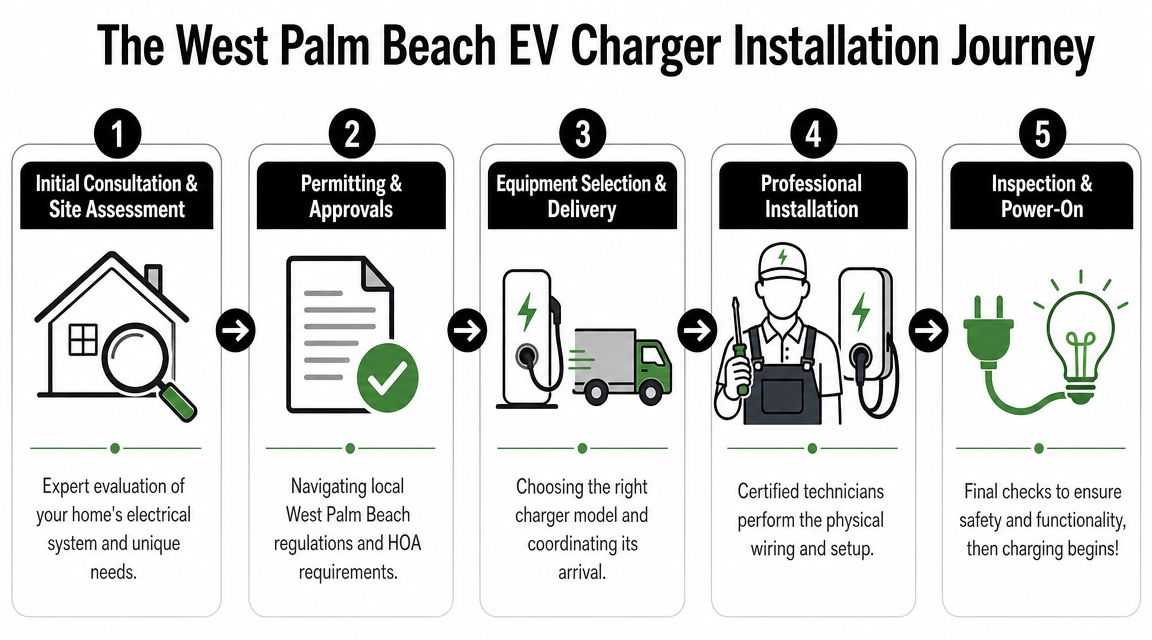
What the timeline really looks like
A typical project starts with a visit to assess the panel, the parking location, and the charger type. After that comes a proposal, permit preparation, submission, approval, installation scheduling, the physical install, and then final inspection.
This West Palm Beach EV charger installation overview notes that the on-site installation itself typically takes 2 to 4 hours, but the full project often runs several weeks because permit submission, approval, and final inspection are the primary factors extending the schedule. That lines up with what homeowners experience locally. The wrench time is short. The administrative path is what stretches the calendar.
The five stages homeowners should expect
Initial assessment
The electrician confirms whether the home can support the charger as planned. It's also when layout decisions get made. Hardwired or plug-in. Garage or exterior wall. Standard amperage or load-managed approach.
Permitting and approvals
This step is not optional. A permit creates a formal review of the work scope and ensures the installation gets inspected. That protects the homeowner, the next buyer, and anyone servicing the electrical system later.
If you're comparing contractors, one practical filter is whether they handle permits directly. A contractor who routinely deals with local compliance tends to produce a smoother project. Homeowners who want that handled professionally can look at government-approved electrical contractors in Palm Beach County and ask exactly who pulls the permit, who meets the inspector, and who closes the job.
Equipment selection
Not every homeowner needs the same charger. Some want app control and scheduled charging. Some just want a reliable hardwired unit with no fuss. This is also where cord length, weather rating, mounting style, and amperage settings matter.
If you're interested in the broader system side of optimizing your EV charging experience, this overview of electric vehicle charging infrastructure from Solana EV is a useful companion read because it helps frame how home charging fits with workplace and public charging habits.
Installation day
This is the part people picture. The electrician shuts down power safely, verifies de-energization, installs the breaker, runs conduit and conductors, mounts the charger, makes up terminations, torques connections properly, and tests the unit.
On a clean, straightforward residential install, this portion can move efficiently. On a difficult house with long wire runs, finished surfaces, limited access, or panel complications, the labor can get more involved fast.
Permit delays frustrate homeowners more than installation work. That's normal. The fix isn't rushing the wiring. It's managing the process correctly from the start.
Inspection and power-on
After installation, the local authority inspects the work. Once the installation passes, the charger can be energized and commissioned fully. If the charger has smart features, this is usually when app setup and charging schedules get finalized.
Why the permit matters
A permitted charger install creates a documented, code-reviewed electrical addition to the home. That matters for safety, insurance questions, and resale clarity. It also matters because EV charging is a sustained load. If something was done incorrectly, the issue may not show up immediately. It may show up after repeated charging cycles, under heat, or when the rest of the house is under heavy demand.
This is one reason homeowners shouldn't treat EV charging like a simple handyman project. The clean-looking install can still hide bad conductor sizing, loose terminations, improper breaker selection, or missing load review.
Special Considerations for Local Properties
West Palm Beach homes come with two local realities that generic EV articles usually ignore. The first is shared-property approval, especially in condos, townhomes, and HOA communities. The second is weather exposure. In South Florida, those two issues can decide whether the project is easy or a headache.
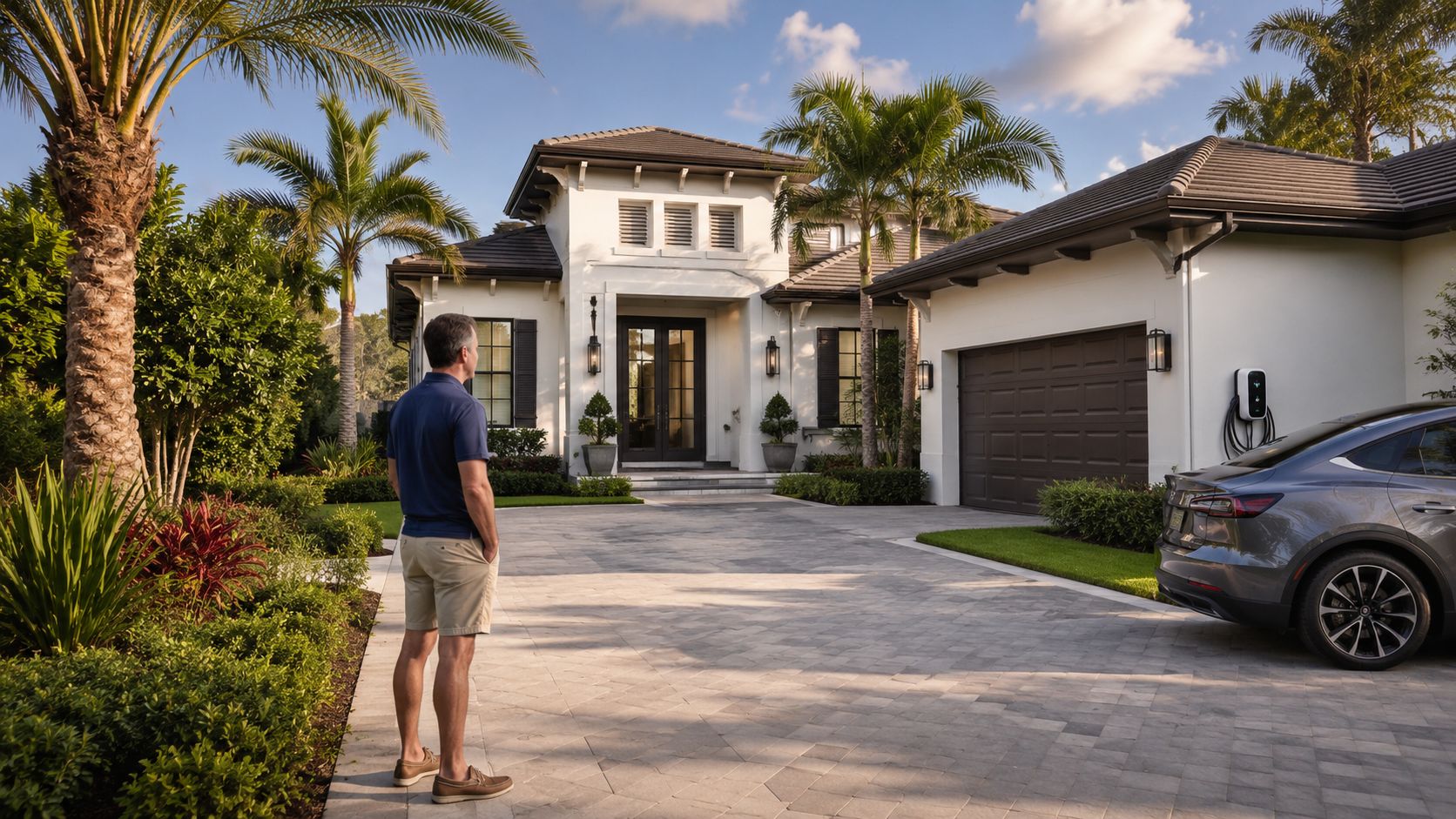
HOAs, condos, and shared electrical systems
Single-family installs are usually the cleanest. You control the panel, the parking area, and the approval path. Multifamily properties are different because the electrical path may cross common areas, shared walls, utility rooms, or parking structures that the resident doesn't control directly.
This South Florida EV charging overview points out a major local challenge clearly. Most online content centers on single-family homes, while property managers and condo boards are often trying to solve different problems such as load-sharing, avoiding service-panel upgrades, and handling approvals for common-area electrical work.
What tends to stall HOA projects
A condo or HOA installation often slows down for reasons that have nothing to do with the charger itself:
- Incomplete approval packages: Boards want drawings, equipment specs, contractor licensing, and the proposed wiring route.
- Metering questions: Someone has to determine how the electricity use is tracked and billed.
- Common-area access: If the conduit path crosses shared property, the board may need to approve not just the charger but the routing method.
- Capacity concerns: Communities worry that one charger request becomes many, and they don't want to approve a design that won't scale.
What works is bringing the board a complete plan. That usually includes the charger model, mounting location, conductor route, panel source, and a clear explanation of whether the system uses dedicated capacity or load management. What doesn't work is asking for “approval in principle” and hoping the technical details can be figured out later.
Storm resilience is not optional in South Florida
Local homeowners also need to think beyond charging speed. In this climate, resilience matters. An outdoor charger in a coastal environment faces salt air, wind-driven rain, and surge risk during storm season.
A better installation plan asks different questions. Is the charger mounted high enough to reduce flood exposure? Is the location sheltered without blocking ventilation or usability? Are corrosion-resistant components appropriate for the site? Does the home need surge protection as part of the charger project?
In South Florida, the wrong charger location can age the equipment faster than the charging load itself.
Practical weather-related choices
A weather-aware installation usually includes choices like these:
- Higher mounting decisions: Keep equipment away from low points where water can collect or enter during severe weather.
- Outdoor-rated materials: The charger, fittings, and enclosure method should match the actual exposure conditions.
- Thoughtful panel-side planning: If the panel or disconnect area is vulnerable, the charger project may reveal a broader resilience issue.
- Outage expectations: A charger doesn't help during a utility outage unless the home has a compatible backup-power strategy.
That last point gets overlooked. Some homeowners assume charger speed is the whole story. In West Palm Beach, reliability after storms can matter more than shaving a little time off a normal charge session.
How to Choose a Qualified EV Charger Installer
Picking the charger is the easy part. Picking the installer is the decision that affects safety, code compliance, and whether the job holds up years from now.
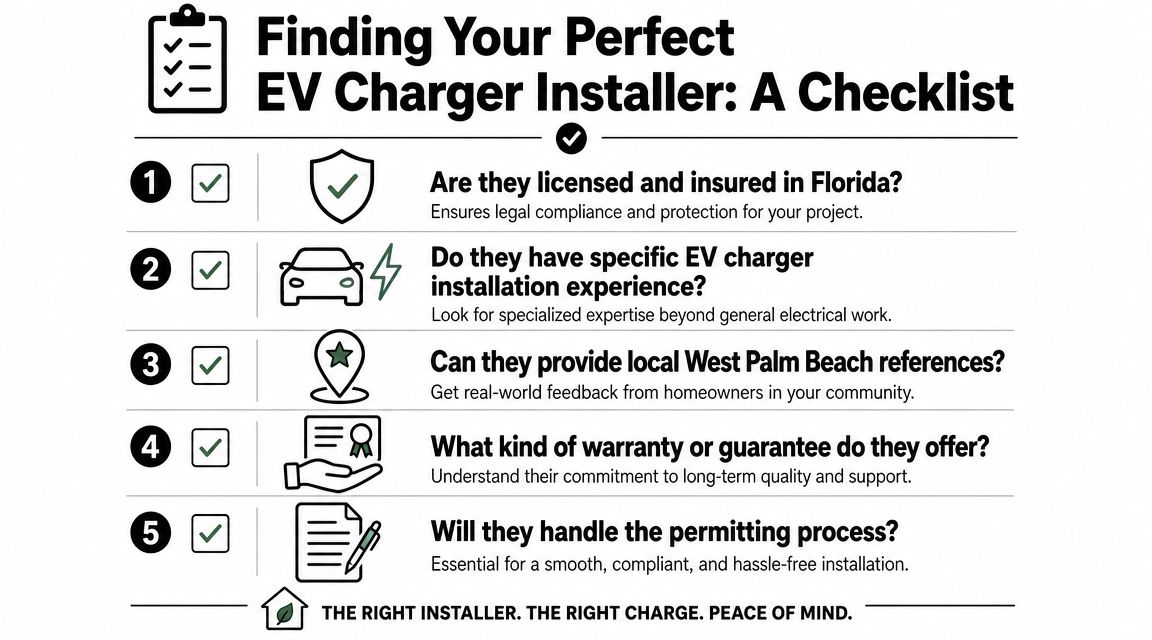
Ask better questions before you hire anyone
A homeowner should ask direct questions and expect direct answers.
Are you licensed and insured for this work in Florida?
This isn't a formality. A charger install involves branch-circuit design, load evaluation, permit compliance, and final inspection. If the answer is vague, move on.
How many EV charger installations like mine have you handled?
General electrical experience matters, but EV charging has its own recurring issues. Continuous-load sizing, panel limitations, charger settings, conduit planning, and smart-load integration all come up often. A contractor who mainly does lights and receptacles may not be strong here.
Will you pull the permit and coordinate inspection?
If the homeowner is being asked to manage the permit without a good reason, that's a warning sign. A professional installer should be comfortable owning the compliance side of the job.
Ask about the part that can't be seen later
The quality of an EV charger install often comes down to decisions that disappear behind the finished work.
- Load calculation approach: How are they determining the home can support the charger?
- Termination practices: Are they using proper torque procedures at breaker and equipment lugs?
- Upgrade options: If the panel is full, can they explain the pros and cons of a subpanel, load management, or service upgrade?
- Support after installation: If the breaker trips, the app won't connect, or charging becomes inconsistent, who answers the phone?
A practical place to vet local contractor qualifications is this West Palm Beach electrical contractor page, which outlines the kind of licensed electrical work homeowners should expect for residential projects. Lighthouse Energy Services is one option in this market, and the company's stated model includes licensed professionals answering calls and residential electrical service across Palm Beach County.
A neat charger on the wall doesn't prove the installation was done well. The proof is in the load planning, conductor sizing, terminations, permit record, and inspection result.
What not to reward
Don't reward the lowest quote if the scope is thin. If one estimate skips permit handling, assumes the panel is adequate without documenting it, or leaves out trenching, conduit, patching, or exterior weather considerations, it may only be cheaper on paper.
A serious installer should be able to explain why the chosen method is safe, code-compliant, and appropriate for your specific house. If they can't explain it clearly, they probably shouldn't be doing it.
Frequently Asked Questions About Home EV Charging
Can I install my own Level 2 charger?
For a hardwired Level 2 charger, that's not a smart risk. This work involves a dedicated 240 volt circuit, breaker sizing, conductor sizing, grounding, terminations, and permit compliance. The danger usually isn't obvious the moment the charger powers up. The danger shows up later as overheating, nuisance tripping, damaged equipment, or an installation that fails inspection.
Will a Level 2 charger always require a panel upgrade?
No. Some homes have enough spare capacity and breaker space already. Others don't. That's why a load calculation and panel inspection come first. The wrong move is assuming every home needs an upgrade, or assuming none do.
Will charging my EV make my power bill jump dramatically?
Your electric use will increase because you're adding vehicle charging to the house. How much depends on how much you drive, when you charge, and what you were spending on fuel before. For a broader ownership perspective beyond installation, this guide to saving money on electric vehicles from Punk Ride LLC is useful because it looks at EV operating costs in the bigger picture.
Is a plug-in charger better than a hardwired charger?
It depends on the application. A plug-in unit can offer flexibility, but a hardwired charger is often the cleaner long-term solution for a permanent home installation. The right answer depends on amperage, outlet configuration, location, and how the homeowner plans to use the system, making a site-specific recommendation more valuable than general internet advice.
Do I really need professional installation if the charger brand says it's homeowner-friendly?
Yes. Manufacturer marketing focuses on the charger. The primary safety issue is the electrical system feeding it. A homeowner-friendly app or mounting bracket doesn't eliminate the need for proper load review, wiring methods, breaker selection, and inspection.
If you're ready to stop relying on slow charging or you want a straight answer about whether your panel can support a Level 2 unit, Lighthouse Energy Services can help you evaluate the job correctly. A proper EV charger installation starts with the house, not the hardware, and getting that part right is what keeps the charger safe, fast, and dependable.