
You've got the EV in the driveway, the charging cable is still in the trunk, and the first practical question hits fast. Where is the charger going, can your panel handle it, and how much of a project is this really going to be?
That's the point where most Lake Worth homeowners discover that EV charging isn't just about buying a wall unit. In South Florida, the primary work is usually behind the cover of the electrical panel. Older homes, heavy air-conditioning demand, outdoor parking layouts, and permit requirements all shape whether your installation is simple or turns into a panel upgrade, trenching job, or load-management conversation.
A clean EV charger installation in Lake Worth FL starts with the house, not the charger. If you understand the site, the electrical capacity, and the permit path before work begins, the install is smoother, the quote is more accurate, and you avoid the common surprise costs that frustrate homeowners.
Table of Contents
- Your Pre-Installation Home and Site Assessment
- Choosing the Right Level 2 Charger for Your Home
- Navigating Electrical Upgrades and Lake Worth Permits
- Estimating Your Total Installation Cost and Incentives
- What to Expect on Your EV Charger Installation Day
- Why a Licensed 24/7 Electrician in Lake Worth Matters
Your Pre-Installation Home and Site Assessment
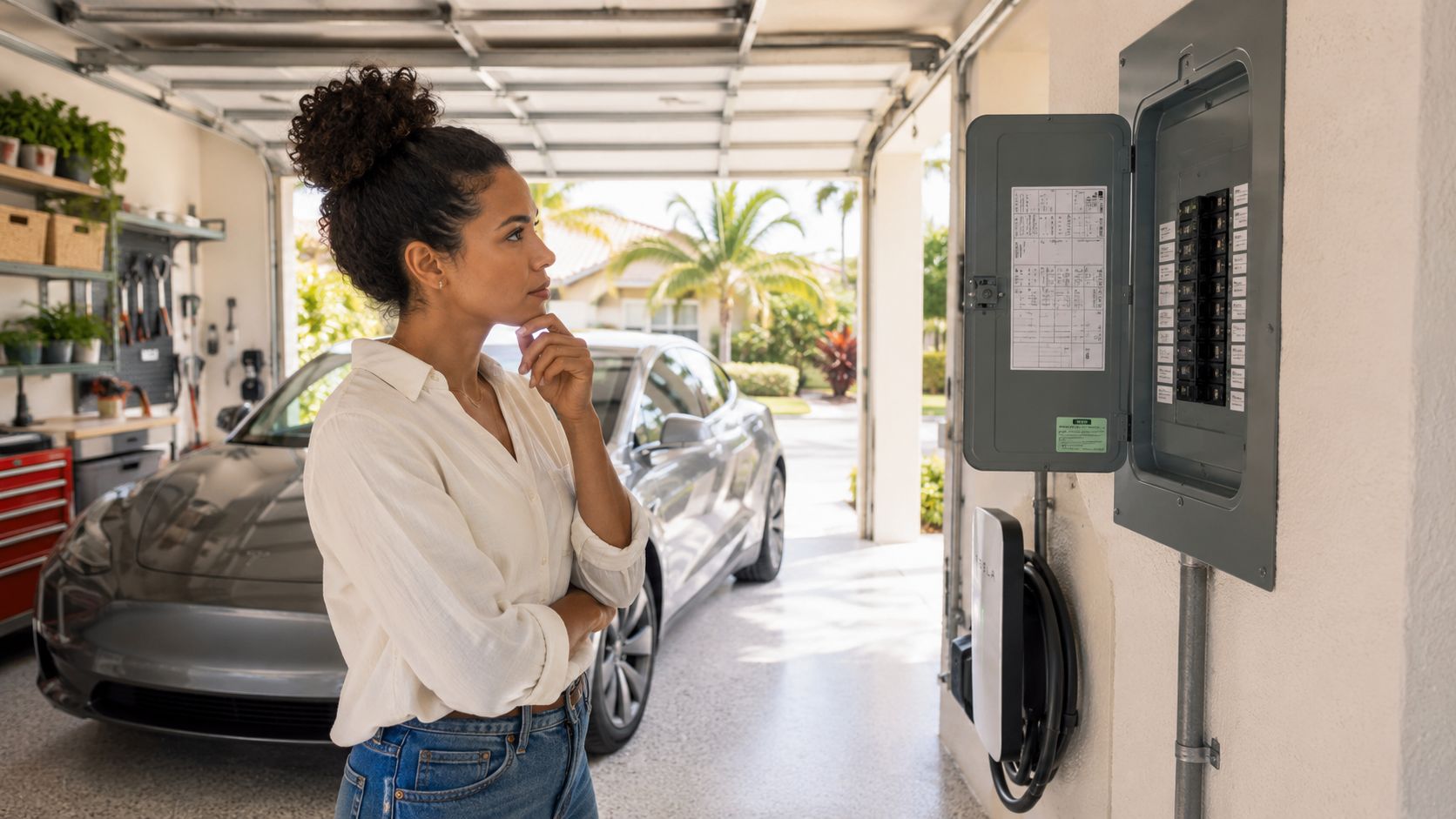
Most charging problems show up before any wire is pulled. The first thing to look at is where the vehicle sits every day, because that determines conduit route, mounting method, weather exposure, and labor.
Start with where the car actually parks
If you park inside a garage and the main panel is on the same wall or nearby, the installation is usually more straightforward. If the car parks on a driveway, under a carport, or outside a fence line, the job may need exterior conduit, weather-rated equipment placement, or a longer circuit run.
Distance matters more than most homeowners expect. A charger mounted close to the panel usually means less conduit, less wire, less labor, and fewer chances for routing complications. A charger placed on the opposite side of the house may still be the right choice, but it needs to be priced that way from the start.
South Florida homes also add a few local realities:
- Garage versus driveway use: A garage install is often cleaner and better protected from weather.
- Outdoor wall condition: Stucco, block, and finished surfaces affect how conduit is secured and how clean the final appearance will be.
- Flood and drainage exposure: Low mounting locations near areas that collect water can create avoidable problems.
- Shared parking or HOA rules: If you live in a condo, townhouse, or managed community, check what the association requires before scheduling work.
If you're already reviewing the condition of your panel and branch circuits, it helps to pair that with a broader home electrical safety check so you're not treating the EV charger as an isolated issue.
Practical rule: Choose the charger location based on how you park every day, not on where the wall looks empty.
Questions to answer before you request a quote
A good quote starts with clear answers. You don't need to solve the electrical design yourself, but you should know the basics of your layout.
Use this checklist before calling an electrician:
- Where does the vehicle sleep? Be specific. Left side of garage, right side of driveway, under carport, or rear parking pad.
- Where is the main electrical panel? Take a photo of the panel and the parking area so routing can be discussed accurately.
- Is the mounting point indoors or outdoors? That affects enclosure choice, conduit method, and wear over time.
- Are there access obstacles? Finished walls, pavers, attic limitations, locked gates, and landscaping all affect installation approach.
- Do you need future flexibility? If a second EV may arrive later, that should be discussed before the first circuit is installed.
Questions to answer before you request a quote
One more issue gets missed often in Lake Worth. Homeowners focus on the charger model before confirming whether the house can support the added demand at all.
That doesn't mean every project needs a major upgrade. It means the site review should happen first, because what works in one house won't necessarily work in the house next door, even if both have similar square footage or similar vehicles.
Choosing the Right Level 2 Charger for Your Home
Once the site makes sense, the next decision is the charger itself. For most homeowners, this comes down to whether you want a slower, minimal solution or a faster, dedicated setup that fits daily driving without constant planning.
Why most homeowners move past Level 1
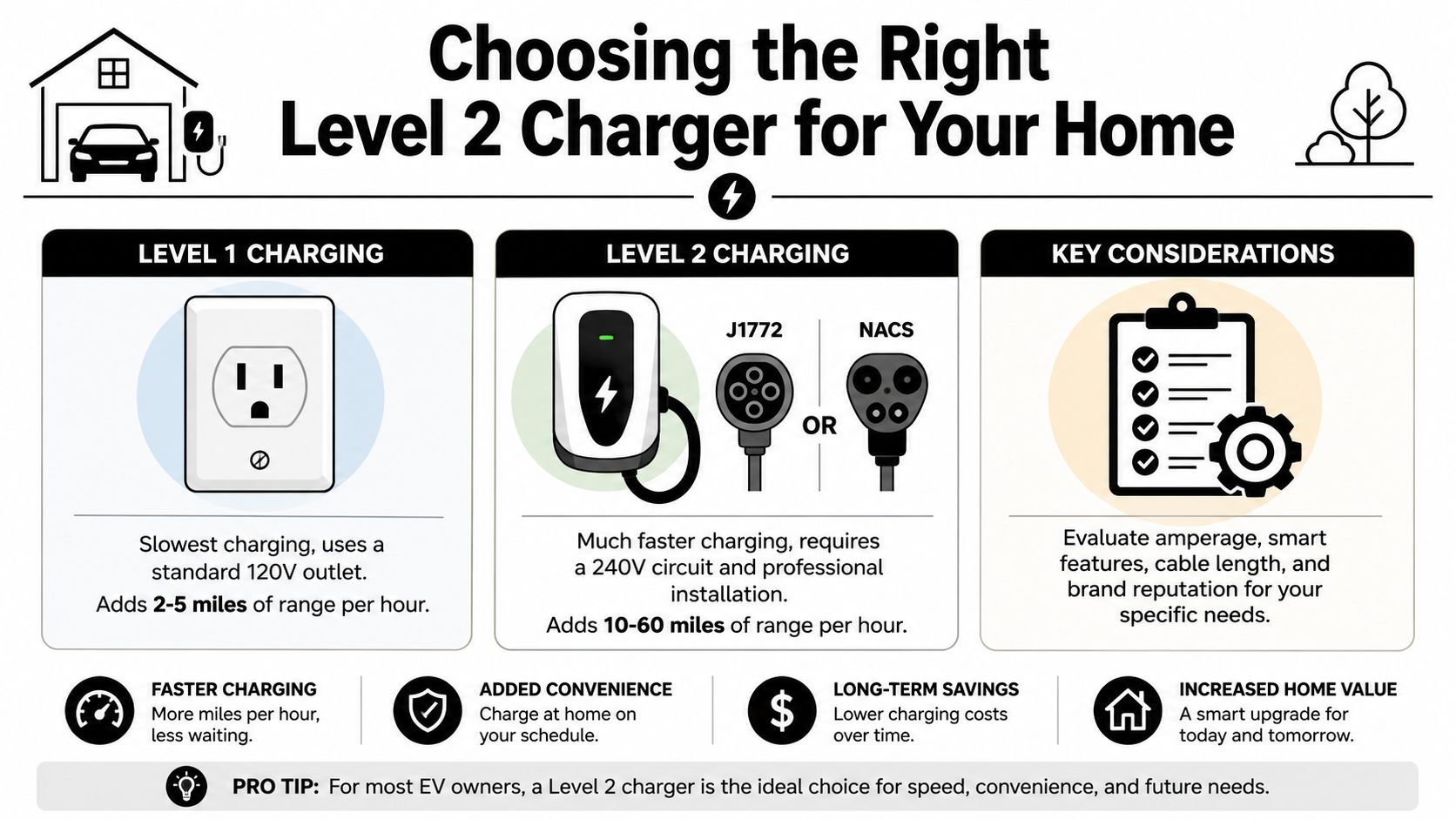
Level 1 uses a standard household outlet. It can work for very light driving, but many households outgrow it quickly because recharge times don't match real schedules, especially if the car gets used daily.
That's why Level 2 charging is the standard residential choice. It uses a dedicated 240V circuit and gives homeowners a practical overnight charging setup instead of a slow recovery process over multiple days.
Lake Worth already has a visible public charging presence. ChargeHub's local inventory showed 20 public charging station ports within 15 km, with 30 Level 2 stations and 10 Level 3 stations, and 0% free stations reported in that listing, which is a useful reminder that public charging exists locally but isn't the same as having dependable charging at home for everyday use (ChargeHub Lake Worth charging inventory).
Public charging is part of the local transportation picture. Home charging is what removes the routine friction.
How to compare Level 2 options
The right charger isn't always the highest-output one. It's the one your home can support cleanly and your daily routine can use.
Here's the practical comparison homeowners should make:
| Option | Best fit | Main advantage | Common drawback |
|---|---|---|---|
| Basic Level 1 | Very light daily driving | Uses an existing outlet | Too slow for many households |
| Mid-range Level 2 | Most homes | Strong balance of speed and electrical demand | Still needs a dedicated circuit |
| Higher-output Level 2 | Homes with strong panel capacity and heavier charging needs | Faster charging | May force harder electrical decisions |
A few buying points matter more than brand marketing:
- Amperage match: The charger should fit the available electrical capacity, not just the maximum the product can offer.
- Cable management: A longer cable can help in awkward parking layouts, but too much extra cable often becomes clutter.
- Smart features: Scheduling and energy monitoring are useful if you'll use them. If not, simple equipment can be easier to live with.
- Mounting design: The unit should suit indoor or outdoor placement without becoming an eyesore or a maintenance headache.
Plug-in versus hardwired in Florida conditions
This is one of the more important decisions in EV charger installation in Lake Worth FL. A plug-in charger can offer easier replacement later. A hardwired charger usually gives a more permanent installation and avoids relying on a receptacle connection at the wall.
In Florida conditions, especially with outdoor exposure, many electricians prefer hardwired setups for durability, security, and reduced points of failure. That doesn't make plug-in installations wrong. It just means the environment matters.
A practical option for homeowners who want help narrowing it down is to work with an installer that handles the circuit, mounting, and commissioning together. Lighthouse Energy Services is one local option that installs home EV chargers and helps homeowners match the charger type to the site and electrical layout.
Navigating Electrical Upgrades and Lake Worth Permits
The practical implementation presents the true challenge. The charger itself is usually the simple part. The hard question is whether the house can take another large continuous load without overloading the service or forcing bad compromises.
What the load calculation is really checking
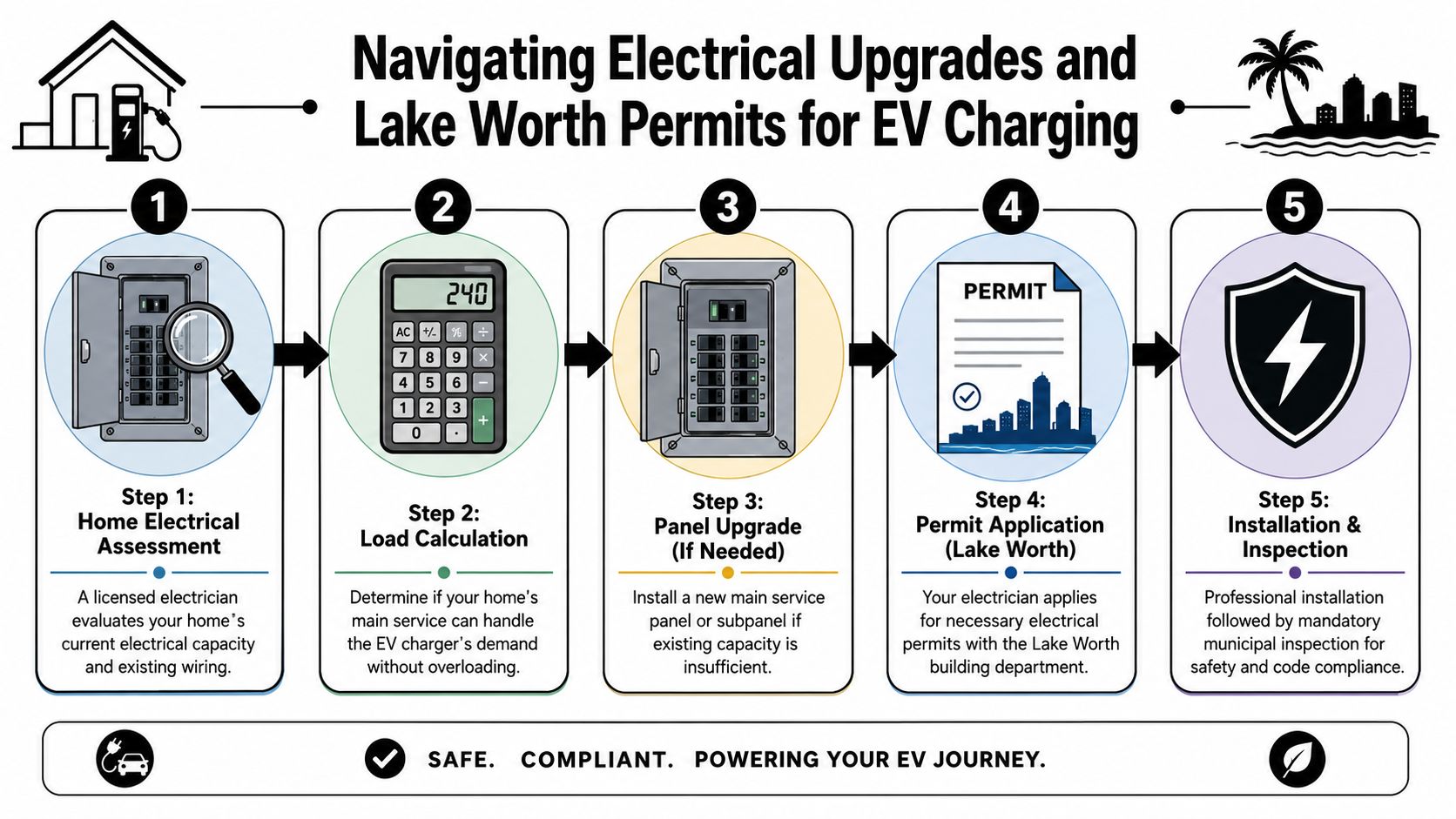
A proper load calculation is the electrician's way of answering one question safely. When the EV charger turns on, what else in the house may already be running, and can the service handle all of it together?
That matters a lot in South Florida because cooling loads are not theoretical. Air conditioning, air handlers, electric water heating, pool equipment, dryers, and cooking appliances can overlap at the same time the vehicle starts charging.
The EPA states that a dedicated EV branch circuit must be sized at 125% of the charger's continuous load, so a 40-amp charger requires a 50-amp circuit. The same EPA guidance notes that homes with 200-amp service and two open breaker spaces are often suitable for Level 2 charging, while 100-amp service may still work depending on the overall household load and panel evaluation (EPA home EV charging guidance).
That's why the panel check is never just about whether there's an empty breaker space. It's about total demand.
A panel can have room for a breaker and still be the wrong panel for the charger you want.
For homeowners who want a plain-language reference before meeting with an electrician, this overview of home EV charger requirements is useful as a general checklist. The code details differ by location, but the decision points are familiar: capacity, dedicated circuiting, protection, and safe installation.
When older South Florida panels become the bottleneck
A lot of Lake Worth homes weren't built with EV charging in mind. Some have older service equipment. Some have undergone additions over the years. Some have enough capacity on paper but become tight once you count modern appliances and cooling demand.
A 150-amp panel can often handle a Level 2 EV charger, but only after a professional load evaluation confirms the system is safe and balanced. That's a practical benchmark noted in South Florida installation guidance, and it reflects the core issue many homeowners face. The panel may work. It may need adjustment. Or it may be time to upgrade the service altogether.
For many homeowners, the most useful conversation isn't “Can I install a charger?” It's “Can I install the charger I want without replacing major electrical equipment?” Older panels and mixed appliance loads are exactly why it helps to review a panel upgrade guide for residential electrical capacity before approving the work.
Some houses can avoid a full upgrade with smarter load handling. Others can't, and pretending otherwise only delays the cost until after the project has started.
How the permit process usually unfolds
Permits frustrate homeowners because they sound like paperwork without value. In reality, the permit and inspection process protects you from hidden shortcuts.
A compliant install usually follows this sequence:
- Site visit and load review to confirm the electrical design.
- Permit submission for the new circuit and associated electrical work.
- Installation of breaker, wiring method, charger mounting, and final terminations.
- Inspection so the work is reviewed for code compliance before the project is considered complete.
- Commissioning to confirm the charger powers up and operates correctly.
Common permit-related delays are simple things. Incomplete scope descriptions, panel issues discovered mid-project, and installations that were originally quoted without enough attention to route, grounding, or available capacity.
If an electrician treats the permit like an annoyance, that's a warning sign. For EV charging, permits and inspection aren't extra. They're part of doing the job correctly.
Estimating Your Total Installation Cost and Incentives
The number homeowners ask for first is the installed price. The better question is what kind of installation you have, because EV charger projects look similar from the driveway and very different once the electrical details are reviewed.
Florida-oriented contractor guidance puts typical residential EV charger installation pricing at $1,000 to $2,500 excluding the charger itself, with cost changes driven by trenching, panel upgrades, and the distance from the service panel to the parking spot (residential EV charger installation cost guidance).
What drives the quote up or down
A straightforward garage job with a nearby panel lands very differently than an outdoor charger mounted far from the service equipment. Labor, material, and permit scope all move with the layout.
The biggest cost drivers are usually:
- Circuit length: Longer wire runs increase labor and material.
- Routing difficulty: Attic access, masonry walls, finished spaces, and exterior paths all add time.
- Trenching needs: If the charger location requires underground routing, the project gets more involved quickly.
- Panel condition: If the panel is full, outdated, or short on capacity, the charger install may trigger additional electrical work.
- Mounting environment: Outdoor placement often needs more attention to durability and weather exposure.
That's why two neighbors can buy the same charger and get very different proposals.
What to ask for in a written estimate
A useful estimate should break the project into understandable parts. Homeowners don't need trade-level terminology for every line item, but they should know what is and isn't included.
Ask for clarity on these points:
- Scope of electrical work: Is it only the branch circuit and charger mounting, or does the quote assume panel modifications too?
- Permit handling: Confirm who pulls the permit and whether inspection coordination is included.
- Charger supply: Are you buying the charger separately, or is the unit included in the proposal?
- Surface restoration: If wall finishes or patching are affected, ask what gets restored and what doesn't.
- Change-order triggers: Ask what conditions could raise the final cost after work begins.
The cheapest quote is often the one that assumed the fewest obstacles.
How to approach incentives without guessing
Homeowners often hear about tax credits, utility rebates, and charger programs, then assume every project qualifies automatically. That's where confusion starts.
The practical approach is simple. Ask your installer what documentation you'll receive, keep the final invoice and permit records, and confirm any current incentive details directly with the program administrator before you rely on savings in your budget.
Incentives can help, but they should be treated as a bonus, not as the only reason the project pencils out. The installation still has to make sense based on your daily charging needs, your home's electrical capacity, and the actual scope of work.
What to Expect on Your EV Charger Installation Day
By installation day, the important decisions should already be made. The charger location is set, the circuit design has been reviewed, and any permit steps should already be in motion. What's left is execution.
The work sequence at the house
A typical residential install starts with the electrician confirming the route, the mounting height, and the panel work one more time before tools come out. That final check matters because small field conditions, like hidden obstructions or a cleaner conduit path, can still improve the result.
Then the crew usually works through the job in a predictable order:
- Power is managed safely at the panel before any circuit work begins.
- Conduit or cable path is installed from the service equipment to the charger location.
- A dedicated breaker and branch circuit are completed to match the charger requirements.
- The charger is mounted and terminated according to the equipment listing and site conditions.
- The unit is tested and commissioned so the homeowner knows it powers up, charges properly, and is ready for use.
The homeowner experience should feel organized, not chaotic. You should know where the crew will be working, whether power interruptions are expected, and when the walkthrough will happen.
How to make the day go smoothly
A little prep makes the install cleaner and faster. Clear the area around the panel, the parking space, and any access points to attics, gates, or side yards. If the charger is going in the garage, move stored items away from the wall where work will happen.
If your home has a 150-amp panel, don't assume that means the charger decision is already settled. Professional guidance notes that a 150-amp panel can often support a Level 2 charger, but only after a proper load evaluation confirms the entire system remains safe and balanced. That review is a core part of a code-compliant installation, not a formality.
A good installer also finishes with a homeowner handoff. You should be shown how to start and stop charging, how the breaker is identified, and what to do if the charger ever faults or loses power.
Why a Licensed 24/7 Electrician in Lake Worth Matters
An EV charger is a permanent electrical load tied directly into your home's service. If the installation is wrong, the problem doesn't stay inside the charger. It can affect breaker performance, conductor heating, nuisance tripping, equipment life, and your confidence every time you plug in.
The risks aren't limited to the charger
The hardest part for many homeowners is understanding whether an older panel can support EV charging without forcing a costly service upgrade. That's a real issue, not a sales line. Experienced contractors can assess the panel and, in some cases, use load-management approaches when appropriate. Generic guides often skip that practical question, even though it's central to the job.
This is where licensing and local experience matter. The installer needs to recognize signs of an overloaded service, incompatible equipment, poor prior modifications, or a circuit plan that looks acceptable on paper but won't age well in a South Florida home.
A qualified electrician also protects you from the softer failures. Bad charger placement, exposed conduit in the wrong location, outdoor hardware that doesn't suit the site, or a setup that works until summer cooling load rises.
What qualified local help should actually do
Don't judge the electrician only by whether they say yes to the job. Judge them by how they evaluate the house.
A capable installer should:
- Inspect the panel: Not just for spare spaces, but for real capacity and condition.
- Discuss routing options: Including what looks cleaner, what costs less, and what will hold up better outdoors.
- Handle permit and inspection requirements: Without asking you to guess your way through local process.
- Explain charger operation clearly: So you understand the equipment after installation, not just before it.
- Stand behind emergency support: Because electrical issues don't always show up during business hours.
If you want a broader homeowner reference on screening technical contractors, this guide to vetting wiring specialists is a useful reminder to look past price and ask about licensing, scope clarity, and job-specific experience. For local electrical work, you should also confirm the company is a licensed electrical contractor in Palm Beach County.
When a homeowner calls about EV charger installation in Lake Worth FL, the actual need usually isn't just “install this box.” It's “tell me whether my house can support this safely, what it will take to do it right, and who answers if something goes wrong later.”
If you're planning a home charger and want a clear answer on panel capacity, permitting, routing, and installation scope, Lighthouse Energy Services can help you evaluate the property and complete the work safely.