
You brought the EV home, parked it in the driveway or garage, and then the practical question hit. How are you going to charge this thing every day without turning every week into a hunt for an open public station?
That's where most Greenacres homeowners are right now. The car is new. The charging habits are not. You might be getting by on the cord that came with the vehicle, or you may already know that plugging into a standard outlet isn't going to fit your routine for long.
In Greenacres, this isn't some far-off trend anymore. The city has already put free EV charging stations at City Hall and the Community Center, with 4 charging ports at each site for a total of 8 public ports, and users activate them through the ChargePoint app as part of a managed network, according to the City of Greenacres announcement on public EV charging. That matters because it tells you something simple. EV charging is already part of daily life here.
Home charging is still where convenience lives. A proper installation means you leave each morning with the car ready, you stop planning your errands around charging, and you avoid the common mistake of treating an EV charger like just another appliance. It isn't. It's a high-draw piece of electrical equipment that has to match your panel, your service, and your property layout.
Table of Contents
- Your New EV Is Here So Whats Next for Charging
- Choosing Your Charger Level 1 vs Level 2 vs DC Fast Charging
- Is Your Electrical Panel Ready for an EV Charger
- Navigating Permits and the Installation Process in Greenacres
- Understanding EV Charger Installation Costs and Timelines
- How to Hire a Qualified Electrician for Your EV Charger
Your New EV Is Here So Whats Next for Charging
The first week with an EV is usually a mix of excitement and small surprises. The driving feels different in a good way. The charging routine usually needs work.
Most homeowners start by using the cord that came with the car. That can work as a short-term bridge, especially if you don't drive much each day. But for most households in Greenacres, it becomes obvious pretty fast that home charging needs to be simpler, faster, and more dependable.
Why home charging changes the ownership experience
A home charger turns the car into something you maintain in the background, the same way you handle your phone overnight. You park, plug in, and move on with your evening.
That's why Level 2 charging becomes the standard choice for most owners. It fits normal household schedules better than relying on public stops, and it gives you a dedicated setup built around your home instead of somebody else's parking lot.
Public charging is helpful. Daily charging at home is what makes EV ownership feel easy.
Greenacres already has visible proof that local demand is real. The city didn't stop at talking about EV infrastructure. It installed working public stations at City Hall and the Community Center, and that local footprint signals that EV charger installation in Greenacres FL is already moving from niche upgrade to normal electrical work.
What usually works and what usually doesn't
Some approaches hold up well over time:
- A charger placed near your normal parking spot: Shorter wire runs, cleaner installation, less hassle every night.
- A panel review before equipment is purchased: This avoids buying a charger that your home can't support without changes.
- A permitted installation: It protects safety, resale, and insurability.
Other approaches create headaches:
- Treating the charger like a simple plug-in gadget: It's a dedicated electrical load, not a convenience outlet.
- Picking the charger before checking panel capacity: That's how projects stall.
- Relying on public charging as the main plan: It works for some drivers, but most households eventually want charging where they live.
The practical path forward
For most homes, the process comes down to three decisions. Choose the right charging level. Confirm the panel can handle it. Install it legally and cleanly.
If those three pieces are handled right, the rest is straightforward.
Choosing Your Charger Level 1 vs Level 2 vs DC Fast Charging
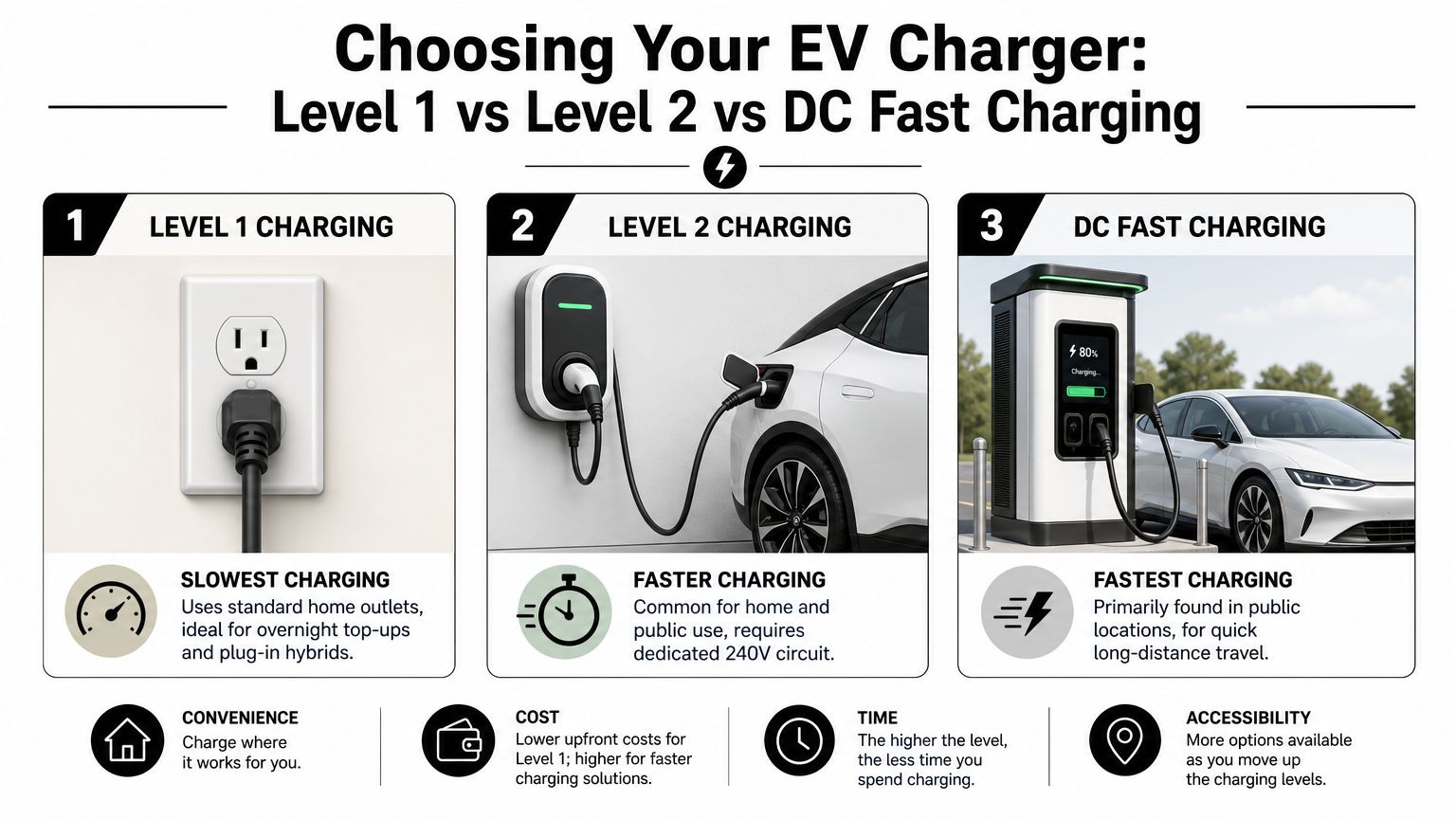
The charging level matters more than the charger label on the box. Homeowners usually hear three terms. Level 1, Level 2, and DC fast charging. Only one of those is the normal answer for a house.
Florida's broader charging market shows why this decision matters now. The state has more than 6,800 Level 2 charging stations, more than 2,200 DC fast-charging locations, and over 9,000 public charging ports statewide. Nationally, charging ports also grew by more than 55% in 2021, according to Florida and national EV charging statistics summarized by Qmerit. Charging access is growing fast, but home equipment still has to match residential electrical reality.
What each charging type means at home
Level 1 uses a standard household outlet. It's the simplest setup because there's often no new equipment to install right away. The trade-off is speed. It's usually best as a temporary plan, a light-use solution, or a backup option.
Level 2 uses a dedicated 240V circuit. This is the setup most homeowners want once they settle into EV ownership. It's much better suited for routine charging, overnight recovery, and households that drive consistently.
DC fast charging is a different category. It's built for public and commercial use, not a normal house. When people ask for a “fast charger” at home, what they usually mean is Level 2.
A simple way to choose
Use this comparison as a practical filter:
| Feature | Level 1 | Level 2 | DC Fast Charging |
|---|---|---|---|
| Power source | Standard household outlet | Dedicated 240V circuit | Commercial-grade electrical service |
| Typical use | Temporary or light daily use | Normal home charging | Public quick charging |
| Installation need | Minimal or none at first | Professional electrical installation | Not a typical residential option |
| Best fit | Low-mileage households | Most homeowners | Highway, fleet, retail, travel corridors |
Here's the plain answer from the field. If you own a home in Greenacres and want reliable daily charging, Level 2 is usually the right target.
Practical rule: If charging speed affects your schedule, Level 1 usually won't stay your main solution for long.
That doesn't mean every Level 2 installation is identical. Garage parking, driveway layout, panel location, and charger placement all affect the final scope. A charger mounted near the panel is usually simpler than one on the far side of the home. Outdoor installs can be done cleanly, but they need thoughtful routing and weather-ready materials.
The main mistake is shopping by marketing language instead of by electrical fit. Start with your home, not the packaging.
Is Your Electrical Panel Ready for an EV Charger
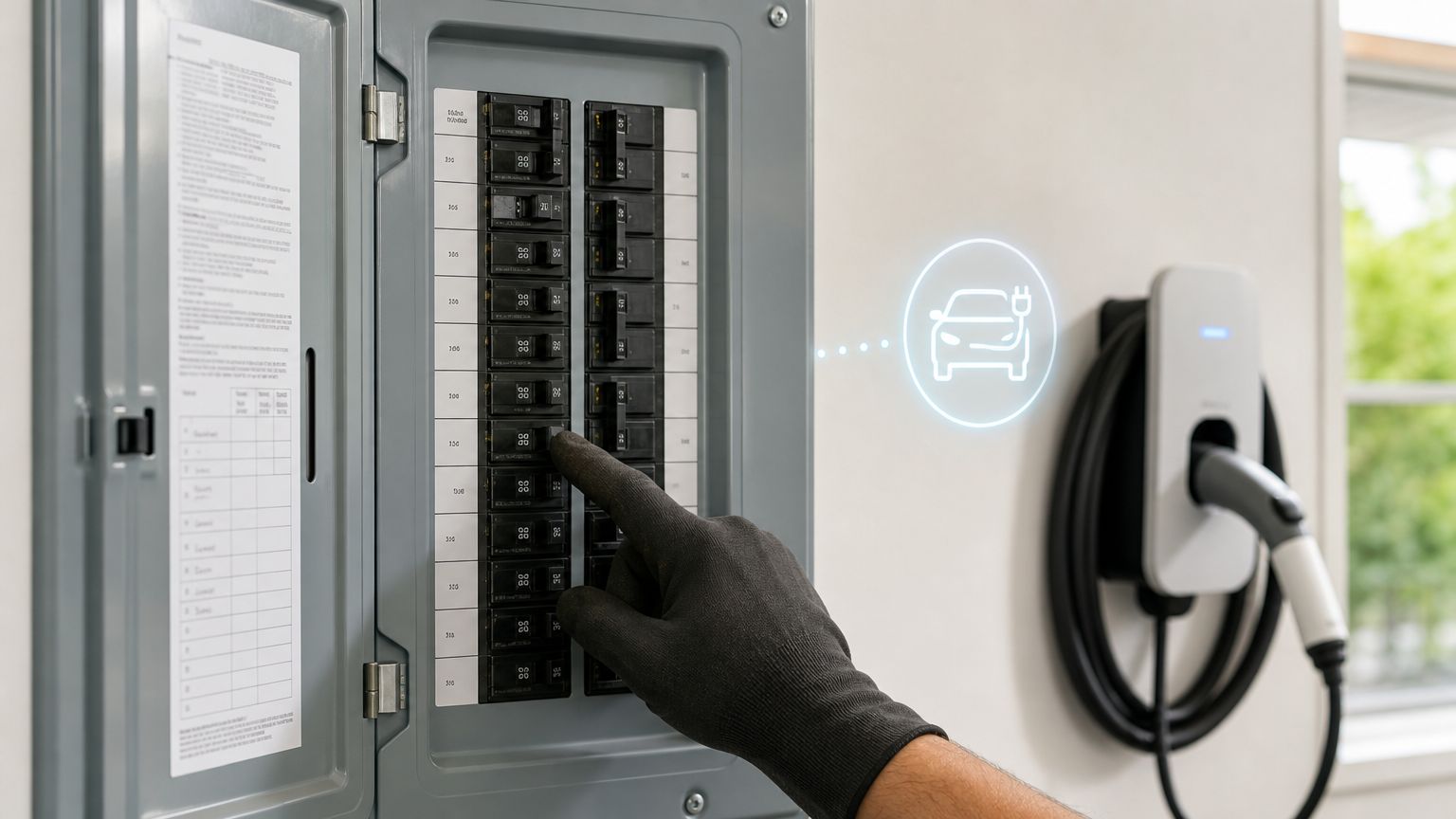
The charger gets the attention. The electrical panel decides whether the project goes smoothly.
A lot of homes in Palm Beach County have enough room for an EV charger. A lot of homes also look fine at first glance and then run into a real capacity issue once the load is calculated. That's especially true in older houses, homes with major electric appliances, and properties that have already had additions or modifications over the years.
Why the panel matters more than the charger brand
From an electrician's side, the panel review comes before almost everything else. The charger may be mounted on the wall, but the actual job starts back at the service equipment.
A recent EV charging overview noted that global electricity demand from EVs reached about 130 TWh in 2024, up roughly 33% year over year, which reinforces a basic installation truth. Charging load is growing, and homes need proper planning before another high-draw circuit is added, as discussed in this overview of EV charging load and panel capacity concerns.
That broader demand trend shows up locally in a simpler form. If your home is already carrying air conditioning, water heating, cooking equipment, laundry, and pool equipment, an EV charger can push a marginal panel into upgrade territory.
What an electrician checks before approving the install
A proper pre-install review usually includes these points:
- Available capacity: Can the existing service handle another sustained load safely?
- Breaker space: Is there room for the required circuit, or is panel reconfiguration needed?
- Distance to charger location: Longer runs can add labor, conduit, and routing complexity.
- Mounting conditions: Garage wall, exterior wall, carport post, and detached structures all change the installation method.
- Existing panel condition: Corrosion, poor labeling, overcrowding, or prior unpermitted work can stop the project until corrected.
If the panel is borderline, the wrong move is forcing the charger in and hoping nuisance trips are the only problem.
The right move is a load calculation. That's the step many homeowners don't hear about until they're already deep into the project. It's also the step that prevents bad estimates and surprise changes.
If you want a clearer sense of what a service upgrade can involve before installing a charger, this electrical panel upgrades guide gives a useful homeowner-level overview.
In practice, there are usually three outcomes. The panel has room and the install is straightforward. The panel can support the charger with a smaller or more carefully planned setup. Or the service needs some level of upgrade before a charger makes sense.
None of those outcomes is unusual. The mistake is skipping the check.
Navigating Permits and the Installation Process in Greenacres
Most homeowners aren't worried about mounting the charger itself. They're worried about the unknowns. Who pulls the permit, what the city expects, how long the job takes on site, and what happens if the inspector wants changes.
The good news is that EV charger installation in Greenacres FL follows a pretty standard electrical path when the job is handled correctly. The key is doing the planning before anybody starts drilling holes or opening the panel.
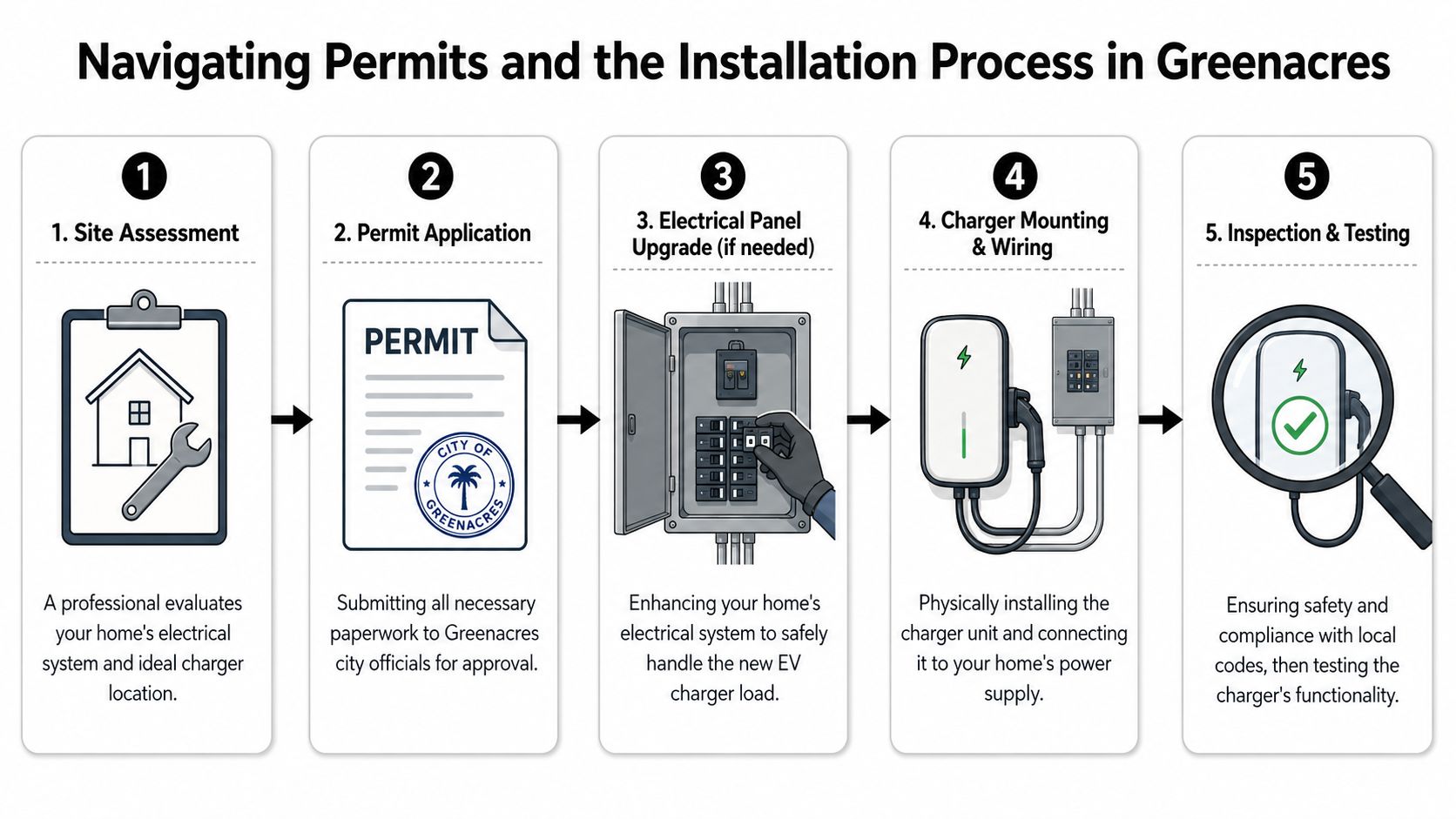
A compliant Level 2 EV charger installation in Florida requires a dedicated 240V circuit, typically 40A, 50A, or 60A, and the standard workflow includes a load calculation, site evaluation, permit filing, and a final inspection, according to Florida guidance on Level 2 EV charger installation workflow.
What happens before installation day
The first visit is usually a site assessment. During this assessment, the electrician confirms the parking location, panel condition, wire path, mounting surface, and whether any upgrades may be needed.
After that, the permit gets handled. In a properly run job, the contractor takes care of that process and coordinates with the city for the electrical work being performed. If you're evaluating contractors, this is one of the easiest ways to separate experienced operators from people who mostly do small handyman-style work. A contractor familiar with local permitting should already understand the documentation and inspection flow. This guide to government approved electrical contractors is a good reference point for what to look for.
What happens during the actual install
Installation day depends on the layout of the property. In a simple garage install, the crew may only need to mount the charger, run the dedicated circuit, terminate conductors, label the breaker, and test the unit. On a more complex house, they may need to route conduit across longer distances, work through masonry, or install additional equipment to support the charger safely.
The dedicated circuit is essential. That point matters because shared circuits cause problems. When a charger competes with other loads, nuisance tripping and inconsistent performance show up fast.
A clean installation usually includes:
- Panel shutdown and safety verification
- Routing the branch circuit from panel to charger location
- Mounting the charger or receptacle in the approved location
- Making up terminations and breaker connections
- Testing charger operation and confirming basic functionality
A neat conduit run and a properly labeled breaker panel tell you a lot about the quality of the work.
Inspection and closeout
After the electrical work is complete, the final piece is inspection. That step confirms the installation meets code requirements and matches the permitted scope.
Homeowners sometimes want to skip permitting because they assume it only slows things down. In practice, unpermitted work usually creates more risk than convenience. It can complicate insurance questions, future home sales, and any later electrical modifications.
A permitted install gives you a documented, inspectable charging setup that belongs with the house. That's the right way to treat a permanent electrical upgrade.
Understanding EV Charger Installation Costs and Timelines
This is the part many want answered first. What's it going to cost, and how long is it going to take?
There isn't one honest flat number for every Greenacres home. A charger install can be simple, or it can uncover panel limitations, long wire runs, awkward mounting conditions, or code corrections that change the scope. The right way to think about cost is by category, not by a one-size-fits-all quote.
What changes the price
The final price usually comes from a few moving parts:
- Charger equipment: Some homeowners already own the charger. Others still need to buy one that matches their vehicle and desired features.
- Labor and installation complexity: A panel close to the parking area usually means a cleaner job. A long run across the house, through finished areas, or to an outdoor driveway raises labor.
- Permit and inspection requirements: These are part of doing the project legally.
- Electrical upgrades if needed: The biggest swing factor is whether the existing service can handle the new load without modification.
The expensive surprises usually don't come from the charger itself. They come from what's behind the wall. Limited panel headroom, worn equipment, or an old service setup can shift a straightforward install into a broader electrical project.
How long the project usually takes
The clock starts with the site visit, not the day the charger goes on the wall. A normal timeline includes estimate review, permit handling, scheduling, installation, and final inspection.
Some jobs move quickly because the panel has room, the charger location is close, and the city review is routine. Others take longer because the scope changes after the load review or because additional electrical work has to happen first.
A few practical timing points help homeowners plan better:
- Don't schedule around the charger arrival alone: The equipment can be in your garage while the permit is still pending.
- Expect the panel review to drive the schedule: If upgrades are needed, that becomes the controlling step.
- Ask who handles inspection coordination: A professional contractor should make that clear upfront.
The best quotes are rarely the fastest-sounding ones. They're the ones that spell out what's included, what could change, and what conditions would trigger added work. That kind of estimate is more useful than a low number that falls apart as soon as the panel cover comes off.
How to Hire a Qualified Electrician for Your EV Charger
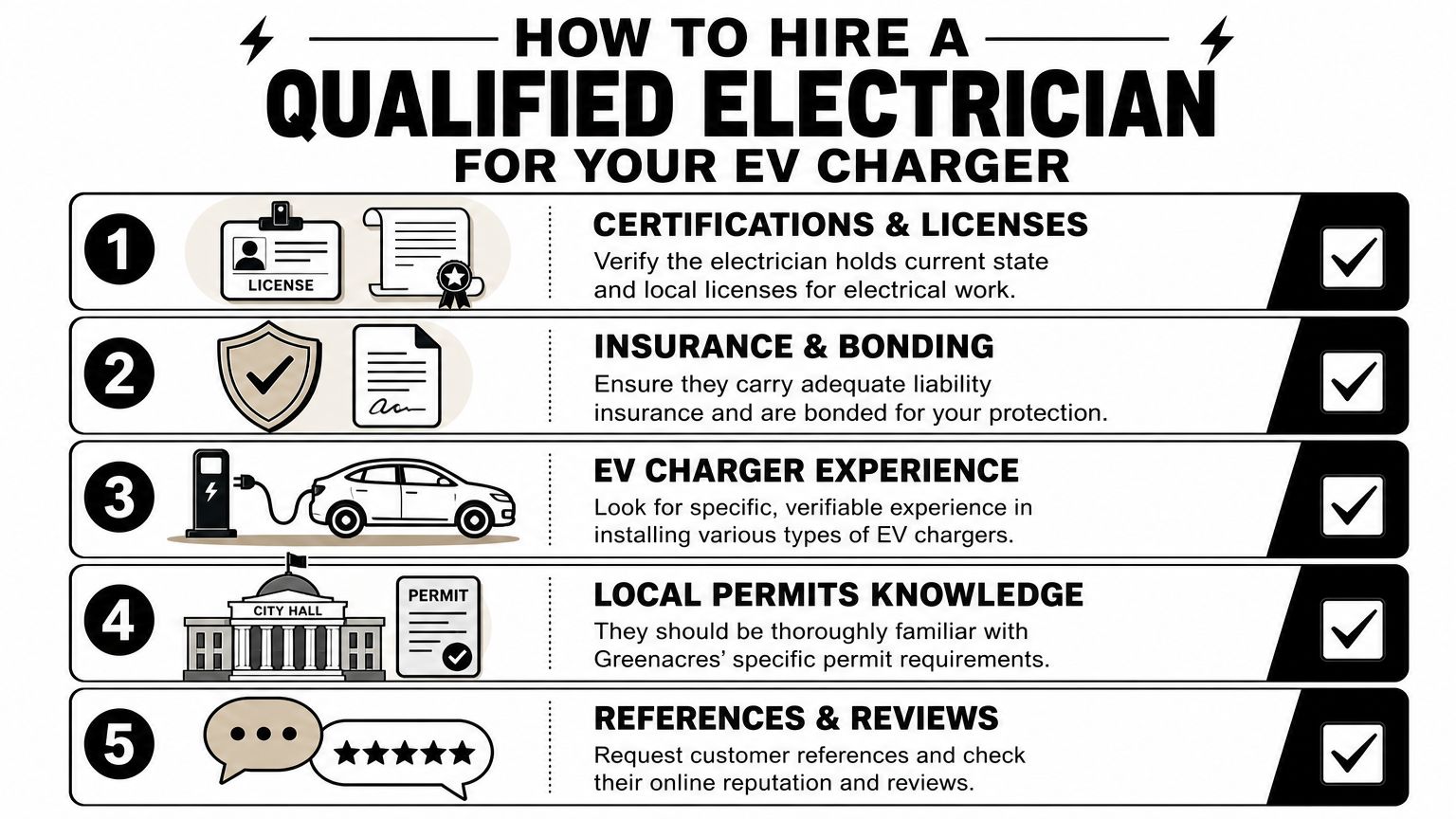
A charger install isn't the place to hire on guesswork. You want somebody who understands residential load calculations, local permit flow, code-compliant installation methods, and the practical realities of Palm Beach County homes.
The easiest way to protect yourself is to ask direct questions and pay attention to how direct the answers are.
Questions worth asking before you sign anything
Use a short list and keep it practical.
- Are you licensed and insured for this type of electrical work? If the answer is vague, keep looking.
- Will you perform a load calculation before finalizing the install plan? That should be standard, not optional.
- Who pulls the permit and who schedules inspection? The homeowner shouldn't be left sorting that out alone.
- What happens if the panel doesn't have enough capacity? A serious electrician will explain the possible paths clearly.
- Will the quote separate base installation from possible upgrade work? That protects you from confusion later.
You can also compare their communication style. Good electricians explain the job in plain language. They don't hide behind jargon, and they don't rush past limitations in your existing system.
If somebody promises a charger install without asking about panel space, service capacity, or parking location, they're skipping the part that matters.
For a broader homeowner checklist, this guide on hiring a new home electrician is worth reviewing before you start calling around.
What solid local service looks like
In this area, good service usually looks the same across well-run jobs. The electrician shows up when scheduled, inspects the actual conditions before quoting final scope, explains whether the charger needs a hardwired setup or a receptacle-based setup, and handles permitting without making it your problem.
Clear pricing matters too. So does availability when something changes. If the inspection raises an issue or the existing panel needs correction, you want a contractor who can finish the electrical side of the project instead of bouncing you to someone else.
One local option homeowners may consider is Lighthouse Energy Services, which provides EV charger installation as part of its residential electrical work in Palm Beach County.
The right hire isn't the person who makes the job sound effortless. It's the person who knows where the trouble spots are, tells you the truth about them, and installs the charger so you don't have to think about it again every night after that.
If you're planning EV charger installation in Greenacres FL and want a straight answer on panel capacity, permitting, charger placement, and the full scope before work starts, contact Lighthouse Energy Services. A proper site review now can save you from the usual delays, rework, and electrical surprises later.