
You bought the EV, parked it in the garage, and then the first real question hit you. How are you going to charge it every day without planning your week around public stations, extension cords, or a slow outlet that barely keeps up?
That's where most Delray Beach homeowners start. The car is easy. The charging setup is where critical electrical decisions begin, especially if your home is older, your panel is already busy, or your HOA has opinions about anything mounted outside.
A proper EV charger installation in Delray Beach FL isn't just about hanging a box on the wall. It's about matching the charger to your driving habits, confirming your service can handle the load, pulling the right permit, and installing equipment that holds up in South Florida conditions. If you do it right the first time, charging becomes routine. If you rush it, the hidden problems show up later as tripped breakers, inspection issues, or a charger location that's inconvenient every single day.
Table of Contents
- Powering Your Drive in Delray Beach
- Level 1 Level 2 and DC Fast Charging Explained
- What to Check Before You Call an Electrician
- Required Electrical Upgrades for Your EV Charger
- Navigating Delray Beach Permits and HOA Rules
- Understanding Installation Costs Timelines and Obstacles
- Why Choose a Certified Delray Beach Electrician
Powering Your Drive in Delray Beach
A lot of homeowners call after trying to make public charging work for a few weeks. They've got a new routine. Plug in when they're out, top off when they can, maybe use the charger that came with the car at home. Then reality sets in. Convenience matters more than they expected.
Delray Beach isn't guessing about EV demand anymore. ChargeHub's Delray Beach charging data lists 104 public charging station ports within 15 km, with 58% of those ports being Level 2 and 40% offering free charging. The same source notes a local charging mix that includes major networks such as Tesla and FPL Evolution. That matters because it tells you something practical. EV drivers are already here, charging behavior is established, and home charging is part of a real local ecosystem, not a future maybe.
Why home charging still matters
Public charging helps, but most homeowners don't want to depend on it for everyday use. You want to come home, plug in, and wake up ready to drive. That's the whole point.
The best home setups are boring in the best way. The charger is mounted where the cable reaches comfortably. The panel has been checked correctly. The permit and inspection are handled. Nothing trips. Nothing overheats. Nobody has to think about it.
Practical rule: The right charger in the wrong location becomes an annoyance fast. Cable reach and parking position matter more than most homeowners expect.
What a solid installation process looks like
From a trade standpoint, the job usually comes down to a few real decisions:
- Charger type: Most homes don't need anything exotic. They need a charger that fits daily use.
- Panel capacity: Many projects change direction due to this.
- Mounting location: Garage, carport, side wall, or driveway edge all create different wiring and weather concerns.
- Local approval: In Delray Beach, the paperwork side matters as much as the wiring side.
If you want a general homeowner overview before getting into the local details, the EVChargers.eu installation guide is a useful plain-English primer. The local version of that conversation is what matters next, because Delray Beach homes, panels, and HOA requirements don't all behave the same way.
Level 1 Level 2 and DC Fast Charging Explained
People often use the word “charger” as if every charger does the same job. It doesn't. In practical terms, think of the three charging levels like water flow.
Level 1 is a trickle hose.
Level 2 is a garden hose.
DC fast charging is a fire hose.
That's the simplest way to understand what belongs at home and what doesn't.
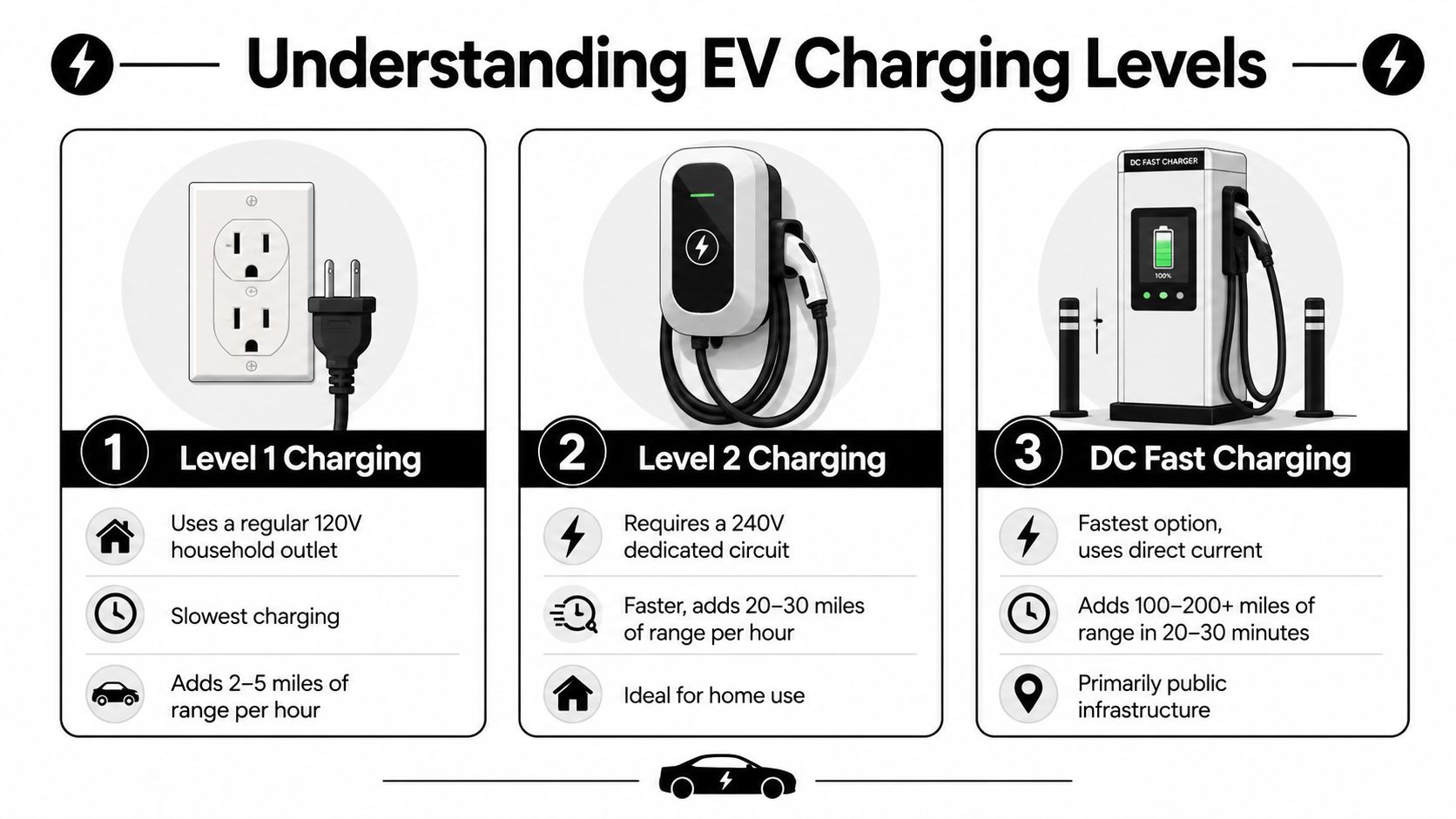
Level 1 works, but it tests your patience
Level 1 uses a standard household outlet. For some drivers, that's enough. If you drive short distances, have long parked hours, and don't mind slow recovery, it can get by.
The problem is consistency. If your daily driving goes up, or you forget to plug in one night, you can spend days catching back up. Homeowners usually reach out for installation when they realize Level 1 leaves too little margin.
Level 2 is the normal answer for homeowners
Level 2 is typically what is understood when a home charger is requested. It uses a 240 V connection and charges much faster than a standard outlet. More important than speed, it gives you predictability. You plug in overnight and the car is ready again.
That's why Level 2 is usually the sweet spot in residential work. It's fast enough to make ownership easy, but still realistic for a home electrical system when installed correctly.
Here's the practical comparison:
| Charging type | Best use | Power setup | Home fit |
|---|---|---|---|
| Level 1 | Light daily driving | Standard household outlet | Acceptable, but slow |
| Level 2 | Daily home charging | Dedicated 240 V circuit | Best fit for most homes |
| DC fast charging | Travel and quick public charging | High-power commercial infrastructure | Not a typical residential option |
Homeowners rarely regret installing Level 2. They do regret waiting too long and trying to make Level 1 do a Level 2 job.
DC fast charging is not a normal house project
DC fast charging belongs in public and specialized commercial environments. It's built for high-speed turnaround, not ordinary residential service. If your goal is charging at home in a safe, code-compliant way, the conversation almost always centers on Level 2.
That's where good decisions start. Not with the biggest unit available, but with the one your home can support and that fits your daily routine.
What to Check Before You Call an Electrician
A little prep saves time and avoids a lot of back-and-forth. Before you schedule an estimate, walk your property like an electrician would. You don't need to diagnose anything. You just need to notice the details that affect the job.
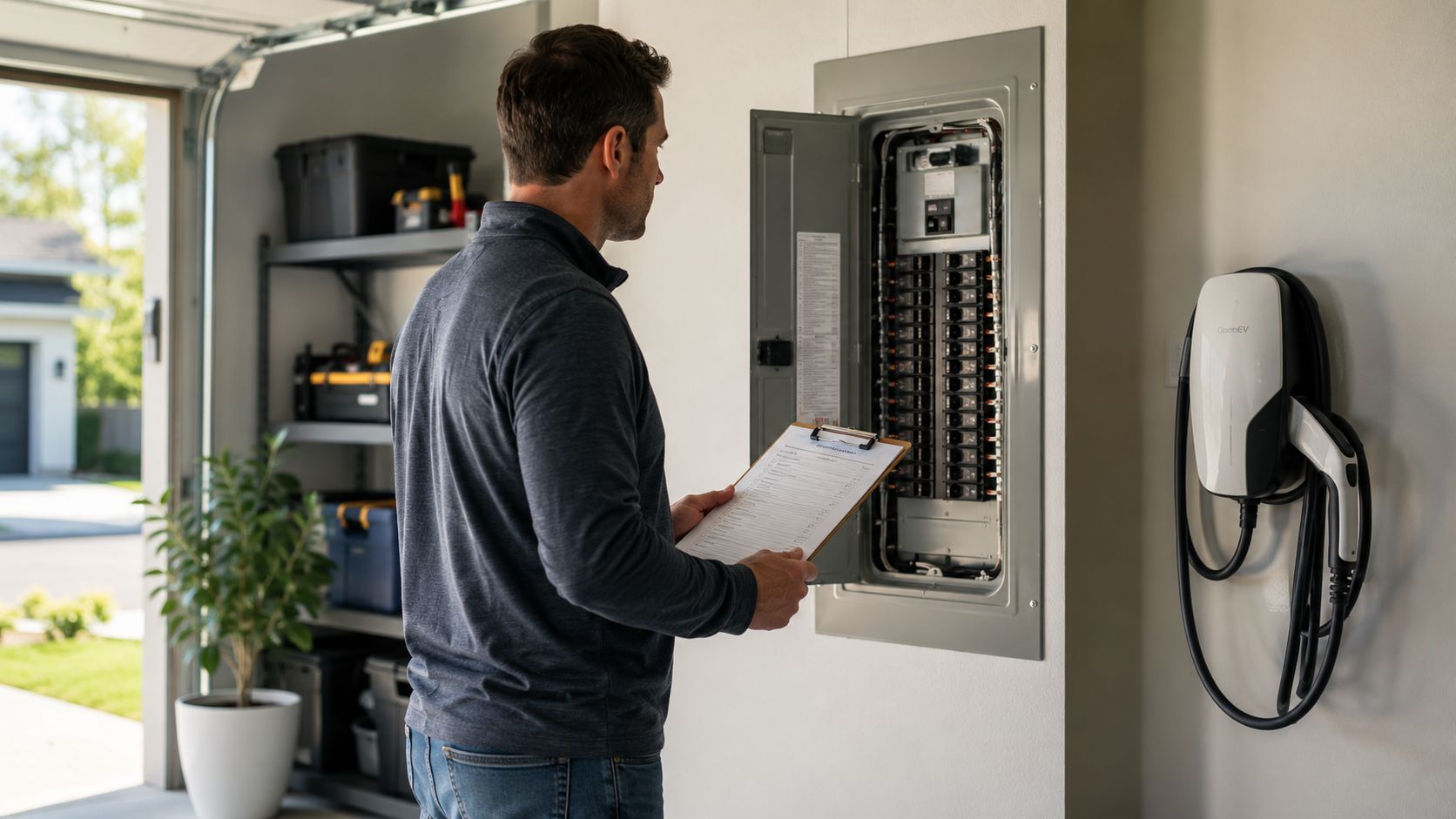
Start at the electrical panel
Find the main panel and open the door. Look for the service rating label. Homeowners usually see something like 100A, 150A, or 200A. Then look at breaker space. A packed panel doesn't automatically kill the project, but it changes the approach.
If you're not sure whether your existing service is enough, this guide on when 150 amp service is plenty and when it's not gives homeowners a useful baseline before an electrician performs a formal load review.
Check the actual parking reality
Stand where the vehicle normally parks. Then ask simple questions that people often skip:
- Cable reach: Will the charging cable comfortably reach the vehicle port without stretching across a walkway?
- Mounting surface: Is there a solid wall where the charger can be mounted, or will the job need a pedestal or alternate support?
- Daily routine: Do you back in, pull in, or switch parking spots depending on who gets home first?
A charger that looks good on paper can be awkward every day if it's mounted on the wrong side of the garage.
Measure what affects labor
You don't need exact construction drawings. Rough field notes are enough.
- Distance from panel to charger location: Longer runs usually mean more conduit, more wire, and more labor.
- Indoor or outdoor path: Exterior routing changes material choices and installation method.
- Access issues: Attic access, finished walls, pavers, detached garages, and blocked work areas can all change the job.
If the shortest wire path creates the worst user experience, it's often better to spend a little more on routing and get a charger location you'll actually like.
Don't forget the smart features
Many homeowners want app-based scheduling, usage tracking, or notifications. If that matters to you, check the Wi-Fi signal where the charger will go. Weak signal doesn't stop installation, but it can make a smart charger feel unreliable even when the electrical work is perfect.
Bring photos when you call. A clear panel photo, the parking area, and the proposed charger wall can answer half the questions before the first truck shows up.
Required Electrical Upgrades for Your EV Charger
The charger itself is usually the easy part. The hard part is whether the house can support it safely.
For Level 2 EV charger installations, the main constraint is often the load on the service panel, not the charger hardware. A 240 V Level 2 installation is typically treated as major electrical work that requires a permit, a licensed electrician, a dedicated circuit, and a load calculation. A practical benchmark noted in this overview of EV charger installation requirements is that modern homes are often expected to have at least a 200 A service when adding EV charging. The same source notes that commercial properties may need 200 A, 400 A, or higher, and installations over 60 A or above 150 V to ground may require a visible disconnect near the unit. For outdoor work, equipment and wiring should be rated for wet exposure, commonly NEMA 3R, 4, or higher.
What a dedicated circuit actually means
A dedicated circuit means the EV charger gets its own breaker and its own circuit path. It isn't sharing power with a dryer, water heater, or a bunch of garage receptacles. That separation matters because EV charging is a continuous electrical load, not a short burst like a microwave.
When people cut corners here, the problems are predictable. Breakers nuisance-trip. Conductors run hotter than they should. Future service work becomes confusing because the panel labeling doesn't match what was installed.
Why load calculation decides the job
A proper load calculation tells you if the existing service can carry the added demand without overstressing the panel. That's not guesswork and it's not something you settle by saying, “We've still got a couple of open breaker spaces.”
Breaker space and service capacity are not the same thing.
Some homes need no upgrade at all. Others need panel modifications, a subpanel strategy, or a full service upgrade before the charger makes sense. If you're already running heavy HVAC loads, pool equipment, kitchen appliances, and electric water heating, the answer can shift quickly. Homeowners looking at that possibility should review electrical panel upgrade options before deciding where the charger fits.
Outdoor installations need Florida-ready materials
Exterior charger installs have to survive heat, rain, humidity, and hose-down conditions near driveways and garages. That means weather-rated enclosures, proper fittings, suitable conduit, and cable protection that holds up outside.
A charger mounted outdoors with indoor-grade assumptions is one of the fastest ways to create callbacks, corrosion, and avoidable safety issues.
This is why EV charger work belongs in the category of serious electrical upgrades, not handyman projects.
Navigating Delray Beach Permits and HOA Rules
A clean electrical install can still stall if the paperwork side isn't handled properly. In Delray Beach, homeowners usually run into two gatekeepers before the charger is fully approved. The city permit process and the HOA review process.
The local government already treats EV charging as part of its public-use infrastructure, not a novelty. The City of Delray Beach EV charging page reports 19 free public EV charging stations in downtown alone, including locations such as the Banker's Row parking lot, the North end of the City Hall parking lot, the Delray Beach Tennis Center parking lot, the old School Square parking lot, and Miller Park. The city also enforces a 2-hour maximum charging time before a vehicle must be moved. For homeowners, that local policy matters because it shows EV charging is already part of parking, access, and compliance decisions in Delray Beach.
What the permit side usually involves
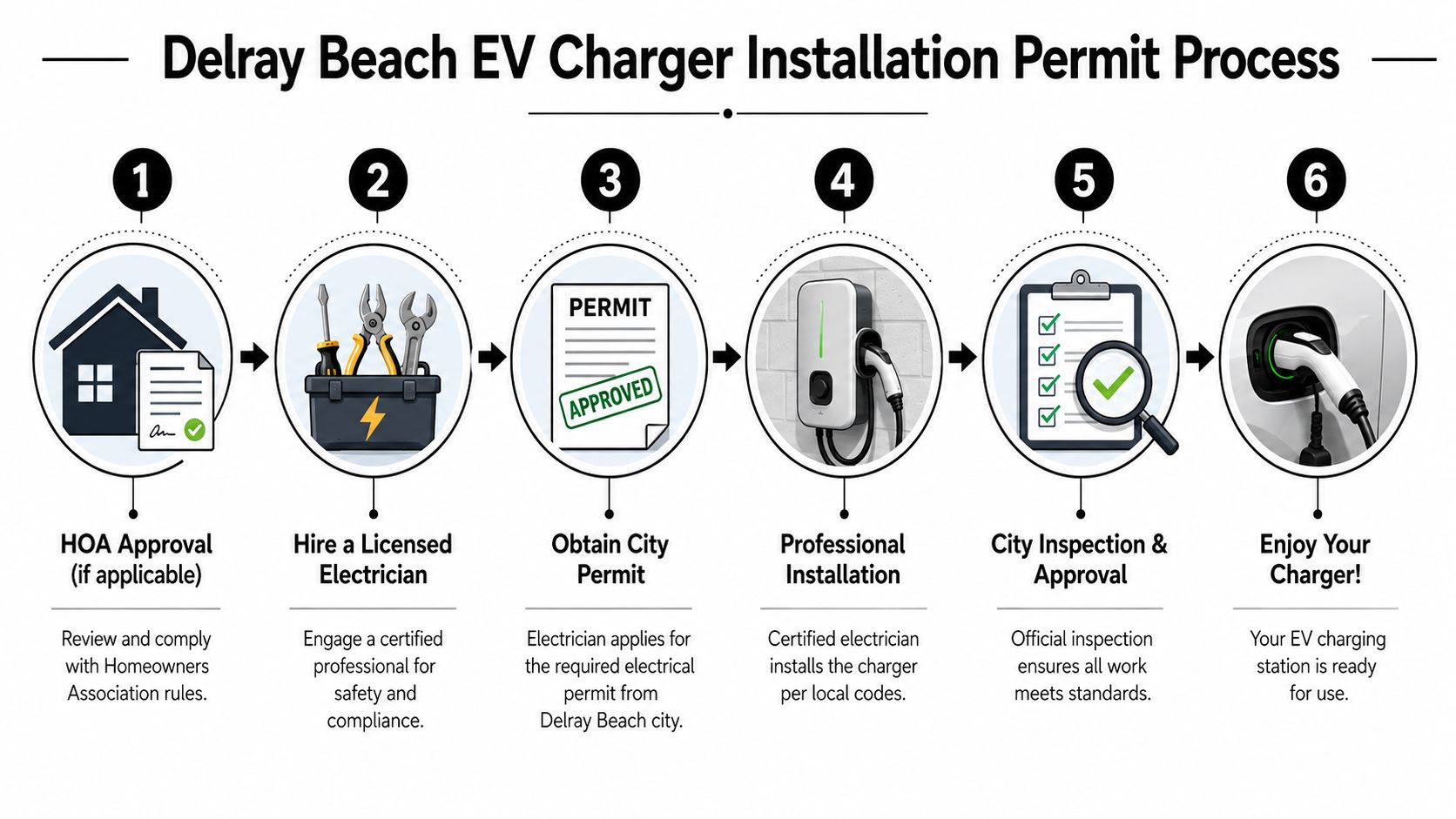
If you're adding a Level 2 charger, expect permitted electrical work. A licensed electrician should handle the application, scope, and inspection coordination. That's not red tape for its own sake. It's how the city verifies the installation meets code.
A typical path looks like this:
- Property review to confirm the charger location and electrical approach.
- Permit filing by the licensed contractor.
- Installation of the circuit, charger, and any related upgrades.
- Inspection before the work is considered complete.
If your property falls under a county jurisdiction detail rather than a city one, your electrician should identify that early and file in the right place.
HOAs can slow the job if you ignore them
Most HOA problems aren't about the charger itself. They're about appearance, exterior conduit, equipment visibility, parking rules, and who is allowed to alter common or limited common areas.
That's why homeowners should gather answers on a few points before installation day:
- Exterior modifications: Does the association require architectural review for wall-mounted equipment or visible conduit?
- Assigned parking: If you live in a townhouse, condo, or shared-parking community, who controls the space where charging will happen?
- Work hours and access: Some communities limit contractor access windows, which affects scheduling.
Get HOA approval in writing if the charger or conduit is visible from outside. Verbal approval is where small jobs turn into long arguments.
The permit keeps the electrical work legal. The HOA approval keeps the project from getting hung up after the install is already planned.
Understanding Installation Costs Timelines and Obstacles
The question homeowners ask first is cost. The honest answer is that EV charger installation in Delray Beach FL can be straightforward or it can turn into a broader electrical upgrade, and those are two very different jobs.
A simple install is usually the one everybody hopes for. The panel has room. The service can support the added load. The charger mounts close to the panel. Routing is clean. Permitting is routine. Those jobs move smoothly because there aren't many surprises.
The more expensive jobs usually get there for physical reasons, not because the charger is fancy. Long wire runs, finished-wall access, detached garages, trenching, panel congestion, outdoor exposure, and service limitations are what change the price.
What usually drives the budget
Instead of thinking in one total number, think in buckets of work:
| Cost area | What affects it most |
|---|---|
| Charger equipment | Basic versus smart features, cord length, mounting style |
| Electrical labor | Panel access, wire route, wall construction, exterior work |
| Permit and inspection | Local filing and final approval process |
| Electrical upgrades | Panel modifications, service changes, added disconnects |
The charger itself is only one piece. Homeowners sometimes spend too much time shopping equipment and not enough time looking at the panel, which is where many budget changes begin.
How long the process usually feels
The install day is only one part of the timeline. The full process often includes scheduling the estimate, choosing equipment, getting HOA approval if needed, filing the permit, completing the installation, and waiting for inspection sign-off.
What delays jobs most often isn't the wiring. It's coordination.
- Panel issues discovered late: A full or outdated panel can change the job after the first visit.
- HOA review lag: Some communities move quickly. Others don't.
- Material matching: Exterior installs sometimes need specific fittings or mounting solutions based on the wall surface.
- Inspection availability: Even after the work is done, final approval depends on the local calendar.
The hidden obstacles homeowners don't see at first
Some of the trickiest issues are simple ones that nobody notices until the electrician walks the site.
A charger location may look perfect until you realize the vehicle door blocks cable handling. A detached garage may look nearby but require a difficult route under hardscape. A tidy garage wall may hide a finished interior that makes concealed wiring far more involved.
The cheapest-looking charger location often becomes the most expensive if it forces bad routing or awkward daily use.
Good estimates ask better questions up front. That doesn't eliminate surprises, but it reduces the expensive kind.
Why Choose a Certified Delray Beach Electrician
This kind of project rewards experience. Not because EV chargers are mysterious, but because the details pile up fast. Panel capacity, wire path, weather rating, mounting height, permit scope, inspection prep, and HOA constraints all show up in one job. That's where a qualified electrician earns their keep.
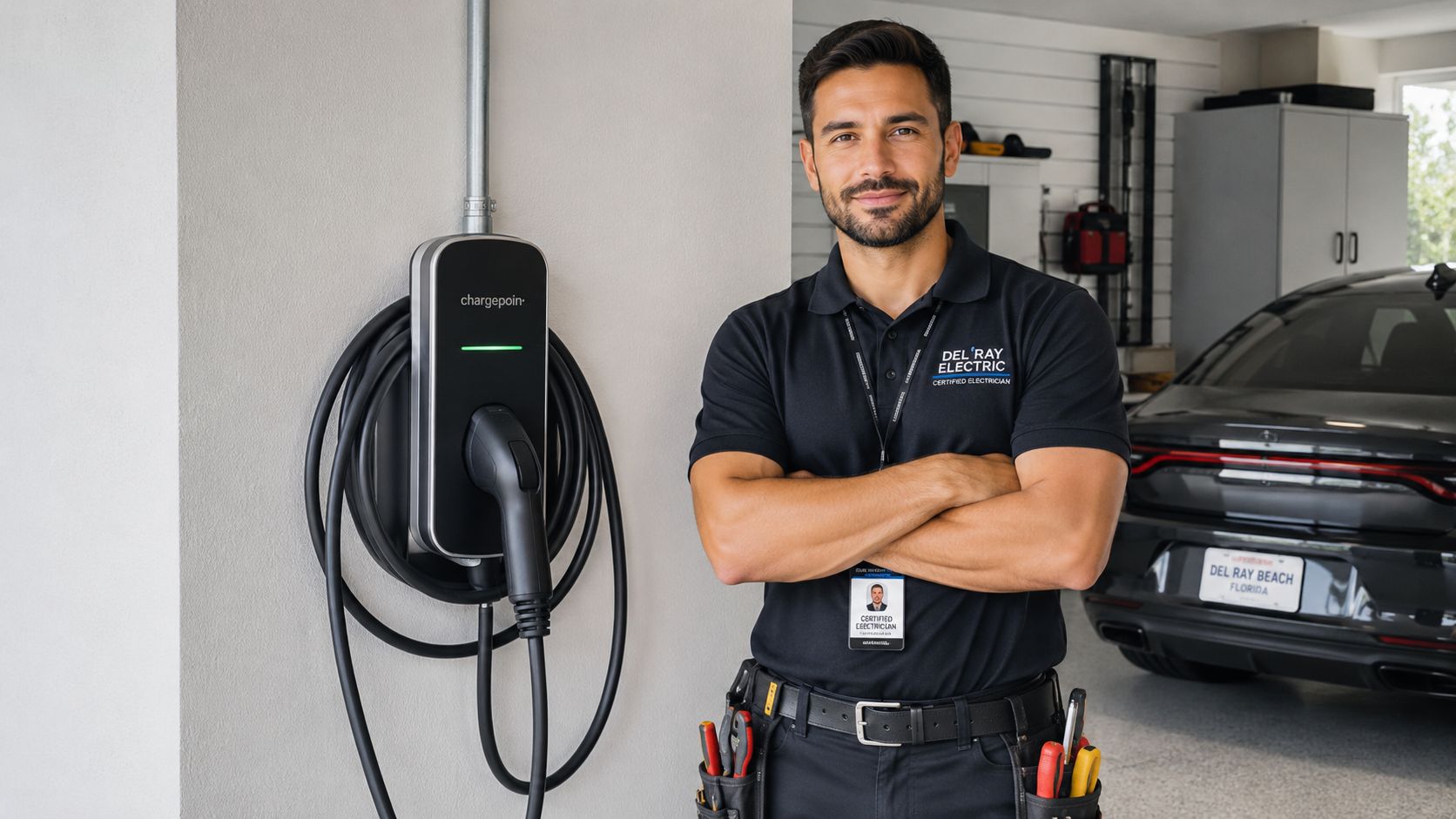
A certified local electrician knows what a clean install looks like in Delray Beach. They know when a panel has enough headroom and when it doesn't. They know when an outdoor wall needs a different mounting approach because of exposure. They know how to set the job up so the inspector sees organized, code-compliant work instead of shortcuts.
What homeowners should look for
Don't hire based on the charger brand someone says they recognize. Hire based on process.
- Licensing and insurance: This is baseline protection for you and the property.
- Permit handling: The contractor should be comfortable pulling permits and closing inspections.
- Panel judgment: They should be able to explain, clearly, whether your service can support the charger.
- Real availability: If there's a problem after hours, you want a contractor who answers the phone.
For homeowners who value after-hours responsiveness, the idea behind tools like Mercateer's AI solution reflects a real market need. People want immediate contact when they're scheduling electrical work or dealing with an urgent issue. The better setup is still a company where licensed electrical professionals handle the conversation.
Why local experience matters after the install too
A charger can be installed correctly and still need follow-up if your usage changes, a second EV arrives, or your panel gets upgraded later. That's why long-term service matters.
Lighthouse Energy Services is a licensed electrical contractor in Palm Beach County that handles residential electrical work, including home EV charging projects, with true 24/7 availability. For homeowners, that means you're not just buying a box on the wall. You're hiring a contractor who can assess the service, install the dedicated circuit, coordinate the permit process, and respond if something needs attention after normal business hours.
The best EV charger install is the one nobody has to think about again. It just works, every night, without drama.
Cut-rate electrical work always looks cheaper before inspection, before the first nuisance trip, and before the first rainstorm on an outdoor install. After that, cheap gets expensive.
If you're ready to install a home charger and want the job handled safely, cleanly, and with local permit experience, contact Lighthouse Energy Services. They serve Delray Beach and the rest of Palm Beach County with residential electrical expertise, transparent communication, and real 24/7 response when timing matters.