
You've got the car in the driveway, the app is set up, and the first real question hits fast. Where are you going to charge it every day without turning errands into charging stops.
That's where most Boynton Beach homeowners start. The car is the exciting part. The charging setup is the part that has to work every single day, in the heat, in the rain, and on a schedule that fits your life instead of the other way around. A generic national guide won't tell you much about local permit expectations, older South Florida service equipment, or what usually turns a simple install into a panel conversation.
This is where local electrical work matters. EV charger installation in Boynton Beach FL isn't just about mounting a charger on a garage wall. It's about load capacity, dedicated circuits, GFCI requirements, permit paperwork, inspection prep, and making sure the installation still makes sense a few years from now if your household adds another EV.
Table of Contents
- Your New EV is Here So What Is Next
- Choosing the Right Charger for Your Home
- Assessing Your Homes Electrical Capacity
- Navigating Boynton Beach Permits and Inspections
- Estimating EV Charger Installation Costs and Timelines
- Federal and Florida Incentives That Lower Your Cost
- Why Boynton Beach Trusts Lighthouse Energy Services
Your New EV is Here So What Is Next
The first week with a new EV usually teaches the same lesson. Public charging is useful, but home charging is what makes the vehicle convenient. If you can leave home each morning with a full battery from an overnight charge, the car starts to feel simple. If you're relying on public stations for routine charging, the novelty wears off quickly.
That's especially true in Florida, where EV infrastructure is expanding at a serious pace. Qmerit reports that Florida has more than 6,800 Level 2 charging stations, more than 2,200 DC fast-charging locations, and over 9,000 public charging ports in total, and the state is set to receive approximately $198 million in NEVI formula funds to support further buildout through the Florida EV infrastructure overview from Qmerit. That tells you two things. EV charging is no longer a fringe upgrade, and local electrical contractors are handling these projects as normal code-driven installations.
In Boynton Beach, that matters because a lot of homes weren't originally designed with EV charging in mind. Some have plenty of room in the panel and a short, clean path to the garage. Others have older service equipment, limited breaker space, detached parking, or long conduit runs that change the job completely.
What changes when you stop treating charging like a gadget
A home charger isn't like adding a smart doorbell or swapping a light fixture. It's a permanent electrical load that has to be planned around the rest of the house. Air conditioning, water heating, cooking equipment, pool systems, dryers, and EV charging can all compete for capacity.
That's why a proper installation starts with the house, not the charger model.
Practical rule: Buy the car first if you want, but don't buy charging equipment until someone has confirmed your panel, circuit path, and permit approach.
The good news is that this process is manageable when it's done in the right order:
- Confirm how you park. Garage, carport, side pad, or shared driveway changes everything.
- Check the panel location. A charger close to the panel is one kind of project. A charger across the house is another.
- Choose the charging level based on how you drive, not on marketing.
- Have a licensed electrician handle load review, permitting, installation, and inspection.
Why local guidance matters
Boynton Beach homeowners don't need broad EV theory. They need to know what passes inspection, what adds cost, and what shortcuts usually come back as problems later. That's the difference between a charger that works and a charger installation that stays safe, reliable, and easy to live with.
Choosing the Right Charger for Your Home
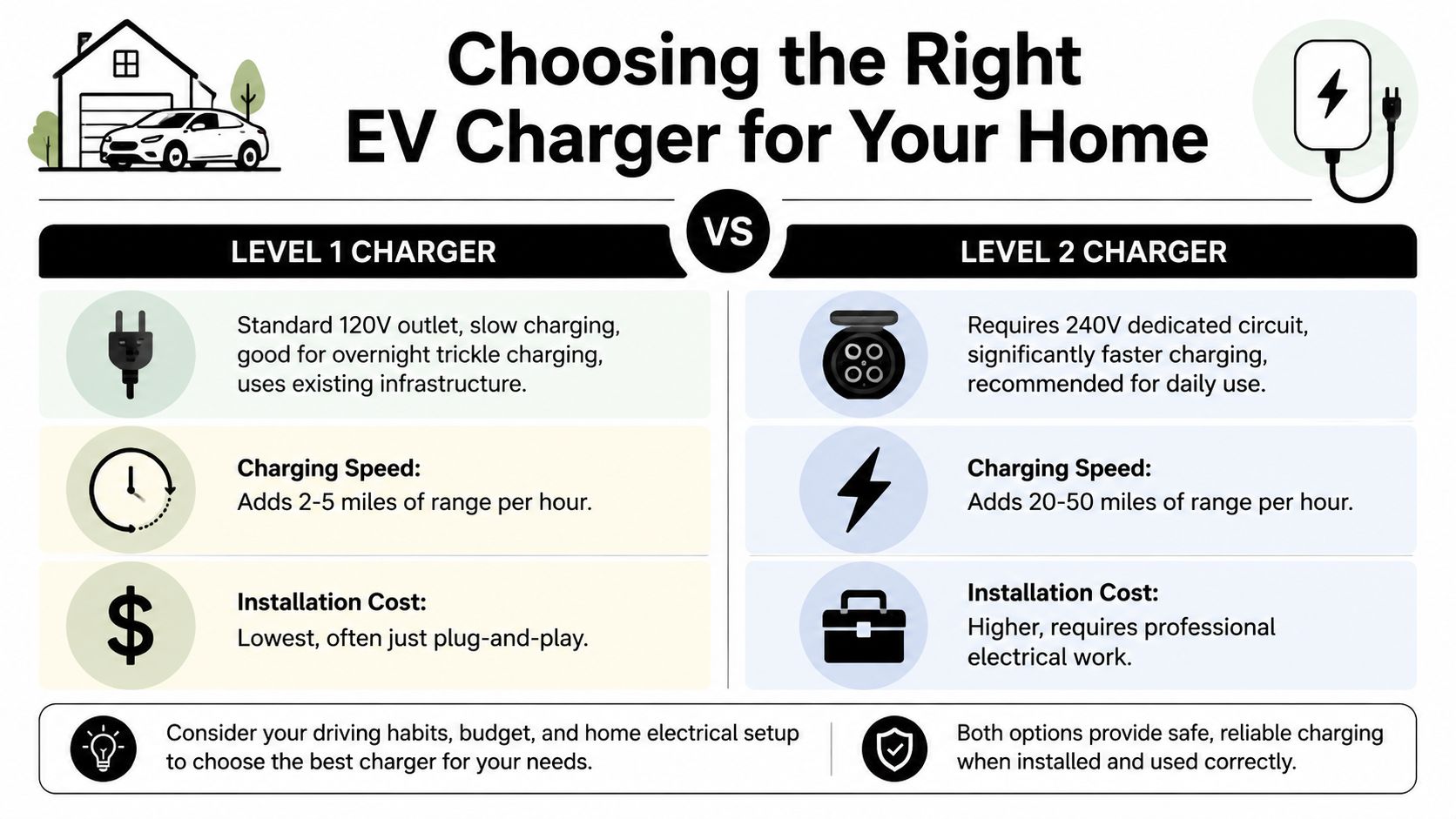
Most homeowners are deciding between a charger that uses a standard outlet and a charger that uses a dedicated higher-voltage circuit. The easiest way to think about it is water flow. One option is a garden hose. The other is a fire hose. Both move water. One gets the job done much faster when daily demand is real.
Why most homeowners end up with Level 2
A standard outlet charger can work if you drive lightly, have long overnight parking windows, and don't mind slower recovery after a busy day. For some households, that's enough.
But most homes installing an EV charger in Boynton Beach want Level 2 because it fits normal life better. If you come home with a lower battery after commuting, errands, school pickup, or a weekend run up the coast, Level 2 is what restores the car in a practical overnight window.
The code side matters too. The Alternative Fuels Data Center guidance on EV charging codes and ordinances notes that EV supply equipment rated at 16 amps or greater, or above 120 volts, must be on an individual branch circuit, and a strong planning benchmark is 208/240 V with a 40-amp circuit for future-ready installations. In plain language, that means the charger usually needs its own circuit, sized correctly, without sharing with other loads.
A Level 2 charger only performs as well as the circuit feeding it. Good equipment on a poorly planned circuit still gives you a bad installation.
A simple comparison
| Feature | Level 1 Charger | Level 2 Charger |
|---|---|---|
| Power source | Standard household outlet | Dedicated 240V circuit |
| Charging pace | Slow, best for light daily use | Faster, better for routine charging |
| Installation work | Often minimal if outlet is suitable | Requires professional electrical installation |
| Best fit | Low-mileage households | Most homeowners with daily EV use |
| Long-term flexibility | Limited | Better for future vehicle needs |
A few practical choices matter more than brand names:
- Hardwired vs plug-in. Hardwired setups are often cleaner and better for permanent locations. Plug-in units can work in the right layout, but placement and code details matter.
- Cable reach. A charger mounted on the wrong wall can become annoying every single day.
- Outdoor exposure. In South Florida, sun and weather matter. The mounting location should match the environment.
- Future use. If there's a chance of a second EV later, plan the circuit path and panel space now.
What works and what does not
What works is matching the charger to your driving pattern and your electrical system. What doesn't work is overspending on charging capability your home can't support, or buying a unit because it looked popular online without checking the branch circuit requirements first.
For most homeowners, the smart move is straightforward. Install a properly permitted Level 2 charger on a dedicated circuit, place it where you park, and size the electrical work so the installation still makes sense if your needs grow.
Assessing Your Homes Electrical Capacity
The charger is rarely the hard part. The house is.
In Boynton Beach, the most common issue is panel capacity. The city's EV charger guidance states that a permit is essential, calls for GFCI protection for outlets used to plug in EV chargers, and highlights the importance of checking whether the home's existing panel can support the added load through the City of Boynton Beach EV charger guidance. That lines up with what electricians see in the field. A Level 2 charger is a sustained load, and if the service is already tight, the installation may require more than a breaker and a wall mount.
What an electrician checks first
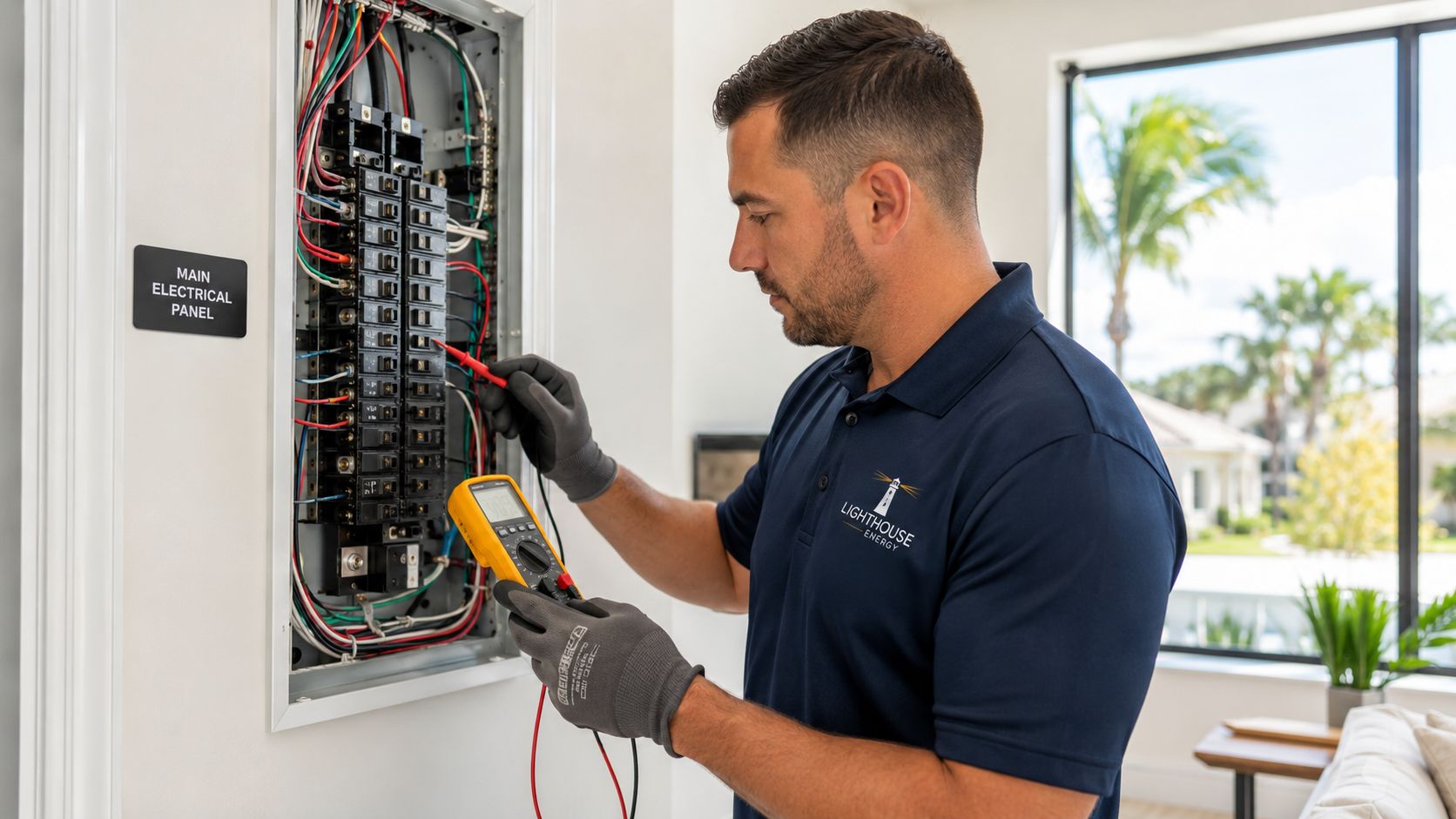
A real site assessment starts at the main service equipment. The electrician is looking at available breaker space, service size, conductor condition, grounding, panel labeling, and the actual loads already on the house.
That's different from a casual glance at whether there's an empty breaker slot. An empty slot doesn't prove the house has load capacity. A full panel doesn't always mean the job stops. It just means someone has to do the math and determine the right path.
Typical review items include:
- Existing service demand. Air conditioning, range, dryer, water heater, pool equipment, and other major loads all matter.
- Panel condition. Corrosion, heat damage, poor labeling, and aging breakers can turn a charger job into a safety upgrade.
- Distance to charger location. Longer runs affect labor, conduit routing, and sometimes wall repair.
- Mounting environment. Garage wall, exterior wall, carport post, or detached structure each changes material and labor requirements.
If you want a deeper primer on how these decisions are made, this electrical panel upgrade resource gives a useful overview of when service equipment becomes the actual issue rather than the device being added.
What usually changes the scope of work
Three scenarios come up often in Palm Beach County homes.
First, the panel has capacity and space. That's the clean job everyone hopes for. Second, the panel can handle the load but has no practical room, so a subpanel or reconfiguration may make sense. Third, the service is already near its limit, and now you're talking about a broader upgrade before charging can be approved and operated safely.
The right answer isn't always “upgrade everything.” The right answer is whatever safely supports the charger and passes inspection without creating the next problem.
Older homes are where experience matters most. A house may have been perfectly adequate for the loads it originally served. Add modern cooling demands, updated appliances, and EV charging, and the old assumptions stop working. If you're trying to understand the signs before scheduling work, this guide to electrical panel upgrades is a helpful starting point.
DIY decision-making usually goes wrong in two places. Homeowners underestimate continuous load, or they assume a nearby dryer outlet means the charger can share it. That's not how a code-compliant installation is planned.
Navigating Boynton Beach Permits and Inspections
A permit isn't red tape for its own sake. It's the city's way of making sure the charger, circuit, overcurrent protection, wiring method, and documentation all line up before that equipment starts pulling power on a regular basis.
Boynton Beach already has established EV charging activity. Public data for the city shows 60 public charging station ports within 15 km, with 63% Level 2 ports and 40% free stations, and the same listing reports 66 Level 2 stations and 28 Level 3 stations through the Boynton Beach charging data on ChargeHub. That local footprint matters because it reflects a market where EV charging is already part of normal electrical review, not a rare exception.
What the city wants to see
Boynton Beach expects EV charger permit submissions to include a detailed electrical floor plan and an electrical panel layout. That requirement tells you a lot. The city doesn't want a vague description like “install charger in garage.” It wants to know where the equipment is going, how it's being fed, and what service equipment supports it.
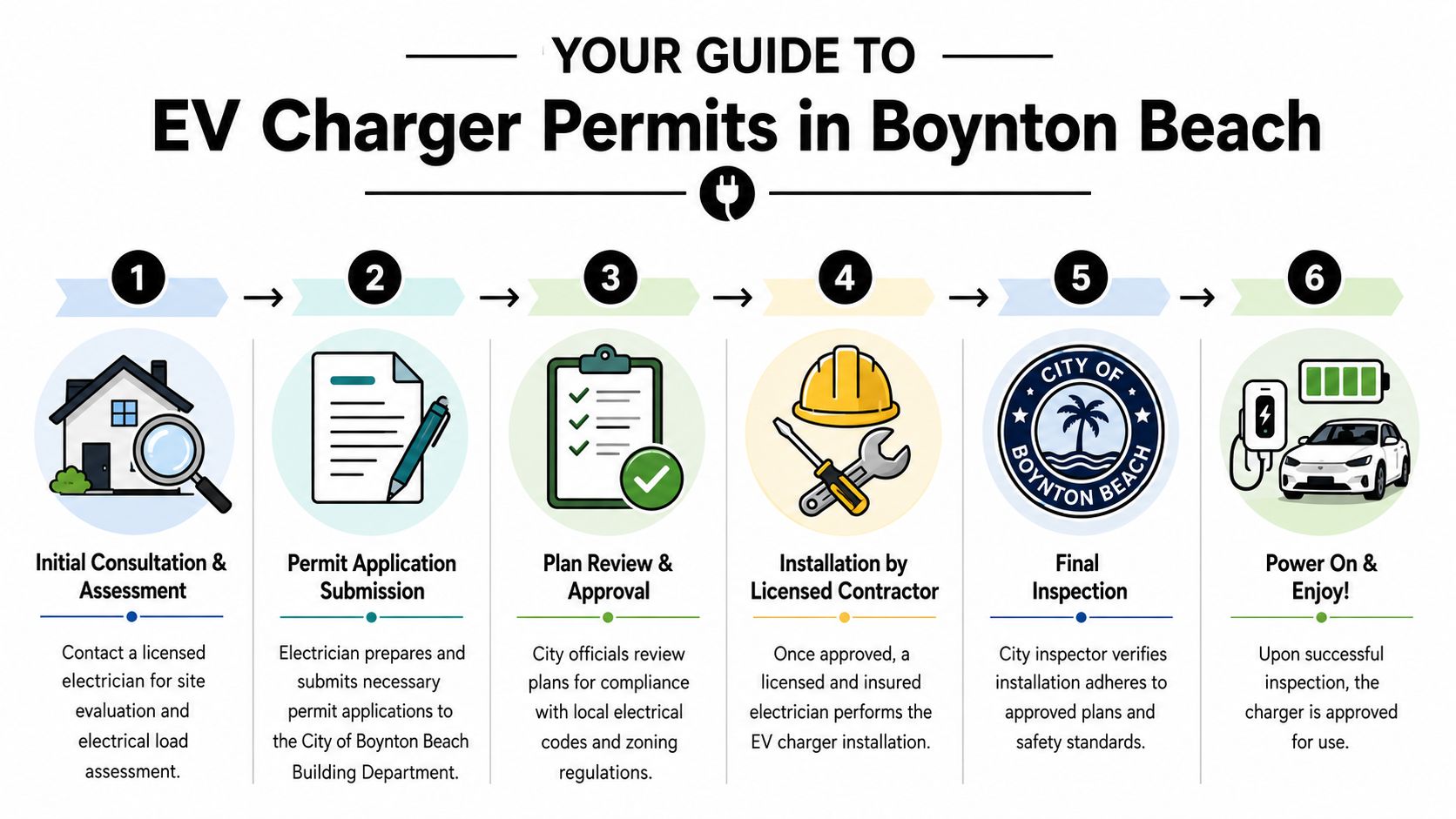
A typical permit flow looks like this:
- Site assessment by a licensed electrician
- Load review and equipment selection
- Preparation of floor plan and panel documentation
- Permit submission to the city
- Installation after approval
- Final inspection and sign-off
If you want to verify that the contractor you hire regularly works within formal municipal approval processes, this page on government-approved electrical contractors is relevant.
What inspection day is really about
Homeowners sometimes worry that inspection is a trap. It isn't. Inspection protects you. The inspector is confirming that the installed work matches the approved plan and meets the applicable code requirements.
The inspection usually focuses on things like:
- Dedicated circuit compliance
- Correct breaker and conductor sizing
- Proper mounting and protection of the equipment
- GFCI-related requirements where applicable
- Workmanship, labeling, and safe routing
If a contractor tells you the permit is optional for a permanent EV charger installation, that's usually a sign to slow down and ask harder questions.
What works best is simple. Let the electrician handle the paperwork, submit the correct plan set, install to the approved design, and be present for any inspection follow-up. The smoother the documents are on the front end, the smoother the job goes on the back end.
Estimating EV Charger Installation Costs and Timelines
This is the part every homeowner wants straight. The total price depends less on the charger itself than on the electrical path required to support it.
A simple installation costs less because the work is limited. The panel has adequate capacity. The charger location is close by. The routing is straightforward. There's no major drywall repair, trenching, subpanel addition, or service upgrade.
A more involved installation costs more because the electrician is solving building conditions, not just mounting hardware.
What drives the final price
Think of the project in four cost buckets.
Equipment is the charger and any mounting accessories or disconnecting means needed for the design. Some homeowners supply the charger themselves. Others want the electrician to furnish equipment that matches the approved plan.
Labor depends on the route from the panel to the charger location. A short garage run is one thing. Running conduit across finished space, through block, into an exterior mounting location, or to detached parking is different work.
Permit and inspection handling are part of a proper installation. Even when the permit process is routine, it still takes time to document, submit, coordinate, and close out correctly.
Electrical upgrades are the wildcard. If the panel is crowded, the service is undersized, or the home needs a subpanel before the charger can be added safely, that changes both scope and schedule.
A good estimate should separate those pieces clearly. It should also tell you what assumptions the price is based on. If the quote only says “install EV charger” with no mention of circuit size, route, permitting, or panel review, it's not detailed enough.
How long the process usually takes
Most projects move through a few distinct phases:
- Initial assessment. The electrician evaluates the panel, the charger location, and the routing.
- Proposal and scope confirmation. You decide whether the job includes only the charger circuit or additional electrical work.
- Permit preparation and approval. Timing depends on how quickly the city reviews the submission.
- Installation day. Straightforward work is faster. Complex routing or service changes take longer.
- Final inspection. The project isn't fully complete until the approved installation passes.
For homeowners, the most important timeline question isn't “How fast can you install a charger?” It's “How fast can you install a charger correctly, with the permit, and without discovering halfway through that the panel can't support it?”
One more practical note. If you're ordering a charger before the electrical assessment, keep the packaging and confirm the final electrical design first. It's much easier to swap equipment on paper than after mounting hardware is already on the wall.
Federal and Florida Incentives That Lower Your Cost
Incentives can help, but they only help when you treat them carefully. It's common for homeowners to get into trouble by assuming a credit or rebate applies before confirming the details with a tax professional, utility, or current program rules.
How to approach incentives without guessing
Start with the federal side. Ask your tax professional whether your planned home charging project qualifies for any available residential tax treatment and what documentation you'll need to keep. Save everything. That means invoices, scope of work, permit records, product information, and proof of payment.
Then check local utility programs directly before you schedule the install. Utility rebates can change, pause, or come with conditions about approved equipment, installation method, or application timing. Don't rely on an old screenshot or a forum post.
Use this checklist:
- Confirm eligibility first. Ask whether your primary residence, equipment type, and installation date fit the current rules.
- Keep itemized records. A one-line invoice is harder to use than a detailed invoice.
- Check deadlines. Some programs require pre-approval or submission within a specific window.
- Ask before changing scope. A panel upgrade tied to the charger may be treated differently than the charger alone.
The safest mindset is this. Treat incentives as a potential reduction in cost, not as a reason to rush the wrong installation. The charger still has to be properly sized, permitted, and inspected. If the electrical work is wrong, a rebate doesn't fix that.
Why Boynton Beach Trusts Lighthouse Energy Services
The reason homeowners hire a local electrician for EV charger work isn't just to hang equipment on a wall. They need someone who can look at an older South Florida house, understand the load profile, identify whether the panel is the actual issue, route the circuit cleanly, handle the permit, and finish the job in a way that won't create repeat problems.
That's where local experience matters.
What homeowners need from an EV charger electrician
They need clear answers. Can the existing service support the charger. Does the job need a subpanel. Is the preferred charger location practical. Will the installation be hardwired or plug-in. What will the permit require. What might change once the panel is opened up.
They also need realistic communication. A trustworthy electrician doesn't promise a “simple install” before checking the service equipment. They don't minimize permitting. They don't assume every garage is an easy route. They explain trade-offs in plain English.
For EV charger installation in Boynton Beach FL, that practical approach matters more than sales language. Homeowners usually do best with a contractor who can handle the whole sequence, from assessment through final sign-off, without handing the tricky parts back to the customer.
One local option is Lighthouse Energy Services in Boynton Beach, which provides residential electrical work in Palm Beach County and handles charger installations as part of broader electrical service and upgrade work.
Why local experience changes the outcome
Palm Beach County homes aren't all built the same. Some have modern service equipment and convenient garage layouts. Some have aging panels, additions wired at different times, exterior equipment exposed to coastal conditions, or parking patterns that make the obvious charger location the wrong one.
That's why experience shows up in the details:
- Assessment discipline. Good electricians start at the panel, not at the product box.
- Permit fluency. They know how to prepare the documentation the city expects.
- Installation judgment. They route circuits in ways that are durable and serviceable, not just fast.
- Troubleshooting mindset. If the job uncovers an issue, they can solve the electrical problem instead of stalling out.
Lighthouse Energy Services fits that kind of work because the company serves Palm Beach County with true 24/7 availability, licensed electricians, and a service model built around prompt response, transparent pricing, and getting electrical problems resolved correctly. For homeowners, that matters because charger work often touches broader house power questions. You want the same contractor to be capable whether the job stays simple or turns into a service-capacity discussion.
If you're planning a charger, the right next step isn't guessing at equipment online. It's getting the house evaluated so you know what your installation requires.
If you want a clear plan for your home charging setup, contact Lighthouse Energy Services. A licensed electrician can assess your panel, explain the best charger location, handle the permit process, and install a code-compliant EV charging circuit that works for the way you use your vehicle.