
A standard Level 2 electric car charger installation near I-95 in West Palm Beach commonly costs $1,000 to $2,500 excluding the charger itself, and the final price usually depends on your panel capacity, the length of the wiring run, and whether permit or service-upgrade issues show up once the electrical review starts. If your home's electrical system is already in good shape, the job is often straightforward. If it isn't, the smart move is to find that out before anyone starts mounting equipment on the wall.
If you're reading this, you're probably in one of a few familiar situations. You just bought an EV and you're tired of planning your week around charging stops. Or you've been getting by with a basic cord and now want something faster, cleaner, and permanent in the garage. Or you're in a condo, townhouse, or HOA neighborhood near the I-95 corridor and you're realizing the charger itself is the easy part. The hard part is the panel, the permit, and getting everyone to agree on where it goes.
That's where local experience matters. Homes near the I-95 West Palm Beach corridor range from older houses with limited service capacity to newer builds with better panel headroom, and the installation path looks very different depending on which one you own. A proper EV charger install isn't just about adding an outlet. It's about matching the charger to the home, the driving pattern, the parking layout, and the local approval process so the system works safely for years.
Table of Contents
- Your Guide to Home EV Charging in West Palm Beach
- Assessing Your Home and Choosing the Right Charger
- Navigating Permits HOA Rules and Multi-Family Buildings
- What to Expect on Installation Day
- Estimating Your Installation Cost and Timeline
- Your Trusted Partner Lighthouse Energy Services
Your Guide to Home EV Charging in West Palm Beach
West Palm Beach already has a real charging footprint. ChargeHub's West Palm Beach charging map lists 451 total charging stations in the city, including 109 free stations, and identifies downtown West Palm Beach as the densest charging zone. The same source notes that the city contracted with Blink Charging Company to add stations in three municipal parking garages at 401 Banyan Boulevard, 500 Banyan Boulevard, and 333 Evernia Street.
That matters because it tells you two things right away. First, EV driving in West Palm Beach is no longer niche. Second, public charging has moved into normal city infrastructure, not just private lots and specialty locations.
For drivers who use I-95 and the Turnpike, the corridor matters just as much as downtown. Florida's Turnpike charging update states that in 2020 Florida Power and Light installed Level 3 chargers at the West Palm Beach Service Plaza, and that eight service plazas are being upgraded with faster chargers. For daily commuters, that supports regional travel. For homeowners, it creates a different kind of question: if public charging is growing, why bother installing at home?
Because convenience isn't the same as control.
Home charging changes the routine
A home charger removes the need to think about where you'll top off before work, after dinner, or on a stormy night. You park, plug in, and the car is ready when you leave. For most homeowners, that reliability is the primary value.
Practical rule: Public charging is a strong backup and a useful corridor tool. It doesn't replace the convenience of waking up to a charged vehicle in your own driveway or garage.
The local layout affects the install
Near I-95 in West Palm Beach, the details matter more than people expect. Older neighborhoods often have tighter electrical capacity. Townhomes and condos may have parking farther from the meter or panel. Some garages make charger placement easy. Some force longer conduit routes that add labor and materials.
Electric car charger installation near I-95 West Palm Beach works best when the plan starts with the house, not the charger box. The charger is the last decision. The electrical path, permitting path, and parking reality come first.
Assessing Your Home and Choosing the Right Charger
The first real question isn't which charger brand to buy. It's whether your electrical system can support the charging speed you want.
Why the panel check comes first
In older West Palm Beach neighborhoods, service capacity can be tight. Guidance on local EV charger installs points out that a professional load calculation is necessary to determine whether a home can support a 40-amp or 48-amp Level 2 charger without a costly service upgrade.
That load calculation isn't paperwork for its own sake. It's the process that tells you what spare capacity the home has after existing loads are considered. Air conditioning, range, water heater, dryer, pool equipment, and other major electrical loads all affect the answer.
A homeowner will often ask, “Can't you just add a breaker?” Sometimes yes. Sometimes no. A panel may have physical space for a breaker and still not have enough available capacity for sustained EV charging.
If you're trying to figure out whether your current service is already close to its limit, this guide on when 150 amp service is plenty and when it's not is a useful starting point.
The expensive version of this job is the one where the charger location gets finalized first and the service limitation gets discovered later.
Level 1 versus Level 2
A lot of confusion clears up once you separate “will it charge” from “will it fit your life.”
| Charger Level | Voltage | Typical Charge Speed (miles/hour) | Installation Needs | Best For |
|---|---|---|---|---|
| Level 1 | 120V | Qualitatively slower | Standard receptacle, circuit condition should still be checked | Light daily driving, temporary setup |
| Level 2 | 240V | Qualitatively faster | Dedicated circuit, panel capacity review, permit and inspection often required | Daily commuting, faster overnight charging |
Level 1 can work for some drivers. If the car sits for long stretches and daily mileage is modest, it may be enough. The trade-off is patience. Recovery is slower, and the setup can become frustrating if the vehicle comes home low and needs to be ready again quickly.
Level 2 is what most homeowners near I-95 are asking for. It gives faster overnight charging and makes weekday use much simpler. It also requires a more serious electrical installation.
What usually works best
A practical selection process looks like this:
- Match the charger to your driving pattern: If the car gets heavy weekday use, Level 2 usually makes more sense than trying to stretch a basic charging cord.
- Match the circuit to the charger: The charger rating, breaker size, conductor size, and termination method all have to line up.
- Match the location to the parking habit: If you always back in, place the charger where the cable reaches cleanly without crossing a walkway or garage door track.
- Match the install to the home's future: If a second EV may be coming later, plan the first install with expansion in mind.
That's what keeps the job from feeling improvised.
Navigating Permits HOA Rules and Multi-Family Buildings
A homeowner in a condo off Okeechobee Boulevard can be ready to buy the charger, pick the wall location, and still lose weeks because the board has not approved conduit routing or meter use. Along the I-95 West Palm Beach corridor, that is a common delay point. The electrical work is usually straightforward. The approvals are what stall the job.
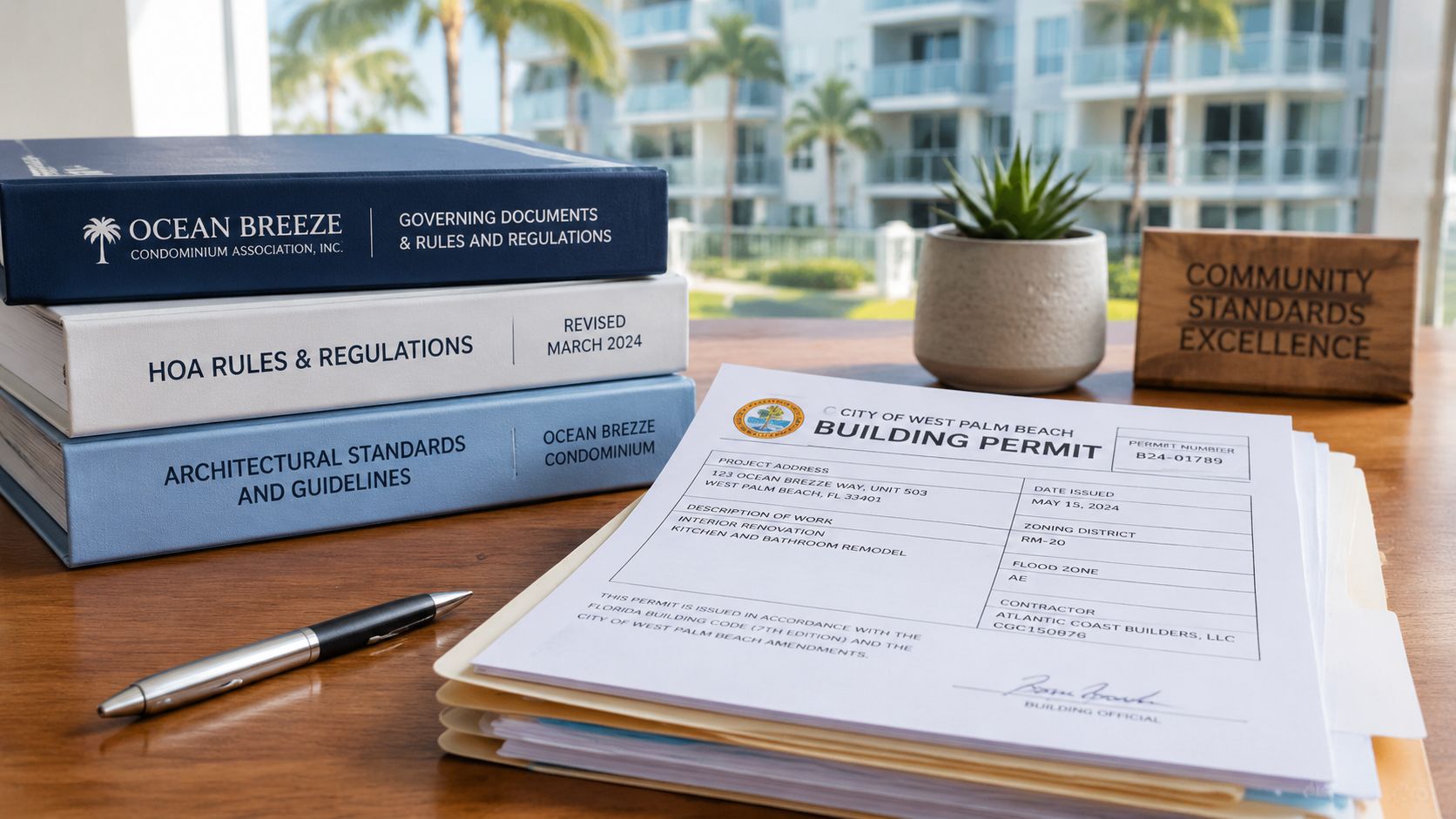
Permits need to be settled before the charger shows up
An EV charger is tied into the home's electrical system as a continuous load. That puts the work into a permit-and-inspection process, not a casual add-on. If the permit is skipped or the scope is vague, the problems show up later as failed inspections, relocation requests, patched walls, and arguments over who approved what.
In single-family homes, the permit path is usually direct. In condos, townhome communities, and other attached properties near I-95, the same charger can involve the unit owner, the association, the property manager, and the local building department. Each one may want a different piece of the plan before work starts.
That is why we tell homeowners to settle three things early. Who owns the equipment, where the power comes from, and what part of the property the installer is allowed to touch.
If you want to confirm you are hiring from the right pool, this page on government approved electrical contractors is a useful checkpoint.
HOA approval is usually about property rights, not the charger itself
Boards rarely object to the idea of EV charging. They object to unclear responsibility. They want to know who pays for installation, who pays for power, what the finished work will look like, and whether approving one charger creates a precedent for twenty more.
Start with the association rules, not with the charger spec sheet. If you need a place to begin, the governing documents HOA resource can help you identify what to review before submitting a request.
The approval packet should answer practical questions in plain language:
- Equipment ownership: Is the charger owned by the resident, landlord, or association?
- Source of power: Does the circuit come from the unit meter, a house panel, or a separately metered setup?
- Parking control: Is the space deeded, assigned, limited common element, or shared?
- Conduit route and appearance: Will wiring cross common areas, pass through rated walls, or be visible on exterior surfaces?
- Future demand: If more residents request chargers next year, can the same approach be repeated without redoing the first installation?
A board can approve a clear policy. It struggles with one-off requests that do not address the next owner, the next tenant, or the next charger.
Multi-family buildings need a different plan than detached homes
This is the part many homeowners do not hear until late in the process. In a detached house, the charger usually serves one meter, one panel, and one parking space. In a condo or apartment setting, those lines are often split.
A resident may own the parking space but not the wall next to it. The nearest electrical room may be common property. The easiest conduit path may cross areas the unit owner does not control. In older buildings near Palm Beach Lakes and the I-95 ramps, panel locations and parking layouts can make a simple charger install turn into a coordination job.
That does not mean the project is a bad idea. It means the scope has to be defined correctly from the start.
A workable multi-family plan usually addresses:
- access to electrical rooms and locked service areas
- approved work hours and noise limits
- wall penetrations and fire-stopping requirements
- billing for common-area electricity if the circuit is not tied to the unit meter
- a written standard for future residents so the first install does not become a special exception
From a contractor's side, that early clarity saves money. From a homeowner's side, it prevents paying for engineering, permits, or material changes before the association has agreed to the basics.
The practical trade-off
The fastest route is not always the best route. A charger fed from the closest common-area panel may look easier on day one, but it can create billing disputes and ownership issues later. A longer run from the unit's own service may cost more up front, yet it often gives cleaner responsibility and fewer conflicts.
That is the kind of trade-off we walk through with West Palm Beach property owners before permits are filed. In HOA and multi-family work, a clean plan beats a fast guess every time.
What to Expect on Installation Day
Most homeowners picture the charger going on the wall and a little wiring in the panel. The actual work is more disciplined than that, and that's a good thing.
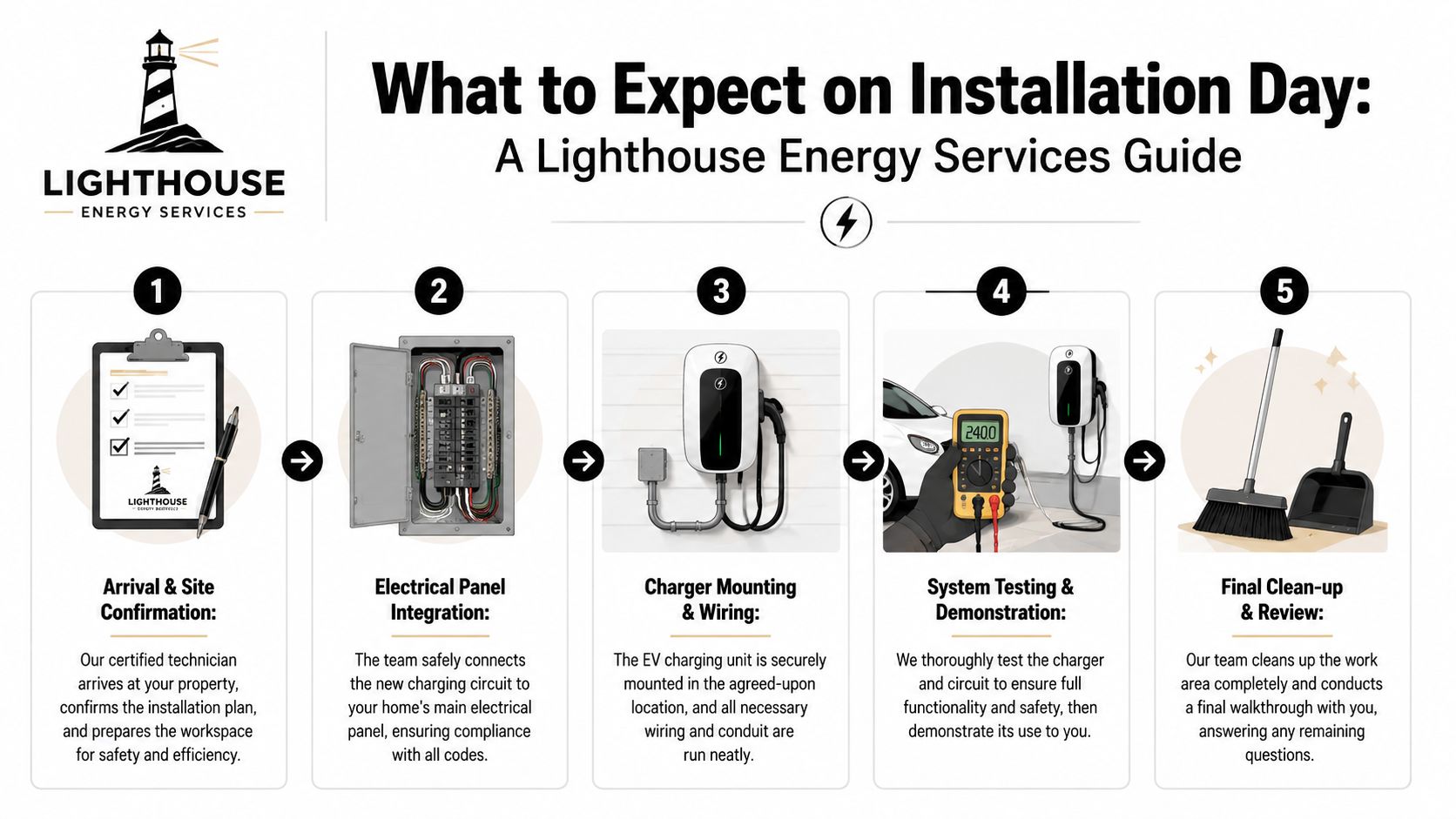
How a professional install actually unfolds
The day starts with confirming the agreed charger location, cable reach, wall condition, panel location, and route for the circuit. If anything on site differs from the original plan, the installer should catch it before opening the panel or drilling into finished surfaces.
Then comes safe isolation and verification. The installer de-energizes as required, checks that the panel conditions match the plan, and confirms the breaker layout and conductor path. This isn't glamorous work, but it prevents the avoidable mistakes that lead to nuisance trips, overheating, or ugly reroutes.
From there, the job usually follows a clean sequence:
- Panel work begins with the dedicated breaker for the EV circuit.
- Conductor routing follows the approved path from panel to charger location.
- Mounting is done where the unit can be reached easily without stressing the cable.
- Grounding and bonding are verified before energizing.
- Testing confirms the charger and circuit operate correctly.
- Final inspection steps are handled according to local requirements.
What separates a clean install from a risky one
A detailed EV charger installation tutorial notes that a technically sound Level 2 charger circuit requires a dedicated breaker, correctly sized conductors, verified grounding and bonding, and post-install inspection. It gives one direct example of a 60-amp breaker with 6-gauge conductors in a direct-wire Level 2 setup, and it warns that EV charging is a continuous load, so improper terminations or undersized wire can overheat.
That continuous-load point is the one homeowners should remember. A charger doesn't behave like a quick kitchen appliance load. It can sit there drawing for hours. A loose lug, poor termination, or bad grounding choice may not fail immediately, but it can create heat over time.
If a charger circuit isn't sized, terminated, and inspected correctly, the problem usually won't announce itself on day one. It shows up later as heat, nuisance tripping, or damaged equipment.
A professional installation also includes a handoff. The homeowner should know how to energize the charger, how to reset it if needed, where the breaker is, and what normal operation looks like. That last part matters more than people think.
Estimating Your Installation Cost and Timeline
A homeowner near the I-95 corridor usually asks two questions first. What will this cost, and how long will my garage or parking area be tied up?
The honest answer depends less on the charger and more on the house. A straightforward install stays predictable. Cost climbs when the charger exposes a panel capacity issue, a long wiring run, or a property-approval problem that was not caught early.
What usually falls inside the standard range
In West Palm Beach, a standard Level 2 installation often lands in a typical local range, excluding the charger itself, when the electrical system is already in good shape and the work does not require added design or service changes.
That kind of job usually looks like this. The panel has room for a dedicated circuit. The charger location is reasonably close to the panel. The wiring path is accessible. The city or county permit process is routine, and the property is a single-family home without association delays.
A clear estimate should spell out:
- Site assessment: Panel review, charger location review, and circuit path planning
- Electrical labor: Breaker installation, wiring, mounting, testing
- Normal materials: Conduit, conductors, fittings, mounting hardware
- Permit handling: Where required by the jurisdiction
- Final verification: Testing and inspection coordination
That is the version homeowners hope for. It is also the version that gets quoted fastest.
What pushes the job beyond the base price
Three factors change the number quickly in this part of Palm Beach County.
- Panel or service upgrades: If the load calculation shows the existing service cannot support EV charging safely, the project expands beyond a charger install.
- Long or difficult conduit runs: Detached garages, exterior walls, block construction, attic access problems, and parking areas far from the main panel all add labor and material.
- Approvals outside the electrical work: HOA review, condo management approval, and multi-family routing decisions can slow the job before a permit is even issued.
Along the I-95 West Palm Beach corridor, I see the third issue more than homeowners expect. Single-family homes usually move faster. Townhomes, condos, and buildings with shared parking often require written approval, assigned parking confirmation, and a clear plan for where the raceway will run. If that paperwork starts late, the install starts late.
If panel capacity is still an open question, this guide to electrical panel upgrades and what triggers them gives a practical overview of what we check first.
Timeline follows the same logic. A simple install can move from assessment to final approval on a short schedule. A more involved project takes longer because permit review, utility coordination, HOA signoff, or panel work has to be handled before the charger is energized.
The fastest jobs are the ones defined correctly at the start. In this area, that means confirming panel capacity, parking location, and property approvals before ordering equipment or setting an installation date.
Your Trusted Partner Lighthouse Energy Services
A homeowner hiring for electric car charger installation near I-95 West Palm Beach usually wants three things. A straight answer about panel capacity, a clean permit process, and confidence that the work will pass inspection and hold up under continuous use.
Why homeowners call a local electrician for this job
Local experience earns its keep. Homes from Boca Raton to Jupiter don't all share the same service size, garage layout, parking arrangement, or association rules. A contractor working this corridor every day sees those differences early and plans around them before the job drifts into change orders and delays.
Lighthouse Energy Services has served Palm Beach County since 2005, with a team backed by more than 100 years of combined expertise, true 24/7 availability, phones answered by licensed electrical professionals, and service across the corridor from Boca Raton to Jupiter. For EV charger work, that means the company can handle site assessment, dedicated circuit installation, mounting, commissioning, and homeowner education as part of a residential electrical project.
What a good estimate should tell you upfront
A useful proposal for this kind of work should answer practical questions in plain language:
- Can the existing panel support the charger
- Is the charger location realistic for how you park
- Will the conduit run be exposed or concealed where possible
- What permit and inspection steps are required
- What could change the price after the initial review
The right contractor doesn't sell the charger first. They verify the electrical path, the service capacity, and the approval path first.
If you own a single-family home, that usually means a cleaner and faster installation. If you're in a condo, townhouse, or managed property, it means fewer surprises with boards, shared power questions, and parking-right issues.
If you're ready to price out a home charger or want a straight answer on whether your panel can handle one, contact Lighthouse Energy Services. A proper site assessment can tell you whether your install is a simple dedicated-circuit job or whether it needs panel, permit, or HOA planning before the work begins.