
Why Construction & Maintenance Electricians Are the Backbone of Modern Infrastructure
A construction & maintenance electrician is a skilled tradesperson who installs, repairs, and maintains electrical systems in residential, commercial, and industrial buildings. They work with everything from basic wiring and lighting to complex control systems and renewable energy installations.
Quick Overview:
- Primary Role: Install, maintain, and repair electrical systems in buildings
- Work Settings: Construction sites, commercial buildings, industrial plants, residential properties
- Key Tasks: Reading blueprints, installing conduit, wiring circuits, troubleshooting faults, testing equipment
- Training Required: 9,000-hour apprenticeship (approximately 5 years) combining on-the-job experience and classroom learning
- Typical Wages: $23.00 to $50.92 per hour (journeyperson rates)
- Certification: Certificate of Qualification required in most jurisdictions
The electrical trade offers diverse career paths. You might work on new construction one week and troubleshoot machinery the next. As one tradesperson puts it: “I enjoy my job because I get to learn, install and put technology into action ahead of what comes to market. We work on the cutting edge.”
Demand for skilled electricians is strong. The IBEW Construction and Maintenance Department represents more than 400,000 highly-trained electricians throughout North America, and that number grows as buildings become more complex and technology-dependent.
This guide breaks down everything you need to know about construction and maintenance electrical work, whether you’re considering a career change or just curious about the trade.
I’m Bruce Kemp, a construction & maintenance electrician with years of experience in electrical contracting, from estimating to hands-on installation. I’ve worked on everything from residential wiring to complex commercial systems, giving me insight into what this career entails.
What is a Construction & Maintenance Electrician?
A construction & maintenance electrician handles the complete life of an electrical system, from installation to long-term maintenance. We ensure lights turn on, outlets work, and all electrical components function safely without risk of fire or shock.
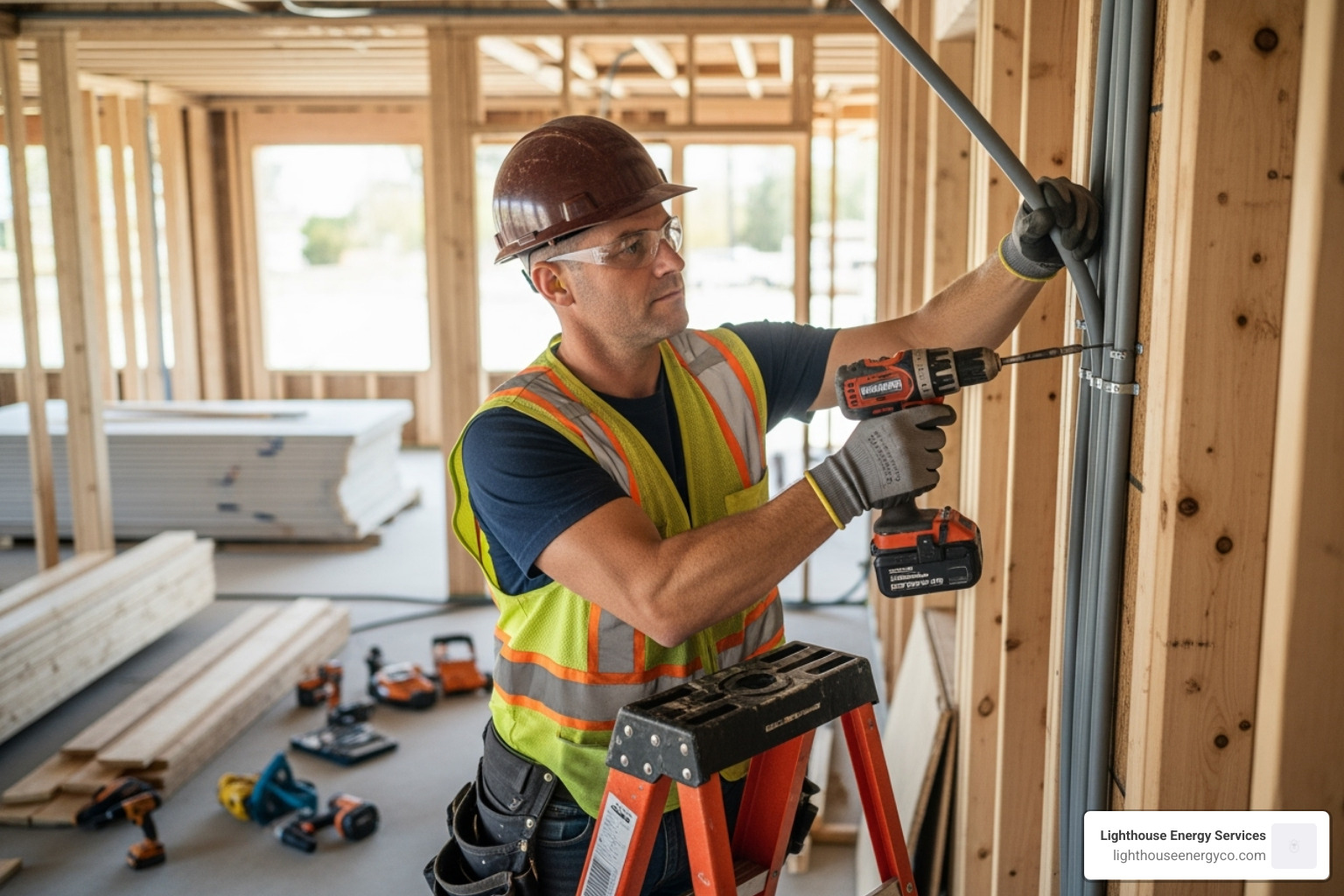
Our work involves assembling, repairing, maintaining, and testing electrical systems in all building types. In a home, we might wire an addition or upgrade a panel. In an office, we install power for computers, emergency lighting, and HVAC controls. In a factory, we work on motor controls, programmable systems, and high-voltage equipment.
The scope is broad. One day you’re pulling wire in a new house; the next, you’re troubleshooting a power outage in a shopping center. This variety keeps the work interesting and requires a blend of electrical theory and practical, real-world application.
Typical Job Duties of a Construction & Maintenance Electrician
Every project starts with reading blueprints and electrical code specifications. These plans are our roadmap, showing where every component goes. Understanding them is critical, as guessing with electricity is dangerous.
Much of the physical work involves installing conduit—protective tubes for wires. We measure, cut, and bend these pathways. Then we pull wire through the conduit, which can be challenging when threading long cables through tight spaces.
Once wired, we prepare and splice conductors for secure connections. A loose wire can cause flickering lights or fire hazards. We also install devices like switches, outlets, lighting fixtures, and control panels.
When systems fail, we troubleshoot circuits to find the problem. This detective work involves testing for tripped breakers, bad connections, or faulty components until the issue is resolved safely.
Throughout every task, we check our work against the National Electrical Code and local building codes. These safety standards are mandatory to prevent fires and injuries, and every qualified electrician knows them thoroughly.
For businesses that need reliable electrical systems, from routine maintenance to major installations, having qualified professionals makes all the difference. You can learn more about our commercial services and how we help keep businesses powered and protected.
Work Environments
A key part of being a construction & maintenance electrician is the variety of work environments. On new construction sites, we build systems from scratch. Renovation projects are trickier, as we work around existing structures and uncover hidden issues.
Commercial properties like offices and stores require reliable power for daily operations. Institutional buildings like schools and hospitals have unique needs, such as backup power systems for hospitals during an outage.
Industrial plants involve heavy machinery, high-voltage equipment, and complex controls. We also do outdoor work, like installing parking lot lighting or infrastructure for solar panels.
We regularly work at heights using lifts, ladders, and scaffolding to reach ceiling fixtures or rooftop equipment. It’s physically demanding work that is rarely boring.
The settings change, but the core mission stays the same: install it right, keep it safe, and make sure it works when people need it.
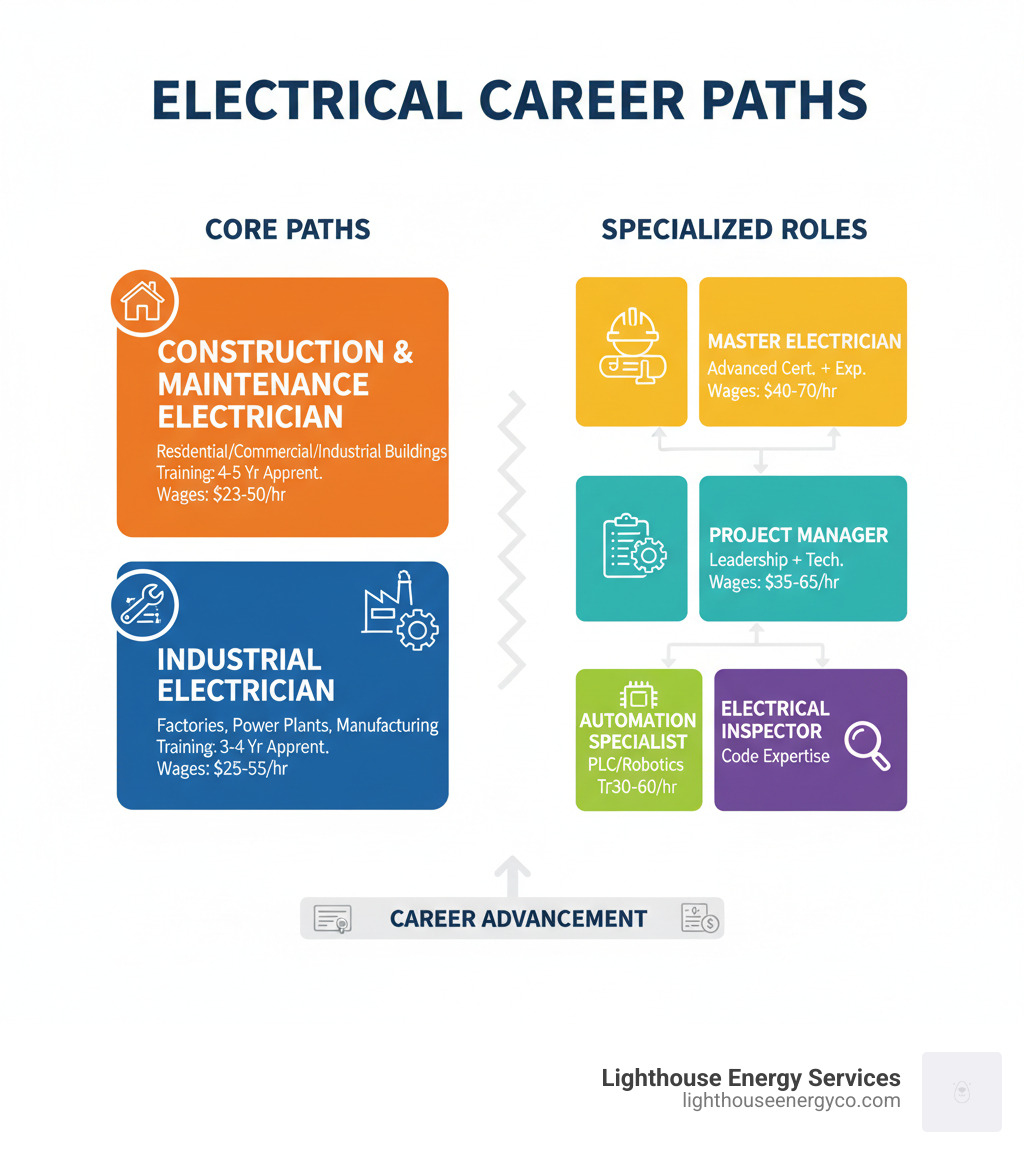
Construction vs. Industrial: Choosing Your Path
When considering an electrician career, a key decision is choosing between construction/maintenance and industrial specialization. Both paths offer solid careers with good pay and security, but daily work and career trajectories differ significantly.

The work setting is a primary difference. A construction & maintenance electrician moves between projects, like wiring a new office or upgrading panels in a mall. An industrial electrician typically works at a single facility, like a factory or power plant, becoming an expert on its specific systems.
Project variety is another key difference. Construction offers changing environments and new challenges with each job. Industrial work provides deep specialization, as you become an expert on the machinery and automation systems that keep a facility running.
Your personal preference is crucial. Do you thrive on the variety of construction sites or prefer the technical depth of maintaining industrial systems? The right choice depends on your personality and career goals.
Key Differences in Job Responsibilities
Let’s break down what you’d actually be doing in each role:
| Feature | Construction Electrician | Industrial Electrician |
|---|---|---|
| Work Environment | Residential, commercial, institutional buildings (new build/renovation) | Factories, power plants, manufacturing facilities, processing plants |
| Primary Tasks | Installation of wiring, fixtures, panels; adherence to building codes; system integration with other trades | Installation & maintenance of complex machinery, control systems; routine maintenance; troubleshooting automation |
| Equipment Used | Wiring, lighting fixtures, power distribution panels, outlets, switches, conduits | Motors, generators, transformers, switchgear, Programmable Logic Controllers (PLCs), industrial automation systems |
| Safety Focus | Electrical safety, fall protection, adherence to building codes for worker/occupant safety | High-voltage, hazardous materials, extreme temperatures, confined spaces, lockout/tagout procedures |
A construction electrician’s day focuses on installation and integration. This includes pulling wire, mounting panels, installing fixtures, and ensuring everything meets code. You’ll read blueprints, coordinate with other trades, and test systems for safety and function. It’s hands-on, problem-solving work where unexpected challenges are common.
Industrial electricians are often maintenance technicians who keep critical systems running. They install and maintain motors, generators, and switchgear. A large part of the job involves Programmable Logic Controllers (PLCs), which control automated processes. They perform routine maintenance and use diagnostic equipment to quickly troubleshoot machine failures, where downtime is costly.
High-voltage equipment is more common in industrial settings, requiring specialized training in lockout/tagout, confined space entry, and hazardous materials. Safety protocols are more complex due to the unique dangers of industrial facilities.
Long-term Career Considerations
Both paths offer excellent career stability. Construction electricians have consistent demand from new builds and upgrades. The project-based work is varied and interesting, but can involve seasonal slowdowns or travel.
Industrial electricians often find in-house maintenance roles with predictable schedules and steady pay. Becoming a go-to expert on specific systems makes you highly valuable. This stability means not having to search for the next job when a project ends.
Specialization opportunities differ between the paths. Construction electricians might specialize in areas like fire alarm systems, renewable energy installations, or smart building technology. Some advance to become estimators, project managers, or inspectors. Others take the entrepreneurial route and end up starting a contracting business, which can be incredibly rewarding if you’ve got the business savvy to match your technical skills.
Industrial electricians can specialize in automation systems, instrumentation, or control engineering. These skills are valuable as factories become more automated. Advancement can lead to roles like maintenance supervisor, controls engineer, or plant engineer with higher pay and responsibility.
Regardless of the path, the electrical trade rewards continuous learning. Technology is always evolving, from smart homes to industrial robotics, and staying current keeps your skills marketable. This blend of hands-on work and education creates a satisfying, dynamic career.
For those considering entering the trade, understanding the business case and value of proper training is essential. Learn about the business case for training apprentices in the electrical field to see why investing in your education pays off over a lifetime.
The Blueprint to Becoming a Qualified Electrician
The path to becoming a qualified construction & maintenance electrician isn’t something you can rush through in a few months. It’s a serious commitment that blends classroom learning with real-world experience, and it takes dedication to see it through.

Most people start with a high school diploma. While some regions technically allow you to begin an apprenticeship with less education, finishing high school gives you a much stronger foundation. Those math and physics classes you might have thought were pointless? They become incredibly relevant when you’re calculating voltage drops or understanding circuit behavior. Shop classes are equally valuable, giving you early exposure to working with tools and solving practical problems.
The real journey begins when you enter an apprenticeship program. This isn’t like traditional schooling where you sit in a classroom all day. It’s a carefully structured combination of hands-on work and technical instruction that typically spans about five years. For a construction & maintenance electrician, you’re looking at roughly 9,000 hours of apprenticeship before you’re ready to become a certified journeyperson.
Those 9,000 hours break down into two essential parts. The majority of your time is spent in on-the-job training, working alongside experienced electricians who’ve been doing this for years. You’ll start with basic tasks and gradually take on more complex work as your skills develop. You’re not just watching—you’re doing the work yourself, under supervision, learning how to handle real problems that arise on actual job sites.
The in-school training component happens in blocks throughout your apprenticeship. You might spend eight to ten weeks at a time in technical training, diving deep into electrical theory, code requirements, and advanced concepts. This classroom time makes sense of what you’re experiencing on the job, giving you the “why” behind the “how.” It’s typically around 840 hours of technical instruction spread across your entire apprenticeship.
This combination is what makes apprenticeships so effective. You’re earning while you’re learning, gaining practical experience while building theoretical knowledge. By the time you finish, you’re not just someone who’s read about electrical work—you’re someone who’s actually done it, under every condition imaginable.
Training, Degrees, and Certifications
Different educational pathways can lead you to a career as a construction & maintenance electrician, depending on your situation and goals. An Associate of Science (AS) degree in Electrical Construction and Maintenance offers a comprehensive program for those just starting out. These programs are typically full-time commitments, with significant classroom and laboratory hours each week, building both theoretical knowledge and practical skills from the ground up.
If you’re already working in the field and want to advance your skills without leaving your job, an Associate of Arts (AA) degree in Electrical Construction and Maintenance might be designed for evening study. These programs assume you’re getting hands-on experience at work and focus on expanding your theoretical understanding and code knowledge.
The credential that really matters in this trade is your Certificate of Qualification. After completing your apprenticeship and passing a rigorous provincial or state examination, you earn this certificate. It’s not just a piece of paper—it’s your legal authorization to work as a qualified electrician and proof that you’ve met all the necessary competency standards.
In Canada, many electricians pursue the Red Seal Program certification. This interprovincial standard means that once you’re certified, you can work anywhere in the country without having to requalify in each province. For trades like Electrician – Construction and Maintenance (309A), this Red Seal designation opens doors across the entire nation.
The quality of training programs matters enormously. The Electrical Training Alliance, partnering with the National Electrical Contractors Association, operates the largest training and apprenticeship program in the entire electrical industry. This collaboration ensures that apprentices across North America receive consistent, industry-leading education that prepares them for the real demands of the job.
Essential Skills and Knowledge for a Construction & Maintenance Electrician
Being a successful construction & maintenance electrician requires more than just knowing which wire goes where. You need a specific blend of mental abilities, physical capabilities, and practical skills that work together on every job.
Mathematical problem-solving comes up constantly in this work. You’ll calculate voltage drops, determine proper wire sizes, figure out conduit fill capacities, and work out load calculations. You don’t need to be a math genius, but you do need solid algebra and geometry skills that you can apply quickly and accurately.
Reading comprehension is equally critical. Electrical blueprints and code specifications aren’t light reading—they’re dense technical documents that tell you exactly how a system should be built. Missing a detail or misinterpreting a symbol can lead to serious problems, so you need to read carefully and understand what you’re looking at.
The job demands strong critical thinking abilities. When something isn’t working right, you can’t just guess at the problem. You need to think systematically, test your hypotheses, and work through the possibilities until you find the actual cause. If you’re someone who enjoys figuring out what’s wrong with something and then finding a solution, this trade will suit you well.
You’ll spend your days working with various hand and power tools—wire strippers, conduit benders, multimeters, power drills, and many others. Proficiency with these tools, combined with strict adherence to safety standards, is essential. Precision matters, and so does working safely every single time.
Here’s something people don’t always consider: color vision is actually a requirement for this work. Electrical wiring is color-coded for safety reasons, and mixing up a neutral wire with a hot wire because you can’t distinguish the colors can be dangerous or even deadly.
The work is physically demanding too. You’ll stand for long periods, bend into tight spaces, crouch under equipment, and pull heavy cables through walls and ceilings. Good stamina and reasonable strength make the job much easier on your body.
Finally, communication skills tie everything together. You’re rarely working alone—you’re part of a team that includes other electricians, general contractors, engineers, and various tradespeople. Clear communication keeps everyone safe, prevents mistakes, and ensures projects finish on time.
These are the skills that make our team at Lighthouse Energy Services effective at what we do. We don’t just hire people who understand electrical systems—we look for individuals who bring critical thinking, clear communication, and a commitment to doing things right. To learn more about the expertise we bring to every project, visit Learn about our qualified team.
Safety, Technology, and Career Advancement
The electrical field never stands still. For a construction & maintenance electrician, staying current with evolving technology and unwavering safety standards isn’t optional—it’s part of the job. This constant evolution is what keeps the work challenging and rewarding, but it also demands a commitment to lifelong learning and vigilance.
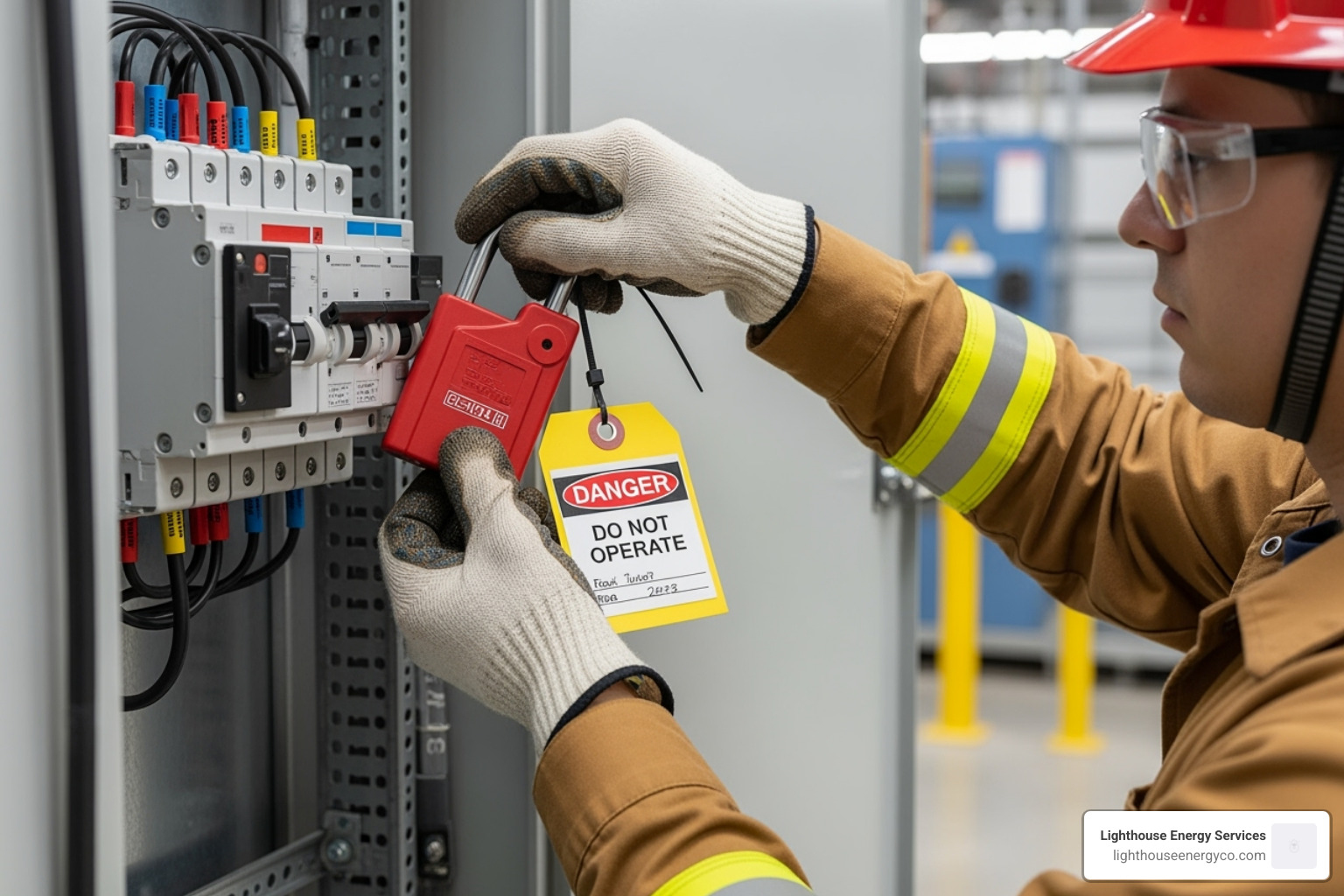
Safety isn’t just a box to check—it’s the foundation of everything we do. Working with electricity means working with real danger, and we take that seriously. Every construction & maintenance electrician learns safety protocols from day one of their apprenticeship, and those lessons never stop.
The National Electrical Code (NEC) serves as our primary guide, establishing the minimum standards for safe electrical installation. We study it, reference it constantly, and build our work around its requirements. But safety goes beyond code compliance. It’s also about the daily habits that keep us protected: consistently wearing Personal Protective Equipment (PPE) like insulated gloves, safety glasses, and when necessary, arc-flash rated clothing that can withstand electrical faults.
Different work environments present unique challenges. When we’re dealing with high-voltage safety in industrial plants or main service feeds, we follow specialized procedures and use equipment designed for those extreme conditions. On construction sites, fall protection becomes critical when we’re working from ladders or lifts to install conduit or fixtures at height. We use proper harnesses, inspect equipment before each use, and never take shortcuts.
These safety practices protect more than just ourselves. They ensure the systems we install will operate safely for years to come, giving building occupants and equipment operators the security they deserve.
The Impact of Technology on the Electrical Trade
Technology has transformed what it means to be an electrician. The days of simply running wire and installing switches are long gone—though those fundamentals remain important. Today’s electrical trade has acceptd smart technology in ways that would have seemed like science fiction a generation ago.
Modern electricians work regularly with computer-controlled equipment. We program sophisticated lighting systems that adjust automatically based on occupancy and daylight levels. We integrate building automation systems that manage everything from HVAC to security. These systems communicate through networks we install and maintain, including fibre optics, Local Area Networks, and coaxial cable infrastructure.
The growth of renewable energy systems has opened entirely new career opportunities. Solar panel installations, wind power integration, and battery storage systems all require electricians who understand both traditional electrical work and emerging green technologies. We’re not just connecting panels to roofs—we’re engineering complete energy solutions that tie into existing grids or operate independently.
Even the electrical grid itself is getting smarter. Innovations like self-healing power grids can detect problems and automatically reroute power before customers even notice an outage. Duke Energy Florida has pioneered this technology, and electricians who understand these complex network systems are in high demand.
Building automation continues to expand, creating structures that respond intelligently to their occupants’ needs while minimizing energy waste. From smart homes to entire smart cities, electricians are the professionals making these visions reality. We’re building the nervous system of modern infrastructure, one connection at a time.
Understanding proper grounding remains fundamental regardless of how advanced the technology becomes. These essential safety requirements ensure every system operates reliably. For detailed guidance on this critical topic, you can review the NEC Requirements for Grounding of Services.
Career Paths and Earning Potential
The financial rewards for skilled electricians reflect the expertise and dedication the trade demands. Starting as an apprentice, your wages grow steadily as you gain competency and experience. Once you complete your training and earn your certification as a journeyperson, the earning potential increases significantly.
Across North America, journeyperson wages for construction and maintenance electricians typically range from $23.00 to $50.92 per hour, with regional variations based on cost of living and demand. In Ontario, for example, the provincial average for a Journeyperson Electrician – Construction and Maintenance reached $50.92 per hour as of 2024. Many positions offer overtime opportunities that can substantially boost annual earnings—some roles in the UK market show On-Target Earnings of £60,000 annually when overtime is included.
But hourly wages tell only part of the story. The real value of an electrical career lies in the advancement opportunities available to those willing to continue learning and taking on greater responsibility.
Experienced electricians can pursue several rewarding paths. Becoming a Master Electrician requires additional experience and examination, but it qualifies you to design electrical systems, supervise installations, and run your own contracting business. Some electricians transition into Site Engineer roles, overseeing electrical installations on major projects with salaries in the £42,500 to £45,100 range plus overtime potential.
Project Manager positions appeal to those who enjoy coordinating teams, managing budgets, and seeing large projects through from planning to completion. If you prefer ensuring quality and compliance, becoming an Electrical Inspector allows you to use your extensive experience to verify that installations meet all code requirements.
The rise of specialized technologies has created demand for electricians who focus on specific areas. Experts in automation systems, renewable energy installations, or building controls command premium wages because their skills are both valuable and relatively rare.
The career outlook remains strong. Construction continues, infrastructure needs constant upgrading, and new technologies require skilled professionals who understand both the fundamentals and the innovations. We’re proud of the work our team accomplishes every day, from routine maintenance to complex installations that push the boundaries of what’s possible. You can see examples of the diverse projects we’ve completed by visiting View our past projects.
Conclusion
The path of a construction & maintenance electrician is genuinely rewarding—one that combines hands-on problem-solving with continuous learning in an changing field. Throughout this guide, we’ve walked through what it takes to build a career in this essential trade, from the rigorous 9,000-hour apprenticeship to the diverse work environments you’ll encounter, whether on busy construction sites or within complex industrial facilities.
We’ve seen how this profession offers something for everyone. If you thrive on variety and enjoy moving from project to project, construction electrical work gives you that dynamic environment. If you prefer diving deep into specialized systems and developing expertise in automation or high-voltage equipment, industrial electrical work might be your calling. Either way, the trade offers stability, competitive wages ranging from $23.00 to over $50.00 per hour, and clear advancement paths to master electrician, project manager, or even running your own contracting business.
Technology continues to reshape our work in exciting ways. From smart technology and building automation to renewable energy systems and self-healing power grids, electricians today are at the forefront of innovation. This means the learning never stops—and honestly, that’s what keeps many of us passionate about the trade. We’re not just maintaining yesterday’s systems; we’re building tomorrow’s infrastructure.
Safety remains the cornerstone of everything we do. Whether it’s following National Electrical Code requirements, using proper lockout/tagout procedures, or wearing appropriate personal protective equipment, we take pride in doing things the right way. It’s not just about getting the job done—it’s about getting it done safely and correctly.
At Lighthouse Energy Services, we live these principles every day. Our team of qualified electricians brings this combination of expertise, dedication, and continuous learning to every job we undertake. We understand that whether you need routine maintenance or a complex installation, you deserve service that’s prompt, professional, and done right the first time—no hidden fees, no runaround, just honest electrical work from people who genuinely care about their craft.
For professional electrical work in Palm Beach County, from routine maintenance to complex installations, trust the experts at Lighthouse Energy Services. We’re available 24/7 because electrical issues don’t wait for business hours. Contact us for your commercial electrical needs and experience the difference that true craftsmanship makes.