Why Every Second of Uptime Counts
Commercial power backup systems are essential solutions that keep your business running when the grid goes down. Here’s what you need to know:
Main Types of Commercial Backup Power:
- UPS (Uninterruptible Power Supply) – Provides instant power for seconds to minutes, protecting equipment and data.
- Generators – Deliver long-term power for hours or days using diesel, natural gas, or propane.
- Battery Energy Storage Systems (BESS) – Store energy for flexible use, integrate with solar, and offer scalable capacity.
Key Selection Factors:
- Power Requirements – How much electricity your critical systems need (measured in kVA or kW).
- Runtime Duration – How long you need backup power to last.
- Budget & ROI – Upfront costs versus the cost of downtime.
- Physical Space – Available area for equipment installation.
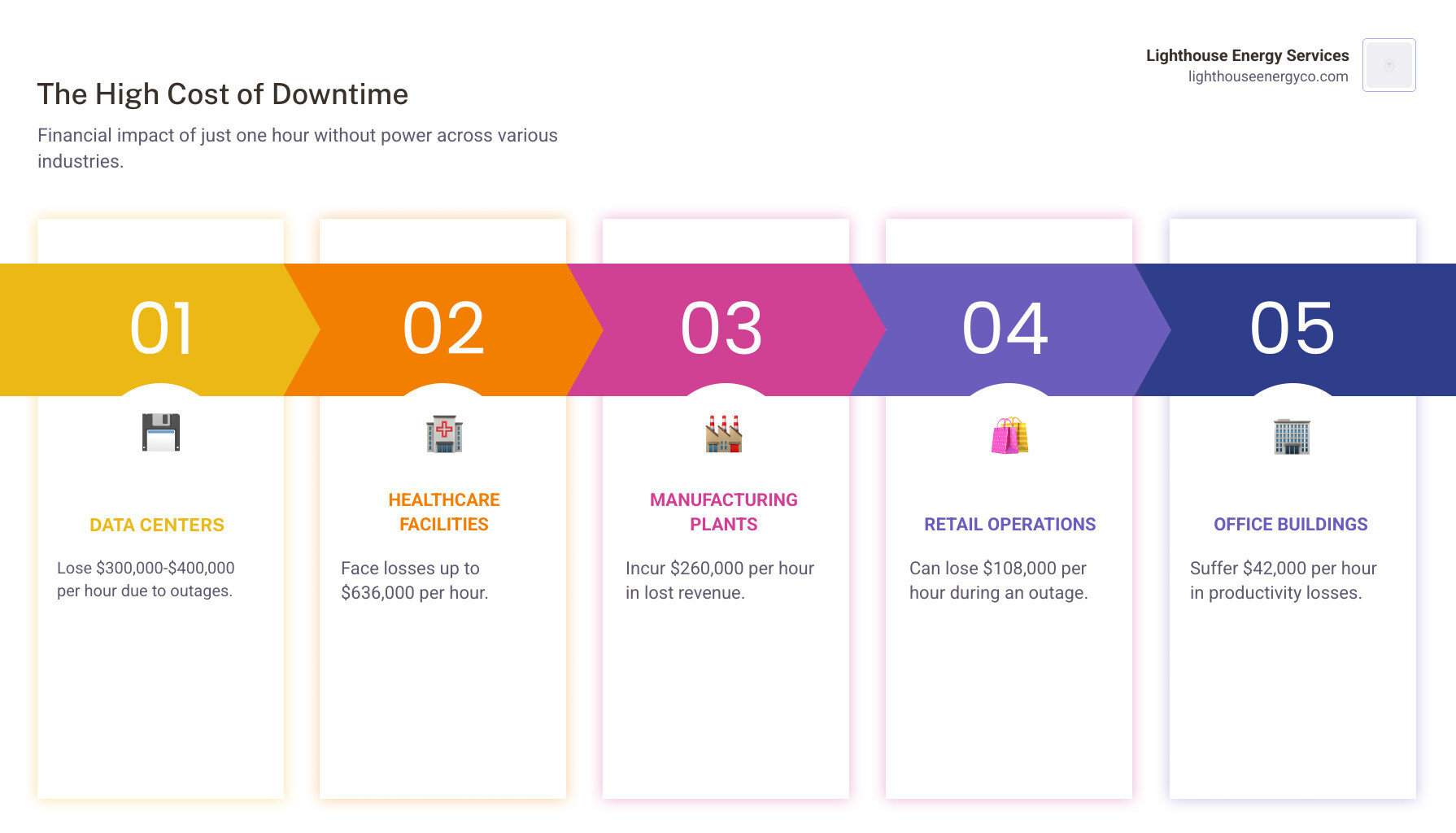
What would happen to your business if the power went out right now? For most, the answer is stark: downtime means lost revenue, damaged equipment, and corrupted data. In today’s commercial and industrial sectors, power resiliency isn’t a convenience—it’s a critical necessity.
The financial impact is real. Whether you run a data center, a healthcare facility with life-saving equipment, or a manufacturing plant, the cost of being unprepared far exceeds the investment in backup power.
Fortunately, modern commercial power backup solutions are more accessible and adaptable than ever. From instantaneous UPS systems to robust generators, there are options to fit your specific needs and budget.
I’m Bruce Kemp, and I’ve spent decades in electrical contracting and energy systems, working on everything from permit preparation to installing commercial power backup solutions worldwide. I’ve seen how the right backup strategy transforms business resilience.
Core Types of Commercial Power Backup
When the lights go out, your business doesn’t have to. The right commercial power backup system keeps operations humming, but not all backup power is created equal. Understanding the options is the first step toward power resiliency.
Uninterruptible Power Supply (UPS)
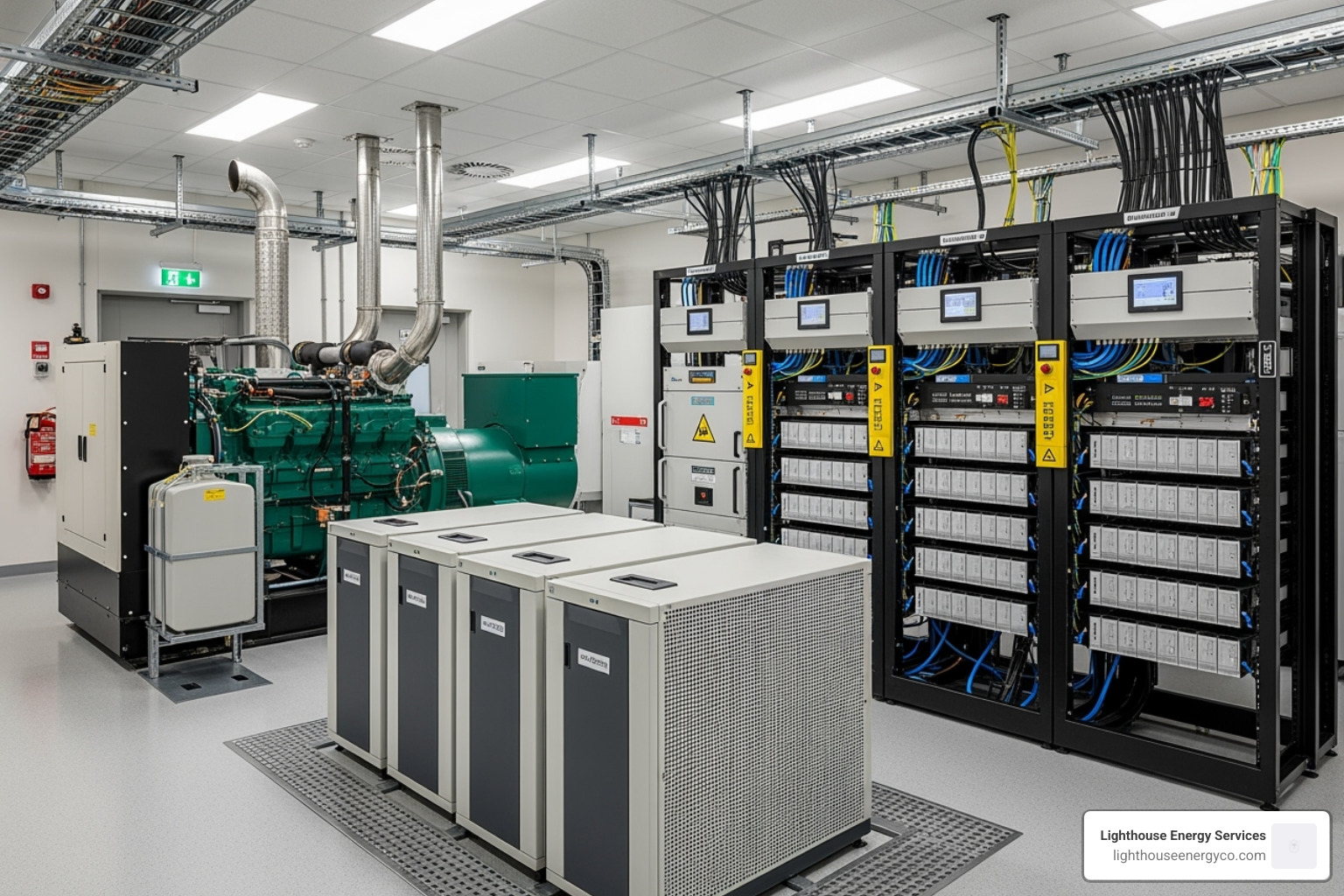
Think of a UPS as your power system’s first responder. An Uninterruptible Power Supply sits between your equipment and the power source, and the moment it detects an outage, it switches to battery power in milliseconds. Your equipment never knows anything happened.
This instant protection is crucial for servers, medical devices, and point-of-sale systems where a single power hiccup can corrupt data or crash systems. A UPS also performs vital power conditioning, filtering out voltage spikes and sags to extend the life of your equipment.
The runtime on a UPS typically ranges from a few minutes to an hour, which is often enough time to bridge the gap until a generator starts or to safely shut down critical systems. UPS systems range from basic standby units to advanced double-conversion online systems that offer the highest level of protection for mission-critical applications.
At Lighthouse Energy, we help businesses in Palm Beach County select and install the right UPS configuration. Learn more about how Our Services can protect your business.
Commercial Generators
When you need power for hours or even days, generators are the workhorses. During an outage, an Automatic Transfer Switch (ATS) detects the power loss, starts the generator, and seamlessly transfers your electrical load in about 10 to 30 seconds.
- Diesel generators are incredibly reliable and efficient, built to run for long periods in harsh conditions. They are a go-to choice for industrial facilities and hospitals but require on-site fuel storage.
- Natural gas generators connect to your existing gas line, eliminating fuel storage concerns and the risk of running out. They burn cleaner and are quieter than diesel.
- Propane generators offer a clean-burning alternative for locations without natural gas access. Propane can be stored on-site and doesn’t degrade over time.
A properly sized generator with an ATS provides automatic, reliable standby power for as long as you have fuel.
Battery Energy Storage Systems (BESS)
BESS represents the newest evolution in commercial power backup. These systems store electrical energy from the grid or renewables (like solar) for use whenever you need it.
What makes BESS so appealing? They are completely silent, produce zero emissions, and are highly scalable, allowing you to expand capacity as your needs grow. This makes them ideal for urban locations or any facility where noise and air quality are concerns.
Integration with renewable energy is where BESS truly shines. Paired with solar panels, a battery system stores excess energy for use at night or during outages, dramatically improving your energy independence and reducing utility costs through peak shaving.
Modern lithium-ion batteries, especially LiFePO4 (Lithium Iron Phosphate), offer high energy density, long lifespans (10+ years), and excellent safety. They can power everything from server rooms to refrigeration systems, depending on their size. For businesses looking to combine backup power with renewables and long-term savings, BESS is a compelling solution. Explore our Commercial Power Backup Solutions to see how we can design a system for your facility.
Choosing the Right Backup Solution for Your Business
Selecting the ideal commercial power backup system requires a custom approach. There’s no one-size-fits-all answer, but by evaluating your specific needs, we can find the perfect fit.
| Feature | UPS | Generators | BESS (Battery Energy Storage Systems) |
|---|---|---|---|
| Runtime | Minutes (to bridge or shut down) | Hours to Days | Hours (scalable) |
| Instant Power | Yes (near-instantaneous) | No (seconds/minutes delay) | Yes (instantaneous) |
| Cost | Lower initial, higher per Wh for long duration | Moderate initial, ongoing fuel/maint. | Higher initial, lower operational |
| Maintenance | Battery replacement, periodic checks | Fuel, oil, filters, regular servicing | Battery health, software updates |
| Footprint | Small to Medium | Medium to Large (plus fuel storage) | Medium to Large (scalable) |
| Emissions | Zero | Significant (fuel-dependent) | Zero |
| Renewable Integration | Limited (unless part of BESS) | No | Excellent |
Assess Your Power Requirements
First, we need to understand your business’s power DNA. This involves identifying your critical loads—the systems that absolutely cannot go down, such as servers, POS systems, or life-support equipment. Next, we measure their power consumption in kVA and kW, adding a buffer for future growth. It’s also vital to understand your peak demand to ensure the system can handle your busiest operational times. Finally, identifying non-essential systems that can be shut off helps right-size the solution and avoid unnecessary expense.
Key Factors for Your Commercial Power Backup System
Once we know what needs power, we determine the best way to provide it.
- Runtime duration is a deciding factor. Do you need minutes for a safe shutdown (UPS), hours for a typical outage (BESS), or days for a major grid failure (generator)?
- The budget and ROI conversation goes beyond the initial price. We consider the Total Cost of Ownership, including installation and maintenance, and weigh it against the massive financial losses of downtime.
- Scalability for future growth is crucial as digitalization increases power needs. Modular UPS and BESS solutions can expand with your business, protecting your investment.
- Physical space is a practical constraint. Generators need outdoor space and fuel storage, while BESS and UPS units require dedicated indoor areas. We’ll assess your facility to recommend solutions that fit.
Industry-Specific Backup Power Strategies
Every industry has unique vulnerabilities, so a cookie-cutter approach to commercial power backup won’t work.
- Data centers require continuous power to prevent data loss. They typically use a layered defense of large-scale UPS systems and powerful generators.
- Healthcare facilities need uninterrupted power for life-support equipment and patient records, often requiring redundant UPS and generator systems to meet strict regulations.
- Manufacturing plants rely on continuous power to avoid costly production stoppages and equipment damage. Large generators or whole-facility BESS are common.
- Retail and hospitality businesses use UPS systems for POS and IT infrastructure, while generators can power entire stores or hotels to protect revenue and guest experience.
- Telecommunications infrastructure uses battery backups and generators to maintain network connectivity, even in remote locations.
Integration, Maintenance, and Future-Proofing Your System
Installing a commercial power backup system is just the beginning. To truly future-proof your business, we must consider integration, maintenance, and emerging technologies.
Integrating with Renewables and Existing Infrastructure
The most resilient backup systems work seamlessly with renewable energy sources. Adding battery storage to an existing solar panel array is a smart investment. This solar battery backup captures excess energy your panels generate, storing it for use at night or during an outage. This maximizes your use of clean solar energy and protects you from grid failures.
Hybrid systems take this further by combining solar, battery storage, and a generator into a robust, multi-layered solution. These systems can even participate in smart grid integration and demand response programs, potentially generating revenue while ensuring power security.
At Lighthouse Energy, we specialize in integrating these complex systems. You can see examples in Our Projects.
Maintenance for Your Commercial Power Backup System
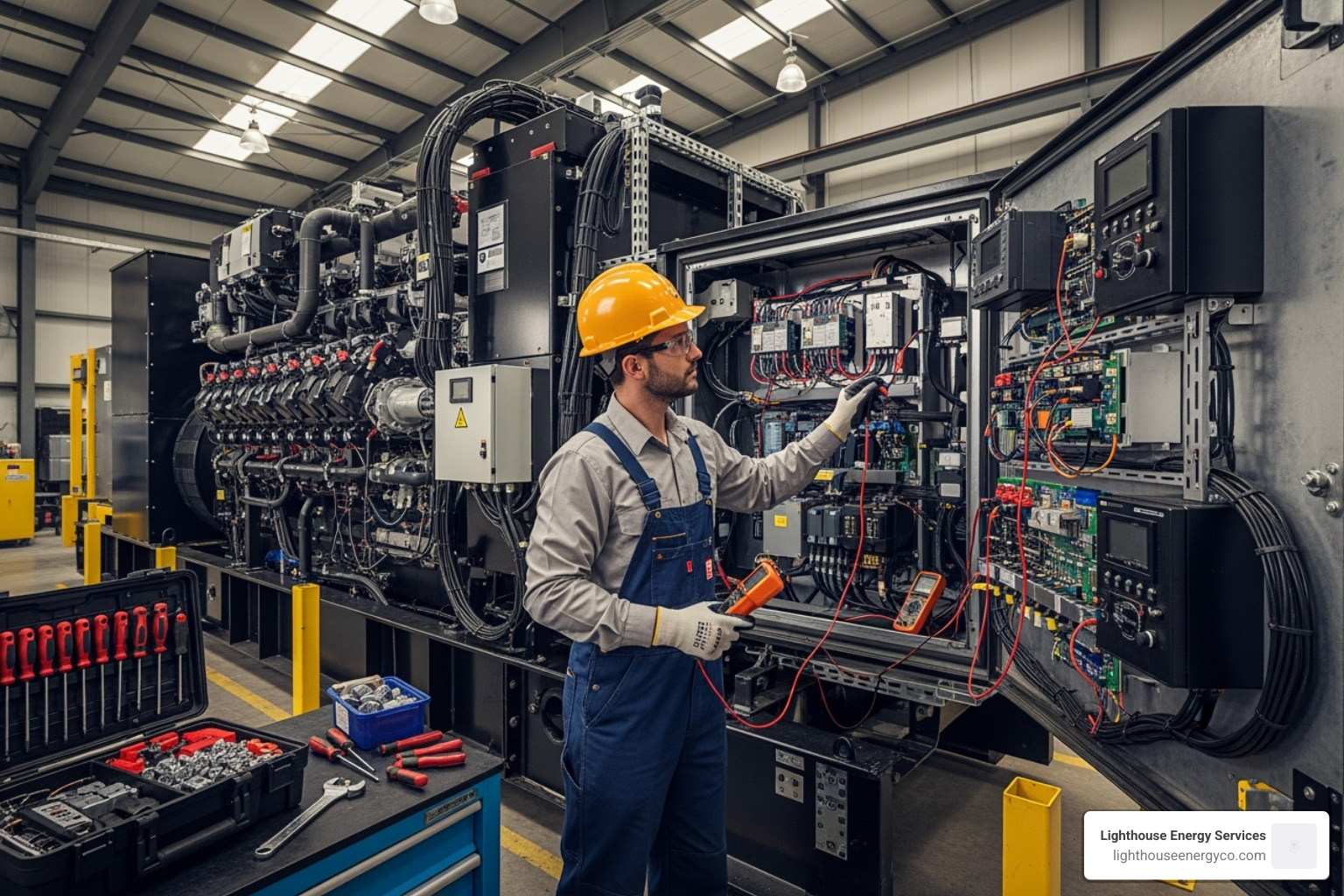
A backup power system must be ready to perform perfectly when you need it most. That’s why regular maintenance is essential. Scheduled reliability checks, including visual inspections and fluid level checks for generators, can catch small problems before they become major failures.
For generators, this includes regular servicing of oil and filters and proper fuel management to prevent degradation. For battery health monitoring, modern BESS and UPS systems use software to track performance and flag potential issues in real-time. Since batteries have a finite lifespan (e.g., 6-8 years for some UPS solutions), planning for eventual replacement is part of a smart maintenance strategy.
While some checks can be done in-house, professional servicing is crucial for complex systems. Lighthouse Energy provides comprehensive maintenance plans to ensure your system is always ready. Our qualified electricians are available 24/7 because we know how critical your backup power is.
Innovations and Trends in Backup Power
The world of commercial power backup is evolving, with new technologies making systems more efficient and reliable.
- Lithium-ion (LiFePO4) technology is becoming the gold standard for energy storage, offering higher energy density, longer lifespans, and faster charging than traditional batteries.
- Modular UPS systems allow you to scale your power capacity as your business grows, so you only pay for what you need today while planning for tomorrow.
- Remote monitoring and management are now standard on advanced systems, allowing you and our service team to check system status from anywhere and proactively address issues.
- Hydrogen fuel cells are an emerging technology worth watching. They generate clean electricity with only water as a byproduct, offering tremendous promise for long-duration, zero-emission backup power.
Frequently Asked Questions about Commercial Backup Power
Business owners often have the same smart questions about their power backup needs. Here are clear, straightforward answers to the most common ones.
What’s the difference between a UPS and a generator?
This is the most important question to understand before investing in commercial power backup. Think of them as a team with different roles.
A UPS (Uninterruptible Power Supply) is your first responder. It provides instant, seamless power from its internal batteries the moment an outage occurs. There’s no interruption, no reboot, and no lost data, making it perfect for protecting sensitive electronics like computers, servers, and medical equipment.
However, a UPS is built for short sprints, providing power for a few minutes to half an hour. Its job is to bridge the critical gap—either allowing for a safe shutdown or keeping things running until your generator takes over.
A generator is your long-distance runner, designed to power your facility for hours or even days. When the grid fails, an Automatic Transfer Switch starts the generator, which takes over the electrical load after a brief delay of a few seconds to a minute. That momentary interruption is why a UPS is so critical for sensitive electronics.
The best strategies combine both: the UPS provides an instant, seamless transition, and the generator provides the long-term staying power.
How long will a commercial battery backup system last?
The honest answer is: it depends. The runtime of any commercial battery backup system comes down to two factors: the battery’s storage capacity (measured in kWh) and the power your equipment is drawing (measured in kW).
For a basic UPS protecting a single computer, you might get 5 to 15 minutes—enough to save your work and shut down. For larger commercial UPS systems, especially those with modern lithium-ion batteries, you can expect 3 to 6 hours of backup power, which is enough to ride out most outages.
When we move to comprehensive Battery Energy Storage Systems (BESS), the runtime can be engineered to last for many hours or even a full day, depending on your critical load. These systems are scalable to meet your specific operational needs, which is why our experts calculate your exact requirements instead of guessing.
Can I add a backup system to my existing solar panels?
Yes, absolutely. Integrating a battery storage system with your existing commercial solar installation is one of the smartest investments you can make for energy independence.
Normally, your solar panels shut down during a grid outage for safety reasons. But when you pair them with a battery storage system, you create a “microgrid.” Your panels can continue generating power, your batteries store it, and your critical systems keep running, all without relying on the utility.
This setup allows you to store excess solar energy generated during the day for use at night or during an outage. The benefits go beyond backup power: you increase your energy independence, reduce your reliance on the grid during expensive peak hours, and shrink your carbon footprint. We’ve completed many projects retrofitting solar installations with advanced battery backup, and you can see some of our work in Our Projects. The technology has matured, and the ROI makes more sense than ever.
Secure Your Business’s Future with Reliable Power
Power outages aren’t a question of if, but when. For any business, the impact is real: lost revenue, damaged equipment, and a frustrated customer base. Being unprepared is a risk most can’t afford to take.
A proactive power strategy is smart business. Investing in the right commercial power backup solution protects your revenue, secures your data, and preserves your reputation. When the lights go out for everyone else, your business keeps running.
That’s where Lighthouse Energy comes in. We’re not just electricians; we are your partners in building a comprehensive backup power strategy that works when you need it most. From the initial consultation and permit preparation to expert installation and 24/7 maintenance, our licensed and insured team is with you every step of the way. We stand by our commitment to get the job done right, and done right now.
Don’t wait for the next outage to learn this lesson the hard way. Protect the business you’ve worked so hard to build.
Contact Us for a Consultation today, and let’s secure your business’s future together. We’re here to make sure you’re never left in the dark.