
Why Every Business Needs a Power Outage Plan
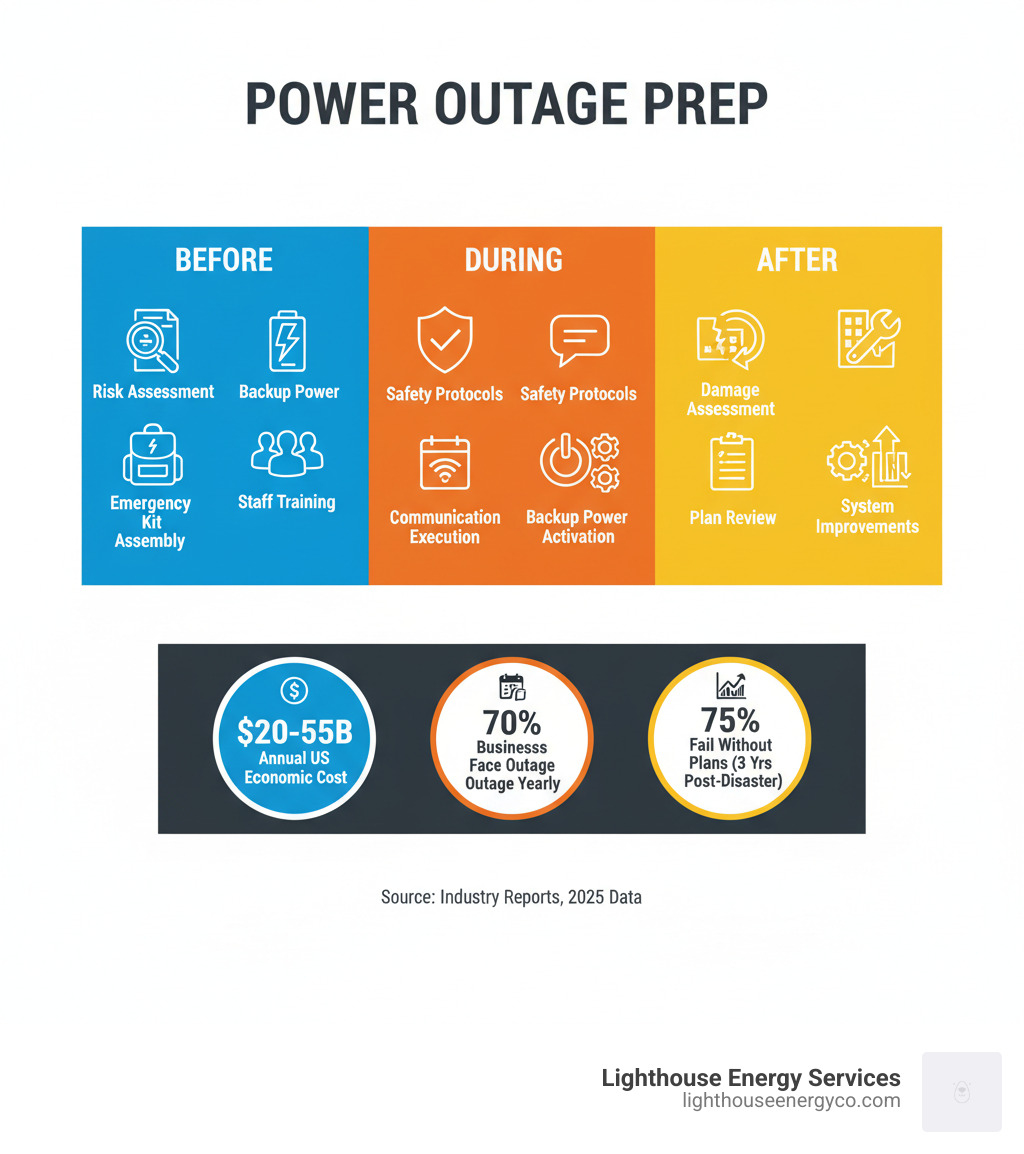
Business power outage preparedness isn’t optional—it’s essential. When the lights go out, businesses face lost revenue, spoiled inventory, and compromised data. The numbers are sobering: power outages from storm-related events cost the U.S. economy $20-$55 billion annually, and 70% of businesses will face an outage in the next year. Worse, experts estimate that 75% of businesses without a continuity plan will fail within three years of a disaster.
Quick Action Checklist for Business Power Outages:
- Report the outage to your utility company immediately
- Turn off and unplug sensitive equipment to prevent surge damage
- Switch to backup power if available (generator or UPS)
- Activate your communication plan to inform employees, customers, and suppliers
- Implement manual processes for critical functions like transactions and time tracking
- Document all losses for insurance and compensation claims
- Stay informed via local radio or utility company updates
Outages can be brief flickers or extended blackouts, either planned for maintenance or unplanned due to storms, equipment failures, or accidents. Weather-related events, which have doubled since 2003, cause about 44% of all outages. Whether you run a restaurant, office, or factory, the impact is immediate and costly.
I’m Bruce Kemp, an electrical contractor and energy systems engineer. I’ve spent my career helping businesses prepare for and recover from power outage events. By designing backup power and emergency electrical solutions, I’ve seen how proper preparation transforms a potential disaster into a manageable inconvenience.
Before the Blackout: Your Preparedness Blueprint
Imagine a workday plunged into darkness. Computers die, operations halt, and your team looks to you for answers. Now, imagine your backup systems kicking in seamlessly because you were prepared. A business power outage doesn’t have to be a disaster; with the right groundwork, it’s a manageable situation.
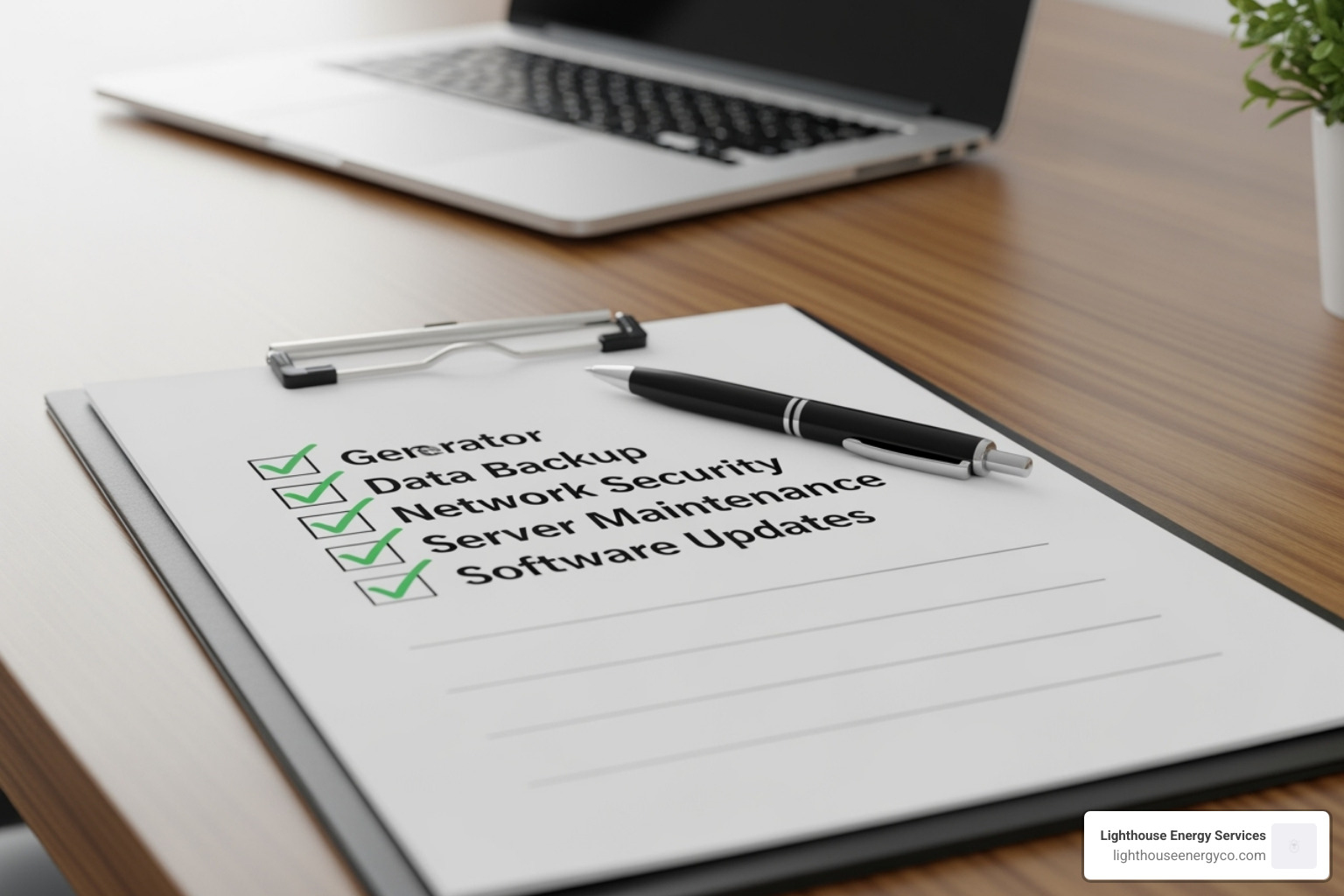
Start with a risk assessment to identify all critical equipment and processes dependent on electricity. This forms the foundation of your business continuity plan. 75% of businesses without one fail within three years of a disaster. Your plan should be detailed but flexible.
Staff training brings your plan to life. Regular drills ensure everyone knows their role, how to use backup systems, and can follow safety protocols without panic. Just like a fire drill, practice makes the response automatic. Also, prioritize data protection with regular backups, cloud storage, and surge protectors. For more strategies, see what are the most effective ways to keep your business running during a power outage.
The Core Components of a Business Power Outage Plan
A solid plan should cover these bases:
- Identify critical functions: What must keep running? For a restaurant, it’s refrigeration; for a medical office, patient records.
- Establish a communication tree: Predetermine who calls whom and how you’ll reach employees, customers, and suppliers. Draft messages in advance for phone, text, and social media.
- Assign emergency roles: Designate and train specific people (with backups) to handle communications, manage backup power, and coordinate with utilities.
- Create a data backup strategy: Use regular, automated backups stored both off-site and in the cloud. Test them periodically.
- Develop a supplier and client contact plan: Quick, professional communication preserves relationships and manages expectations. Learn more info about our services at Lighthouse Energy for help building your plan.
Protecting Your Digital and Physical Assets
Protect your assets with multiple layers of defense.
- Uninterruptible Power Supplies (UPS): These battery backups provide minutes of power for a safe shutdown of computers and servers, preventing data loss and hardware damage.
- Surge protectors: When power returns, voltage spikes can fry electronics. Quality surge protectors absorb this impact.
- Cloud-based data backups: Ensure your vital information is safe and accessible from anywhere, even if your building is inaccessible.
- Manual overrides: Know how to manually operate electronic locks and security systems to avoid being trapped or vulnerable. Battery backups for these systems are a wise investment.
- Equipment shutdown procedures: Document and post clear shutdown sequences for sensitive or industrial machinery to prevent damage.
Assembling an Emergency Kit and Training Your Team
Every business, from a small shop in Boca Raton to a large office in West Palm Beach, needs a well-stocked emergency kit.
Your business emergency kit should include:
- Flashlights and extra batteries (no candles)
- Battery-powered or hand-crank radio
- First-aid supplies
- Bottled water and non-perishable snacks
- Portable phone chargers
- Blankets
- A printed copy of your emergency plan with critical contacts
- Cash in small bills
- Basic tools
Having a kit isn’t enough; your team must be trained. Conduct regular drills to review safety procedures, practice using backup systems, and role-play scenarios. Walk through the steps: locating the kit, activating the generator, communicating with customers, and deciding when to send employees home. Familiarity reduces panic and builds confidence, showing customers you’re a resilient and reliable operation.
Choosing Your Shield: Backup Power Solutions
When the grid goes dark, a reliable backup power solution is the difference between a minor inconvenience and a major catastrophe for businesses in Palm Beach and Miami-Dade County.
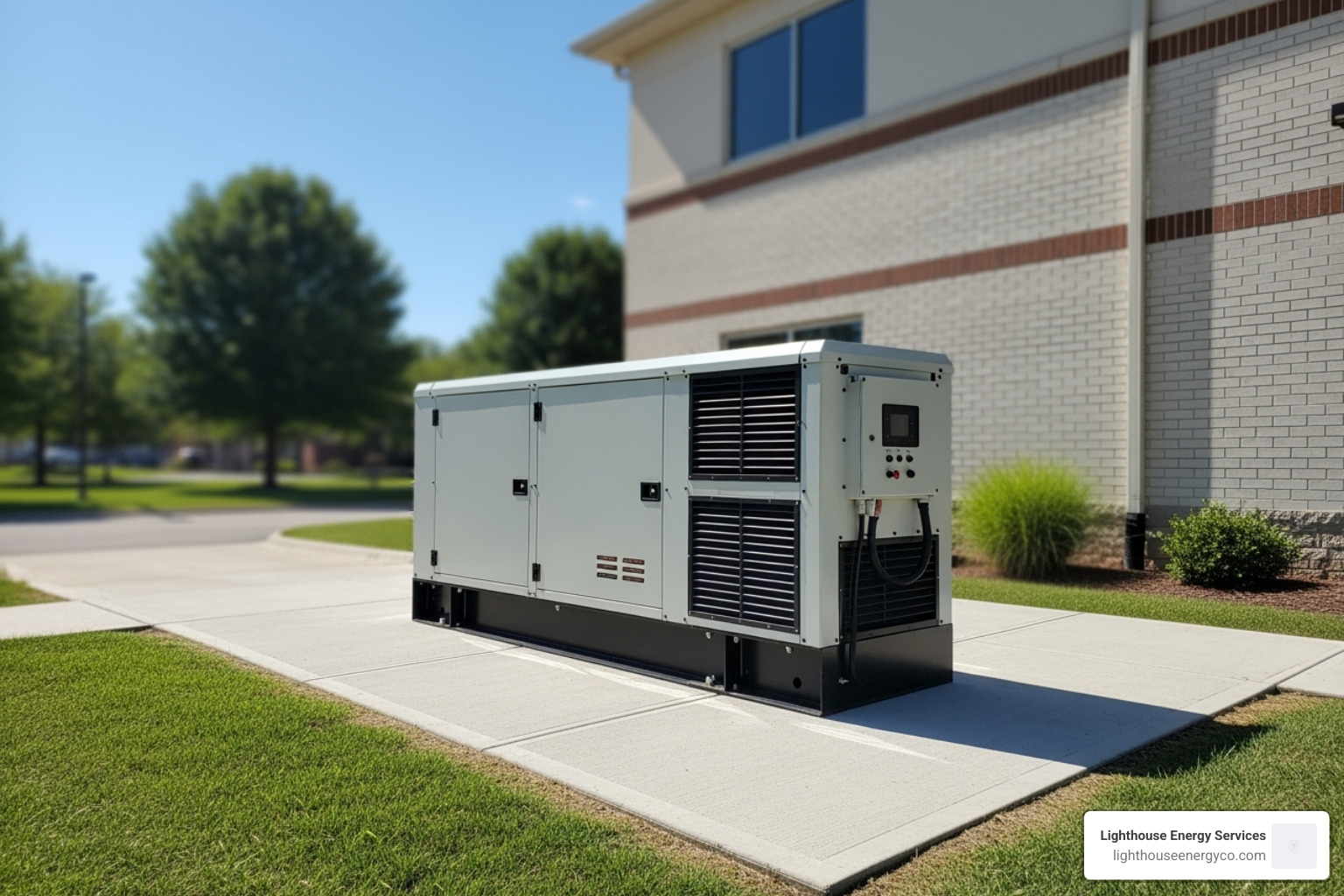
Choosing the right system starts with calculating your power requirements by adding up the wattage of all essential equipment. A small office may need 5,000 watts, while a restaurant could require 30,000 watts or more. Fuel type is another key consideration: natural gas offers unlimited runtime from a utility line, propane is easily stored in tanks, and diesel provides the highest power output.
Professional installation is essential for safety, code compliance, and warranty protection. A poorly installed generator is a significant hazard. Our Commercial Electrical Services team ensures your system is installed safely and performs optimally, helping South Florida businesses design and implement reliable backup power.
Uninterruptible Power Supplies (UPS)
An Uninterruptible Power Supply (UPS) is your first line of defense, providing instantaneous battery power when the grid fails. This is crucial for sensitive electronics like computers and servers. A UPS isn’t for long-term operation; its purpose is to provide enough time (a few minutes to an hour) to shut down equipment safely, preventing data corruption and hardware damage. UPS batteries typically last 3-5 years and require periodic checks and replacement.
Generators: The Key to Long-Term Operation
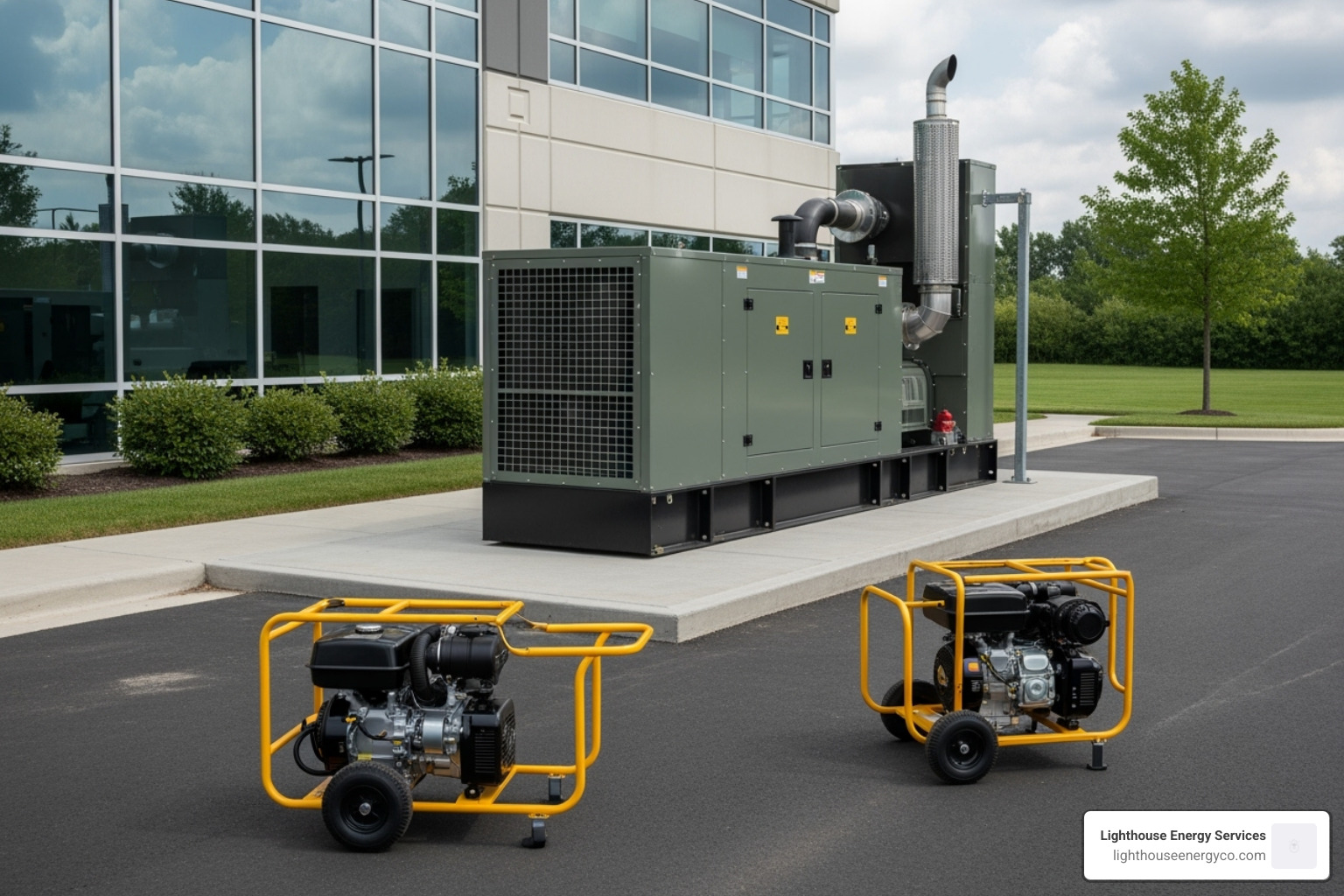
For extended outages, generators are the workhorses that keep a business running. They provide continuous electricity to maintain operations, not just shut down safely. There are two main options:
| Feature | Standby Generators | Portable Generators |
|---|---|---|
| Cost | Higher initial investment | Lower initial investment |
| Power Output | High, can power entire business | Moderate, powers essential circuits/appliances |
| Runtime | Long (connected to natural gas line or large fuel tank), automatic refueling | Limited (requires manual refueling from small tank) |
| Convenience | Automatic start-up, permanent installation, quiet operation (often) | Manual start-up, requires moving and connecting, noisy, requires extension cords |
| Installation | Professional installation required, connected to electrical panel | Plug-and-play, but requires safe operation (e.g., outdoors, away from windows) and transfer switch for home circuits |
| Fuel | Natural gas, propane, diesel | Gasoline, propane, diesel |
| Maintenance | Regular professional maintenance recommended | User-dependent, requires more frequent checks and fuel stabilization |
| Safety | Integrated safely into electrical system, proper ventilation | Requires careful handling of fuel, risk of carbon monoxide poisoning if used indoors, backfeeding risk if not properly connected via transfer switch |
Standby generators are the premium solution for businesses that cannot afford downtime. Permanently installed, they turn on automatically within seconds of an outage. Connected to a natural gas line or a large fuel tank, they offer runtimes measured in days. At Lighthouse Energy, we specialize in designing, installing, and maintaining these robust systems for businesses throughout South Florida.
Portable generators are a budget-friendly option for small operations. These manual-start units can power a few essential items but require careful handling, outdoor placement for ventilation, and frequent refueling. They are generally not robust enough for comprehensive business continuity.
Choosing the right generator is a critical investment in your business’s resilience. Our Commercial Electrical Services team helps businesses with everything from assessment to installation and maintenance, ensuring that when the next storm hits, your lights stay on.
Lights Out: Your Immediate Action Plan During a Business Power Outage
When the lights go out, calm, decisive leadership is crucial. For any business, from a Boca Raton restaurant to a Fort Lauderdale office, your response in the first few minutes sets the tone.

When a business power outage hits, it’s time to execute your plan. Your priorities are safety, communication, damage assessment, and operational adjustments. This is about following the blueprint you already created.
Safety First: Protecting People and Property
People always come first. During an outage, immediately account for all employees and customers. Ensure emergency lighting is working and evacuation routes are clear. If necessary, begin a calm, controlled evacuation.
- Generator Safety: Ensure backup generators run in well-ventilated areas, far from windows, to prevent carbon monoxide poisoning. Never “backfeed” power into an electrical panel without a proper transfer switch; it can injure utility workers.
- Hazard Avoidance: Treat all downed power lines as live. Use flashlights, not candles, to prevent fires.
- Equipment Protection: Turn off and unplug sensitive electronics to protect them from the surge when power returns.
- Access Control: Know how to manually override electronic locks so no one is trapped. For more tips, see this guide on 15 Power Outage Safety Tips for Small Businesses.
Executing Your Plan and Staying Informed
Activate your communication tree. Inform employees of the situation and next steps. Update customers and suppliers via text, social media, or your phone system—transparency builds trust.
Switch to backup power for critical equipment. For other functions, implement manual processes like hand-writing receipts or accepting cash. It’s not ideal, but it keeps you operational.
Contact your utility company to report the business power outage and get an estimated restoration time. In Florida, the FPL Power Tracker Map offers real-time updates. Stay informed through multiple channels, including utility websites and local radio. Knowledge is power, even when the power is out.
Lighthouse Energy Services understands how stressful outages are for businesses in Palm Beach, Broward, and Miami-Dade counties. Our 24/7 team is here to help you restore operations quickly and safely.
The Aftermath: Recovery, Evaluation, and Financials
When the lights come back on, the work isn’t over. This recovery phase is critical for returning to normal, assessing the impact, and improving your plan for next time.
Powering Back Up and Assessing Damage
When power returns, use a staggered equipment restart to prevent power surges from damaging electronics. Turn on essential systems first, then gradually bring everything else online.
Walk through your facility to check for electrical damage like burn marks or strange smells. Inspect temperature-sensitive inventory for spoilage. Document everything—spoiled goods, damaged equipment, and property issues—for insurance claims. If you’re uncertain about your electrical system’s safety, don’t take chances. Our team at Lighthouse Energy Services is available 24/7 for inspections and repairs. When in doubt, call an Emergency Electrician.
Understanding the Financial Impact of a Business Power Outage
A business power outage has significant financial costs beyond a few hours of no sales. The total impact includes:
- Lost revenue from the inability to operate.
- Spoilage costs for ruined inventory.
- Repair or replacement expenses for surge-damaged equipment.
- Extra payroll costs for overtime to catch up.
- Temporary solution costs like renting generators or buying dry ice.
Thoroughly document all losses: gather receipts, photograph damage, and calculate missed sales. This is essential for insurance claims. Contact your business insurance provider immediately, as many policies cover business interruption. While some utility companies offer compensation, it’s often limited and requires detailed proof of loss.
Reviewing and Refining Your Preparedness Plan
Every outage is a real-world test of your plan. Use it as a learning opportunity.
Schedule a post-outage team debrief while the experience is fresh. Discuss what worked, what didn’t, and what could be improved. Be honest about identifying plan weaknesses, such as a failed communication method or an unprotected piece of equipment.
Based on this feedback, update contact lists and procedures. Revise what didn’t work and incorporate new solutions. Finally, schedule future drills with the improved plan. Continuous evaluation and improvement are key to building true organizational resilience. A preparedness plan should be a living document that evolves with your business and learns from experience.
Conclusion
When the lights go out, the difference between a minor setback and a major crisis is preparation. We’ve covered how to handle a business power outage: building a plan, choosing backup power, acting during an outage, and recovering afterward.
The statistics are clear: with storm-related outages costing the U.S. economy up to $55 billion annually and 70% of businesses facing an outage each year, this is a real threat. The good news is you don’t have to face it unprepared.
Being proactive is essential. Whether you’re in Boca Raton, Fort Lauderdale, or West Palm Beach, a comprehensive power outage plan is vital for protecting your inventory, connectivity, and sales.
At Lighthouse Energy Services, we help businesses across Palm Beach County, Broward County, and Miami-Dade County build resilient electrical systems. When your power goes out, you need a partner who answers the phone 24/7, shows up fast, and gets the job done right. Our licensed electricians are always available because emergencies don’t keep business hours.
From installing commercial backup generators to providing emergency repairs, we are committed to keeping your business running with honest, professional service. No hidden fees, no runarounds.
Don’t wait for the dark to think about backup power. Contact us for a consultation to design a solution for your business. If an emergency strikes, Contact our 24/7 emergency electricians today!
Your business deserves the peace of mind that comes with being prepared. Let’s build that security together before the next business power outage arrives.