
You’re probably reading this with the lights half on, your phone in your hand, and a problem that wasn’t there an hour ago. Maybe part of the house went dark. Maybe an outlet started buzzing. Maybe there’s a faint burnt smell you can’t place, and it’s late enough that every decision feels heavier.
Homeowners often search for After hours electrical services near me during these urgent moments. The challenge involves more than finding someone who answers the phone. It requires knowing how to act first, identifying which details matter, avoiding vague pricing discussions, and selecting a legitimate Palm Beach County electrician while under pressure.
In Florida, after-hours demand has grown because outages, breaker failures, and outlet problems don’t wait for business hours, as noted by Electrical Connections emergency service information. If you’re dealing with that tonight, start with safety. Then get organized. Then make the call.
Immediate Safety Steps for an Electrical Emergency
If you smell burning, see sparks, or hear crackling from a panel or outlet, treat that as urgent. Don’t start testing switches, and don’t keep plugging things in to “see if it works.” Electricity gives very little warning before a small problem becomes a dangerous one.
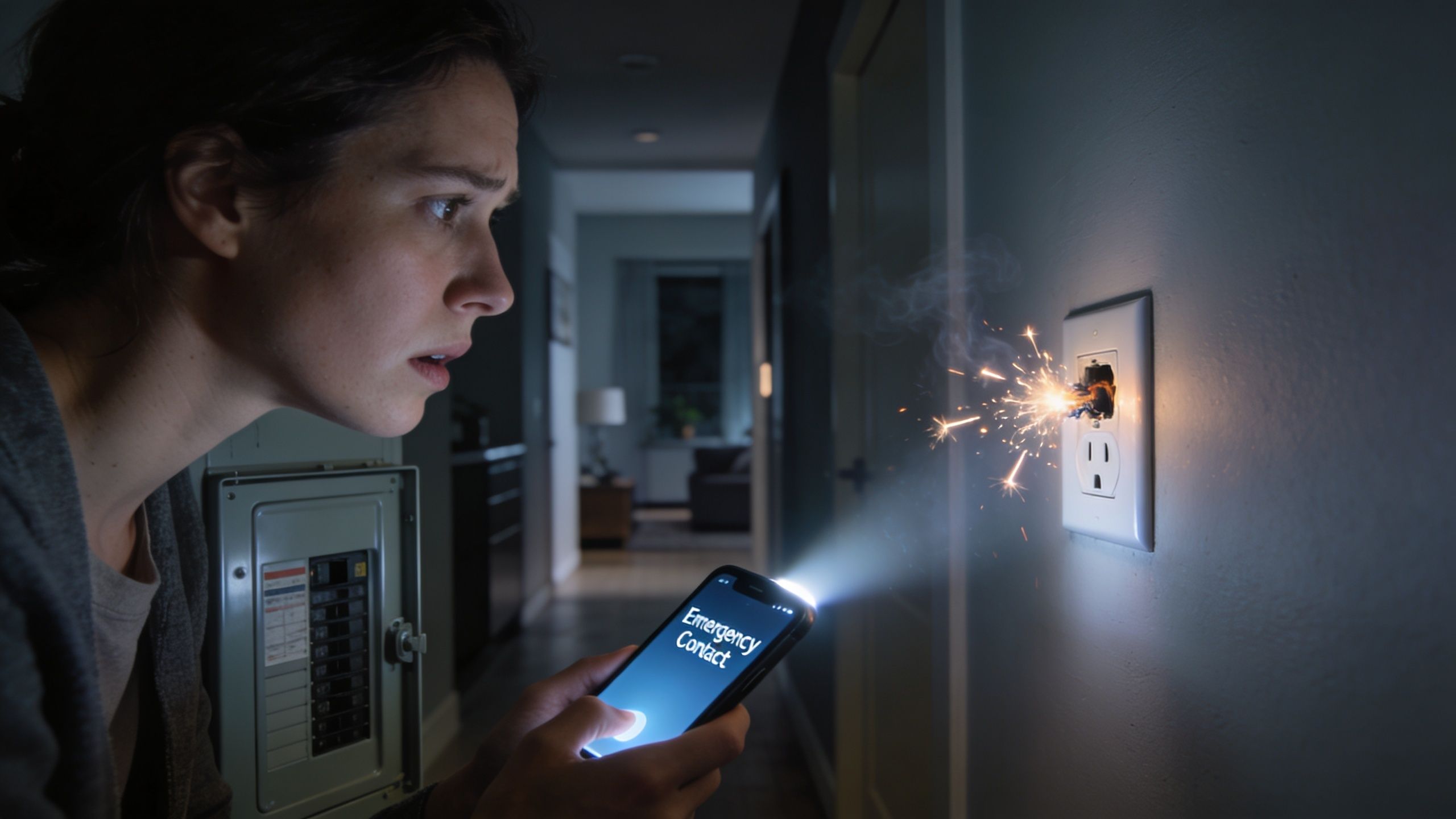
What to do in the first few minutes
Start with the simplest rule. Keep people away from the problem area. That means children, pets, and anyone barefoot on a damp floor. If the issue is in a kitchen, bathroom, garage, or outside, assume water may be part of the hazard.
Then do these steps in order:
- Unplug what you can safely reach. If one appliance seems tied to the problem and the plug is cool, dry, and easy to access, unplug it. Don’t touch a damaged cord.
- Shut off the affected circuit if you know which breaker controls it. Use one hand, stand to the side, and switch it fully off.
- Turn off the main breaker if the problem is spreading. This is the right move if multiple areas are affected, the panel is buzzing, or you can’t isolate the issue.
- Use flashlights, not candles. Open flame and electrical trouble don’t belong together.
Practical rule: If you smell burning and can’t immediately identify a harmless source, shut power down and act as if the wiring is overheating.
When to leave the house and call 911
Some problems move beyond “call an electrician” and into “get out now.”
Leave the home and call 911 if you have any of these:
- Visible smoke from an outlet, panel, switch, or wall
- Active fire or glowing material
- Arcing that continues after you switch the breaker off
- A service mast or exterior equipment issue after storm damage
- Anyone shocked or injured, even if they say they feel okay
If the situation is urgent but stable, it helps to know how electrical contractors think through triage and communication during outages. A practical read on emergency response for electrical owners gives useful context on what happens between the first call and dispatch.
One more point. Don’t remove panel covers, don’t open scorched outlets, and don’t assume a reset will solve it. If you want a calmer way to review basic home hazards after the immediate issue is under control, use this electrical home safety check.
Gathering Key Information for Your Electrician
Once everyone is safe, your next job is to become a good witness. The better your description, the better the electrician’s chances of arriving ready to solve the problem instead of spending half the call just figuring out where to start.
A lot of emergency calls sound like this: “The power is weird” or “something popped.” That’s understandable, but it slows diagnosis. Give a brief, concrete report instead.
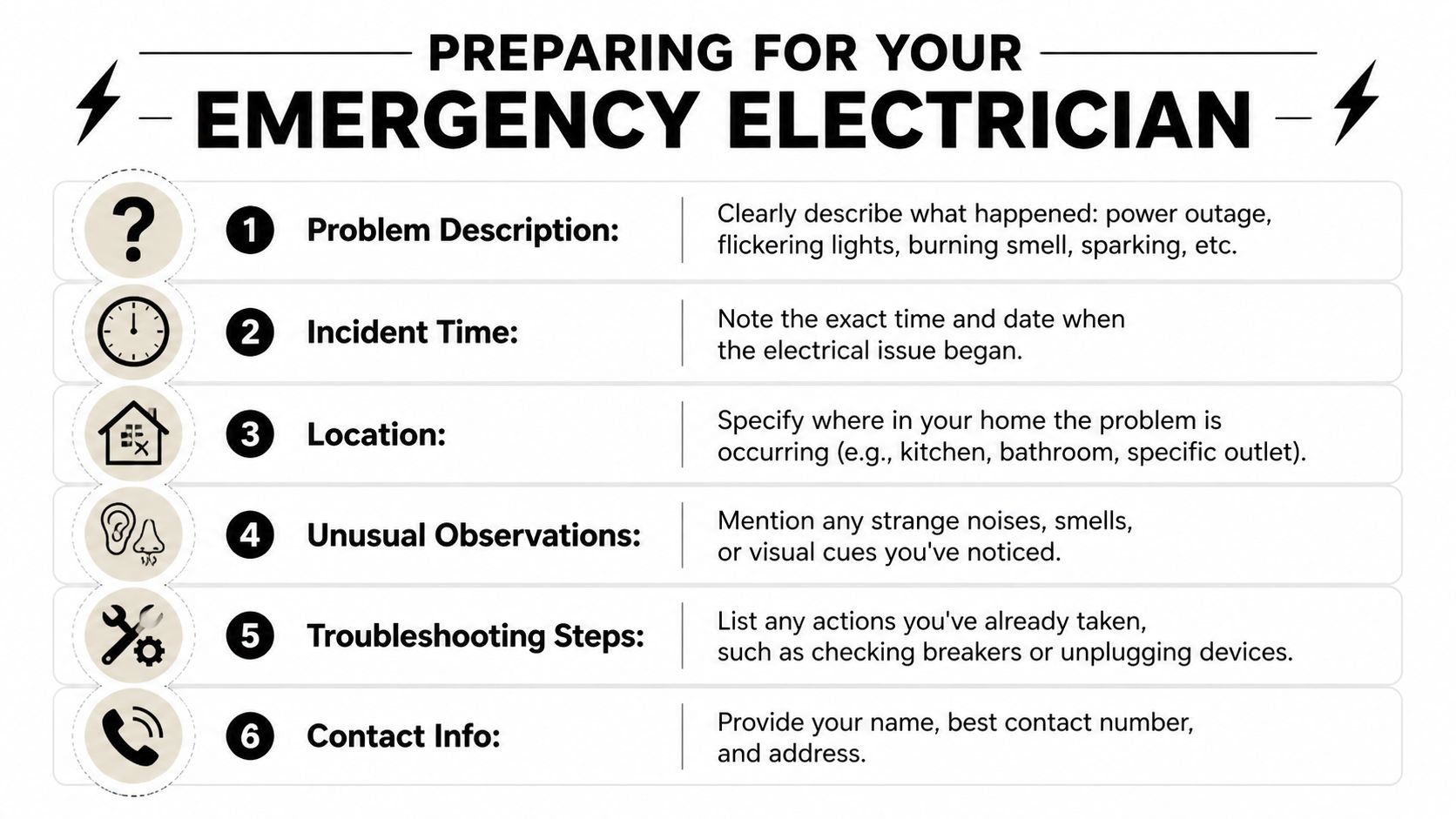
Build a useful briefing
Have these details ready before you call back or text photos:
What happened first
Did the lights flicker, did an outlet stop working, did a breaker trip, or did you smell something before anything shut off?Where it happened
Name the exact room, wall, outlet, switch, panel, or exterior area. “Back patio GFCI” is much better than “outside.”What was running at the time
Air fryer, space heater, dryer, pool equipment, microwave, EV charger, refrigerator. Heavy loads like these often reveal weak connections or overloaded circuits.What changed recently
New appliance, storm, remodel work, handyman repair, panel reset, outlet replacement, or repeated breaker trips over the past few days.What you already did
Tell them if you shut off a breaker, unplugged a device, or noticed that one side of the house still has power.
Why this matters on an after-hours call
Emergency service works better when the field technician gets complete information before arrival. Industry guidance on after-hours operations points to First-Visit Fix Rate, or FTFR, as a critical measure of success. When technicians show up without the right diagnostic information or parts, first-visit fixes drop and repeat visits go up, as explained by FieldEdge’s emergency electrical service best practices.
A short, accurate description often saves more time than a long, panicked one.
If you can safely take a photo of the panel, the affected outlet, or the tripped breaker, do it from a distance with good light. Don’t touch damaged equipment just to get a better picture.
How to Find and Vet a 24/7 Electrician in Palm Beach County
At night, search results can make every company look the same. “Fast response.” “Emergency service.” “Available now.” Those phrases don’t tell you who’s prepared, who’s licensed, or who’s going to show up and diagnose the issue instead of guessing.
The right move is to ask pointed questions. Not rude ones. Specific ones.
Questions worth asking on the first call
Start with the basics, but don’t stop there.
Ask:
- Are you a licensed electrical contractor, and can you verify it?
- Do you carry insurance for emergency service work?
- Who answers the phone after hours? A live professional can usually triage better than a generic answering service.
- What information do you need from me before dispatching? Good companies ask about symptoms, affected circuits, and recent work.
- Do you give a clear quote before repair starts?
- What does your service call include?
These questions tell you a lot about the company’s process. A serious shop usually has a structured intake. A weak one jumps straight to “we’ll see when we get there.”
Preparedness matters more than promises
A company can claim quick service and still arrive unprepared. That’s why FTFR matters in practical situations. If the technician doesn’t have the right information, tools, or common replacement parts, the call drags into a second visit.
Ask a version of this: “What do you do to improve first-visit fixes on emergency calls?” You’re listening for signs of real systems. Good dispatch notes. Well-stocked vehicles. Questions about symptoms. Clear communication between office and field.
That matters more than flashy wording on a website.
If the person on the phone can’t explain their process, don’t expect the jobsite to feel organized.
What to look for in local search results
Search visibility doesn’t prove quality, but it does help you identify whether a contractor is local and active. If you want to judge listings more carefully, these Netco Design LLC local SEO tips are useful for understanding how business profiles are built and what details customers should compare.
Then verify what matters in Palm Beach County:
- A real service area instead of vague countywide claims
- Detailed service categories such as panels, troubleshooting, lighting, and emergency repairs
- Consistent business information across listings
- Clear language about pricing or diagnostics, not just “call now”
One factual way to screen a provider is to review whether they present themselves as a licensed electrical contractor and whether that matches the kind of work you need. Residential troubleshooting is one thing. Commercial service, industrial equipment, and aircraft obstruction lighting require a different level of experience.
Red flags during a stressful call
These should make you pause:
- Vague pricing with no explanation of fees or labor
- Pressure to approve work before diagnosis
- No questions about symptoms
- Claims that everything is an emergency replacement
- No written estimate or text confirmation
A calm, competent electrician usually sounds calm on the phone. They ask where, what, when, and whether there’s heat, smell, smoke, or water involved. That’s what good triage sounds like.
What to Expect from an After-Hours Service Call
Most homeowners worry about two things once they’ve made the call. First, what’s this going to cost? Second, what exactly is the electrician going to do when they arrive?
The useful answer is that after-hours electrical work usually follows a three-part pricing structure. There’s an emergency response fee, labor, and materials. Industry pricing guidance shows a flat emergency response fee of $100 to $200, labor commonly priced at $50 to $130+ per hour with 50% to 100% premiums for off-hours work, and more complex emergency diagnosis and repair often totaling $300 to $800+, according to Sartell Electrical’s troubleshooting cost guide.
Typical after-hours electrical service costs
| Service Component | Typical Price Range |
|---|---|
| Emergency response fee | $100 to $200 |
| Service call fee | $75 to $150 |
| Labor | $50 to $130+ per hour |
| Off-hours labor premium | 50% to 100% above standard rates |
| Complex diagnosis and repair total | $300 to $800+ |
Those numbers are a framework, not a shortcut to a final bill. The actual total depends on what failed, how accessible it is, and whether parts are needed immediately.
What a good service visit looks like
The technician should arrive, ask you to describe the sequence of events, and inspect the affected area before touching anything major. They may test the panel, the failed device, nearby circuits, and any signs of heat damage.
Then you should get a plain-language explanation:
- what failed
- what needs to be made safe now
- what can be repaired immediately
- what, if anything, should be scheduled later
That explanation should come before repair work begins, along with a quote or a pricing method you can understand.
For Palm Beach County homeowners comparing costs and service structure, this emergency electrician cost guide is useful because it helps frame what questions to ask before authorizing work.
You’re not just paying for time on site. You’re paying for diagnosis, safe isolation of the hazard, the right repair, and the judgment to know what can’t wait until morning.
What doesn’t work well
A poor after-hours call usually follows a familiar pattern. The contractor gives no clear pricing. The technician arrives with little information. The homeowner gets a vague warning instead of a specific diagnosis, then feels pushed into a rushed decision.
A better call feels orderly. The work area is made safe. The problem is traced instead of guessed at. The repair is documented. The space is left clean enough that you’re not cleaning up someone else’s emergency response at midnight.
If the issue can’t be permanently repaired on the first visit, you should still expect a safe temporary solution when possible, a clear explanation of what remains, and a documented next step.
After the Repair: Prevention and Future-Proofing Your Home
An emergency repair ends the immediate problem. It shouldn’t be the end of the conversation. The same house that produced one late-night call often has another weak point waiting in the background.

Look past the failed part
If an outlet burned up, the actual issue may be a loose connection, an overloaded circuit, or an aging device in a damp environment. If the panel tripped repeatedly, the problem may be load management, not just a “bad breaker.”
Ask the electrician what they’d inspect next if this were their own home. That answer usually tells you whether you’re getting a patch or a proper fix.
A smart prevention list often includes:
- Panel review for signs of heat, corrosion, or crowding
- Dedicated circuits for heavy appliances that shouldn’t share loads
- Whole-home surge protection where equipment value or storm exposure justifies it
- Replacement of worn devices such as loose receptacles, damaged switches, or weathered exterior components
Efficiency can also reduce strain
Prevention isn’t only about safety hardware. It’s also about reducing electrical stress where it makes sense. After-hours emergency work prevents safety risks and disruption, and efficiency upgrades can lower strain on equipment. One example is the Smartcool ECO3, which can reduce AC electricity use by up to 25%, as discussed in this overview of emergency electrical services and efficiency integrations.
That matters in Palm Beach County, where air conditioning systems run hard and often reveal underlying electrical weaknesses during peak demand.
Keep a written record
Save the invoice, photos, and diagnosis notes from the emergency call. If a second problem shows up months later, that record helps the next electrician see the pattern quickly.
It also helps you make better upgrade decisions instead of treating every electrical issue like a one-off surprise.
Your Trusted Palm Beach County Electrician Lighthouse Energy Services
When people search for after-hours electrical services near me, the biggest concern usually isn’t whether someone can show up. It’s whether the response will be competent, clear, and fairly priced.
That’s where the local gap is obvious. Many emergency service pages talk about availability and speed, but not about what the homeowner will actually pay or how after-hours charges work. That gap matters because pricing uncertainty is one of the biggest sources of stress during an electrical emergency.
What makes the difference in Palm Beach County
Lighthouse Energy Services addresses that gap directly with no extra charges for after-hours calls and transparent pricing, a distinction noted in the market analysis published at L&L Electrical’s emergency services context page. For homeowners, property managers, and HOAs, that’s not a small detail. It changes how comfortable you feel making the call in the first place.
The company also serves Palm Beach County with true 24/7 availability, from Boca Raton to Jupiter, and handles residential, commercial, and industrial electrical work. That range matters because emergency troubleshooting isn’t always limited to a house panel or one dead outlet. Sometimes it involves parking lot lighting, high-capacity systems, or specialized compliance-related lighting on rooftops and towers.
Why this matters during a night call
A useful after-hours contractor should do three things well:
- Answer with technical understanding so the call gets triaged correctly
- Explain pricing clearly before work begins
- Finish safely and cleanly without turning a repair into a sales pitch
Lighthouse Energy Services fits that model with phones answered by licensed professionals, service rooted in decades of field experience, and a team with over 100 years of combined expertise since 2005. For customers comparing options quickly, that combination of availability, practical experience, and pricing clarity makes the decision simpler.
If you’re dealing with a power loss, sparking outlet, failed breaker, damaged lighting, or an urgent commercial electrical issue in Palm Beach County, the next step should feel straightforward, not risky.
If you need immediate help, contact Lighthouse Energy Services. You’ll reach a team that handles Palm Beach County emergency electrical calls around the clock, explains the problem in plain language, and gives you clear pricing without extra after-hours charges.