
If you're shopping for an EV charger right now, you're probably also staring at your garage wall, your panel, or your HOA rules and wondering which part is going to become the headache. In Royal Palm Beach, the charger itself usually isn't the hard part. The hard part is figuring out whether your home can support it cleanly, whether the install location makes sense for daily use, and whether your community rules or Florida weather will create problems later.
That's why EV charger installation in Royal Palm Beach FL needs a local approach. A generic checklist won't tell you much about older panels in Palm Beach County homes, long driveway parking setups, or what happens when heat, storms, and air-conditioning loads all hit at once. Good installations are built around the house, the car, and how the homeowner lives.
Table of Contents
- Your Home's EV Readiness Check
- Choosing the Right Level 2 Charger for Your Lifestyle
- Permitting and HOA Approvals in Royal Palm Beach
- The Professional Installation Process Explained
- Budgeting for Your EV Charger Installation
- EV Charging FAQs for Florida Homeowners
Your Home's EV Readiness Check
The first job isn't mounting a charger. It's finding out whether your electrical system can safely carry a new continuous load.
According to the EPA, the installer needs to verify panel capacity and size the breaker at at least 125% of the charger rating. That means a 40-amp Level 2 charger requires a dedicated 50-amp circuit, as outlined in the EPA's home EV charging guidance. If that rule gets ignored, the installation may still power on, but it won't be set up the way it should be for safety and code compliance.
Why the panel check comes first
A lot of homeowners ask the same question: “Do I have enough power for a charger?” The honest answer is that you don't know until someone calculates the load and looks at the panel in person.
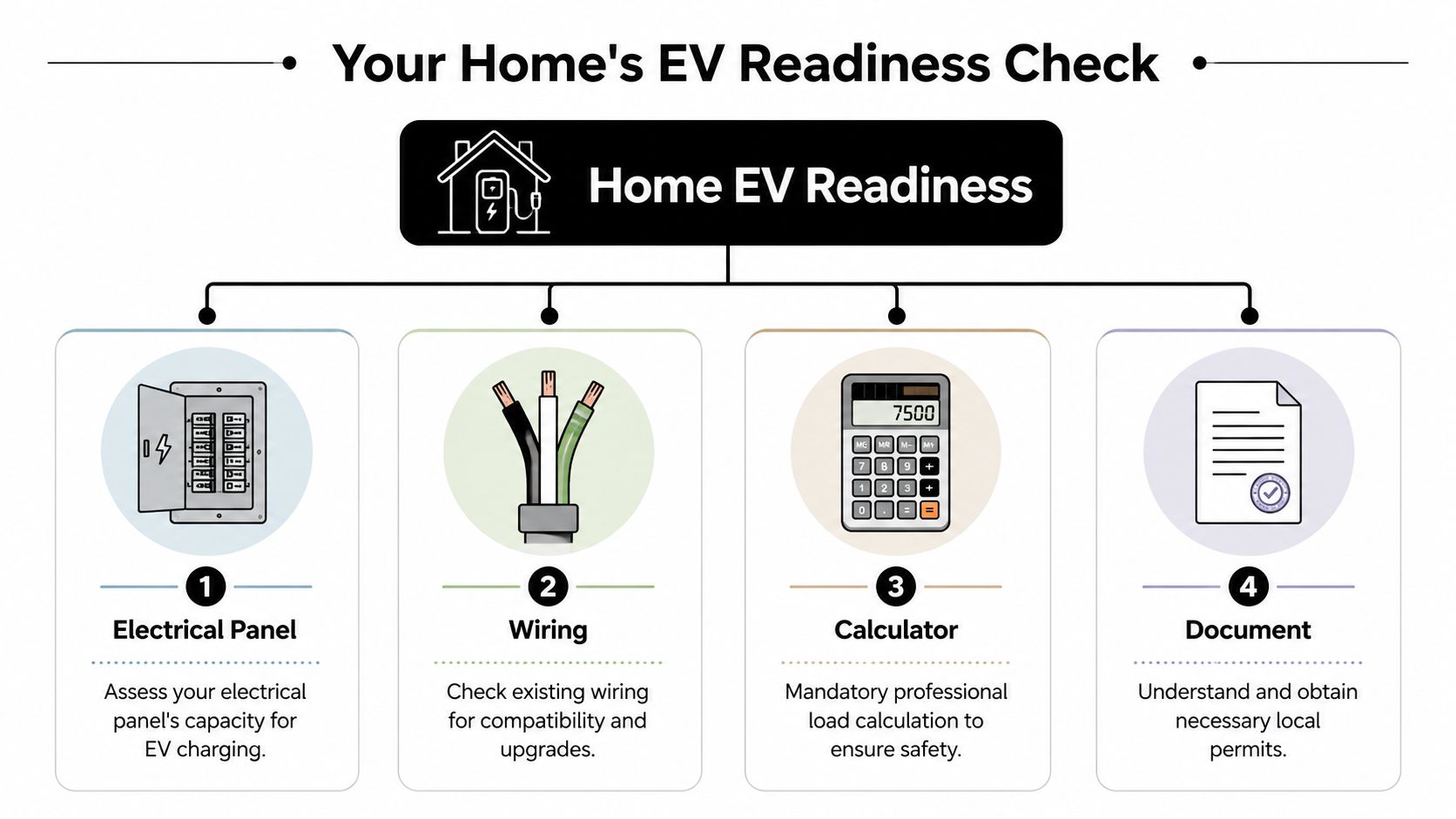
An electrician checks more than empty breaker spaces. The key questions are:
- Panel capacity: Can the service support another sustained load without pushing the system too hard?
- Physical space: Is there room for the new breaker and wiring layout?
- Circuit path: Can the new 240-volt branch circuit reach the parking area without awkward routing?
- Condition of equipment: Are there signs of heat, corrosion, age, or previous modifications that need attention first?
If you're not sure about the overall condition of the house wiring, a broader electrical home safety check can uncover issues before the charger install starts.
Practical rule: If the panel is already crowded or the home has several heavy electrical loads, don't buy charger hardware first and ask questions later.
What a load calculation actually tells you
“Load calculation” sounds more complicated than it is. It's the process of adding up how the home uses power and determining whether the service can handle the charger along with everything else.
In Royal Palm Beach, older homes and renovated homes can be tricky. Some have enough service but limited panel space. Others have room in the panel but not enough headroom once the air conditioning, kitchen loads, water heating, pool equipment, or other large circuits are considered.
A dedicated 240-volt circuit means the charger gets its own branch circuit. It doesn't share with a dryer, range, or general-use receptacles. That matters because charging is a continuous demand, not a quick on-and-off appliance load.
A solid readiness check usually ends in one of three conclusions:
| Outcome | What it means |
|---|---|
| Ready as-is | The panel has capacity and space for a properly sized EV circuit. |
| Minor electrical work needed | The charger is feasible, but routing, breaker arrangement, or related cleanup is needed first. |
| Upgrade likely | Panel or service limitations need to be addressed before the charger goes in. |
That early assessment saves money, delays, and rework. It also tells you whether the install will be simple or whether the panel is the main project.
Choosing the Right Level 2 Charger for Your Lifestyle
For most homeowners, the practical decision isn't Level 1 versus Level 2. It's which Level 2 setup fits the way you park, drive, and charge.
Royal Palm Beach doesn't have dense public charging coverage. ChargeHub shows 6 public EV charging station ports within 15 km, and 33% are Level 2, which works out to roughly 2 public Level 2 ports in the area according to ChargeHub's Royal Palm Beach listing. That's enough to show local infrastructure exists, but not enough for most drivers to treat public charging as their everyday plan.
Why home charging matters more locally
If you leave for work every morning and want the car ready without planning around errands, home charging is the backbone of the setup. Public charging is useful. It just isn't the thing most suburban households want to depend on day after day.
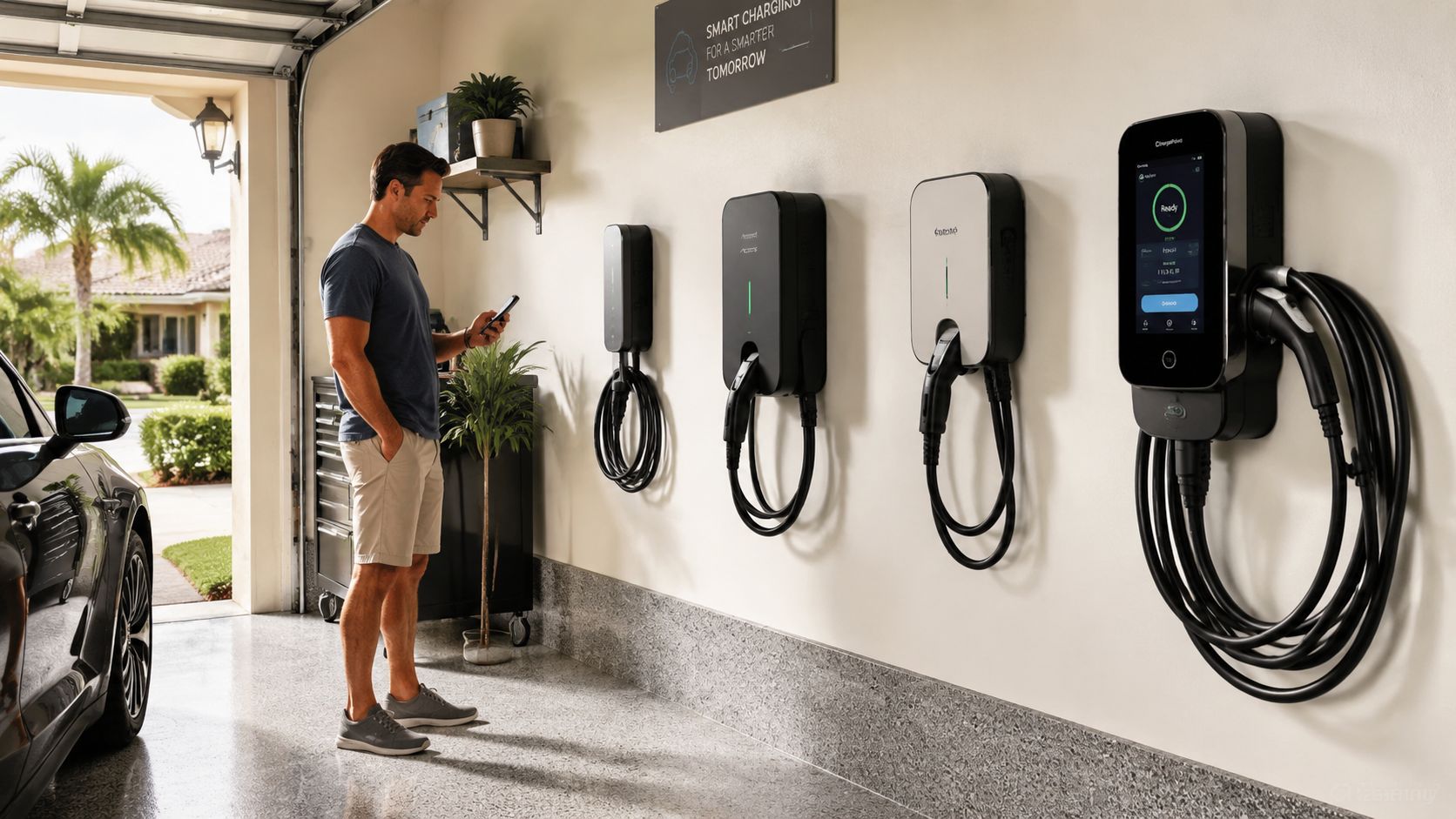
That changes how I'd think about the charger purchase. The right unit isn't the one with the flashiest app. It's the one that fits your parking position, cable reach, outdoor exposure, and charging habits without creating daily annoyance.
Standard charger vs smart charger
Some homeowners want a simple charger that starts when plugged in. Others want scheduling, notifications, and usage tracking. Both can work.
Here's the practical comparison:
- Basic charger: Best for drivers who want simple operation and don't care about app features. Fewer settings can mean fewer user-side complications.
- Smart charger: Better if you want charging schedules, visibility into usage, and more control over when the vehicle draws power.
- Outdoor-focused setup: Important if the charger is exposed in a driveway or side-yard location. In South Florida, placement and weather resistance matter as much as charging speed.
- Long-cable priority: Useful when the vehicle doesn't always park in exactly the same spot. Too short a cable creates frustration fast.
A charger that barely reaches the port is a bad installation even if the electrical work is perfect.
Don't overlook physical layout. A charger mounted on the wrong wall, too far from the car, or across a walking path becomes a daily nuisance and sometimes a trip hazard.
If you want a non-promotional explainer before deciding on hardware features, this guide on understanding EV charger installation gives a useful consumer-level overview of what to evaluate before choosing a home unit.
A good charger choice should match your routine. Short commute, one EV, sheltered garage parking. Keep it simple. Shared driveway, outdoor mounting, changing schedules, or likely second EV later. Choose more flexibility now so you don't pay to redo the setup.
Permitting and HOA Approvals in Royal Palm Beach
The electrical work may be straightforward, but the approval side can still slow the project down. That's especially true in communities where exterior appearance, shared walls, assigned parking, or common-area electrical systems are involved.
One of the biggest local friction points isn't the charger hardware at all. It's panel capacity and upgrade planning for older homes and HOAs, and the broader issue that HOA rules often become the main bottleneck rather than the charger itself, as noted in this Royal Palm Beach charging overview.
Permits aren't paperwork for the sake of paperwork
For residential EV charging, permits and inspections matter because the work adds a new 240-volt circuit and a continuous electrical load. That affects safety, code compliance, and, in some cases, future home sale documentation.
The practical sequence is usually simple:
- Confirm scope of work so the electrician knows whether the install is a straightforward branch circuit or part of a bigger panel issue.
- Submit permit documentation with the equipment and electrical details needed for review.
- Complete the installation according to the approved scope.
- Pass inspection before treating the charger as a finished permanent upgrade.
If you want a homeowner-friendly overview of county process and paperwork, this Homeowner permit action plan is a useful starting point.
How to approach an HOA without delays
HOA approval goes better when the board receives a complete package instead of a vague request. “I want to install a charger” usually creates back-and-forth. A clear submittal moves faster.
Bring these items together before you ask for approval:
- Site plan: Show where the charger will mount and where the conduit will run.
- Equipment details: Include the charger spec sheet and mounting method.
- Electrical scope: Note whether the work is fully within your home's electrical system or touches common elements.
- Permit path: Show that the work will be permitted and inspected.
- Responsibility details: Clarify who maintains the charger and who pays for the electricity.
Older communities often care about surface-mounted conduit, visibility from the street, and parking layout. Townhome and condo settings add another layer because the charger location may affect common walls, shared garages, or assigned spaces.
The easiest HOA approval is the one that answers questions before the board has to ask them.
For single-family homeowners, the HOA issue is often aesthetic. For attached housing, it can become an electrical design problem. That's why a local installation plan should be drawn around both the panel and the property rules, not just the charger model.
The Professional Installation Process Explained
Installation day should feel organized, not chaotic. If the planning has been done properly, most of the work is about safe execution, clean routing, and final verification.
Industry best practice is straightforward. The process includes mounting the unit, running proper conductors, terminating connections with correct torque, and then testing and inspecting the system. Common mistakes include inadequate breaker sizing and poor placement that creates a trip hazard, as summarized in this installation best-practices guide.
What happens on installation day
A clean install usually follows a predictable sequence. The electrician verifies the approved location, shuts off power where needed, installs the dedicated circuit, routes wiring or conduit, mounts the charger, makes up the terminations, and tests the system.
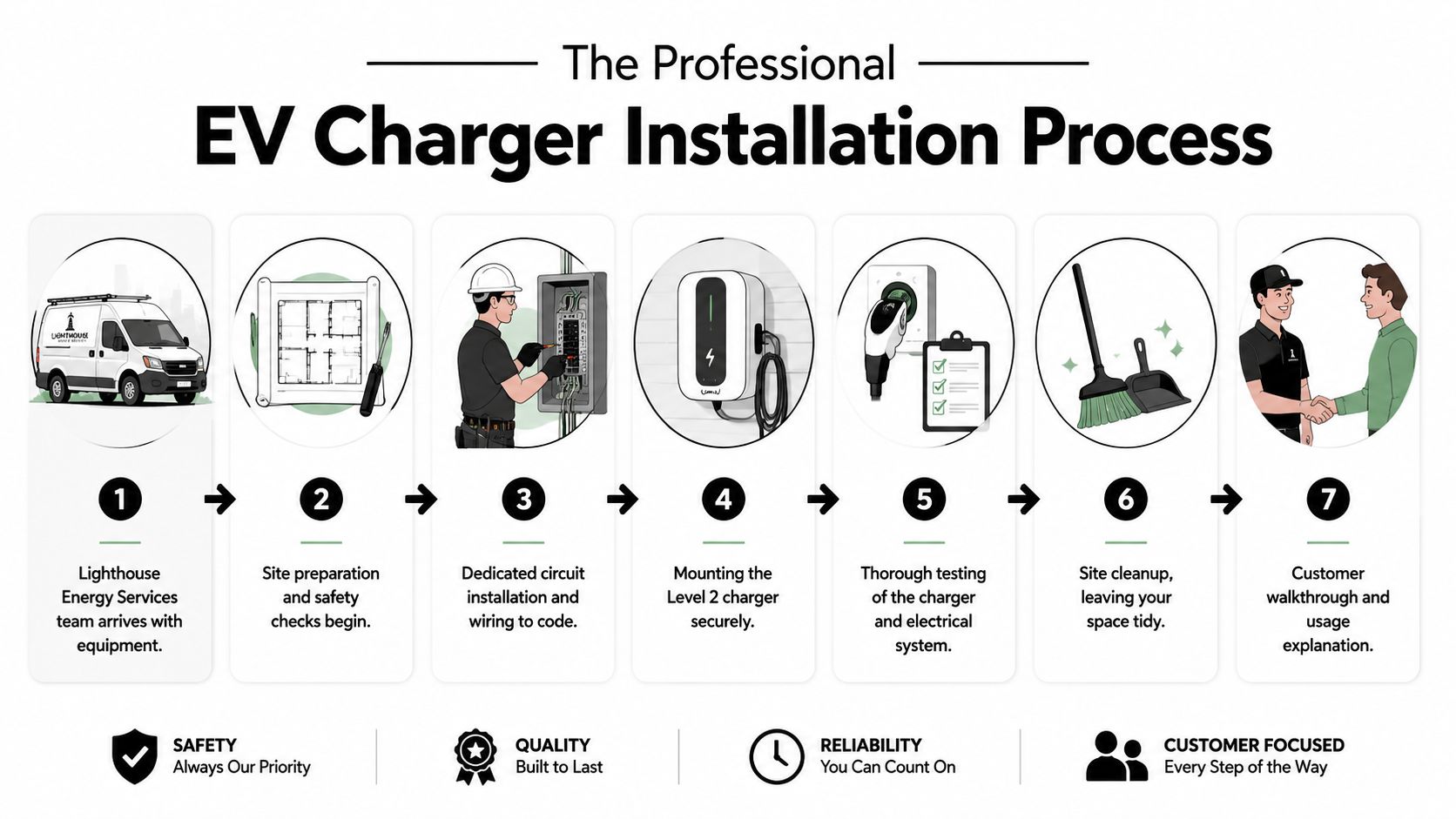
From the homeowner's perspective, the noticeable decisions are usually these:
- Mounting height and position: The charger should be accessible without forcing the cable across a walkway.
- Conduit route: A shorter, cleaner route is usually better if it still preserves access and appearance.
- Breaker and conductor match: The circuit components have to match the charger requirements and the approved design.
- Testing before handoff: The charger should be verified before anyone calls the job done.
If you're comparing electricians for this kind of project, this new home electrician hiring guide is a practical checklist for what to ask before scheduling the work.
Where installs go wrong
The failures I see most often aren't dramatic. They're the quiet mistakes that create nuisance problems later.
One installer places the charger where it looks neat on the wall but the cable barely reaches the charge port. Another uses a route that technically works but leaves exposed runs where they're likely to get bumped. The most serious errors happen at the electrical connections: wrong breaker, wrong conductor choice, poor torque, or sloppy grounding.
Here's what solid workmanship looks like in practice:
| Installation detail | What works | What doesn't |
|---|---|---|
| Charger placement | Near the usual parking position with safe cable reach | Across a walkway or too far from the vehicle |
| Circuit design | Dedicated branch circuit matched to charger requirements | Shared or undersized circuit |
| Connections | Properly terminated and tested | Loose terminations or rushed assembly |
| Finish work | Clean routing and tidy cable management | Tangled cable, awkward bends, exposed problem areas |
One option local homeowners may consider is Lighthouse Energy Services, which handles residential electrical upgrades and EV charging work as part of broader panel and circuit projects. The important thing is less about branding and more about whether the electrician treats the charger like a code-driven electrical installation instead of a wall accessory.
Good EV charger installation is quiet. No nuisance trips, no heat issues, no awkward cable drag, no surprises at inspection.
Budgeting for Your EV Charger Installation
Most homeowners start by pricing the charger and stop there. That's not how the budget works.
The full cost of EV charger installation in Royal Palm Beach FL usually has three parts. There's the charging unit itself, the electrical labor and materials to install it, and the permit and inspection side of the job. The biggest wildcard is whether the home needs panel work first.
The cost categories that actually matter
This visual is a useful way to think about the budget structure.
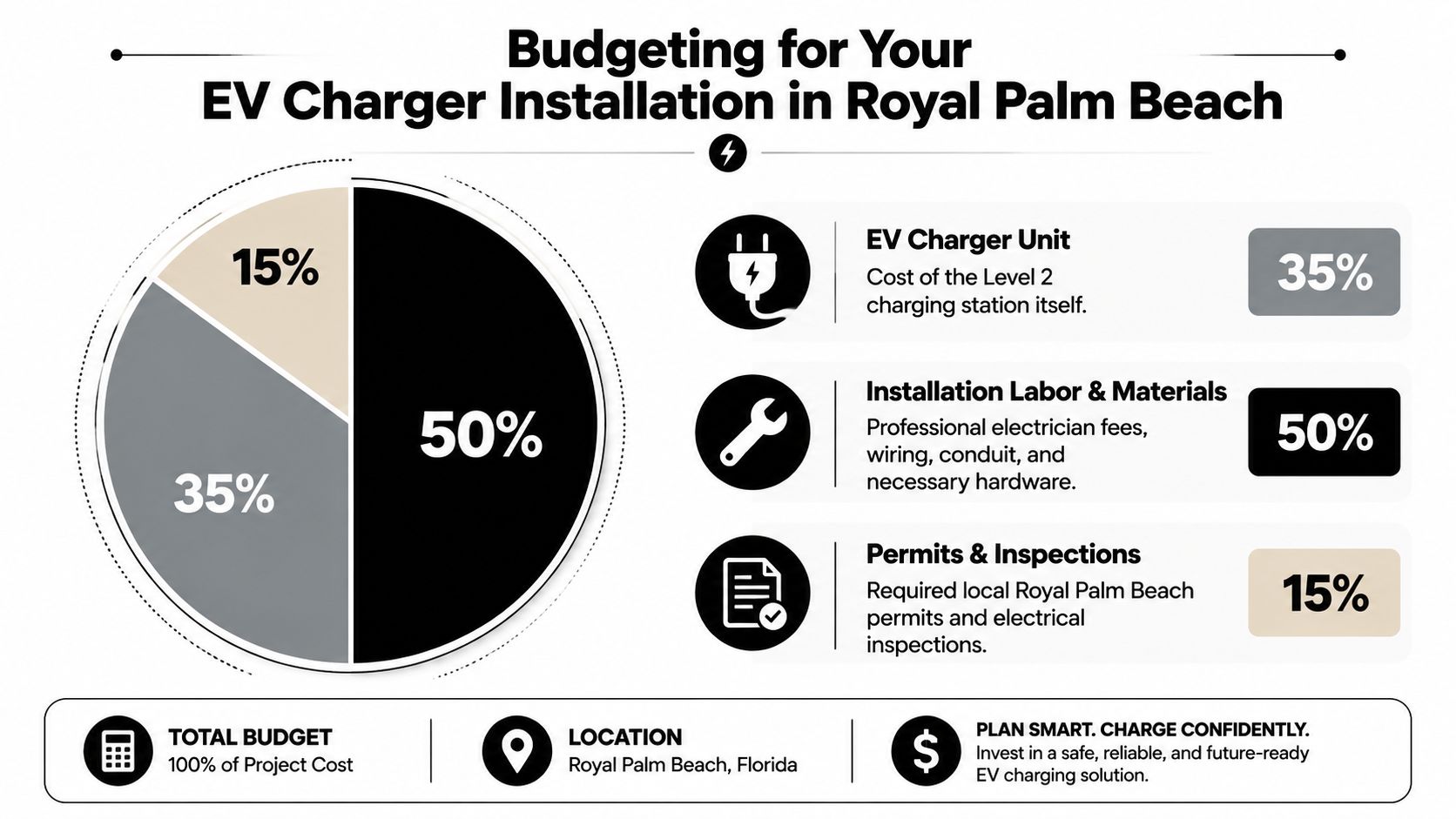
A practical budget review should separate these categories:
- Charger hardware: The unit you buy, with features that may be simple or more connected.
- Installation labor and materials: Circuit breaker, conductors, conduit, fittings, mounting hardware, and the electrician's time.
- Permit and inspection costs: Required administrative work that turns the install into a documented, code-compliant upgrade.
- Potential panel work: The item that changes a small project into a larger electrical improvement.
If your home is older or the panel is already near its limit, review electrical panel upgrade considerations before you assume the charger can be added without related work.
How to think about value instead of just price
The cheapest quote isn't always the lower-cost decision. If an installer leaves out permit handling, uses a poor location, or doesn't address panel constraints, the “savings” can disappear fast.
There's also a bigger planning point. Florida's highway network has become more EV-friendly for trip support. Florida's Turnpike notes that Level 3 chargers were installed in 2020 at service plazas including West Palm Beach and Pompano Beach, and multiple companies are involved across the Turnpike's eight service plazas, according to Florida's Turnpike EV corridor information. For homeowners, that means the house charger can handle daily routine while corridor charging covers longer drives.
That changes the financial question. You're not trying to build every charging scenario at home. You're investing in the setup that makes ordinary life easy. For most households, the best value comes from getting the home installation right the first time, especially if the panel and circuit are designed with future flexibility in mind.
EV Charging FAQs for Florida Homeowners
Homeowners usually have the same questions after the charger is installed. They're less worried about the wall unit itself and more worried about weather, reliability, and what happens when the house gets stressed.
A Florida-specific concern is resilience. The City of West Palm Beach's EV charging information notes the importance of monitored infrastructure, and the broader local concern is that high ambient temperatures can affect charging efficiency, while proper installations should consider surge protection and load management, especially where air conditioning already puts pressure on electrical demand, as reflected in West Palm Beach's EV charging amenities context.
Do heat and storms affect charging
Yes, they can. Heat can affect charging behavior and overall efficiency, and storms raise the importance of electrical protection.
The practical takeaways are straightforward:
- Use surge protection thinking: In Florida, it makes sense to consider protection for sensitive electrical equipment connected to the home.
- Choose the location carefully: Covered, sheltered mounting usually ages better than fully exposed placement.
- Respect household load: Charging while the home is already carrying heavy cooling demand can be a planning issue in some houses.
- Keep the area dry and orderly: Good cable management matters more when weather and humidity are part of daily life.
In South Florida, charger reliability isn't only about the device. It's about where it's mounted, how the circuit is built, and what else the house is carrying.
What if you add another EV later
Plan for that possibility early, even if you're a one-EV household today. The question isn't just whether a second charger can fit on the wall. It's whether the electrical system can support more charging demand without a redesign.
Ask these questions now:
- Is the current panel likely to support future expansion?
- Can the charger location work for a second vehicle later?
- Would load management or a revised charging schedule make more sense than adding another full-power circuit?
Basic maintenance is simple. Keep the unit clean, inspect the cable for wear, don't force the connector, and pay attention if breakers trip or charging behavior changes. Those are signs to have the system checked instead of guessing.
If the power goes out, the charger won't operate unless the home has a properly designed backup power arrangement that supports it. Most homeowners shouldn't assume EV charging will continue during an outage just because the charger is mounted and connected.
If you're planning an EV charger at your Royal Palm Beach home and want the electrical side handled correctly from the start, Lighthouse Energy Services can help you evaluate panel capacity, circuit requirements, installation layout, and code compliance before you spend money in the wrong place.