
You bring the EV home, plug into a standard outlet the first night, and quickly realize the car is ready for this transition before the house is. That's the moment most Wellington homeowners start asking the main question. Not which car to buy, but how to charge it every day without babysitting cords, extension runs, or a garage routine that stops being convenient after a week.
Around Wellington, that question isn't hypothetical. Public charging already has a foothold here. ChargeHub lists 23 public charging station ports within 15 km of Wellington, with 65% of those ports being Level 2 and 65% offering free charging, according to local Wellington charging data from ChargeHub. That tells you two things. EV adoption is already visible in the area, and Level 2 charging is the practical standard most drivers end up wanting at home.
The catch is that home charging usually isn't a simple appliance install. In Wellington, house age, panel capacity, outdoor exposure, permitting, and HOA rules can all change the scope. If you're still sorting out what kind of electrician should handle that process, this residential electrical contractors guide gives a useful baseline for what to look for before anyone touches your panel.
Table of Contents
- Your Guide to Home EV Charging in Wellington
- Choosing the Right Charger for Your Wellington Lifestyle
- Assessing Your Home's Electrical System
- Navigating Permits and Inspections in Palm Beach County
- Understanding Installation Costs and Timelines
- EV Charging for HOAs and Multifamily Properties
- Why Choose Lighthouse Energy Services for Your Installation
Your Guide to Home EV Charging in Wellington
Most homeowners start with the same assumption. Buy the charger, pick a spot in the garage, and have an electrician hook it up. Sometimes that happens. A lot of the time, especially in South Florida homes with older panels or tight service capacity, the charger is the easy part.
A more realistic Wellington scenario looks like this. You've got a new EV in the driveway, a decent place to mount a charger, and a panel that hasn't been evaluated in years. The question isn't just whether a charger can be installed. It's whether the house can support a dedicated 240-volt circuit cleanly, safely, and without creating nuisance trips or code problems later.
What homeowners usually want
Homeowners aren't looking for a complicated system. They want a charger that works every night, doesn't monopolize the garage, and won't become obsolete if the household adds another EV later.
That usually means balancing four things:
- Daily driving needs. A shorter commute may leave more flexibility in charger size and scheduling.
- Parking layout. Garage, driveway, carport, and exterior wall locations all affect wiring path and weather protection.
- Panel headroom. Available breaker space and service capacity often decide whether the job stays simple.
- Future use. A setup that works for one EV today may feel undersized if a second vehicle shows up later.
Home charging works best when the electrical system is planned around the property, not just around the charger box.
What works in Wellington homes
In this area, the strongest installs are the ones that treat charging as part of the home's electrical infrastructure. That means looking at panel condition, conduit path, exterior rating, surge protection, and inspection requirements before hardware gets ordered.
For some houses, the answer is straightforward. For others, especially older homes, the right move is to pause and inspect first. That's where EV Charger Installation in Wellington FL stops being a retail purchase and becomes an electrical project.
Choosing the Right Charger for Your Wellington Lifestyle
A Wellington homeowner buys a 48-amp Level 2 charger online, expects a quick install, and then finds out the garage panel is full or the service is already tight because of the pool equipment and air conditioning. That is a common way costs climb. The better approach is to choose the charger around the house, the driving pattern, and the parking setup.
For most homes, the main decision is not whether Level 2 is better than Level 1. It usually is. The main question is how much charging speed the household needs, and whether that speed fits the existing electrical system without forcing a bigger project than necessary.
What the charging levels mean
Level 1 uses a standard 120-volt receptacle. It suits light daily driving, long overnight parking windows, and owners who do not need fast recovery after a busy day.
Level 2 uses a 240-volt circuit and is the setup most Wellington homeowners ask for. It gives much faster overnight charging and works well for homes with regular commuting, school drop-offs, errands, and weekend driving.
DC fast charging is not a normal residential choice. It belongs in commercial, fleet, and public charging settings because it requires much higher power infrastructure.
| Charger Level | Voltage | Typical Speed (Miles of Range per Hour) | Best For |
|---|---|---|---|
| Level 1 | 120V | Qualitatively slow | Overnight top-offs, light daily driving |
| Level 2 | 240V | Qualitatively faster | Most homes, routine daily charging |
| DC Fast Charging | Higher-power commercial service | Qualitatively very fast | Public corridors, fleet and commercial sites |
Choosing the charger size without overspending
Bigger is not always better.
A higher-amperage charger can shorten charging time, but it also increases circuit demand. In many Wellington homes, especially properties with older panels or heavy existing loads, a moderate Level 2 charger is the better value because it covers normal overnight charging without pushing the panel into upgrade territory. If a homeowner needs more capacity for two EVs or a high-mileage schedule, then a panel upgrade may make sense. In that case, it helps to understand the cost and scope of a 150-amp to 200-amp electrical panel upgrade before buying hardware.
A practical selection process looks like this:
Match charging speed to daily mileage
A shorter commute usually does not require the highest-output charger on the market.Choose the charger around the parking location
Garage installs are usually simpler. Driveway, carport, and exterior wall installs need the right mounting height, conduit path, and weather-rated equipment.Decide whether one EV will stay one EV
If a second electric vehicle is realistic, charger location and circuit planning should account for it now.Use smart features only when they solve a real issue
Scheduling, app control, and usage tracking help some households. They are not automatic must-haves.
For outdoor or semi-exposed installations in South Florida, enclosure rating matters. The National Electrical Manufacturers Association outlines the differences in NEMA enclosure types for indoor and outdoor use, which is why electricians commonly specify equipment rated for wet or weather-exposed conditions rather than treating all charger housings as interchangeable.
Local trade-offs homeowners should plan for
In Wellington, the charger choice often gets tied to HOA rules, garage layout, and where the vehicle parks at night. A charger that looks ideal on paper may become awkward if the cord barely reaches the charge port or if the approved mounting wall creates a long conduit run.
Multifamily properties add another layer. Condo owners and townhome residents may need association approval, assigned parking coordination, and a plan for metering or shared electrical areas before equipment is selected. In those cases, the right charger is the one that fits the property rules and electrical path, not just the one with the highest output rating.
The strongest installations start with the site conditions, then match the charger to the home. That keeps the project practical, code-compliant, and easier to live with every day.
Assessing Your Home's Electrical System
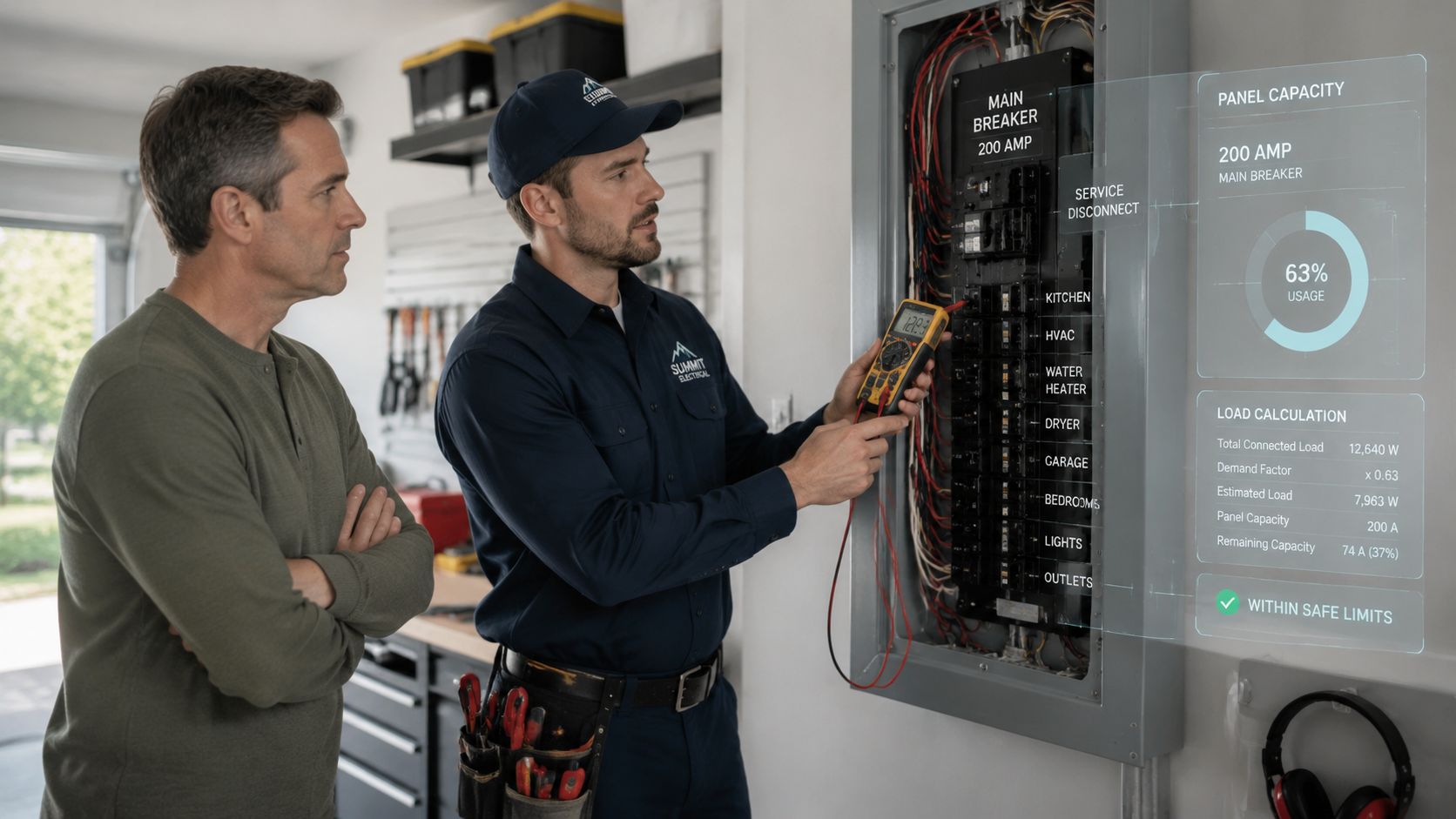
The biggest mistake homeowners make is assuming the charger determines the project. It doesn't. The panel does.
Why the panel matters more than the charger
A major issue in older South Florida homes is whether the existing service can support Level 2 charging without a costly upgrade. As noted in this discussion of EV charger feasibility in older local homes, the main cost driver is often the electrical infrastructure, including a possible 100-amp or 200-amp upgrade, not the charger itself.
That's why the first step is a load calculation. In plain language, that means checking what the house already demands from the panel and whether there's safe capacity left for a new 240-volt charging circuit. Air conditioning, water heating, cooking equipment, dryers, pool systems, and other major loads all matter.
If the panel is already tight, adding an EV charger the wrong way can force compromises nobody wants. Breakers get crowded. Conductor sizing gets rushed. Homeowners end up with a charger that exists on paper but doesn't fit the house well.
Signs your home may need electrical upgrades
A homeowner doesn't need to perform code analysis to spot warning signs. A few patterns usually justify a closer look:
- Older service equipment. If the panel is dated, has limited space, or hasn't been reviewed in years, it deserves inspection before planning the charger.
- Crowded breaker layout. A full panel often means there's no clean place for a dedicated EV circuit.
- Existing performance issues. Flickering lights, warm breakers, or nuisance tripping under heavy appliance use are red flags.
- Long run to the parking area. Distance from panel to charger location can increase labor and material demands.
- Future expansion plans. If you're considering a service change anyway, bundling that work can make more sense than patching around limitations.
Some homeowners in this situation benefit from a full service upgrade. If you're trying to understand what that involves, this overview of a 150-amp to 200-amp electrical service upgrade is a useful reference point.
If the home can't support the charger cleanly today, forcing it rarely saves money. It usually just moves the cost into troubleshooting later.
What a proper assessment looks like
A real assessment is more than glancing at the panel cover. The electrician should inspect the service rating, available breaker space, conductor path, grounding, charger location, and whether the installation will be indoors or exposed to weather.
The visit should also answer these practical questions:
- Can the home support Level 2 without a panel upgrade?
- If not, is the constraint breaker space, service capacity, or both?
- Where should the charger go for shortest wiring path and best daily use?
- Will the install need exterior-rated equipment and added surge protection?
That conversation gives the homeowner something better than a generic quote. It gives a project scope that matches the house.
Navigating Permits and Inspections in Palm Beach County
A charger install can be physically simple and still get delayed by paperwork. That's common when the job gets treated like a device swap instead of a permitted electrical project.
What gets submitted before work starts
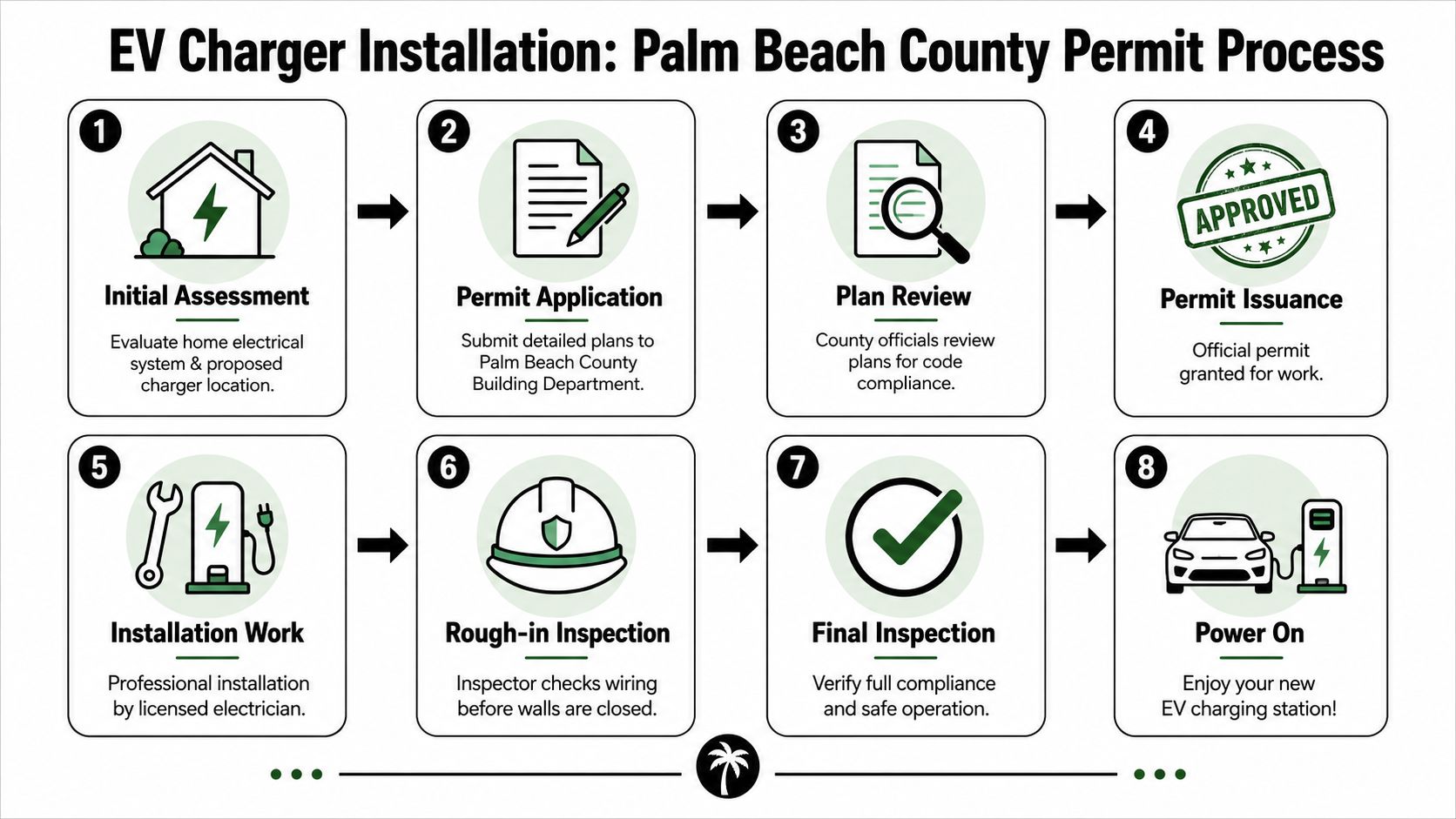
According to FPL's EV Power Delivery Guide, a proper installation follows a staged workflow that typically requires a panel schedule, one-line diagram, site plan, and charger specifications, followed by pre-construction review, grid system check, final inspection approval, and energization, as described in FPL's EV Power Delivery Guide.
That matters because many delays don't come from the charger or the wiring crew. They come from incomplete documentation, unclear site information, or utility coordination that starts too late.
A clean permit process usually follows this order:
- Site evaluation first. The electrician confirms capacity, equipment location, and circuit design.
- Plans second. Drawings and supporting details get prepared for submission.
- Permit review next. Local review checks code compliance before work starts.
- Installation after approval. Once the permit is active, the field work can move.
- Inspection before final use. Final approval closes the loop and keeps the installation legal and insurable.
Where projects usually slow down
The most common delay points are predictable.
- Missing panel information. If the existing electrical service isn't documented clearly, plan review stalls.
- Unclear charger specifications. The submitted equipment details need to match the proposed circuit and installation method.
- Utility coordination left too late. If service questions show up after permit submittal, the schedule stretches.
- Homeowner assumptions about access. Gated communities, HOA notice requirements, or limited work windows can affect inspections and field scheduling.
For homeowners, the simplest path is to hand the workflow to a licensed contractor that already understands local approvals. This page on government-approved electrical contractors outlines the kind of qualifications and compliance mindset that matter on permitted jobs.
The charger isn't considered finished when it's mounted on the wall. It's finished when the paperwork, inspection, and utility side are all closed out.
Understanding Installation Costs and Timelines
A Wellington homeowner usually asks two questions right away. Can my current panel handle a Level 2 charger, and what happens to the budget if it cannot?
What actually changes the price
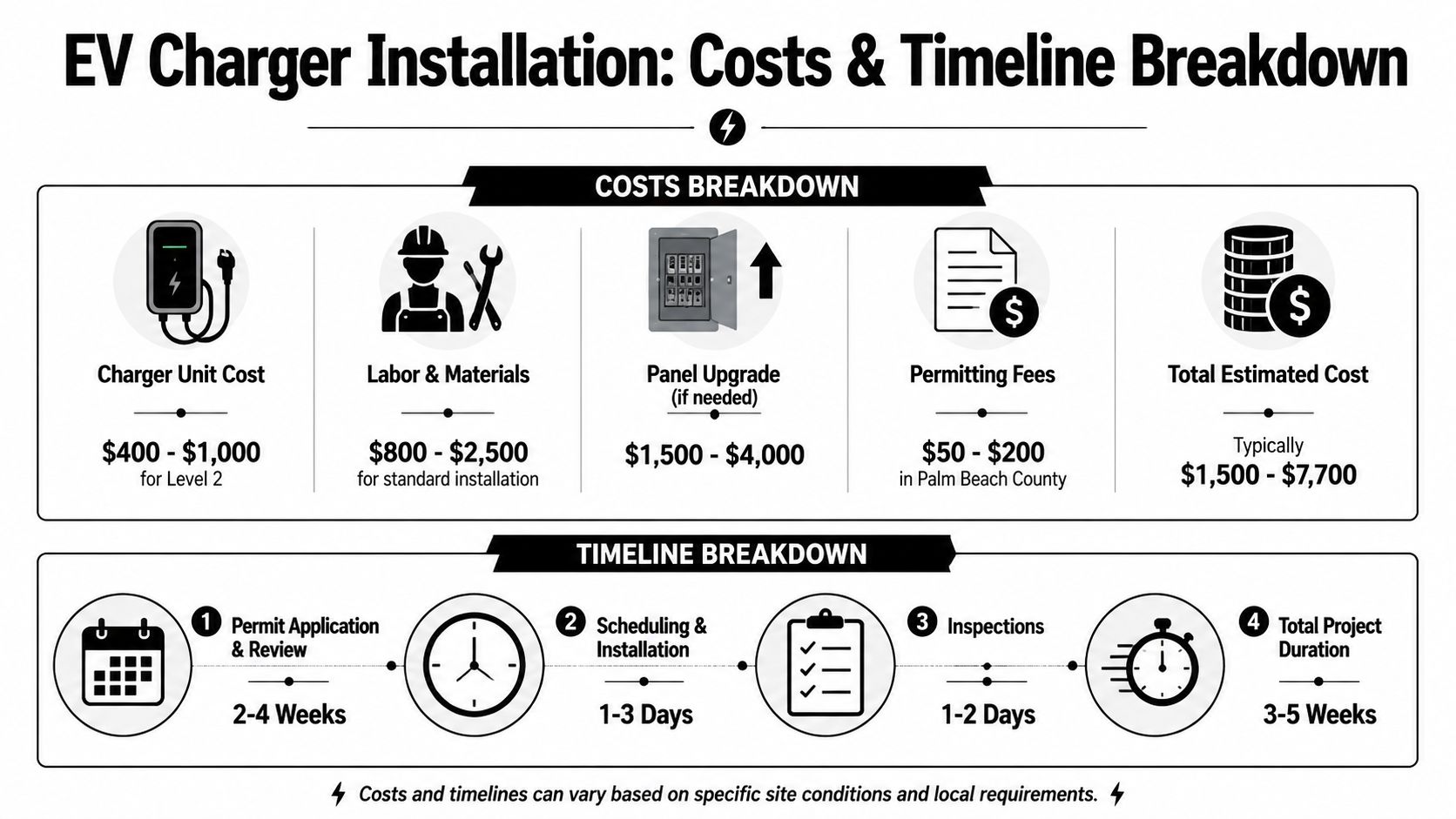
The final cost depends less on the charger box and more on the electrical work behind it. A straightforward installation costs far less than a project that uncovers panel limitations, service constraints, or a difficult wiring route.
For homeowners in Wellington, I usually break pricing into two categories:
Standard installation
The existing panel has enough calculated capacity, open breaker space, and a clean path to the garage or driveway. In that case, the work is usually limited to the new circuit, breaker, wiring method, charger mounting, and final testing.Panel-limited installation
The home needs more than a charger circuit. We may need to replace or rework the panel, add a subpanel, correct existing code issues, or coordinate a service upgrade if the load calculation does not support the charger.
That second category is where budgets move. A homeowner may start out focused on the charger model, then find that the cost sits in service equipment, conductor length, trenching or wall access, weather protection, and panel upgrades.
Older homes and homes with heavy electric loads often land here. Pool equipment, electric water heaters, large air conditioning loads, and existing garage appliances all affect available capacity.
The panel question drives both cost and scope
A load calculation is the point where the project becomes real.
If the panel can support the charger, the job stays relatively contained. If it cannot, there are trade-offs. One option may be a full panel upgrade. Another may be a lower-amperage charger setting that still fits the homeowner's driving habits. In some cases, load management equipment makes more sense than replacing service equipment immediately.
Those choices affect cost in very different ways. They also affect charging speed, future expansion, and how much work gets done now versus later.
The wrong way to budget for an EV charger is to assume every Level 2 install is the same job. It is not.
What usually affects the timeline
The physical installation is often the shortest part of the project. The full schedule depends on permit processing, equipment availability, access to the property, and inspection timing. Industry guidance from the U.S. Department of Energy's Alternative Fuels Data Center notes that home charging installation costs and project requirements vary based on electrical capacity and site conditions, which is why timelines can differ from one home to the next (home charging guidance from the Alternative Fuels Data Center).
In practice, the timeline usually includes:
- Site assessment and load calculation
- Final charger and circuit decisions
- Permit preparation and approval
- Installation scheduling
- Field work
- Inspection and closeout
A simple single-family job may move quickly once approvals are in place. A project with a panel replacement, HOA access limits, or utility coordination usually takes longer.
Common Wellington cost surprises
A few items cause budget changes more often than homeowners expect:
- Long wire runs from the panel to the charger location
- Outdoor mounting requirements for driveways or exposed side walls
- Limited panel space even when total service size looks adequate
- Code corrections that need to be addressed before new work can be finalized
- HOA or multifamily access restrictions that compress work hours or require extra coordination
These are not unusual problems. They are normal job conditions, and they should be priced accurately from the beginning.
Budgeting insight: A low quote only helps if it includes the actual electrical scope, permit requirements, and any panel limitations already verified on site.
Before approving a proposal, check four things:
- Was the panel capacity verified with a real load assessment?
- Does the price include permit and inspection handling?
- Has the contractor confirmed the charger location and wiring path?
- If the panel is marginal, is the quote based on a lower charging rate, load management, or a full upgrade?
Clear answers to those questions make quotes easier to compare and help avoid change orders halfway through the job.
EV Charging for HOAs and Multifamily Properties
Single-family installs are one thing. Shared properties create a different set of problems, and they're common around Wellington.
The three issues that decide the project
For HOA, condo, and multifamily properties, the hard questions are usually about load management, metering, and who pays for the electricity. Shared-site charging often requires managed charging or make-ready infrastructure to control demand charges and allocate costs fairly, as explained in guidance on multifamily EV charging considerations.
That changes the conversation immediately. A resident may want one charger near one parking space, but the property manager has to think about the whole building. Can the existing service handle multiple vehicles charging at once? How will usage be tracked? Who approves conduit routing, wall penetrations, or common-area power access?
What works better in shared properties
In practice, successful HOA and multifamily projects usually start with policy and infrastructure together.
A workable plan often includes:
- Managed load strategy. Charging demand gets coordinated so the building doesn't get overwhelmed by simultaneous use.
- Clear metering approach. The property needs a clean way to assign electricity cost to the right user or unit.
- Defined approval path. Board approvals, resident rules, and contractor access need to be settled before installation day.
- Make-ready planning. Even if only one charger goes in now, conduit and electrical prep can support later expansion.
For condo owners, the biggest mistake is treating the project like a private garage install. It rarely is. Common walls, shared power, parking assignments, and building rules all matter.
For property managers, the best approach is usually to plan a framework instead of approving chargers one at a time with different methods and no common standard. That keeps future requests from turning into repeated redesigns.
Why Choose Lighthouse Energy Services for Your Installation
A Wellington EV charging project usually succeeds or fails on the basics. Accurate panel assessment. Clean permitting. Proper outdoor equipment selection. Inspection-ready workmanship. None of that is flashy, but that's what keeps the installation safe and usable.
Lighthouse Energy Services handles residential, commercial, and industrial electrical work in Palm Beach County with true 24/7 availability, phones answered by licensed electrical professionals, and a team backed by more than 100 years of combined experience. For EV charger work, that means the job can be approached as it should be approached. As an electrical system project with load review, dedicated circuit planning, equipment installation, and commissioning based on the property's actual conditions.
That broader perspective also matters for boards, commercial owners, and operators who manage multiple assets. If you're evaluating electrical vendors across sites, this strategic guide for facility managers is a useful outside reference for thinking through service coverage, response expectations, and vendor fit.
Homeowners don't need a sales pitch here. They need straight answers to the questions that affect the job. Can the panel handle it? If not, what has to change? What needs a permit? How long will approval take? What's the cleanest, code-compliant way to install it once and not revisit it later?
If you're planning an EV Charger Installation in Wellington FL, contact Lighthouse Energy Services for a professional site assessment. A qualified review of your panel, charger location, and permitting path will tell you quickly whether your home is ready for a straightforward Level 2 install or whether an upgrade should be handled first.