You brought the EV home. The app is set up, the first drive felt great, and then the practical question hit you in the garage. How are you going to charge it every day without relying on extension cords, guesswork, or public stations across town?
That's where most Palm Beach Gardens homeowners get stuck. The charger itself looks simple enough, but the actual job usually has nothing to do with hanging a box on the wall. It's the panel capacity, the dedicated circuit, the permit package, the final inspection, and in many neighborhoods, the HOA conversation before any work starts.
In Palm Beach County, the timing is favorable for this kind of upgrade. The Bipartisan Infrastructure Law has allocated nearly $200 million for EV charging stations in the county, a major local milestone that directly affects projects in Palm Beach Gardens, according to Palm Beach Post reporting shared here. Homeowners don't need to become electrical engineers to move forward, but they do need a plan that fits the house, the car, and the local approval process.
If you like having a little background before talking to an installer, a resource like DocsBot for the EV charging industry can help you get familiar with common project questions and terminology. Then the conversation becomes much easier.
Table of Contents
- Your Guide to Home EV Charging in Palm Beach Gardens
- Choosing Your Charger Level 1 Level 2 and DC Fast Charging
- Assessing Your Homes Electrical System for an EV Charger
- Navigating Palm Beach Gardens Permits and HOA Rules
- Understanding Installation Costs Timelines and Incentives
- The Lighthouse Energy Services Installation Process
- EV Charger Maintenance Safety and Long-Term Support
Your Guide to Home EV Charging in Palm Beach Gardens
A lot of homeowners in Palm Beach Gardens start in the same place. They know they want dependable overnight charging, but they don't know if the house can support it, whether the HOA has to sign off, or what the permit office is going to require.
That uncertainty is normal. EV charger installation in Palm Beach Gardens FL isn't difficult when the project is planned correctly, but it becomes frustrating fast when someone skips the assessment and treats it like a simple outlet swap.
The local reality
Palm Beach Gardens homes often have heavier electrical demands than people realize. Air conditioning runs hard for much of the year. Some homes have pool equipment, outdoor lighting, or kitchen upgrades that already push the service close to its practical limit. Adding EV charging means looking at the whole system, not just the garage wall.
For single-family homes, the path is usually straightforward once the electrical capacity is confirmed. For condos, townhomes, and HOA-governed properties, the charger decision is tied to parking rights, wiring paths, common-area rules, and approval timelines.
A clean installation starts long before the charger arrives. It starts with the load calculation, the panel review, and a realistic placement plan.
What homeowners usually want answered first
Individuals asking about home charging are trying to solve a few direct problems:
- Daily reliability: You want the car ready each morning without planning a stop at a public charger.
- Safe installation: You don't want overheated wiring, nuisance breaker trips, or a setup that won't pass inspection.
- Clear responsibility: You want one licensed team handling the electrical scope, permit coordination, and final testing.
- Fast help if something goes wrong: If a breaker trips at night or the charger faults out over a weekend, waiting until Monday isn't ideal.
That's why the right installer isn't just someone who can mount the unit. You need someone who can look at the service equipment, identify capacity issues early, and handle the paperwork side without turning it into your second job.
Choosing Your Charger Level 1 Level 2 and DC Fast Charging
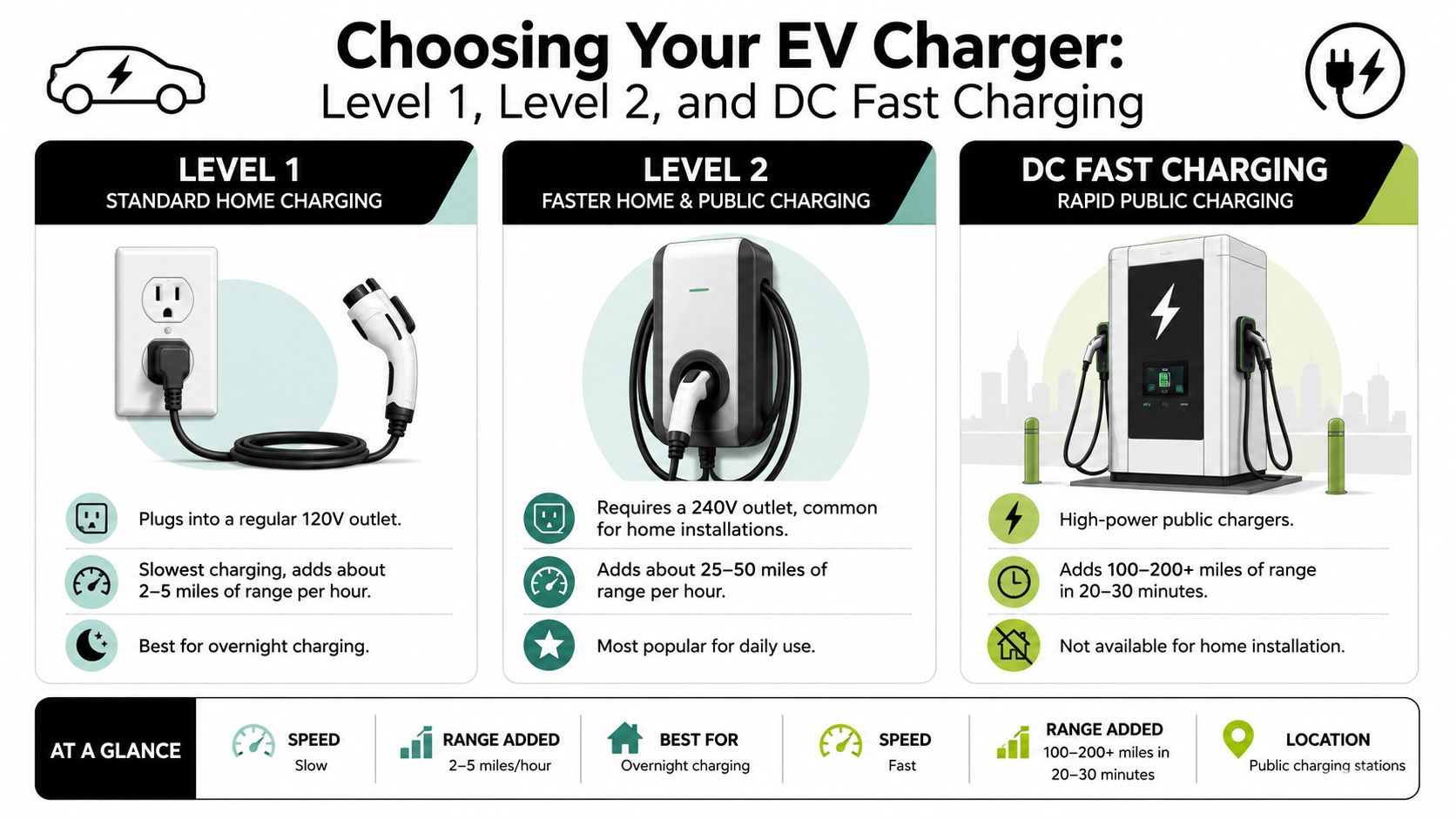
Not every charger fits every home. The simplest way to think about charging levels is by water flow. Level 1 is a slow trickle. Level 2 is a steady garden hose. DC fast charging is a fire hose, and it belongs in commercial and public settings, not a typical house.
What each charger level means in real life
Level 1 uses a standard household outlet. It's the slowest option and works best when the vehicle is driven lightly and parked for long stretches. Some homeowners start here just to get by, but many outgrow it once the car becomes part of the daily routine.
Level 2 is the practical residential standard. It charges much faster than Level 1 and is usually the right answer for overnight home charging. If you want convenience, consistency, and a setup that feels permanent, this is the category most homeowners should be evaluating.
DC fast charging is designed for rapid charging away from home. It's useful on the road and at commercial sites, but it isn't a normal home-install option. For a residential property, the conversation almost always comes back to whether the house can support Level 2 cleanly and safely.
Practical rule: If you want your garage charger to keep up with normal daily driving without turning charging into a chore, Level 2 is usually the right target.
EV Charger Levels at a Glance
| Charger Level | Charging Speed (Miles of Range per Hour) | Electrical Requirement | Best For |
|---|---|---|---|
| Level 1 | About 2-5 miles of range per hour | Standard 120V outlet | Light driving, temporary use, long overnight parking |
| Level 2 | About 25-50 miles of range per hour | 240V circuit | Daily home charging |
| DC Fast Charging | About 100-200+ miles of range in 20-30 minutes | High-power commercial equipment | Public rapid charging |
What works well at home
For most Palm Beach Gardens homeowners, the best setup is a properly permitted Level 2 charger located where the cable reaches the vehicle naturally without crossing walkways or forcing awkward parking. Wall position matters. Cable management matters. Weather exposure matters if the charger isn't fully inside the garage.
What usually doesn't work is trying to save time with a compromise location, an undersized circuit, or an installation that ignores how the household uses power. A charger that looks neat on day one but trips the panel every time the air conditioning and pool equipment run isn't a successful installation.
Assessing Your Homes Electrical System for an EV Charger
The charger is only half the job. The house has to support it.
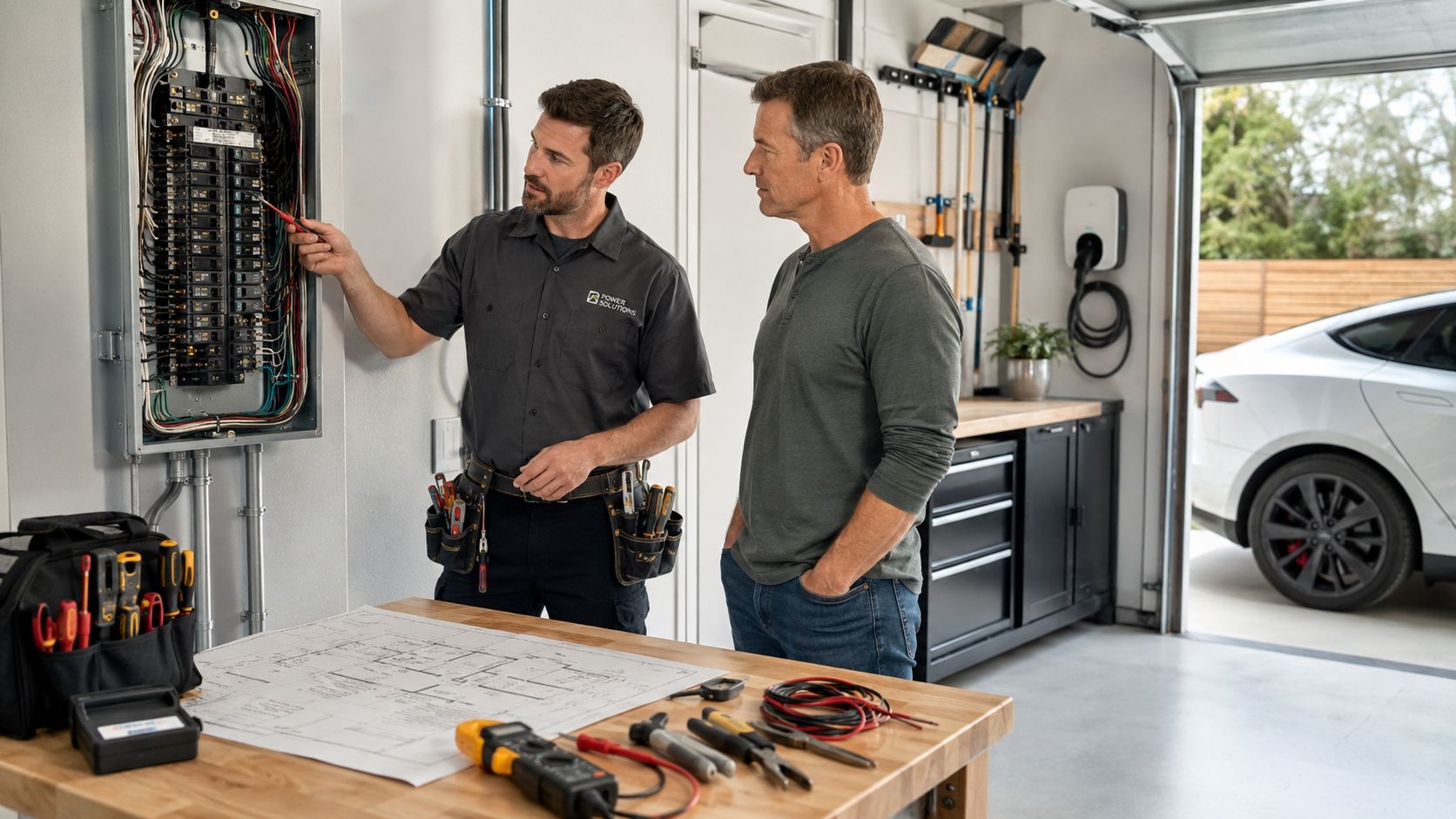
In Florida, Level 2 EV charging commonly requires a dedicated 240-volt branch circuit, with typical breaker sizes in the 40A to 60A range. Many chargers draw roughly 7,000 to 11,500 watts, so the primary constraint is often panel capacity and feeder headroom, which is why installations frequently lead to load-calculation-driven panel upgrades, as explained in this Florida EV charger installation overview.
Why the panel matters more than the charger
Homeowners sometimes assume the installer just adds a breaker and moves on. Sometimes that happens. Often it doesn't.
A proper assessment checks whether the panel has physical space, available capacity, and a service size that can handle the added continuous load. In Palm Beach Gardens, that review matters because cooling loads can already be substantial. Add a range, dryer, water heater, pool pump, or workshop equipment, and the margin can disappear quickly.
A licensed electrician should evaluate:
- Panel space: Is there room for the new breaker and associated equipment?
- Load balance: Will the new circuit push the service beyond what the house can support during peak usage?
- Conductor path: Can the charger be routed cleanly from panel to parking location?
- Future flexibility: Will this setup still work if you add a second EV later?
What usually triggers an upgrade
If the load calculation shows the service is tight, there are a few common paths. Sometimes a subpanel helps organize new circuits. Sometimes the existing panel itself needs replacement. In other cases, the service has to be upgraded because the house doesn't have enough headroom for another major load.
That's why the inspection phase is where money is saved. It's much better to identify the constraint before permits are filed and equipment is ordered than after the installation has started. If your project needs broader electrical work, a dedicated electrical panel upgrade assessment is usually the next step.
If a home already runs heavy cooling loads, a pool system, and modern kitchen equipment, the charger may be the item that exposes an electrical system that was already near its limit.
A good installer won't guess. They'll calculate, inspect, and size the work so the charger performs consistently in August, not just on a mild day during testing.
Navigating Palm Beach Gardens Permits and HOA Rules
Many EV projects often experience slowdowns here. The complexity isn't with the charger itself, but with ensuring paperwork precisely matches the actual installation.
What goes into a permit package
For EV charger installation in Palm Beach Gardens, a strong permitting package usually needs a site plan, load calculations, panel schedules, conduit schedules, manufacturer specifications, and zoning review for setbacks, parking ratios, lighting, signage, and ADA spaces, according to this Palm Beach County EV charging design and permitting guide.
That level of detail matters for residential work too, especially when the charger location affects parking layout, exterior conduit routing, or shared property areas. Palm Beach County also uses pre-application review and final inspections before the system is energized, so the approved plans and the installed equipment need to match.
Here's what usually causes trouble:
- Missing load calculations: The permit reviewer wants to know the house can support the charger.
- Vague site drawings: “Garage wall” isn't enough if conduit routing or parking position matters.
- Equipment mismatch: Swapping charger models after approval can create inspection problems.
- Exterior scope changes: Any visible conduit, pedestal, or altered parking area may trigger extra scrutiny.
Where HOA projects usually slow down
HOA approval is often separate from permitting. One doesn't replace the other.
In single-family communities, the main issue is usually exterior appearance. In condo and townhome settings, the bigger issues are ownership boundaries, assigned parking, common-area conduit paths, and who pays for the electricity. Those questions need answers before hardware is purchased.
Palm Beach Gardens also has a dense public charging network, which can make some residents hesitate about installing at home. But convenience and access aren't the same thing. Public charging can be nearby and still be inconvenient if you depend on shared parking, can't charge overnight, or have to coordinate around HOA restrictions.
Public charging is useful. Reliable home charging is different. The right choice depends on your parking rights, wiring path, and how often you want charging to compete with the rest of your schedule.
The smoothest projects usually involve a complete package submitted to the HOA from the start. That means equipment details, routing sketches, photos of the proposed location, and a clear explanation of how the work will stay code-compliant and visually controlled.
Understanding Installation Costs Timelines and Incentives
Most homeowners don't need a vague “it depends.” They need to know what drives the price and why one EV charger installation is simple while another turns into a broader electrical project.
What you are paying for
In Palm Beach Gardens, EV charger installation labor typically falls within a defined range. According to local installation pricing information, qualified licensed electricians generally charge $50 to $100 per hour for standard installations, while urgent or off-hours calls can run $100 to $200 per hour. Project-based pricing may also include a 10% to 20% markup of total construction cost, depending on complexity.
That labor range is only one part of the total budget. The final cost usually reflects some mix of:
- Charger hardware: The unit itself, plus mounting accessories if needed.
- Electrical labor: Circuit installation, wiring path, breaker work, and testing.
- Permit handling: Preparation, filing, coordination, and inspection scheduling.
- Panel work: New breakers, reconfiguration, subpanel work, or a larger service upgrade if required.
- Site conditions: Long conduit runs, finished-wall access, detached garages, or exterior mounting.
A straightforward installation costs less because the path is short and the panel has room. A more involved job costs more because the electrical system needs work before the charger can be added safely.
What affects timing
Timelines in Palm Beach Gardens are less about the charger and more about approvals and existing conditions. A project usually moves through assessment, quote, permit submission, scheduling, installation, inspection, and turnover.
What extends the timeline most often?
| Project factor | Why it adds time |
|---|---|
| Panel constraints | Load calculations may lead to redesign or upgrade work |
| HOA review | Approval may take longer than the electrical work itself |
| Equipment changes | Revised plans can delay permit or inspection signoff |
| Complex routing | Longer conduit paths and exterior work take more coordination |
The county funding environment is also worth noting. Palm Beach County has seen nearly $200 million allocated for EV charging investment, which signals strong institutional support for charging infrastructure in the area, as noted earlier from local reporting. For homeowners, that doesn't automatically mean direct cash in hand for every job, but it does mean EV charging is no longer treated like a fringe upgrade.
The best budgeting approach is simple. Start with a real site assessment, not an online guess. That's how you separate charger cost from electrical-system cost and avoid surprises halfway through the project.
The Lighthouse Energy Services Installation Process
A good EV project should feel organized from the first phone call. If it feels improvised, that's a warning sign.
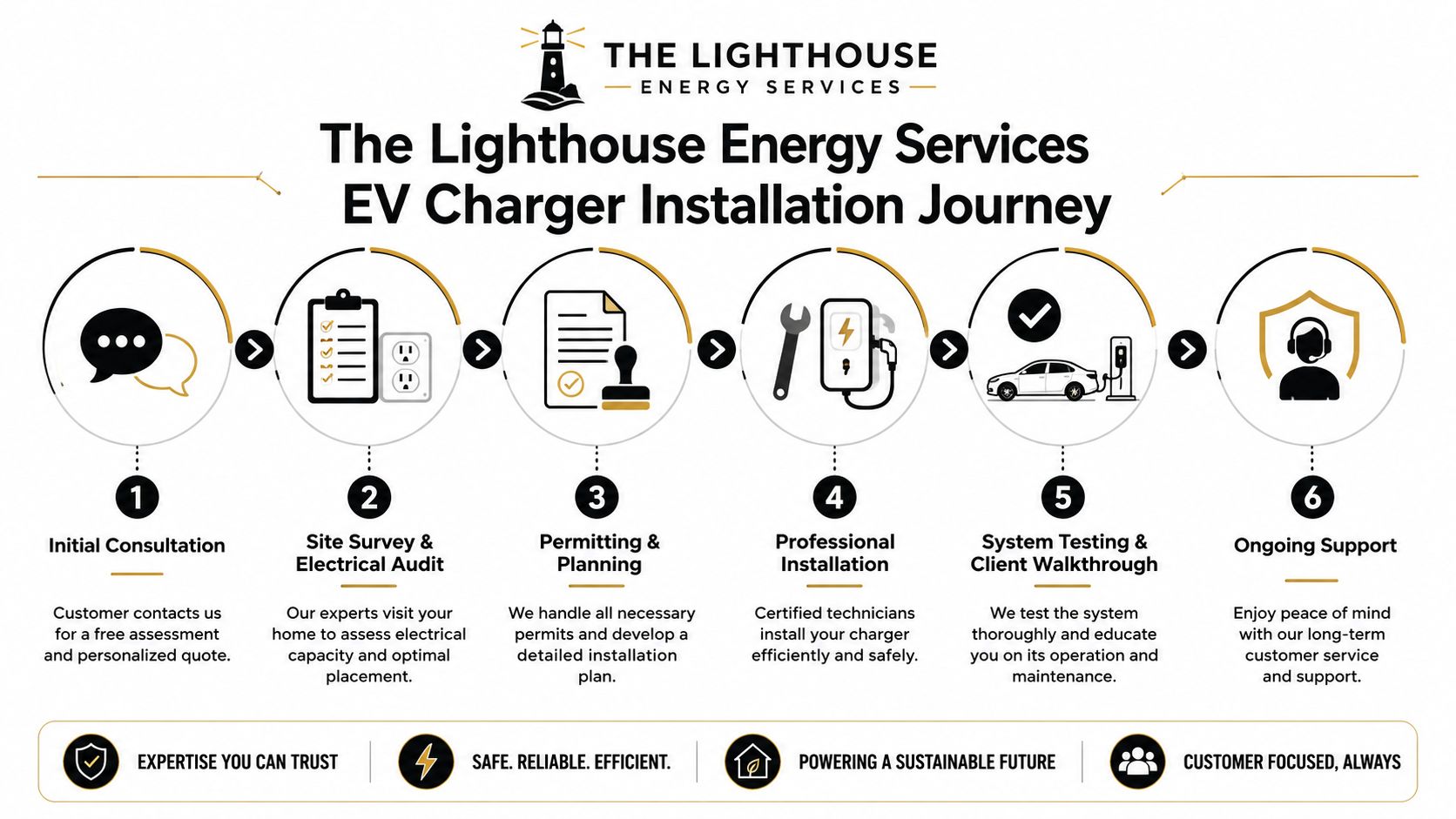
How the project moves from call to charging
The process works best when one licensed electrical contractor owns the job from assessment through final testing. If you're evaluating who should handle the work, it helps to verify they're operating as a licensed electrical contractor and not just coordinating subcontracted labor.
A reliable installation path usually looks like this:
Initial call and screening
The first conversation should identify the vehicle, charger type, panel location, parking setup, and whether the property is under HOA control.On-site electrical audit
The electrician checks service capacity, circuit path, mounting location, and any conditions that could change the scope.Quote and scope review
The homeowner should see what's included, what assumptions were made, and what could trigger added work, such as panel limitations.Permitting and approvals
Drawings, equipment details, and supporting electrical information get prepared for the local jurisdiction and, when needed, for the HOA.Installation and testing
The actual field work should be neat, code-compliant, and followed by operational testing before the system is handed over.Walkthrough and support
The homeowner should leave knowing how to use the charger, what normal operation looks like, and when to call if something changes.
Why process matters on electrical work
The difference between a smooth charger install and a painful one is usually process discipline. A useful benchmark is the kind of step-by-step review you see in a SaberTask quality control checklist. Electrical work needs the same mindset. Check the scope, verify the conditions, document the plan, and confirm the finished installation matches the approved intent.
One option homeowners in Palm Beach County use for this kind of project is Lighthouse Energy Services. The company handles residential electrical work with true 24/7 availability, and phones are answered by licensed electrical professionals rather than a generic call center. That matters when a charger fault, tripping breaker, or urgent electrical concern shows up outside normal business hours.
Good electrical work is visible in the details. Straight conduit, accurate labeling, a clear scope, and a final walkthrough usually tell you more than a sales pitch ever will.
EV Charger Maintenance Safety and Long-Term Support
The charger doesn't need much day-to-day attention, but it does need basic care. Small problems are easier to fix when they're noticed early.
Simple habits that protect the equipment
Keep the unit clean and dry, especially around the connector and cable holster. Don't let the cable stay twisted on the floor where it can be pinched, stepped on, or damaged by storage items in the garage.
A few smart habits go a long way:
- Inspect the cable regularly: Look for cuts, flattening, or unusual wear near the handle.
- Check for heat or discoloration: The plug, connector, and breaker area shouldn't show signs of overheating.
- Use listed equipment only: Charger, breaker, and accessories should all be properly rated for the application.
- Pay attention to nuisance trips: A charger that suddenly starts faulting may be signaling a wiring or equipment issue.
When to call for service
Call an electrician if the charger stops communicating, the breaker trips repeatedly, charging speed changes unexpectedly, or the equipment feels unusually warm during use. Those aren't issues to troubleshoot with trial and error.
It's also smart to schedule a periodic home electrical safety review, especially if the charger was added to an older house or if you've recently upgraded other major appliances. A professional electrical home safety check can catch developing issues before they interrupt charging or affect the rest of the system.
If you want a safe, code-compliant EV charger setup without chasing permits, HOA paperwork, or panel questions on your own, contact Lighthouse Energy Services. A licensed electrical professional can review your home, explain the trade-offs clearly, and help you get to a charging setup that works every day.