
You brought the EV home, plugged it into a regular outlet, and within a day realized that setup isn't how you want to live. It works in a pinch, but it's slow, awkward, and easy to outgrow once the novelty wears off and the car becomes part of your daily routine.
That's usually when people start searching for EV charger installation near Palm Beach FL. They want a straight answer. Can the house handle it? Do they need a panel upgrade? Does the city require permits? If they live in a condo or deal with an HOA, who approves what?
Those are the right questions. A clean EV charger install isn't just about hanging a box on the wall. It's about electrical capacity, code compliance, placement, weather exposure, future vehicle needs, and making sure you're not paying twice because someone skipped planning on day one. If your home already needs broader electrical attention, it helps to start with a contractor who handles residential electrical work in Palm Beach County and can look at the charger as part of the whole system, not as a one-off gadget.
Table of Contents
- Your New EV Is Here So How Do You Charge It in Palm Beach
- Assessing Your Property for an EV Charger Installation
- Choosing the Right EV Charger for Your Home or Business
- Navigating Palm Beach County Permits and Electrical Codes
- Understanding Installation Costs and Available Incentives
- Why Your Installer Matters The Lighthouse Energy Advantage
- Palm Beach EV Charging FAQs for Homeowners and HOAs
Your New EV Is Here So How Do You Charge It in Palm Beach
Your new EV is in the driveway, the battery is already lower than you expected, and by day three you are checking public chargers before dinner plans. That gets old fast.
If you live in Palm Beach County, home charging is the setup that keeps the car useful instead of turning it into another thing to manage. Public stations have their place for travel and backup charging. Day-to-day ownership works better when the car charges where it sleeps.
My advice is straightforward. Plan for a Level 2 charger on a dedicated 240-volt circuit and treat the installation like any other serious electrical upgrade. The charger matters, but the property matters more. In older Florida homes, panel capacity, service condition, outdoor equipment, and load calculations decide whether this is a clean install or an expensive correction job.
That is often the primary decision before you pick charger features.
Palm Beach County also adds a layer many homeowners underestimate. Permits matter. Inspections matter. Condo boards and HOAs can slow down a good project if the installation plan is vague or the electrical path crosses common areas. I see this all the time on townhomes, waterfront properties, and older homes that have had a few remodels over the years.
If you own a single-family home, the process is usually manageable with the right electrical assessment up front. If you are in a condo or shared parking setup, get answers before you buy hardware. You need to know who controls the parking space, who owns the electrical infrastructure feeding it, and what approvals are required.
A licensed contractor should also look at the documents behind the walls, especially when the property has been renovated or expanded. Good records can prevent bad assumptions about conduit paths, slab penetrations, and panel locations. If you need a clearer picture of existing conditions, 3D scanning for as-builts can help clarify what is there before anyone starts cutting, drilling, or quoting.
For homeowners who want the electrical side handled correctly from the start, this is the kind of work covered by our licensed residential electrical services in Palm Beach. Safe installation is the baseline. The goal is a charger that works every night, passes inspection, and does not create panel or permitting problems a year from now.
Assessing Your Property for an EV Charger Installation
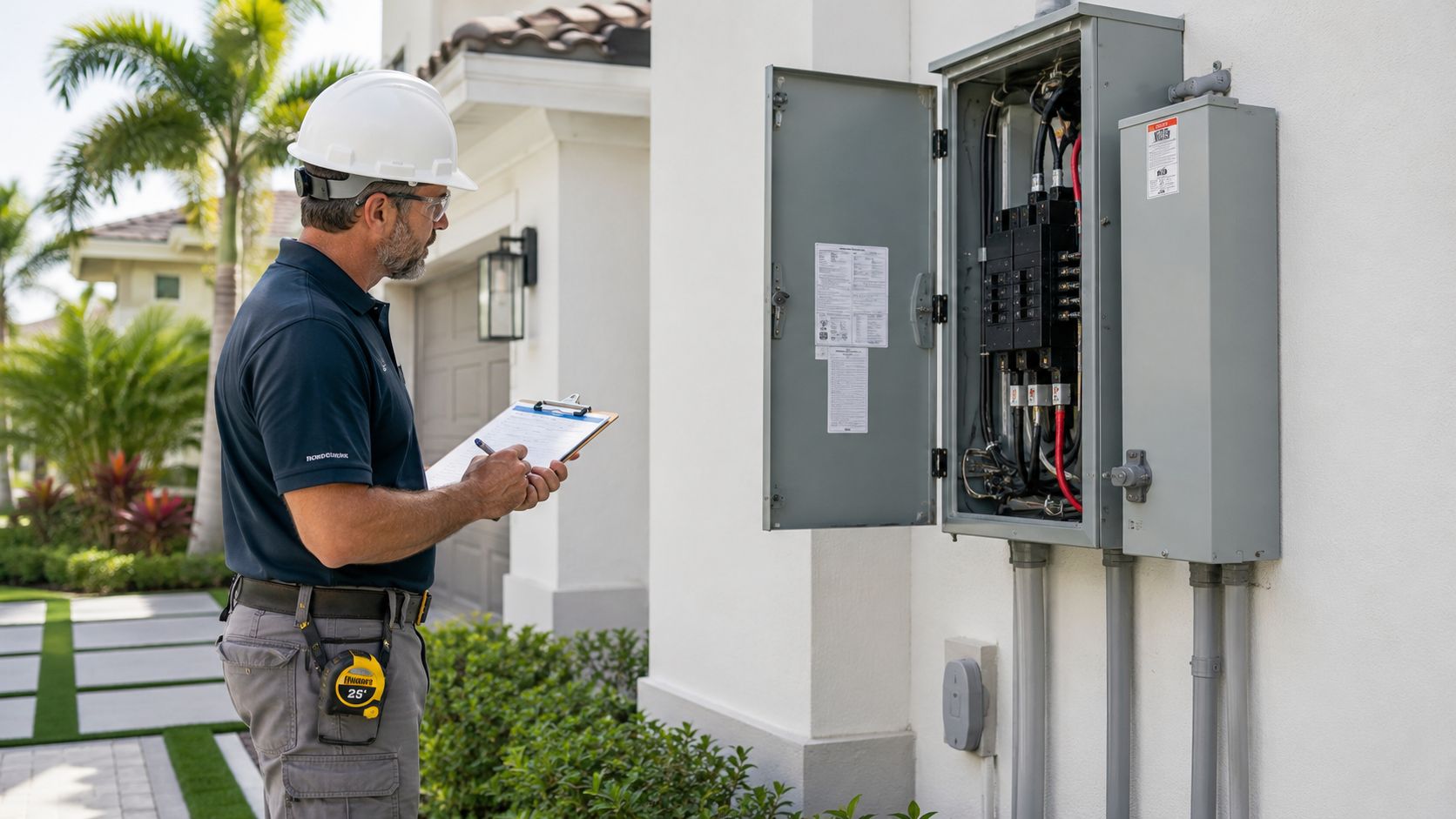
A proper site assessment saves money, time, and arguments later. Don't start by shopping charger brands. Start by looking at your parking, your panel, and your cable path.
Start with the parking spot, not the charger
Where do you park the vehicle most nights? That's the first question. Not where you wish you parked. Not where the charger would look nicest. Where the car reliably sits.
A few common locations work well:
- Garage wall near the panel: Usually the cleanest and simplest install.
- Carport post or adjacent wall: Often workable, but exposure and conduit routing matter more.
- Exterior wall by the driveway: Common in Palm Beach County, especially when the panel is already outside.
The shortest practical route between panel and charger location is usually the right route. Long conduit runs mean more labor, more materials, and more chances to run into problems. Exterior placement also needs to account for rain, salt air, physical protection, and how the charging cord will hang when it's not in use.
If you've got an older property, documentation helps. On remodels, additions, or homes with unclear wall and slab conditions, even something like 3D scanning for as-builts can be useful for understanding where existing building elements and utilities sit before anyone starts opening walls or planning a route blindly.
The panel question matters more than most homeowners think
This is the part too many installers treat like a footnote. It isn't one.
A charger may look simple on the wall, but electrically it's a new major load. Independent electrical guidance notes that a 150-amp panel can sometimes support a Level 2 charger, but only after a full household load calculation. Whether a 200-amp upgrade is needed depends on the home's existing HVAC, other large loads, and charger amperage, as explained in this panel capacity and EV charging overview.
That's why older Florida homes need a real calculation, not a guess. A house with central air, pool equipment, electric water heating, kitchen loads, and an already crowded panel may not have much headroom left. A different house with similar square footage might be fine.
Practical rule: If someone tells you your panel can handle EV charging without checking the household load, they're skipping the most important safety step.
Use this quick screening list before you call for installation:
| What to check | Why it matters |
|---|---|
| Panel amperage | Tells you the starting point, not the final answer |
| Available breaker space | A charger needs a dedicated circuit |
| Distance to parking area | Longer runs raise complexity and cost |
| Major existing loads | HVAC, range, dryer, water heater, pool gear all count |
| Wall or slab obstacles | These affect routing, labor, and finish quality |
If your house needs broader service work first, read up on electrical panel upgrades and when they make sense. That's often the primary decision before the charger decision.
Choosing the Right EV Charger for Your Home or Business
You pull into the garage with a new EV and realize the charger decision will affect your daily routine for years. Pick the right unit, and charging becomes automatic. Pick the wrong one, and you deal with slow charging, awkward cable runs, access problems, or a setup that needs to be redone when your needs change.
The right charger depends on the property, the parking layout, and who needs access. In Palm Beach County, that question gets more important in older homes, condos, and mixed-use buildings where electrical capacity, shared parking rules, and equipment placement can create problems fast.
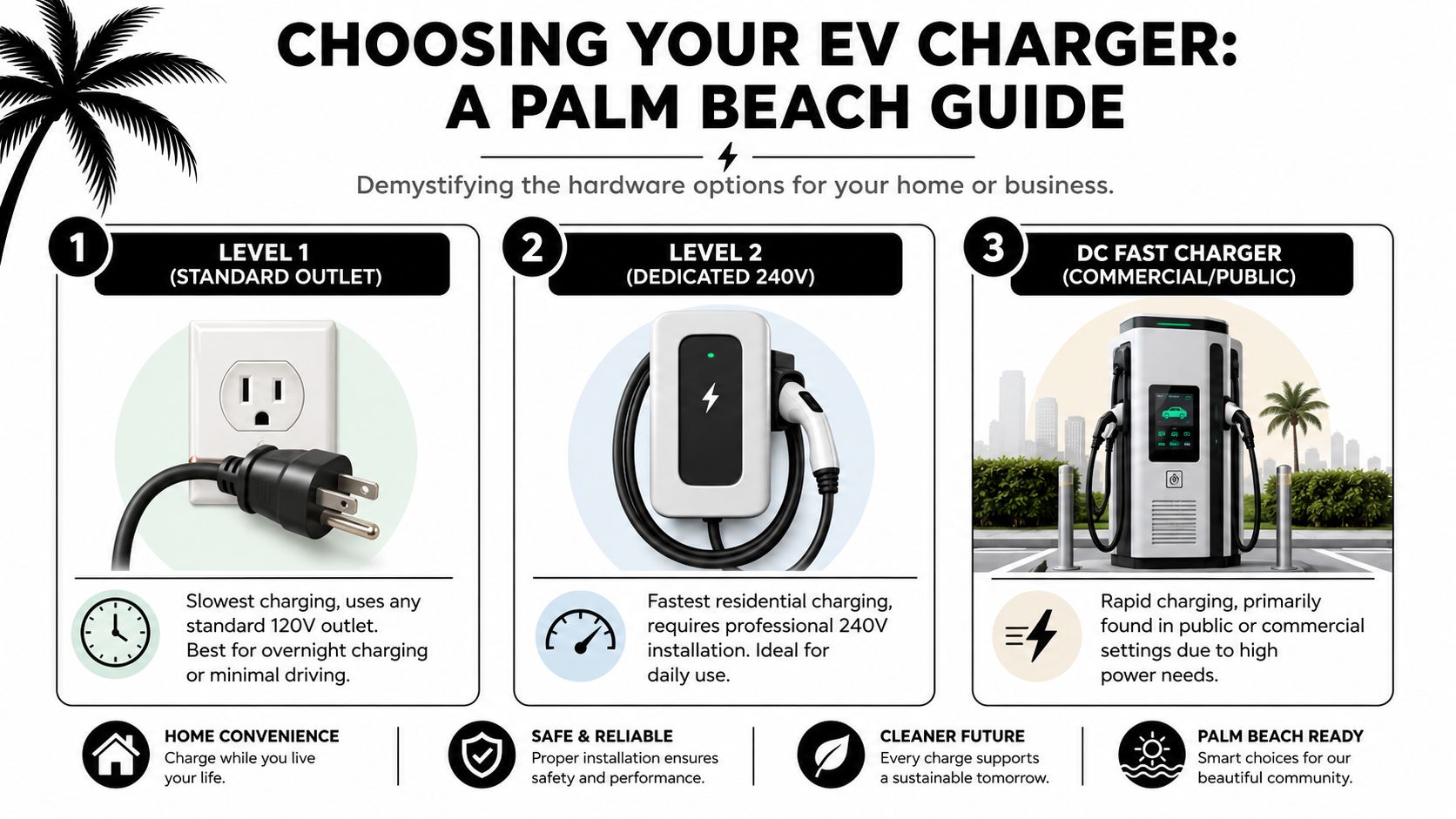
Public charging is available across Florida, as noted earlier. That helps for travel and occasional top-offs. It does not replace a charger that fits your own home, business, or shared parking setup.
What usually makes sense for a house
For a single-family home, Level 2 is the practical choice in most cases. Level 1 works as a short-term stopgap or for very low-mileage driving, but it is too slow for many households. A standard Level 2 charger covers the needs of most drivers with a dedicated 240-volt circuit and straightforward operation.
A smart Level 2 charger is worth the extra cost when you want scheduling, usage tracking, app control, or the ability to manage charging around other household loads. That is often a good fit in Palm Beach homes with pool equipment, multiple air-conditioning systems, or more than one EV expected later.
If you want a neutral overview of equipment types and feature differences, this Level 2 EV charging guide is a decent starting point.
Business, condo, and shared parking setups are a different job
Commercial properties and shared parking areas need more than a charger that turns on and off. They need control. You need to decide who can use it, how charging gets tracked, and who is responsible for maintenance, repairs, and electricity use.
That is why condo and HOA installations in Palm Beach County need careful equipment selection from the start. The wrong charger can create disputes over access, billing, cable reach, and future expansion. The right charger supports managed access and clear operating rules.
Use this decision table as a starting point:
| Property type | Best fit |
|---|---|
| Single-family home | Standard or smart Level 2 |
| Small office or private fleet area | Network-capable Level 2 with controlled access |
| HOA or condo shared parking | Managed Level 2 with clear rules for access and maintenance |
| Public-facing retail or travel stop | Higher-power public charging if service capacity supports it |
DC fast charging belongs mostly in commercial and public settings with heavy electrical demand and a real reason to recover vehicles quickly. For a house, it usually adds cost and complexity without giving the owner much return.
One more straight answer. Buy for the next five years, not just for this month. If you expect a second EV, a panel upgrade, tenant turnover, or HOA policy changes, choose equipment that will still make sense after those changes.
If you want a contractor to handle the site assessment, dedicated 240-volt circuit, equipment mounting, and testing, Lighthouse Energy Services offers EV charger installation as one option among its electrical services.
Navigating Palm Beach County Permits and Electrical Codes
If you're planning EV charger installation near Palm Beach FL, understand this early. It's a permitted electrical job, not a weekend DIY project. The charger may look simple on the wall, but the code side is what protects you when inspectors, insurers, buyers, and future electricians look at the work.
What the real permit workflow looks like
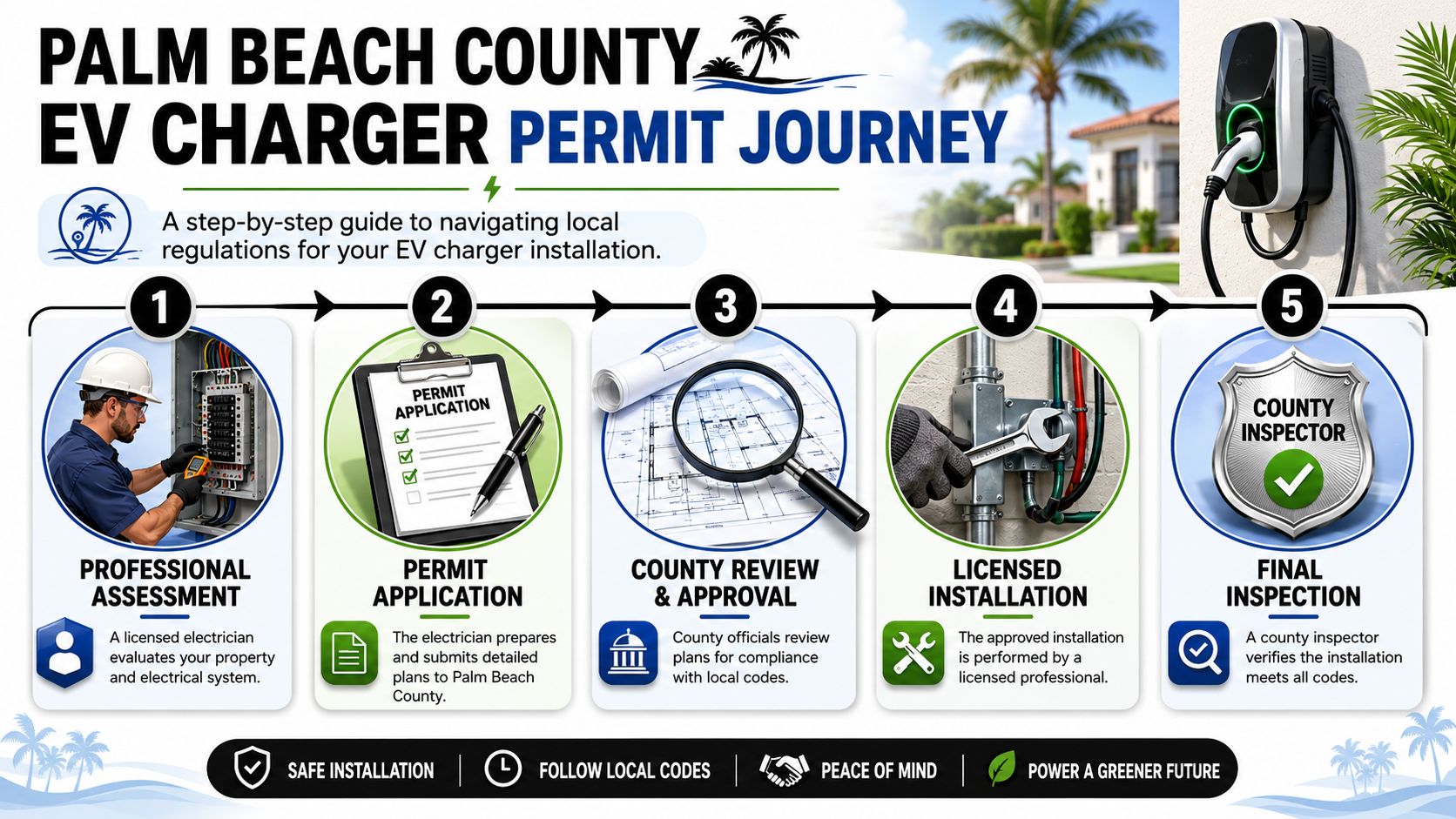
In Florida, a Level 2 EV charger installation requires a licensed electrician to install a dedicated 240-volt circuit, pull local permits, and pass a final municipal inspection. The installation itself often takes 2 to 4 hours, but the full permitting and approval process can stretch to weeks according to this Florida EV charger permit and installation guide.
That timeline surprises homeowners because the physical work is usually the shortest part of the job. The slower part is paperwork, review, scheduling, and final signoff.
Here's the practical sequence most jobs follow:
Site visit and load review
The electrician checks service capacity, panel space, location, and routing.Permit preparation
The job details get submitted to the local authority having jurisdiction.Approval before work begins
Work shouldn't start just because the charger arrived in the mail.Installation day
Circuit gets installed, charger gets mounted, and the system gets tested.Final inspection
The municipality signs off after confirming code compliance.
Why skipping permits is a bad idea
Some homeowners still ask if they can just “have someone put it in” and deal with permits later. That's the wrong move.
Permits matter for a few reasons:
- Safety: The circuit, breaker sizing, wire sizing, grounding, and location all need to match code.
- Insurance: Unpermitted electrical work can become a problem after a loss.
- Resale: Buyers and inspectors notice electrical additions that don't look documented.
- Rework risk: If the city requires corrections, you pay for the same work twice.
If a charger install doesn't end with inspection, the job isn't really finished.
Palm Beach County properties also come with local quirks. Some homes have outdoor service equipment exposed to weather. Some garages were altered years ago. Some parking areas are farther from the main service than the homeowner realized. That's why a clean permit package matters. It forces the job to be thought through before tools come out.
If an installer seems annoyed by permits, move on. A licensed electrician should expect them, handle them, and build them into the schedule from the start.
Understanding Installation Costs and Available Incentives
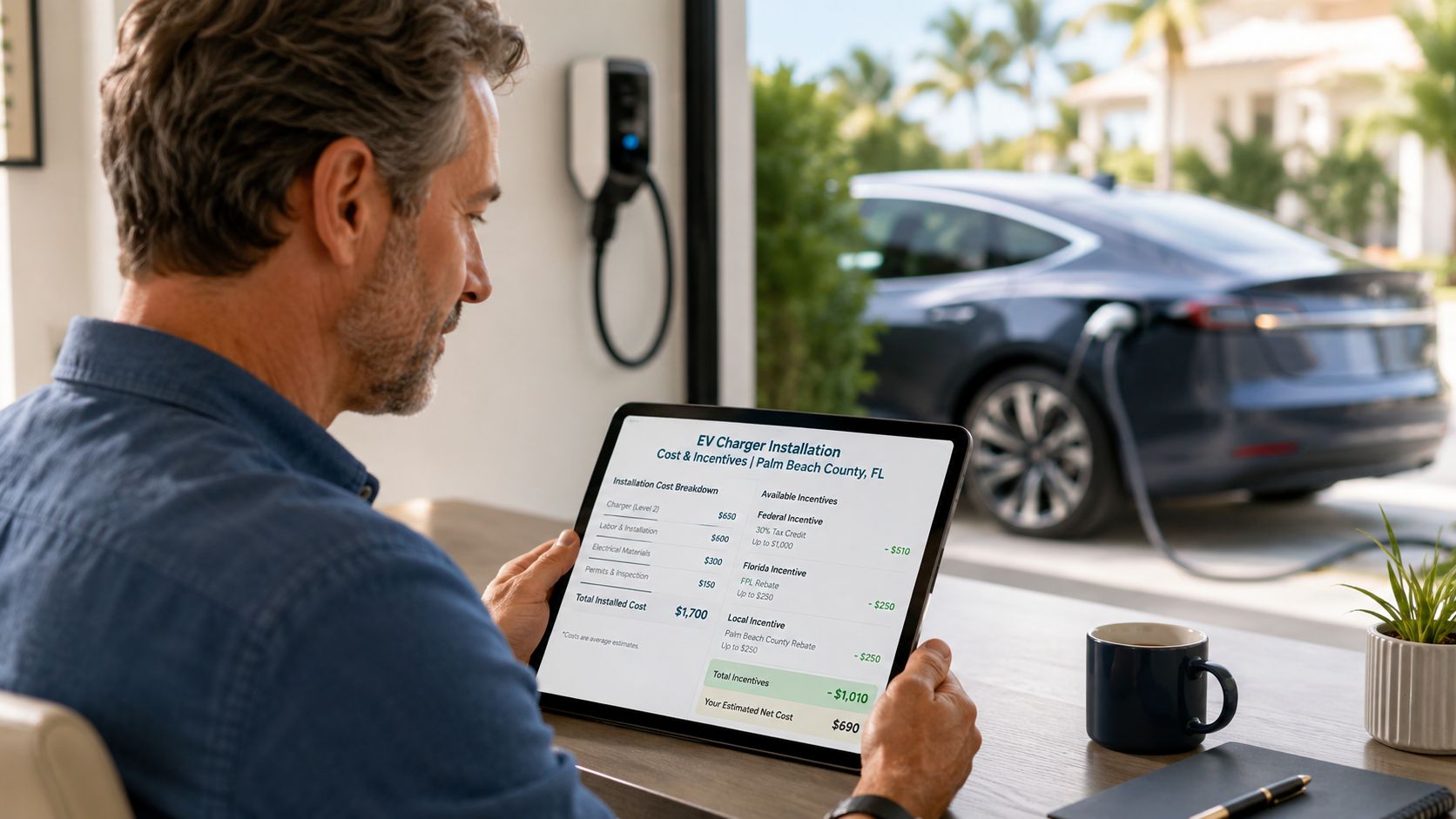
The biggest cost mistake homeowners make is focusing only on the charger unit. The charger is just one line item. The install cost depends more on the property than on the box itself.
What actually drives the price
Your final number usually comes from a mix of labor, materials, and job conditions.
Key cost drivers include:
- Circuit length: Longer distance from panel to charger means more wire, more conduit, and more labor.
- Installation path: Attic runs, exterior conduit, trenching, or finished-wall access all change the workload.
- Panel condition: If the panel lacks space or capacity, the job can expand quickly.
- Mounting conditions: Garage installs are often simpler than exposed exterior installs.
- Permit requirements: Local permit and inspection steps add time and administrative work.
Cheap installs usually aren't cheap. They're incomplete, unpermitted, undersized, or poorly planned.
A straightforward install is one thing. An older Palm Beach home with limited panel headroom, a long run to the driveway, and outdoor mounting needs is another. That's why fixed-price promises made before a site review should make you skeptical.
Where to look for offset opportunities
Homeowners should also ask about available tax credits, utility programs, or local incentives before approving the work. These programs change, so verify current eligibility before counting on them.
One encouraging local signal is public utility involvement in charging infrastructure. Florida Power & Light installed Level 3 chargers at service plazas along Florida's Turnpike, including the one in West Palm Beach, as described in this Florida's Turnpike charging expansion announcement. That doesn't guarantee a residential rebate for your house, but it does show continued utility and regional support for EV adoption.
My advice is simple. Budget for the whole project, not just the charger. Ask for a scope that includes the circuit, mounting, permit handling, testing, and inspection closeout. If the estimate is vague, expect surprises.
Why Your Installer Matters The Lighthouse Energy Advantage
An EV charger install is easy to oversimplify. It looks small, so homeowners assume almost any electrician can squeeze it in between other jobs. That's where headaches start. The wrong installer won't ask enough questions up front, and you'll pay for that later in delays, corrections, or nuisance breaker trips.
Questions you should ask before hiring anyone
Ask these before you sign anything:
- Are you licensed and insured for this work?
- Will you perform a real load calculation, not just glance at the panel?
- Who pulls the permit and coordinates inspection?
- What happens if the panel can't support the charger as planned?
- Will you test the charger and circuit before calling the job complete?
- If there's a problem later, who answers the phone?
Those aren't picky questions. They're basic screening.
For homeowners comparing contractors, this guide to choosing residential electrical contractors gives a useful framework for judging professionalism before work starts. The companies worth hiring won't dodge these questions. They'll answer them clearly, in writing, and without getting defensive.
My opinion is blunt. Don't hire based on who can hang the charger fastest. Hire based on who can install it correctly, legally, and in a way that still makes sense when you sell the home or add more electrical load later.
Palm Beach EV Charging FAQs for Homeowners and HOAs
The hard questions usually show up after the homeowner understands the basic install. They're not about plugging in the charger. They're about property rules, shared power, and whether the building can support the plan.
Common questions with straight answers
Do I need a panel upgrade to install a Level 2 charger?
Maybe. Some homes can support it on existing service, some can't. The answer comes from a proper load calculation, not panel age alone and not guesswork.
How long does the project take?
The actual installation is often quick once the permit is approved. The longer part is review, approval, scheduling, and inspection.
I live in a condo. Is this harder?
Yes. The electrical work may not be the hardest part. Approval, metering, access control, and responsibility for maintenance often create the main challenge.
A key gap in local guidance is how to plan charging for condos, HOAs, and multi-unit properties in South Florida, where shared parking, permitting, and electrical capacity are more complex, as noted by this multi-unit EV charging overview. That means the conversation has to cover more than one parking space and more than one resident.
If you're on an HOA board or managing a condo property, focus on these early:
- Power allocation: Decide how the building will handle available capacity before promising chargers to everyone.
- Metering and billing: Usage has to be assigned cleanly so disputes don't start later.
- Access rules: Shared chargers need operating rules, not assumptions.
- Maintenance responsibility: Someone must own inspection, repair, and replacement responsibility.
- Permit coordination: Multi-unit properties need tighter documentation than single-family installs.
Can I install first and ask the association later?
That's a bad strategy. In shared property settings, approval should come before installation planning is finalized.
Is an exterior install okay near the coast?
Yes, if the equipment and installation method are suitable for the environment and the location is protected appropriately. Outdoor installs just require more thought.
If you want the job scoped correctly before anyone starts drilling or pulling wire, contact Lighthouse Energy Services. A proper EV charger installation starts with load review, permit planning, and a layout that fits how you park and charge. That's how you avoid rework, inspection trouble, and the kind of electrical shortcuts that become expensive later.