
You've got the car. The next problem shows up the first night you pull into the garage and realize the charger that came with the vehicle isn't a long-term plan. Maybe the cable barely reaches. Maybe the charging speed is too slow for your daily routine. Maybe you've already started calling around and half the answers sound like guesswork.
That's where a lot of homeowners in West Palm Beach get into trouble. A home EV charger looks simple on the wall, but the important part is behind it: panel capacity, breaker sizing, conductor sizing, grounding, permit handling, and final testing. If the person installing it treats it like a handyman job, you can end up with nuisance tripping, failed inspections, overheated wiring, warranty problems, or a charger that never performs the way it should.
West Palm Beach already has a real EV charging market, not a fringe one. ChargeHub's West Palm Beach listing shows 451 total charging stations, including 325 Level 2 stations (72%), 126 Level 3 stations (28%), and 109 free stations, with major networks in the mix. That tells you something important. Local demand is established, and the installers worth hiring should already understand EV work as a serious electrical service, not a side job.
Table of Contents
- Your Guide to a Safe EV Charger Installation in West Palm Beach
- Your Pre-Installation Checklist Site and System Assessment
- Choosing the Right Charger and Understanding Electrical Needs
- Navigating Permits and Inspections in Palm Beach County
- How to Vet Installers and Spot Critical Red Flags
- Why Lighthouse Energy Services Excels in Palm Beach County
Your Guide to a Safe EV Charger Installation in West Palm Beach
Most homeowners start with the same question: “Can't I just add an outlet in the garage and plug the charger in?” Sometimes the answer is yes. A lot of the time, the honest answer is “not without checking the house first.”
An EV charger adds a meaningful electrical load to your home. That changes the conversation from convenience to system design. The right installer isn't just mounting hardware. They're checking whether your existing service can carry the load, whether the panel has capacity, whether the charger location makes sense, and whether the installation will pass inspection without cleanup work later.
What good installers do differently
A solid EV charger installation in West Palm Beach usually follows a straightforward discipline:
- Assess the site first: They look at the parking location, cable reach, panel location, path for conduit or cable, and exposure to weather.
- Check the electrical system: They verify available capacity instead of assuming an empty breaker space means the house is ready.
- Match the charger to the house: They don't overspec a charger your panel can't support safely.
- Handle permit and inspection requirements: They don't ask you to “skip the paperwork.”
- Test after installation: They energize, verify charger function, and confirm the equipment operates as intended.
Practical rule: If someone gives you a price for an EV charger install without asking for panel photos, charger specs, or installation location, they're pricing a guess.
What goes wrong with rushed installs
The bad jobs usually fail in predictable ways. The charger ends up too far from the vehicle port. The breaker trips because the circuit was mismatched to the charger rating. The panel wasn't evaluated properly. The permit was never pulled. The owner only finds out when there's a problem, or when the house is being sold.
West Palm Beach homes also vary a lot. Some have attached garages with easy panel access. Some have older service equipment, detached parking, condo or townhouse constraints, or long runs from the panel to the mounting point. That's why hyperlocal experience matters. The best EV charger installer in West Palm Beach FL won't treat every house like the same house.
Your Pre-Installation Checklist Site and System Assessment
Before you start collecting quotes, do some homework. A few photos and a few basic notes can save time, shorten the back-and-forth, and make it easier to separate serious electricians from sales-first bidders.
Start with the parking spot
Stand where the vehicle usually parks. Look at the charging port on the car, then look at the wall space around it. The best charger location is the one that gives you easy cable reach without stretching the cord across a walkway, garage opening, or storage area.
Check these details:
- Mounting surface: Drywall, block, masonry, and exterior walls all affect how the charger gets mounted and how the wiring route is built.
- Distance to the panel: In general, shorter and cleaner runs are simpler. Long runs, attic routes, and exterior conduit can add labor and material.
- Exposure: If the charger will be outside, the installer needs to account for weather-rated equipment and a location that makes daily use practical.
- Vehicle habits: If you back in sometimes and pull in other times, charger placement needs to work for both.
A common mistake is centering the charger on the wall because it “looks right.” Function matters more than symmetry. The charger should fit the car, not the wall.
Check the panel before you call anyone
Find your main electrical panel and open the door. You're not diagnosing anything here. You're gathering information.
Look for:
- Main breaker rating: This tells the electrician part of the story about your service size.
- Available breaker spaces: Empty spaces help, but they don't prove capacity.
- Existing large loads: Pool equipment, electric water heaters, ovens, dryers, and air conditioning all matter during a load review.
- Panel condition: Rust, double-tapped breakers, missing knockouts, discoloration, or a crowded interior are all signs the installer needs to look closely.
Don't tell an electrician, “I've got room in the panel,” just because you see two blank spaces. Space and capacity are not the same thing.
Older Palm Beach County homes can be especially deceptive here. A panel can look physically able to accept a breaker while the service is already carrying enough continuous and non-continuous load that the charger design needs to change. In some homes, the cleanest answer is a lower-amperage charger. In others, the correct answer is a panel or service upgrade.
Take photos and note the conditions
When you contact installers, send useful photos. You'll get better questions and usually a more realistic first conversation.
Take:
- A full photo of the panel with the door open
- A close photo of the panel directory
- A photo of the main breaker
- A photo of the proposed charger wall
- A wide shot showing panel-to-charger distance
- Any obstacles such as water heaters, shelving, attic access points, or exterior pathways
Also note whether the charger will be in a garage, carport, driveway-side wall, or detached structure. That one detail can change the installation method.
Choosing the Right Charger and Understanding Electrical Needs
The charger decision should come after the site review, not before it. Homeowners often shop by marketing labels, app features, or the highest amperage on the box. The electrical system usually decides what makes sense.
Level 1 versus Level 2 in real life
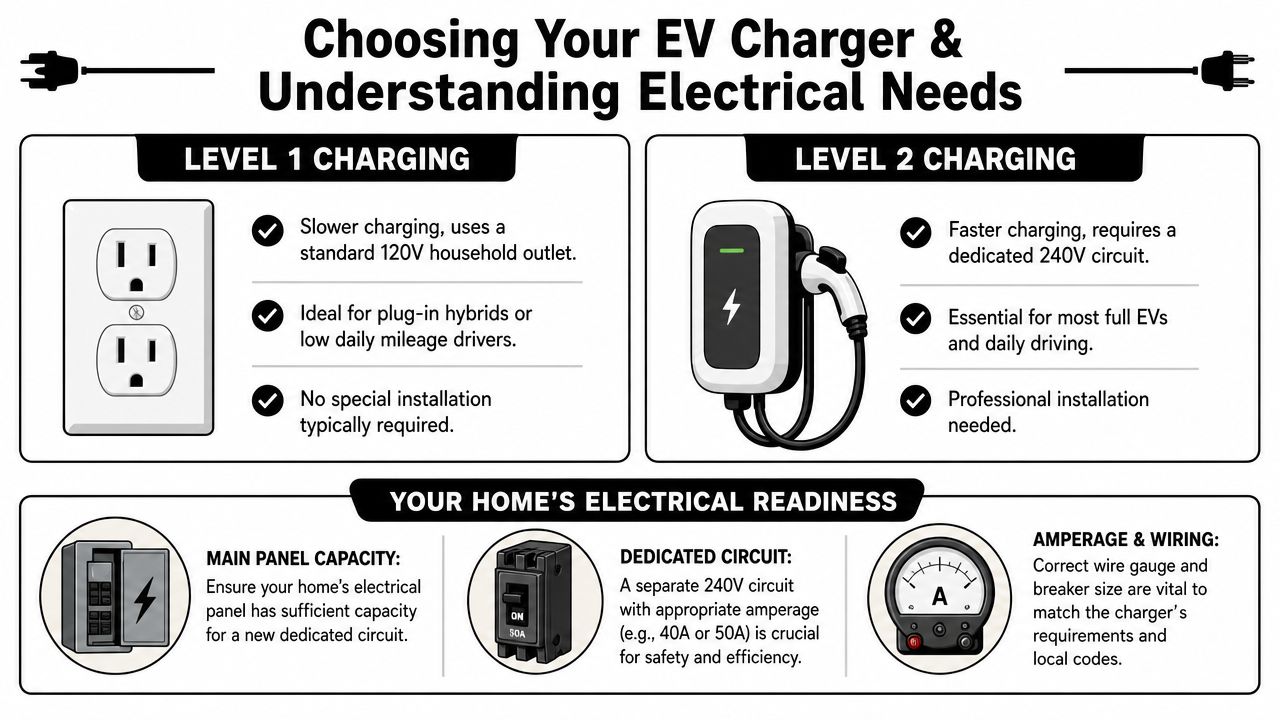
Level 1 charging uses a standard household outlet. It can work for some households, especially if the vehicle isn't driven much, but many full EV owners find it too limiting for normal daily use. It's usually more of a temporary answer than a finished setup.
Level 2 charging is what most homeowners are looking for. It requires a dedicated 240V circuit and a real installation plan. If you drive every day, want predictable overnight charging, or don't want your charging routine to run your life, Level 2 is usually the practical path.
That doesn't mean bigger is always better. The right setup balances vehicle needs, house capacity, and installation conditions.
Why amperage changes the whole job
Licensed electrical work is essential; EV charger installation guidance tied to NEC Article 220 states that EV charging is a continuous load, and branch circuits must be sized at 125% of the charger's rated current. In practice, that means a 48 A Level 2 charger is typically installed on a 60 A circuit, while a 32 A unit usually maps to a 40 A circuit.
That one rule affects almost everything:
- Breaker size
- Conductor size
- Panel capacity
- Heat management
- Voltage drop on longer runs
- Whether a service change is needed
If an installer talks only about the charger brand and not about the load calculation, stop there. The load study is not paperwork filler. It's the core safety step.
For homes that need additional capacity work, an electrician may recommend a panel upgrade before the charger goes in. If that turns out to be the right move, this overview of electrical panel upgrades is a useful starting point for understanding what that work involves.
A charger that's too large for the house isn't an upgrade. It's a design mistake with a glossy finish.
Hardwired versus receptacle installations
This decision gets simplified too often. Both methods can be valid. The right one depends on the charger model, location, local approval requirements, and how permanent you want the setup to be.
Hardwired installation usually makes the most sense when you want a cleaner, more permanent setup. It eliminates the receptacle and plug connection point, can reduce some failure points, and is often the cleaner option for outdoor walls or high-use charging.
Receptacle-based installation can make sense where the charger is designed for plug-in connection and the site supports it properly. But it still needs a dedicated circuit, correct device selection, proper mounting, and code-compliant installation. It isn't a shortcut.
A good electrician will walk through the trade-offs in plain language:
| Installation Type | Usually Works Best When | Watch For |
|---|---|---|
| Hardwired | You want a permanent charger setup with a clean finish | Future charger swaps may require minor electrical work |
| Receptacle | The charger is designed for plug-in use and the location supports it | The receptacle, breaker, and wiring still have to match the load correctly |
The point isn't to force one method every time. It's to build the circuit around actual use, not internet opinions.
Navigating Permits and Inspections in Palm Beach County
A Level 2 charger installation is electrical work that changes the house. In Palm Beach County, that usually means permit and inspection. If a contractor tries to frame that as optional, they're asking you to carry the risk.
What the permit process usually looks like
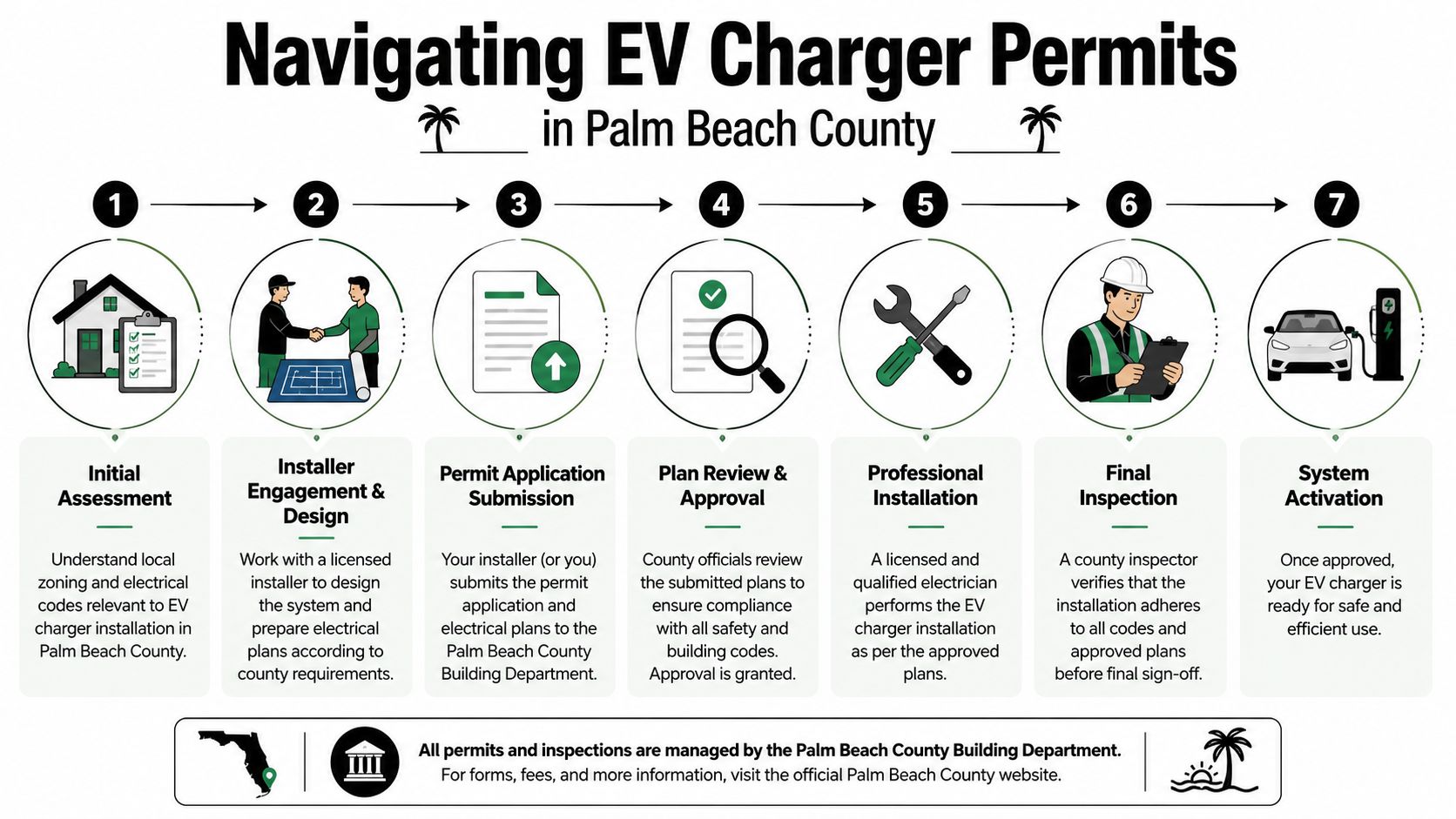
The clean version of the process is simple. The electrician reviews the site, confirms the installation method, prepares the permit submission, completes the work, and schedules the final inspection. You shouldn't be chasing forms or guessing which office handles what.
In Palm Beach County and city jurisdictions, details can vary by property type and location. Detached homes, townhomes, and some managed communities don't always move through the exact same administrative path. A local electrician should know how to handle those differences without turning you into the project manager.
Here's the normal workflow:
- Site review and scope confirmation: The installer decides what's being added and whether related upgrades are required.
- Permit filing: The licensed contractor submits the permit information.
- Installation: Work gets done according to the approved scope.
- Inspection scheduling: The final inspection is requested after the install is complete.
- Approval: The inspector signs off if the work meets code and matches the permit.
What inspectors care about
Inspectors aren't there to make your life harder. They're there to verify that the installation is safe and code-compliant.
They'll typically focus on things like:
- Correct breaker and conductor sizing
- Proper grounding and bonding
- Dedicated circuit configuration
- Equipment listing and installation method
- Workmanship at the panel and charger
- Whether the installed work matches the permit scope
If a charger install can't survive an inspection, it wasn't done correctly. Passing paperwork after the fact is not the same as doing the work right.
The biggest homeowner mistake here is trying to save time by allowing unpermitted work. That can create problems with insurance claims, disclosure during sale, and liability after an electrical failure. If something goes wrong, “the contractor said it was fine” won't protect you.
How to Vet Installers and Spot Critical Red Flags
Most bad EV charger installs can be prevented before the truck ever shows up. The trick is asking questions that force clarity. You're not looking for polished sales language. You're looking for signs that the contractor understands electrical work, communicates clearly, and takes responsibility for the full job.
Questions worth asking before you hire
Ask these directly and listen for direct answers.
- Who pulls the permit? The right answer is that the licensed electrical contractor handles it.
- Will you perform a load calculation before finalizing the installation plan? A real EV installer won't skip that step.
- Are you installing hardwired equipment or a receptacle, and why? They should be able to explain the reason without hand-waving.
- What photos or information do you need from me before quoting? If they need nothing, that's a problem.
- Will I receive a written scope of work? You want materials, installation method, and exclusions in writing.
- Who will perform the work on site? That answer should be clear, not vague.
If you want background on how reputable trades businesses present themselves online, this breakdown of how contractors can rank on Google is useful because it shows what transparent local service information looks like. It won't replace vetting, but it helps you spot whether a contractor's online presence matches a real, service-based operation.
For local licensing context, homeowners can also review what a licensed electrical contractor is expected to handle on regulated electrical work.
Red flags that should end the conversation
Some warning signs aren't minor. They're disqualifiers.
If the contractor says you don't need a permit for a new Level 2 charger circuit, end the conversation.
Other red flags include:
- Large cash requests upfront: Reasonable deposit structures are one thing. Pressure for cash before documentation is another.
- Verbal-only pricing: If there's no written estimate, there's no stable scope.
- No discussion of panel capacity: They should care about the service, not just the wall location.
- High-pressure urgency: Electrical contractors don't need to manufacture panic to book qualified work.
- Brand-only expertise: If all they talk about is the charger app or hardware finish, they're avoiding the electrical part.
A strong estimate doesn't need to be long, but it does need to be specific. It should identify what's being installed, whether permits are included, what assumptions were made about the panel and wiring path, and what conditions could change the final scope.
Installer Vetting Checklist
| Question | What a Good Answer Looks Like |
|---|---|
| Are you licensed and insured for this electrical work? | Clear yes, with no hesitation and no attempt to dodge documentation |
| Who handles permits and inspection coordination? | The contractor handles it from submission through final sign-off |
| How do you determine charger size for my home? | They reference panel review, load calculation, and actual driving needs |
| Can you explain the circuit requirements for my charger? | They explain breaker and conductor sizing in plain language |
| Will you provide a detailed written estimate? | Yes, with scope, assumptions, and exclusions spelled out |
| What happens if the panel can't support the charger I want? | They offer alternatives such as lower-amperage design or upgrade options, not guesswork |
Why Lighthouse Energy Services Excels in Palm Beach County
The best EV charger installer in West Palm Beach FL isn't the one with the flashiest ad. It's the company that handles the job the way a serious electrical project should be handled: site review first, load evaluation before promises, permit management, clean installation, and real accountability after energization.
What strong EV installation service looks like
Lighthouse Energy Services fits that standard on the basics that matter. The company has been serving Palm Beach County since 2005, and its team brings more than 100 years of combined expertise according to the company background provided here. That matters because EV charger work looks simple until the house presents a real electrical constraint.
The practical strengths are straightforward:
- Licensed electrical judgment at the front end: Phones are answered by licensed electrical professionals, which means the first conversation can move the job forward.
- Around-the-clock availability: If a charger installation turns into a broader electrical issue, there's real support behind it.
- Transparent quoting: Clear scope and no hidden-fee style pricing lines up with what homeowners should demand from any contractor.
- Broad electrical capability: If the charger project reveals panel or service issues, the same contractor can address the larger system problem.
For homeowners comparing local providers, the company's West Palm Beach electrical contractor page gives a direct look at the service area and electrical scope.
Why that matters in this market
EV charging in West Palm Beach is part of an active local infrastructure environment, not a novelty category. The city's EV network reflects that broader demand mix. The City of West Palm Beach EV charging information describes municipal charging expansion and supports the broader point that the local market includes both 72% Level 2 and 28% Level 3 charging in the public mix, which points to different use cases and real electrical planning needs.
That local context matters because homeowners aren't just buying a gadget. They're adding a permanent electrical load to the house in a region where installation quality, permit handling, and response speed all matter. If you want to understand how electricians win this kind of work operationally, this guide for electricians to secure jobs is useful because it highlights how speed, clarity, and follow-through affect homeowner decisions.
A capable EV installer should feel boring in the best way. They should ask the right questions, document the work, build the circuit correctly, and leave you with a charger that works every day without drama.
If you want a licensed electrician to evaluate your home, explain the safest charger options, and handle the permit and installation process from start to finish, contact Lighthouse Energy Services.