
You brought home an EV, parked it in the driveway, and then the main question hit you. How are you going to charge it every day without planning your week around public stations, garage detours, and cable juggling?
That's where affordable EV charger installation in West Palm Beach, FL becomes less of a luxury upgrade and more of a practical home project. Around here, EV charging isn't some fringe add-on anymore. West Palm Beach already has an established public network, and homeowners are now making the same move people made years ago with garage door openers and whole-home surge protection. They want the convenience at home, on their schedule, with equipment that's installed safely and legally.
The catch is that national guides usually skip the part that matters most. In West Palm Beach, the details that affect cost and the final result are local. Your electrical panel, your permit path, FPL service, where the charger sits in relation to the driveway or garage, and whether the electrician knows Palm Beach County inspection expectations all matter.
Table of Contents
- Why a Home EV Charger is a Game-Changer in West Palm Beach
- Your Pre-Installation Checklist Before Calling an Electrician
- Breaking Down Costs and Finding EV Charger Incentives
- The West Palm Beach Permitting and Inspection Process Explained
- How to Hire the Right Electrician for Your EV Charger
- What to Expect on Installation Day and Beyond
- Frequently Asked Questions About Home EV Charger Installation
Why a Home EV Charger is a Game-Changer in West Palm Beach
West Palm Beach is already far enough along with EV adoption that home charging makes practical sense. According to ChargeHub's West Palm Beach charging map, the city has 451 total charging stations, including 325 Level 2 stations and 109 free stations. It also reports that 24% of the city's stations are free, and downtown West Palm Beach is the densest charging zone.
That matters for one reason. You're not betting on an unproven trend. You're adding a home charger in a city where EV charging is already visible, normal, and built into day-to-day life.
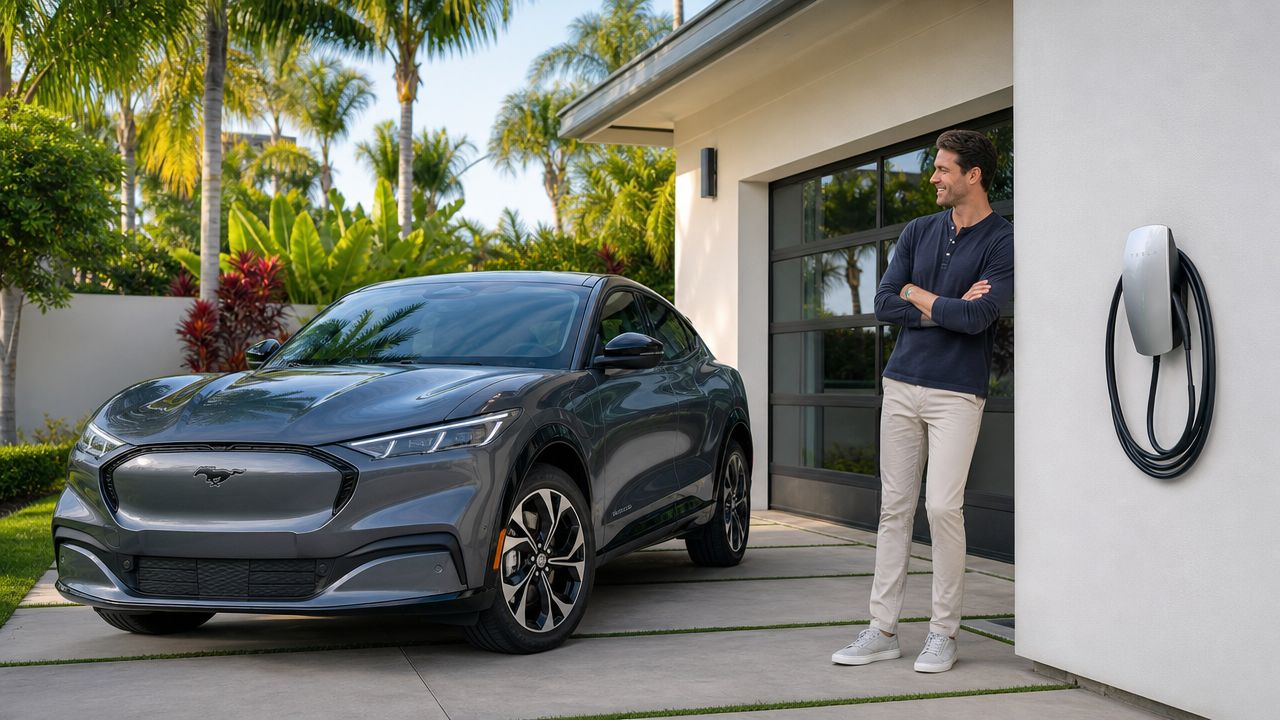
A lot of homeowners start by relying on public charging because it feels easier than making a decision at home. That works for a while. Then the routine gets old. You start planning errands around charger availability, wondering whether a station is open, or topping off when you'd rather just go home. A properly installed home unit fixes that friction.
Why home charging changes the routine
Home charging gives you control. You park, plug in, and start the next day with the car ready.
For most households, that's the main advantage:
- No detours after work
- No depending on busy public locations
- No guessing whether a charger will be open
- No daily wear on patience for something that should be simple
Practical rule: Public charging is useful backup. Home charging is what makes EV ownership feel easy.
If you're still narrowing down equipment, it helps to review the basics of choosing an electric vehicle home charger before you buy. The right unit for a West Palm Beach home depends less on marketing claims and more on your panel capacity, parking setup, and the connector your vehicle needs.
Your Pre-Installation Checklist Before Calling an Electrician
The fastest way to get a useful quote is to do a little homework first. You don't need to diagnose your own electrical system, but you should know how you use the car, where the charger should go, and what your existing panel looks like.
Know how you actually drive
Start with your routine, not the charger brochure. If the car sits overnight and your driving pattern is predictable, a Level 2 setup is usually what homeowners want because it fits normal daily charging better than a basic plug-in approach.
Ask yourself:
- How often do you drive the EV every day: Daily commuting, school pickup, local errands, and weekend driving create a different charging need than occasional use.
- Where does the car park most nights: Garage, driveway, side pad, or rear parking all affect wiring distance and weather exposure.
- Do you want one charger to serve one car or future vehicles too: That changes placement and sometimes changes what amperage setup makes sense.
If you have more than one driver in the household, think through parking habits now. A charger installed in the wrong spot can turn an expensive upgrade into an everyday annoyance.
Find your panel before anyone gives you a quote
A serious electrician is going to check load capacity first. That's not a technicality. It's one of the main factors that determines whether the job is straightforward or whether additional electrical work is needed.
Walk out to your main electrical panel and look for the label showing the service size. Don't remove the dead front or poke around inside. Just identify where the panel is, whether it's easy to access, and whether there appears to be room for a new breaker.
Here's what's useful to have ready when you call:
| What to check | Why it matters |
|---|---|
| Panel location | A nearby panel usually makes installation easier |
| Service size label | Helps the electrician evaluate charging load |
| Open breaker spaces | Indicates whether circuit additions may be simpler |
| Distance to parking area | Longer runs can mean more conduit and wire |
| Indoor or outdoor install | Changes equipment selection and mounting method |
If your home is already tight on electrical capacity, a panel upgrade may be part of the discussion. If that possibility comes up, this guide on upgrading from 150 amp to 200 amp service gives a good homeowner-level overview of what that kind of project involves.
The biggest mistake I see homeowners make is shopping for the charger first and asking about electrical capacity later. The panel decides what's realistic.
Pick the charger location with daily use in mind
A charger should be where the car naturally parks. Not where the wall looks empty. Not where the product photo would look best.
Think through these points before the estimate visit:
- Cable reach: The charging cord should comfortably reach the vehicle's port without stretching across a walkway or under a garage door.
- Mounting surface: Solid wall space matters. Stucco, block, finished garage walls, and pedestal-style outdoor setups all install differently.
- Weather exposure: Outdoor locations can work well, but they need the right equipment rating and smart placement.
- Future convenience: If you back in today but may pull in nose-first later, the mounting spot needs to remain practical.
A little planning here saves money and frustration. The cleanest install is usually the one that matches how you already use the space.
Breaking Down Costs and Finding EV Charger Incentives
Affordable EV charger installation in West Palm Beach, FL usually comes down to one thing. Knowing what portion of the project is fixed, what portion depends on your house, and what incentives can reduce the sting.
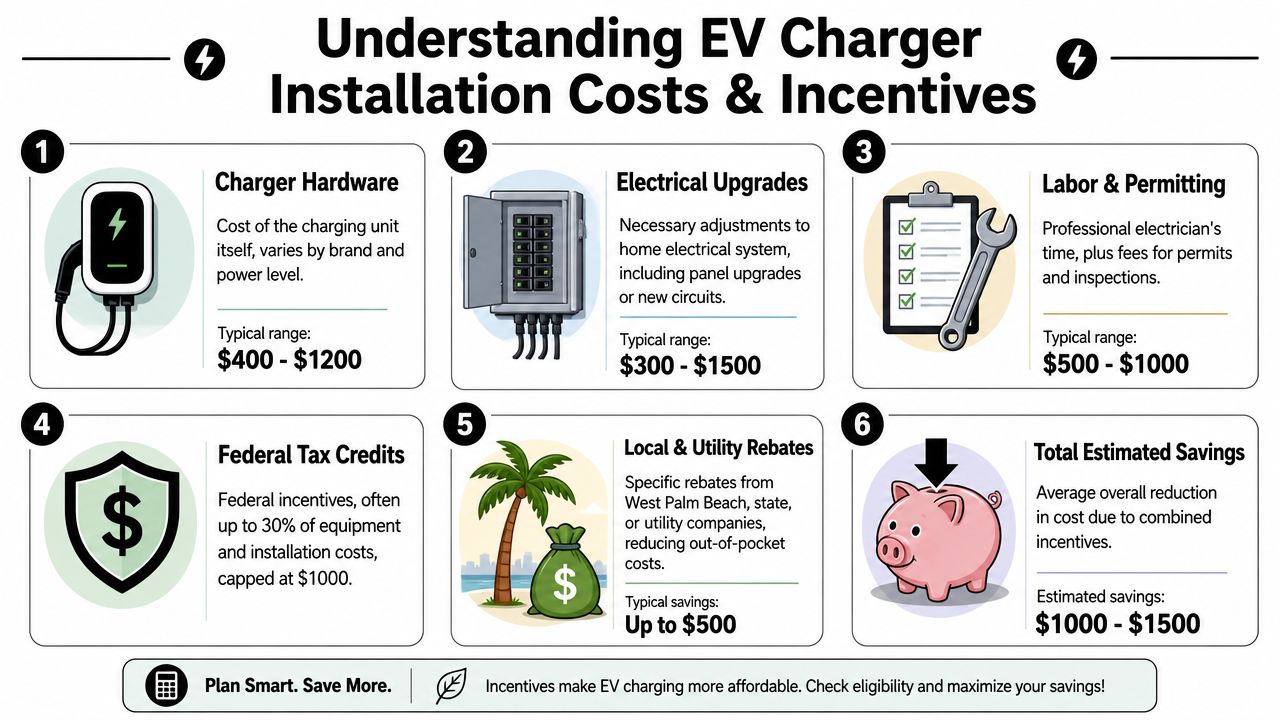
What you're really paying for
There are three separate cost buckets in most home charger jobs.
First is the charger hardware itself. Second is the installation labor and materials. Third is any electrical upgrade work your home needs in order to support the charger safely.
For installation labor alone, a Florida-focused benchmark cited in this EV charger installation cost guide is $1,000-$2,500 excluding the charger hardware. The same source notes that cost is mainly driven by distance from panel to charger, conduit and wiring complexity, and whether a panel upgrade is needed.
That's why two neighbors on the same street can get very different quotes. One home may have a panel in the garage with a short, clean route to the charger location. Another may need a longer run, finished-wall patching, exterior conduit, or service changes.
Where West Palm Beach homeowners can lower the out-of-pocket cost
The local utility and federal credit can make a real difference if you qualify. According to Qmerit's Florida EV charging and electrification statistics, West Palm Beach-area drivers served by FPL can use the EVolution Home program, which provides residential electrical upgrades and a Level 2 charger for a flat monthly fee of $31 to $38. The same source says the federal Alternative Fuel Vehicle Refueling Property Credit can cover up to $1,000 for home charger installation through June 30, 2026.
If you're served by FPL, don't price a charger project until you've compared a standard purchase-and-install route against the EVolution Home monthly model.
The same Qmerit source also reports that Florida has more than 6,800 Level 2 public charging stations, more than 2,200 DC fast-charging locations, and over 9,000 public charging ports statewide. It notes that Florida ranks 30th in EV charging cost affordability, with a full EV charge ranging from $6 to $13. That's a good reminder that cost still drives decision-making, even in a state with a large charging footprint.
What usually pushes a job out of the affordable range
Some jobs are inexpensive because the house is ready. Some aren't.
The common cost drivers are usually these:
- Long wiring distance: More wire, more conduit, more labor.
- Difficult routing: Attics, masonry, finished spaces, and limited access slow the job down.
- Panel constraints: If the existing service can't handle the added load, the scope changes.
- Permit compliance work: If prior electrical work wasn't done cleanly, an electrician may need to correct issues before adding the charger circuit.
A cheap quote that ignores load calculation, permit handling, or inspection usually isn't cheap. It's incomplete.
The most affordable install is rarely the lowest sticker price. It's the one that gets designed correctly the first time, qualifies for available incentives, and doesn't come back later as a repair job.
The West Palm Beach Permitting and Inspection Process Explained
A permit isn't paperwork for paperwork's sake. It's the step that confirms the charger circuit, breaker, conductor sizing, equipment connection, and final installation meet code.
Why the permit matters
When a Level 2 charger is added, the work typically involves a dedicated branch circuit and changes to your home's electrical system. That means safety, liability, and future resale all come into play.
Skipping permits usually creates trouble in one of four ways:
- Inspection problems later: Unpermitted work often gets flagged when other electrical work is done.
- Insurance headaches: If something fails, undocumented work can complicate claims.
- Unsafe installations: Oversized breakers, undersized wire, and poor terminations don't always fail immediately.
- Property transfer questions: Buyers and inspectors notice electrical additions.
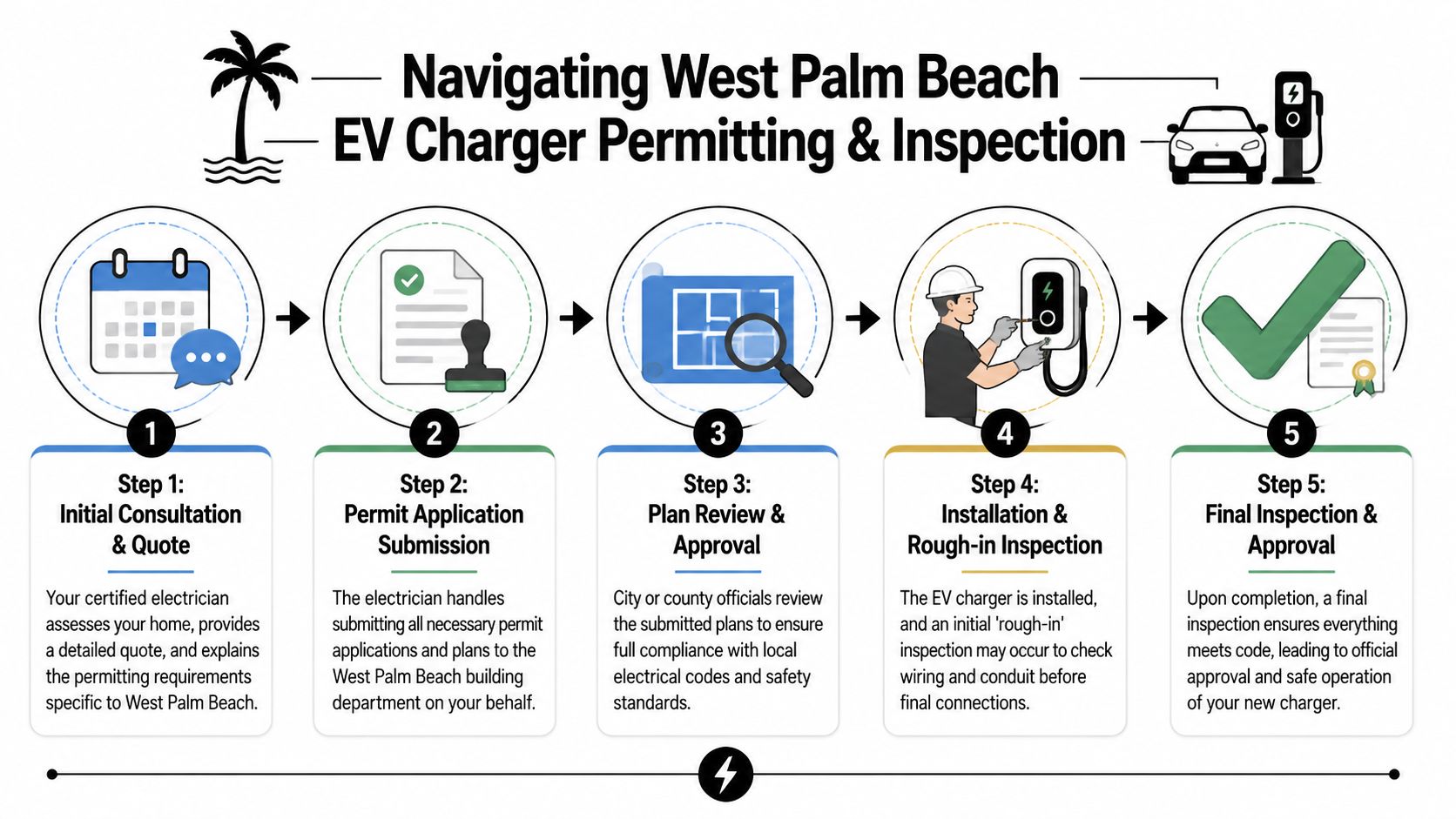
How the process usually moves
The basic local workflow is straightforward when the electrician handles it properly.
A typical path looks like this:
Site visit and load review
The electrician checks the panel, confirms the charger location, and determines whether the existing service can support the added load.Permit application
The contractor submits the required permit information for the electrical work.Installation
The dedicated circuit is run, the charger is mounted, connections are made, and the installation is completed to code.Inspection
The jurisdiction reviews the completed work before the charger is placed into regular service.
Permit and inspection aren't obstacles. They're quality control. A homeowner should want another set of eyes on a new high-load circuit.
In practice, a qualified electrician should manage this for you. You shouldn't be left figuring out permit forms, explaining the scope to reviewers, or trying to schedule inspections without support. The homeowner's job is to approve the work. The contractor's job is to build it legally and get it signed off.
How to Hire the Right Electrician for Your EV Charger
Anybody can say they install EV chargers. What you need is someone who understands load capacity, dedicated circuits, permit handling, and the difference between a neat-looking install and a code-compliant one.
What to ask before you book anyone
Keep the screening simple and direct.
Ask these questions:
- Are you licensed and insured for residential electrical work in this area: If the answer is vague, move on.
- Have you installed Level 2 chargers before: Experience matters because these jobs are more than just mounting hardware.
- Will you handle permits and inspection coordination: You don't want a handoff halfway through the job.
- Have you looked at panel capacity before quoting: If they skip that, the number may not hold.
- What's included in the written price: Make sure conduit, breaker, wire, mounting, and permit handling are spelled out.
A contractor who can answer those cleanly usually runs cleaner jobs.
If you want a starting point for evaluating local qualifications, electrical contractor services in West Palm Beach should clearly show that a company handles residential electrical work, service upgrades, troubleshooting, and installation scope beyond basic handyman work. Lighthouse Energy Services is one local option that provides electric car charger installation as part of its residential electrical services.
How to read the quote without getting burned
Price matters, but context matters more. The Florida-focused benchmark for installation labor is $1,000-$2,500 excluding charger hardware, as noted earlier in the article. A quote far below that may still be legitimate for a very simple install, but it should make you slow down and read the scope carefully.
Look for these details in writing:
| Quote item | What you want to see |
|---|---|
| Circuit scope | Dedicated EV charger circuit clearly listed |
| Materials | Breaker, wire, conduit, fittings, and mounting hardware |
| Permit handling | Permit and inspection responsibility identified |
| Panel review | Confirmation that capacity will be verified |
| Exclusions | Anything not included should be stated plainly |
A weak estimate usually has one of two problems. It's too vague to enforce, or it assumes the house is easier than it really is.
Good EV charger quotes are boring. That's a good sign. They should read like a scope of work, not a sales pitch.
The right electrician doesn't just install the charger. They keep you out of trouble with overloaded panels, failed inspections, and surprise change orders.
What to Expect on Installation Day and Beyond
Once the quote is approved and the permit path is set, installation day should feel organized, not chaotic.
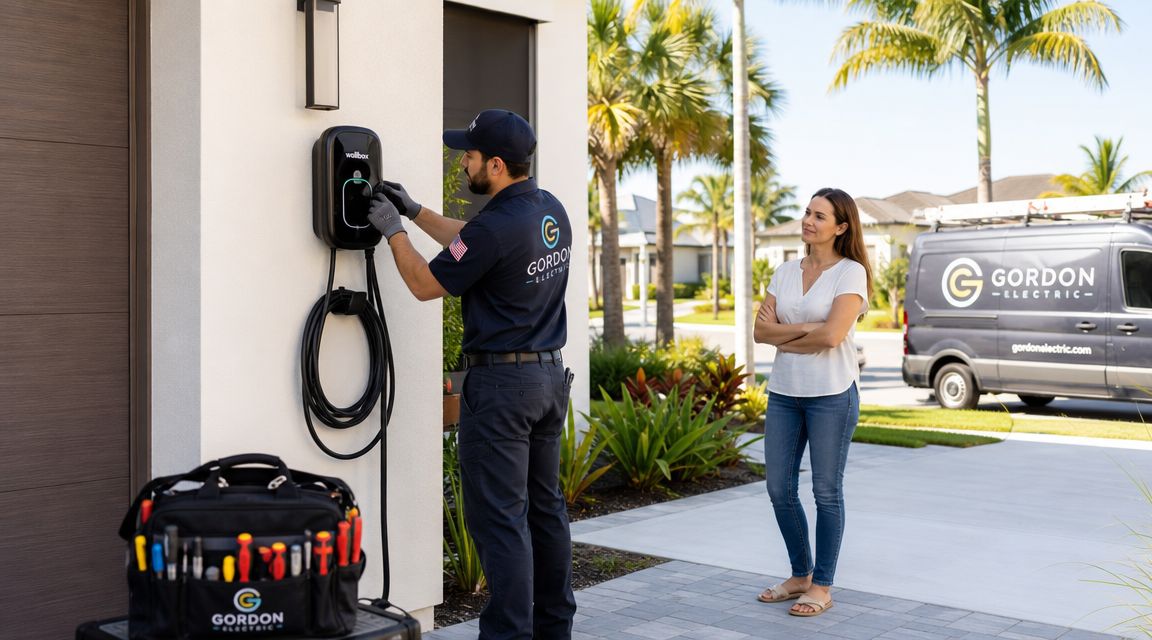
For a reliable Level 2 EV charger installation, the practical workflow is to verify panel capacity, choose the charger and connector standard, secure permits, run the dedicated branch circuit, mount and land the equipment, then perform functional testing and inspection, according to this West Palm EVSE installation workflow reference.
How the install typically unfolds
Most homeowners see only the charger on the wall. The important work happens behind it.
A clean installation day usually includes:
- Arrival and confirmation: The electrician confirms charger placement, circuit route, and vehicle access before drilling or mounting anything.
- Circuit work: The dedicated branch circuit is run from the panel to the charger location.
- Equipment mounting: The charger gets mounted securely, with attention to height, reach, and cord handling.
- Terminations and startup: Conductors are landed, the breaker is installed, and the unit is powered up for testing.
If the electrician is doing the job right, they'll also check how the cable hangs, whether the unit is exposed to unnecessary impact, and whether the install will still make sense six months from now when the novelty wears off.
After the charger is live
Testing matters. You want to know the charger powers up correctly, communicates as expected, and charges the vehicle without nuisance trips or heat issues.
After commissioning, basic homeowner maintenance is simple:
- Keep the unit clean: Wipe off dust and dirt so vents and ports stay clear.
- Check the cable occasionally: Look for wear, cuts, or damage where the cord bends.
- Don't strain the connector: Hang the cable properly instead of letting it drag.
- Pay attention to tripping breakers: Repeated trips are a service call, not something to ignore.
A charger should feel invisible once it's installed. Park, plug in, move on with your day.
Frequently Asked Questions About Home EV Charger Installation
Can I install an EV charger myself
For a Level 2 setup, that's not a good idea. This is not the same as changing a light fixture. The work involves a dedicated high-load circuit, correct breaker sizing, conductor sizing, equipment termination, and code compliance. If your breaker is tripping now or your panel already has signs of stress, deal with that first. Problems like that often need proper diagnosis, and circuit breaker tripping solutions should be handled before adding another major electrical load.
How long does the process take from the first call to charging at home
That depends on the home, the panel condition, the charger location, and permit timing. A simple install moves faster than one that needs service upgrades or more complicated routing. The best way to avoid delays is to have your panel location, parking setup, and charger preference ready before the estimate visit.
Will one home charger work with any electric car
The charger has to match the vehicle's connector standard and charging setup. That's why the equipment choice should happen alongside the electrical review, not separately. Most compatibility issues are easy to solve when the electrician and homeowner confirm the vehicle details before installation.
If you want a charger installed the right way in Palm Beach County, contact Lighthouse Energy Services. They handle residential electrical work, including EV charger circuits and installations, with permit-aware planning and local service coverage that fits West Palm Beach homeowners.