
You bought the EV. The first week feels great. The car is quiet, the pickup is smooth, and you stop thinking about gas stations almost immediately.
Then real life in West Palm Beach kicks in. You finish work, check your range, and start planning around chargers instead of around your schedule. Maybe you swing by a public charger after dinner. Maybe the charger you wanted is occupied. Maybe it's downtown, not near your house, and now a simple charge turns into extra driving, waiting, and rearranging your night.
That's usually the point where homeowners start looking seriously at a garage charger. Not because public charging has no value, but because daily charging at home is a different category of convenience. Plug in when you get home, wake up with the range you need, and stop managing your week around charger availability.
Table of Contents
- The Convenience of Home EV Charging in West Palm Beach
- Your Pre-Installation Home Assessment
- Choosing the Right Level 2 Charger and Equipment
- Budgeting and Permitting Your Installation in Palm Beach County
- What to Expect on Installation Day and After
- Why Local Expertise Is Crucial for Your West Palm Beach Installation
The Convenience of Home EV Charging in West Palm Beach
A lot of West Palm Beach homeowners start with the same assumption. There are public chargers around town, so home charging can wait. On paper, that sounds reasonable.
In practice, it usually doesn't hold up. The city has charging in downtown garages and key corridors, and public access is growing, but that layout still means many drivers have to go out of their way to charge. The city's EV amenities page makes that local pattern clear in West Palm Beach's public charging overview. Public charging works. It just doesn't work with the same consistency as walking into your garage at night and plugging in.
Why the daily routine matters
The difference isn't only cost or speed. It's friction.
With a home charger, your charging time happens when you're already home. With public charging, the task becomes another stop in your day. Even when the station is functioning and available, you're still spending time driving there, waiting, and then driving home again.
That's why homeowners who commute, run errands across Palm Beach County, or just don't want range anxiety usually end up in the same place. They want guaranteed overnight charging.
A garage charger isn't about novelty. It's about removing one more weekly errand from your life.
Why this matters in West Palm Beach specifically
West Palm Beach already has a visible charging footprint. That helps normalize EV ownership, but it also creates a false sense that public charging alone is enough for everyone. It isn't, especially once the car becomes part of your normal household routine.
A garage installation makes the most sense when the EV is not a weekend car. If you drive it most days, home charging becomes the practical foundation and public charging becomes backup, not the other way around.
That shift also changes how you think about installation. The question stops being “Should I get a charger?” and becomes “Can my garage and panel support one without turning this into a much larger electrical project?”
Your Pre-Installation Home Assessment
Before choosing brands, features, or cord length, check whether the house is ready. That's where most installation mistakes start. Homeowners pick a charger first and only later find out the panel is full, the wiring path is awkward, or the garage location adds avoidable labor.
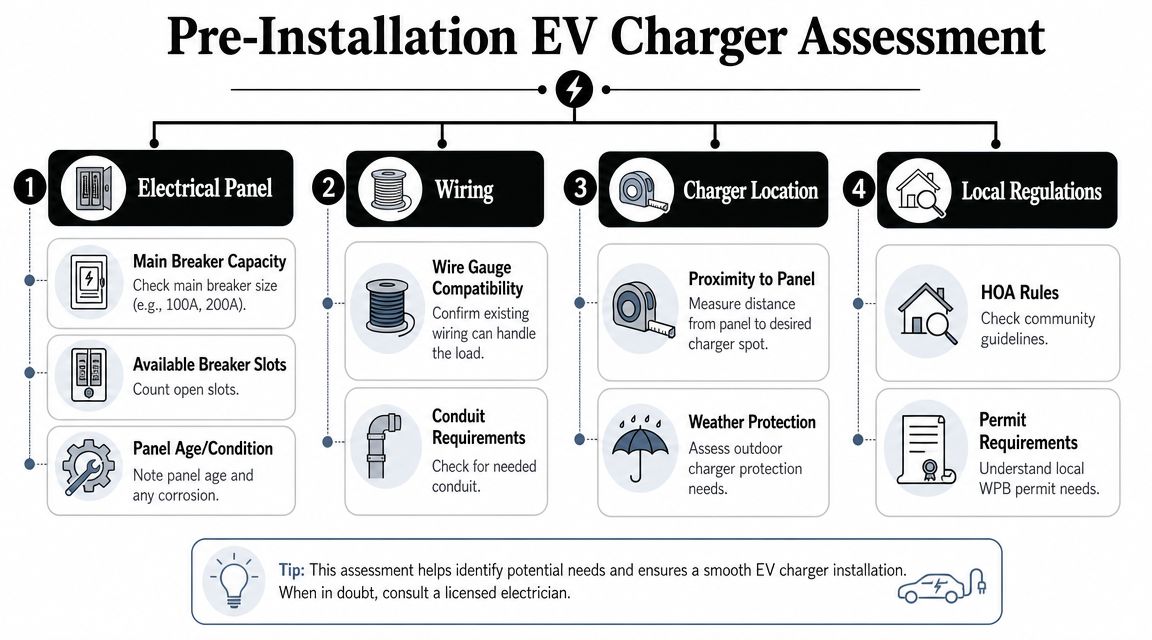
A realistic assessment starts with one issue that many online guides skip. A Level 2 charger commonly needs a dedicated circuit and can draw roughly 30 to 50 amps, which means older homes may need a load calculation, panel capacity check, or even a service upgrade before installation makes sense, as noted in this explanation of EV charger electrical demands.
Start with the panel, not the charger
Open the panel door and do a visual check only. Don't remove the dead front. You're looking for basics:
- Main breaker size: Read the number on the main breaker handle or label.
- Open breaker spaces: A charger circuit needs room in the panel, unless other approved changes are made.
- Panel condition: Rust, heat marks, loose labeling, and age-related wear are warning signs.
- Existing large loads: Air conditioning, pool equipment, ovens, dryers, water heaters, and similar loads all matter.
If the panel looks crowded, that doesn't automatically kill the project. It means the next step is a proper load calculation. That calculation tells you whether the service can support the added continuous load safely.
For homeowners trying to understand whether their existing service is enough, this guide on 150 amp service and when it's enough is a useful starting point.
Practical rule: If your house already struggles with breaker space or has a long list of major electric appliances, assume the panel needs review before you buy equipment.
Look at the route and the parking setup
The second part of the assessment is physical, not electrical. Where will the charger go, and how will the wiring get there?
Some garages are easy. The panel is on the same wall, the car parks close to the mounting point, and the run is short. Others are more involved. The panel may be outside on the opposite side of the house, the charger may need conduit through finished areas, or the ideal parking spot may put the cord in a place where it gets dragged, pinched, or run over.
A quick homeowner checklist helps:
- Measure parking position. Know where the vehicle charge port sits when the car is parked normally.
- Pick a mounting wall. Choose a location that avoids stretching the cable across walking paths.
- Check exposure. Even inside a garage, think about water intrusion, door swing, storage shelving, and impact risk.
- Note panel distance. Longer runs often mean more labor and more materials.
Don't ignore HOA or community rules
Single-family homeowners still need to think about community requirements if they live in a managed neighborhood. That usually matters less than the electrical work itself, but it can still delay a job if exterior conduit, visible equipment, or shared walls are involved.
The best approach is simple. Confirm whether your association wants an architectural request, a site sketch, or contractor license information before the work is scheduled. That's easier to handle up front than after materials are already on site.
A good assessment doesn't answer every question, but it should tell you whether the job is likely to be straightforward or whether you're heading toward a panel upgrade, a difficult wire run, or a permit-heavy install.
Choosing the Right Level 2 Charger and Equipment
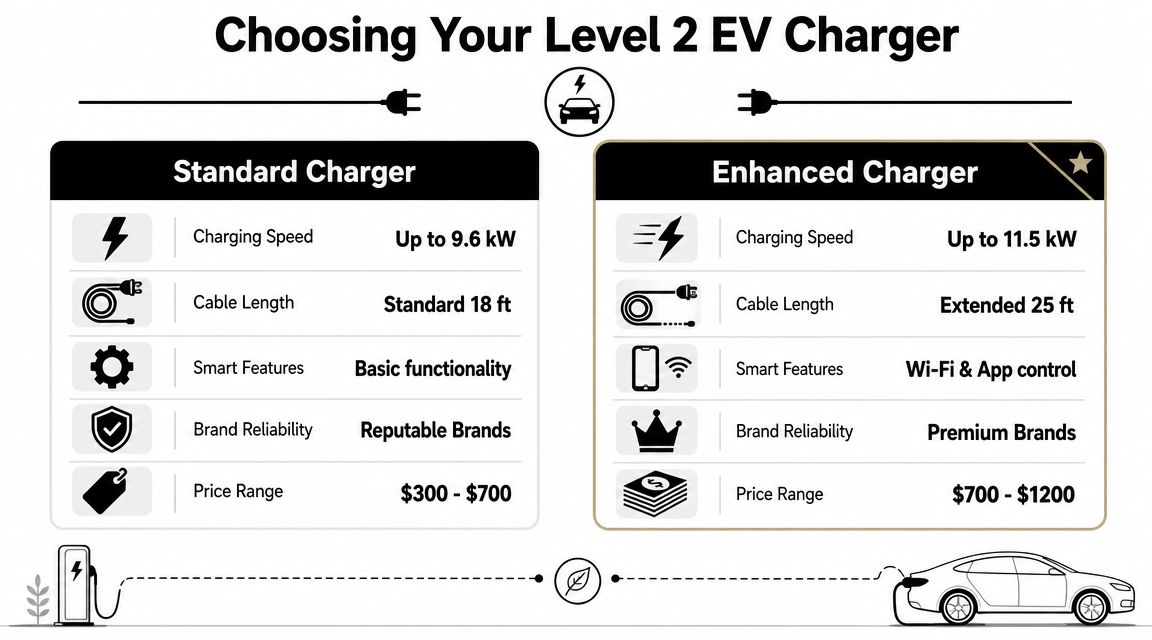
For most garage EV charger installation in West Palm Beach FL, Level 2 is the standard setup. It uses a dedicated 240V circuit and typically connects through J1772 or NACS, depending on the vehicle and charger, as explained in this overview of Level 2 home charger requirements.
The charger itself matters, but not as much as homeowners think. The bigger issue is matching the charger to the circuit, breaker, wire size, and how you use the car. An oversized unit on an undersized circuit is a common failure point. A basic charger properly matched to the electrical system is better than a feature-heavy unit installed wrong.
Hardwired vs plug-in
This is the first real equipment decision.
| Option | Where it works well | Main trade-off |
|---|---|---|
| Hardwired charger | Permanent installations, cleaner appearance, fewer connection points | Less portable if you want to replace or relocate it |
| Plug-in charger | Homeowners who want easier swap-out or already have the right receptacle plan | Receptacle choice and circuit setup need to be exact |
Hardwired units are often the cleaner long-term solution for a garage. They reduce variables and make it easier to build the installation around one fixed charging location. Plug-in models can work well too, but only when the receptacle type, breaker sizing, and branch circuit are selected correctly.
A lot of homeowners focus on convenience here, but electricians focus on fit. The charger should match the house first, then the wishlist second.
Smart features and connector choices
Smart features are useful when you use them. Scheduling, energy tracking, and app controls can help if your routine changes a lot or if you want more visibility into charging behavior. If you just come home, plug in, and leave the next morning, basic controls may be enough.
Connector choice is simpler than it sounds:
- J1772: Common across many Level 2 setups.
- NACS: Relevant depending on vehicle and charger compatibility.
The right answer depends on the vehicle you own now and whether you want flexibility for a future vehicle. What doesn't work is buying around marketing language and ignoring installation requirements.
If you're also evaluating whether the house needs broader electrical work at the same time, this page on home electrical upgrades helps frame the bigger picture.
Buy the charger that fits your electrical capacity and parking habits. Don't buy the one with the longest feature list and hope the panel figures it out later.
Budgeting and Permitting Your Installation in Palm Beach County
The part homeowners usually underestimate isn't the mounting or the wiring. It's everything around it. Permits, approvals, inspections, and the occasional panel problem are what turn a simple-looking charger job into a project that needs planning.
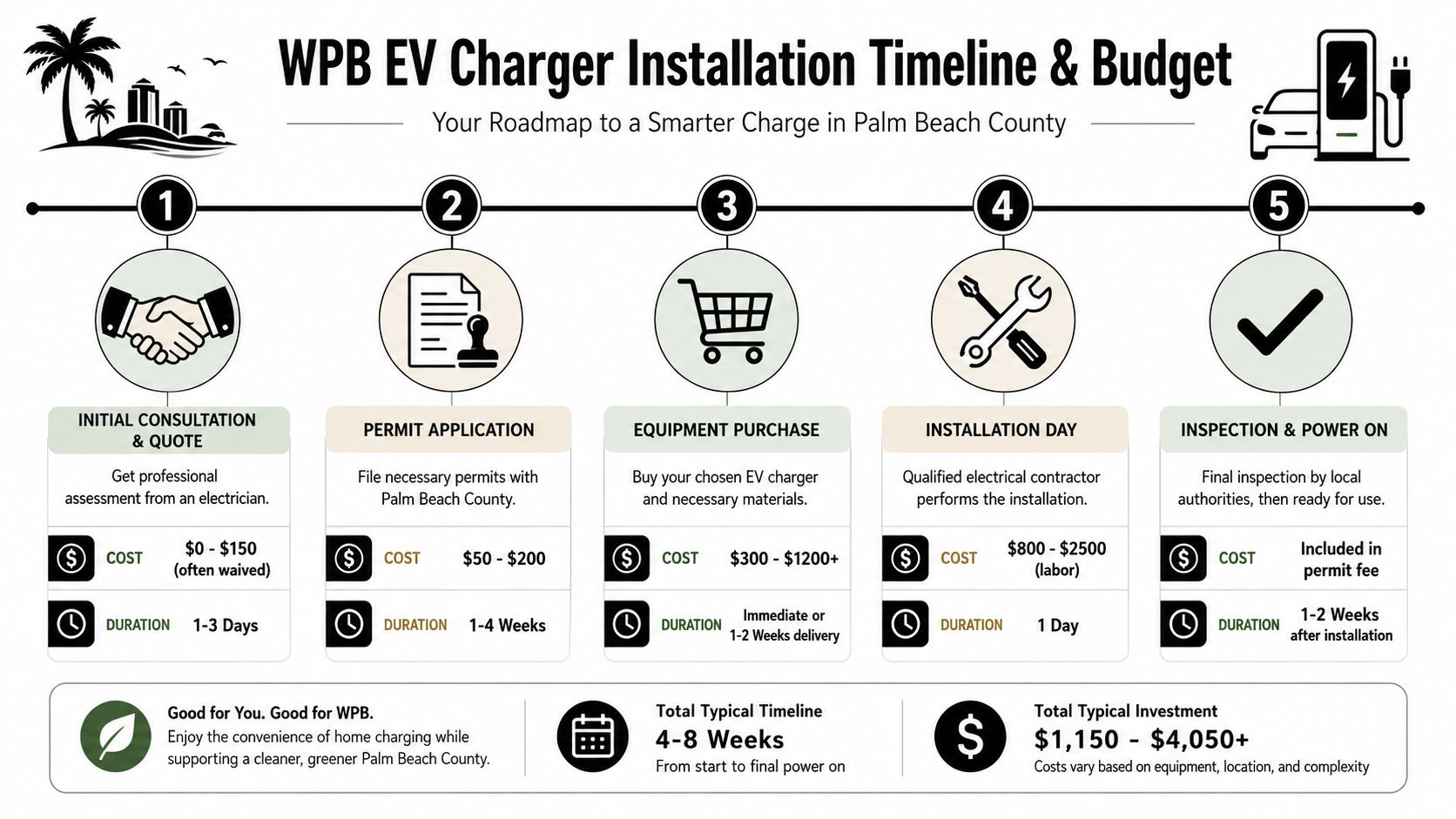
One thing is consistent. The physical charger installation often takes only 2 to 4 hours, but the full process can stretch to several weeks or even a few months because site review, permit submission, approval, and final inspection all happen on separate timelines, as described in this summary of the EV charger installation process and permit timeline.
What actually affects the price
There's no honest flat answer without seeing the house. A garage charger job can stay simple, or it can grow because of one bottleneck. Usually that bottleneck is panel capacity or the wiring route.
Here's what tends to move the budget up or down:
- Distance from panel to charger location: Longer runs mean more wire, more conduit, and more labor.
- Panel capacity: If the service can't support the added load, the project changes fast.
- Need for a subpanel or service upgrade: This is often the biggest cost swing.
- Wall construction and access: Open garage walls are easier than finished paths through tight spaces.
- Permit and inspection logistics: Administrative steps add time even when the electrical work is straightforward.
If your assessment suggests the service may be undersized, it helps to review typical factors behind the cost of a 200-amp panel upgrade before you approve charger work. Not every home needs that upgrade, but when it does, it becomes the main budget driver.
Why the schedule feels longer than the work
Homeowners often think the electrician is only needed for installation day. That's not how these jobs unfold.
A clean workflow usually looks like this:
- Site and load review
- Panel capacity check
- Permit submission
- Rough-in and mounting
- Final wiring and termination
- Inspection
- Commissioning
The charger may go on the wall fast. The paperwork won't. In West Palm Beach and the surrounding county process, permitting for meaningful electrical modifications is part of the job, not a side issue.
The fastest installs are the ones that were planned correctly before a single hole was drilled.
That's why a realistic estimate should include both labor in the garage and the off-site time spent handling paperwork, scheduling, and inspection coordination. If a contractor talks only about install day and not about approvals, you're not hearing the whole story.
What to Expect on Installation Day and After
Once permits and scheduling are out of the way, installation day is usually the easiest part for the homeowner. The work is direct. The crew confirms the charger location, protects the work area, runs the circuit, mounts the unit, makes terminations, and tests everything before cleanup.
West Palm Beach already has 325 public Level 2 charging stations listed by ChargeHub, and that local saturation means electricians in the area are working with familiar technology. ChargeHub's city data is part of a broader network of 451 total public charging stations, including 126 Level 3 stations and 109 free stations, which shows how established the local charging environment already is in West Palm Beach's charging station listing.
What the crew is doing in your garage
A professional install isn't just “wire it and leave.” The sequence matters.
Typical work on site includes:
- Confirming placement: The charger should sit where the cable reaches the vehicle cleanly without becoming a trip hazard.
- Running the branch circuit: This may involve conduit, wall penetrations, or routing around obstructions.
- Mounting the charger: The unit needs solid support and the right clearances.
- Making terminations: Breaker, conductors, and charger terminals all need proper installation and torque.
- Testing operation: The charger should power up, communicate correctly, and start a charging session normally.
Some homes are quick and clean. Others require more time because the wire path is tight or the garage layout forces compromises. Good electricians don't hide that. They explain the trade-offs before the work starts.
What you should check before signoff
A proper handoff should include more than “it turns on.”
According to the verified installation guidance above, a professional setup should include torque verification on terminations, GFCI protection where required, and a commissioning check for charger communication before the job is handed over. That's what separates a code-minded installation from a rushed one.
Ask for a final walkthrough that covers:
- Breaker identification: You should know exactly which breaker feeds the charger.
- Shutdown procedure: If something goes wrong, you need to know how to safely de-energize it.
- Cable storage: Proper cable management prevents wear and accidental damage.
- Basic charger indicators: You should understand what the normal lights or app status mean.
If the charger works on day one but the cable is always under tension or the unit is mounted in an awkward spot, the job wasn't finished thoughtfully.
Basic care and simple troubleshooting
After installation, maintenance is light. Keep the cable off the floor when possible, don't coil it too tightly, and check occasionally for impact damage, loose mounting hardware, or signs of heat at the connection area.
If charging stops, start with the simple checks:
- Look at the charger status indicator
- Check the dedicated breaker
- Confirm the connector is fully seated
- Rule out a vehicle-side issue
If the breaker trips repeatedly, the unit loses power intermittently, or the charger shows fault behavior that doesn't clear, stop there and have it diagnosed. Repeated resets are not a fix. They're a sign that something needs attention.
Why Local Expertise Is Crucial for Your West Palm Beach Installation
A charger install in West Palm Beach can look straightforward until the permit is submitted and the panel cover comes off. I see that pattern often. The homeowner expects a one-day job, then we find a full panel, limited service capacity, or a meter-main setup that changes the scope and the price.
That is why local experience matters here. Palm Beach County paperwork, utility coordination, and the condition of older South Florida electrical systems all affect how smoothly the project goes.
Local code knowledge saves time and rework
A contractor who regularly handles EV charger work in Palm Beach County usually spots the expensive problems early. That starts with the service and panel, not the charger brand.
Some homes can take a new 240-volt circuit with little drama. Others need load calculations, tandem breaker limits checked, corrosion addressed, or a panel upgrade before a charger makes sense. In West Palm Beach, that is common in older homes, garages added after the original build, and houses that already have large air-conditioning loads, pool equipment, or electric water heating.
Permit handling matters too. A clean installation plan on paper can still stall if the application is missing details, the panel schedule is unclear, or the scope does not match what the inspector expects to see. Local electricians who do this work regularly know how to set up the job so the permit, inspection, and final installation line up the first time.
That saves money in two places:
- It reduces the chance of buying equipment that does not fit the home's electrical capacity.
- It keeps a basic charger install from turning into a half-finished project waiting on revised permit paperwork or added scope.
The right contractor handles the job from panel to final approval
Homeowners in West Palm Beach usually need more than a charger mounted on a garage wall. They need someone who can assess the service, explain whether a load management option or panel upgrade makes more sense, route the circuit cleanly, pull the permit, and correct issues if inspection turns up something unexpected.
That full-process approach matters even more here because public charging is not always a practical fallback. If the home charger timeline slips, daily charging can turn into extra stops, waiting, and higher charging costs. For many households, the primary goal is dependable overnight charging at home, not just getting the equipment installed.
If you are comparing electricians, ask who is handling the permit, who is responsible if the panel cannot support the charger as planned, and what happens if the inspector calls for a correction. Those answers tell you more than a low initial quote. Homeowners looking for West Palm Beach electrical contractor services should look for that kind of project control from the start.
Lighthouse Energy Services handles residential electrical work in Palm Beach County, including charger circuit planning, service upgrades, installation, and troubleshooting. That is the kind of local support that keeps the job realistic, code-compliant, and less likely to turn into an expensive redo.